


 Скачать презентацию AFNOR Rus Risk in conformity assessment Leonid DVORKIN
bb44045e72f10b8d0cca0633d60ff6b8.ppt
- Количество слайдов: 24
 AFNOR Rus Risk in conformity assessment Leonid DVORKIN 25 November 2009
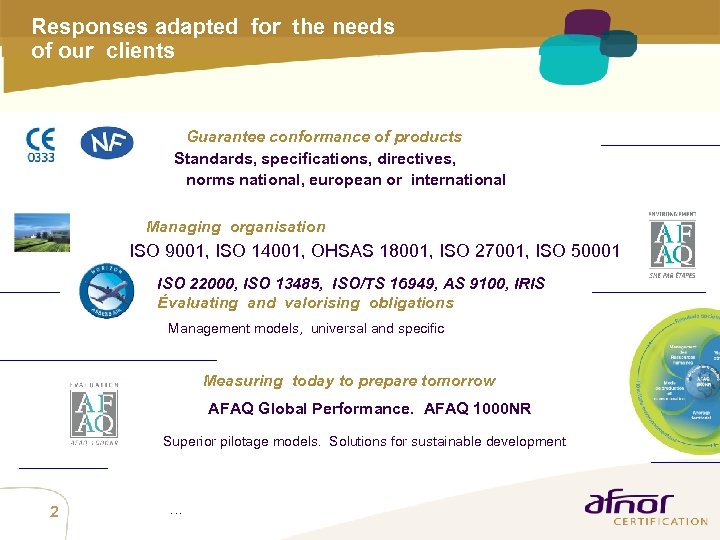 Responses adapted for the needs of our clients Guarantee conformance of products Standards, specifications, directives, norms national, european or international Managing organisation ISO 9001, ISO 14001, OHSAS 18001, ISO 27001, ISO 50001 ISO 22000, ISO 13485, ISO/TS 16949, AS 9100, IRIS Évaluating and valorising obligations Management models, universal and specific Measuring today to prepare tomorrow AFAQ Global Performance. AFAQ 1000 NR Superior pilotage models. Solutions for sustainable development 2 …
 Risk definition Risk - effect of uncertainty on objectives NOTE 1 An effect is a deviation from the expected — positive and/or negative. NOTE 2 Objectives can have different aspects (such as financial, health and safety, and environmental goals) and can apply at different levels (such as strategic, organization-wide, project, product and process). NOTE 3 Risk is often characterized by reference to potential events (2. 19) and consequences (2. 20), or a combination of these. NOTE 4 Risk is often expressed in terms of a combination of the consequences of an event (including changes in circumstances) and the associated likelihood (2. 21) of occurrence NOTE 5 Uncertainty is the state, even partial, of deficiency of information related to, understanding or knowledge of anevent, its consequence, or likelihood. 3 ISO Guide 73: 2009, definition 1. 1
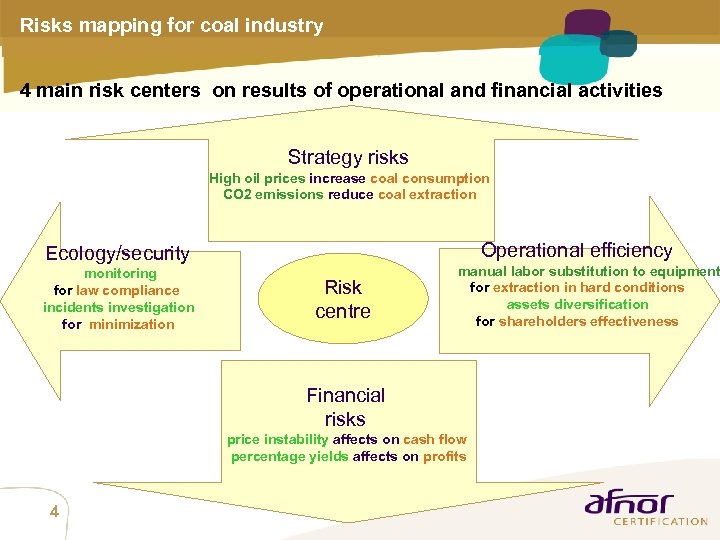 Risks mapping for coal industry 4 main risk centers on results of operational and financial activities Strategy risks High oil prices increase coal consumption CO 2 emissions reduce coal extraction Operational efficiency Ecology/security monitoring for law compliance incidents investigation for minimization Risk centre manual labor substitution to equipment for extraction in hard conditions assets diversification for shareholders effectiveness Financial risks price instability affects on cash flow percentage yields affects on profits 4
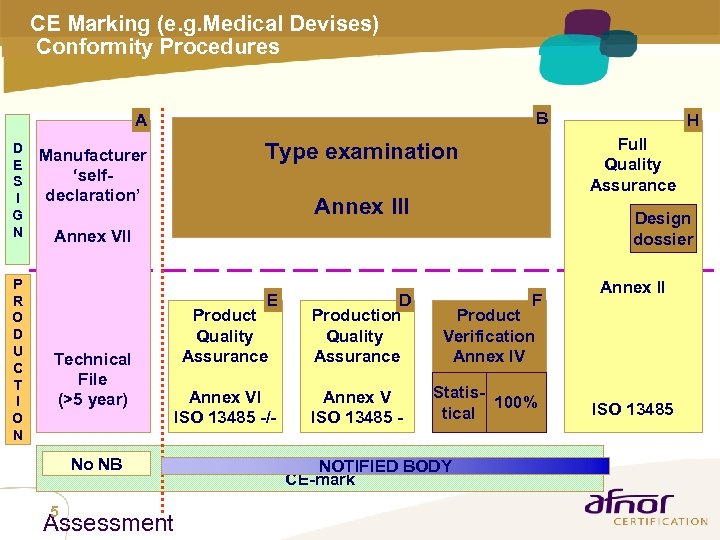 CE Marking (e. g. Medical Devises) Conformity Procedures B A D E S I G N P R O D U C T I O N Manufacturer ‘selfdeclaration’ Full Quality Assurance Type examination Annex III Design dossier Annex VII E Technical File (>5 year) No NB 5 Assessment H Product Quality Assurance D Production Quality Assurance F Product Verification Annex IV Annex VI ISO 13485 -/- Annex V ISO 13485 - Statis 100% tical Annex II NOTIFIED BODY CE-mark ISO 13485
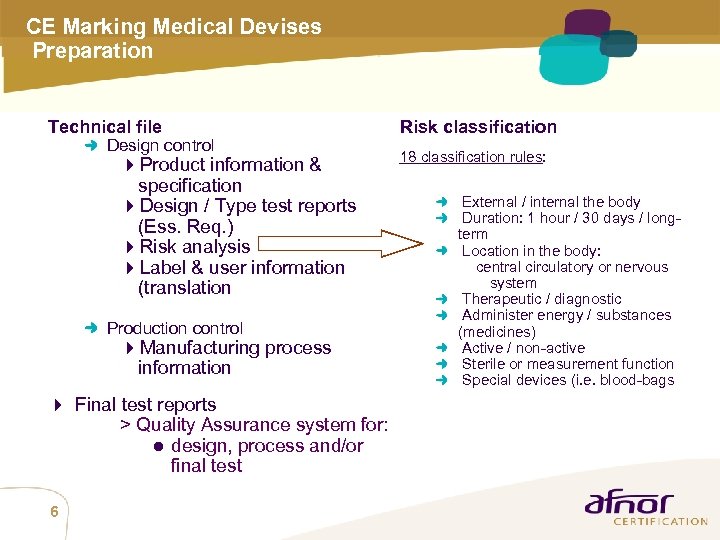 CE Marking Medical Devises Preparation Technical file Design control 4 Product information & specification 4 Design / Type test reports (Ess. Req. ) 4 Risk analysis 4 Label & user information (translation Production control 4 Manufacturing process information 4 Final test reports > Quality Assurance system for: l design, process and/or final test 6 Risk classification 18 classification rules: External / internal the body Duration: 1 hour / 30 days / longterm Location in the body: central circulatory or nervous system Therapeutic / diagnostic Administer energy / substances (medicines) Active / non-active Sterile or measurement function Special devices (i. e. blood-bags
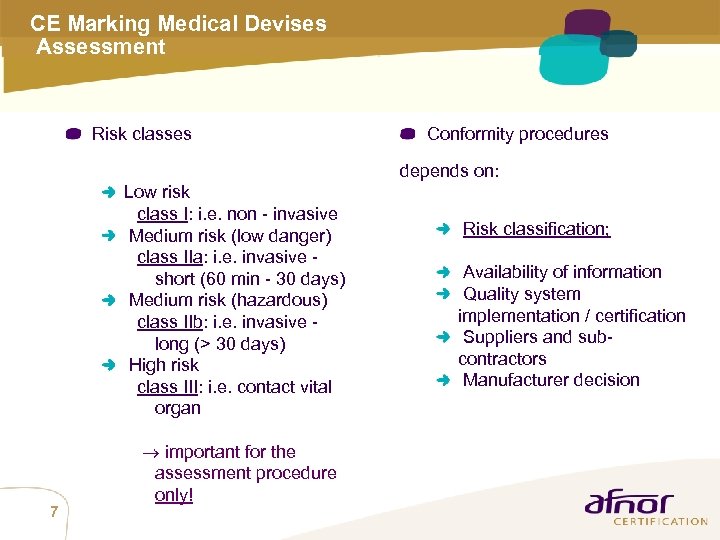 CE Marking Medical Devises Assessment Risk classes Conformity procedures depends on: Low risk class I: i. e. non - invasive Medium risk (low danger) class IIa: i. e. invasive short (60 min - 30 days) Medium risk (hazardous) class IIb: i. e. invasive long (> 30 days) High risk class III: i. e. contact vital organ 7 important for the assessment procedure only! Risk classification; Availability of information Quality system implementation / certification Suppliers and subcontractors Manufacturer decision
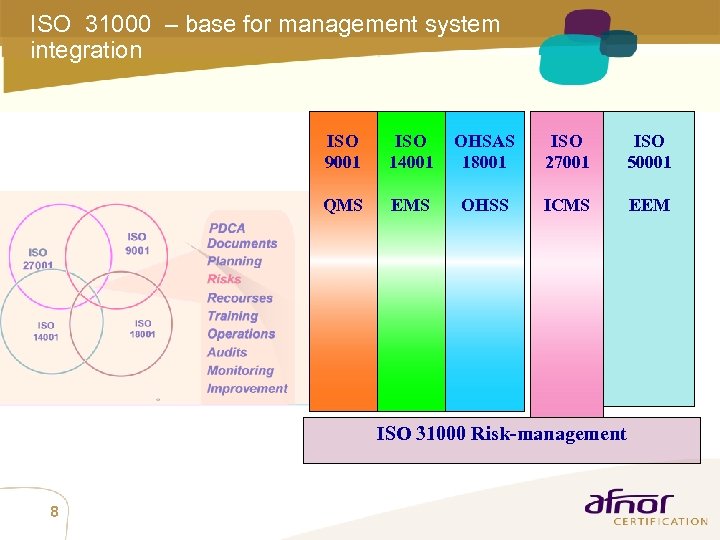 ISO 31000 – base for management system integration ISO 9001 ISO 14001 OHSAS 18001 ISO 27001 ISO 50001 QMS EMS OHSS ICMS EEM ISO 31000 Risk-management 8
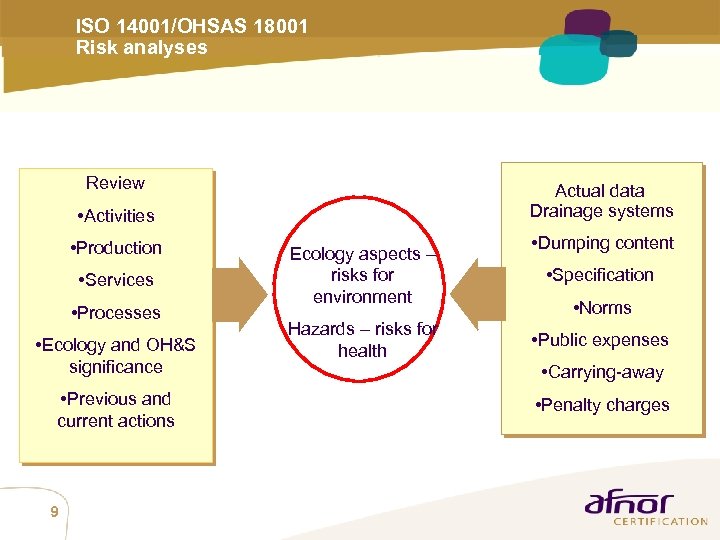 ISO 14001/OHSAS 18001 Risk analyses Review Actual data Drainage systems • Activities • Production • Services • Processes • Ecology and OH&S significance • Previous and current actions 9 Ecology aspects – risks for environment Hazards – risks for health • Dumping content • Specification • Norms • Public expenses • Carrying-away • Penalty charges
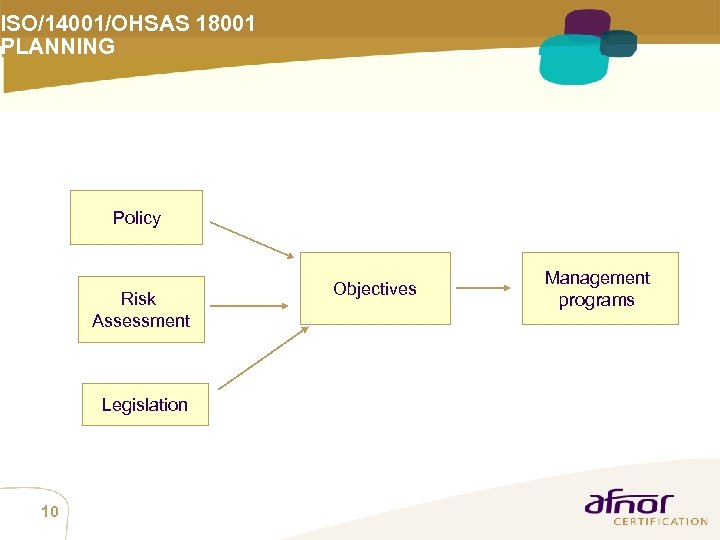 ISO/14001/OHSAS 18001 PLANNING Policy Risk Assessment Legislation 10 Objectives Management programs
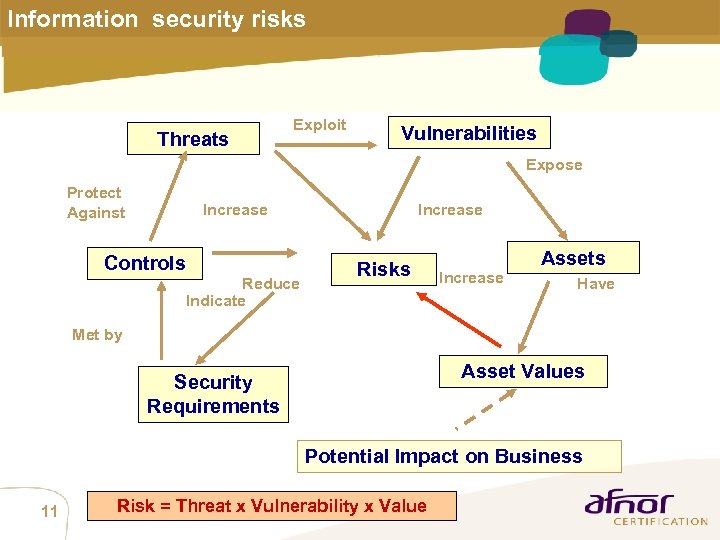 Information security risks Threats Exploit Vulnerabilities Expose Protect Against Increase Controls Reduce Indicate Increase Risks Increase Assets Have Met by Asset Values Security Requirements Potential Impact on Business 11 Risk = Threat x Vulnerability x Value
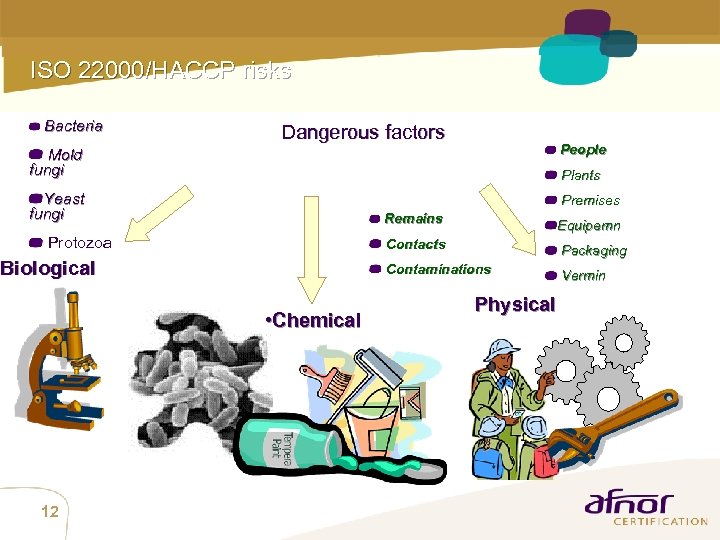 ISO 22000/HACCP risks Bacteria Dangerous factors Mold fungi People Yeast fungi Premises Plants Remains Contacts Biological • Chemical 12 Packaging Contaminations Protozoa Equipemn Vermin Physical
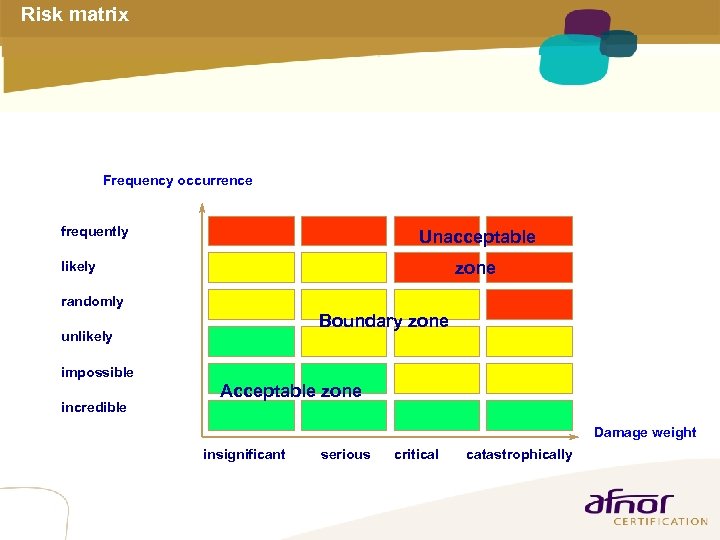 Risk matrix Frequency occurrence frequently Unacceptable zone likely randomly Boundary zone unlikely impossible incredible Acceptable zone Damage weight insignificant serious critical catastrophically
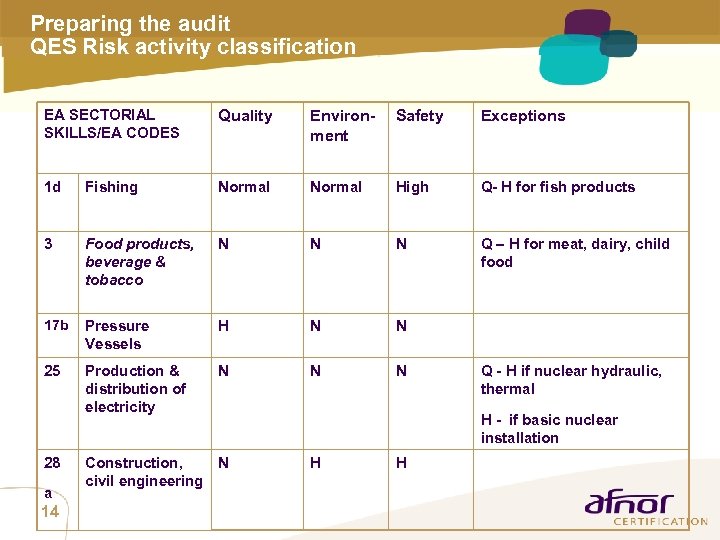 Preparing the audit QES Risk activity classification EA SECTORIAL SKILLS/EA CODES Quality Environment Safety Exceptions 1 d Fishing Normal High Q- H for fish products 3 Food products, beverage & tobacco N N N Q – H for meat, dairy, child food 17 b Pressure Vessels H N N 25 Production & distribution of electricity N N N 28 a 14 Construction, N civil engineering Q - H if nuclear hydraulic, thermal H - if basic nuclear installation H H
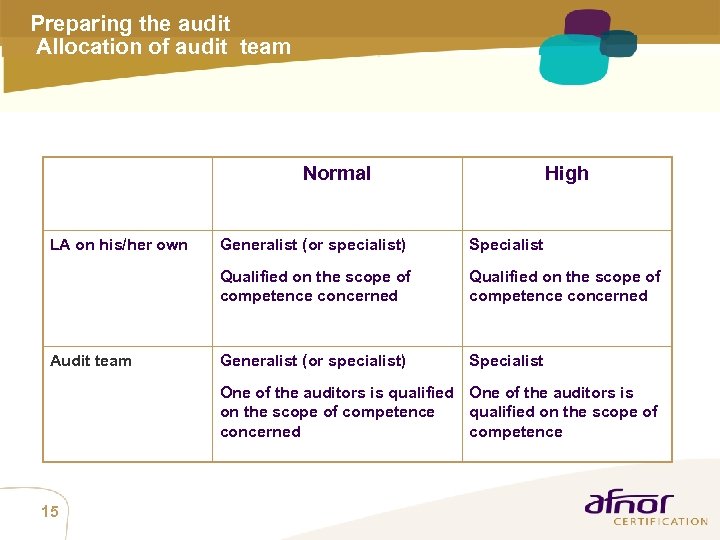 Preparing the audit Allocation of audit team Normal LA on his/her own High Specialist Qualified on the scope of competence concerned Audit team Generalist (or specialist) Qualified on the scope of competence concerned Generalist (or specialist) Specialist One of the auditors is qualified One of the auditors is on the scope of competence qualified on the scope of concerned competence 15
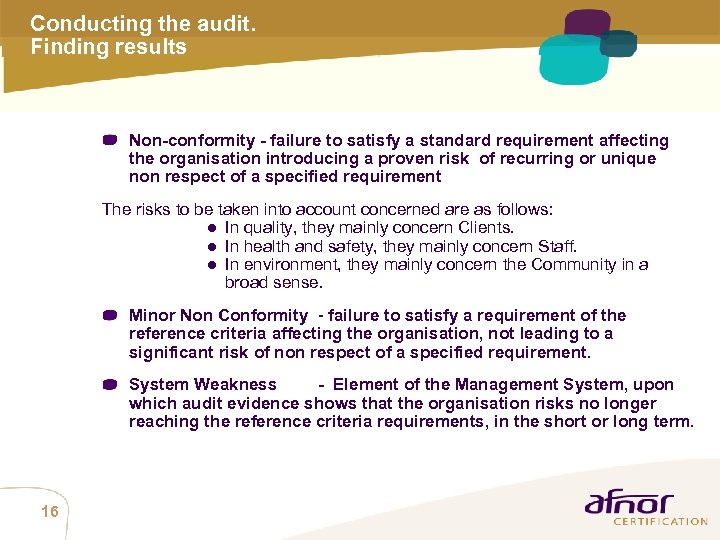 Conducting the audit. Finding results Non-conformity - failure to satisfy a standard requirement affecting the organisation introducing a proven risk of recurring or unique non respect of a specified requirement The risks to be taken into account concerned are as follows: l In quality, they mainly concern Clients. l In health and safety, they mainly concern Staff. l In environment, they mainly concern the Community in a broad sense. Minor Non Conformity - failure to satisfy a requirement of the reference criteria affecting the organisation, not leading to a significant risk of non respect of a specified requirement. System Weakness - Element of the Management System, upon which audit evidence shows that the organisation risks no longer reaching the reference criteria requirements, in the short or long term. 16
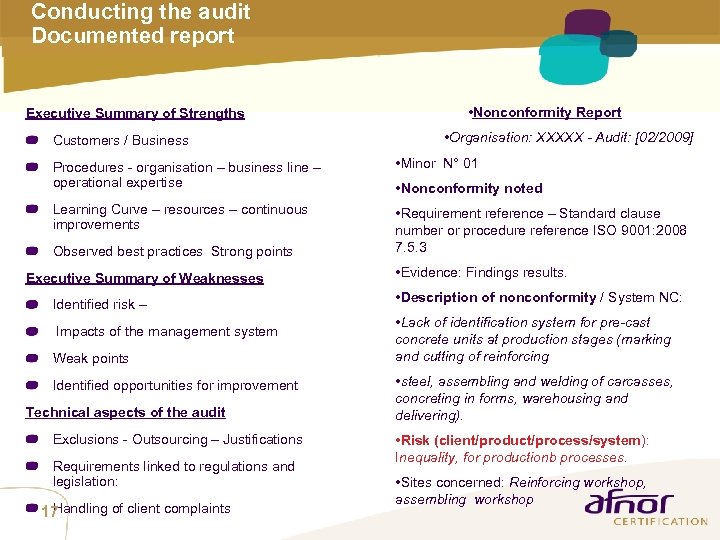 Conducting the audit Documented report Executive Summary of Strengths Customers / Business • Nonconformity Report • Organisation: XXXXX - Audit: [02/2009] Procedures - organisation – business line – operational expertise • Minor N° 01 Learning Curve – resources – continuous improvements • Requirement reference – Standard clause number or procedure reference ISO 9001: 2008 7. 5. 3 Observed best practices Strong points Executive Summary of Weaknesses Identified risk – Impacts of the management system Weak points Identified opportunities for improvement Technical aspects of the audit Exclusions - Outsourcing – Justifications Requirements linked to regulations and legislation: Handling of client complaints 17 • Nonconformity noted • Evidence: Findings results. • Description of nonconformity / System NC: • Lack of identification system for pre-cast concrete units at production stages (marking and cutting of reinforcing • steel, assembling and welding of carcasses, concreting in forms, warehousing and delivering). • Risk (client/product/process/system): Inequality, for productionb processes. • Sites concerned: Reinforcing workshop, assembling workshop
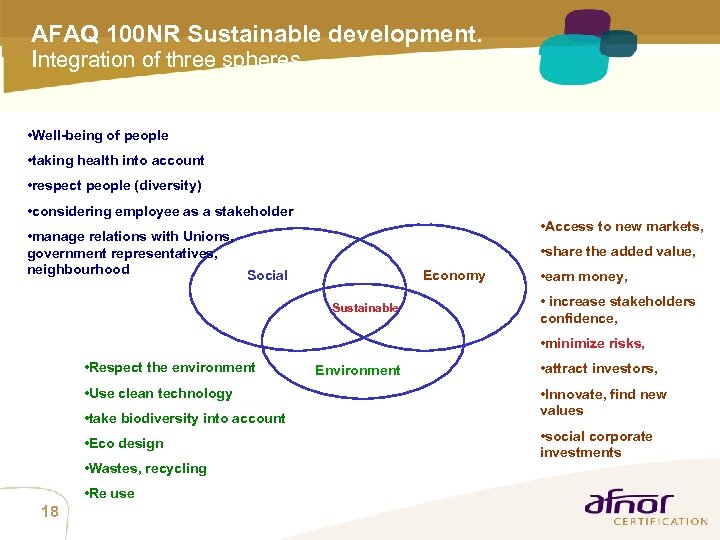 AFAQ 100 NR Sustainable development. Integration of three spheres • Well-being of people • taking health into account • respect people (diversity) • considering employee as a stakeholder • Access to new markets, • manage relations with Unions, government representatives, neighbourhood Social • share the added value, Economy Sustainable • earn money, • increase stakeholders confidence, • minimize risks, • Respect the environment • Use clean technology • take biodiversity into account • Eco design • Wastes, recycling • Re use 18 Environment • attract investors, • Innovate, find new values • social corporate investments
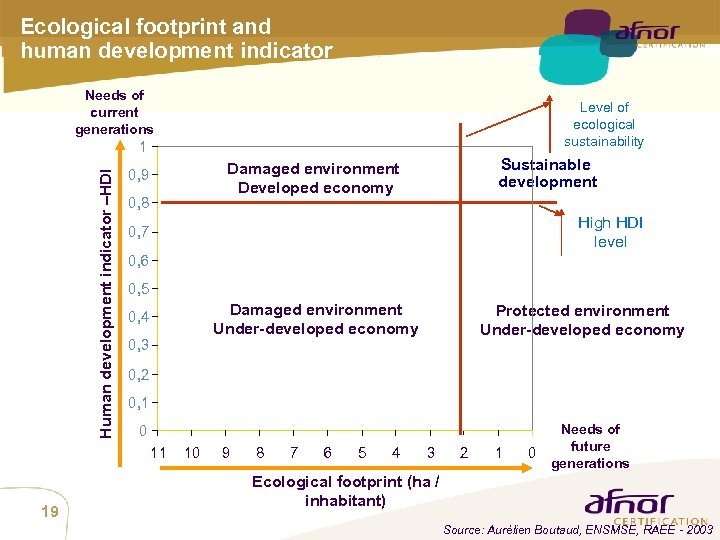 Ecological footprint and human development indicator Needs of current generations Level of ecological sustainability Human development indicator –HDI 1 0, 8 High HDI level 0, 7 0, 6 0, 5 Damaged environment Under-developed economy 0, 4 0, 3 Protected environment Under-developed economy 0, 2 0, 1 0 11 19 Sustainable development Damaged environment Developed economy 0, 9 10 9 8 7 6 5 4 3 2 1 0 Needs of future generations Ecological footprint (ha / inhabitant) Source: Aurélien Boutaud, ENSMSE, RAEE - 2003
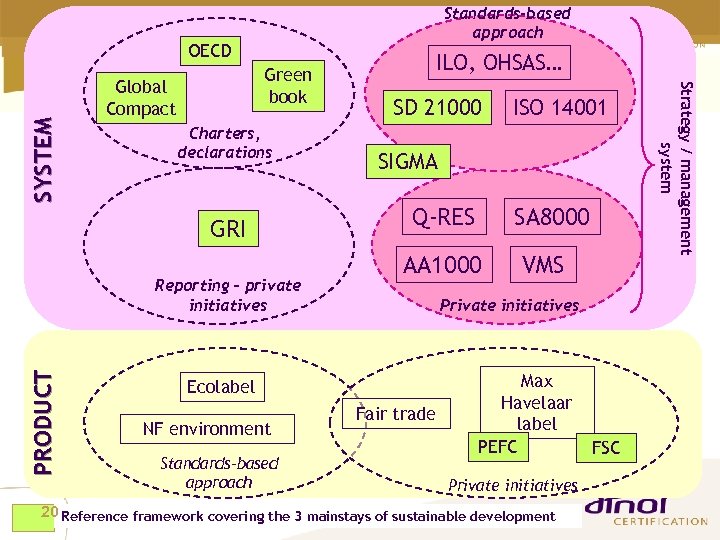 Standards-based approach Green book Global Compact Charters, declarations GRI PRODUCT Reporting – private initiatives ILO, OHSAS… SD 21000 SIGMA Q-RES Standards-based approach SA 8000 AA 1000 VMS Private initiatives Ecolabel NF environment ISO 14001 Fair trade Max Havelaar label PEFC Private initiatives 20 Reference framework covering the 3 mainstays of sustainable development FSC Strategy / management system SYSTEM OECD
 Risk and sustainable development Sustainable development improvements are compatible with the goals of risk assessment: to protect nature, human health while maintaining sustainable forms of economic development. The concept of sustainable risk suggests that cost-benefit analysis can also be applied to a broader economic development issue, The burden on future generations shall be minimized by - selecting disposal options for radioactive wastes which do not rely on long-term institutional controls as a necessary safety feature; - implementing these disposal options at an appropriate time, technical, social, and economic factors being taken into account; - ensuring that there are no predicted future risks to human health and environment that would not be currently accepted Michael D. Mehta 21
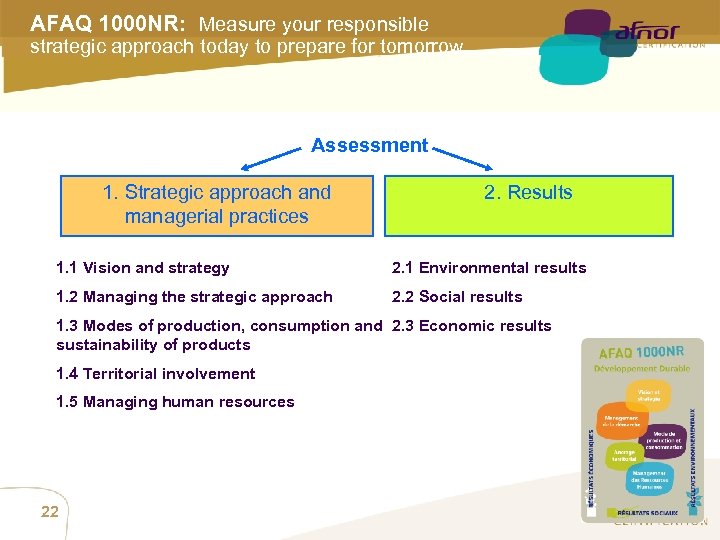 AFAQ 1000 NR: Measure your responsible strategic approach today to prepare for tomorrow Assessment 1. Strategic approach and managerial practices 2. Results 1. 1 Vision and strategy 2. 1 Environmental results 1. 2 Managing the strategic approach 2. 2 Social results 1. 3 Modes of production, consumption and 2. 3 Economic results sustainability of products 1. 4 Territorial involvement 1. 5 Managing human resources 22
 AFAQ 1000 NR assessment criteria Criterions 1. Strategic approach and managerial practices 1. 1 Vision and strategy 1. 2 Managing the approach 1. 4 Territorial presence 2. Results 1. 1. 4 The company determines its significant issues based especially on the identification of risks 1. 2. 5 The information and data on products, activities and the system are analyzed and used: risk data in the economic, social and environmental fields are identified and used 1. 4. 1 The company integrates the characteristics of its territory in its risk analysis 2. 1. 4 Biodiversity : habitats are located in zones affected by the activities, listed by level of risk of extinction 2. 2. 6 Human rights: activities identified as presenting a significant risk of incidents 2. 1 Environmental results 2. 2. 7 Civil society: percentage and total number of strategic business areas analyzed for the risks related to corruption 2. 2 Social results . 2. 3 Economic results 23 2. 3. 1 Economic performance: financial implications and other risks and opportunities for the organisation’s activities as a result of climate change
 RESUME Risk management in conformity assessment helps to ensure confidence for products and systems and to minimize risks for today business and customers taking into account the needs of future generations. Thanks for attention! www. afnor. org E-mail: russia@afnor. org 24