 Скачать презентацию Affordable homeownership policy Implications for housing markets and
1f20ed709aa9546abedd044ea77c13f5.ppt
- Количество слайдов: 24



Affordable homeownership policy: Implications for housing markets and housing elasticities Professor Sock-Yong Phang Singapore Management University ERES, June 2009, Stockholm 1
Outline I. III. IV. V. Homeownership as policy objective Indicators of housing affordability House price to income ratio target – market implications Singapore Conclusion 2
I. Homeownership as policy objective Advantages of homeownership n n n Dwelling – size and quality Accumulation of wealth Non-tangible benefits, positive externalities n Better maintenance n Better citizens and communities n Better children Evidence is not overwhelming 3
Homeownership as policy objective Some negatives: n Household immobility n Overconcentration of household investment n Risks from interest rate and price fluctuations Proposals: n Insurance on market values n Hedging against house price risk 4
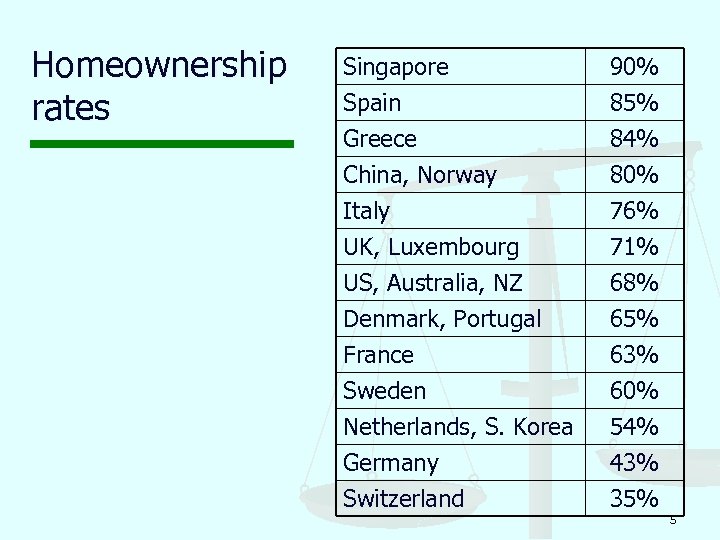
Homeownership rates Singapore Spain Greece China, Norway 90% 85% 84% 80% Italy UK, Luxembourg US, Australia, NZ Denmark, Portugal France Sweden Netherlands, S. Korea Germany Switzerland 76% 71% 68% 65% 63% 60% 54% 43% 35% 5
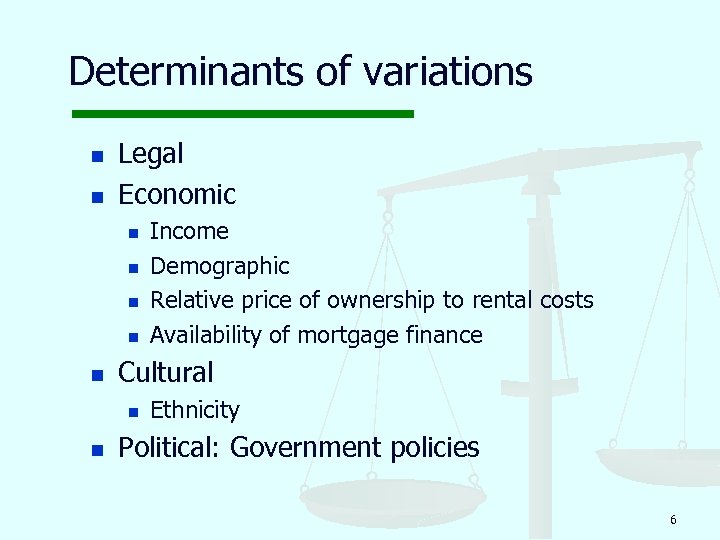
Determinants of variations n n Legal Economic n n n Cultural n n Income Demographic Relative price of ownership to rental costs Availability of mortgage finance Ethnicity Political: Government policies 6
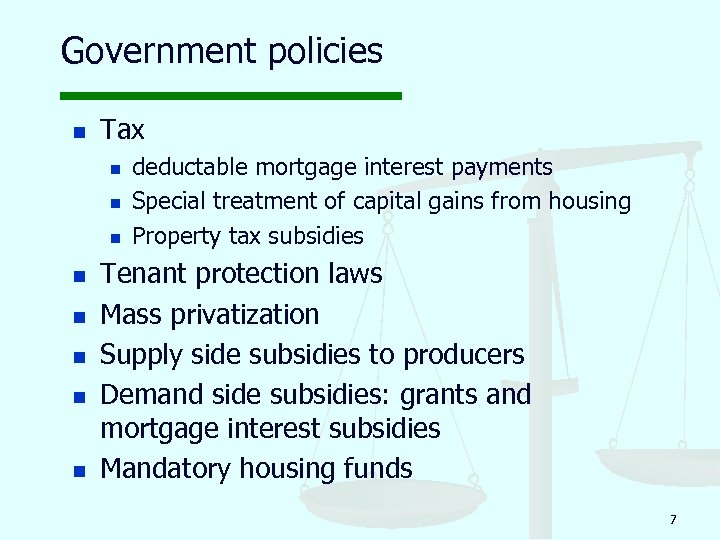
Government policies n Tax n n n n deductable mortgage interest payments Special treatment of capital gains from housing Property tax subsidies Tenant protection laws Mass privatization Supply side subsidies to producers Demand side subsidies: grants and mortgage interest subsidies Mandatory housing funds 7
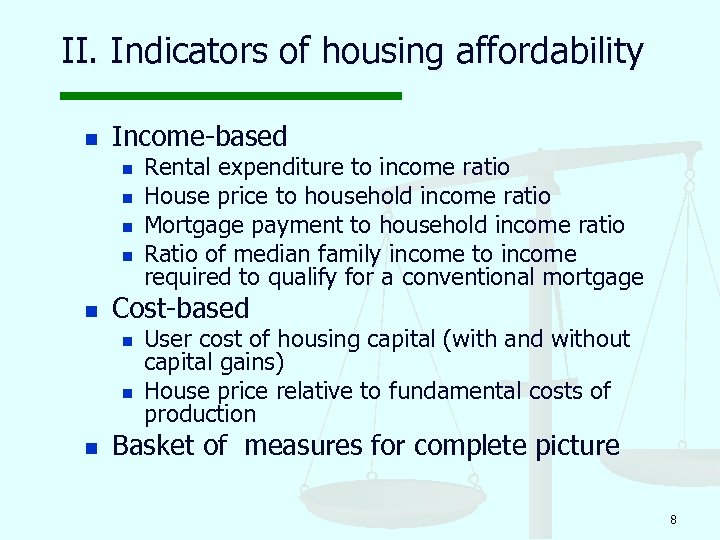
II. Indicators of housing affordability n Income-based n n n Cost-based n n n Rental expenditure to income ratio House price to household income ratio Mortgage payment to household income ratio Ratio of median family income to income required to qualify for a conventional mortgage User cost of housing capital (with and without capital gains) House price relative to fundamental costs of production Basket of measures for complete picture 8
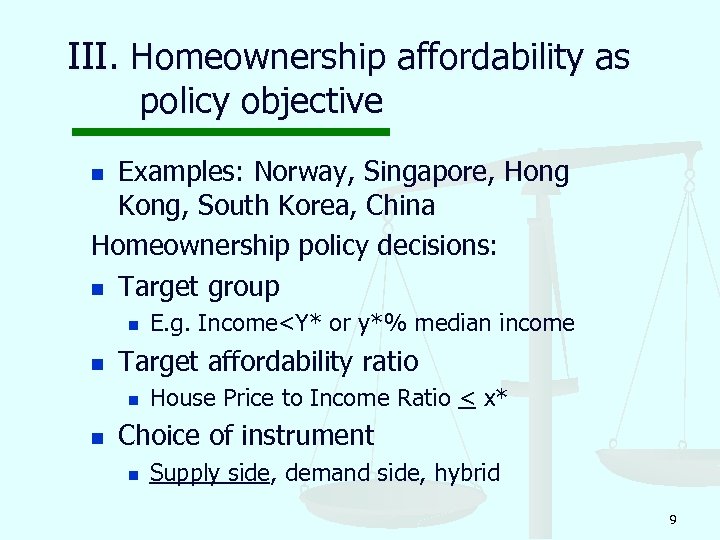
III. Homeownership affordability as policy objective Examples: Norway, Singapore, Hong Kong, South Korea, China Homeownership policy decisions: n Target group n n n Target affordability ratio n n E. g. Income<Y* or y*% median income House Price to Income Ratio < x* Choice of instrument n Supply side, demand side, hybrid 9
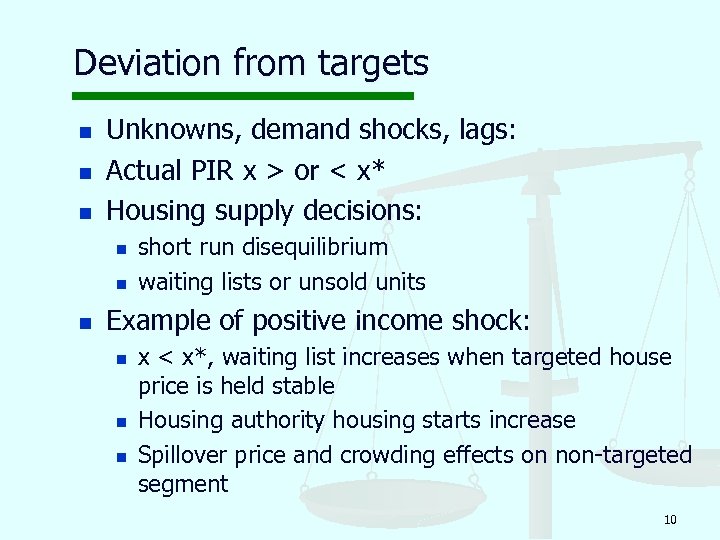
Deviation from targets n n n Unknowns, demand shocks, lags: Actual PIR x > or < x* Housing supply decisions: n n n short run disequilibrium waiting lists or unsold units Example of positive income shock: n n n x < x*, waiting list increases when targeted house price is held stable Housing authority housing starts increase Spillover price and crowding effects on non-targeted segment 10
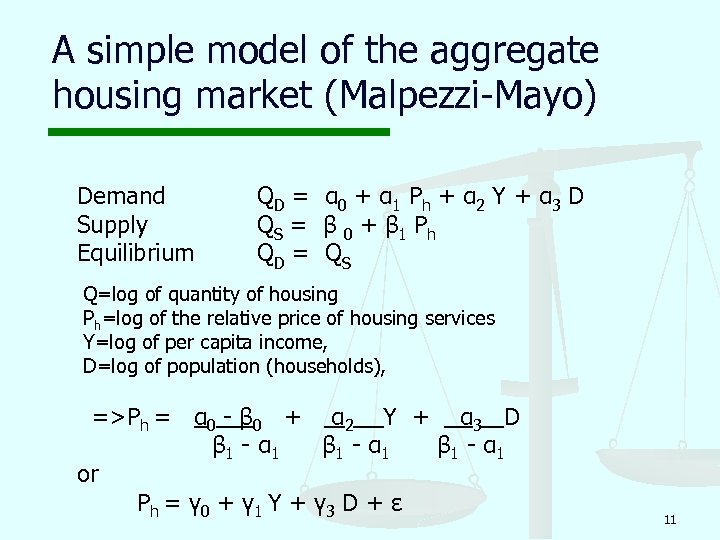
A simple model of the aggregate housing market (Malpezzi-Mayo) Demand Supply Equilibrium QD = α 0 + α 1 P h + α 2 Y + α 3 D QS = β 0 + β 1 P h QD = Q S Q=log of quantity of housing Ph=log of the relative price of housing services Y=log of per capita income, D=log of population (households), =>Ph = α 0 - β 0 + α 2 Y + α 3 D β 1 - α 1 or P h = γ 0 + γ 1 Y + γ 3 D + ε 11
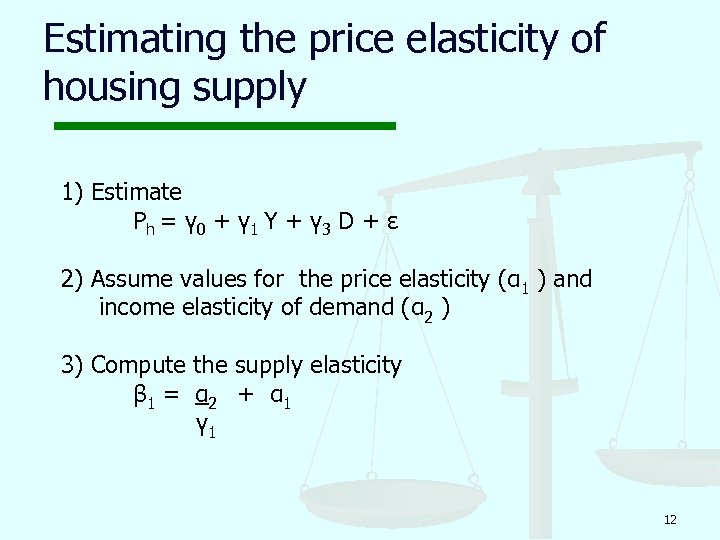
Estimating the price elasticity of housing supply 1) Estimate P h = γ 0 + γ 1 Y + γ 3 D + ε 2) Assume values for the price elasticity (α 1 ) and income elasticity of demand (α 2 ) 3) Compute the supply elasticity β 1 = α 2 + α 1 γ 1 12
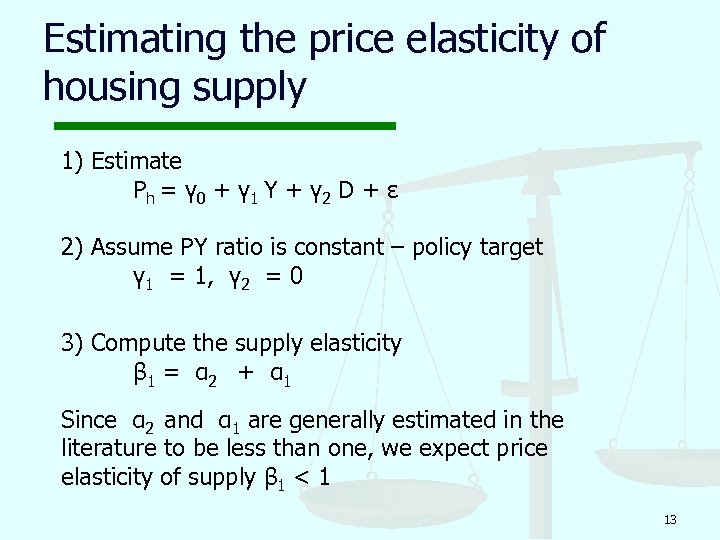
Estimating the price elasticity of housing supply 1) Estimate P h = γ 0 + γ 1 Y + γ 2 D + ε 2) Assume PY ratio is constant – policy target γ 1 = 1, γ 2 = 0 3) Compute the supply elasticity β 1 = α 2 + α 1 Since α 2 and α 1 are generally estimated in the literature to be less than one, we expect price elasticity of supply β 1 < 1 13
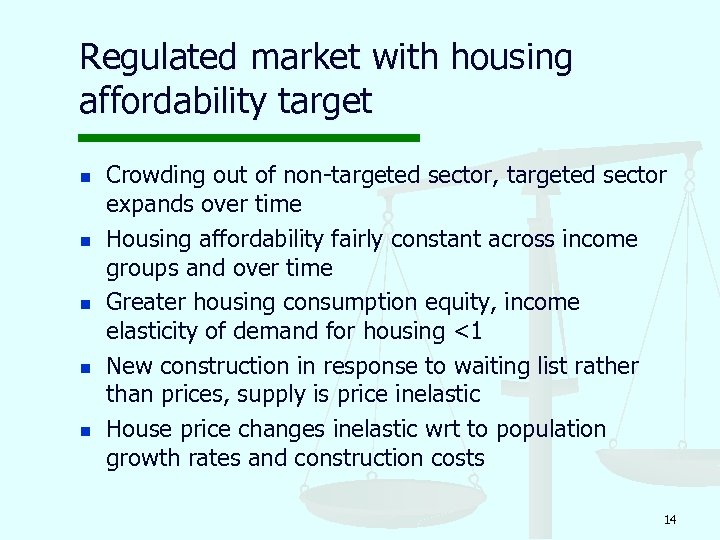
Regulated market with housing affordability target n n n Crowding out of non-targeted sector, targeted sector expands over time Housing affordability fairly constant across income groups and over time Greater housing consumption equity, income elasticity of demand for housing <1 New construction in response to waiting list rather than prices, supply is price inelastic House price changes inelastic wrt to population growth rates and construction costs 14
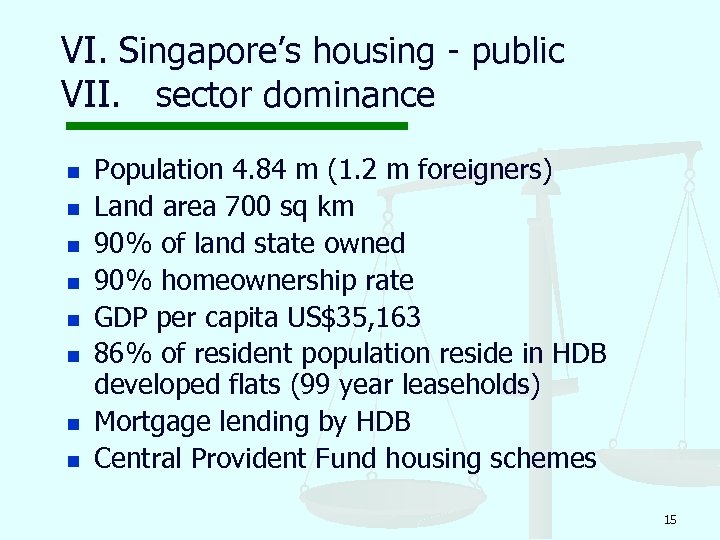
VI. Singapore’s housing - public VII. sector dominance n n n n Population 4. 84 m (1. 2 m foreigners) Land area 700 sq km 90% of land state owned 90% homeownership rate GDP per capita US$35, 163 86% of resident population reside in HDB developed flats (99 year leaseholds) Mortgage lending by HDB Central Provident Fund housing schemes 15
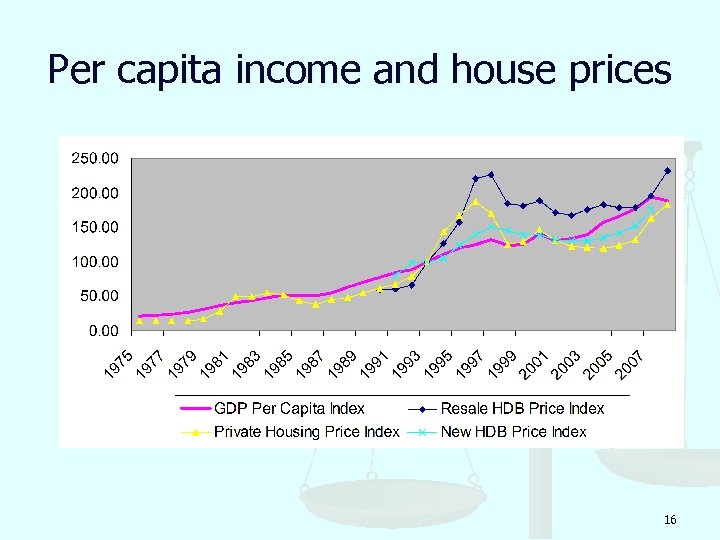
Per capita income and house prices 16
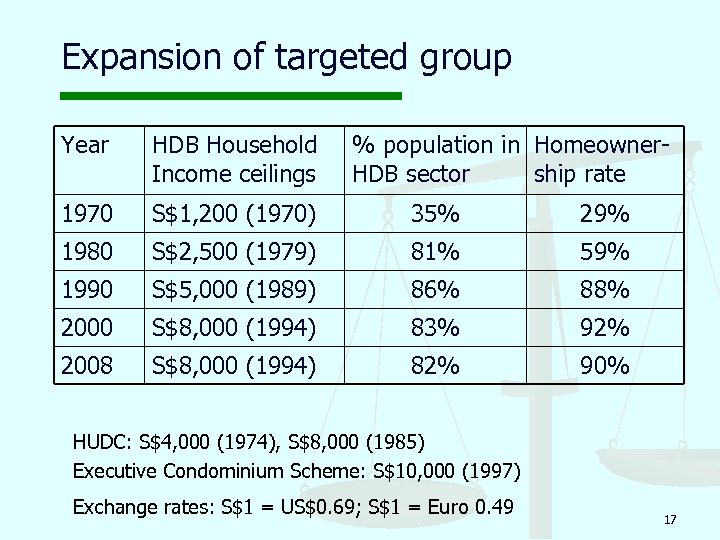
Expansion of targeted group Year HDB Household Income ceilings % population in Homeowner. HDB sector ship rate 1970 S$1, 200 (1970) 35% 29% 1980 S$2, 500 (1979) 81% 59% 1990 S$5, 000 (1989) 86% 88% 2000 S$8, 000 (1994) 83% 92% 2008 S$8, 000 (1994) 82% 90% HUDC: S$4, 000 (1974), S$8, 000 (1985) Executive Condominium Scheme: S$10, 000 (1997) Exchange rates: S$1 = US$0. 69; S$1 = Euro 0. 49 17
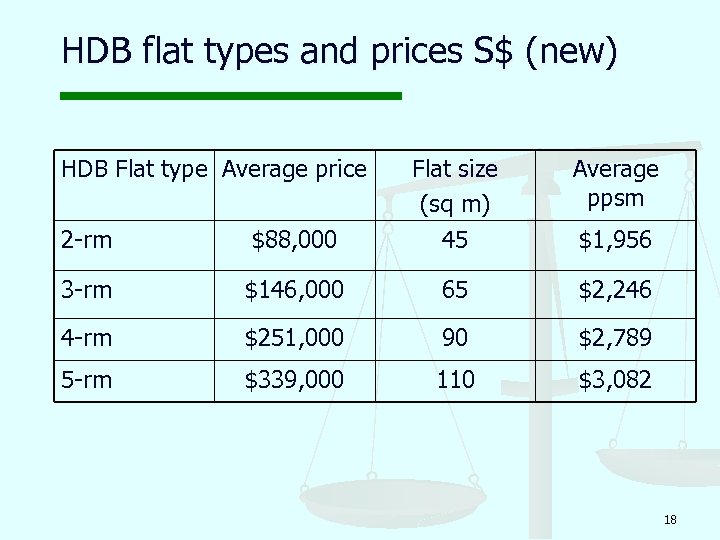
HDB flat types and prices S$ (new) HDB Flat type Average price 2 -rm $88, 000 Flat size (sq m) 45 Average ppsm 3 -rm $146, 000 65 $2, 246 4 -rm $251, 000 90 $2, 789 5 -rm $339, 000 110 $3, 082 $1, 956 18
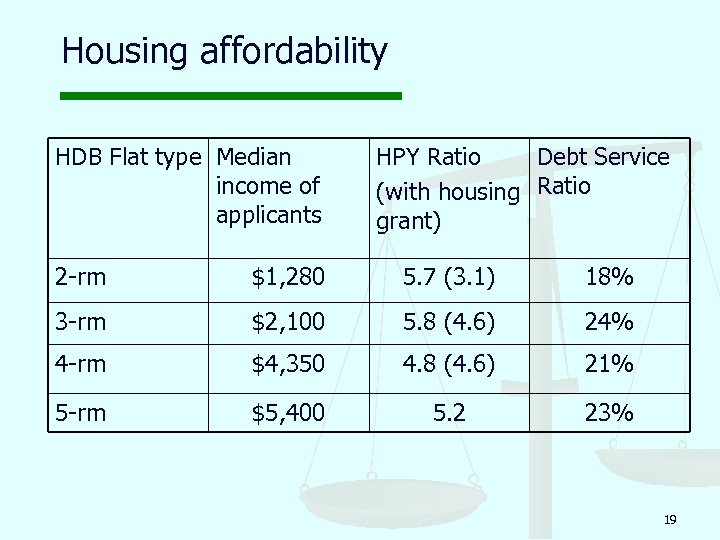
Housing affordability HDB Flat type Median income of applicants HPY Ratio Debt Service (with housing Ratio grant) 2 -rm $1, 280 5. 7 (3. 1) 18% 3 -rm $2, 100 5. 8 (4. 6) 24% 4 -rm $4, 350 4. 8 (4. 6) 21% 5 -rm $5, 400 5. 2 23% 19
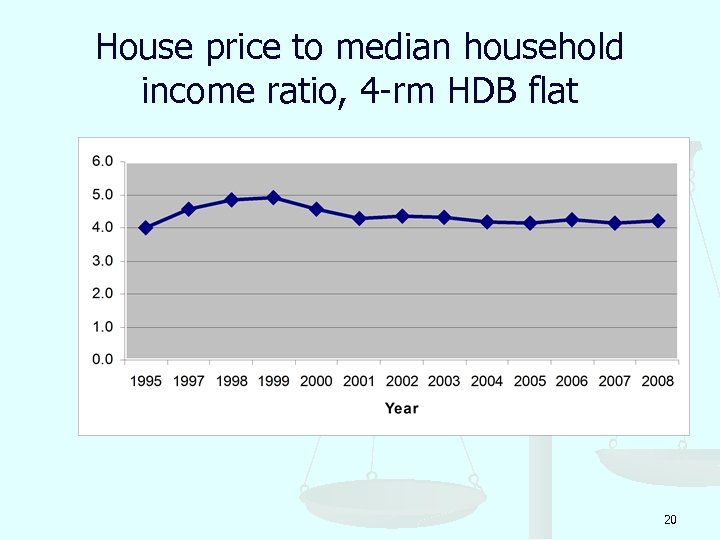
House price to median household income ratio, 4 -rm HDB flat 20
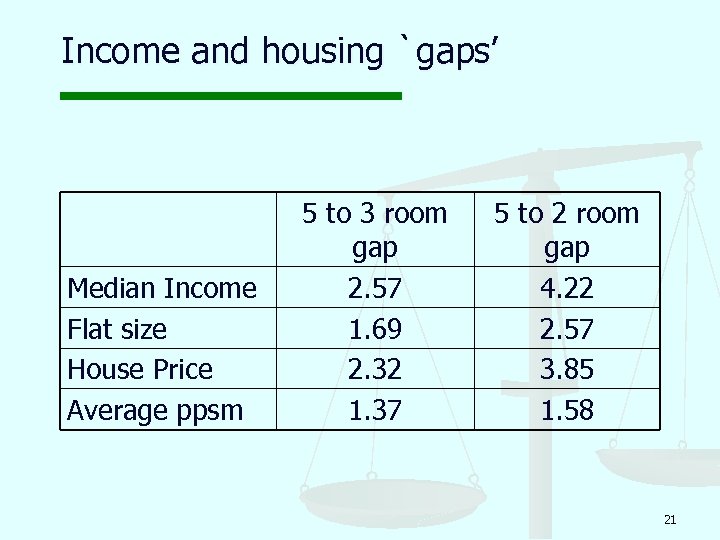
Income and housing `gaps’ Median Income Flat size House Price Average ppsm 5 to 3 room gap 2. 57 1. 69 2. 32 1. 37 5 to 2 room gap 4. 22 2. 57 3. 85 1. 58 21
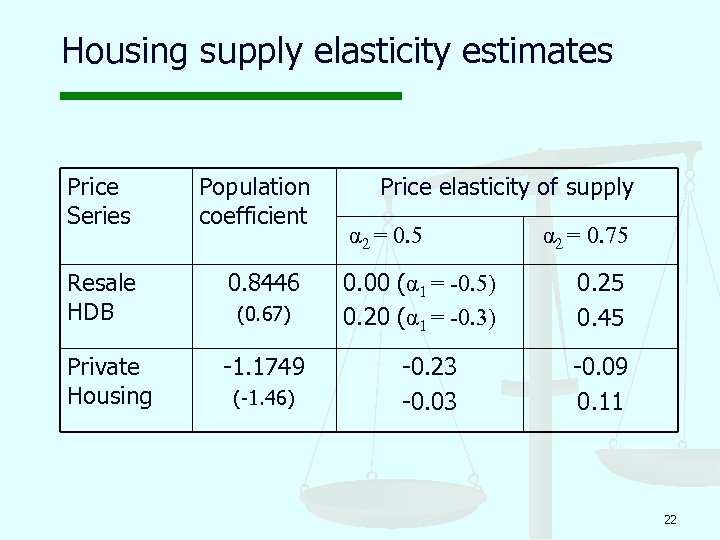
Housing supply elasticity estimates Price Series Population coefficient Resale HDB 0. 8446 Private Housing -1. 1749 (0. 67) (-1. 46) Price elasticity of supply α 2 = 0. 5 0. 00 (α 1 = -0. 5) 0. 20 (α 1 = -0. 3) -0. 23 -0. 03 α 2 = 0. 75 0. 25 0. 45 -0. 09 0. 11 22
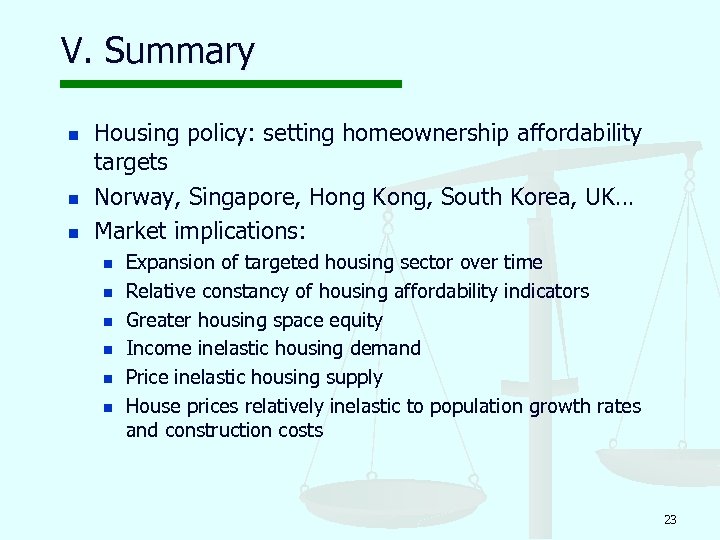
V. Summary n n n Housing policy: setting homeownership affordability targets Norway, Singapore, Hong Kong, South Korea, UK… Market implications: n n n Expansion of targeted housing sector over time Relative constancy of housing affordability indicators Greater housing space equity Income inelastic housing demand Price inelastic housing supply House prices relatively inelastic to population growth rates and construction costs 23

Thank you 24
Скачать презентацию Affordable homeownership policy Implications for housing markets and
1f20ed709aa9546abedd044ea77c13f5.ppt