


 Скачать презентацию AF 301 Introduction to Financial Management Introduction and
57a7c5994f861874379527e1c476fe78.ppt
- Количество слайдов: 60
 AF 301: Introduction to Financial Management Introduction and Time Value of Money Instructor: Kristen Callahan 0
 Finance What is finance? Cash & Risk Finance vs. Accounting 1
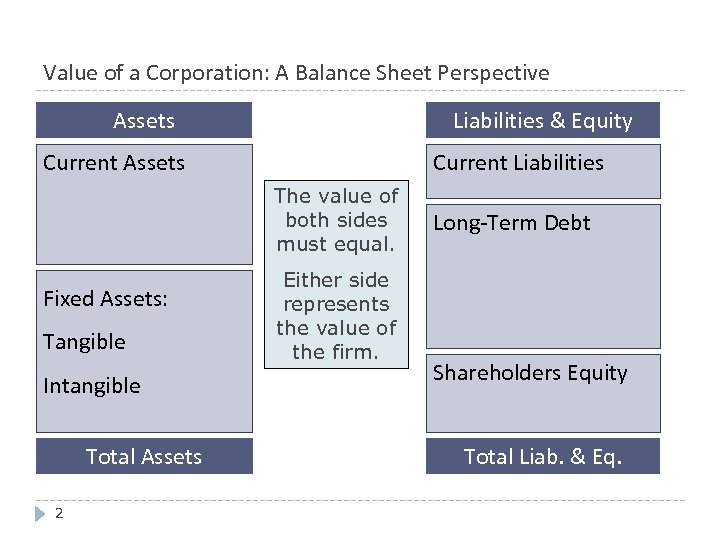 Value of a Corporation: A Balance Sheet Perspective Assets Liabilities & Equity Current Assets Current Liabilities The value of both sides must equal. Fixed Assets: Tangible Intangible Total Assets 2 Either side represents the value of the firm. Long-Term Debt Shareholders Equity Total Liab. & Eq.
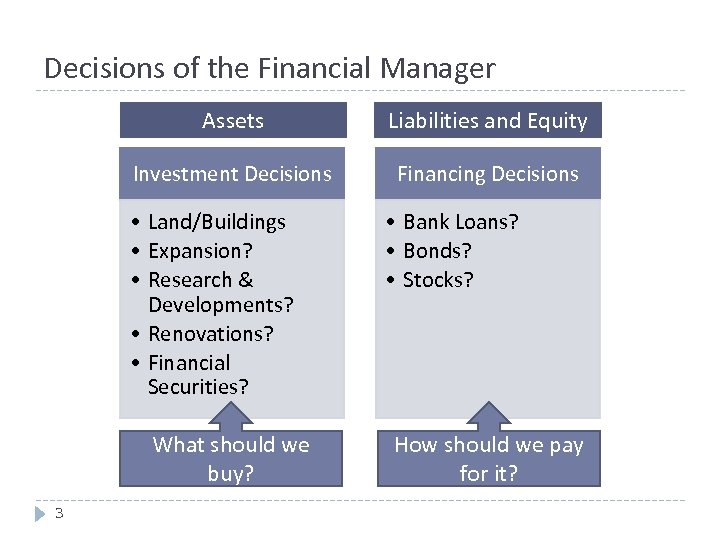 Decisions of the Financial Manager Assets Liabilities and Equity Investment Decisions Financing Decisions • Land/Buildings • Expansion? • Research & Developments? • Renovations? • Financial Securities? What should we buy? 3 • Bank Loans? • Bonds? • Stocks? How should we pay for it?
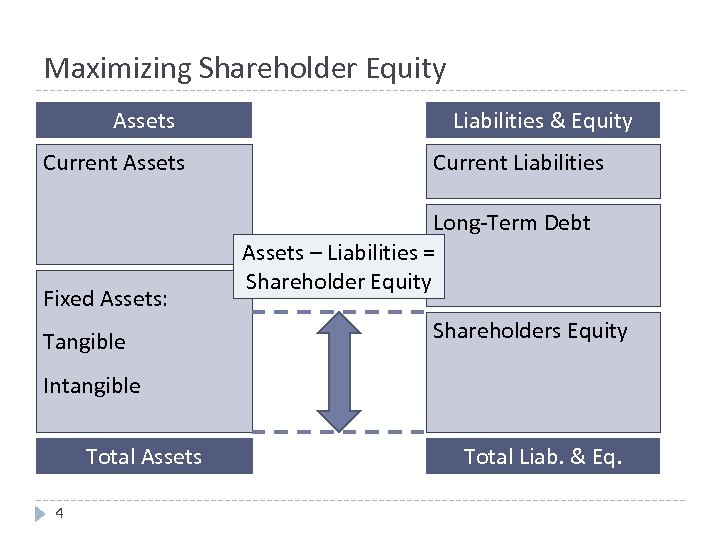 Maximizing Shareholder Equity Assets Current Assets Fixed Assets: Tangible Liabilities & Equity Current Liabilities Long-Term Debt Assets – Liabilities = Shareholder Equity Shareholders Equity Intangible Total Assets 4 Total Liab. & Eq.
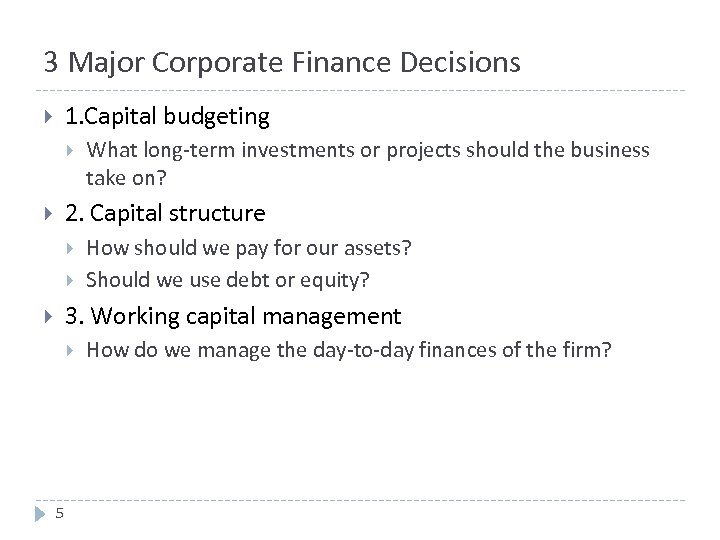 3 Major Corporate Finance Decisions 1. Capital budgeting What long-term investments or projects should the business take on? 2. Capital structure How should we pay for our assets? Should we use debt or equity? 3. Working capital management 5 How do we manage the day-to-day finances of the firm?
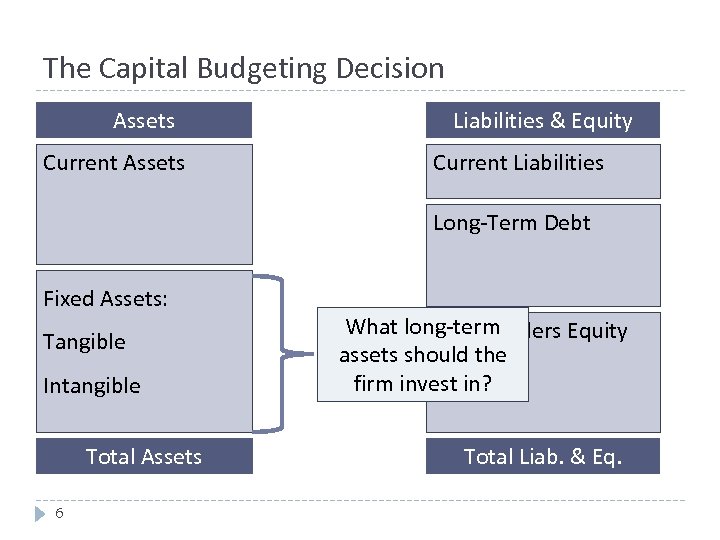 The Capital Budgeting Decision Assets Current Assets Liabilities & Equity Current Liabilities Long-Term Debt Fixed Assets: Tangible Intangible Total Assets 6 What long-term Shareholders Equity assets should the firm invest in? Total Liab. & Eq.
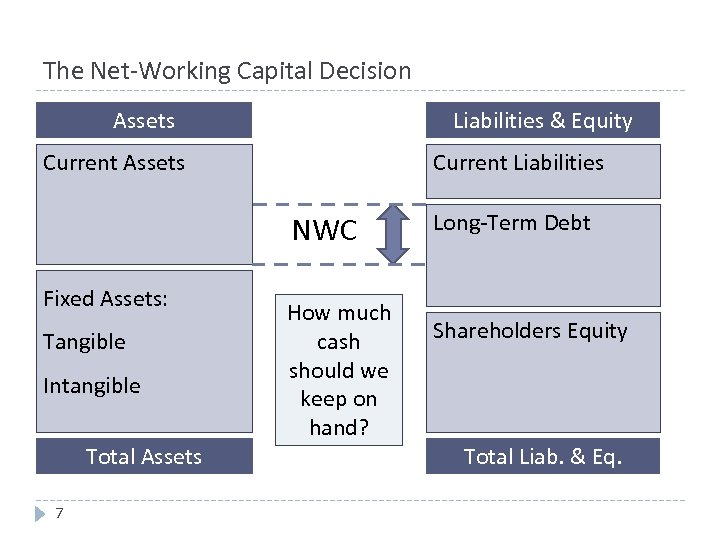 The Net-Working Capital Decision Assets Liabilities & Equity Current Assets Current Liabilities NWC Fixed Assets: Tangible Intangible Total Assets 7 How much cash should we keep on hand? Long-Term Debt Shareholders Equity Total Liab. & Eq.
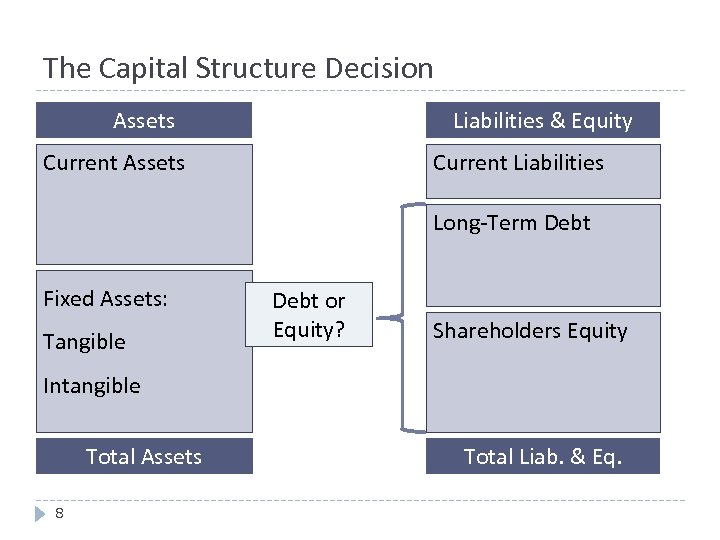 The Capital Structure Decision Assets Liabilities & Equity Current Assets Current Liabilities Long-Term Debt Fixed Assets: Tangible Debt or Equity? Shareholders Equity Intangible Total Assets 8 Total Liab. & Eq.
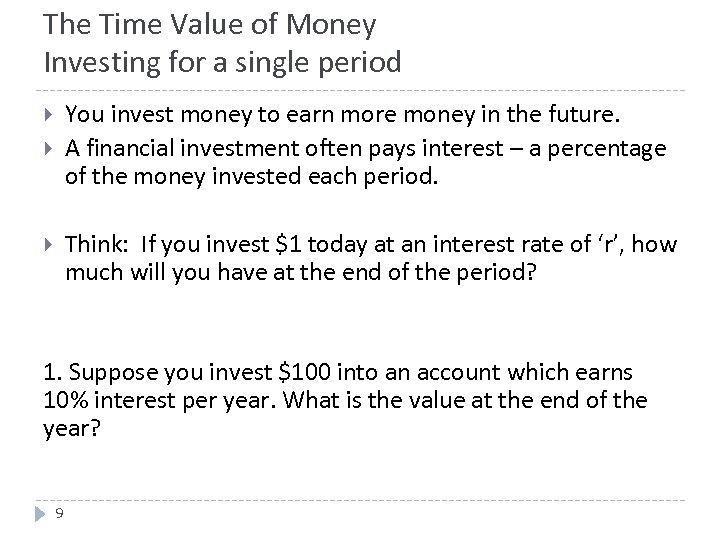 The Time Value of Money Investing for a single period You invest money to earn more money in the future. A financial investment often pays interest – a percentage of the money invested each period. Think: If you invest $1 today at an interest rate of ‘r’, how much will you have at the end of the period? 1. Suppose you invest $100 into an account which earns 10% interest per year. What is the value at the end of the year? 9
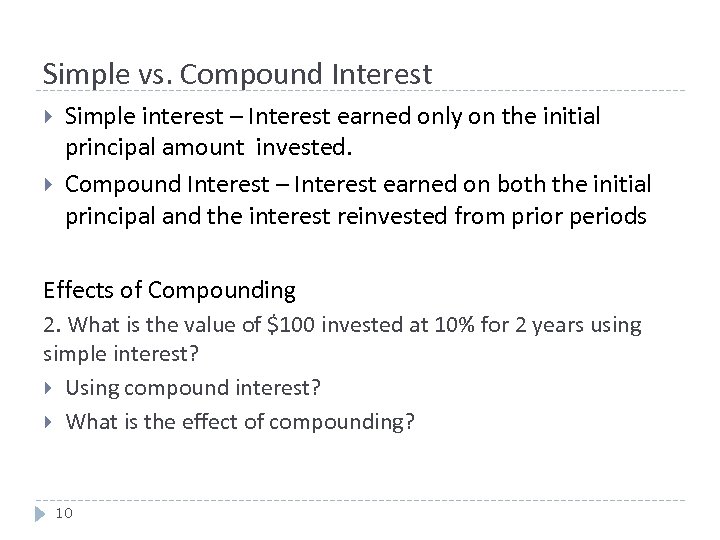 Simple vs. Compound Interest Simple interest – Interest earned only on the initial principal amount invested. Compound Interest – Interest earned on both the initial principal and the interest reinvested from prior periods Effects of Compounding 2. What is the value of $100 invested at 10% for 2 years using simple interest? Using compound interest? What is the effect of compounding? 10
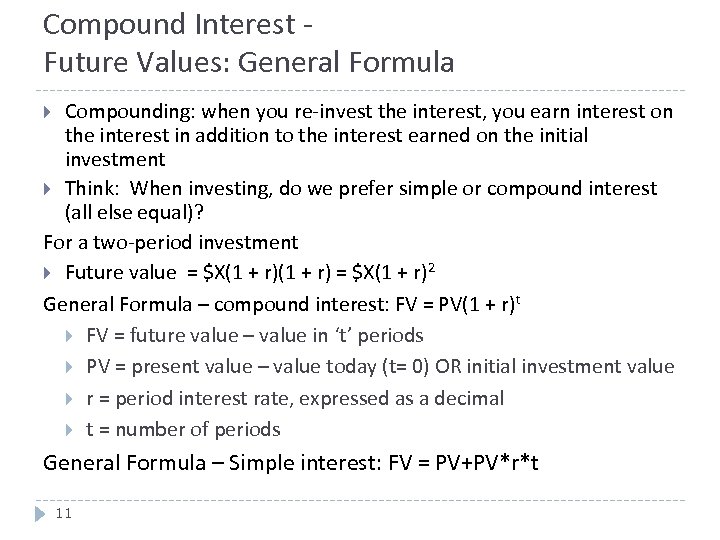 Compound Interest Future Values: General Formula Compounding: when you re-invest the interest, you earn interest on the interest in addition to the interest earned on the initial investment Think: When investing, do we prefer simple or compound interest (all else equal)? For a two-period investment Future value = $X(1 + r)2 General Formula – compound interest: FV = PV(1 + r)t FV = future value – value in ‘t’ periods PV = present value – value today (t= 0) OR initial investment value r = period interest rate, expressed as a decimal t = number of periods General Formula – Simple interest: FV = PV+PV*r*t 11
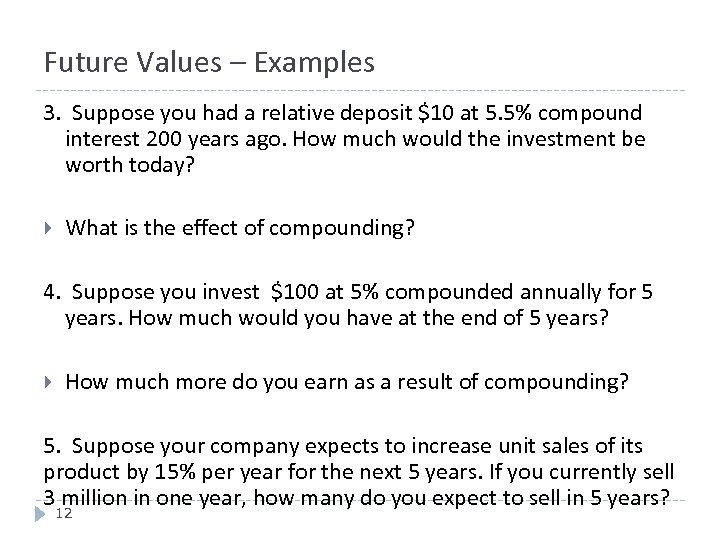 Future Values – Examples 3. Suppose you had a relative deposit $10 at 5. 5% compound interest 200 years ago. How much would the investment be worth today? What is the effect of compounding? 4. Suppose you invest $100 at 5% compounded annually for 5 years. How much would you have at the end of 5 years? How much more do you earn as a result of compounding? 5. Suppose your company expects to increase unit sales of its product by 15% per year for the next 5 years. If you currently sell 3 million in one year, how many do you expect to sell in 5 years? 12
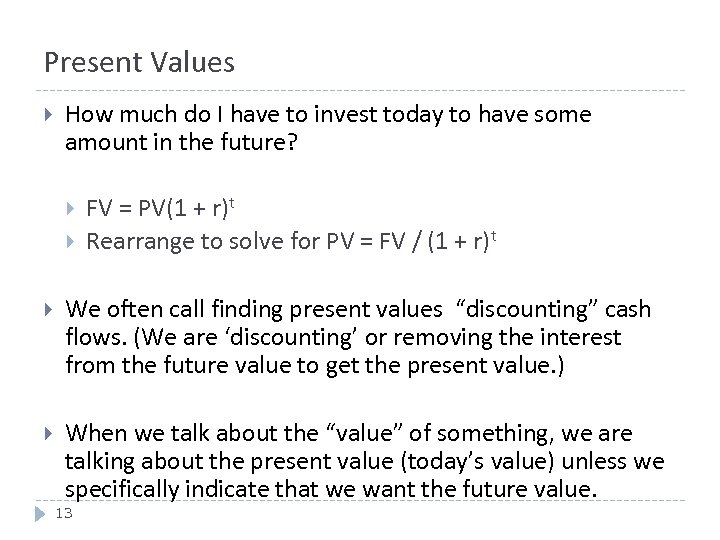 Present Values How much do I have to invest today to have some amount in the future? FV = PV(1 + r)t Rearrange to solve for PV = FV / (1 + r)t We often call finding present values “discounting” cash flows. (We are ‘discounting’ or removing the interest from the future value to get the present value. ) When we talk about the “value” of something, we are talking about the present value (today’s value) unless we specifically indicate that we want the future value. 13
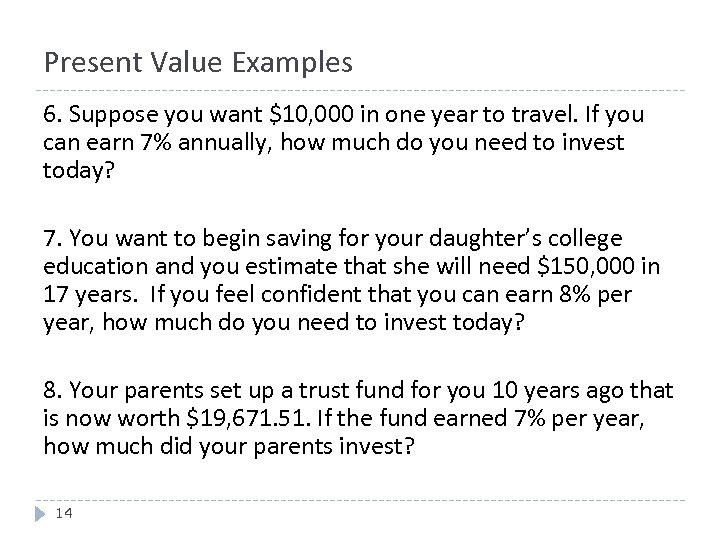 Present Value Examples 6. Suppose you want $10, 000 in one year to travel. If you can earn 7% annually, how much do you need to invest today? 7. You want to begin saving for your daughter’s college education and you estimate that she will need $150, 000 in 17 years. If you feel confident that you can earn 8% per year, how much do you need to invest today? 8. Your parents set up a trust fund for you 10 years ago that is now worth $19, 671. 51. If the fund earned 7% per year, how much did your parents invest? 14
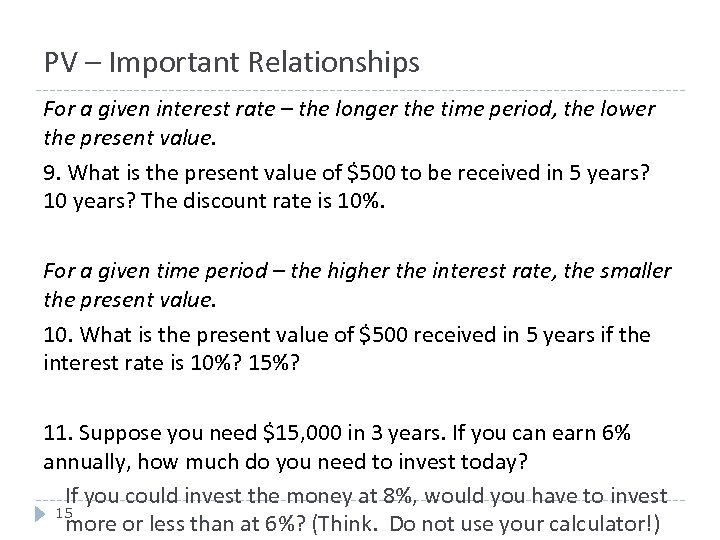 PV – Important Relationships For a given interest rate – the longer the time period, the lower the present value. 9. What is the present value of $500 to be received in 5 years? 10 years? The discount rate is 10%. For a given time period – the higher the interest rate, the smaller the present value. 10. What is the present value of $500 received in 5 years if the interest rate is 10%? 15%? 11. Suppose you need $15, 000 in 3 years. If you can earn 6% annually, how much do you need to invest today? If you could invest the money at 8%, would you have to invest 15 more or less than at 6%? (Think. Do not use your calculator!)
 The General PV Equation PV = FV / (1 + r)t There are four parts to this equation PV, FV, r and t If we know any three, we can solve for the fourth Calculator Tip: For financial functions on the calculator you have one outflow and one inflow – make sure either PV or FV is negative 16
 Discount Rate Often we will want to know what the implied interest rate of an investment is. Rearrange the basic PV equation and solve for r FV = PV(1 + r)t r = (FV / PV)1/t – 1 If you are using formulas, you want to make use of both the yx and the 1/x keys 17
 Discount Rate – Example 12. You are looking at an investment that will pay $1200 in 5 years if you invest $1000 today. What is the implied rate of interest? 13. Suppose you are offered an investment that will allow you to double your money in 6 years. You have $10, 000 to invest. What is the implied rate of interest? 14. Suppose you have a 1 -year old son and you want to provide $75, 000 in 17 years towards his college education. You currently have $5000 to invest. What interest rate must you earn to have the $75, 000 when you need it? 18
 Evaluating Investments How do we determine if the investment is a good one? We need to look at other investments opportunities with the SAME RISK level (For example, it would not make sense to compare the return on a savings account to a return on Tesla stock) The one with the greater interest rate is the better investment 15. Consider the following investment choices: 19 You can invest $500 today and receive $600 in 5 years. The investment is considered low risk. You can invest the $500 in a bank account paying 4%. What is the implied interest rate for the first choice and which investment should you choose?
 Patriot’s #12 16. In 2000, Tom Brady earned a total of $231, 500 as quarterback for the Patriots. In 2016, he took home $28, 774, 301. What is the implied rate of growth of Brady’s earnings over the 16 years? 20
 Finding the Number of Periods Start with basic equation and solve for t (remember your logs and remember to perform calculations inside parenthesis first) FV = PV(1 + r)t t = ln(FV / PV) / ln(1 + r) Remember: For financial functions on the calculator you have one outflow and one inflow – make sure either PV or FV is negative 17. Your goal is to have $20, 000 for a down payment on a house. If you can invest at 10% per year and you currently have $15, 000, how long will it be before you have enough money for the down payment? 21
 Discounted Cash Flow Valuation & Effective Annual Rates
 FV Multiple Cash Flows 1. Suppose you invest $500 in a Fidelity Spartan mutual fund today and $600 in one year. If you expect that the fund will pay 9% annually, how much will you have in two years? How much will you have in 5 years if you make no further deposits? There are 2 ways to solve the problem. What are the two ways? 2. Suppose you plan to deposit $100 into an account in one year and $300 into the account in three years. How much will be in the account in five years if the interest rate is 8%? n 23
 PV Multiple Uneven Cash Flows 3. You are considering an investment that will pay you $200 in one year, $400 in two years, $600 in three years, and $800 in four years. If you want to earn 12% on your money, how much would you be willing to pay? 4. Your broker calls you and tells you that he has this great investment opportunity. If you invest $100 today, you will receive $40 in one year and $75 in two years. If you require a 15% return on investments of this risk, should you take the investment? n 24 What is the highest price you would be willing to pay?
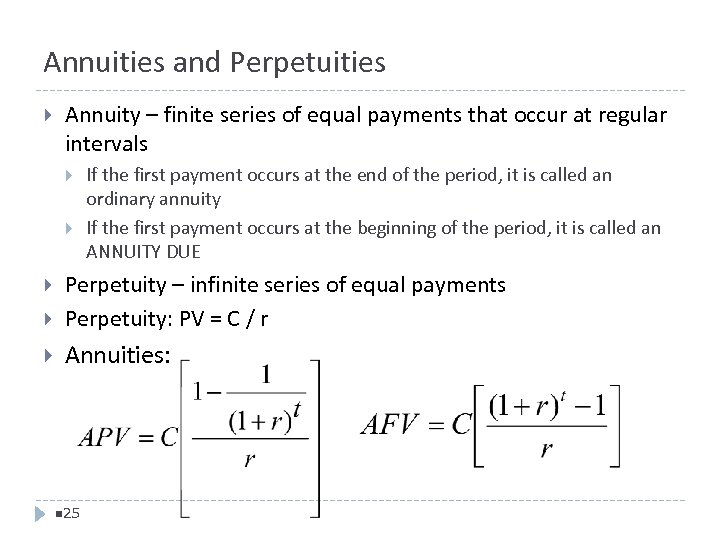 Annuities and Perpetuities Annuity – finite series of equal payments that occur at regular intervals If the first payment occurs at the end of the period, it is called an ordinary annuity If the first payment occurs at the beginning of the period, it is called an ANNUITY DUE Perpetuity – infinite series of equal payments Perpetuity: PV = C / r Annuities: n 25
 Annuities – Lottery Winnings 5. Suppose you win the $10 million lottery. The money is paid in equal annual installments of $500, 000 over 20 years beginning one year from today. If the appropriate discount rate is 5%, how much is the sweepstakes actually worth today? a. Suppose there is a lump sum option to receive $6 million dollars today. Will you choose the installments or lump sum? 6. Assume that you choose the installments and invest each installment at 5%. How much will you have at the end of 20 years? a. Suppose instead that you chose the lump sum. How much will you have at the end of 20 years if you invest at 5%? n 26
 Annuities: Finding the Payment (C) 7. Suppose you want buy a new car that costs $20, 000. You can borrow at 8% per year, compounded monthly. If you take a 4 year loan, what is your monthly payment? What if you wanted to borrow more money, but this is the maximum payment you can afford. What changes can be made to the loan to make this possible? 8. Subsidized Stafford. You will have a accumulated $30, 000 in student loans by the time you graduate in 2 years. The interest rate on the loan is 4. 36%. What will be your monthly payment for a term of 30 years? n 27
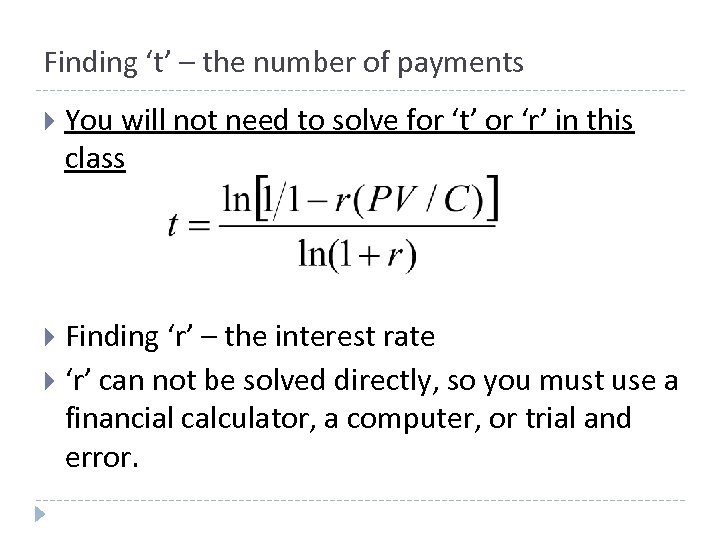 Finding ‘t’ – the number of payments You will not need to solve for ‘t’ or ‘r’ in this class Finding ‘r’ – the interest rate ‘r’ can not be solved directly, so you must use a financial calculator, a computer, or trial and error.
 Annuity Due – Definition and Example An ordinary annuity assumes payments begin one period from today (at t=1) An annuity due is an annuity with cash flows that begin today (at t=0) 9. You are saving for a new house and you put three payments of $10, 000 per year in an account paying 8%. The first payment is made today. How much will you have at the end of 3 years? n 29
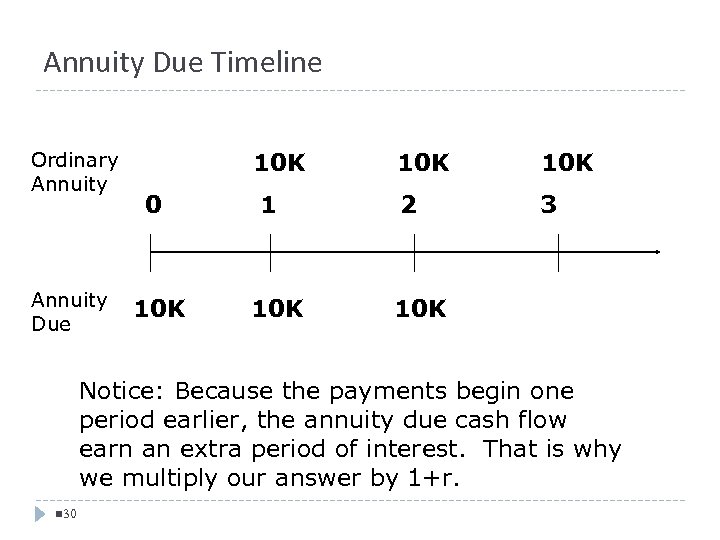 Annuity Due Timeline Ordinary Annuity Due 10 K 0 10 K 10 K 10 K 2 3 10 K Notice: Because the payments begin one period earlier, the annuity due cash flow earn an extra period of interest. That is why we multiply our answer by 1+r. n 30
 Patriot’s #12 10. Tom Brady signed a 2 -year contract in 2017. The contract will pay him a $28, 000 bonus paid at the time of signing (time 0) and, if he plays in every game each season, his average annual salary will be $20, 500, 000 for each of the two years. Given an interest rate of 6%, what is the present value of Tom Brady’s compensation package? 31
 Practice Problem 11. You are going to lease a car and can afford to pay $350 per month for a 3 year lease. The interest rate is 7% and your first payment is to be made today. If you will be putting down $2000 today, how much are you paying to lease the car? Alternatively, you can purchase the same car for $15, 000. If you plan to keep the car for only 3 years no matter how you decide to pay for the car, would you prefer to lease or buy the car? n 32
 Perpetuity: Defined and Example Perpetuity – an annuity in which the cash flows continue forever Perpetuity formula: PV = C / r Most common perpetuities - Preferred Stock which often pay a dividend in perpetuity 12. A company currently pays preferred shareholders a $0. 75 dividend per quarter. If the dividend is expected to continue forever, and the required rate of return on stocks of similar risk is 7. 5% per year, what is the fair price of the stock? n 33
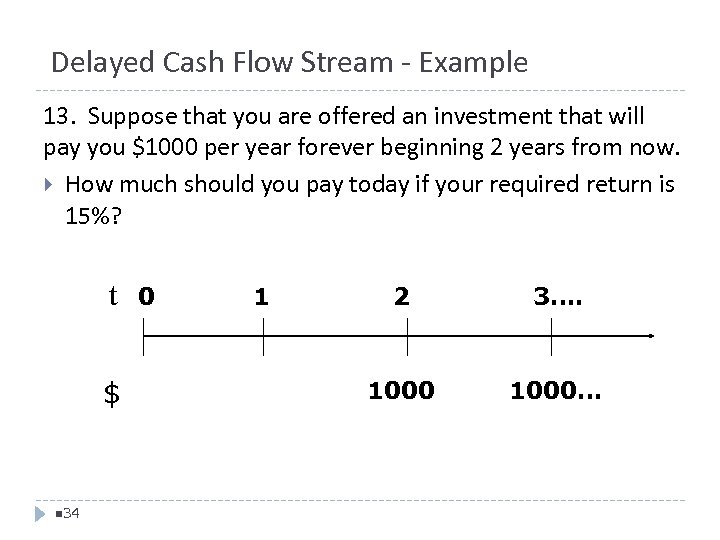 Delayed Cash Flow Stream - Example 13. Suppose that you are offered an investment that will pay you $1000 per year forever beginning 2 years from now. How much should you pay today if your required return is 15%? t $ n 34 0 1 2 3…. 1000…
 Delayed Cash Flow Stream The annuity and perpetuity formulas provide the PV of the cash flow stream as of the time period before the first cash flow is paid. To find PV of a delayed cash flow stream it is a Two-step process: Find PV of cash flow stream and then discount PV back to today. The Two-Step Process 1. Find the PV of the perpetuity. Cash flow stream begins at t=2 so this gives PV as of t=1 2. Discount the PV of the cash flow stream back to today
 PV Annuity: Saving For Retirement 14. You are offered the opportunity to put some money away for retirement. You will receive five annual payments of $25, 000 each beginning in 40 years. How much would you be willing to invest today if you desire an interest rate of 12%? n 36
 Effective Annual Rates Comparing Rates: The Effect of Compounding 37
 Comparing Rates: The Effect of Compounding Is 5% every six months the same as 10% per year? Which account is better an account that earns 15. 5% compounded quarterly or one that earns 16% compounded annually? When number of compounding periods differ you must determine the Effective Annual Rate (EAR) to compare rates. The EAR captures the effect of compounding periods throughout the year. An Annual Percentage Rate (APR) or quoted rate does not reflect the number of compounding periods per year.
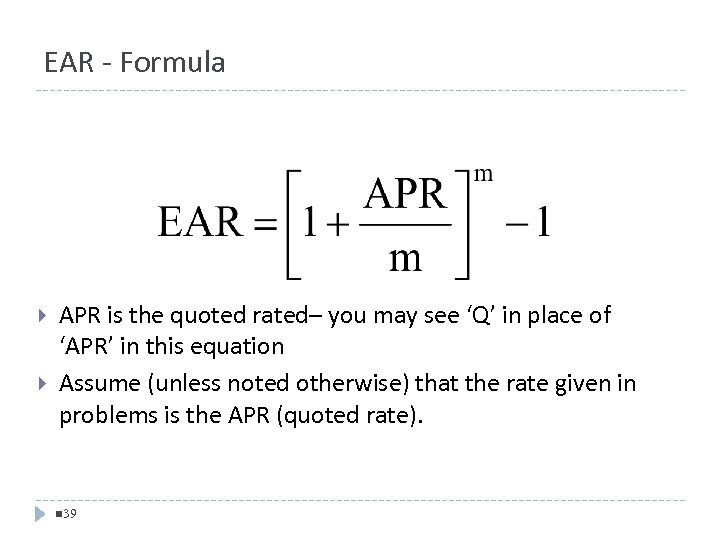 EAR - Formula APR is the quoted rated– you may see ‘Q’ in place of ‘APR’ in this equation Assume (unless noted otherwise) that the rate given in problems is the APR (quoted rate). n 39
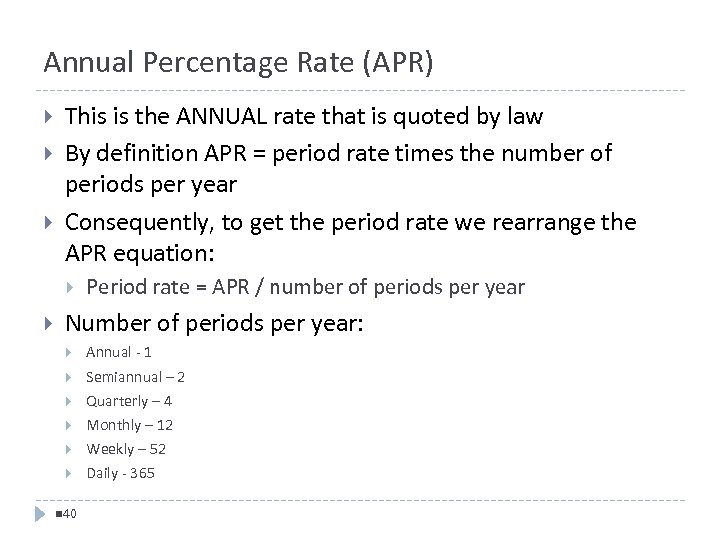 Annual Percentage Rate (APR) This is the ANNUAL rate that is quoted by law By definition APR = period rate times the number of periods per year Consequently, to get the period rate we rearrange the APR equation: Period rate = APR / number of periods per year Number of periods per year: Annual - 1 Semiannual – 2 Quarterly – 4 Monthly – 12 Weekly – 52 Daily - 365 n 40
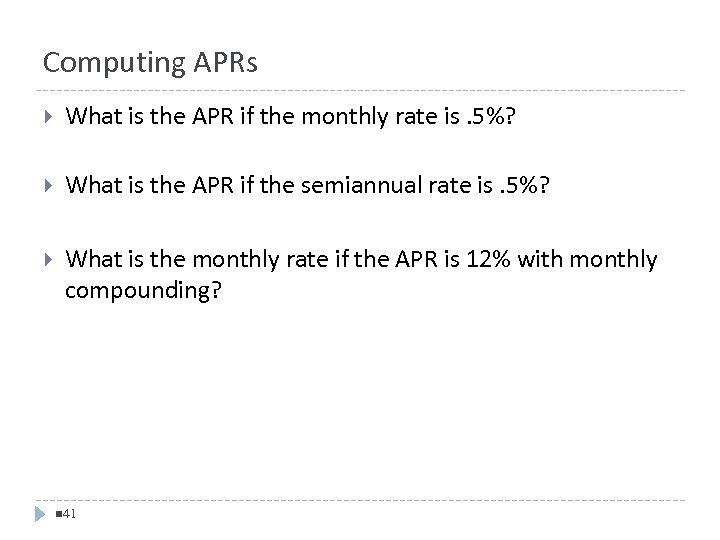 Computing APRs What is the APR if the monthly rate is. 5%? What is the APR if the semiannual rate is. 5%? What is the monthly rate if the APR is 12% with monthly compounding? n 41
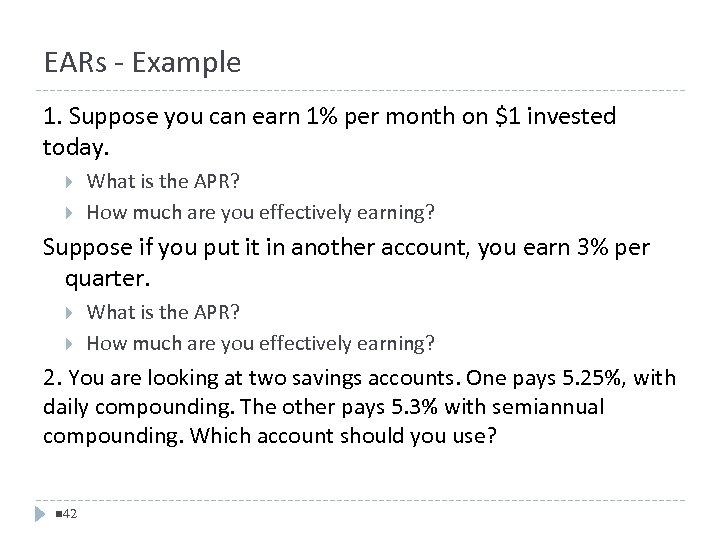 EARs - Example 1. Suppose you can earn 1% per month on $1 invested today. What is the APR? How much are you effectively earning? Suppose if you put it in another account, you earn 3% per quarter. What is the APR? How much are you effectively earning? 2. You are looking at two savings accounts. One pays 5. 25%, with daily compounding. The other pays 5. 3% with semiannual compounding. Which account should you use? n 42
 Interest Rates & Bond Valuation
 Bond Terminology, continued Bond – a debt instrument Bond issuer – the corporation or government entity that sells the bonds to raise capital – the debtor/borrower Bondholder – the investor who purchases the bond – the lender/creditor Par value (face value) – the principal amount of a bond which is repaid at the end of the term Coupon payment – the periodic coupon (interest payment) of a bond Coupon rate – the annual coupon divided by the face value of a bond Maturity date – date on which the principal amount of the bond is paid (All of the above are fixed at issuance -they never change) Yield or Yield to maturity – the rate of return required on similar bonds (can change constantly) § 44
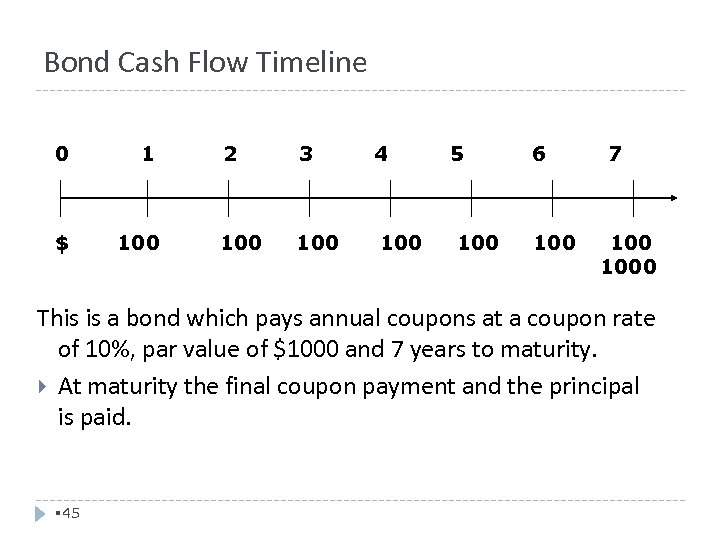 Bond Cash Flow Timeline 0 1 $ 100 2 3 4 100 100 5 100 6 100 7 1000 This is a bond which pays annual coupons at a coupon rate of 10%, par value of $1000 and 7 years to maturity. At maturity the final coupon payment and the principal is paid. § 45
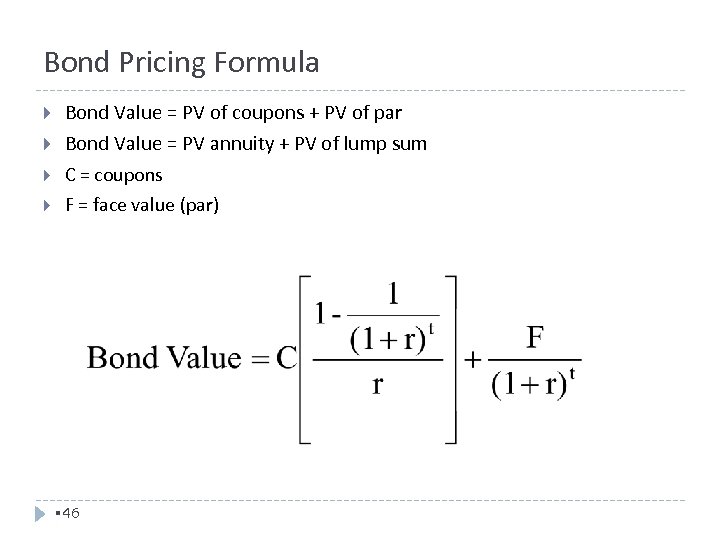 Bond Pricing Formula Bond Value = PV of coupons + PV of par Bond Value = PV annuity + PV of lump sum C = coupons F = face value (par) § 46
 Bond Example 1 A. B. C. D. § 47 A bond is issued with 10 years to maturity and an annual coupon of 8%. Similar bonds are yielding 8%. Calculate the current price of the bond. Now assume a year has gone by and market rates on similar bonds remain at 8%. Determine the price of the bond today Now assume that a year has gone by and market rates on similar bonds rise to 10%. Determine the price of the bond today. Now instead assume that the yield to maturity falls to 7% over the first year. What happens to the price now?
 Bond Value and Interest Rates When issued, bonds are typically priced to sell at par. Which means that the coupon rate is set equal to the prevailing market rate for similar bonds. When coupon = yield, price = par As interest rates increase, PV decrease As interest rates decrease, PV increases So, as interest rates increase, bond prices decrease And, as interest rates decrease, bond prices increase § 48
 Bond Value and Interest Rates: The Economic Reality The cash flows of a bond (coupon and par value) is fixed at bond issuance – they never change Interest rates are always changing The bond price MUST change then to adjust the bond so that investors earn a fair market return. As interest rates increase, a par bonds cash flows become less valuable (other bonds are offering greater yields) and therefore the bonds price must decrease As interest rates decrease a par bonds cash flows become more valuable (other bonds are offering lower yields and therefore the bonds price must increase § 49
 Par, Discount and Premium Bonds Par Bonds – a bond that is selling at par; a bond whose coupon rate is equal to the YTM Discount bond - a bond that is selling at less than par; a bond whose coupon rate is less than the YTM Premium bond – a bond that is selling at greater than par; a bond whose coupon rate is greater than the YTM § 50
 Bond Examples 2. A bond has a 9% annual coupon and a face value of $1000. There are 20 years to maturity and the yield to maturity is 8%. Should the bond sell at par , a discount or a premium? What is the price of this bond? 3. A bond has a 10% semi-annual coupon and a face value of $1000. There are 20 years to maturity and the yield to maturity is 8%. Should the bond sell at par, a discount, or a premium? What is the price of this bond? § 51
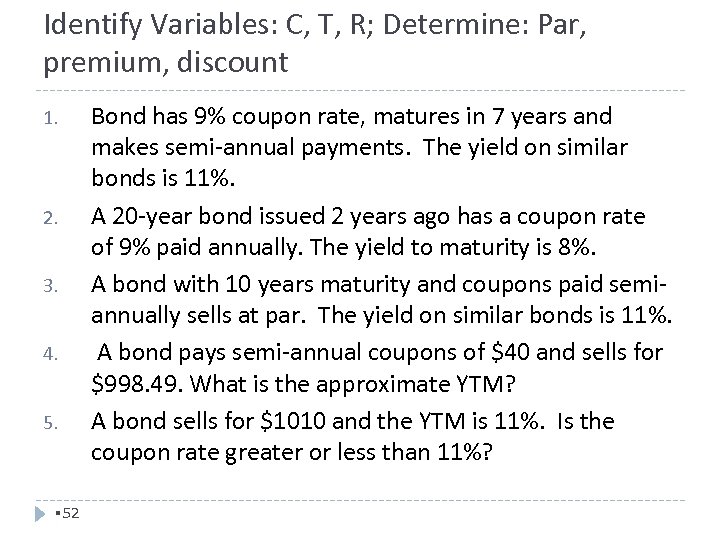 Identify Variables: C, T, R; Determine: Par, premium, discount 1. 2. 3. 4. 5. § 52 Bond has 9% coupon rate, matures in 7 years and makes semi-annual payments. The yield on similar bonds is 11%. A 20 -year bond issued 2 years ago has a coupon rate of 9% paid annually. The yield to maturity is 8%. A bond with 10 years maturity and coupons paid semiannually sells at par. The yield on similar bonds is 11%. A bond pays semi-annual coupons of $40 and sells for $998. 49. What is the approximate YTM? A bond sells for $1010 and the YTM is 11%. Is the coupon rate greater or less than 11%?
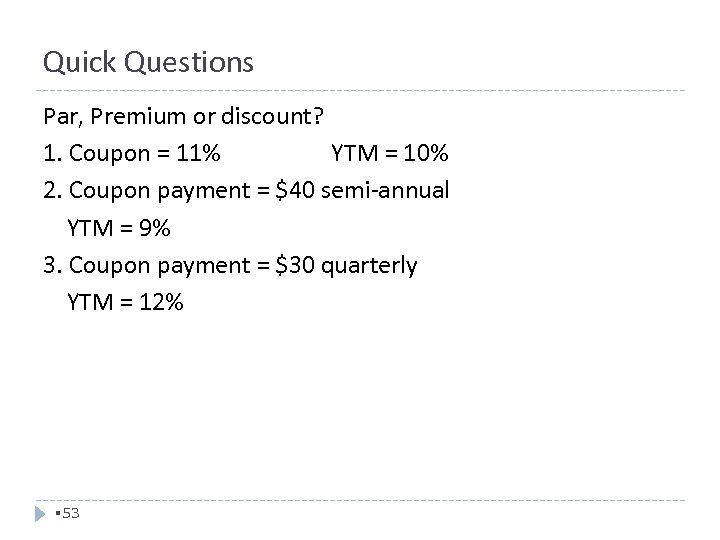 Quick Questions Par, Premium or discount? 1. Coupon = 11% YTM = 10% 2. Coupon payment = $40 semi-annual YTM = 9% 3. Coupon payment = $30 quarterly YTM = 12% § 53
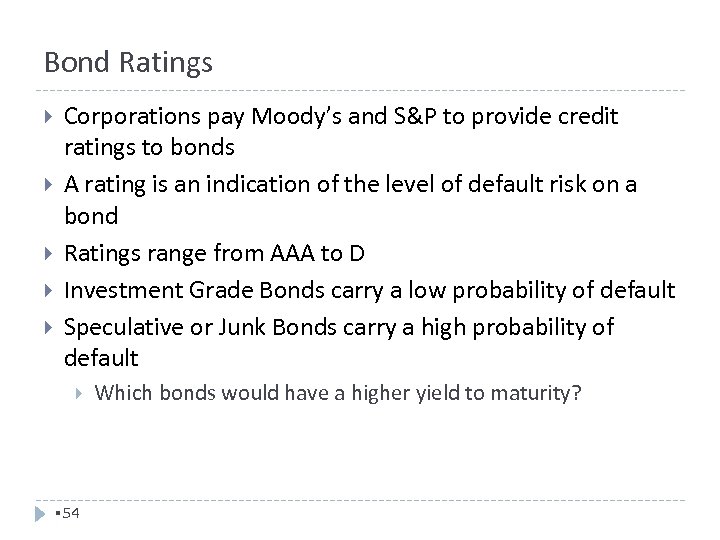 Bond Ratings Corporations pay Moody’s and S&P to provide credit ratings to bonds A rating is an indication of the level of default risk on a bond Ratings range from AAA to D Investment Grade Bonds carry a low probability of default Speculative or Junk Bonds carry a high probability of default § 54 Which bonds would have a higher yield to maturity?
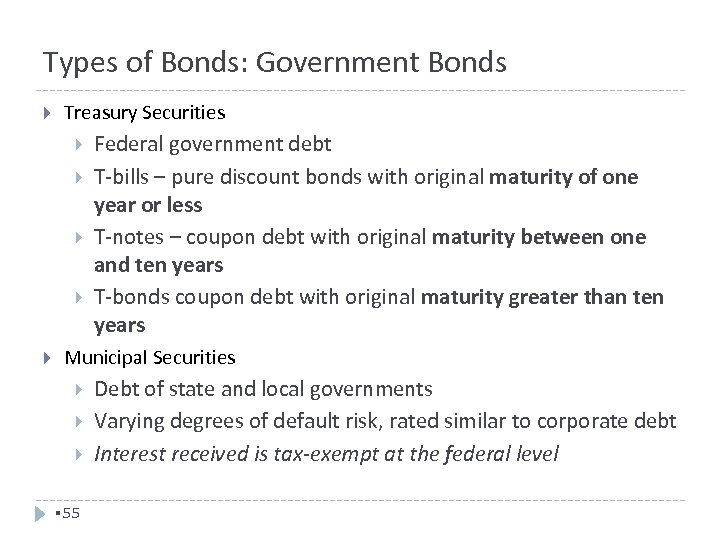 Types of Bonds: Government Bonds Treasury Securities Federal government debt T-bills – pure discount bonds with original maturity of one year or less T-notes – coupon debt with original maturity between one and ten years T-bonds coupon debt with original maturity greater than ten years Municipal Securities § 55 Debt of state and local governments Varying degrees of default risk, rated similar to corporate debt Interest received is tax-exempt at the federal level
 Tax Exempt Bonds When comparing taxable returns to tax-exempt return, you must find the after-tax return for your taxable investment After tax return = r (1 – T) Where § 56 R = return (before tax) T = tax rate
 Tax-exempt Bonds, Example A taxable bond has a yield of 8% and a municipal bond has a yield of 6% If you are in a 40% tax bracket, which bond do you prefer? § 57 Hint: Calculate the after-tax yield on the corporate bond and compare it to the yield on the municipal bond. At what tax rate would you be indifferent between the two bonds?
 Types of Bonds: Zero Coupon Bonds Make no periodic interest payments (coupon rate = 0%) The entire yield-to-maturity comes from the difference between the purchase price and the par value Cannot sell for more than par value (why not? ) Sometimes called zeroes, or deep discount bonds Treasury Bills and principal only Treasury strips are good examples of zeroes § 58
 Types of Bonds: Floating Rate Bonds Coupon rate floats depending on some index value Examples – adjustable rate mortgages and inflation-linked Treasuries There is less price risk with floating rate bonds The coupon floats, so it is less likely to differ substantially from the yield-to-maturity Coupons may have a “collar” – the rate cannot go above a specified “ceiling” or below a specified “floor” § 59