 Скачать презентацию AEROSPACE QUALITY MANAGEMENT SYSTEMS Eugene M Barker Past
0de4bda36776cff38a3baa13a8c3d13e.ppt
- Количество слайдов: 48



AEROSPACE QUALITY MANAGEMENT SYSTEMS Eugene M. Barker. Past Chairman Americas Aerospace Quality Group 20 February 2001 D. K. Gordon 1 of 59
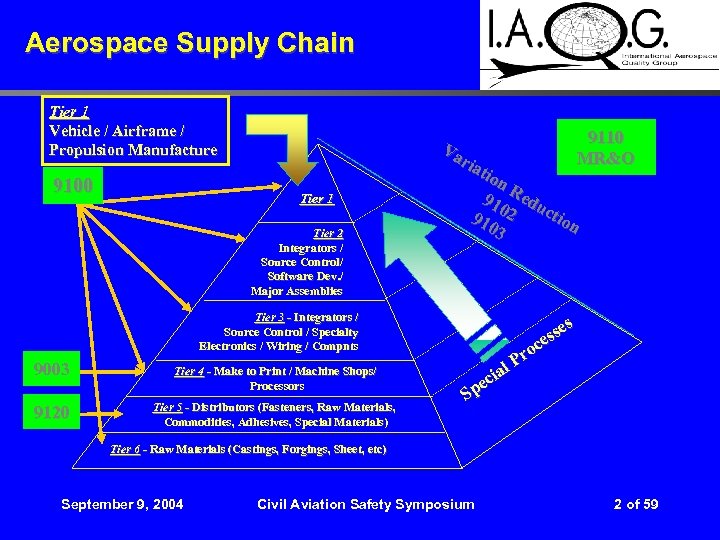
Aerospace Supply Chain Tier 1 Vehicle / Airframe / Propulsion Manufacture 9100 Tier 1 Tier 2 Integrators / Source Control/ Software Dev. / Major Assemblies 9110 Va MR&O ria tio n. R 91 edu 0 cti 91 2 on 03 Tier 3 - Integrators / Source Control / Specialty Electronics / Wiring / Compnts 9003 Tier 4 - Make to Print / Machine Shops/ Processors 9120 Tier 5 - Distributors (Fasteners, Raw Materials, Commodities, Adhesives, Special Materials) l cia e Sp s sse e oc Pr Tier 6 - Raw Materials (Castings, Forgings, Sheet, etc) September 9, 2004 Civil Aviation Safety Symposium 2 of 59
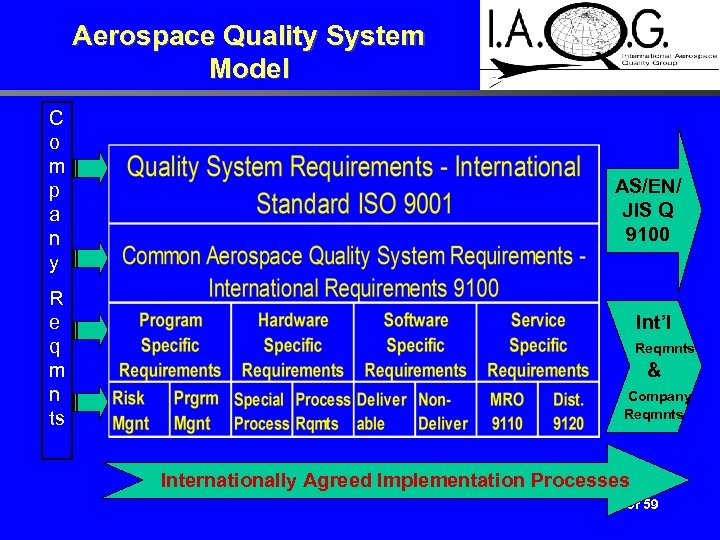
Aerospace Quality System Model C o m p a n y R e q m n ts AS/EN/ JIS Q 9100 Int’l Reqmnts & Company Reqmnts Internationally Agreed Implementation Processes 3 of 59
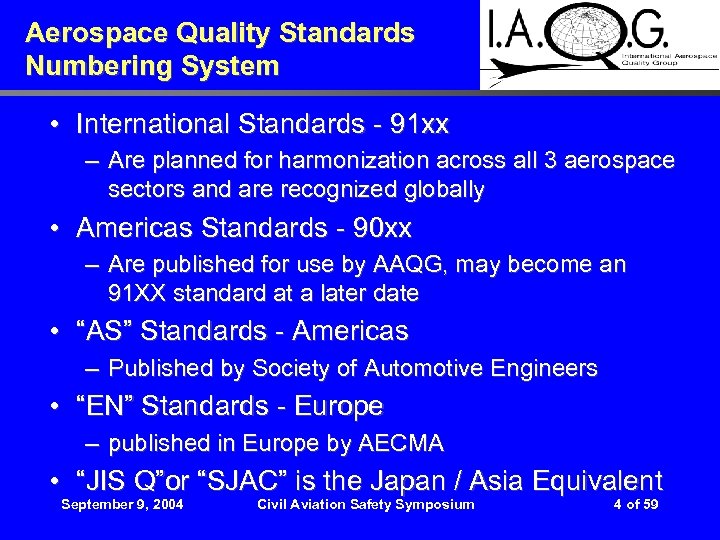
Aerospace Quality Standards Numbering System • International Standards - 91 xx – Are planned for harmonization across all 3 aerospace sectors and are recognized globally • Americas Standards - 90 xx – Are published for use by AAQG, may become an 91 XX standard at a later date • “AS” Standards - Americas – Published by Society of Automotive Engineers • “EN” Standards - Europe – published in Europe by AECMA • “JIS Q”or “SJAC” is the Japan / Asia Equivalent September 9, 2004 Civil Aviation Safety Symposium 4 of 59
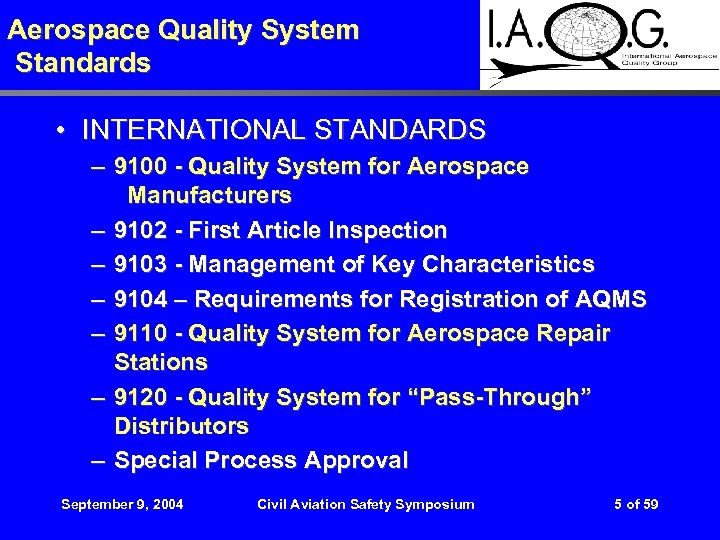
Aerospace Quality System Standards • INTERNATIONAL STANDARDS – 9100 - Quality System for Aerospace Manufacturers – 9102 - First Article Inspection – 9103 - Management of Key Characteristics – 9104 – Requirements for Registration of AQMS – 9110 - Quality System for Aerospace Repair Stations – 9120 - Quality System for “Pass-Through” Distributors – Special Process Approval September 9, 2004 Civil Aviation Safety Symposium 5 of 59
Why 9100? • To standardize Aerospace quality expectations on a global level • To achieve improvements in quality and reduce costs throughout the value stream • ISO 9000 model for quality does not capture regulatory requirements or importance of safety, reliability or maintainability • Captures aerospace supplements agreed to at an international level September 9, 2004 Civil Aviation Safety Symposium 6 of 59
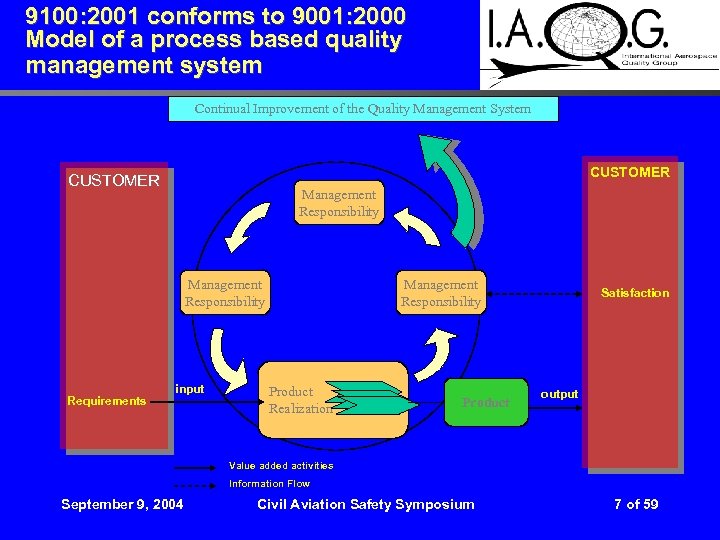
9100: 2001 conforms to 9001: 2000 Model of a process based quality management system Continual Improvement of the Quality Management System CUSTOMER Management Responsibility Requirements input Management Responsibility Product Realization Product Satisfaction output Value added activities Information Flow September 9, 2004 Civil Aviation Safety Symposium 7 of 59
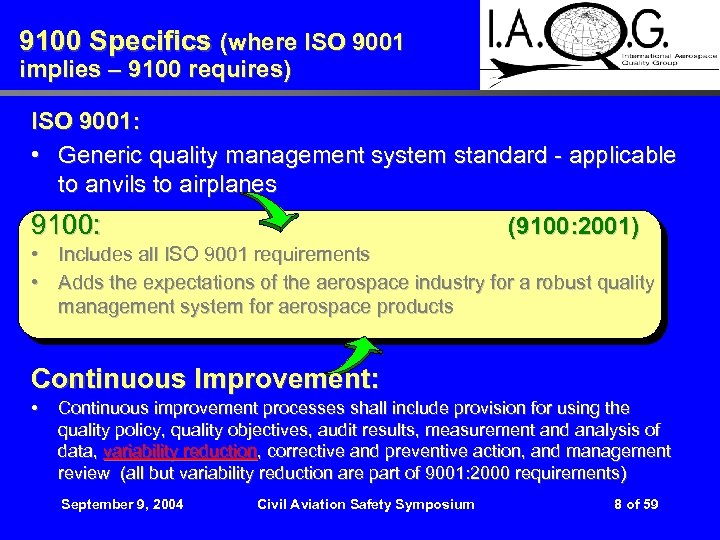
9100 Specifics (where ISO 9001 implies – 9100 requires) ISO 9001: • Generic quality management system standard - applicable to anvils to airplanes 9100: (9100: 2001) • Includes all ISO 9001 requirements • Adds the expectations of the aerospace industry for a robust quality management system for aerospace products Continuous Improvement: • Continuous improvement processes shall include provision for using the quality policy, quality objectives, audit results, measurement and analysis of data, variability reduction, corrective and preventive action, and management review (all but variability reduction are part of 9001: 2000 requirements) September 9, 2004 Civil Aviation Safety Symposium 8 of 59
ISO 9001 versus 9100 • 9100 version is formatted to match ISO 9001: 2000 and added “requirements” that provide for • • • Regulatory organizations interfaces Configuration Management Design and Development V& V. , & V&V testing Control of changes in Production Process Control of production equipment, tools, NC machines Control of work in outside facilities Control of service operations First Article Inspection documentation These added requirements enables a standardized approach to supplier flow down requirements September 9, 2004 Civil Aviation Safety Symposium 9 of 59
9100: Quality Management Systems (ISO Clause 4) • Requirements of regulatory authorities must be included in documentation – Including access by authorities to the records, documentation and change approval (as req’d) • Must show relationship of 9100 standard to lower level procedures • Documented procedure for records control • Requires Configuration Management for the product / process September 9, 2004 Civil Aviation Safety Symposium 10 of 59
9100: Product Realization (ISO Clause 7) • Design and Development output includes: – – Identification of Key Characteristics (FMECA) All necessary data to manufacture the product Gated Design Reviews Documentation of both Design Verification and Design Validation (reports / calculations / etc. ) – Design Verification and Validation testing • Design Change Control – Includes customer and regulatory approval as necessary September 9, 2004 Civil Aviation Safety Symposium 11 of 59
9100: Product Realization (ISO Clause 7) • Purchasing – Responsible for all suppliers (incl. customer designated ones) – Must have a list of suppliers – Supplier performance review process – Control of special process sources – Whoever approves a supplier, can disapprove them as well – Stringent flow down requirements - sub-tier – Notification of nonconformance / process change – Right of access by customer and regulatory personnel September 9, 2004 Civil Aviation Safety Symposium 12 of 59
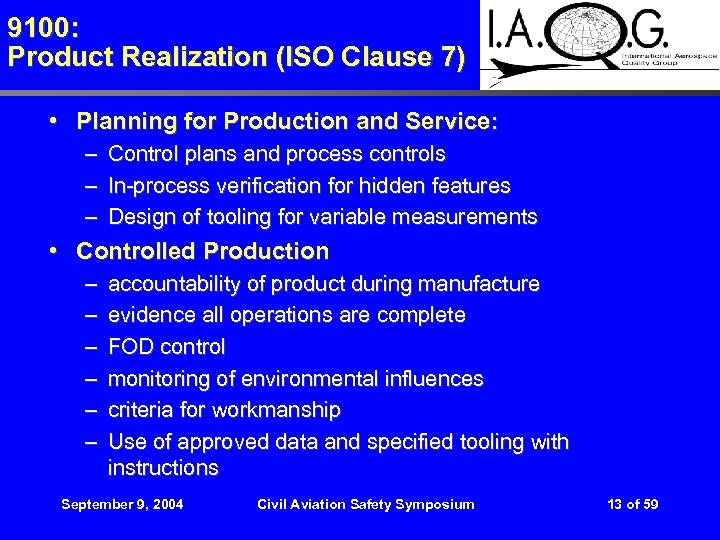
9100: Product Realization (ISO Clause 7) • Planning for Production and Service: – Control plans and process controls – In-process verification for hidden features – Design of tooling for variable measurements • Controlled Production – – – accountability of product during manufacture evidence all operations are complete FOD control monitoring of environmental influences criteria for workmanship Use of approved data and specified tooling with instructions September 9, 2004 Civil Aviation Safety Symposium 13 of 59
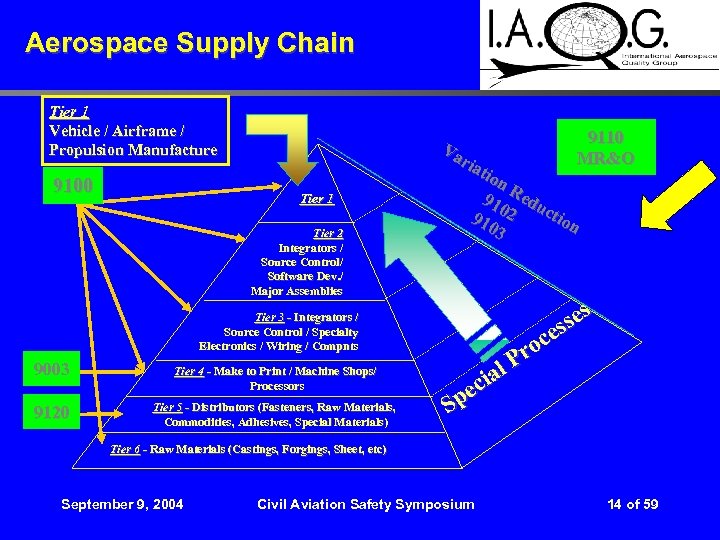
Aerospace Supply Chain Tier 1 Vehicle / Airframe / Propulsion Manufacture 9100 Tier 1 Tier 2 Integrators / Source Control/ Software Dev. / Major Assemblies Tier 3 - Integrators / Source Control / Specialty Electronics / Wiring / Compnts 9003 Tier 4 - Make to Print / Machine Shops/ Processors 9120 Tier 5 - Distributors (Fasteners, Raw Materials, Commodities, Adhesives, Special Materials) 9110 Va MR&O ria tio n. R 91 edu 0 cti 91 2 on 03 ses s ce ro P al i ec Sp Tier 6 - Raw Materials (Castings, Forgings, Sheet, etc) September 9, 2004 Civil Aviation Safety Symposium 14 of 59
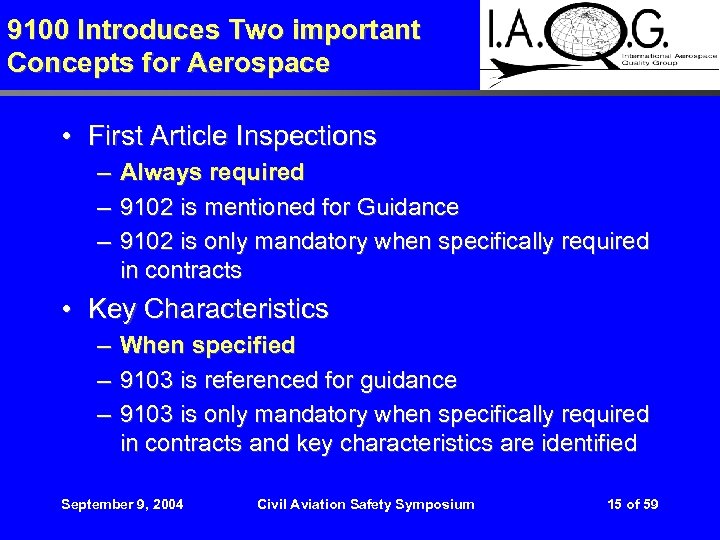
9100 Introduces Two important Concepts for Aerospace • First Article Inspections – Always required – 9102 is mentioned for Guidance – 9102 is only mandatory when specifically required in contracts • Key Characteristics – – – When specified 9103 is referenced for guidance 9103 is only mandatory when specifically required in contracts and key characteristics are identified September 9, 2004 Civil Aviation Safety Symposium 15 of 59
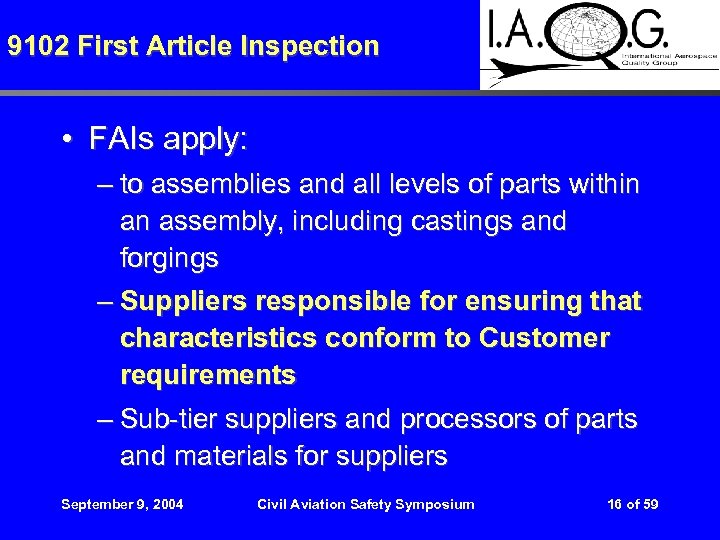
9102 First Article Inspection • FAIs apply: – to assemblies and all levels of parts within an assembly, including castings and forgings – Suppliers responsible for ensuring that characteristics conform to Customer requirements – Sub-tier suppliers and processors of parts and materials for suppliers September 9, 2004 Civil Aviation Safety Symposium 16 of 59
What is Included in First Article Inspection? • Verification of All Design Characteristics: – – • Dimensional Verification via Marked-up (or “Ballooned”) Drawings that Correlate Characteristic Number from FAI to the Drawing. Part Marking Material and Special Process Certifications Including Operator Certs (e. g. NDT, Welding) • Manufacturing Process Verifications – – – Manufacturing Routing Sheets. Referenced Exhibits Supporting the FAI (e. g. CMM Data Printouts, Test Data, Acceptance Test Procedures, Process Certifications, etc. ). Process Capability Studies, As Applicable. Gauge Correlation, As Applicable. Tooling Traceability, If Tooling Is Used to Verify Design Characteristics • Nonconformance Resolutions September 9, 2004 Civil Aviation Safety Symposium 17 of 59
9102 First Article Inspection • Any 9100 compliant organization in absence of a contractual requirement to use 9102 or other specific FAI customer requirement, can devise any methods and processes it chooses to meet the requirements of this clause and the "extent" of an FAI is also at the discretion of the organization as along as it is applied to each " new part" and subsequent changes thereto. • New part means – Parts, sub-assemblies and assemblies, however FAI’s are progressive September 9, 2004 Civil Aviation Safety Symposium 18 of 59
9103 Key Characteristics • Variation Management of Key Characteristics will provide a common standard for expectations for KC’s within the aerospace industry. • Key Characteristic (9100): The features of a material or part whose variation has a significant influence on the fit, performance, service life, or manufacturability. – Dimensional features - thickness, diameter, length, etc. – Chemical concentrations – Time, Pressure, speed, rates, temperature, etc. September 9, 2004 Civil Aviation Safety Symposium 19 of 59
Variation Management of Key Characteristics Purpose (9103) Intent to drive the improvement of the manufacturing processes through adequate planning and effective management of Key Characteristic variation. • Methodology for component/process proving focused on Key Characteristics. Understanding processes Using appropriate tools Demonstrating acceptable process capabilities Guidelines for reporting process capability data to primes. September 9, 2004 Civil Aviation Safety Symposium 20 of 59
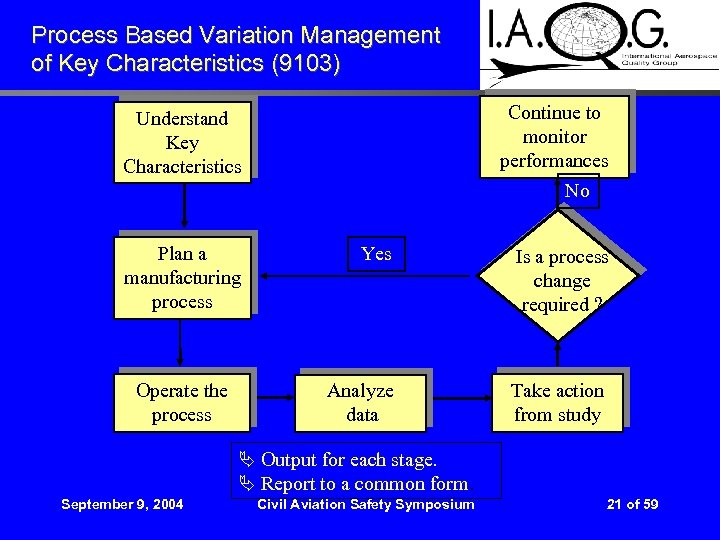
Process Based Variation Management of Key Characteristics (9103) Continue to monitor performances Understand Key Characteristics No Plan a manufacturing process Operate the process Yes Is a process change required ? Analyze data Take action from study Output for each stage. Report to a common form. September 9, 2004 Civil Aviation Safety Symposium 21 of 59
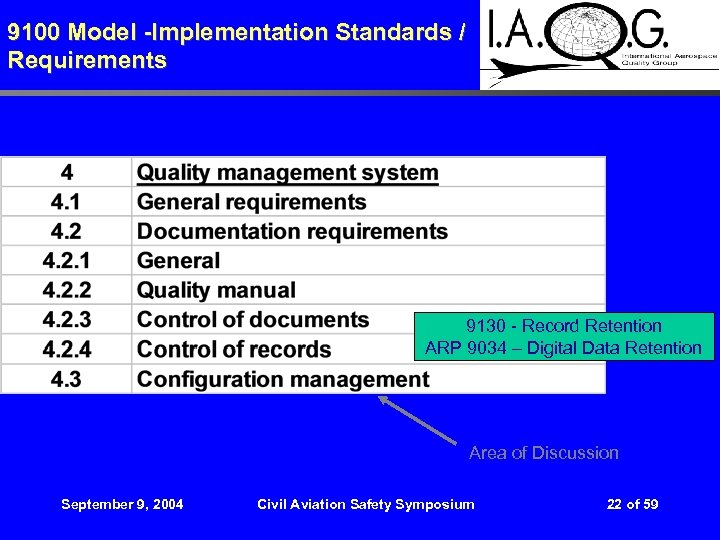
9100 Model -Implementation Standards / Requirements 9130 - Record Retention ARP 9034 – Digital Data Retention Area of Discussion September 9, 2004 Civil Aviation Safety Symposium 22 of 59
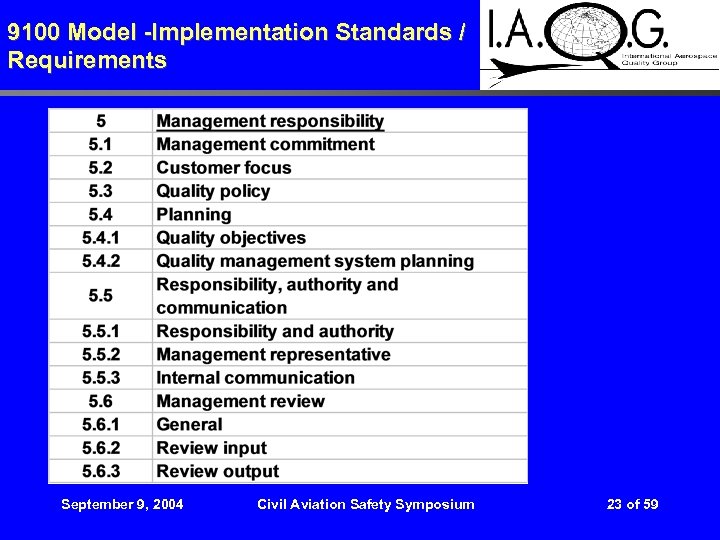
9100 Model -Implementation Standards / Requirements September 9, 2004 Civil Aviation Safety Symposium 23 of 59
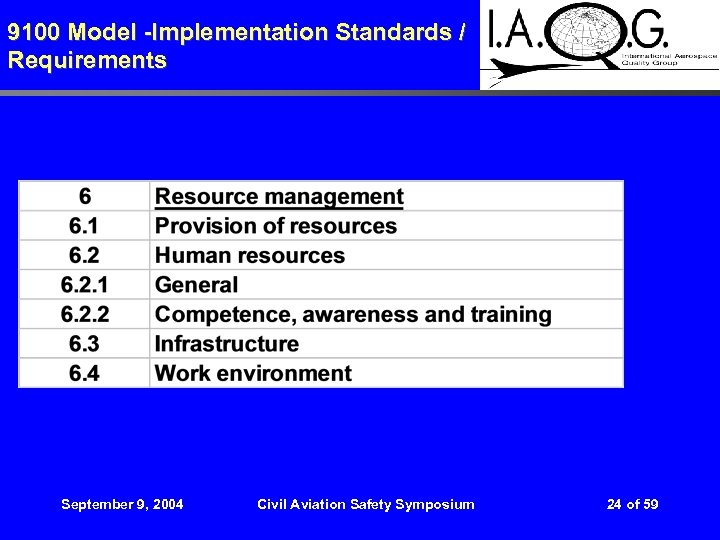
9100 Model -Implementation Standards / Requirements September 9, 2004 Civil Aviation Safety Symposium 24 of 59
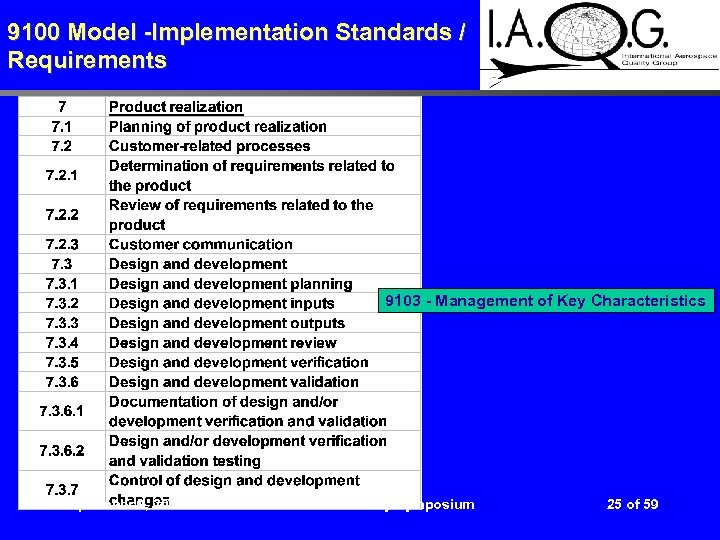
9100 Model -Implementation Standards / Requirements 9103 - Management of Key Characteristics September 9, 2004 Civil Aviation Safety Symposium 25 of 59
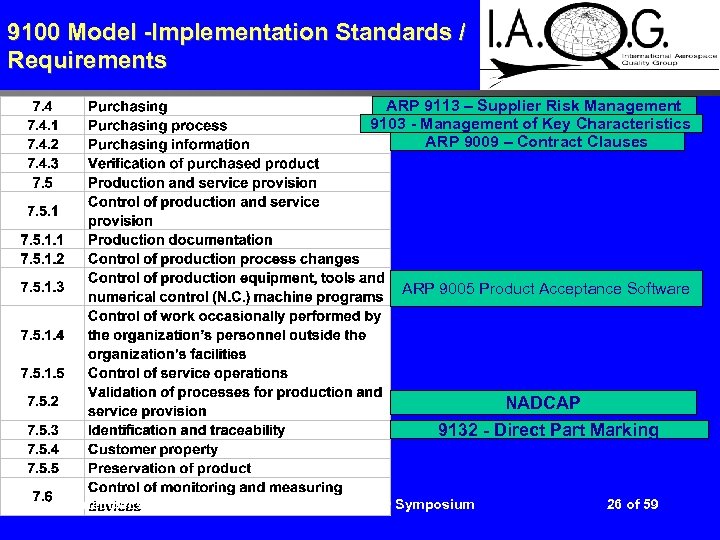
9100 Model -Implementation Standards / Requirements ARP 9113 – Supplier Risk Management 9103 - Management of Key Characteristics ARP 9009 – Contract Clauses ARP 9005 Product Acceptance Software NADCAP 9132 - Direct Part Marking September 9, 2004 Civil Aviation Safety Symposium 26 of 59
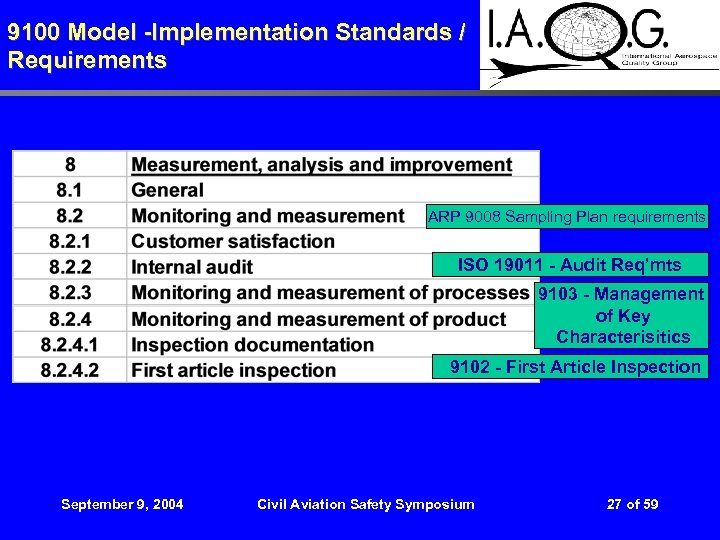
9100 Model -Implementation Standards / Requirements ARP 9008 Sampling Plan requirements ISO 19011 - Audit Req’mts 9103 - Management of Key Characterisitics 9102 - First Article Inspection September 9, 2004 Civil Aviation Safety Symposium 27 of 59
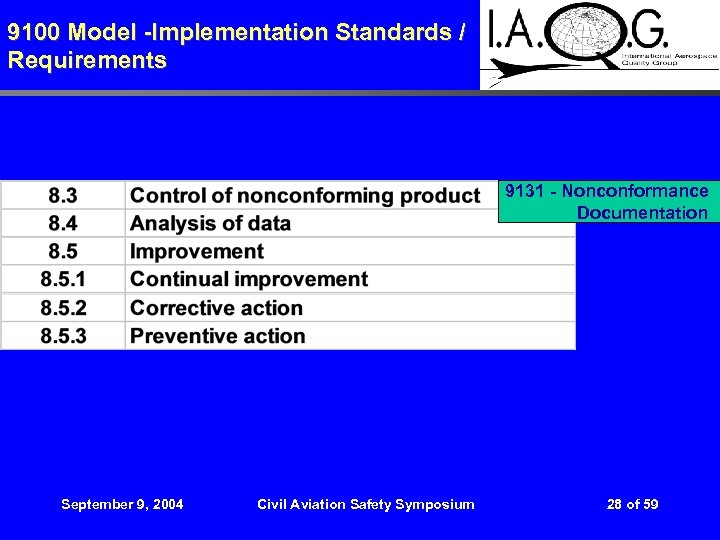
9100 Model -Implementation Standards / Requirements 9131 - Nonconformance Documentation September 9, 2004 Civil Aviation Safety Symposium 28 of 59
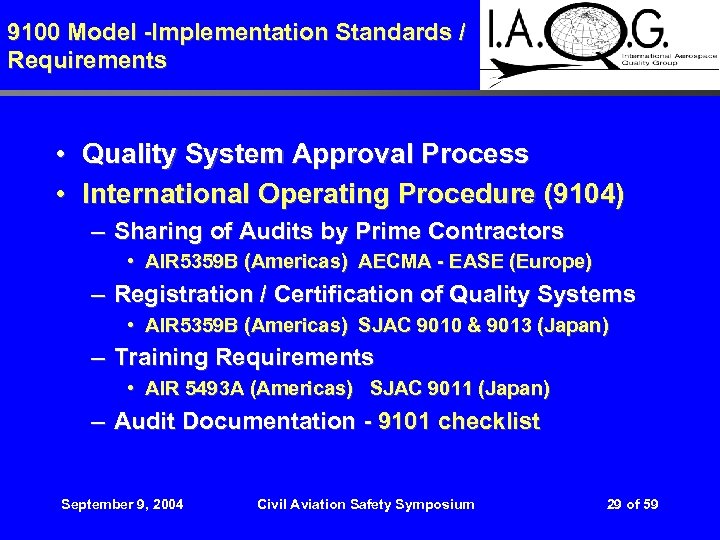
9100 Model -Implementation Standards / Requirements • Quality System Approval Process • International Operating Procedure (9104) – Sharing of Audits by Prime Contractors • AIR 5359 B (Americas) AECMA - EASE (Europe) – Registration / Certification of Quality Systems • AIR 5359 B (Americas) SJAC 9010 & 9013 (Japan) – Training Requirements • AIR 5493 A (Americas) SJAC 9011 (Japan) – Audit Documentation - 9101 checklist September 9, 2004 Civil Aviation Safety Symposium 29 of 59
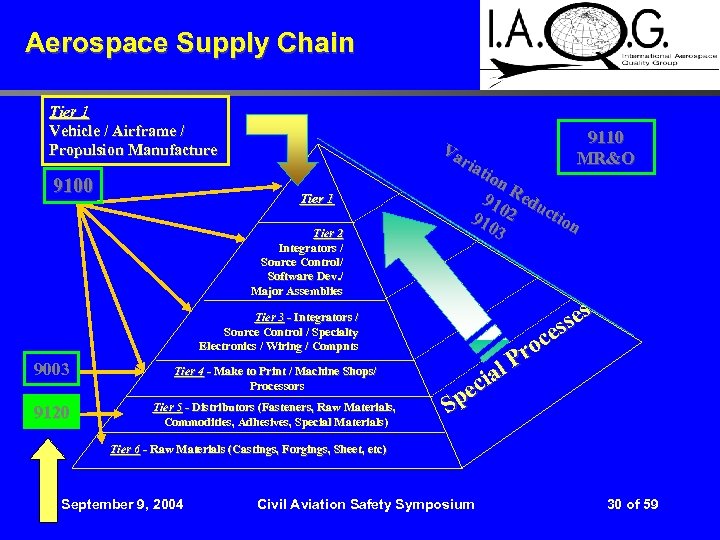
Aerospace Supply Chain Tier 1 Vehicle / Airframe / Propulsion Manufacture 9100 Tier 1 Tier 2 Integrators / Source Control/ Software Dev. / Major Assemblies Tier 3 - Integrators / Source Control / Specialty Electronics / Wiring / Compnts 9003 Tier 4 - Make to Print / Machine Shops/ Processors 9120 Tier 5 - Distributors (Fasteners, Raw Materials, Commodities, Adhesives, Special Materials) 9110 Va MR&O ria tio n. R 91 edu 0 cti 91 2 on 03 ses s ce ro P al i ec Sp Tier 6 - Raw Materials (Castings, Forgings, Sheet, etc) September 9, 2004 Civil Aviation Safety Symposium 30 of 59
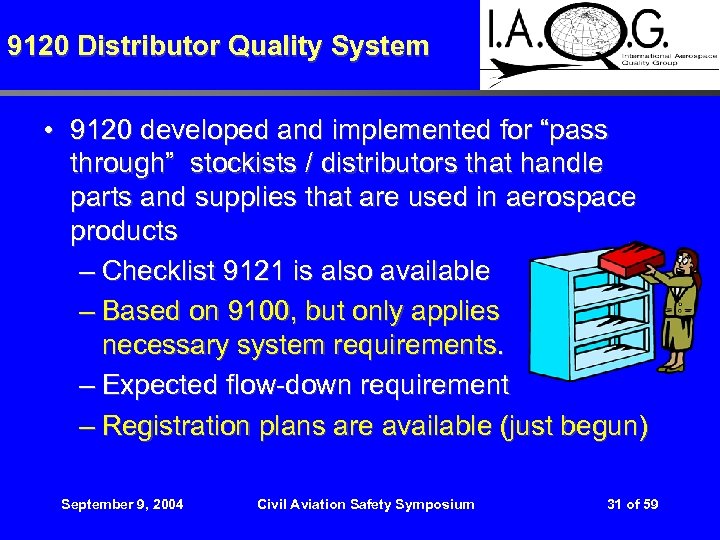
9120 Distributor Quality System • 9120 developed and implemented for “pass through” stockists / distributors that handle parts and supplies that are used in aerospace products – Checklist 9121 is also available – Based on 9100, but only applies necessary system requirements. – Expected flow-down requirement – Registration plans are available (just begun) September 9, 2004 Civil Aviation Safety Symposium 31 of 59
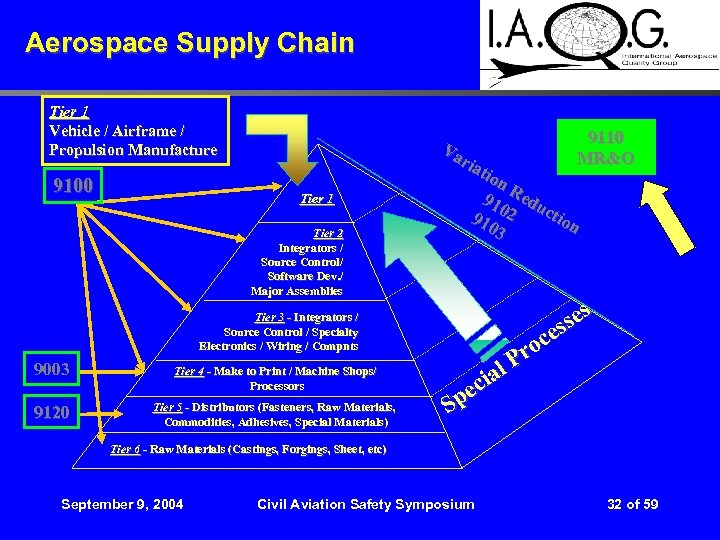
Aerospace Supply Chain Tier 1 Vehicle / Airframe / Propulsion Manufacture 9100 Tier 1 Tier 2 Integrators / Source Control/ Software Dev. / Major Assemblies Tier 3 - Integrators / Source Control / Specialty Electronics / Wiring / Compnts 9003 Tier 4 - Make to Print / Machine Shops/ Processors 9120 Tier 5 - Distributors (Fasteners, Raw Materials, Commodities, Adhesives, Special Materials) 9110 Va MR&O ria tio n. R 91 edu 0 cti 91 2 on 03 ses s ce ro P al i ec Sp Tier 6 - Raw Materials (Castings, Forgings, Sheet, etc) September 9, 2004 Civil Aviation Safety Symposium 32 of 59
9110 Repair Station Quality System • Why 9110? – Manufacturers want a Quality Management System flow-down requirement for their MR&O activity – Manufacturers want reputable suppliers that have repair station approvals and a defined quality system – There is a need to put all of the expectations in one document for Maintenance, Repair and Overhaul organizations – Military is very interested in having defined Quality System requirements for MR&O September 9, 2004 Civil Aviation Safety Symposium 33 of 59
9110 Repair Station Quality System • 9110 developed and implemented in for facilities that perform maintenance & repair of aerospace products – Based on 9100 requirements and FAA / JAA - 145 requirements (new version) • Corresponding 9111 checklist has also been developed • Registration plans are in development and expect full implementation in 2004 September 9, 2004 Civil Aviation Safety Symposium 34 of 59
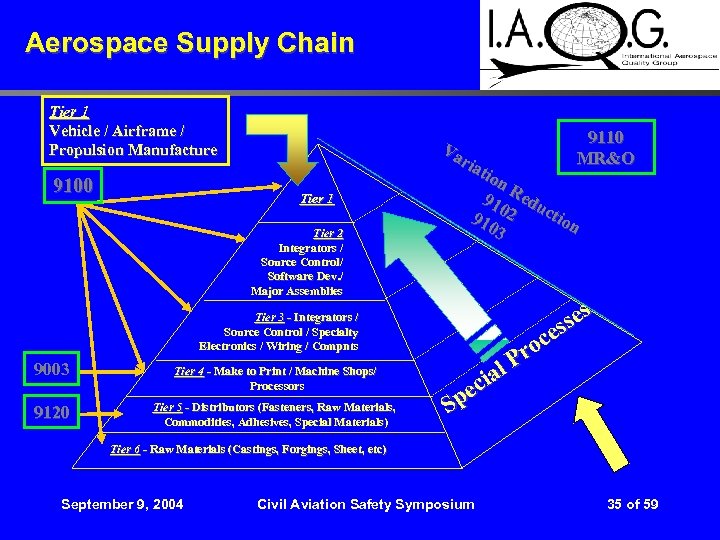
Aerospace Supply Chain Tier 1 Vehicle / Airframe / Propulsion Manufacture 9100 Tier 1 Tier 2 Integrators / Source Control/ Software Dev. / Major Assemblies Tier 3 - Integrators / Source Control / Specialty Electronics / Wiring / Compnts 9003 Tier 4 - Make to Print / Machine Shops/ Processors 9120 Tier 5 - Distributors (Fasteners, Raw Materials, Commodities, Adhesives, Special Materials) 9110 Va MR&O ria tio n. R 91 edu 0 cti 91 2 on 03 ses s ce ro P al i ec Sp Tier 6 - Raw Materials (Castings, Forgings, Sheet, etc) September 9, 2004 Civil Aviation Safety Symposium 35 of 59
9100 Special Process Requirements • 7. 5. 2 Validation of processes for production and service • …processes …where the resulting output cannot be verified by subsequent monitoring or measurement. NOTE: These processes are frequently referred to as special processes. • • …demonstrate the ability of these processes to achieve planned results. …establish arrangements for these processes including, as applicable a) defined criteria for review and approval of the processes, qualification and approval of special processes prior to use, b) approval of equipment and qualification of personnel, c) use of specific methods and procedures, control of the significant operations and parameters of special processes in accordance with documented process specifications and changes thereto, d) requirements for records (see 4. 2. 4), and e) revalidation. September 9, 2004 Civil Aviation Safety Symposium 36 of 59
Special Process Approval Objectives • To put in place industry controlled process for meeting requirements of 9100 clause 7. 5. 2 – Supplier processes are an extension of the OEM processes • To reduce redundant audits for the special process at suppliers and improve the global quality level – – – Common requirements (auditors and audit questionnaires) Harmonized assessment process Data exchange Demonstrated industry managed process Process oversight Mutual system recognition September 9, 2004 Civil Aviation Safety Symposium 37 of 59
The Road Ahead • Obtain Sector Commitment • Develop Areas of Focus: • • Assign Strategy Team members to each area of focus Further Develop Definition and Strategic Objective Develop initiatives against areas of focus Seek Champions for the initiatives • Enhance the IAQG Operating Management System: • Revise Charter – Don Buehler • Revise procedure 101 – J. Addey, G. Baker, S. Shepherd • Validate Current Initiatives for Alignment to Areas of Focus Next Steps for the Strategy Development September 9, 2004 Civil Aviation Safety Symposium 38 of 59
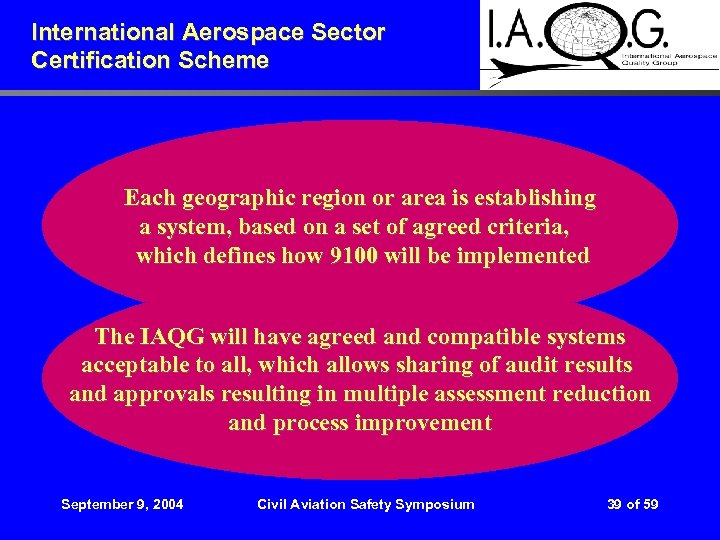
International Aerospace Sector Certification Scheme Each geographic region or area is establishing a system, based on a set of agreed criteria, which defines how 9100 will be implemented The IAQG will have agreed and compatible systems acceptable to all, which allows sharing of audit results and approvals resulting in multiple assessment reduction and process improvement September 9, 2004 Civil Aviation Safety Symposium 39 of 59
What is the Goal of the System? The goal of the system is for a supplier to receive one aerospace quality systems approval that will be acceptable to all aerospace OEMs throughout the world. The key element in this is confidence. The aerospace OEMs must have confidence in the approvals being performed on a global basis All Aerospace organizations will be able to take advantage of the system for supplier control purposes September 9, 2004 Civil Aviation Safety Symposium 40 of 59
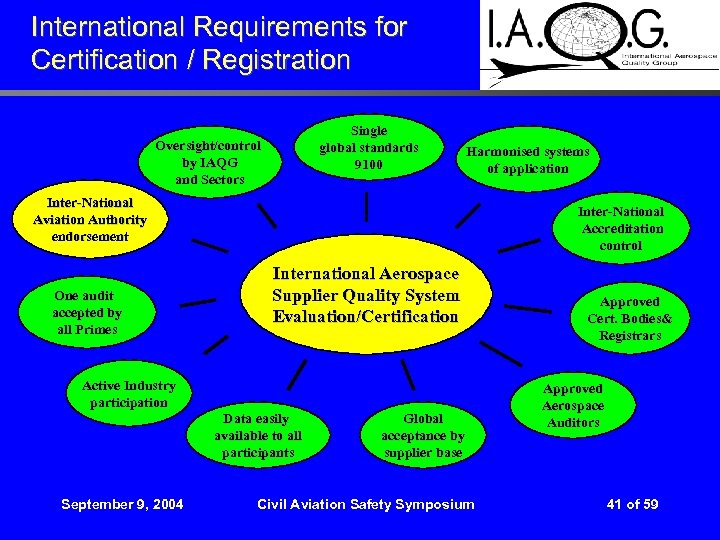
International Requirements for Certification / Registration Single global standards 9100 Oversight/control by IAQG and Sectors Harmonised systems of application Inter-National Aviation Authority endorsement One audit accepted by all Primes Inter-National Accreditation control International Aerospace Supplier Quality System Evaluation/Certification Active Industry participation Data easily available to all participants September 9, 2004 Global acceptance by supplier base Civil Aviation Safety Symposium Approved Cert. Bodies& Registrars Approved Aerospace Auditors 41 of 59
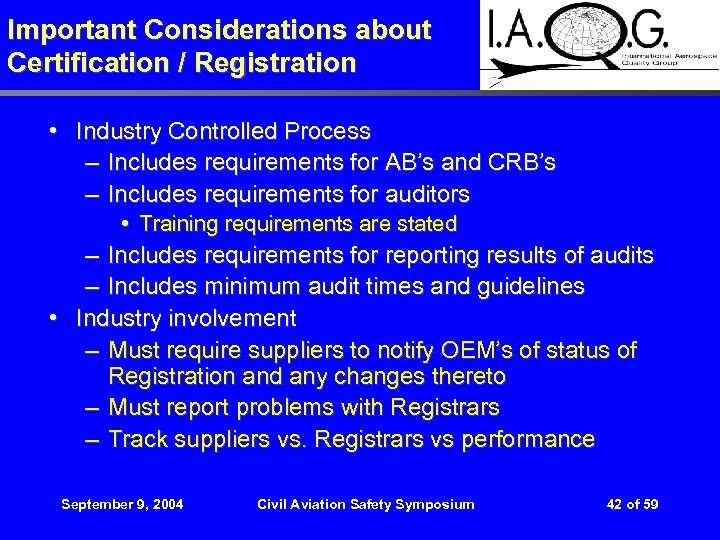
Important Considerations about Certification / Registration • Industry Controlled Process – Includes requirements for AB’s and CRB’s – Includes requirements for auditors • Training requirements are stated – Includes requirements for reporting results of audits – Includes minimum audit times and guidelines • Industry involvement – Must require suppliers to notify OEM’s of status of Registration and any changes thereto – Must report problems with Registrars – Track suppliers vs. Registrars vs performance September 9, 2004 Civil Aviation Safety Symposium 42 of 59
O. A. S. I. S. - Database • On-line Aerospace Supplier Information System • Went “Live” 1 July 2003 – Assessments are entered by CRB’s • Assessment results are to be entered when performed or can be entered now for assessments prior to 1 Jul 03 • Organizations can access information now • Restricted access to data September 9, 2004 Civil Aviation Safety Symposium 43 of 59
Why OASIS? The database is essential to provide independent verification of the status of certification, thereby validating the entire other party process to stakeholders Enables the acceptance of a single assessment globally thus preventing multiple visits / audits by multiple stakeholders Without the database OEMs would have to independently verify each auditor, CRB and assessment results September 9, 2004 Civil Aviation Safety Symposium 44 of 59
OASIS Benefits • Customers / OEM’s / Suppliers – Provides Up-to- date and complete information on Aerospace QMS approvals, with data on Who, How, When and What is Approved, including results. • AB’s / CRB’s / Auditors – Current information on Who is Approved and for What by the Aerospace Industry • NAAs / Do. D’s and Space Agencies – Complete oversight information available in one source with no conflicting information (i. e. multiple data entries) September 9, 2004 Civil Aviation Safety Symposium 45 of 59
OASIS Benefits • OASIS should be part of the OEM / Supplier’s process of supplier management – The database should allow a supplier to be added to an ASL without additional showing of QMS approval – OEMs need to insist that suppliers be listed in OASIS – Available to entire Aerospace Supply Chain • Fee for every INITIAL certification/registration into the IAQG-OASIS database – invoiced via the CRB. – The recurring fee for reassessment (normally in 3 years) – WILL BE LESS “If a database entry saves 1 Day of an OEM / supplier’s time in a QMS audit it will be worth the fee” September 9, 2004 Civil Aviation Safety Symposium 46 of 59
Industry Leaders are Listening l l l Agreed to improve the overall approach to quality Major Aerospace Companies have agreed upon Quality Management System approval approaches A key objective is to improve performance and reduce the number of audits There are significant benefits to the entire Aerospace Industry supply chain International approach is based on agreed standards, harmonization of system application and shared information September 9, 2004 Civil Aviation Safety Symposium

QUESTIONS September 9, 2004 Civil Aviation Safety Symposium 48 of 59
Скачать презентацию AEROSPACE QUALITY MANAGEMENT SYSTEMS Eugene M Barker Past
0de4bda36776cff38a3baa13a8c3d13e.ppt