 Скачать презентацию Aerosol Properties over Bright-Reflecting Source Regions The Deep
a04de17cd047954b5ebf0919c888236c.ppt
- Количество слайдов: 16



Aerosol Properties over Bright-Reflecting Source Regions: The Deep Blue Algorithm and its Applicability to MODIS N. Christina Hsu S. -C. Tsay, M. D. King, Y. J. Kaufman, J. R. Herman, and J. C. Wei NASA Goddard Space Flight Center Greenbelt, Maryland USA
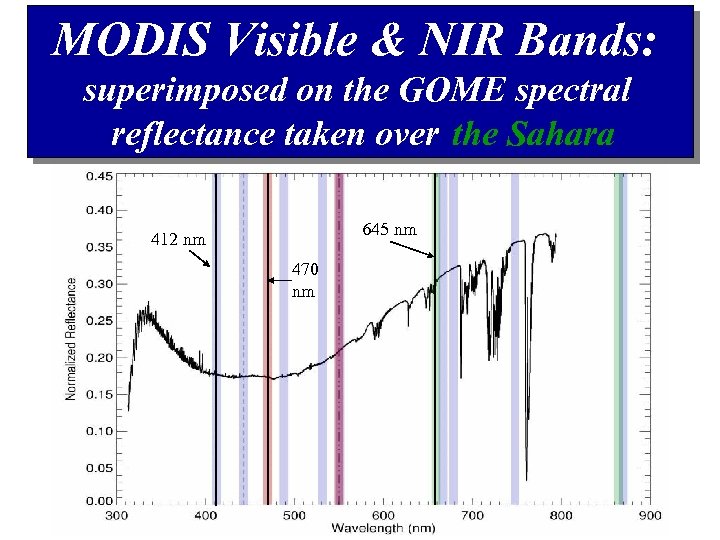
MODIS Visible & NIR Bands: superimposed on the GOME spectral reflectance taken over the Sahara 645 nm 412 nm 470 nm
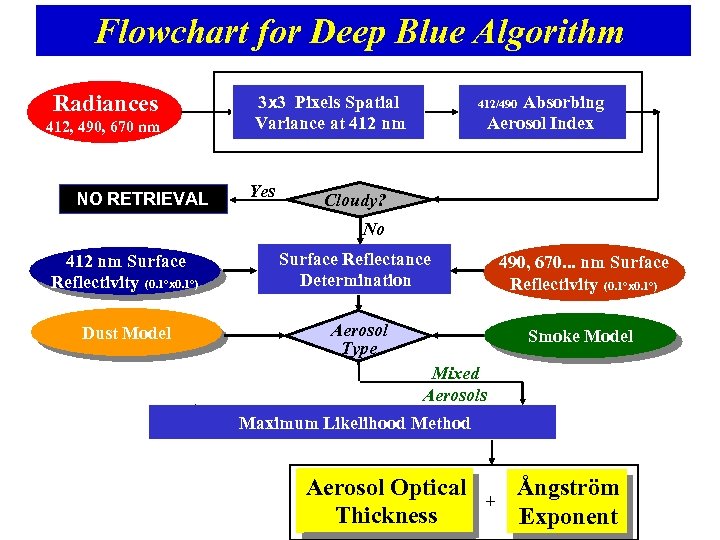
Flowchart for Deep Blue Algorithm Radiances 3 x 3 Pixels Spatial 412/490 Absorbing Cloud Screening or Cloud Mask Algorithm Variance at 412 nm Aerosol Index 412, 490, 670 nm Yes NO RETRIEVAL Cloudy? No 412 nm Surface Reflectivity (0. 1ºx 0. 1º) Surface Reflectance Determination 490, 670. . . nm Surface Reflectivity (0. 1ºx 0. 1º) Dust Model Aerosol Type Smoke Model Dust Dominant Mixed Aerosols Maximum Likelihood Method Single-Scattering Albedo + Aerosol Optical Thickness + Ångström Exponent
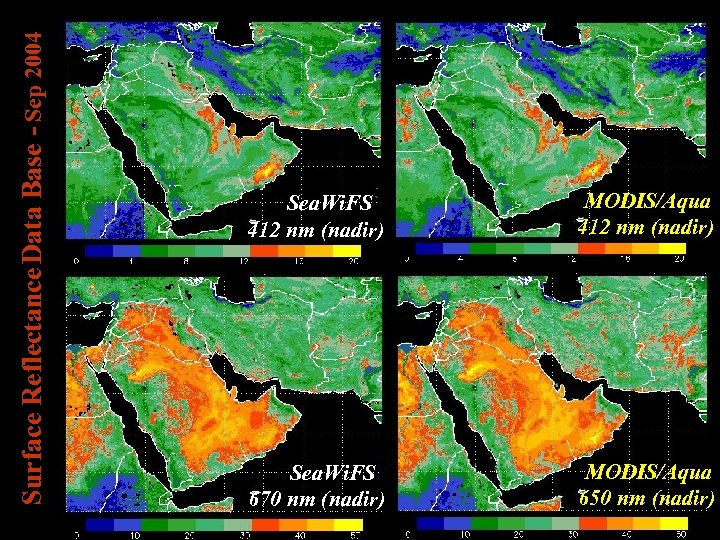
Surface Reflectance Data Base - Sep 2004 Sea. Wi. FS 412 nm (nadir) MODIS/Aqua 412 nm (nadir) Sea. Wi. FS 670 nm (nadir) MODIS/Aqua 650 nm (nadir)
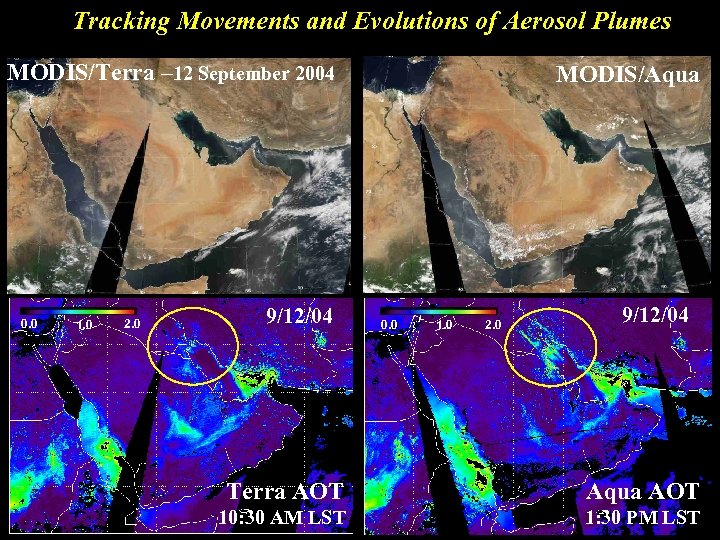
Tracking Movements and Evolutions of Aerosol Plumes MODIS/Terra – 12 September 2004 0. 0 1. 0 2. 0 9/12/04 MODIS/Aqua 0. 0 1. 0 2. 0 9/12/04 Terra AOT Aqua AOT 10: 30 AM LST 1: 30 PM LST
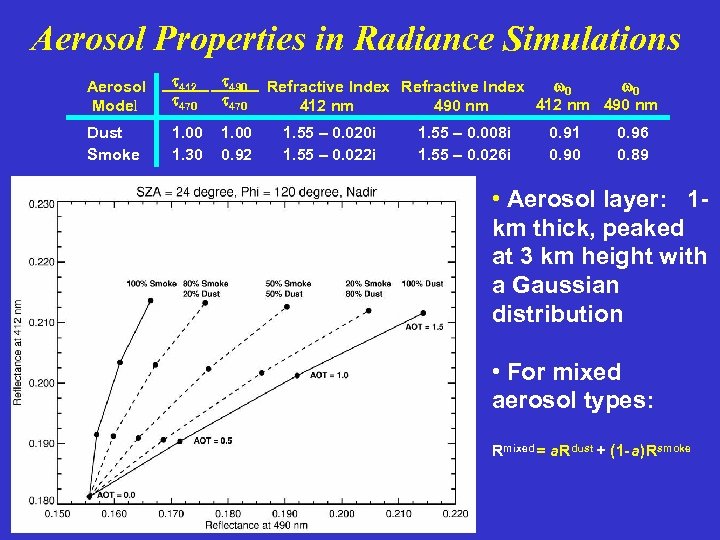
Aerosol Properties in Radiance Simulations Aerosol Model 412 470 490 470 Dust Smoke 1. 00 1. 30 1. 00 0. 92 0 0 Refractive Index 412 nm 490 nm 1. 55 – 0. 020 i 1. 55 – 0. 022 i 1. 55 – 0. 008 i 1. 55 – 0. 026 i 0. 91 0. 90 0. 96 0. 89 • Aerosol layer: 1 km thick, peaked at 3 km height with a Gaussian distribution • For mixed aerosol types: Rmixed = a. Rdust + (1 -a)Rsmoke
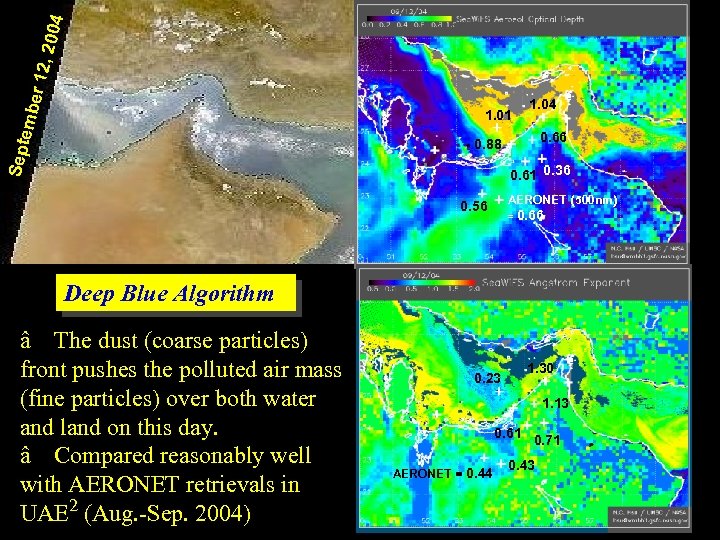
4 , 200 emb er 12 1. 01 1. 04 0. 66 Sept 0. 88 0. 61 0. 36 AERONET (500 nm) 0. 56 = 0. 66 Deep Blue Algorithm â The dust (coarse particles) front pushes the polluted air mass (fine particles) over both water and land on this day. â Compared reasonably well with AERONET retrievals in UAE 2 (Aug. -Sep. 2004) 0. 23 1. 30 1. 13 0. 61 0. 71 AERONET = 0. 44 0. 43
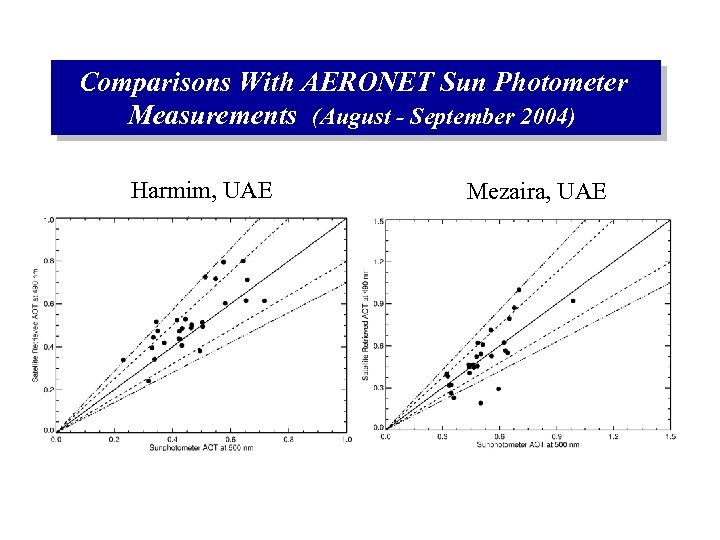
Comparisons With AERONET Sun Photometer Measurements (August - September 2004) Harmim, UAE Mezaira, UAE
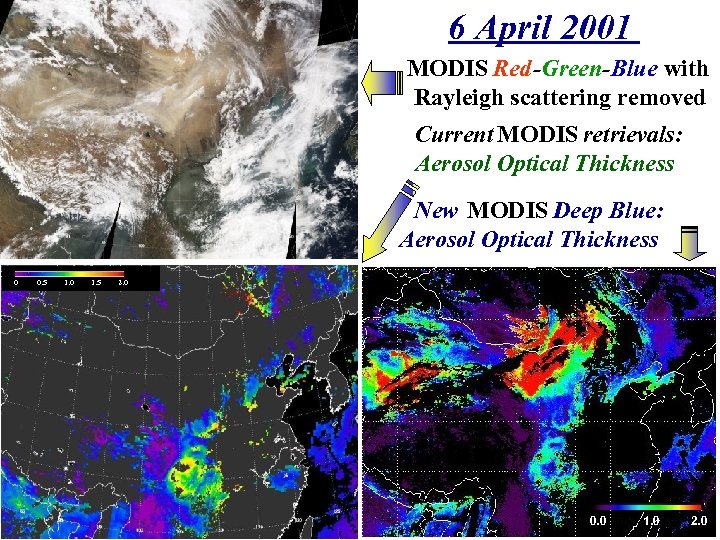
6 April 2001 MODIS Red-Green-Blue with Rayleigh scattering removed Current MODIS retrievals: Aerosol Optical Thickness New MODIS Deep Blue: Aerosol Optical Thickness 0 0. 5 1. 0 1. 5 2. 0 0. 0 1. 0 2. 0
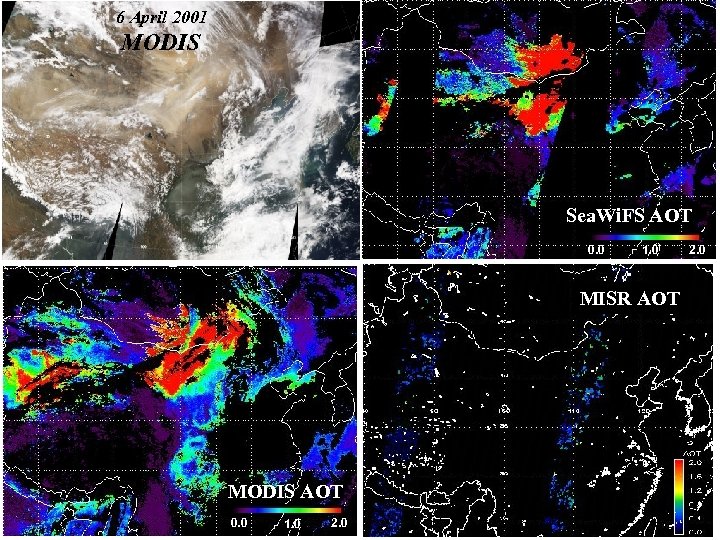
6 April 2001 MODIS Sea. Wi. FS AOT 0. 0 1. 0 MISR AOT MODIS AOT 0. 0 1. 0 2. 0
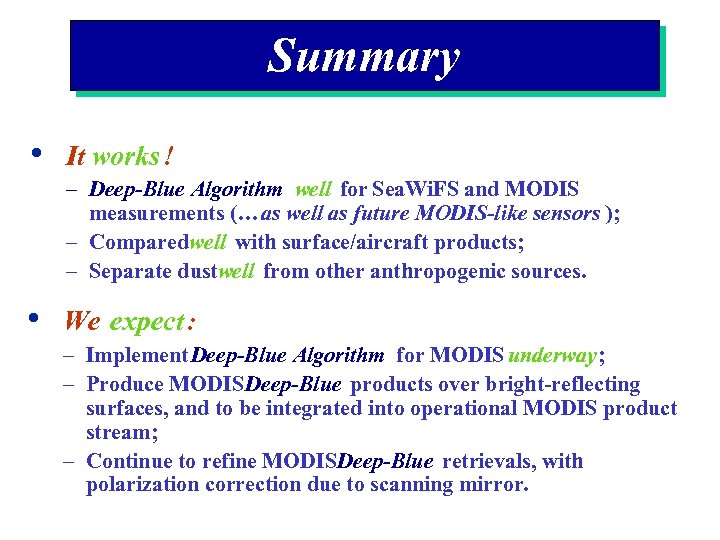
Summary • It works ! – Deep-Blue Algorithm well for Sea. Wi. FS and MODIS measurements (… as well as future MODIS-like sensors ); – Comparedwell with surface/aircraft products; – Separate dustwell from other anthropogenic sources. • We expect : – Implement Deep-Blue Algorithm for MODIS underway; – Produce MODIS Deep-Blue products over bright-reflecting surfaces, and to be integrated into operational MODIS product stream; – Continue to refine MODISDeep-Blue retrievals, with polarization correction due to scanning mirror.
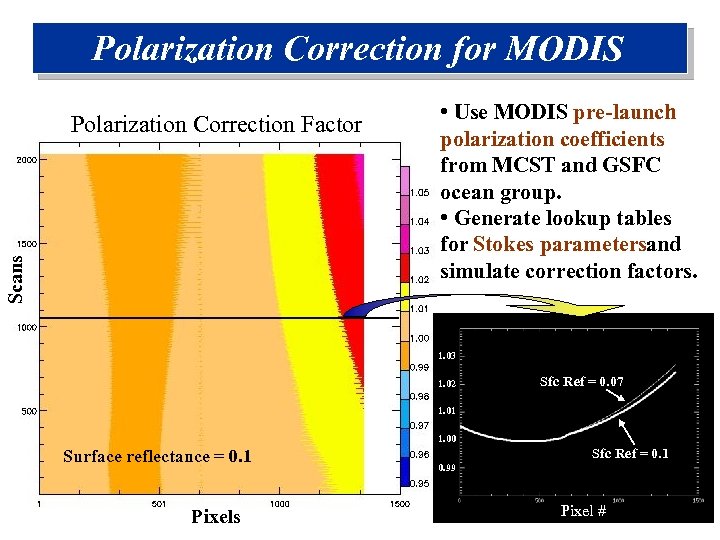
Polarization Correction for MODIS Scans Polarization Correction Factor • Use MODIS pre-launch polarization coefficients from MCST and GSFC ocean group. • Generate lookup tables for Stokes parametersand simulate correction factors. 1. 03 1. 02 Sfc Ref = 0. 07 1. 01 1. 00 Surface reflectance = 0. 1 Pixels Sfc Ref = 0. 1 0. 99 Pixel #

Backup Slides
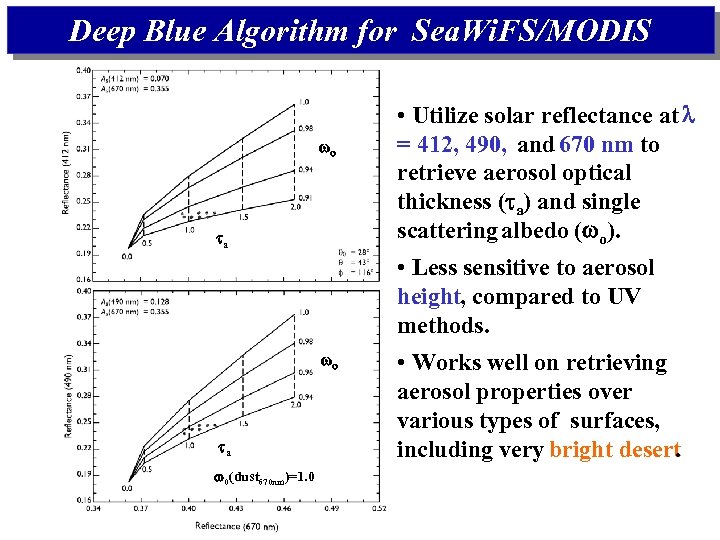
Deep Blue Algorithm for Sea. Wi. FS/MODIS o a • Utilize solar reflectance at l = 412, 490, and 670 nm to retrieve aerosol optical thickness ( a) and single scattering albedo ( o). • Less sensitive to aerosol height, compared to UV methods. o a 0(dust 670 nm)=1. 0 • Works well on retrieving aerosol properties over various types of surfaces, including very bright desert.
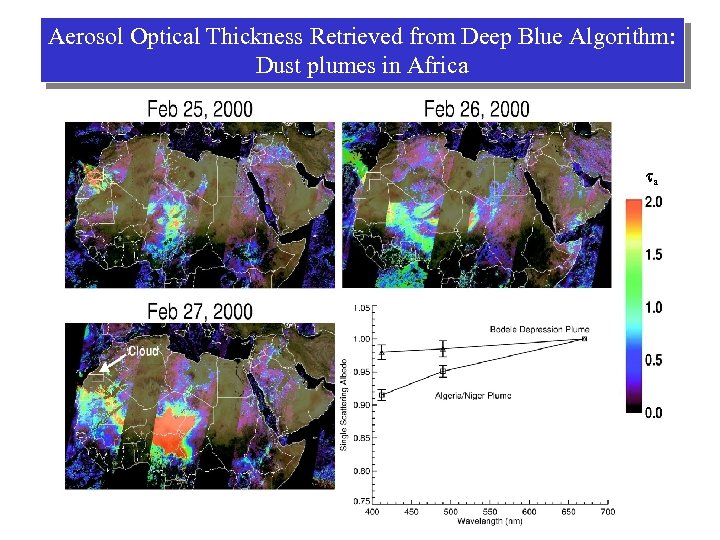
Aerosol Optical Thickness Retrieved from Deep Blue Algorithm: Dust plumes in Africa a
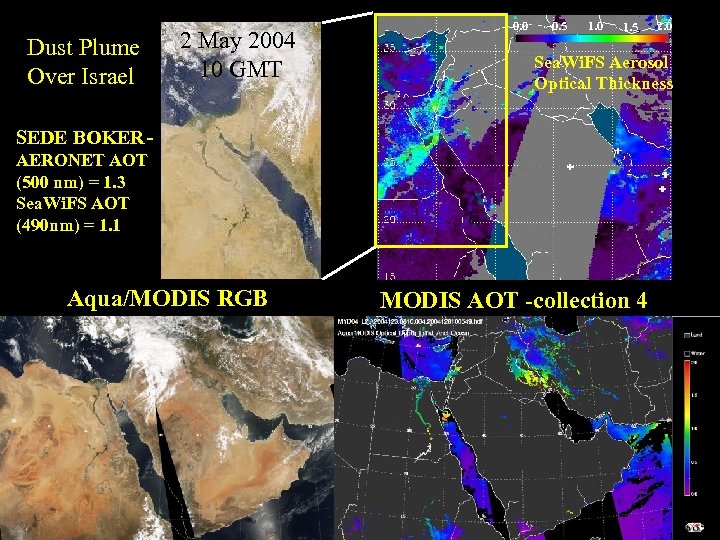
Dust Plume Over Israel 2 May 2004 10 GMT 0. 0 0. 5 1. 0 1. 5 Sea. Wi. FS Aerosol Optical Thickness SEDE BOKER AERONET AOT (500 nm) = 1. 3 Sea. Wi. FS AOT (490 nm) = 1. 1 Aqua/MODIS RGB 2. 0 MODIS AOT -collection 4
Скачать презентацию Aerosol Properties over Bright-Reflecting Source Regions The Deep
a04de17cd047954b5ebf0919c888236c.ppt