 Скачать презентацию Aerosol-Cloud Ocean Biology Mission ACOB M Schoeberl NASA GSFC
cc836a4ea530346187b51fcdd6cc3a70.ppt
- Количество слайдов: 24



Aerosol-Cloud Ocean Biology Mission (ACOB) M. Schoeberl NASA/GSFC C. Mc. Clain NASA/GSFC Contributions from D. Diner, L. Remer, J. V. Martins, P. Hildebrand, J. Welton, B. Blair, M. Mc. Gill, G. Jackson, M. Mischenko, D. Starr, P. Colarco, and a bunch of other people.
What is ACOB? • ACOB is a multi-user mission with two science goals – Quantifying Aerosol-cloud interaction – Determining Ocean Carbon Cycling and other biological processes • Why two goals? – Next generation ocean color measurements require precise estimation of the aerosol contribution to the backscatter radiation – Precise aerosol measurements are of interest to the aerosol cloud community – There are common science problems between the two communities • Aeolian fertilization of the ocean • Aerosol formation by DMS GSFC
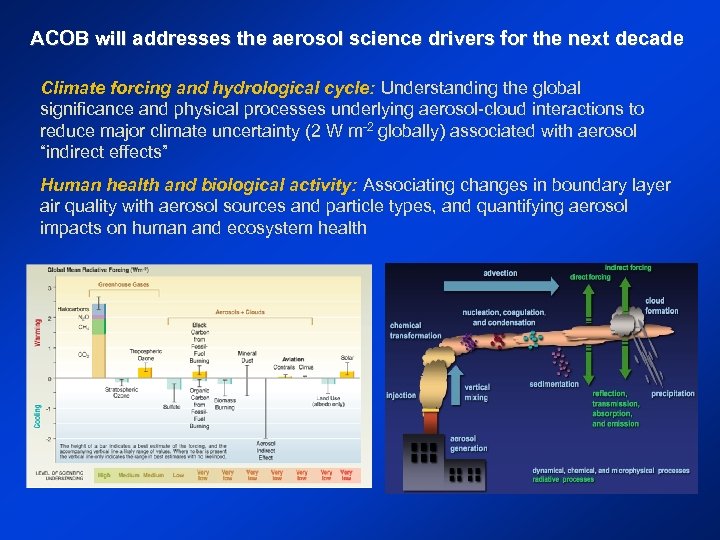
ACOB will addresses the aerosol science drivers for the next decade Climate forcing and hydrological cycle: Understanding the global significance and physical processes underlying aerosol-cloud interactions to reduce major climate uncertainty (2 W m-2 globally) associated with aerosol “indirect effects” Human health and biological activity: Associating changes in boundary layer air quality with aerosol sources and particle types, and quantifying aerosol impacts on human and ecosystem health
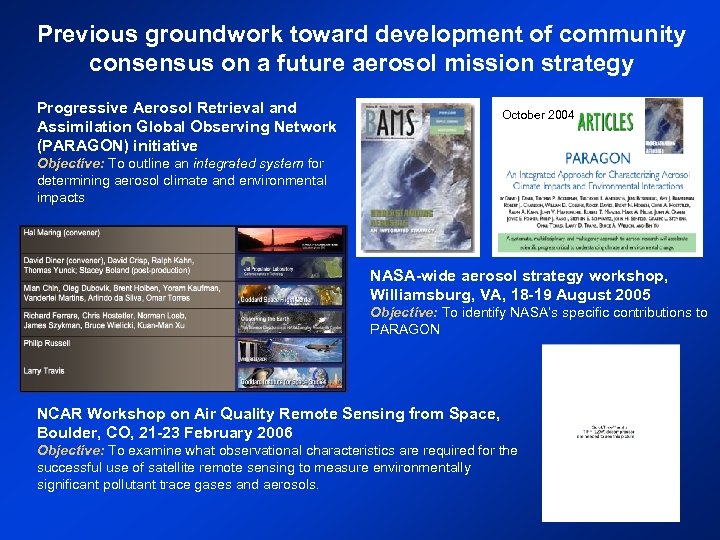
Previous groundwork toward development of community consensus on a future aerosol mission strategy Progressive Aerosol Retrieval and Assimilation Global Observing Network (PARAGON) initiative October 2004 Objective: To outline an integrated system for determining aerosol climate and environmental impacts NASA-wide aerosol strategy workshop, Williamsburg, VA, 18 -19 August 2005 Objective: To identify NASA’s specific contributions to PARAGON NCAR Workshop on Air Quality Remote Sensing from Space, Boulder, CO, 21 -23 February 2006 Objective: To examine what observational characteristics are required for the successful use of satellite remote sensing to measure environmentally significant pollutant trace gases and aerosols.
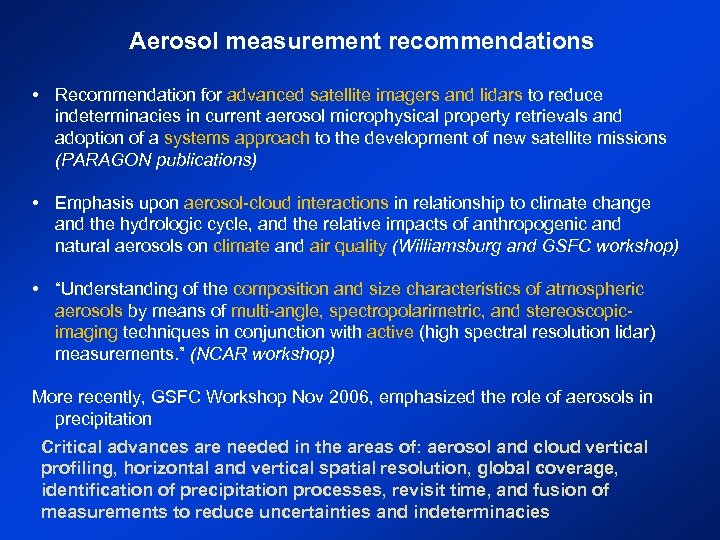
Aerosol measurement recommendations • Recommendation for advanced satellite imagers and lidars to reduce indeterminacies in current aerosol microphysical property retrievals and adoption of a systems approach to the development of new satellite missions (PARAGON publications) • Emphasis upon aerosol-cloud interactions in relationship to climate change and the hydrologic cycle, and the relative impacts of anthropogenic and natural aerosols on climate and air quality (Williamsburg and GSFC workshop) • “Understanding of the composition and size characteristics of atmospheric aerosols by means of multi-angle, spectropolarimetric, and stereoscopicimaging techniques in conjunction with active (high spectral resolution lidar) measurements. ” (NCAR workshop) More recently, GSFC Workshop Nov 2006, emphasized the role of aerosols in precipitation Critical advances are needed in the areas of: aerosol and cloud vertical profiling, horizontal and vertical spatial resolution, global coverage, identification of precipitation processes, revisit time, and fusion of measurements to reduce uncertainties and indeterminacies
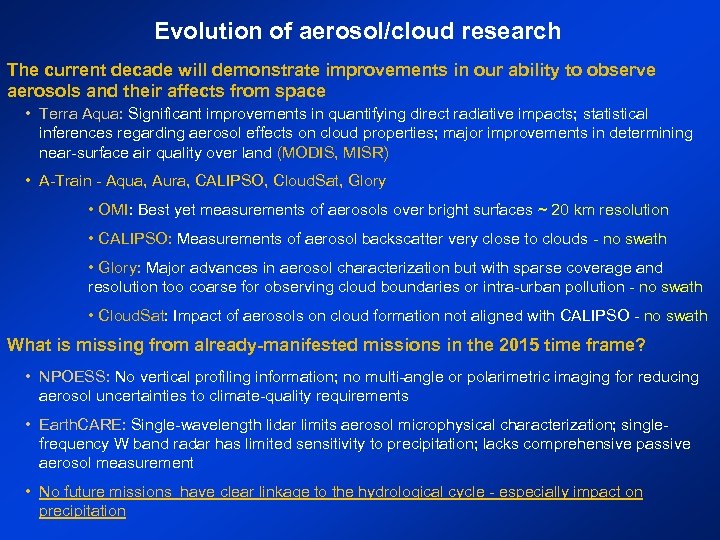
Evolution of aerosol/cloud research The current decade will demonstrate improvements in our ability to observe aerosols and their affects from space • Terra Aqua: Significant improvements in quantifying direct radiative impacts; statistical inferences regarding aerosol effects on cloud properties; major improvements in determining near-surface air quality over land (MODIS, MISR) • A-Train - Aqua, Aura, CALIPSO, Cloud. Sat, Glory • OMI: Best yet measurements of aerosols over bright surfaces ~ 20 km resolution • CALIPSO: Measurements of aerosol backscatter very close to clouds - no swath • Glory: Major advances in aerosol characterization but with sparse coverage and resolution too coarse for observing cloud boundaries or intra-urban pollution - no swath • Cloud. Sat: Impact of aerosols on cloud formation not aligned with CALIPSO - no swath What is missing from already-manifested missions in the 2015 time frame? • NPOESS: No vertical profiling information; no multi-angle or polarimetric imaging for reducing aerosol uncertainties to climate-quality requirements • Earth. CARE: Single-wavelength lidar limits aerosol microphysical characterization; singlefrequency W band radar has limited sensitivity to precipitation; lacks comprehensive passive aerosol measurement • No future missions have clear linkage to the hydrological cycle - especially impact on precipitation
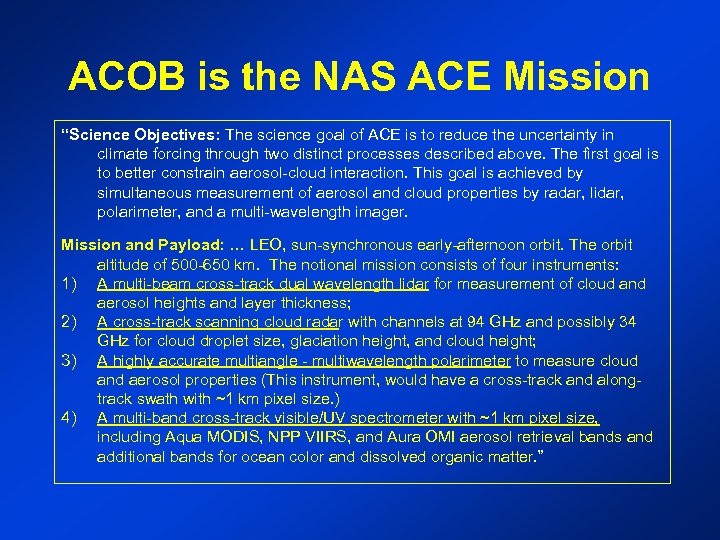
ACOB is the NAS ACE Mission “Science Objectives: The science goal of ACE is to reduce the uncertainty in climate forcing through two distinct processes described above. The first goal is to better constrain aerosol-cloud interaction. This goal is achieved by simultaneous measurement of aerosol and cloud properties by radar, lidar, polarimeter, and a multi-wavelength imager. Mission and Payload: … LEO, sun-synchronous early-afternoon orbit. The orbit altitude of 500 -650 km. The notional mission consists of four instruments: 1) A multi-beam cross-track dual wavelength lidar for measurement of cloud and aerosol heights and layer thickness; 2) A cross-track scanning cloud radar with channels at 94 GHz and possibly 34 GHz for cloud droplet size, glaciation height, and cloud height; 3) A highly accurate multiangle - multiwavelength polarimeter to measure cloud and aerosol properties (This instrument, would have a cross-track and alongtrack swath with ~1 km pixel size. ) 4) A multi-band cross-track visible/UV spectrometer with ~1 km pixel size, including Aqua MODIS, NPP VIIRS, and Aura OMI aerosol retrieval bands and additional bands for ocean color and dissolved organic matter. ”
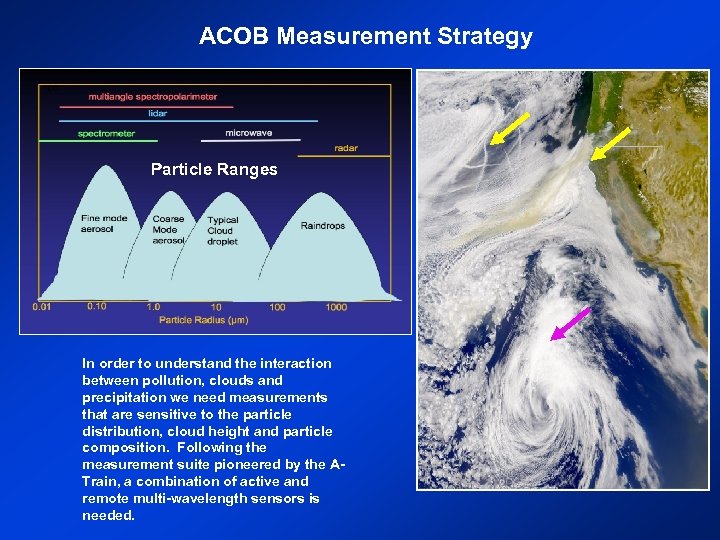
ACOB Measurement Strategy Particle Ranges In order to understand the interaction between pollution, clouds and precipitation we need measurements that are sensitive to the particle distribution, cloud height and particle composition. Following the measurement suite pioneered by the ATrain, a combination of active and remote multi-wavelength sensors is needed.
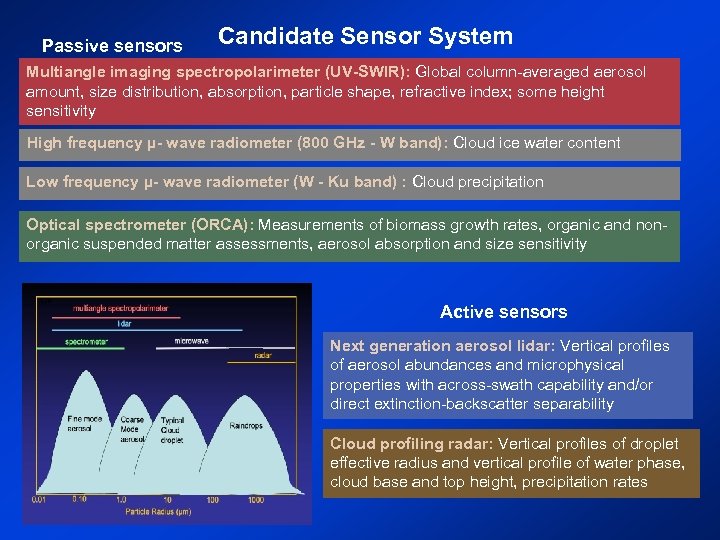
Passive sensors Candidate Sensor System Multiangle imaging spectropolarimeter (UV-SWIR): Global column-averaged aerosol amount, size distribution, absorption, particle shape, refractive index; some height sensitivity High frequency µ- wave radiometer (800 GHz - W band): Cloud ice water content Low frequency µ- wave radiometer (W - Ku band) : Cloud precipitation Optical spectrometer (ORCA): Measurements of biomass growth rates, organic and nonorganic suspended matter assessments, aerosol absorption and size sensitivity Active sensors Particle Ranges Next generation aerosol lidar: Vertical profiles of aerosol abundances and microphysical properties with across-swath capability and/or direct extinction-backscatter separability Cloud profiling radar: Vertical profiles of droplet effective radius and vertical profile of water phase, cloud base and top height, precipitation rates
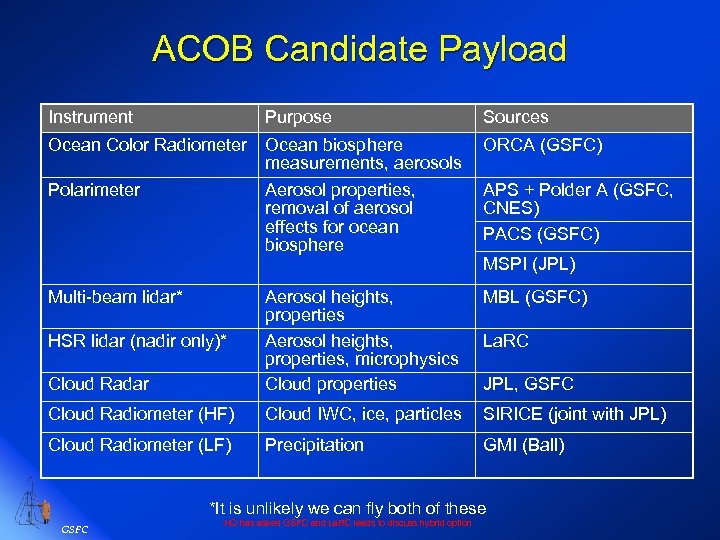
ACOB Candidate Payload Instrument Purpose Sources Ocean Color Radiometer Ocean biosphere measurements, aerosols Aerosol properties, removal of aerosol effects for ocean biosphere ORCA (GSFC) MBL (GSFC) Cloud Radar Aerosol heights, properties, microphysics Cloud properties Cloud Radiometer (HF) Cloud IWC, ice, particles SIRICE (joint with JPL) Cloud Radiometer (LF) Precipitation GMI (Ball) Polarimeter Multi-beam lidar* HSR lidar (nadir only)* APS + Polder A (GSFC, CNES) PACS (GSFC) MSPI (JPL) La. RC JPL, GSFC *It is unlikely we can fly both of these GSFC HQ has asked GSFC and La. RC leads to discuss hybrid option
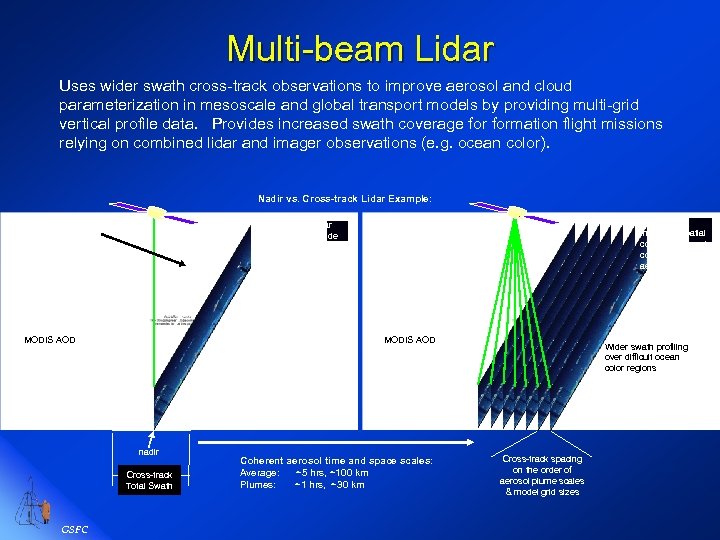
Multi-beam Lidar Uses wider swath cross-track observations to improve aerosol and cloud parameterization in mesoscale and global transport models by providing multi-grid vertical profile data. Provides increased swath coverage formation flight missions relying on combined lidar and imager observations (e. g. ocean color). Nadir vs. Cross-track Lidar Example: Forest fires in Quebec generate thick smoke plumes transported to NE United States Nadir-only lidar does not provide enough spatial coverage for most aerosol plumes MODIS AOD Improved spatial coverage through complicated aerosol plumes MODIS AOD nadir Cross-track Total Swath GSFC Cross-track lidar example: 500 km Sun Synch Orbit 7 Fixed Lidar beams 0°, ± 5°, ± 10°, ± 15° angles Coherent aerosol time and space scales: Average: ~5 hrs, ~100 km Plumes: ~1 hrs, ~30 km Wider swath profiling over difficult ocean color regions Cross-track spacing on the order of aerosol plume scales & model grid sizes
Polarimeters Three concepts 1) MSPI JPL 2) POLDER-A +EOSP 3) PACS
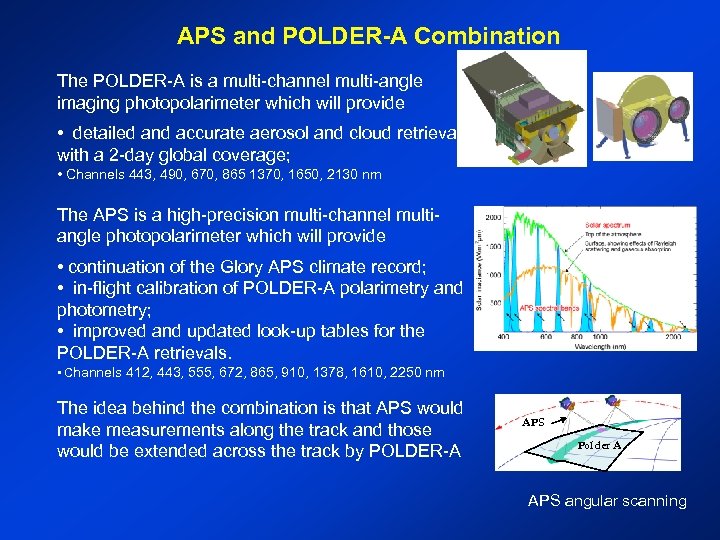
APS and POLDER-A Combination The POLDER-A is a multi-channel multi-angle imaging photopolarimeter which will provide • detailed and accurate aerosol and cloud retrievals with a 2 -day global coverage; • Channels 443, 490, 670, 865 1370, 1650, 2130 nm The APS is a high-precision multi-channel multiangle photopolarimeter which will provide • continuation of the Glory APS climate record; • in-flight calibration of POLDER-A polarimetry and photometry; • improved and updated look-up tables for the POLDER-A retrievals. • Channels 412, 443, 555, 672, 865, 910, 1378, 1610, 2250 nm The idea behind the combination is that APS would make measurements along the track and those would be extended across the track by POLDER-A APS Polder A APS angular scanning
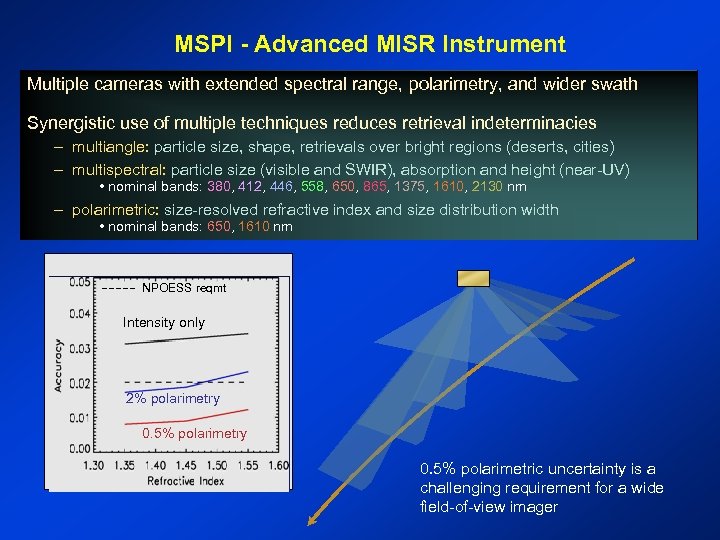
MSPI - Advanced MISR Instrument Multiple cameras with extended spectral range, polarimetry, and wider swath Synergistic use of multiple techniques reduces retrieval indeterminacies – multiangle: particle size, shape, retrievals over bright regions (deserts, cities) – multispectral: particle size (visible and SWIR), absorption and height (near-UV) • nominal bands: 380, 412, 446, 558, 650, 865, 1375, 1610, 2130 nm – polarimetric: size-resolved refractive index and size distribution width • nominal bands: 650, 1610 nm NPOESS reqmt Intensity only 2% polarimetry 0. 5% polarimetric uncertainty is a challenging requirement for a wide field-of-view imager
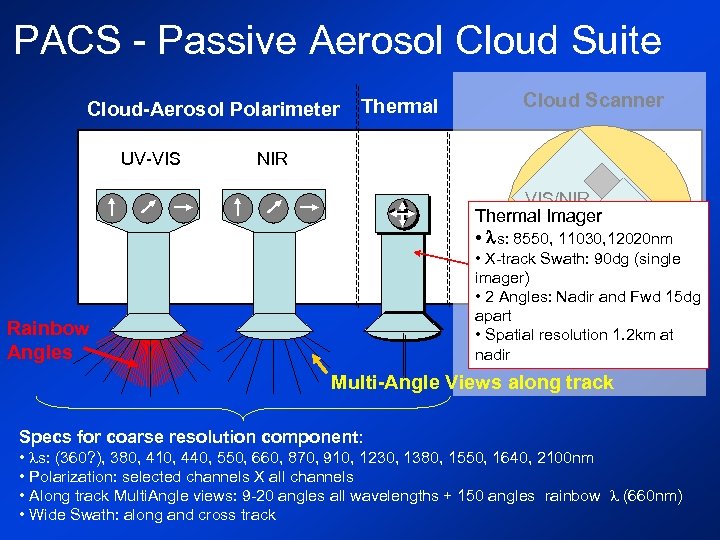
PACS - Passive Aerosol Cloud Suite Cloud-Aerosol Polarimeter UV-VIS Thermal Cloud Scanner TIR NIR VIS/NIR Thermal Imager TIR • ls: 8550, 11030, 12020 nm • X-track Swath: 90 dg (single imager) • 2 Angles: Nadir and Fwd 15 dg apart • Spatial resolution 1. 2 km at nadir Rainbow Angles Multi-Angle Views along track Specs for coarse resolution component: • ls: (360? ), 380, 410, 440, 550, 660, 870, 910, 1230, 1380, 1550, 1640, 2100 nm • Polarization: selected channels X all channels • Along track Multi. Angle views: 9 -20 angles all wavelengths + 150 angles rainbow l (660 nm) • Wide Swath: along and cross track
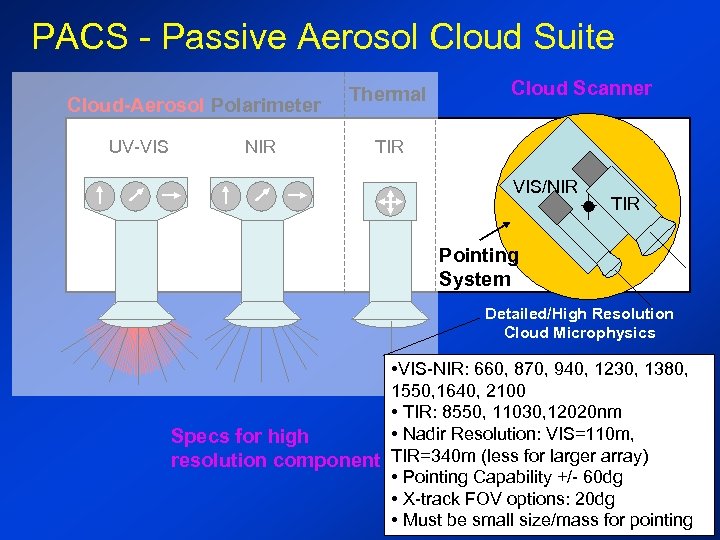
PACS - Passive Aerosol Cloud Suite Cloud-Aerosol Polarimeter UV-VIS NIR Thermal Cloud Scanner TIR VIS/NIR TIR Pointing System Detailed/High Resolution Cloud Microphysics • VIS-NIR: 660, 870, 940, 1230, 1380, 1550, 1640, 2100 • TIR: 8550, 11030, 12020 nm • Nadir Resolution: VIS=110 m, Specs for high resolution component TIR=340 m (less for larger array) • Pointing Capability +/- 60 dg • X-track FOV options: 20 dg • Must be small size/mass for pointing
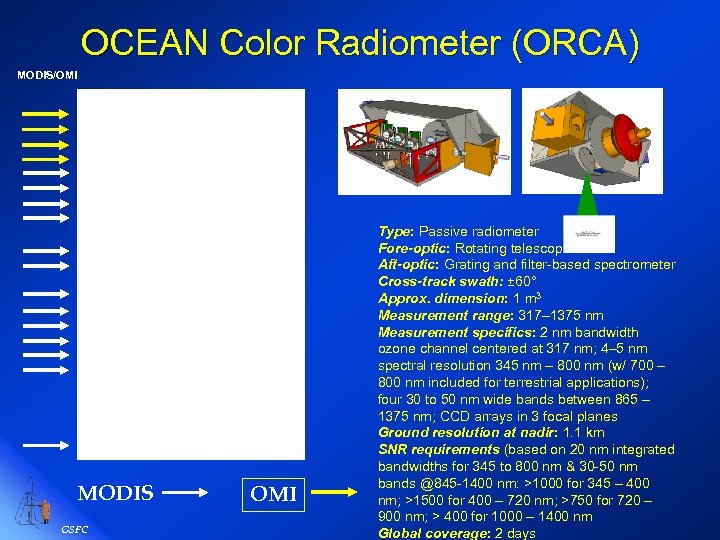
OCEAN Color Radiometer (ORCA) MODIS/OMI MODIS GSFC OMI Type: Passive radiometer Fore-optic: Rotating telescope Aft-optic: Grating and filter-based spectrometer Cross-track swath: ± 60° Approx. dimension: 1 m 3 Measurement range: 317– 1375 nm Measurement specifics: 2 nm bandwidth ozone channel centered at 317 nm; 4– 5 nm spectral resolution 345 nm – 800 nm (w/ 700 – 800 nm included for terrestrial applications); four 30 to 50 nm wide bands between 865 – 1375 nm; CCD arrays in 3 focal planes Ground resolution at nadir: 1. 1 km SNR requirements (based on 20 nm integrated bandwidths for 345 to 800 nm & 30 -50 nm bands @845 -1400 nm: >1000 for 345 – 400 nm; >1500 for 400 – 720 nm; >750 for 720 – 900 nm; > 400 for 1000 – 1400 nm Global coverage: 2 days
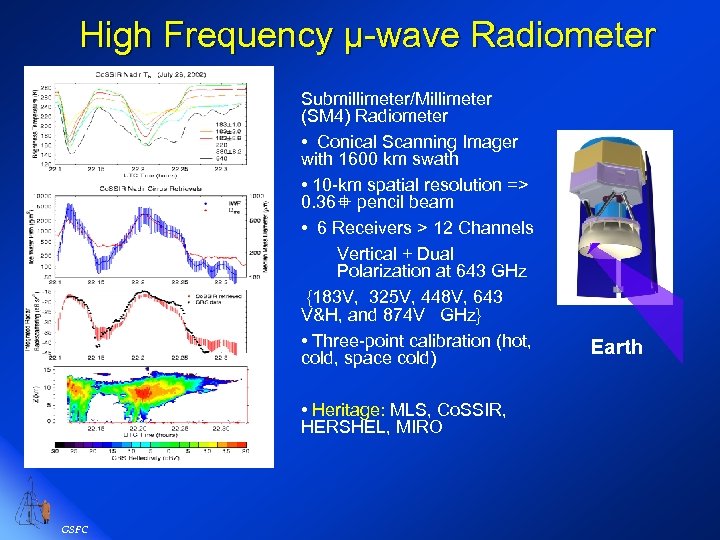
High Frequency µ-wave Radiometer Submillimeter/Millimeter (SM 4) Radiometer • Conical Scanning Imager with 1600 km swath • 10 -km spatial resolution => 0. 36 pencil beam • 6 Receivers > 12 Channels Vertical + Dual Polarization at 643 GHz {183 V, 325 V, 448 V, 643 V&H, and 874 V GHz} • Three-point calibration (hot, cold, space cold) • Heritage: MLS, Co. SSIR, HERSHEL, MIRO GSFC Earth
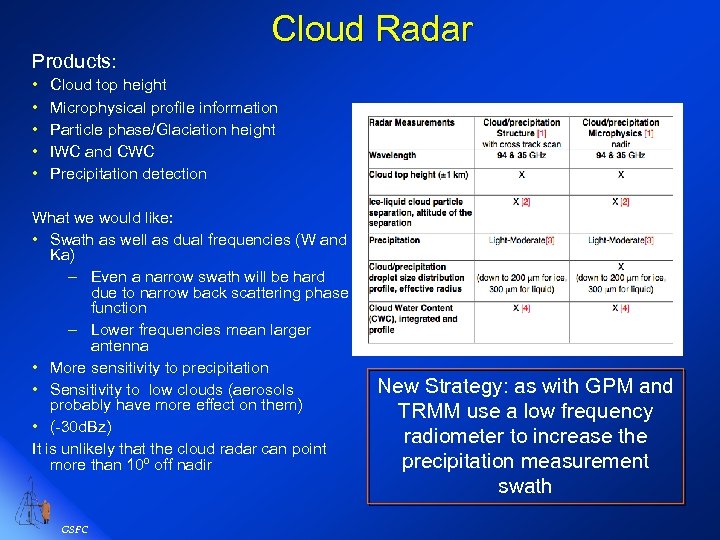
Products: • • • Cloud Radar Cloud top height Microphysical profile information Particle phase/Glaciation height IWC and CWC Precipitation detection What we would like: • Swath as well as dual frequencies (W and Ka) – Even a narrow swath will be hard due to narrow back scattering phase function – Lower frequencies mean larger antenna • More sensitivity to precipitation • Sensitivity to low clouds (aerosols probably have more effect on them) • (-30 d. Bz) It is unlikely that the cloud radar can point more than 10º off nadir GSFC New Strategy: as with GPM and TRMM use a low frequency radiometer to increase the precipitation measurement swath
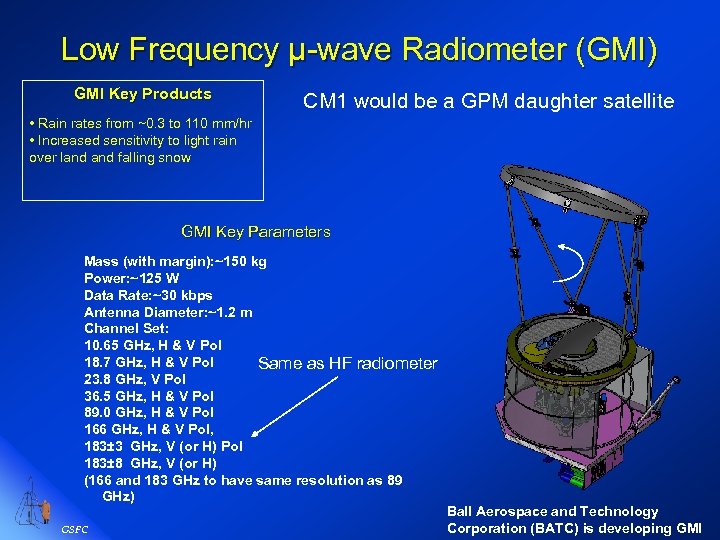
Low Frequency µ-wave Radiometer (GMI) GMI Key Products CM 1 would be a GPM daughter satellite • Rain rates from ~0. 3 to 110 mm/hr • Increased sensitivity to light rain over land falling snow GMI Key Parameters Mass (with margin): ~150 kg Power: ~125 W Data Rate: ~30 kbps Antenna Diameter: ~1. 2 m Channel Set: 10. 65 GHz, H & V Pol 18. 7 GHz, H & V Pol Same as HF radiometer 23. 8 GHz, V Pol 36. 5 GHz, H & V Pol 89. 0 GHz, H & V Pol 166 GHz, H & V Pol, 183± 3 GHz, V (or H) Pol 183± 8 GHz, V (or H) (166 and 183 GHz to have same resolution as 89 GHz) GSFC Ball Aerospace and Technology Corporation (BATC) is developing GMI
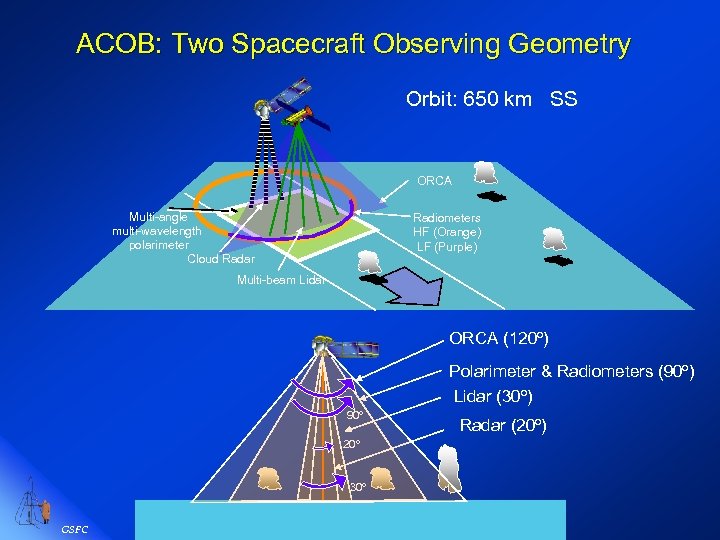
ACOB: Two Spacecraft Observing Geometry Orbit: 650 km SS ORCA Multi-angle multi-wavelength polarimeter Cloud Radar Radiometers HF (Orange) LF (Purple) Multi-beam Lidar ORCA (120º) Polarimeter & Radiometers (90º) Lidar (30º) 90º 20º 30º GSFC Radar (20º)
Next Steps • Community driven STM and white paper • IMDC studies of payload • Cost estimates – cheaper than the space station – more near term than the human settlement of Mars • HQ buy in GSFC
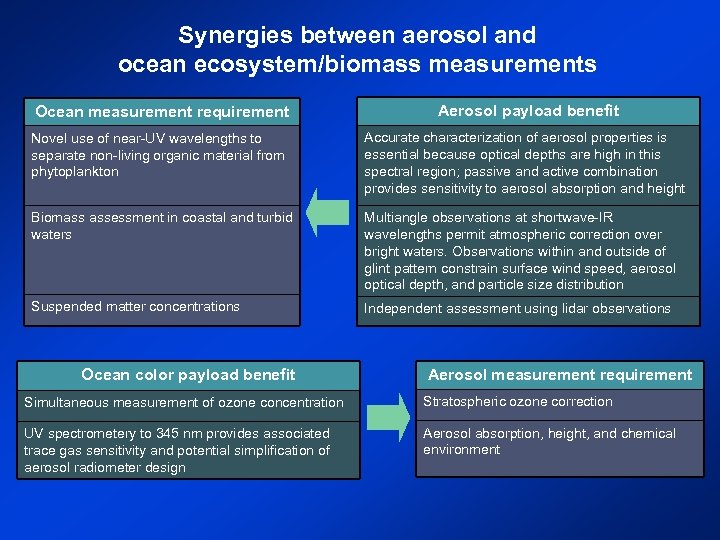
Synergies between aerosol and ocean ecosystem/biomass measurements Ocean measurement requirement Aerosol payload benefit Novel use of near-UV wavelengths to separate non-living organic material from phytoplankton Accurate characterization of aerosol properties is essential because optical depths are high in this spectral region; passive and active combination provides sensitivity to aerosol absorption and height Biomass assessment in coastal and turbid waters Multiangle observations at shortwave-IR wavelengths permit atmospheric correction over bright waters. Observations within and outside of glint pattern constrain surface wind speed, aerosol optical depth, and particle size distribution Suspended matter concentrations Independent assessment using lidar observations Ocean color payload benefit Aerosol measurement requirement Simultaneous measurement of ozone concentration Stratospheric ozone correction UV spectrometery to 345 nm provides associated trace gas sensitivity and potential simplification of aerosol radiometer design Aerosol absorption, height, and chemical environment
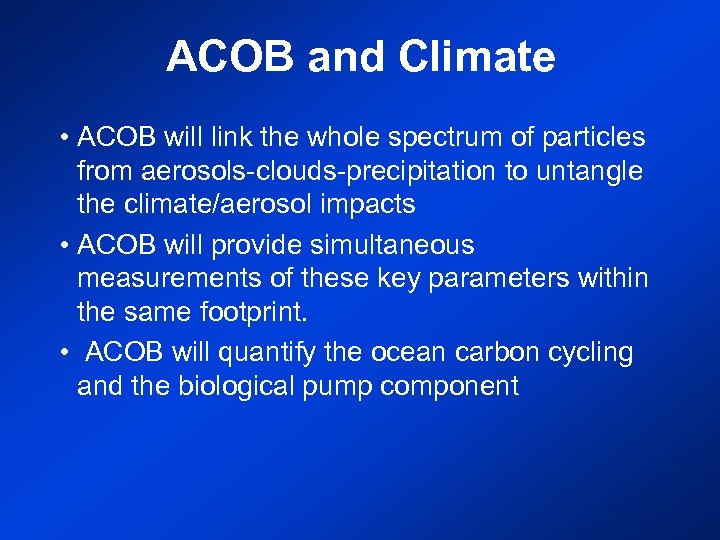
ACOB and Climate • ACOB will link the whole spectrum of particles from aerosols-clouds-precipitation to untangle the climate/aerosol impacts • ACOB will provide simultaneous measurements of these key parameters within the same footprint. • ACOB will quantify the ocean carbon cycling and the biological pump component
Скачать презентацию Aerosol-Cloud Ocean Biology Mission ACOB M Schoeberl NASA GSFC
cc836a4ea530346187b51fcdd6cc3a70.ppt