


 Скачать презентацию Aeronautics Visions and Opportunities A Do D Perspective
d6d421f990360ec1e66fb7c1c484935b.ppt
- Количество слайдов: 21
 Aeronautics Visions and Opportunities: A Do. D Perspective Paul F. Piscopo Staff Specialist for Aircraft Systems Office of Deputy Under Secretary of Defense (S&T)
 AERONAUTICS SCIENCE & TECHNOLOGY The Do. D Environment Is Changing (1999 -2001) • New and significant forces are impacting the Do. D aeronautics S&T program Ø Service Readiness and Modernization are driving S&T budgets (and priorities) Ø Army Transformation/Future Naval Capabilities (FNCs)/Air Force Migration-to-Space Ø The role and importance of aircraft in the Joint Warfighting Objectives and Plans are not always recognized or clearly visible (platform vs payload capability issue) Ø Reductions in Do. D/NASA aeronautics investments driving increased dependency/partnering • Budgetary instabilities have produced significant programmatic turmoil Ø Ø Re-scoped/re-structured the Fixed Wing Vehicle Program (lost 25% of AF workforce ) Turbine Engine (IHPTET) Program delayed 8 years with FY 00 submittal (restored by OSD) Hypersonic propulsion technology eliminated with FY 00 submittal (restored by OSD) Major reductions in Aircraft Power investments after FY 03 (new focus is on weapons/space power) • … And misconceptions still abound Ø Perception that there is little system-level capability left to be gained by advancement in aircraft and engine technologies--we’re operating in the margins Ø Services have historically funded this technology, and will continue to do so -- low priority Ø Industry will pick up the funding “slack” because of strong commercial relevance
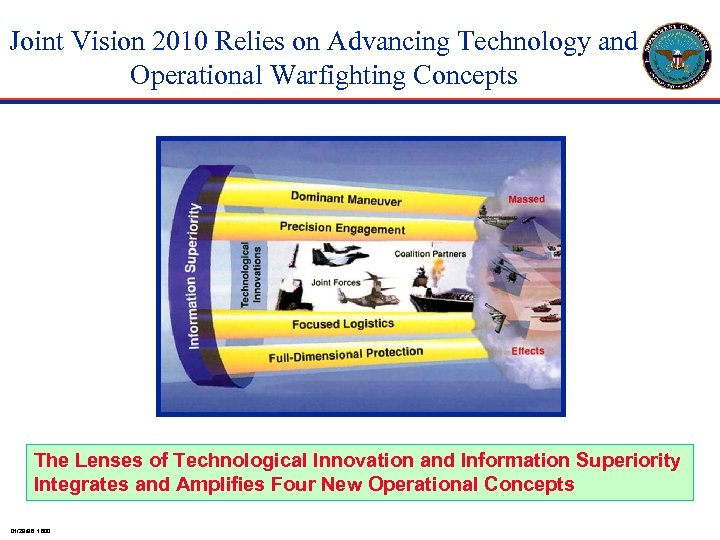 Joint Vision 2010 Relies on Advancing Technology and Operational Warfighting Concepts The Lenses of Technological Innovation and Information Superiority Integrates and Amplifies Four New Operational Concepts 01/29/98 1600
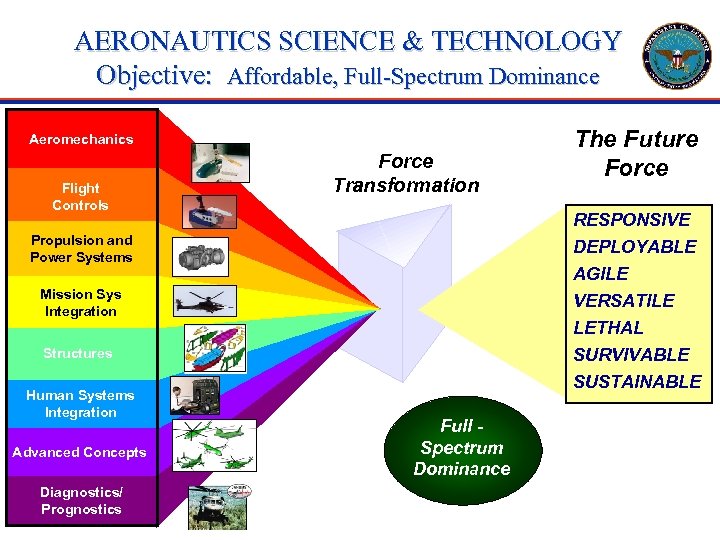 AERONAUTICS SCIENCE & TECHNOLOGY Objective: Affordable, Full-Spectrum Dominance Aeromechanics Flight Controls Force Transformation RESPONSIVE Propulsion and Power Systems DEPLOYABLE AGILE Mission Sys Integration VERSATILE LETHAL SURVIVABLE SUSTAINABLE Structures Human Systems Integration Advanced Concepts Diagnostics/ Prognostics The Future Force Full Spectrum Dominance
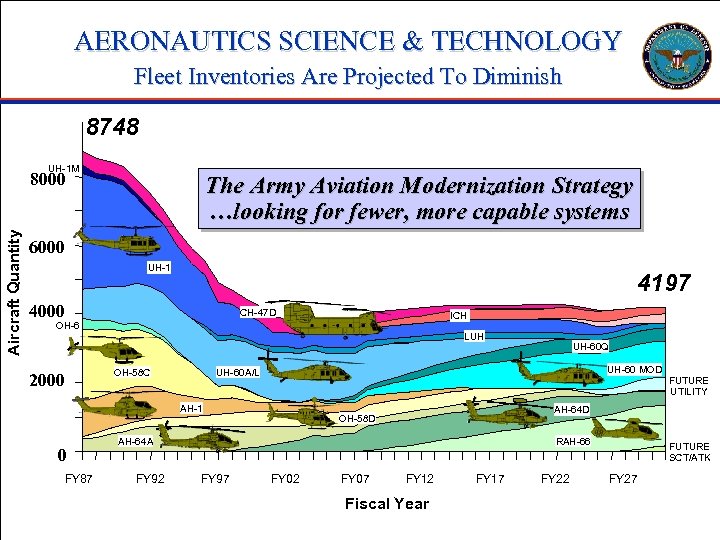 AERONAUTICS SCIENCE & TECHNOLOGY Fleet Inventories Are Projected To Diminish 8748 UH-1 M Aircraft Quantity 8000 The Army Aviation Modernization Strategy …looking for fewer, more capable systems 6000 UH-1 4197 4000 CH-47 D ICH OH-6 2000 LUH OH-58 C UH-60 MOD UH-60 A/L AH-1 0 FY 87 RAH-66 FY 97 FY 02 FY 07 FUTURE UTILITY AH-64 D OH-58 D AH-64 A FY 92 UH-60 Q FY 12 Fiscal Year FY 17 FY 22 FUTURE SCT/ATK FY 27
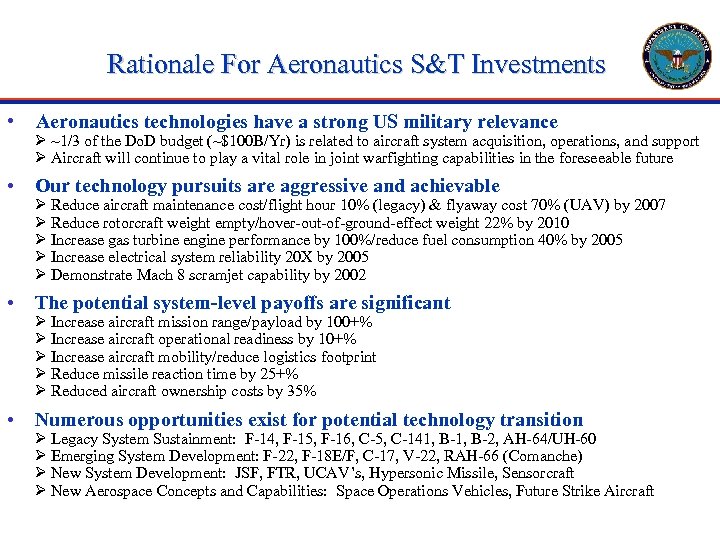 Rationale For Aeronautics S&T Investments • Aeronautics technologies have a strong US military relevance Ø ~1/3 of the Do. D budget (~$100 B/Yr) is related to aircraft system acquisition, operations, and support Ø Aircraft will continue to play a vital role in joint warfighting capabilities in the foreseeable future • Our technology pursuits are aggressive and achievable Ø Reduce aircraft maintenance cost/flight hour 10% (legacy) & flyaway cost 70% (UAV) by 2007 Ø Reduce rotorcraft weight empty/hover-out-of-ground-effect weight 22% by 2010 Ø Increase gas turbine engine performance by 100%/reduce fuel consumption 40% by 2005 Ø Increase electrical system reliability 20 X by 2005 Ø Demonstrate Mach 8 scramjet capability by 2002 • The potential system-level payoffs are significant Ø Increase aircraft mission range/payload by 100+% Ø Increase aircraft operational readiness by 10+% Ø Increase aircraft mobility/reduce logistics footprint Ø Reduce missile reaction time by 25+% Ø Reduced aircraft ownership costs by 35% • Numerous opportunities exist for potential technology transition Ø Legacy System Sustainment: F-14, F-15, F-16, C-5, C-141, B-2, AH-64/UH-60 Ø Emerging System Development: F-22, F-18 E/F, C-17, V-22, RAH-66 (Comanche) Ø New System Development: JSF, FTR, UCAV’s, Hypersonic Missile, Sensorcraft Ø New Aerospace Concepts and Capabilities: Space Operations Vehicles, Future Strike Aircraft
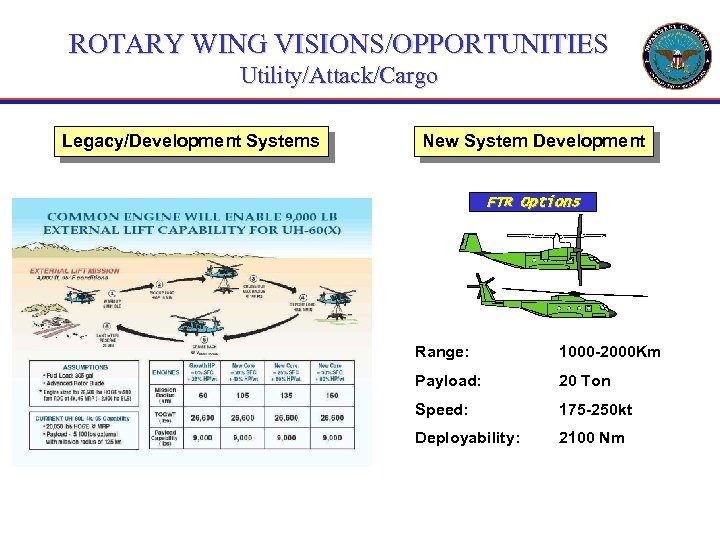 ROTARY WING VISIONS/OPPORTUNITIES Utility/Attack/Cargo Legacy/Development Systems New System Development FTR Options Range: 1000 -2000 Km Payload: 20 Ton Speed: 175 -250 kt Deployability: 2100 Nm
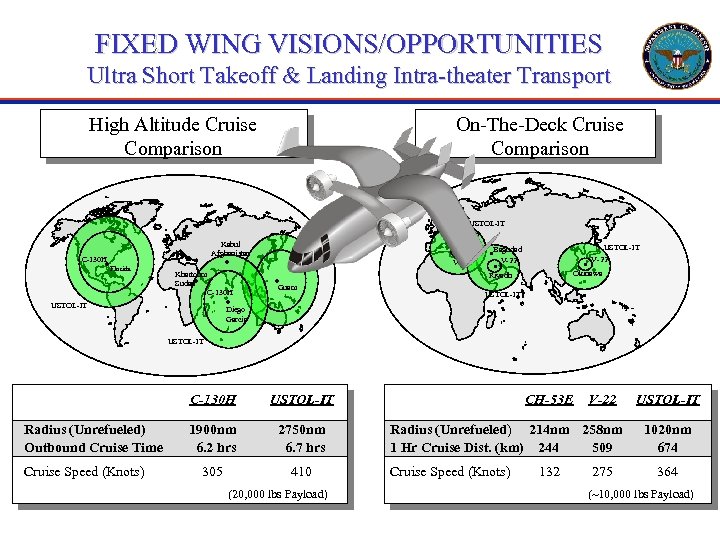 FIXED WING VISIONS/OPPORTUNITIES Ultra Short Takeoff & Landing Intra-theater Transport High Altitude Cruise Comparison . C-130 H Florida USTOL-IT . . . Kabul Afghanistan Khartoum Sudan C-130 H On-The-Deck Cruise Comparison . . USTOL-IT Sarajevo . V-22 Riyadh Guam . . Baghdad V-22 USTOL-IT V-22 . Okinawa USTOL-IT Diego Garcia USTOL-IT C-130 H Radius (Unrefueled) Outbound Cruise Time Cruise Speed (Knots) USTOL-IT 1900 nm 6. 2 hrs 2750 nm 6. 7 hrs 305 410 (20, 000 lbs Payload) CH-53 E V-22 Radius (Unrefueled) 214 nm 258 nm 1 Hr Cruise Dist. (km) 244 509 Cruise Speed (Knots) 132 275 USTOL-IT 1020 nm 674 364 (~10, 000 lbs Payload)
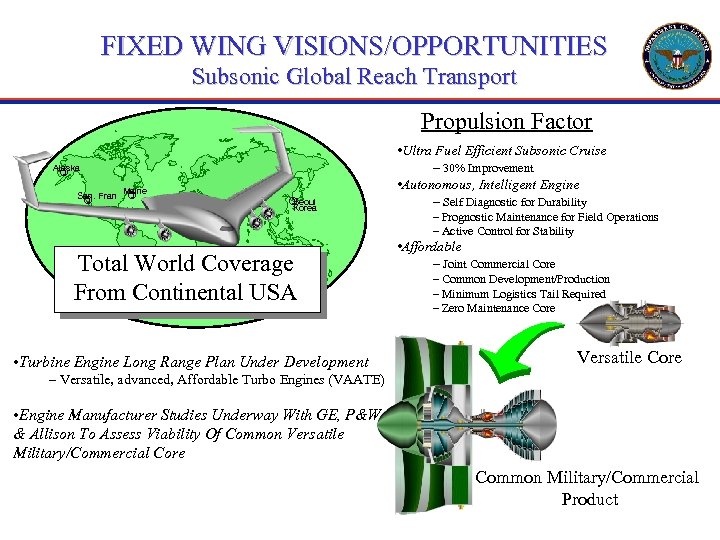 FIXED WING VISIONS/OPPORTUNITIES Subsonic Global Reach Transport Propulsion Factor Alaska ) ) San. Fran Maine ) Florida ) Baghdad Iraq ) Seoul ) Korea Total World Coverage From Continental USA • Turbine Engine Long Range Plan Under Development • Ultra Fuel Efficient Subsonic Cruise – 30% Improvement • Autonomous, Intelligent Engine – Self Diagnostic for Durability – Prognostic Maintenance for Field Operations – Active Control for Stability • Affordable – Joint Commercial Core – Common Development/Production – Minimum Logistics Tail Required – Zero Maintenance Core Versatile Core – Versatile, advanced, Affordable Turbo Engines (VAATE) • Engine Manufacturer Studies Underway With GE, P&WA, & Allison To Assess Viability Of Common Versatile Military/Commercial Core Common Military/Commercial Product
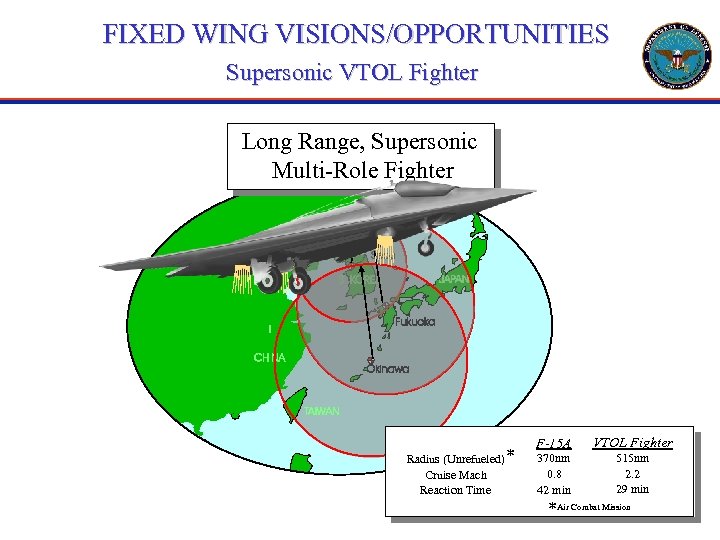 FIXED WING VISIONS/OPPORTUNITIES Supersonic VTOL Fighter Long Range, Supersonic Multi-Role Fighter Radius (Unrefueled) * Cruise Mach Reaction Time F-15 A VTOL Fighter 370 nm 0. 8 42 min 515 nm 2. 2 29 min *Air Combat Mission
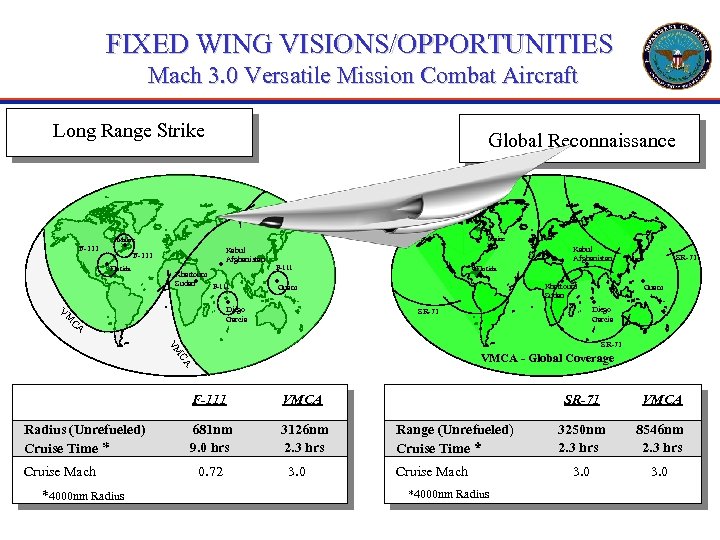 FIXED WING VISIONS/OPPORTUNITIES Mach 3. 0 Versatile Mission Combat Aircraft Long Range Strike F-111 . . . Maine Kabul Afghanistan F-111 Florida Global Reconnaissance Khartoum Sudan F-111 V . F-111 CA Florida *4000 nm Radius . SR-71 Guam Diego Garcia SR-71 CA CA VM VM Cruise Mach . . . Kabul Afghanistan Khartoum Sudan SR-71 VMCA - Global Coverage F-111 Radius (Unrefueled) Cruise Time * Maine Guam Diego Garcia M . . VMCA 681 nm 9. 0 hrs 3126 nm 2. 3 hrs 0. 72 3. 0 SR-71 Range (Unrefueled) Cruise Time * Cruise Mach *4000 nm Radius VMCA 3250 nm 2. 3 hrs 8546 nm 2. 3 hrs 3. 0
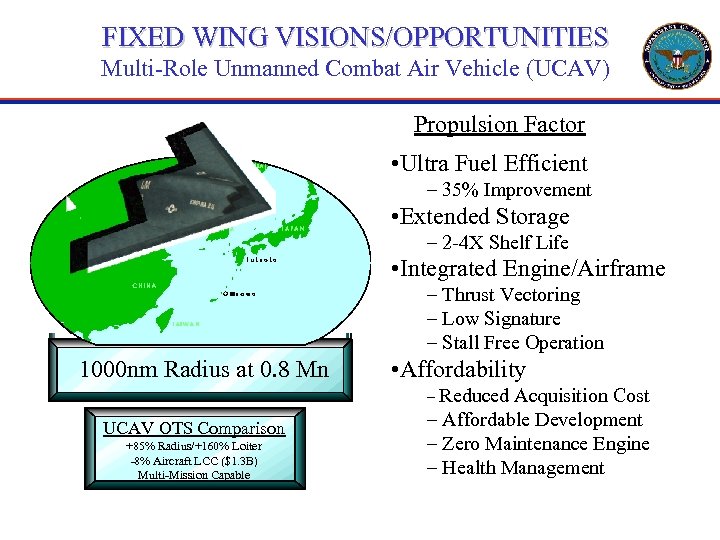 FIXED WING VISIONS/OPPORTUNITIES Multi-Role Unmanned Combat Air Vehicle (UCAV) Propulsion Factor • Ultra Fuel Efficient – 35% Improvement • Extended Storage – 2 -4 X Shelf Life • Integrated Engine/Airframe – Thrust Vectoring – Low Signature – Stall Free Operation 1000 nm Radius at 0. 8 Mn • Affordability – Reduced UCAV OTS Comparison +85% Radius/+160% Loiter -8% Aircraft LCC ($1. 3 B) Multi-Mission Capable Acquisition Cost – Affordable Development – Zero Maintenance Engine – Health Management
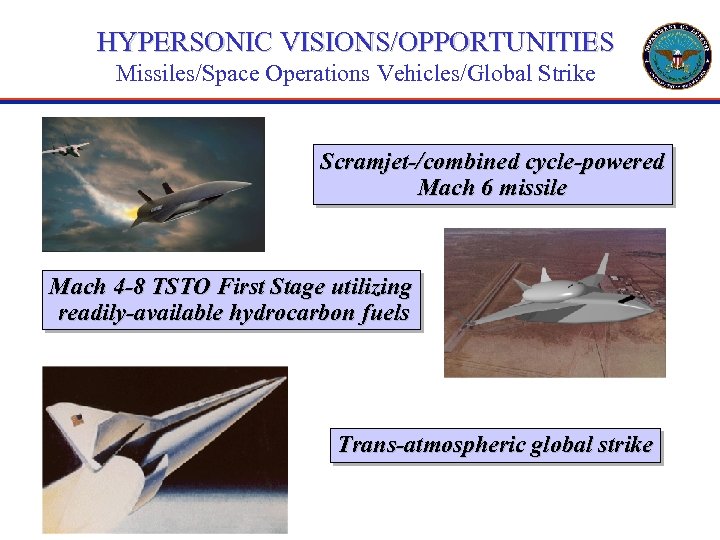 HYPERSONIC VISIONS/OPPORTUNITIES Missiles/Space Operations Vehicles/Global Strike Scramjet-/combined cycle-powered Mach 6 missile Mach 4 -8 TSTO First Stage utilizing readily-available hydrocarbon fuels Trans-atmospheric global strike
 AERONAUTICS SCIENCE & TECHNOLOGY A New Set of Concerns Is Emerging • Business volatility is making technology planning difficult Ø What are the right goals, program structure, and development pace? Ø What’s the right mix between short-/long-term technology development? Ø What’s the right balance between commercial-/military-driven needs? • Growing emphasis on a new/different set of technology drivers Ø Affordability (cost to develop, procure, and operate) Ø Life, durability, and sustainment (increased service life) Ø Fuel reduction (reduced logistics footprint/global warming) Ø Emissions and noise (environmentally-driven basing considerations) Ø What’s the right balance between capability and these other drivers? • Sustaining a world-class workforce Ø Moves, consolidations, and general down-sizing (loss of expertise base) Ø Motivating our young people to choose a career in aeronautics
 Summary • Aeronautics S&T is important to both the military and civil sectors – Role of aircraft will continue to grow for the foreseeable future (military superiority) – Large impact on US balance of trade (economic competitiveness) • Substantive technological advancements are being made in all sectors of the Do. D Aeronautics S&T program/transition potential is high • Significant improvements in capability are still achievable • Current aeronautics technology budget trends are cause for concern – Do. D/NASA both showing substantial declines – Steps are being taken to reverse the trend
 BACKUP CHARTS
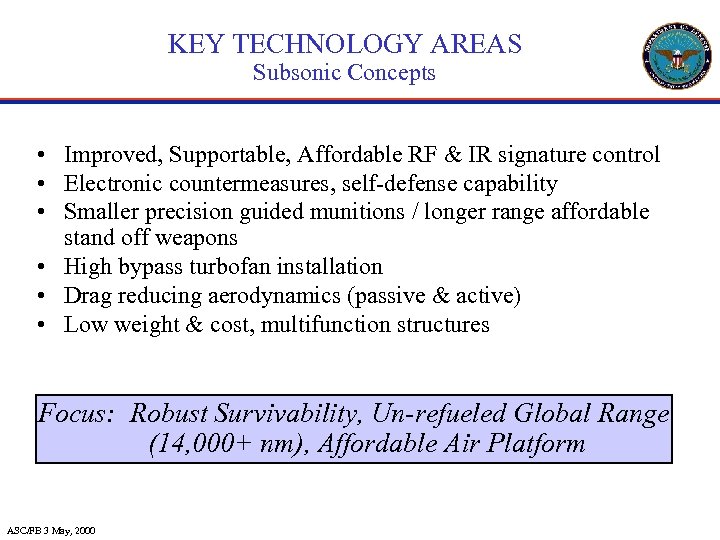 KEY TECHNOLOGY AREAS Subsonic Concepts • Improved, Supportable, Affordable RF & IR signature control • Electronic countermeasures, self-defense capability • Smaller precision guided munitions / longer range affordable stand off weapons • High bypass turbofan installation • Drag reducing aerodynamics (passive & active) • Low weight & cost, multifunction structures Focus: Robust Survivability, Un-refueled Global Range (14, 000+ nm), Affordable Air Platform ASC/FB 3 May, 2000
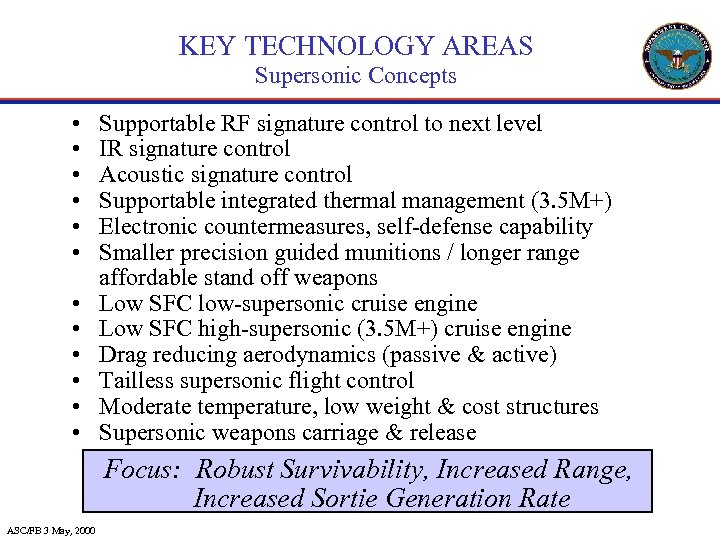 KEY TECHNOLOGY AREAS Supersonic Concepts • • • Supportable RF signature control to next level IR signature control Acoustic signature control Supportable integrated thermal management (3. 5 M+) Electronic countermeasures, self-defense capability Smaller precision guided munitions / longer range affordable stand off weapons Low SFC low-supersonic cruise engine Low SFC high-supersonic (3. 5 M+) cruise engine Drag reducing aerodynamics (passive & active) Tailless supersonic flight control Moderate temperature, low weight & cost structures Supersonic weapons carriage & release Focus: Robust Survivability, Increased Range, Increased Sortie Generation Rate ASC/FB 3 May, 2000
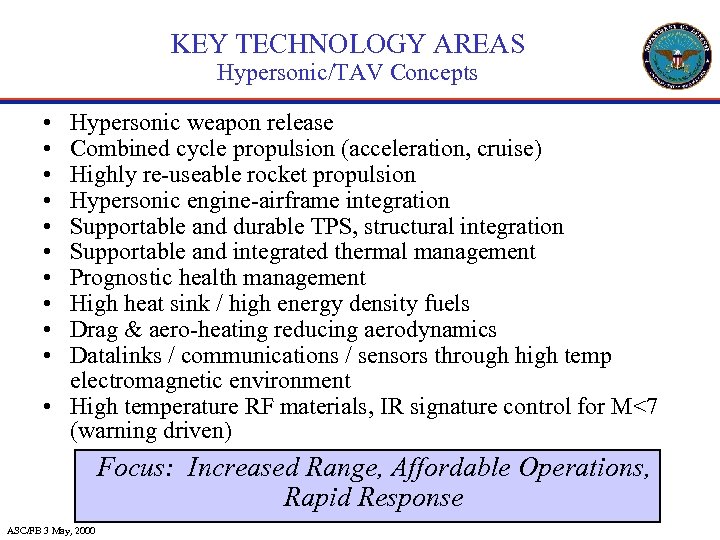 KEY TECHNOLOGY AREAS Hypersonic/TAV Concepts • • • Hypersonic weapon release Combined cycle propulsion (acceleration, cruise) Highly re-useable rocket propulsion Hypersonic engine-airframe integration Supportable and durable TPS, structural integration Supportable and integrated thermal management Prognostic health management High heat sink / high energy density fuels Drag & aero-heating reducing aerodynamics Datalinks / communications / sensors through high temp electromagnetic environment • High temperature RF materials, IR signature control for M<7 (warning driven) Focus: Increased Range, Affordable Operations, Rapid Response ASC/FB 3 May, 2000
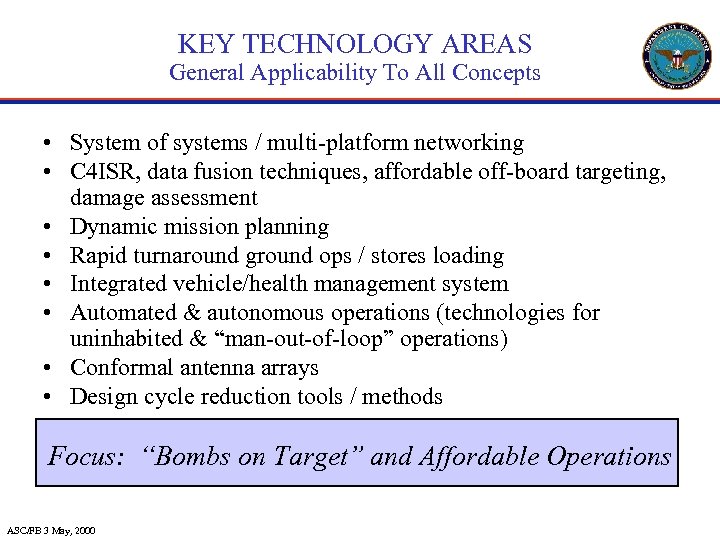 KEY TECHNOLOGY AREAS General Applicability To All Concepts • System of systems / multi-platform networking • C 4 ISR, data fusion techniques, affordable off-board targeting, damage assessment • Dynamic mission planning • Rapid turnaround ground ops / stores loading • Integrated vehicle/health management system • Automated & autonomous operations (technologies for uninhabited & “man-out-of-loop” operations) • Conformal antenna arrays • Design cycle reduction tools / methods Focus: “Bombs on Target” and Affordable Operations ASC/FB 3 May, 2000
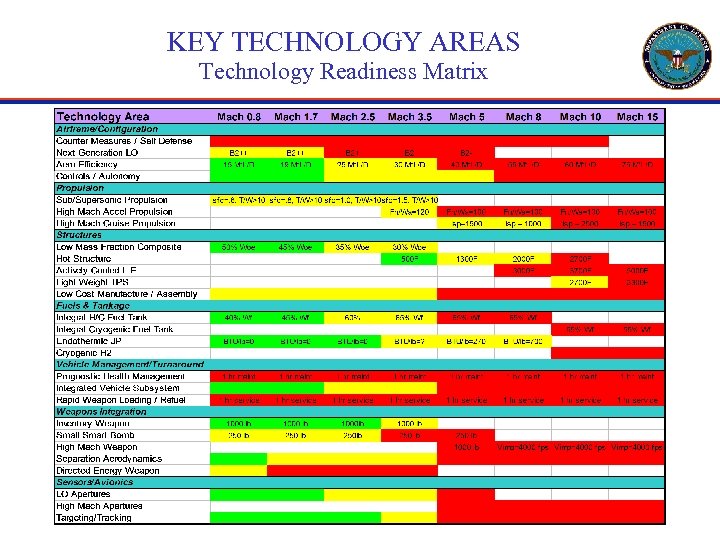 KEY TECHNOLOGY AREAS Technology Readiness Matrix