


 Скачать презентацию AEP s Virtual Wide Area Power Quality Measurement System
8720885db4808b37afa7654400ebde0c.ppt
- Количество слайдов: 20
 AEP’s Virtual Wide Area Power Quality Measurement System using Energy Meters Prashant Kansal, Paulo C Cambraia, Nathaniel R Dunn October-12 -2015, CIGRE USNC-Chicago 1
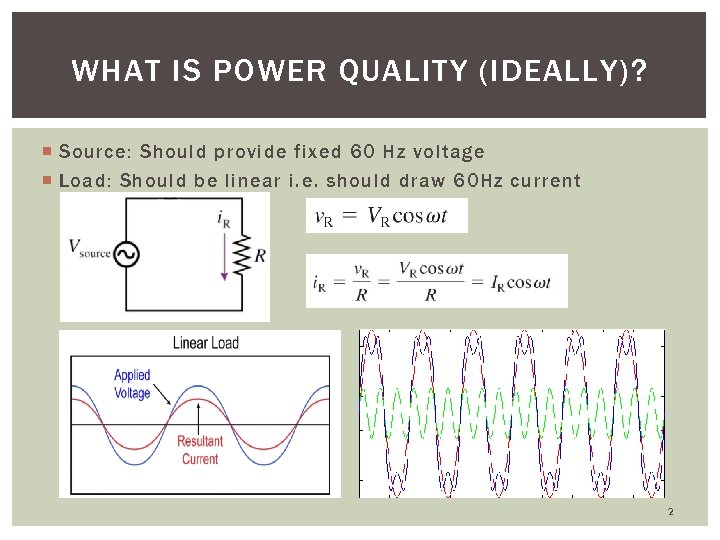 WHAT IS POWER QUALITY (IDEALLY)? Source: Should provide fixed 60 Hz voltage Load: Should be linear i. e. should draw 60 Hz current 2
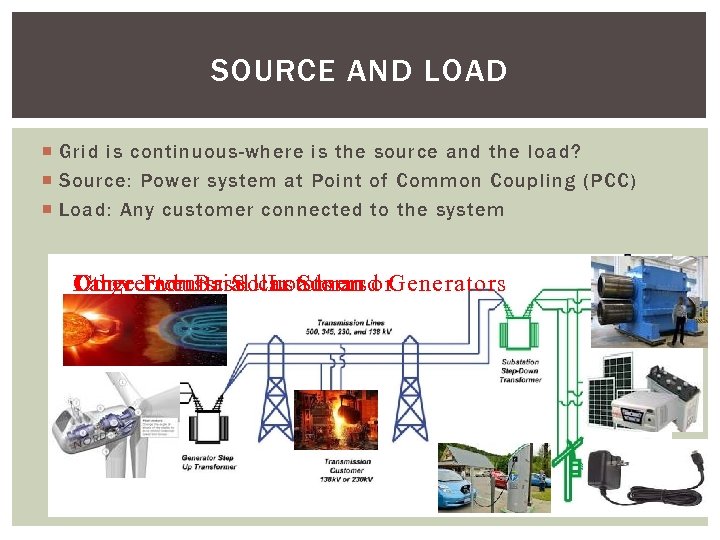 SOURCE AND LOAD Grid is continuous-where is the source and the load? Source: Power system at Point of Common Coupling (PCC) Load: Any customer connected to the system Other Events: Solar Storm or Large Industrial customers Generators Convertor Based Loads and EMP 3
 WHY POWER QUALITY ? Problems Reduces insulation life-Increased chances of failure Increased system losses-More heating Network Resonance Issues- Temporary Over Voltages Communication Interference-Noisy communication signals EM relays mis-operation -Undesired tripping- Not an issue for AEP Solutions Sink the harmonics to ground at the origin- Filters Harmonics cancellation- Transformer connection Static VAR Compensator- Voltage Flicker Bottom-line Harmonics should not flow back into the system- Customers should resolve issues to meet PQ standards If not taken care by a customer, utility has to resolve the issue. Other customers expect good PQ 4
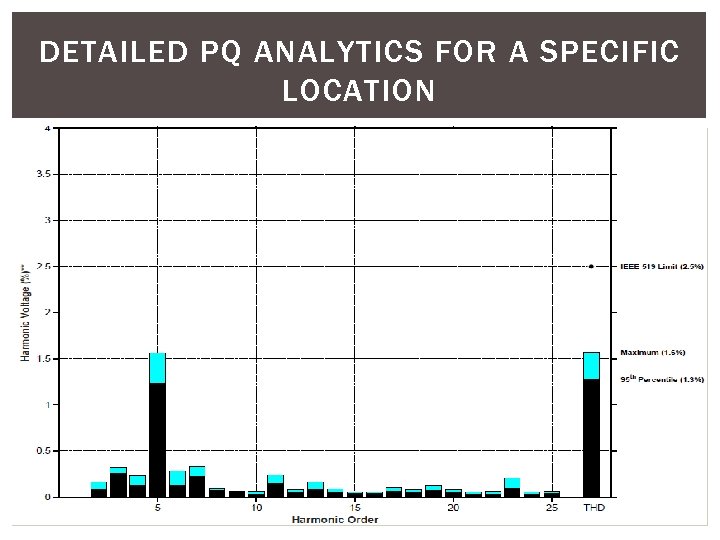
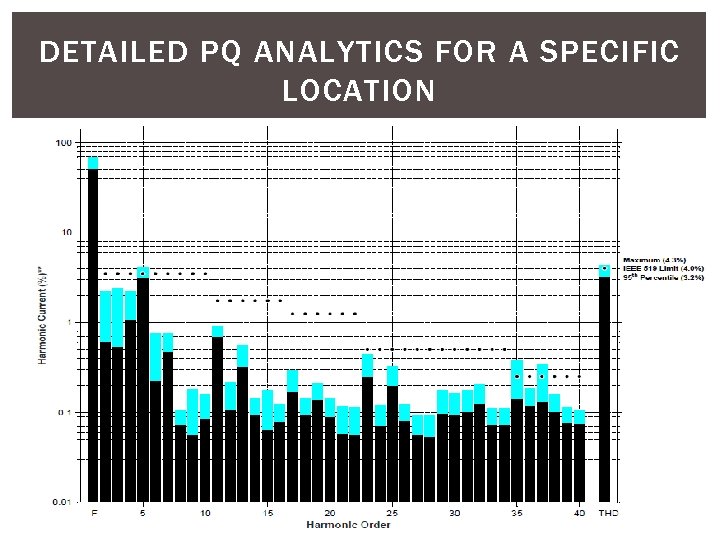
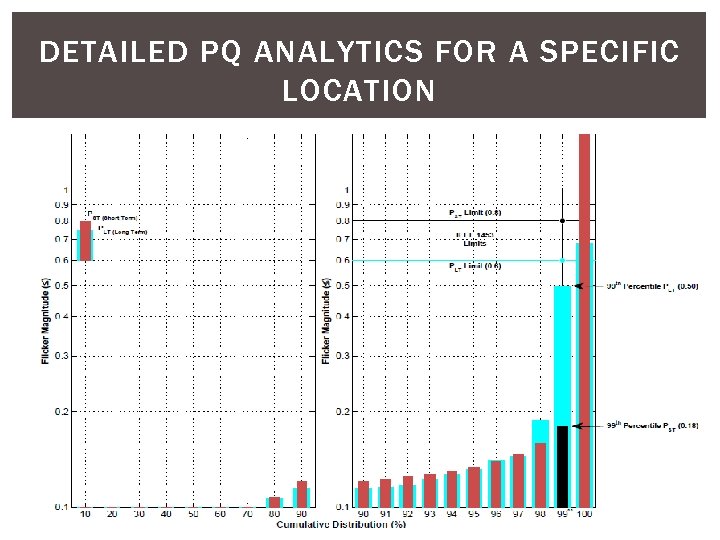
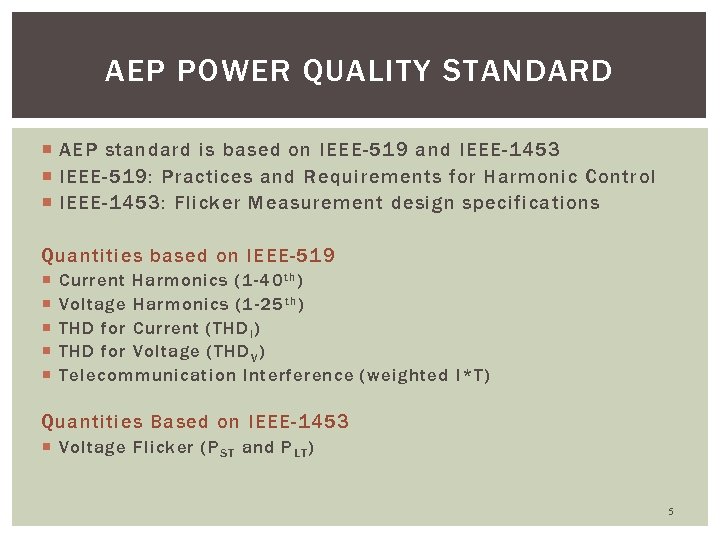 AEP POWER QUALITY STANDARD AEP standard is based on IEEE-519 and IEEE-1453 IEEE-519: Practices and Requirements for Harmonic Control IEEE-1453: Flicker Measurement design specifications Quantities based on IEEE-519 Current Harmonics (1 -40 t h ) Voltage Harmonics (1 -25 t h ) THD for Current (THD I ) THD for Voltage (THD V ) Telecommunication Interference (weighted I*T) Quantities Based on IEEE-1453 Voltage Flicker (P S T and P L T ) 5
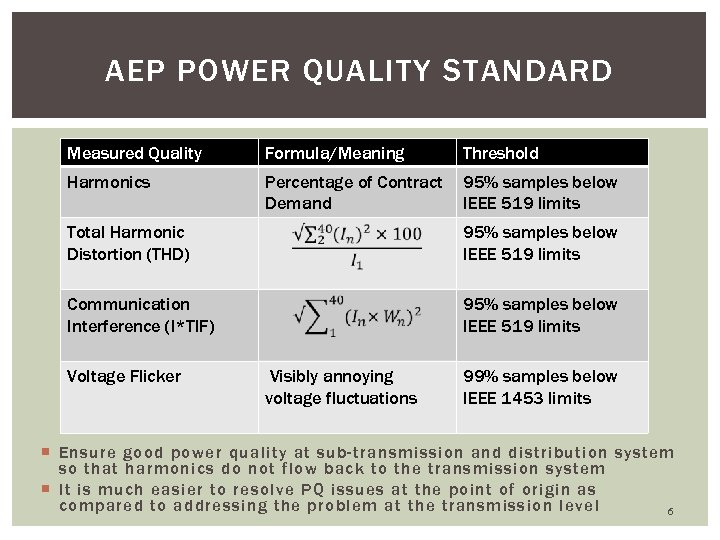 AEP POWER QUALITY STANDARD Measured Quality Formula/Meaning Threshold Harmonics Percentage of Contract Demand 95% samples below IEEE 519 limits Total Harmonic Distortion (THD) 95% samples below IEEE 519 limits Communication Interference (I*TIF) 95% samples below IEEE 519 limits Voltage Flicker Visibly annoying voltage fluctuations 99% samples below IEEE 1453 limits Ensure good power quality at sub-transmission and distribution system so that harmonics do not flow back to the transmission system It is much easier to resolve PQ issues at the point of origin as compared to addressing the problem at the transmission level 6
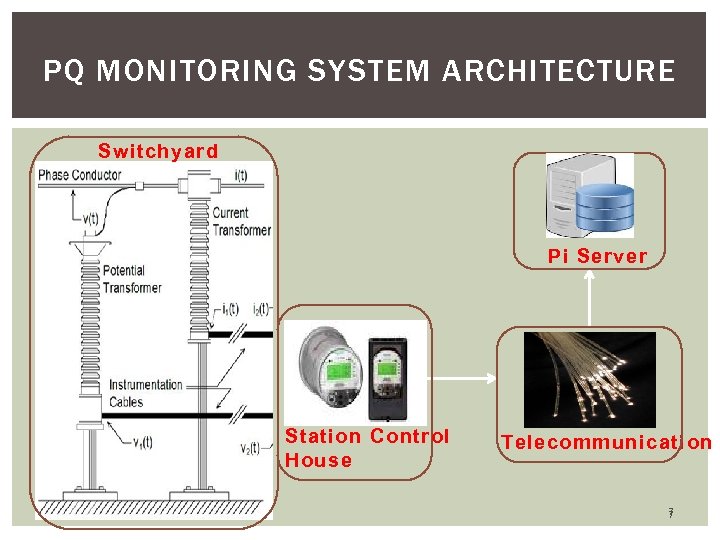 PQ MONITORING SYSTEM ARCHITECTURE Switchyard Pi Server Station Control House Telecommunication 7 7
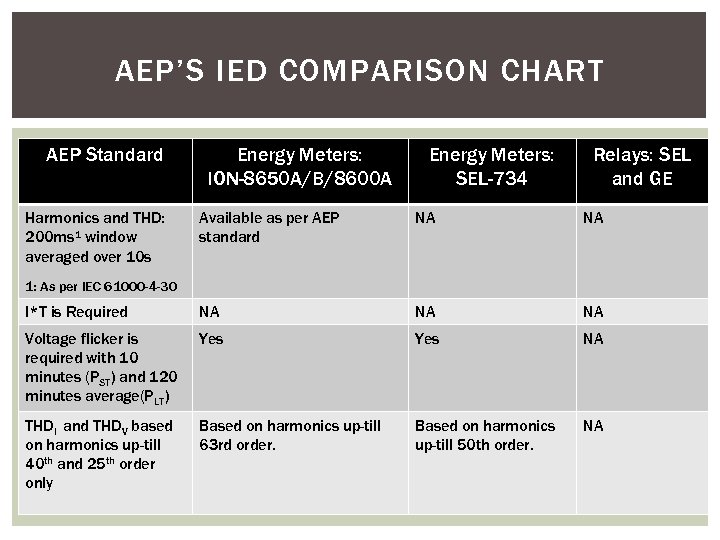 AEP’S IED COMPARISON CHART AEP Standard Harmonics and THD: 200 ms 1 window averaged over 10 s Energy Meters: ION-8650 A/B/8600 A Energy Meters: SEL-734 Relays: SEL and GE Available as per AEP standard NA NA I*T is Required NA NA NA Voltage flicker is required with 10 minutes (PST) and 120 minutes average(PLT) Yes NA THDI and THDV based on harmonics up-till 40 th and 25 th order only Based on harmonics up-till 63 rd order. Based on harmonics up-till 50 th order. NA 1: As per IEC 61000 -4 -30 8
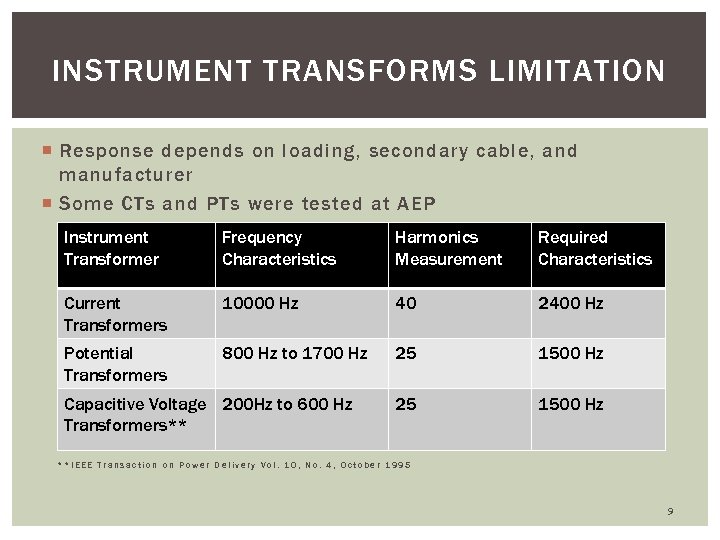 INSTRUMENT TRANSFORMS LIMITATION Response depends on loading, secondary cable, and manufacturer Some CTs and PTs were tested at AEP Instrument Transformer Frequency Characteristics Harmonics Measurement Required Characteristics Current Transformers 10000 Hz 40 2400 Hz Potential Transformers 800 Hz to 1700 Hz 25 1500 Hz Capacitive Voltage 200 Hz to 600 Hz Transformers** **IEEE Transaction on Power Delivery Vol. 10, No. 4, October 1995 9
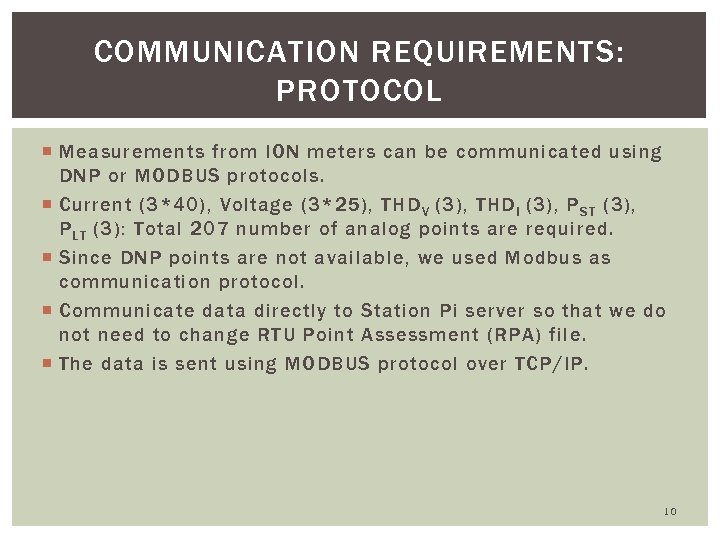 COMMUNICATION REQUIREMENTS: PROTOCOL Measurements from ION meters can be communicated using DNP or MODBUS protocols. Current (3*40), Voltage (3*25), THD V (3), THD I (3), P S T (3), P L T (3): Total 207 number of analog points are required. Since DNP points are not available, we used Modbus as communication protocol. Communicate data directly to Station Pi server so that we do not need to change RTU Point Assessment (RPA) file. The data is sent using MODBUS protocol over TCP/IP. 10
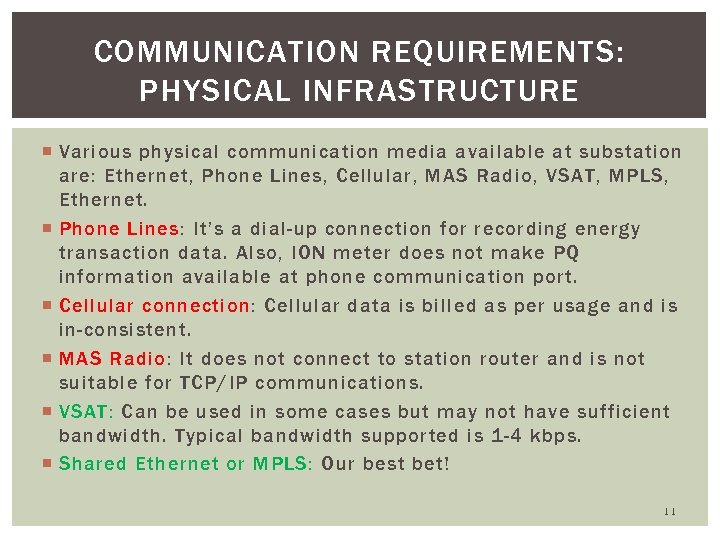 COMMUNICATION REQUIREMENTS: PHYSICAL INFRASTRUCTURE Various physical communication media available at substation are: Ethernet, Phone Lines, Cellular, MAS Radio, VSAT, MPLS, Ethernet. Phone Lines: It’s a dial-up connection for recording energy transaction data. Also, ION meter does not make PQ information available at phone communication port. Cellular connection: Cellular data is billed as per usage and is in-consistent. MAS Radio: It does not connect to station router and is not suitable for TCP/IP communications. VSAT: Can be used in some cases but may not have sufficient bandwidth. Typical bandwidth supported is 1 -4 kbps. Shared Ethernet or MPLS: Our best bet! 11
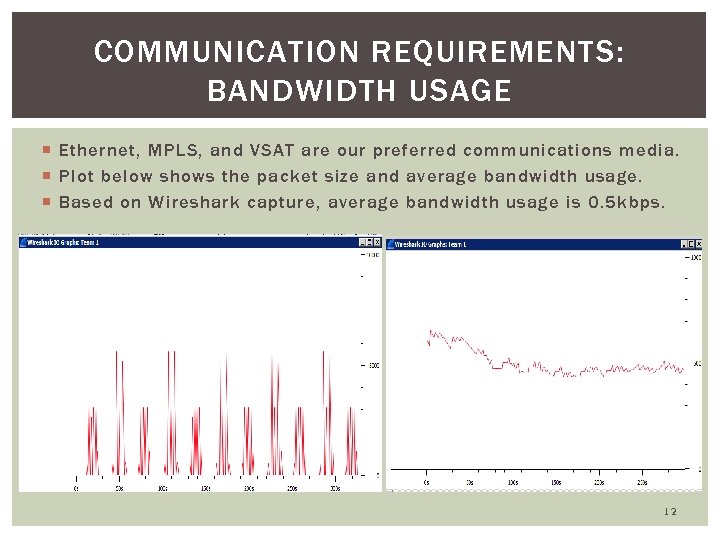 COMMUNICATION REQUIREMENTS: BANDWIDTH USAGE Ethernet, MPLS, and VSAT are our preferred communications media. Plot below shows the packet size and average bandwidth usage. Based on Wireshark capture, average bandwidth usage is 0. 5 kbps. 12
 METER LOCATION SELECTION A. Meter availability: Clearly, we need ION 8600 A and 8650 B meters. B. Communication Medium: Need Ethernet, MPLS, or VSAT C. AEP Owned Meter: Meter should be AEP owned D. AEP Owned Substation: Station should be AEP owned so that we can do installation and use the communication infrastructure. E. ERCOT Polled Settlement (EPS): If a meter is EPS meter, we do not consider it for upgrade (so far) because of regulatory reasons. F. CIP station: We do not make any changes to the CIP stations as well. 13
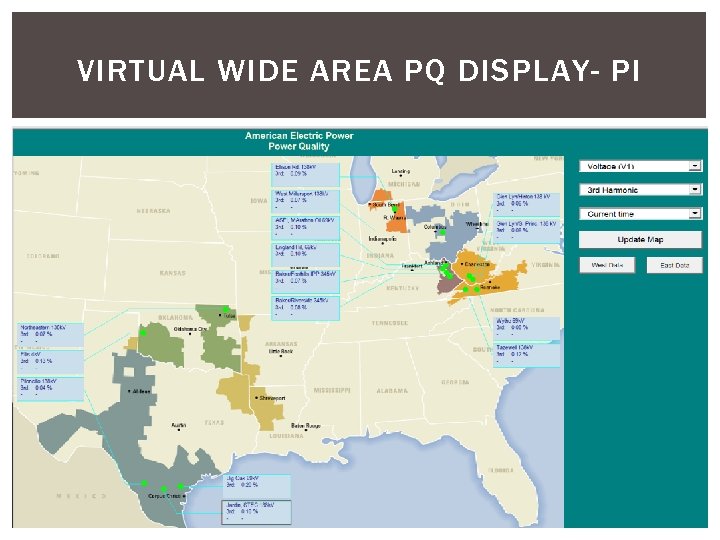 VIRTUAL WIDE AREA PQ DISPLAY- PI 14
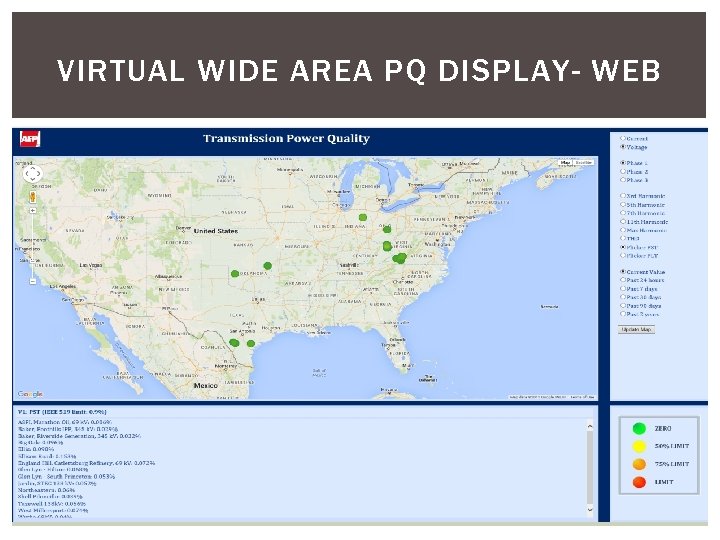 VIRTUAL WIDE AREA PQ DISPLAY- WEB 15
 16
16
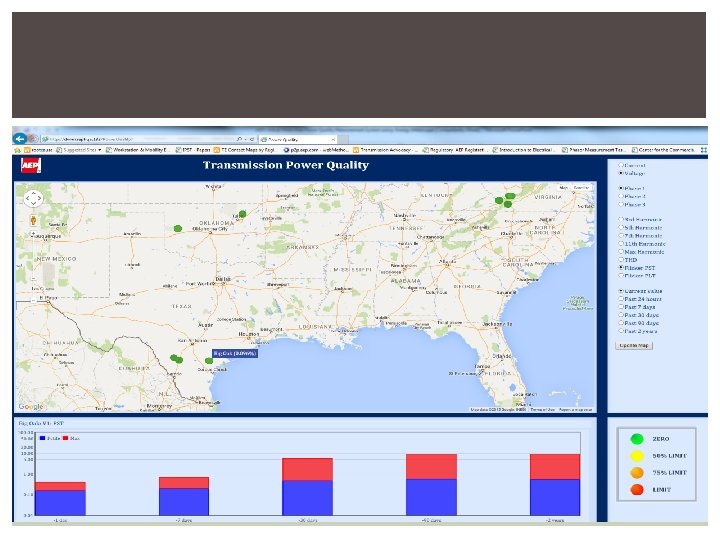
 DETAILED PQ ANALYTICS FOR A SPECIFIC LOCATION 17
 DETAILED PQ ANALYTICS FOR A SPECIFIC LOCATION 18
 DETAILED PQ ANALYTICS FOR A SPECIFIC LOCATION 19
 ACKNOWLEDGEMENT Richard Gutman Sanjoy Sarawgi Jeff Fleeman Carlos Casablanca John Mandeville Schneider Team Transmission Meter Operations Team Bradford P Martin 20