


 Скачать презентацию AE with Xn G The Multiplier C Ig
ba28d19e0d897d10fe7165840a1e3352.ppt
- Количество слайдов: 33
![AE with. Xn & G, The Multiplier [C+Ig] [C+Ig+G+Xn] S (AE 3)630 (AE 2)550](https://present5.com/presentation/ba28d19e0d897d10fe7165840a1e3352/image-1.jpg "AE with. Xn & G, The Multiplier [C+Ig] [C+Ig+G+Xn] S (AE 3)630 (AE 2)550") AE with. Xn & G, The Multiplier [C+Ig] [C+Ig+G+Xn] S (AE 3)630 (AE 2)550 (AE 1)470 C=390 G +20 n +20 X Ig +20 +80 +80 ( Closed Economy ) (Open Economy ) AE 3 (C+Ig+G+Xn) (Complex Economy) [Open & mixed] AE 2 (C+Ig+Xn) (Open & Private) [X(40)-M(20)] AE 1(C+Ig)[Basic Economy][Private(no G)&Closed(no X or M)] S AE(C+Ig 2) AE(C+Ig 1) Consumption AE(C+Ig ) 0 390 470 550 630 Real GDP 10 Ig 460 YR 500 Real GDP Y*
AE with. Xn & G, The Multiplier [C+Ig] [C+Ig+G+Xn] S (AE 3)630 (AE 2)550 (AE 1)470 C=390 G +20 n +20 X Ig +20 +80 +80 ( Closed Economy ) (Open Economy ) AE 3 (C+Ig+G+Xn) (Complex Economy) [Open & mixed] AE 2 (C+Ig+Xn) (Open & Private) [X(40)-M(20)] AE 1(C+Ig)[Basic Economy][Private(no G)&Closed(no X or M)] S AE(C+Ig 2) AE(C+Ig 1) Consumption AE(C+Ig ) 0 390 470 550 630 Real GDP 10 Ig 460 YR 500 Real GDP Y*
 In A Perfect World… AE could be understood in the context of closed economy. And any change in consumption would cause an equal change in real GDP. But its not that way.
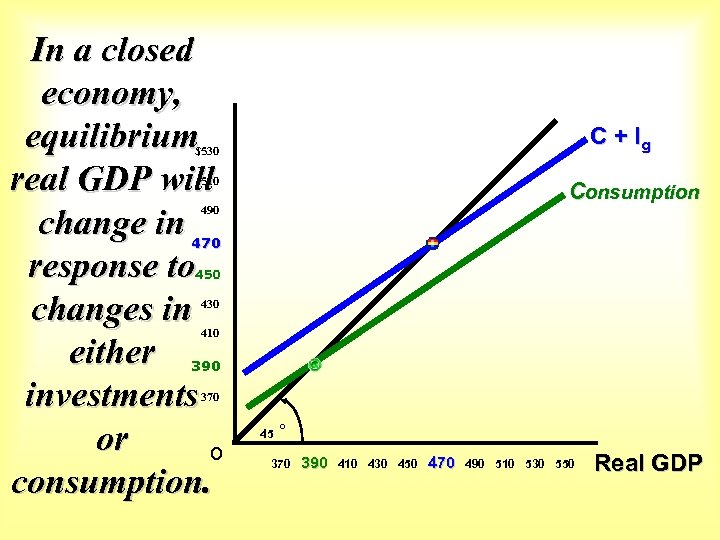 In a closed economy, equilibrium real GDP will change in response to changes in either investments or o consumption. C + Ig $530 510 Consumption 490 470 450 430 410 390 370 45 o 370 390 410 430 450 470 490 510 530 550 Real GDP
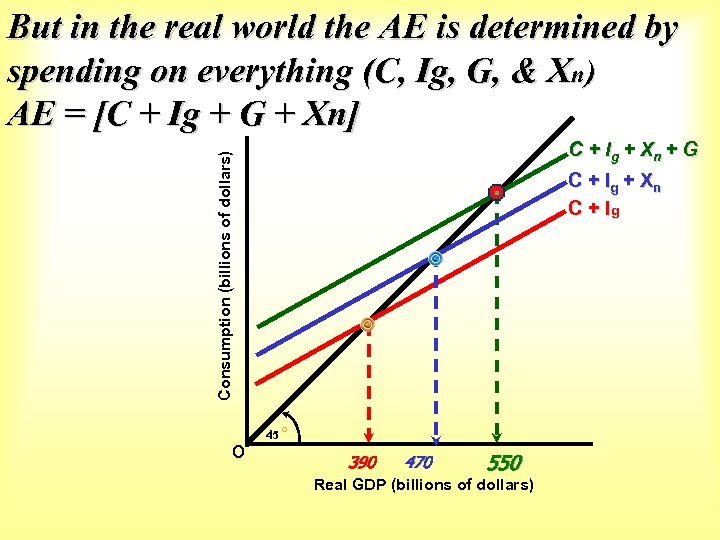 But in the real world the AE is determined by spending on everything (C, Ig, G, & Xn) AE = [C + Ig + G + Xn] Consumption (billions of dollars) C + Ig + Xn + G o C + Ig + Xn C + Ig 45 o 390 470 550 Real GDP (billions of dollars)
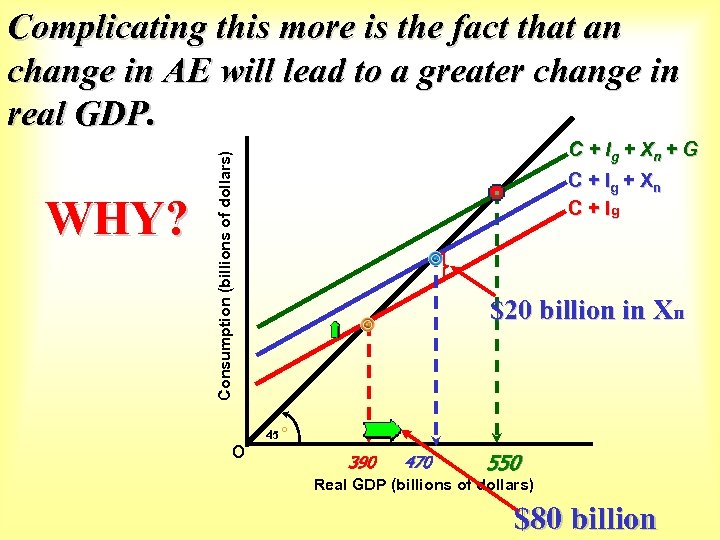 Complicating this more is the fact that an change in AE will lead to a greater change in real GDP. Consumption (billions of dollars) WHY? C + Ig + Xn + G o C + Ig + Xn C + Ig $20 billion in Xn 45 o 390 470 550 Real GDP (billions of dollars) $80 billion
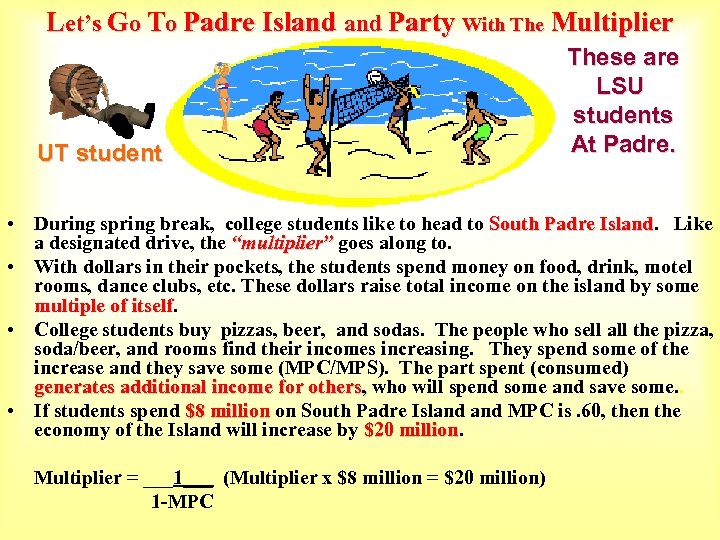 Let’s Go To Padre Island Party With The Multiplier UT student These are LSU students At Padre. • During spring break, college students like to head to South Padre Island. Like Island a designated drive, the “multiplier” goes along to. • With dollars in their pockets, the students spend money on food, drink, motel rooms, dance clubs, etc. These dollars raise total income on the island by some multiple of itself • College students buy pizzas, beer, and sodas. The people who sell all the pizza, soda/beer, and rooms find their incomes increasing. They spend some of the increase and they save some (MPC/MPS). The part spent (consumed) generates additional income for others, who will spend some and save some. . • If students spend $8 million on South Padre Island MPC is. 60, then the economy of the Island will increase by $20 million Multiplier = ___1___ (Multiplier x $8 million = $20 million) 1 -MPC
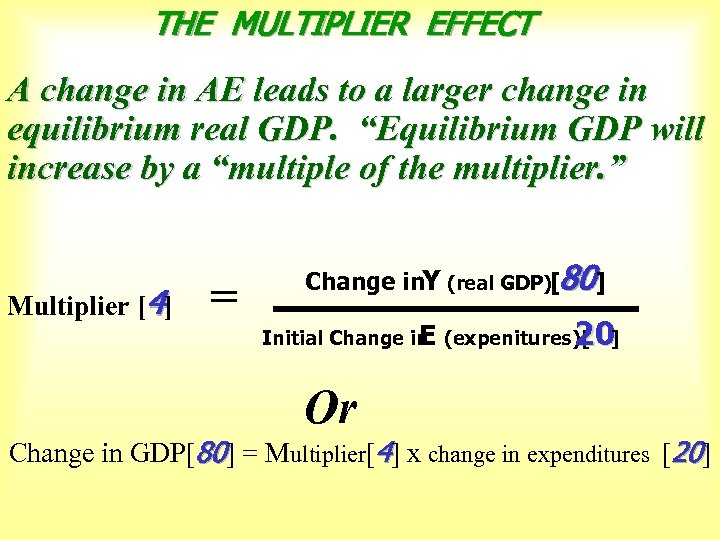 THE MULTIPLIER EFFECT A change in AE leads to a larger change in equilibrium real GDP. “Equilibrium GDP will increase by a “multiple of the multiplier. ” Multiplier [4] = Change in. Y (real GDP)[80] 20] Initial Change in (expenitures)[ E Or Change in GDP[80] = Multiplier[4] x change in expenditures [20]
 Three things to remember about the multiplier; • The multiplier will affect, investment spending, net exports, and government purchases. • The change in spending will result in an upward or downward shift in the AE schedule. • The multiplier effect works in both directions (shifts of the AE schedule. )
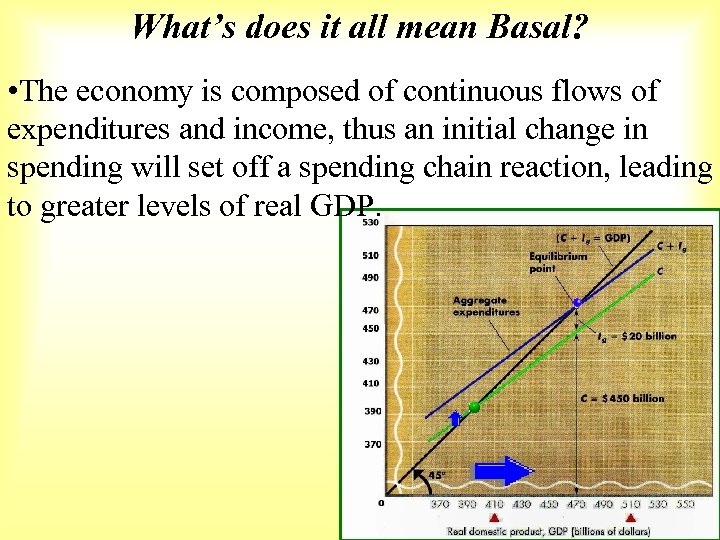 What’s does it all mean Basal? • The economy is composed of continuous flows of expenditures and income, thus an initial change in spending will set off a spending chain reaction, leading to greater levels of real GDP.
 Since the multiplier effect is determined by MPC (how much of our new money we consume in the economy), the smaller the MPS the greater the multiplier. Inverse relationship between MPS & Multiplier MPS Multiplier
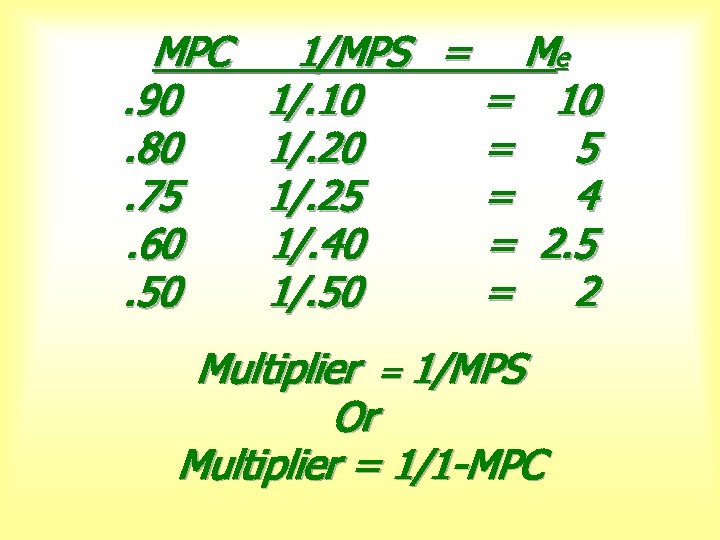 MPC. 90. 80. 75. 60. 50 1/MPS = Me 1/. 10 = 10 1/. 20 = 5 1/. 25 = 4 1/. 40 = 2. 5 1/. 50 = 2 Multiplier = 1/MPS Or Multiplier = 1/1 -MPC
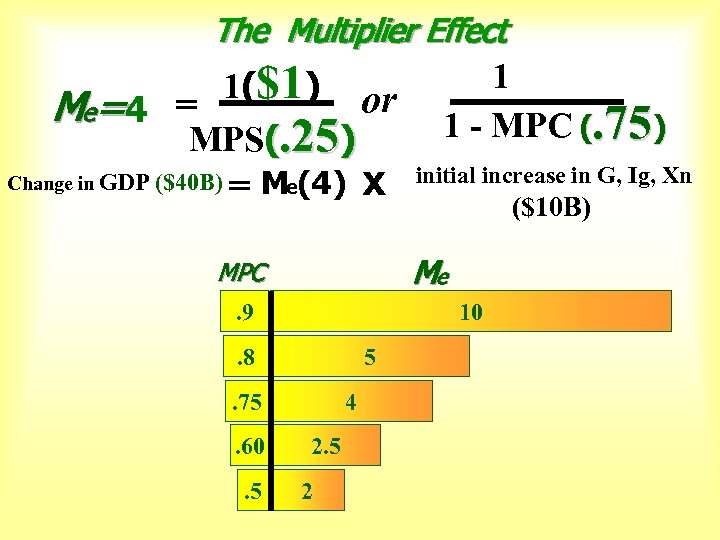 The Multiplier Effect 1($1) or M e= 4 = MPS(. 25) Change in GDP ($40 B) = Me(4) x . 9 ($10 B) 10 . 8 5 . 75 . 5 initial increase in G, Ig, Xn Me MPC . 60 1 1 - MPC (. 75) 4 2. 5 2
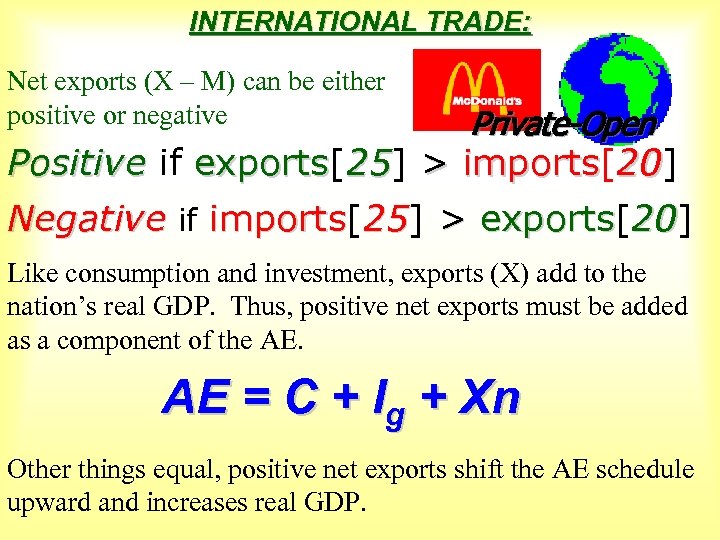 INTERNATIONAL TRADE: Net exports (X – M) can be either positive or negative Private-Open Positive if exports[25] > imports[20] exports 25 imports 20 Negative if imports[25] > exports[20] imports 25 exports 20 Like consumption and investment, exports (X) add to the nation’s real GDP. Thus, positive net exports must be added as a component of the AE. AE = C + Ig + Xn Other things equal, positive net exports shift the AE schedule upward and increases real GDP.
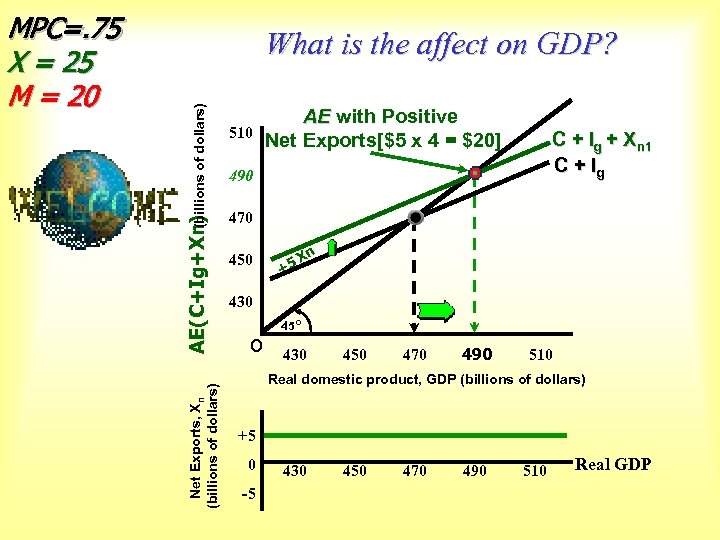 AE(C+Ig+Xn) (billions of dollars) What is the affect on GDP? Net Exports, Xn (billions of dollars) MPC=. 75 X = 25 M = 20 510 AE with Positive Net Exports[$5 x 4 = $20] C + Ig + Xn 1 C + Ig 490 470 450 X +5 n 430 o 45 o 430 450 470 490 510 Real domestic product, GDP (billions of dollars) +5 0 -5 430 450 470 490 510 Real GDP
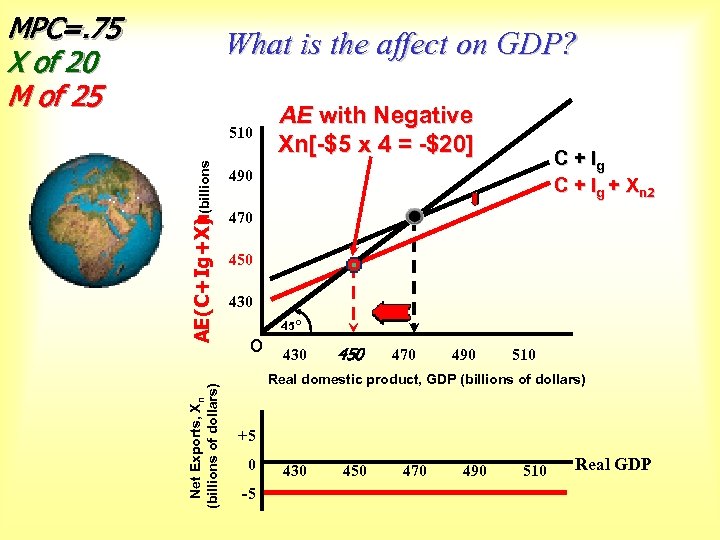 MPC=. 75 X of 20 M of 25 What is the affect on GDP? Net Exports, Xn (billions of dollars) AE(C+Ig+Xn(billions ) 510 AE with Negative Xn[-$5 x 4 = -$20] C + Ig + Xn 2 490 470 450 430 o 45 o 430 450 470 490 510 Real domestic product, GDP (billions of dollars) +5 0 -5 430 450 470 490 510 Real GDP
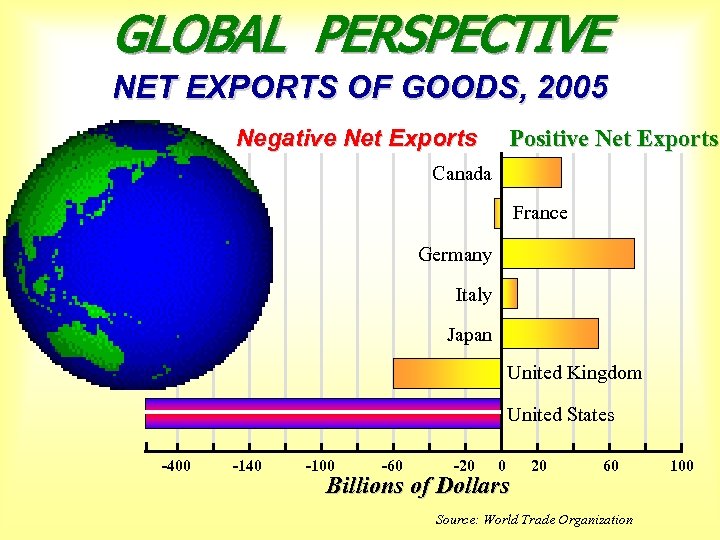 GLOBAL PERSPECTIVE NET EXPORTS OF GOODS, 2005 Negative Net Exports Positive Net Exports Canada France Germany Italy Japan United Kingdom United States -400 -140 -100 -60 -20 0 Billions of Dollars 20 60 Source: World Trade Organization 100
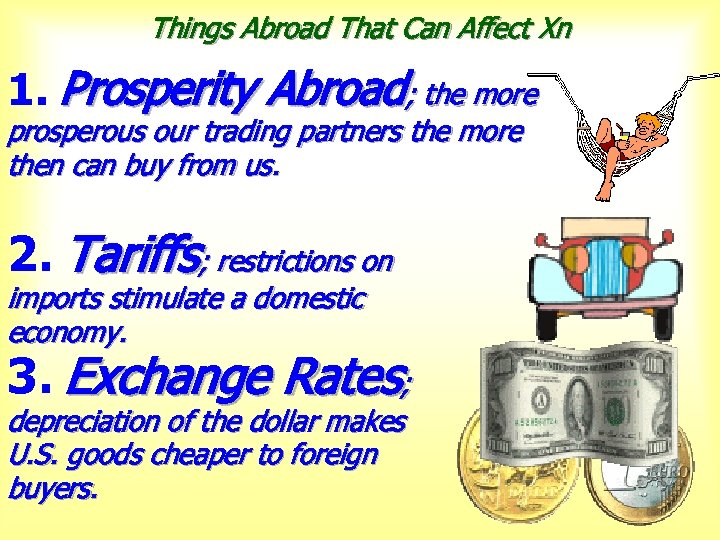 Things Abroad That Can Affect Xn 1. Prosperity Abroad; the more prosperous our trading partners the more then can buy from us. 2. Tariffs; restrictions on imports stimulate a domestic economy. 3. Exchange Rates; depreciation of the dollar makes U. S. goods cheaper to foreign buyers.
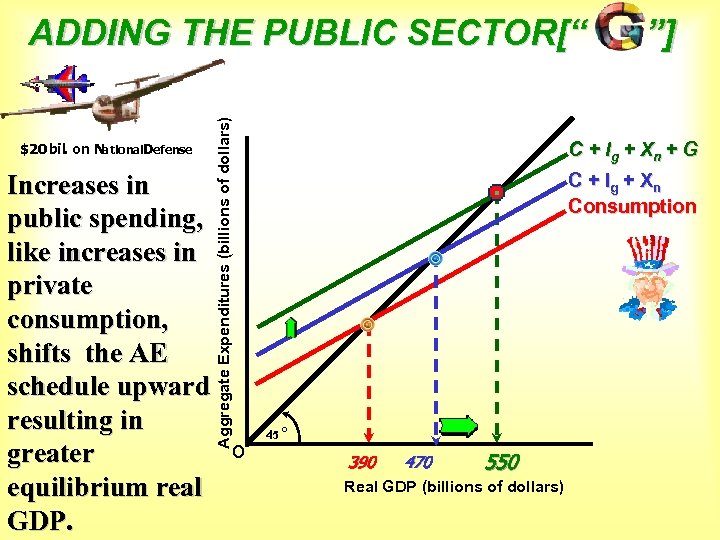 $20 bil. on National. Defense Aggregate Expenditures (billions of dollars) ADDING THE PUBLIC SECTOR[“ Increases in public spending, like increases in private consumption, shifts the AE schedule upward resulting in o greater equilibrium real GDP. ”] C + Ig + Xn + G C + Ig + Xn Consumption 45 o 390 470 550 Real GDP (billions of dollars)
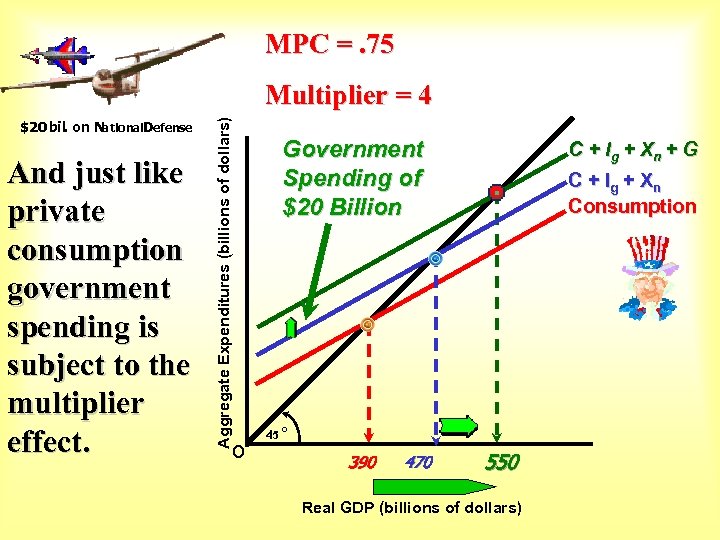 MPC =. 75 $20 bil. on National. Defense And just like private consumption government spending is subject to the multiplier effect. Aggregate Expenditures (billions of dollars) Multiplier = 4 Government Spending of $20 Billion o 45 C + Ig + Xn + G C + Ig + Xn Consumption o 390 470 550 Real GDP (billions of dollars)
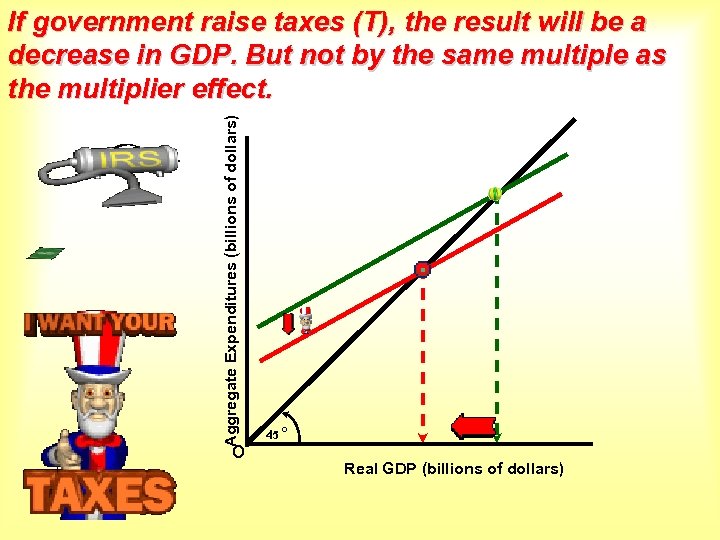 Aggregate Expenditures (billions of dollars) If government raise taxes (T), the result will be a decrease in GDP. But not by the same multiple as the multiplier effect. o 45 o Real GDP (billions of dollars)
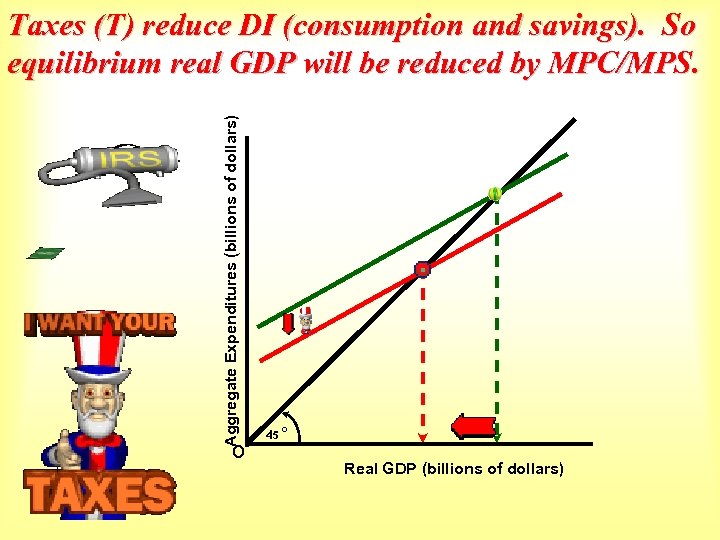 Aggregate Expenditures (billions of dollars) Taxes (T) reduce DI (consumption and savings). So equilibrium real GDP will be reduced by MPC/MPS. o 45 o Real GDP (billions of dollars)
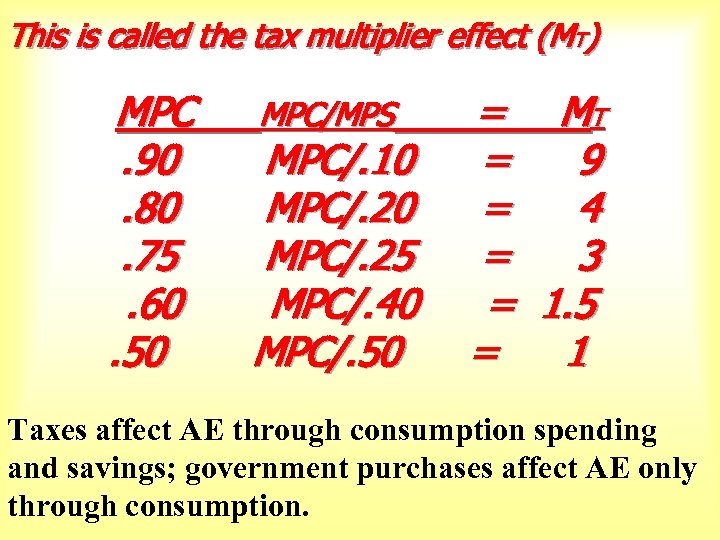 This is called the tax multiplier effect (MT) MPC. 90. 80. 75. 60. 50 MPC/MPS MPC/. 10 MPC/. 25 MPC/. 40 MPC/. 50 = MT = 9 = 4 = 3 = 1. 5 = 1 Taxes affect AE through consumption spending and savings; government purchases affect AE only through consumption.
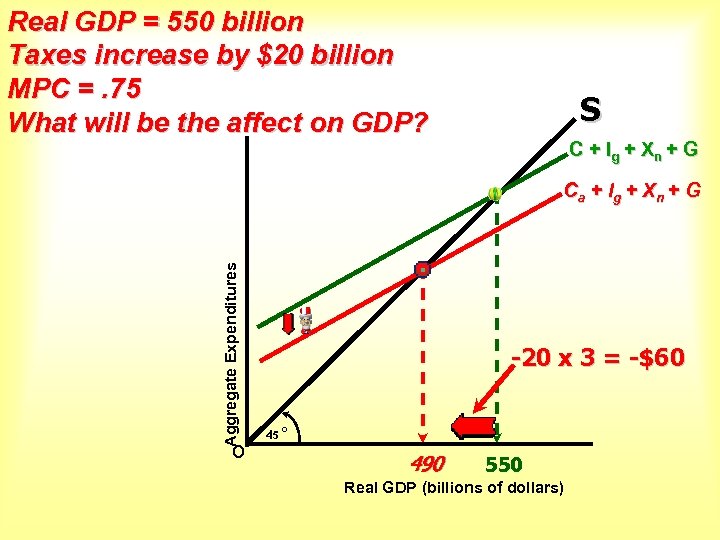 Real GDP = 550 billion Taxes increase by $20 billion MPC =. 75 What will be the affect on GDP? S C + Ig + Xn + G Aggregate Expenditures Ca + I g + X n + G o -20 x 3 = -$60 45 o 490 550 Real GDP (billions of dollars)
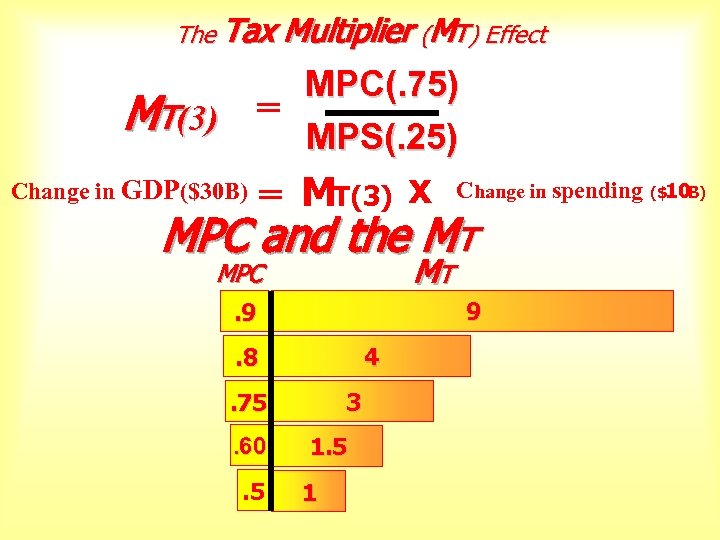 The Tax MT(3) = Change in GDP($30 B) Multiplier (MT) Effect MPC(. 75) MPS(. 25) = MT(3) x Change in spending ($10 B) MPC and the MT MT MPC 9 . 9 4 . 8. 75. 60. 5 3 1. 5 1
![Balanced Budget Multiplier [$20 billion] Net Change in GDP = The increase in “T”](https://present5.com/presentation/ba28d19e0d897d10fe7165840a1e3352/image-25.jpg "Balanced Budget Multiplier [$20 billion] Net Change in GDP = The increase in “T”") Balanced Budget Multiplier [$20 billion] Net Change in GDP = The increase in “T” means we will consumed $15 less and save $5 less. Sa= -$5 T $20 Ca= -$15 The increase in “G” flows directly into the economy. +$20 GDP = -$60 GDP = $80 G $20 ME = 1/MPS ME = 1/. 25 = 4 MT = MPC/MPS=. 75/. 25= 3 So, 4 x $20 = $80 So, 3 x -$20= -$60 MPC =. 75
Balanced Budget Multiplier [$20 billion] Net Change in GDP = The increase in “T” means we will consumed $15 less and save $5 less. Sa= -$5 T $20 Ca= -$15 The increase in “G” flows directly into the economy. +$20 GDP = -$60 GDP = $80 G $20 ME = 1/MPS ME = 1/. 25 = 4 MT = MPC/MPS=. 75/. 25= 3 So, 4 x $20 = $80 So, 3 x -$20= -$60 MPC =. 75
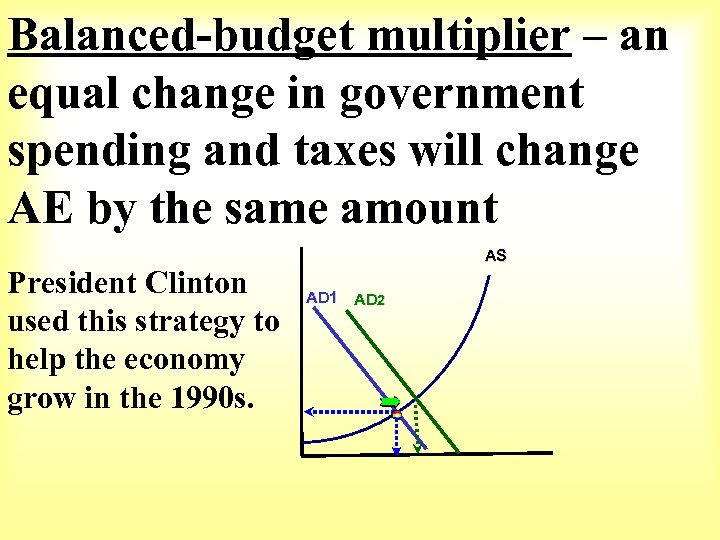 Balanced-budget multiplier – an equal change in government spending and taxes will change AE by the same amount President Clinton used this strategy to help the economy grow in the 1990 s. AS AD 1 AD 2
 When the economy falters, Presidents Use Their Facial Leadership to Coerce Congress To Help The Economy So They Can Win Re-election.
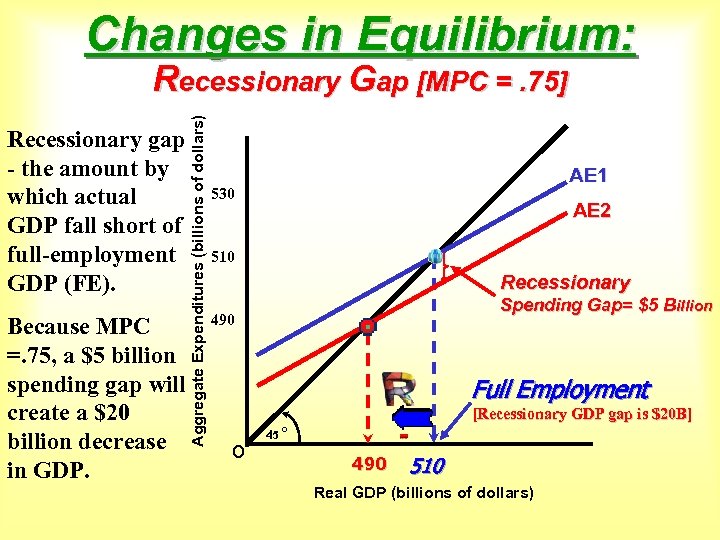 Changes in Equilibrium: Recessionary gap - the amount by which actual GDP fall short of full-employment GDP (FE). Because MPC =. 75, a $5 billion spending gap will create a $20 billion decrease in GDP. Aggregate Expenditures (billions of dollars) Recessionary Gap [MPC =. 75] AE 1 530 AE 2 510 Recessionary Spending Gap= $5 Billion 490 Full Employment o 45 [Recessionary GDP gap is $20 B] o 490 510 Real GDP (billions of dollars)
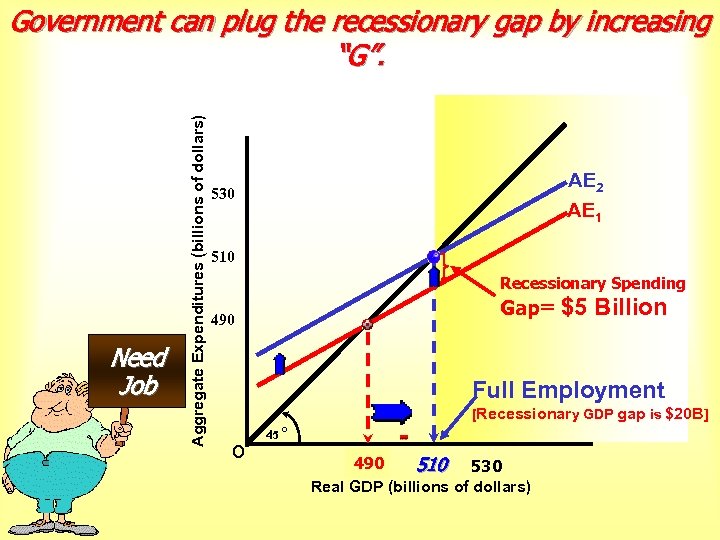 Need Job Aggregate Expenditures (billions of dollars) Government can plug the recessionary gap by increasing “G”. AE 2 AE 1 530 510 Recessionary Spending Gap = 490 $5 Billion Full Employment [Recessionary GDP gap is $20 B] o 45 o 490 510 530 Real GDP (billions of dollars)
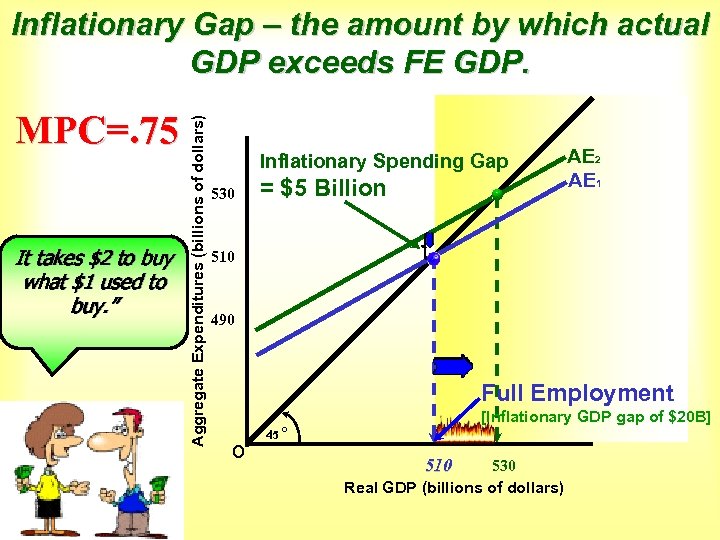 MPC=. 75 It takes $2 to buy what $1 used to buy. ” Aggregate Expenditures (billions of dollars) Inflationary Gap – the amount by which actual GDP exceeds FE GDP. Inflationary Spending Gap 530 = $5 Billion AE 2 AE 1 510 490 Full Employment o 45 [Inflationary GDP gap of $20 B] o 510 530 Real GDP (billions of dollars)
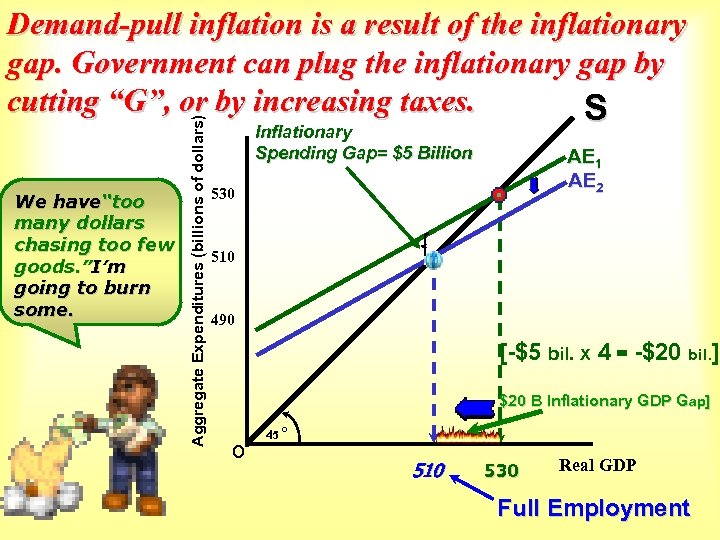 We have“too many dollars chasing too few goods. ”I’m going to burn some. Aggregate Expenditures (billions of dollars) Demand-pull inflation is a result of the inflationary gap. Government can plug the inflationary gap by cutting “G”, or by increasing taxes. S Inflationary Spending Gap= $5 Billion AE 1 AE 2 530 510 490 [-$5 bil. X 4 = -$20 bil. ] $20 B Inflationary GDP Gap] o 45 o 510 530 Real GDP Full Employment
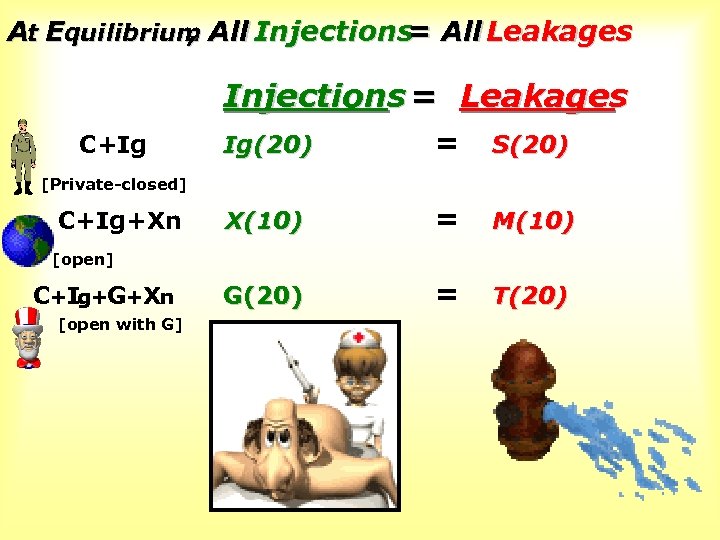 At Equilibrium All Injections All Leakages , = Injections = Leakages C+Ig Ig(20) = S(20) X(10) = M(10) G(20) = T(20) [Private-closed] C+Ig+Xn [open] C+Ig+G+Xn [open with G]
 The End