


 Скачать презентацию Advisory Group on Outreach of ISO TC 211 Standards
79cd3cfbc39de9063d3fa89aeb75fb2c.ppt
- Количество слайдов: 65
 Advisory Group on Outreach of ISO/TC 211 Standards in Action Workshop ISO/TC 211 23 rd meeting in Riyadh, KSA - November 13, 2006 ISO based Integration of Geoinformation in Germany for European Spatial Data Infrastructure Hans Knoop, Germany ISO/TC 211 – CEN/TC 287 - DIN
 Advisory Group on Outreach of ISO/TC 211 Standards in Action Workshop ISO/TC 211 23 rd meeting in Riyadh, KSA - November 13, 2006 ISO based Integration of Geoinformation in Germany for European Spatial Data Infrastructure Hans Knoop, Germany Technical University of Braunschweig DIN • German Institute for Standardization, Head of Section 03 Head of German Delegation and Co-Chair, Advisory Groups on Outreach, to ISO/TC 211 and CEN/TC 287 • Representative of ISPRS to ISO/TC 211 Formerly Ministry of the Intereor of Lower Saxony
 Agenda • Introduction • International Standardization (ISO/TC 211, OGC, …) • European Standardization (CEN/TC 287) • Europe (INSPIRE) • Germany (AAA-System) • Benefits of Standardization Hans Knoop ISO-based Integration of Geoinformation for European Spatial Data Infrastructure in Germany Riyadh, November 13, 2006
 Agenda • Introduction • International Standardization (ISO/TC 211, OGC, …) • European Standardization (CEN/TC 287) • Europe (INSPIRE) • Germany (AAA-System) • Benefits of Standardization Hans Knoop ISO-based Integration of Geoinformation for European Spatial Data Infrastructure in Germany Riyadh, November 13, 2006
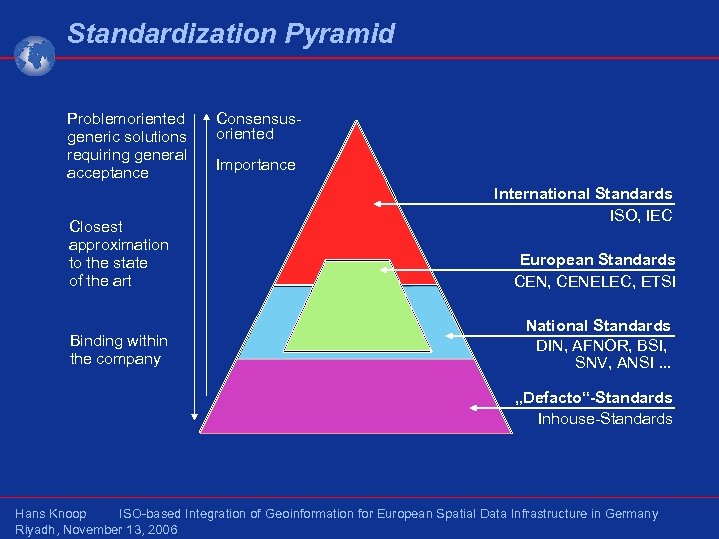 Standardization Pyramid Problemoriented generic solutions requiring general acceptance Closest approximation to the state of the art Binding within the company Consensusoriented Importance International Standards ISO, IEC European Standards CEN, CENELEC, ETSI National Standards DIN, AFNOR, BSI, SNV, ANSI. . . „Defacto“-Standards Inhouse-Standards Hans Knoop ISO-based Integration of Geoinformation for European Spatial Data Infrastructure in Germany Riyadh, November 13, 2006
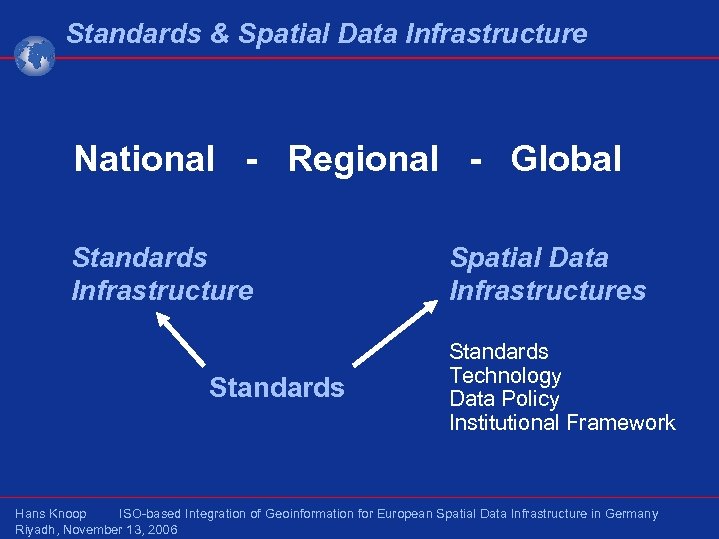 Standards & Spatial Data Infrastructure National - Regional - Global Standards Infrastructure Standards Spatial Data Infrastructures Standards Technology Data Policy Institutional Framework Hans Knoop ISO-based Integration of Geoinformation for European Spatial Data Infrastructure in Germany Riyadh, November 13, 2006
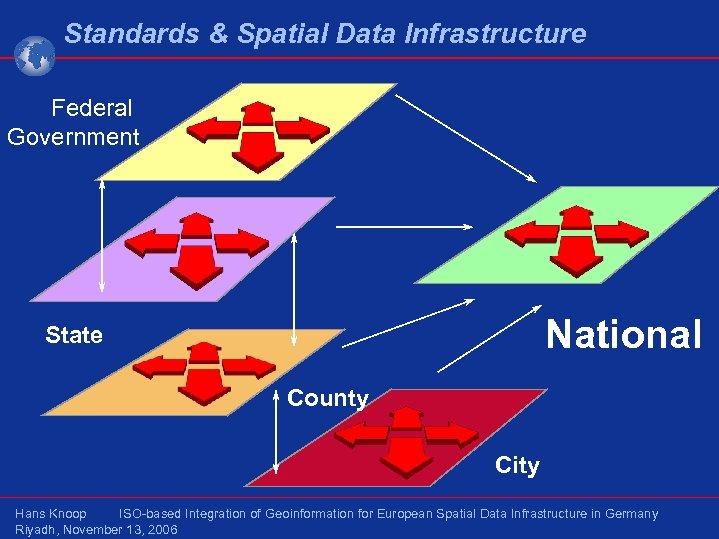 Standards & Spatial Data Infrastructure Federal Government National State County City Hans Knoop ISO-based Integration of Geoinformation for European Spatial Data Infrastructure in Germany Riyadh, November 13, 2006
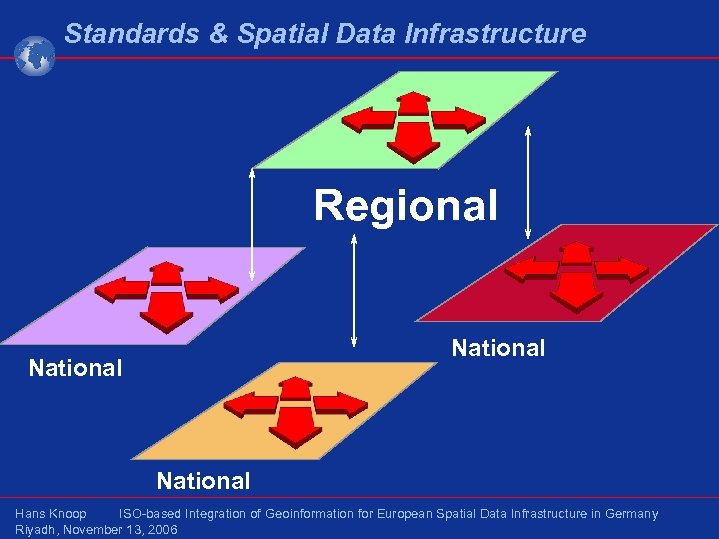 Standards & Spatial Data Infrastructure Regional National Hans Knoop ISO-based Integration of Geoinformation for European Spatial Data Infrastructure in Germany Riyadh, November 13, 2006
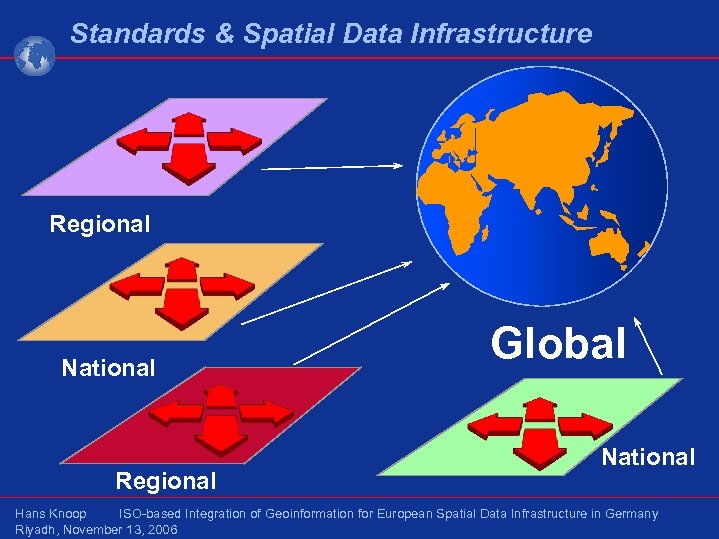 Standards & Spatial Data Infrastructure Regional National Regional Global National Hans Knoop ISO-based Integration of Geoinformation for European Spatial Data Infrastructure in Germany Riyadh, November 13, 2006
 ISO/TC 211 Advisory Group on Outreach Mission Promote the awareness, adoption, and advocacy of ISO/TC 211 standards in user communities. Hans Knoop ISO-based Integration of Geoinformation for European Spatial Data Infrastructure in Germany Riyadh, November 13, 2006
 User Communities CEOS, Committee on Earth Observation Satellites DGIWG, Digital Geographic Information Working Group EPSG, European Petroleum Survey Group FIG, International Federation of Surveyors GSDI, Global Spatial Data Infrastructure IAG, International Association of Geodesy ICA, International Cartographic Association ICAO, International Civil Aviation Organization IEEE, Geoscience and Remote Sensing Society IHB, International Hydrographic Bureau ISCGM, International Steering Committee for Global Mapping ISPRS, International Society for Photogrammetry and Remote Sensing JRC, Joint Research Centre, European Commission OGC, Open Geospatial Consortium Hans Knoop ISO-based Integration of Geoinformation for European Spatial Data Infrastructure in Germany Riyadh, November 13, 2006
 User Communities PCGIAP, Permanent Committee on GIS Infrastructure for Asia and the Pacific UNECE Economic Commission for Europe, Statistical Division UNFAO Food and Agriculture Organization UNGEGN, United Nations Group of Experts on Geographic Names UNGIWG, United Nations Geographic Information Working Group WMO, World Meteorological Organization PCIDEA, Permanent Committee on Spatial Data Infrastructure for the Americas SCAR, Scientific Committee on Antarctic Research CEN/TC 287, Geographic information … All these enumerated user communities are the external liaison organizations to ISO/TC 211 Geographic information / Geomatics Hans Knoop ISO-based Integration of Geoinformation for European Spatial Data Infrastructure in Germany Riyadh, November 13, 2006
 ISO/TC 211 & OGC 1994 • ISO/TC 211 - de jure formal standards technical committee • OGC - de facto industry technical specifications • 1999 - OGC - ISO/TC 211 Class A Liaison status • ISO/TC 211 & OGC Joint Advisory Group (JAG) • ISO standardization of OGC specifications: Simple Features Access, Web Mapping Server Interface • Jointly develop the Imagery & gridded data Reference Model, Framework, and the OGC Sensor Markup Language • Geography Markup Language (GML) etc. Hans Knoop ISO-based Integration of Geoinformation for European Spatial Data Infrastructure in Germany Riyadh, November 13, 2006
 UNFAO - UN/Food and Agricultural Organisation LCCS Land Cover Classification System GLCN Global Land Cover Network Hans Knoop ISO-based Integration of Geoinformation for European Spatial Data Infrastructure in Germany Riyadh, November 13, 2006
 Agenda • Introduction • International Standardization (ISO/TC 211, OGC, …) • European Standardization (CEN/TC 287) • Europe (INSPIRE) • Germany (AAA-System) • Benefits of Standardization Hans Knoop ISO-based Integration of Geoinformation for European Spatial Data Infrastructure in Germany Riyadh, November 13, 2006
 Regional Activities European New Activities • INSPIRE • EUROGEOGRAPHICS • CEN/TC 287 reestablished 10. /11. November 2003 Plenary 1 Working Group Advisory Group on Outreach Hans Knoop ISO-based Integration of Geoinformation for European Spatial Data Infrastructure in Germany Riyadh, November 13, 2006
 Implications of Standards Initial International Interoperability INSPIRE INfrastructure for SPatial Info. Rmation in European Spatial Data Infrastructure ISO/TC 211 & Open Geospatial Consortium standards & specifications Europe - initial interoperability testing ground Hans Knoop ISO-based Integration of Geoinformation for European Spatial Data Infrastructure in Germany Riyadh, November 13, 2006
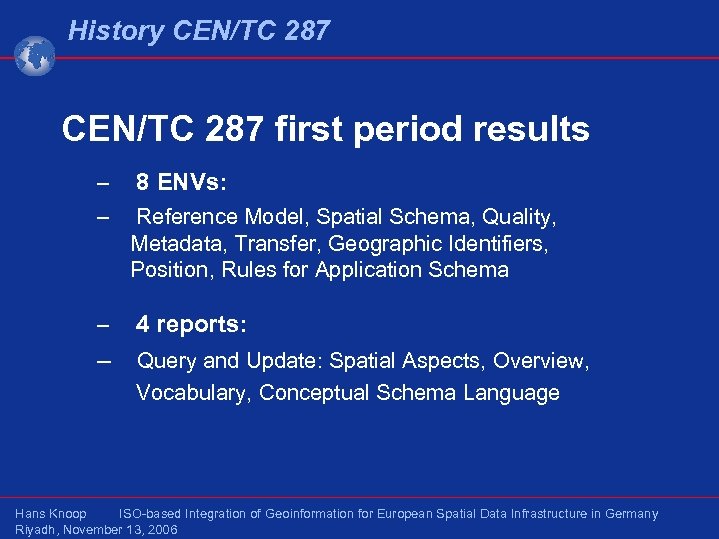 History CEN/TC 287 first period results – 8 ENVs: – Reference Model, Spatial Schema, Quality, Metadata, Transfer, Geographic Identifiers, Position, Rules for Application Schema – 4 reports: – Query and Update: Spatial Aspects, Overview, Vocabulary, Conceptual Schema Language Hans Knoop ISO-based Integration of Geoinformation for European Spatial Data Infrastructure in Germany Riyadh, November 13, 2006
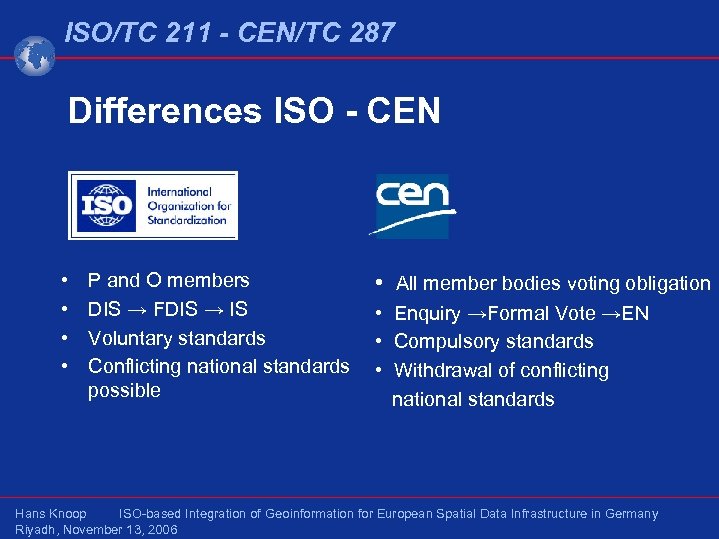 ISO/TC 211 - CEN/TC 287 Differences ISO - CEN • • P and O members DIS → FDIS → IS Voluntary standards Conflicting national standards possible • All member bodies voting obligation • Enquiry →Formal Vote →EN • Compulsory standards • Withdrawal of conflicting national standards Hans Knoop ISO-based Integration of Geoinformation for European Spatial Data Infrastructure in Germany Riyadh, November 13, 2006
 Agenda • Introduction • International Standardization (ISO/TC 211, OGC, …) • European Standardization (CEN/TC 287) • Europe (INSPIRE) • Germany (AAA-System) • Benefits of Standardization Hans Knoop ISO-based Integration of Geoinformation for European Spatial Data Infrastructure in Germany Riyadh, November 13, 2006
 Agenda GSDI in Europe - INSPIRE Infrastructure for Spatial Information in Europe Hans Knoop ISO-based Integration of Geoinformation for European Spatial Data Infrastructure in Germany Riyadh, November 13, 2006
 Memorandum of understanding between Commissioners Wallstróm, Solbes, Busquin 11 April 2002 The European Sustainable Development Strategy advocates a new approach to policy-making through more coherence in the Community policies. An information base that provides detailed relevant harmonised spatial information for different policy areas and that is commonly accessible could significantly contribute to this objective. Currently, exploitation of the potential of GI is hampered by lack of standards, of data and of a coherent data policy. A Community initiative to address these difficulties could unlock a vast potential of information and information services. . . Standardisation of GI services would furthermore open up new ways of communication, narrowing the gap between Europe and its citizens. © 2005 by ies Hans Knoop ISO-based Integration of Geoinformation for European Spatial Data Infrastructure in Germany Riyadh, November 13, 2006
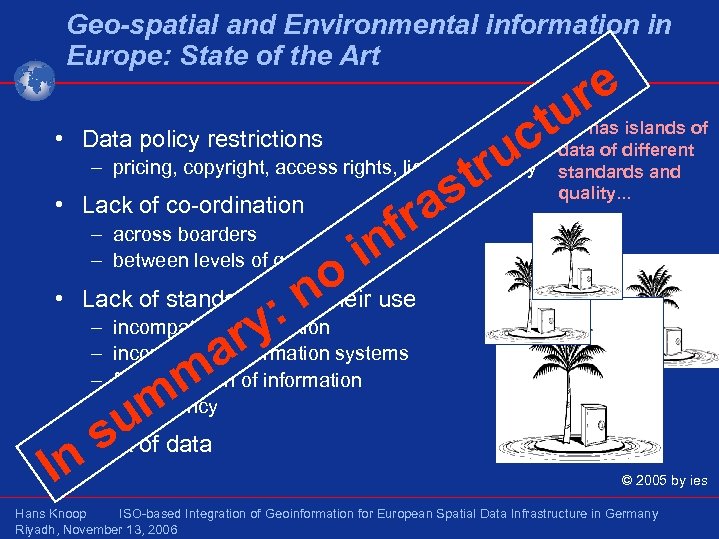 Geo-spatial and Environmental information in Europe: State of the Art re tu c • Data policy restrictions ru t s – pricing, copyright, access rights, licensing policy • Lack of co-ordination in – across boarders – between levels of government : y o n ra f EU has islands of data of different standards and quality. . . • Lack of standards and their use – – r a incompatible information systems fragmentation of information redundancy m m suof data • Lack In © 2005 by ies Hans Knoop ISO-based Integration of Geoinformation for European Spatial Data Infrastructure in Germany Riyadh, November 13, 2006
 Overall context • Increasing calls for more information to support environmental policies at European and MS level • Difficulties to manage existing information flows and obtain timely, accurate and policy-relevant information • Need to take into account differentiation across regions with respect to the state of the environment • Revision of approach to reporting and monitoring, moving to concept of sharing of information • Spatial information plays a special role: early action needed EC Proposal COM(2004) 516 for a Directive establishing an infrastructure for spatial information in the Community - INSPIRE © 2005 by ies Hans Knoop ISO-based Integration of Geoinformation for European Spatial Data Infrastructure in Germany Riyadh, November 13, 2006
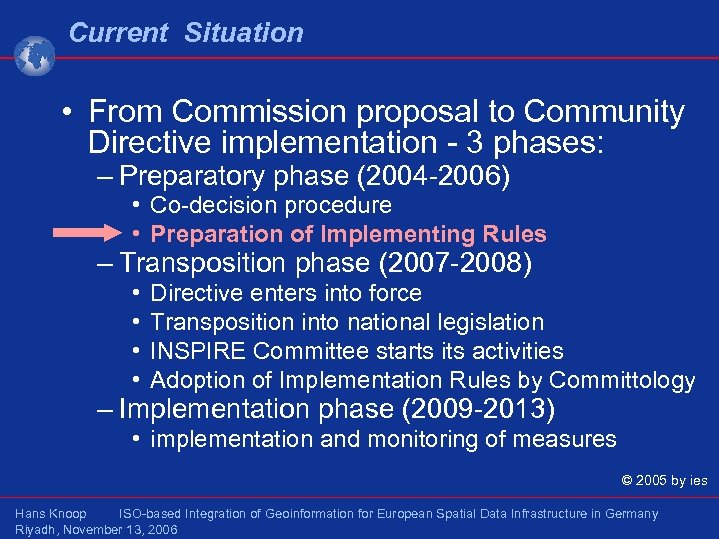 Current Situation • From Commission proposal to Community Directive implementation - 3 phases: – Preparatory phase (2004 -2006) • Co-decision procedure • Preparation of Implementing Rules – Transposition phase (2007 -2008) • • Directive enters into force Transposition into national legislation INSPIRE Committee starts its activities Adoption of Implementation Rules by Committology – Implementation phase (2009 -2013) • implementation and monitoring of measures © 2005 by ies Hans Knoop ISO-based Integration of Geoinformation for European Spatial Data Infrastructure in Germany Riyadh, November 13, 2006
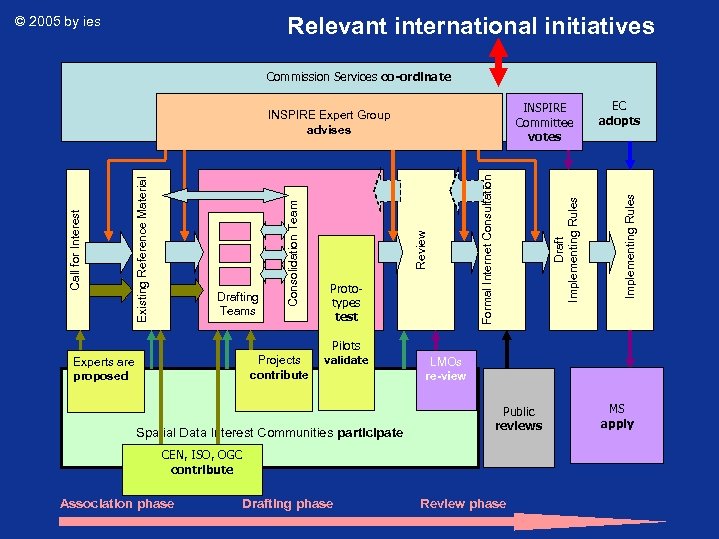 Relevant international initiatives © 2005 by ies Commission Services co-ordinate Draft Implementing Rules Prototypes test Formal Internet Consultation Review Consolidation Team Existing Reference Material Call for Interest Drafting Teams EC adopts Implementing Rules INSPIRE Committee votes INSPIRE Expert Group advises Pilots Projects contribute Experts are proposed validate Spatial Data Interest Communities participate LMOs re-view Public reviews CEN, ISO, OGC contribute Association phase Drafting phase Review phase MS apply
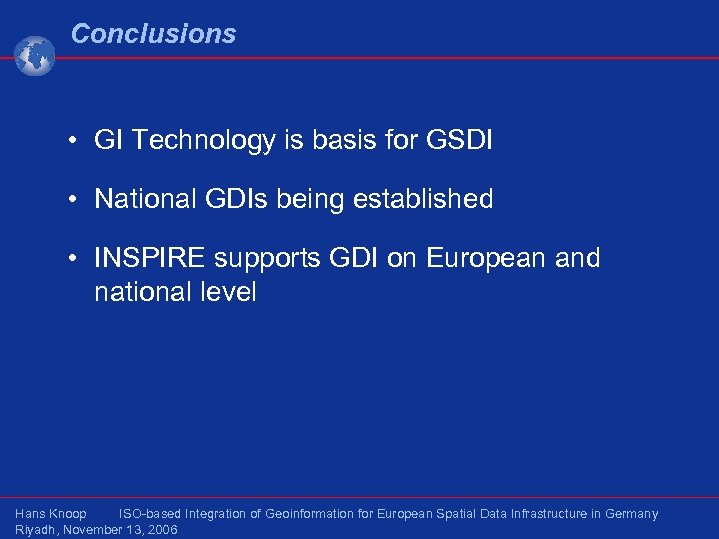 Conclusions • GI Technology is basis for GSDI • National GDIs being established • INSPIRE supports GDI on European and national level Hans Knoop ISO-based Integration of Geoinformation for European Spatial Data Infrastructure in Germany Riyadh, November 13, 2006
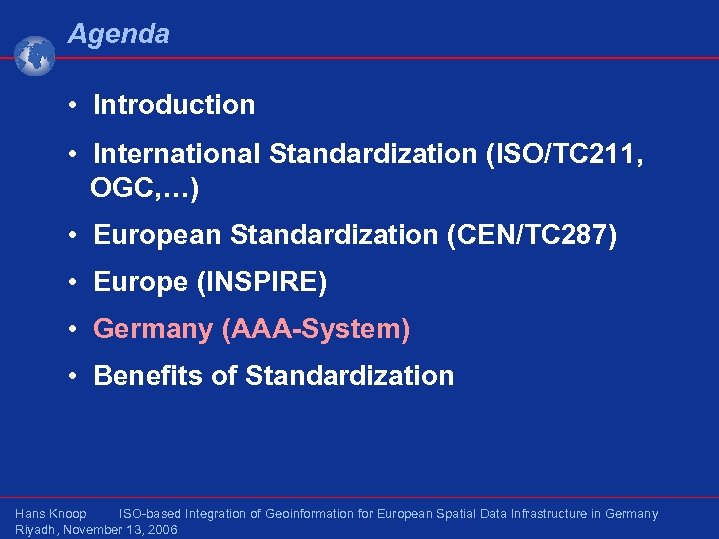 Agenda • Introduction • International Standardization (ISO/TC 211, OGC, …) • European Standardization (CEN/TC 287) • Europe (INSPIRE) • Germany (AAA-System) • Benefits of Standardization Hans Knoop ISO-based Integration of Geoinformation for European Spatial Data Infrastructure in Germany Riyadh, November 13, 2006
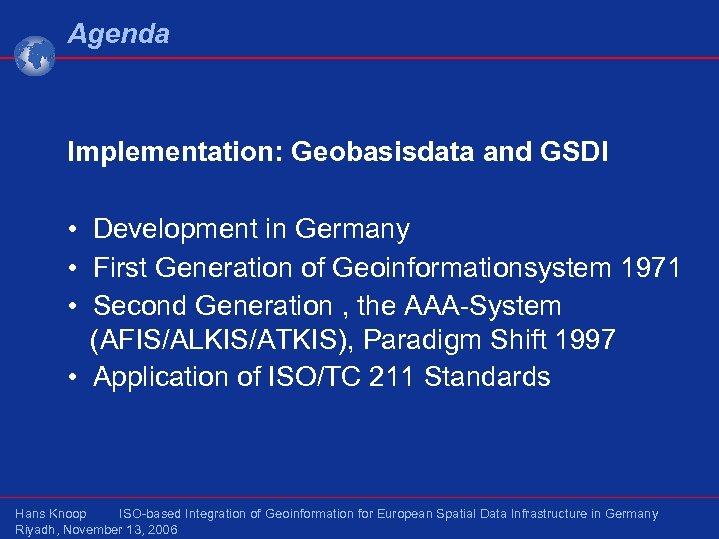 Agenda Implementation: Geobasisdata and GSDI • Development in Germany • First Generation of Geoinformationsystem 1971 • Second Generation , the AAA-System (AFIS/ALKIS/ATKIS), Paradigm Shift 1997 • Application of ISO/TC 211 Standards Hans Knoop ISO-based Integration of Geoinformation for European Spatial Data Infrastructure in Germany Riyadh, November 13, 2006
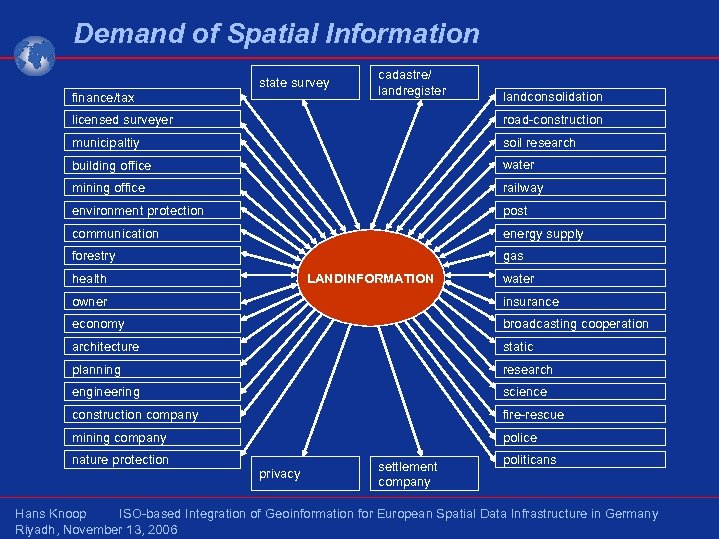 Demand of Spatial Information finance/tax state survey cadastre/ landregister landconsolidation licensed surveyer road-construction municipaltiy soil research building office water mining office railway environment protection post communication energy supply forestry gas LANDINFORMATION health water owner insurance economy broadcasting cooperation architecture static planning research engineering science construction company fire-rescue mining company police nature protection privacy settlement company politicans Hans Knoop ISO-based Integration of Geoinformation for European Spatial Data Infrastructure in Germany Riyadh, November 13, 2006
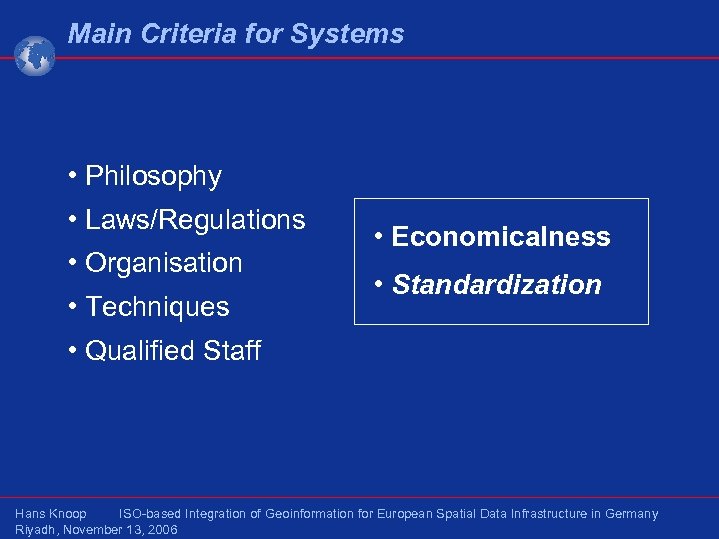 Main Criteria for Systems • Philosophy • Laws/Regulations • Organisation • Techniques • Economicalness • Standardization • Qualified Staff Hans Knoop ISO-based Integration of Geoinformation for European Spatial Data Infrastructure in Germany Riyadh, November 13, 2006
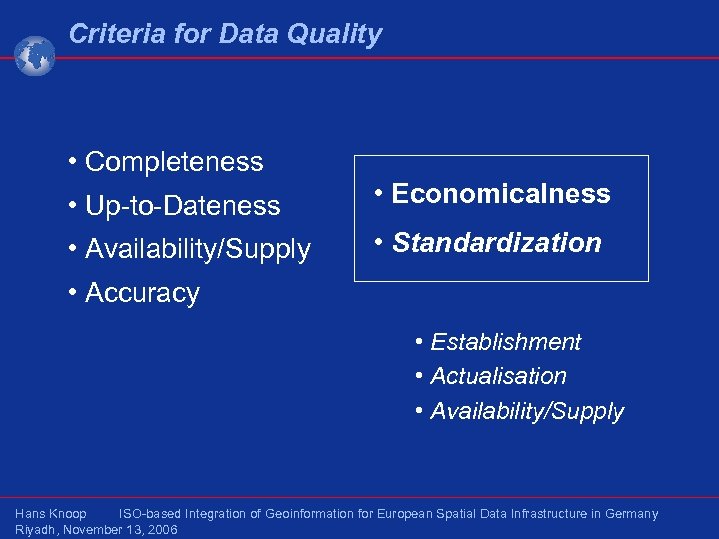 Criteria for Data Quality • Completeness • Up-to-Dateness • Economicalness • Availability/Supply • Standardization • Accuracy • Establishment • Actualisation • Availability/Supply Hans Knoop ISO-based Integration of Geoinformation for European Spatial Data Infrastructure in Germany Riyadh, November 13, 2006
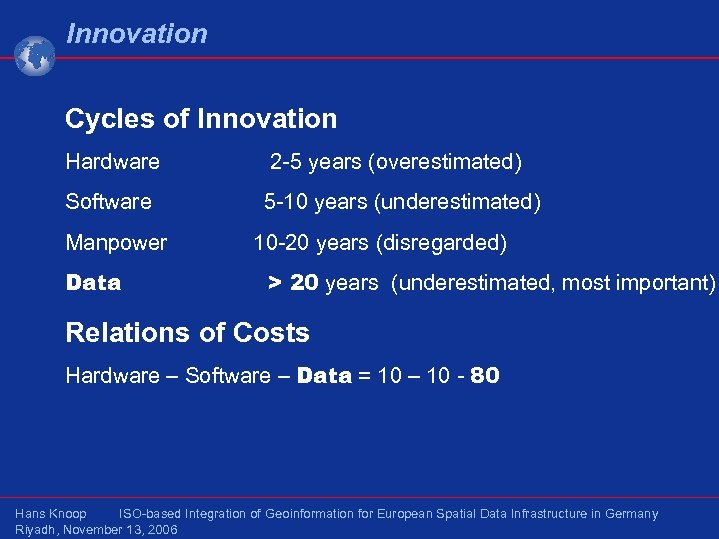 Innovation Cycles of Innovation Hardware 2 -5 years (overestimated) Software 5 -10 years (underestimated) Manpower Data 10 -20 years (disregarded) > 20 years (underestimated, most important) Relations of Costs Hardware – Software – Data = 10 – 10 - 80 Hans Knoop ISO-based Integration of Geoinformation for European Spatial Data Infrastructure in Germany Riyadh, November 13, 2006
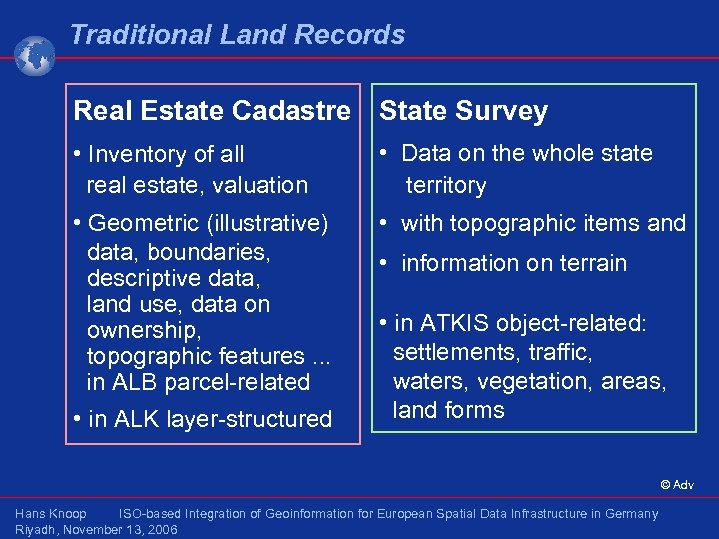 Traditional Land Records Real Estate Cadastre State Survey • Inventory of all real estate, valuation • Data on the whole state territory • Geometric (illustrative) data, boundaries, descriptive data, land use, data on ownership, topographic features. . . in ALB parcel-related • with topographic items and • in ALK layer-structured • information on terrain • in ATKIS object-related: settlements, traffic, waters, vegetation, areas, land forms © Adv Hans Knoop ISO-based Integration of Geoinformation for European Spatial Data Infrastructure in Germany Riyadh, November 13, 2006
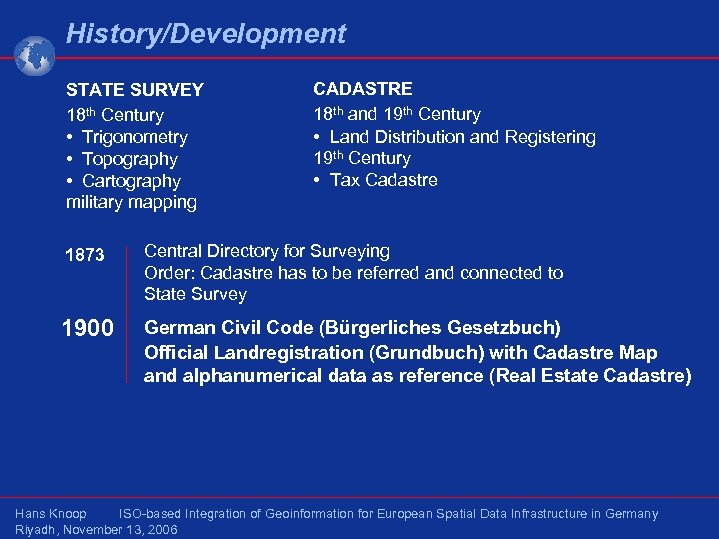 History/Development History STATE SURVEY 18 th Century • Trigonometry • Topography • Cartography military mapping CADASTRE 18 th and 19 th Century • Land Distribution and Registering 19 th Century • Tax Cadastre 1873 Central Directory for Surveying Order: Cadastre has to be referred and connected to State Survey 1900 German Civil Code (Bürgerliches Gesetzbuch) Official Landregistration (Grundbuch) with Cadastre Map and alphanumerical data as reference (Real Estate Cadastre) Hans Knoop ISO-based Integration of Geoinformation for European Spatial Data Infrastructure in Germany Riyadh, November 13, 2006
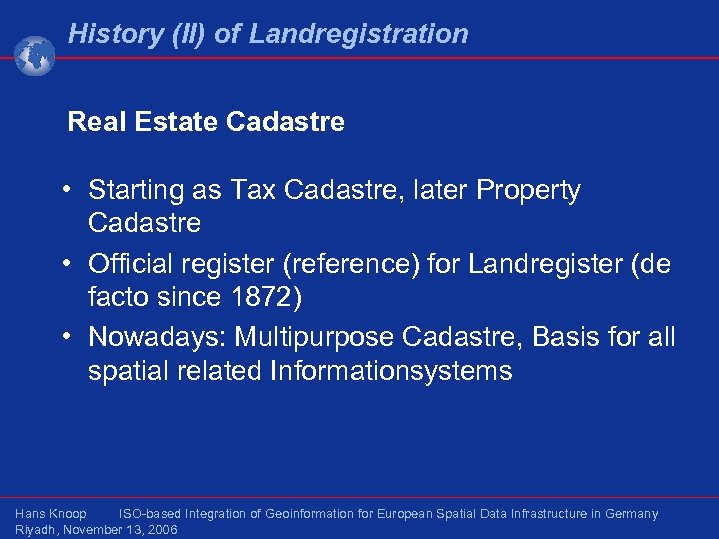 History (II) of Landregistration Real Estate Cadastre • Starting as Tax Cadastre, later Property Cadastre • Official register (reference) for Landregister (de facto since 1872) • Nowadays: Multipurpose Cadastre, Basis for all spatial related Informationsystems Hans Knoop ISO-based Integration of Geoinformation for European Spatial Data Infrastructure in Germany Riyadh, November 13, 2006
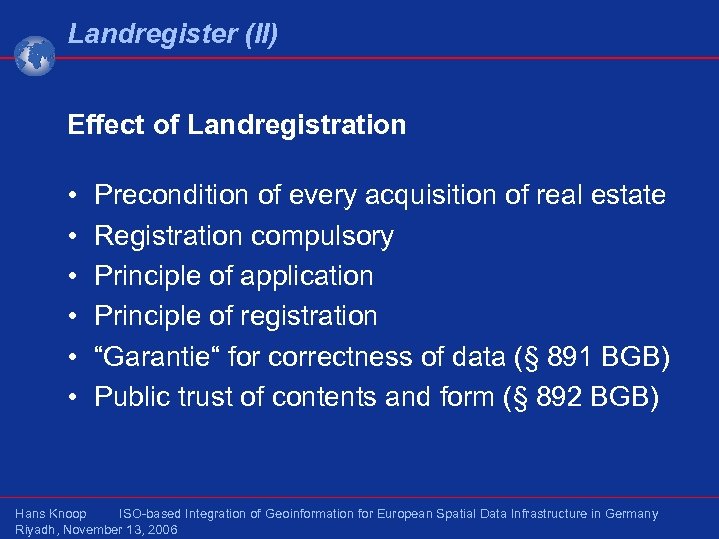 Landregister (II) Effect of Landregistration • • • Precondition of every acquisition of real estate Registration compulsory Principle of application Principle of registration “Garantie“ for correctness of data (§ 891 BGB) Public trust of contents and form (§ 892 BGB) Hans Knoop ISO-based Integration of Geoinformation for European Spatial Data Infrastructure in Germany Riyadh, November 13, 2006
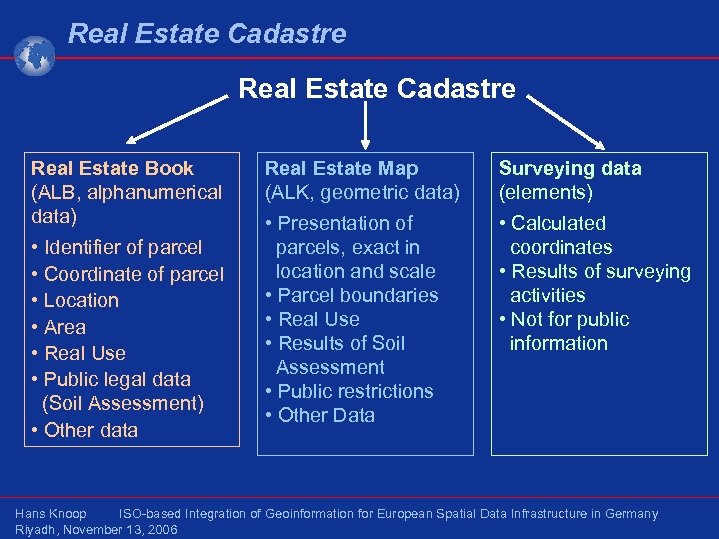 Real Estate Cadastre Real Estate Book (ALB, alphanumerical data) • Identifier of parcel • Coordinate of parcel • Location • Area • Real Use • Public legal data (Soil Assessment) • Other data Real Estate Map (ALK, geometric data) Surveying data (elements) • Presentation of parcels, exact in location and scale • Parcel boundaries • Real Use • Results of Soil Assessment • Public restrictions • Other Data • Calculated coordinates • Results of surveying activities • Not for public information Hans Knoop ISO-based Integration of Geoinformation for European Spatial Data Infrastructure in Germany Riyadh, November 13, 2006
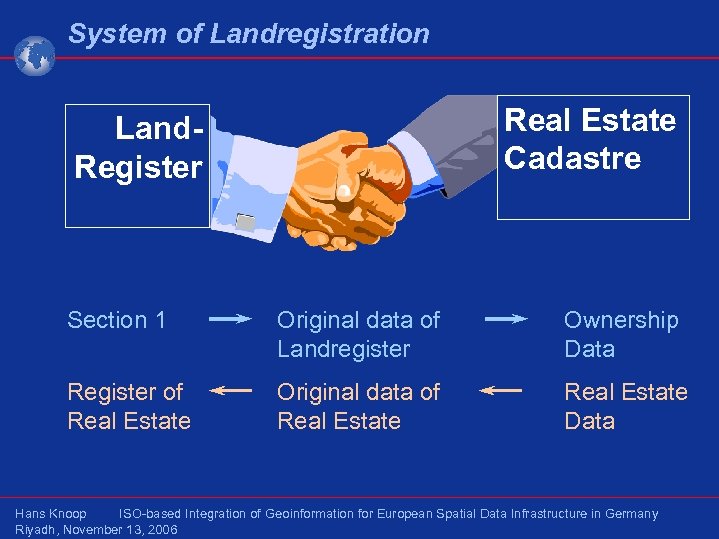 System of Landregistration Real Estate Cadastre Land. Register Section 1 Original data of Landregister Ownership Data Register of Real Estate Original data of Real Estate Data Hans Knoop ISO-based Integration of Geoinformation for European Spatial Data Infrastructure in Germany Riyadh, November 13, 2006
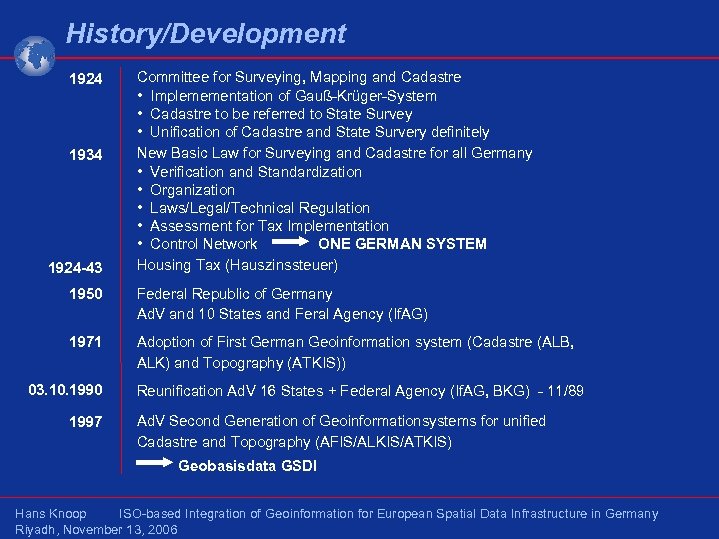 History/Development 1924 1934 1924 -43 Committee for Surveying, Mapping and Cadastre • Implemementation of Gauß-Krüger-System • Cadastre to be referred to State Survey • Unification of Cadastre and State Survery definitely New Basic Law for Surveying and Cadastre for all Germany • Verification and Standardization • Organization • Laws/Legal/Technical Regulation • Assessment for Tax Implementation • Control Network ONE GERMAN SYSTEM Housing Tax (Hauszinssteuer) 1950 Federal Republic of Germany Ad. V and 10 States and Feral Agency (If. AG) 1971 Adoption of First German Geoinformation system (Cadastre (ALB, ALK) and Topography (ATKIS)) 03. 10. 1990 1997 Reunification Ad. V 16 States + Federal Agency (If. AG, BKG) - 11/89 Ad. V Second Generation of Geoinformationsystems for unified Cadastre and Topography (AFIS/ALKIS/ATKIS) Geobasisdata GSDI Hans Knoop ISO-based Integration of Geoinformation for European Spatial Data Infrastructure in Germany Riyadh, November 13, 2006
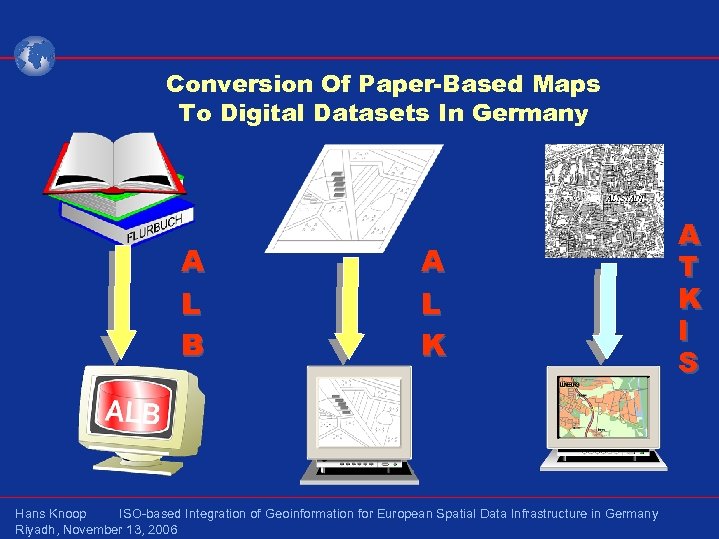 Conversion Of Paper-Based Maps To Digital Datasets In Germany A L B A L K Hans Knoop ISO-based Integration of Geoinformation for European Spatial Data Infrastructure in Germany Riyadh, November 13, 2006 A T K I S
 Paradigm Shift Since 1997: Concept of Ad. V for Modelling of Geoinformation of the Official Surveying and Mapping“ • Integration of Cadastre Map and Register (ALK and ALB) • Harmonisation of Cadastre and Topographic Mapping (ALKIS-ATKIS) Cornerstones • • • Integrated maintenance of graphic data and descriptive data Constant object view Data maintenance without redundancies User profile according to data protection legislation Focus on customers Economicalness of the concept Hans Knoop ISO-based Integration of Geoinformation for European Spatial Data Infrastructure in Germany Riyadh, November 13, 2006
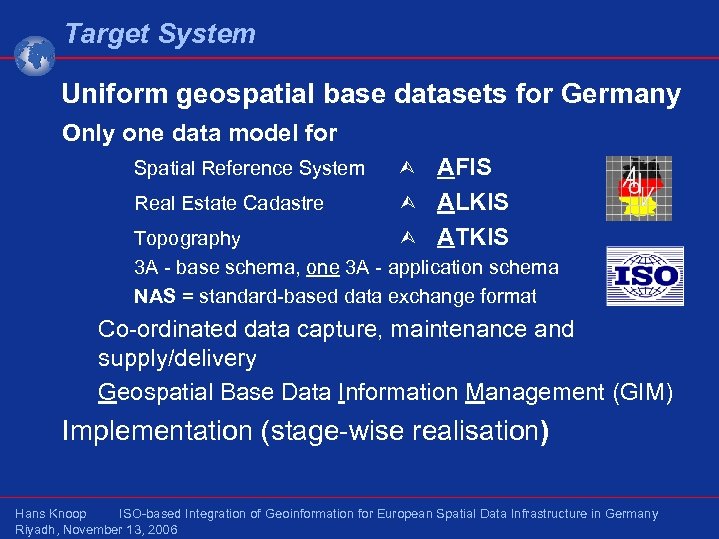 Target System Uniform geospatial base datasets for Germany Only one data model for Spatial Reference System Real Estate Cadastre AFIS ALKIS ATKIS Topography 3 A - base schema, one 3 A - application schema NAS = standard-based data exchange format Co-ordinated data capture, maintenance and supply/delivery Geospatial Base Data Information Management (GIM) Implementation (stage-wise realisation) Hans Knoop ISO-based Integration of Geoinformation for European Spatial Data Infrastructure in Germany Riyadh, November 13, 2006
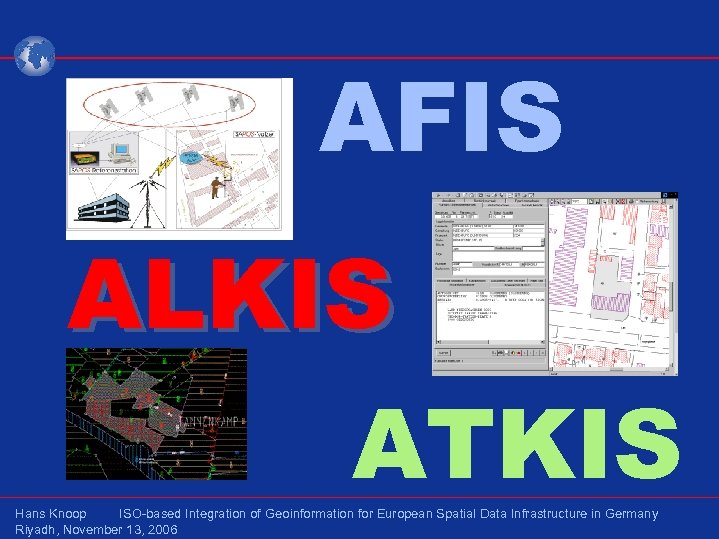 AFIS ALKIS ATKIS Hans Knoop ISO-based Integration of Geoinformation for European Spatial Data Infrastructure in Germany Riyadh, November 13, 2006
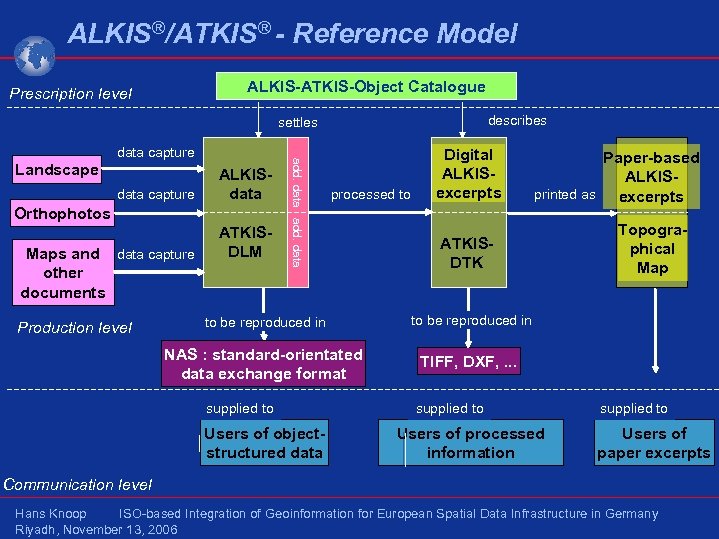 ALKIS®/ATKIS® - Reference Model ALKIS-ATKIS-Object Catalogue Prescription level describes settles Landscape data capture ALKISdata Orthophotos Maps and data capture other documents ATKISDLM add. data capture processed to Digital ALKISexcerpts ATKISDTK to be reproduced in Topographical Map to be reproduced in NAS : standard-orientated data exchange format Production level Paper-based ALKISprinted as excerpts TIFF, DXF, . . . supplied to Users of objectstructured data supplied to Users of processed information supplied to Users of paper excerpts Communication level Hans Knoop ISO-based Integration of Geoinformation for European Spatial Data Infrastructure in Germany Riyadh, November 13, 2006
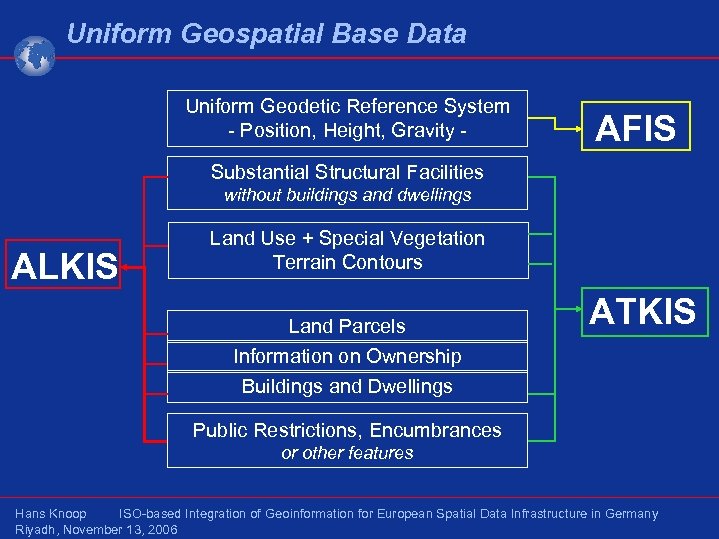 Uniform Geospatial Base Data Uniform Geodetic Reference System - Position, Height, Gravity - AFIS Substantial Structural Facilities without buildings and dwellings ALKIS Land Use + Special Vegetation Terrain Contours Land Parcels Information on Ownership Buildings and Dwellings ATKIS Public Restrictions, Encumbrances or other features Hans Knoop ISO-based Integration of Geoinformation for European Spatial Data Infrastructure in Germany Riyadh, November 13, 2006
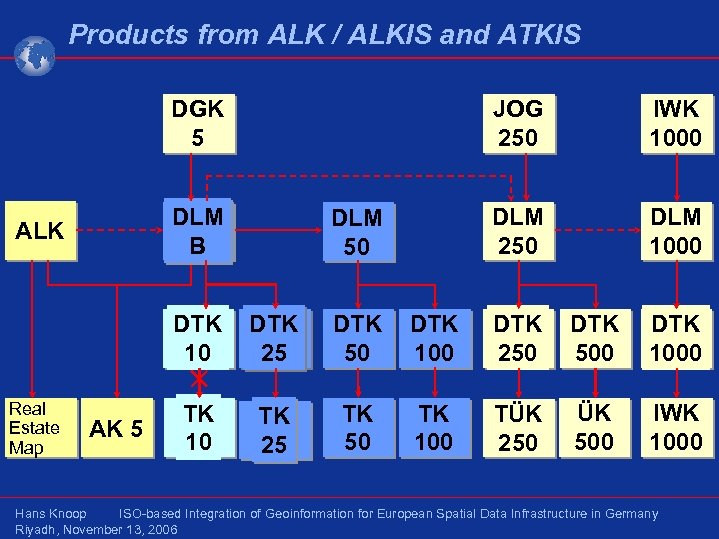 Products from ALK / ALKIS and ATKIS DGK 5 JOG 250 DLM B ALK DLM 250 DLM 50 IWK 1000 DLM 1000 DTK 10 Real Estate Map AK 5 DTK 25 DTK 50 DTK 100 DTK 250 DTK 500 DTK 1000 TK 10 TK 25 TK 50 TK 100 TÜK 250 ÜK 500 IWK 1000 Hans Knoop ISO-based Integration of Geoinformation for European Spatial Data Infrastructure in Germany Riyadh, November 13, 2006
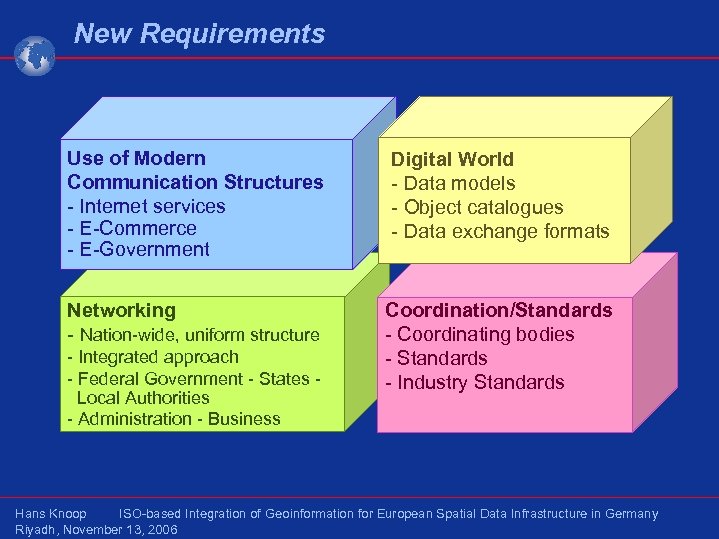 New Requirements Use of Modern Communication Structures - Internet services - E-Commerce - E-Government Digital World - Data models - Object catalogues - Data exchange formats Networking - Nation-wide, uniform structure Coordination/Standards - Coordinating bodies - Standards - Industry Standards - Integrated approach - Federal Government - States Local Authorities - Administration - Business Hans Knoop ISO-based Integration of Geoinformation for European Spatial Data Infrastructure in Germany Riyadh, November 13, 2006
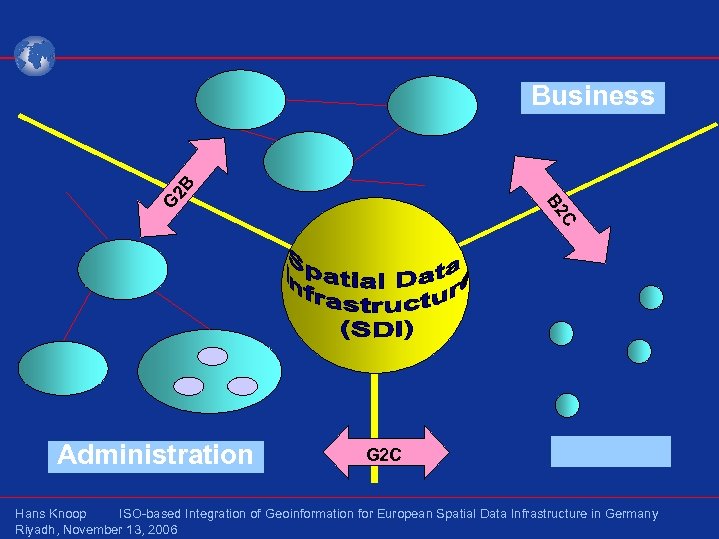 G C B 2 2 B Business Administration G 2 C Citizen Hans Knoop ISO-based Integration of Geoinformation for European Spatial Data Infrastructure in Germany Riyadh, November 13, 2006
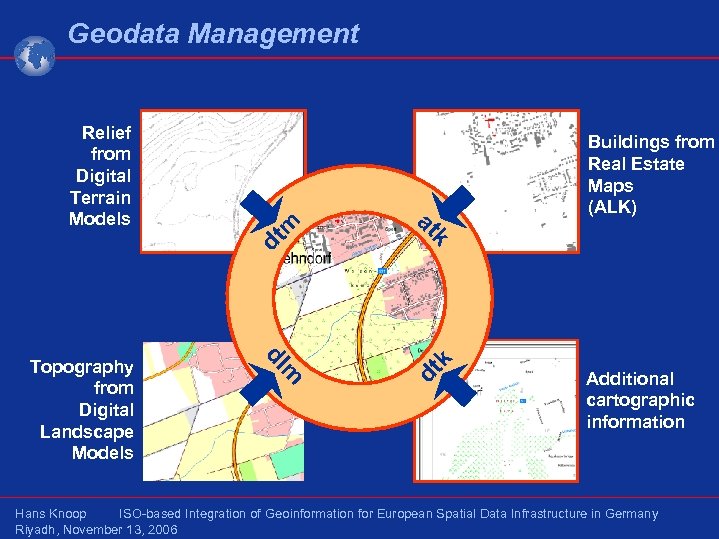 Geodata Management k dt dt m k m dl Topography from Digital Landscape Models Buildings from Real Estate Maps (ALK) at Relief from Digital Terrain Models Additional cartographic information Hans Knoop ISO-based Integration of Geoinformation for European Spatial Data Infrastructure in Germany Riyadh, November 13, 2006
 Revision of Legal Situation Political Decision Use of Geoinformation • Importance of geoinformation • Thorough strategy for state, regions and municipalities • Development of geoinformation and SDI • Transfer to business • Easier access to geodata Hans Knoop ISO-based Integration of Geoinformation for European Spatial Data Infrastructure in Germany Riyadh, November 13, 2006
 Paradigm Shift • Economicalness ðMuch of the information redundant in register and map ðMultiple acquisition and maintenance of information • Customer Requirements ðUsers expect geoinformation usable in a flexible manner and integrated service delivery • Nation-wide Uniformity of Datasets ð Increasing importance (also in a European context) ð Decision of the German Bundestag on the use of GI ð Harmonisation at state borders Hans Knoop ISO-based Integration of Geoinformation for European Spatial Data Infrastructure in Germany Riyadh, November 13, 2006
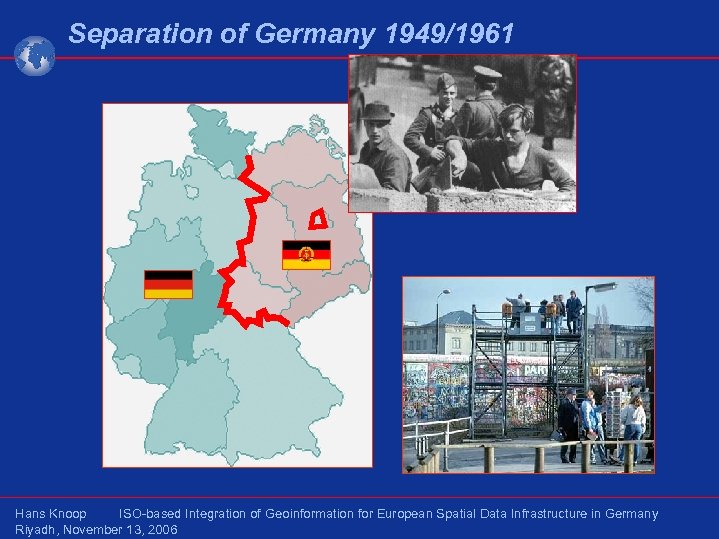 Separation of Germany 1949/1961 Hans Knoop ISO-based Integration of Geoinformation for European Spatial Data Infrastructure in Germany Riyadh, November 13, 2006
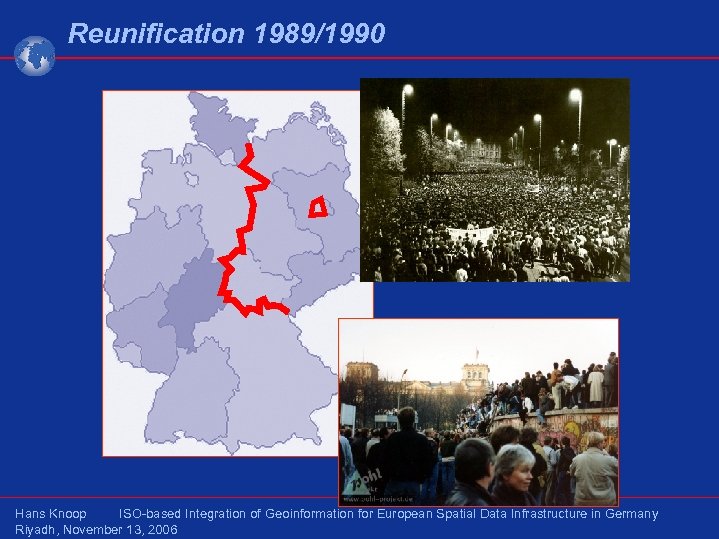 Reunification 1989/1990 Hans Knoop ISO-based Integration of Geoinformation for European Spatial Data Infrastructure in Germany Riyadh, November 13, 2006
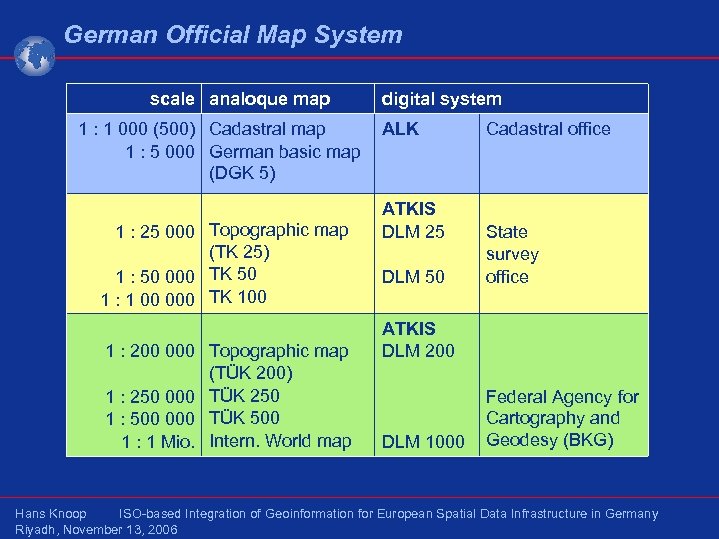 German Official Map System scale analoque map 1 : 1 000 (500) Cadastral map 1 : 5 000 German basic map (DGK 5) 1 : 25 000 Topographic map (TK 25) 1 : 50 000 TK 50 1 : 1 00 000 TK 100 1 : 200 000 Topographic map (TÜK 200) 1 : 250 000 TÜK 250 1 : 500 000 TÜK 500 1 : 1 Mio. Intern. World map digital system ALK ATKIS DLM 25 DLM 50 Cadastral office State survey office ATKIS DLM 200 DLM 1000 Federal Agency for Cartography and Geodesy (BKG) Hans Knoop ISO-based Integration of Geoinformation for European Spatial Data Infrastructure in Germany Riyadh, November 13, 2006
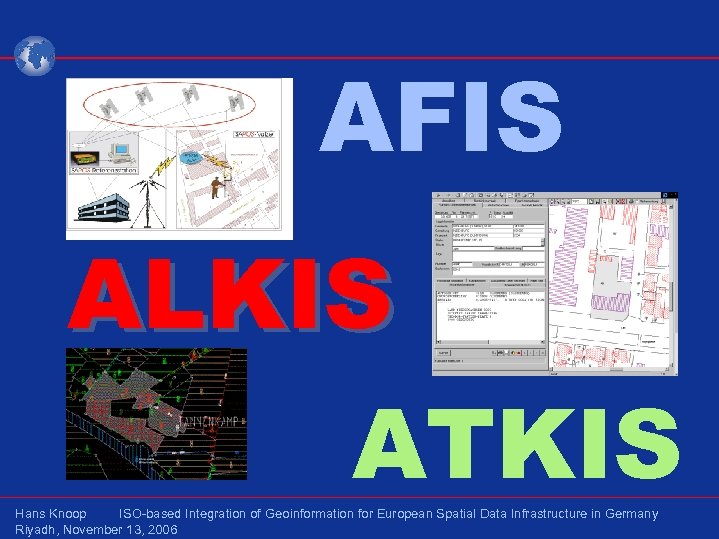 AFIS ALKIS ATKIS Hans Knoop ISO-based Integration of Geoinformation for European Spatial Data Infrastructure in Germany Riyadh, November 13, 2006
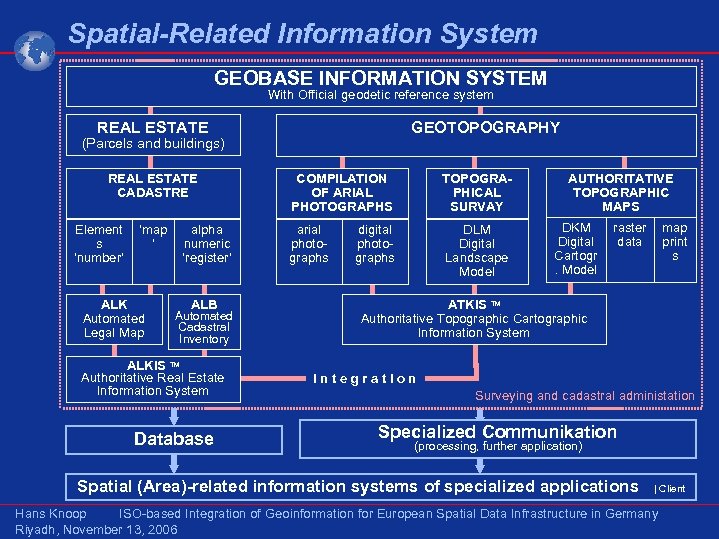 Spatial-Related Information System GEOBASE INFORMATION SYSTEM With Official geodetic reference system REAL ESTATE GEOTOPOGRAPHY (Parcels and buildings) REAL ESTATE CADASTRE Element s ‘number‘ ‘map ‘ ALK Automated Legal Map alpha numeric ‘register‘ ALB Automated Cadastral Inventory ALKIS TM Authoritative Real Estate Information System Database COMPILATION OF ARIAL PHOTOGRAPHS TOPOGRAPHICAL SURVAY arial photographs DLM Digital Landscape Model digital photographs AUTHORITATIVE TOPOGRAPHIC MAPS DKM Digital Cartogr. Model raster data map print s ATKIS TM Authoritative Topographic Cartographic Information System Integration Surveying and cadastral administation Specialized Communikation (processing, further application) Spatial (Area)-related information systems of specialized applications | Client Hans Knoop ISO-based Integration of Geoinformation for European Spatial Data Infrastructure in Germany Riyadh, November 13, 2006
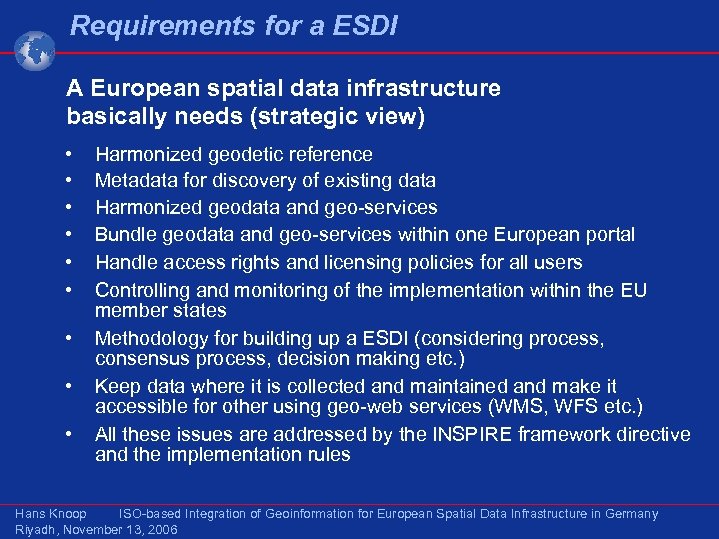 Requirements for a ESDI A European spatial data infrastructure basically needs (strategic view) • • • Harmonized geodetic reference Metadata for discovery of existing data Harmonized geodata and geo-services Bundle geodata and geo-services within one European portal Handle access rights and licensing policies for all users Controlling and monitoring of the implementation within the EU member states Methodology for building up a ESDI (considering process, consensus process, decision making etc. ) Keep data where it is collected and maintained and make it accessible for other using geo-web services (WMS, WFS etc. ) All these issues are addressed by the INSPIRE framework directive and the implementation rules Hans Knoop ISO-based Integration of Geoinformation for European Spatial Data Infrastructure in Germany Riyadh, November 13, 2006
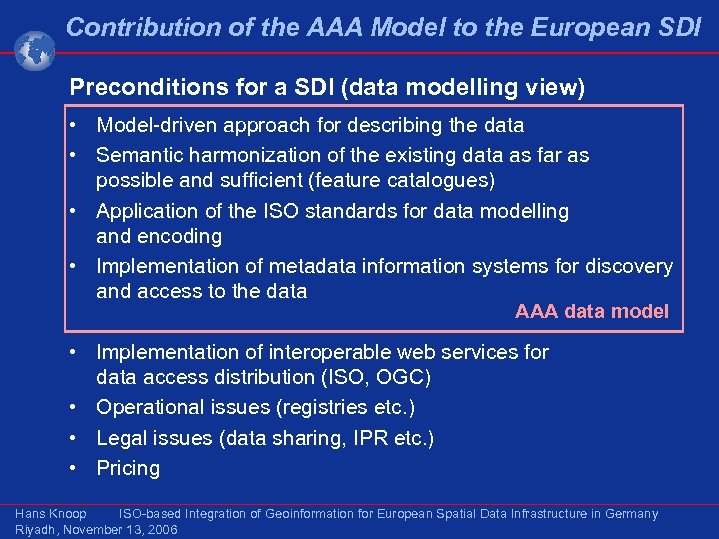 Contribution of the AAA Model to the European SDI Preconditions for a SDI (data modelling view) • Model-driven approach for describing the data • Semantic harmonization of the existing data as far as possible and sufficient (feature catalogues) • Application of the ISO standards for data modelling and encoding • Implementation of metadata information systems for discovery and access to the data AAA data model • Implementation of interoperable web services for data access distribution (ISO, OGC) • Operational issues (registries etc. ) • Legal issues (data sharing, IPR etc. ) • Pricing Hans Knoop ISO-based Integration of Geoinformation for European Spatial Data Infrastructure in Germany Riyadh, November 13, 2006
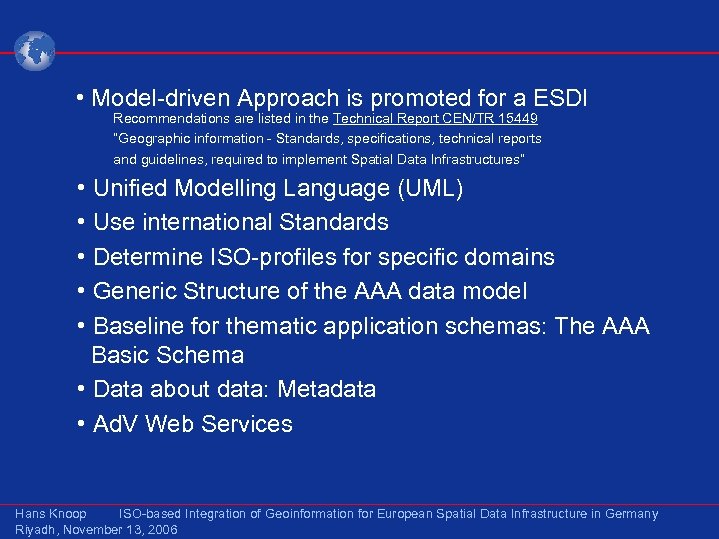 • Model-driven Approach is promoted for a ESDI Recommendations are listed in the Technical Report CEN/TR 15449 “Geographic information - Standards, specifications, technical reports and guidelines, required to implement Spatial Data Infrastructures” • Unified Modelling Language (UML) • Use international Standards • Determine ISO-profiles for specific domains • Generic Structure of the AAA data model • Baseline for thematic application schemas: The AAA Basic Schema • Data about data: Metadata • Ad. V Web Services Hans Knoop ISO-based Integration of Geoinformation for European Spatial Data Infrastructure in Germany Riyadh, November 13, 2006
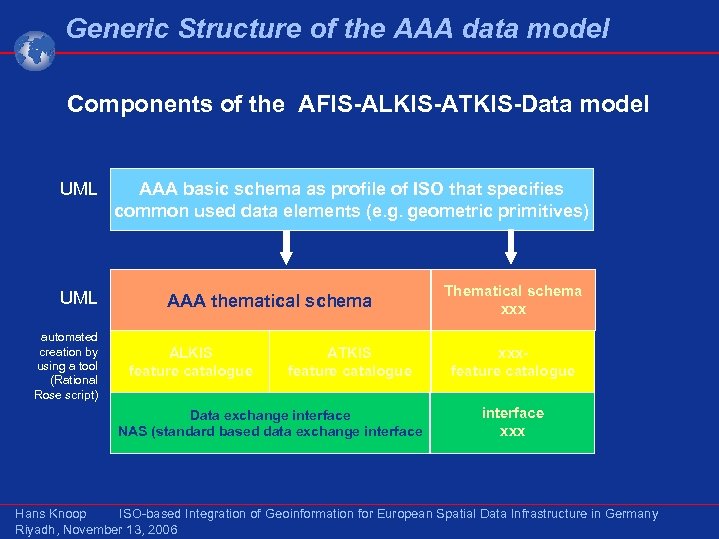 Generic Structure of the AAA data model Components of the AFIS-ALKIS-ATKIS-Data model UML automated creation by using a tool (Rational Rose script) AAA basic schema as profile of ISO that specifies common used data elements (e. g. geometric primitives) AAA thematical schema ALKIS feature catalogue ATKIS feature catalogue Data exchange interface NAS (standard based data exchange interface Thematical schema xxxfeature catalogue interface xxx Hans Knoop ISO-based Integration of Geoinformation for European Spatial Data Infrastructure in Germany Riyadh, November 13, 2006
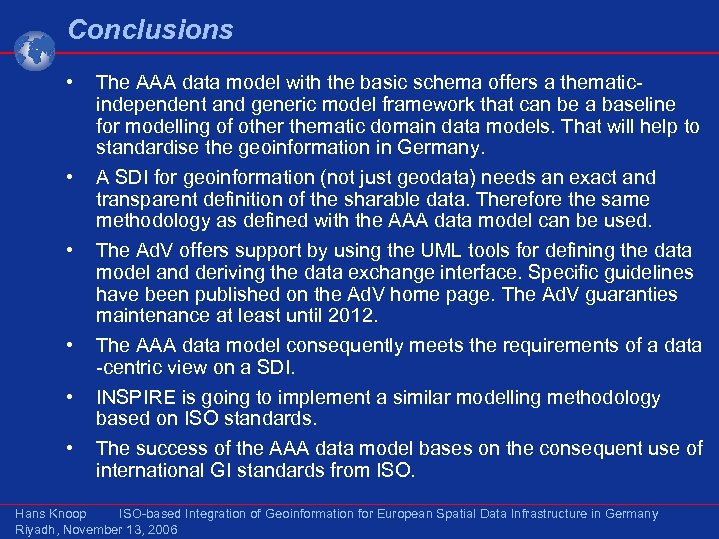 Conclusions • • • The AAA data model with the basic schema offers a thematicindependent and generic model framework that can be a baseline for modelling of other thematic domain data models. That will help to standardise the geoinformation in Germany. A SDI for geoinformation (not just geodata) needs an exact and transparent definition of the sharable data. Therefore the same methodology as defined with the AAA data model can be used. The Ad. V offers support by using the UML tools for defining the data model and deriving the data exchange interface. Specific guidelines have been published on the Ad. V home page. The Ad. V guaranties maintenance at least until 2012. The AAA data model consequently meets the requirements of a data -centric view on a SDI. INSPIRE is going to implement a similar modelling methodology based on ISO standards. The success of the AAA data model bases on the consequent use of international GI standards from ISO. Hans Knoop ISO-based Integration of Geoinformation for European Spatial Data Infrastructure in Germany Riyadh, November 13, 2006
 Agenda • Introduction • International Standardization (ISO/TC 211, OGC, …) • European Standardization (CEN/TC 287) • Europe (INSPIRE) • Germany (AAA-System) • Benefits of Standardization Hans Knoop ISO-based Integration of Geoinformation for European Spatial Data Infrastructure in Germany Riyadh, November 13, 2006
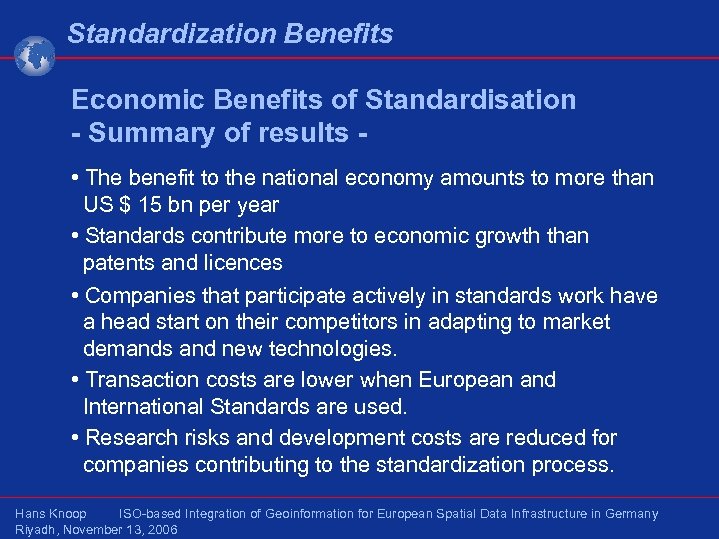 Standardization Benefits Economic Benefits of Standardisation - Summary of results • The benefit to the national economy amounts to more than US $ 15 bn per year • Standards contribute more to economic growth than patents and licences • Companies that participate actively in standards work have a head start on their competitors in adapting to market demands and new technologies. • Transaction costs are lower when European and International Standards are used. • Research risks and development costs are reduced for companies contributing to the standardization process. Hans Knoop ISO-based Integration of Geoinformation for European Spatial Data Infrastructure in Germany Riyadh, November 13, 2006
 Thank you! Questions & Discussion Hans Knoop hans. knoop@gmx. de hans. knoop@t-online. de +49 - 511 - 57 19 73 tel +49 - 511 - 161 21 30 fax +49 - 179 - 231 20 27 mobile Hans Knoop ISO-based Integration of Geoinformation for European Spatial Data Infrastructure in Germany Riyadh, November 13, 2006