


 Скачать презентацию Adviser Workshop April 27 and August 17 2017
fa212a4ad9e1c5d4ba65d014d88300bc.ppt
- Количество слайдов: 33
 Adviser Workshop April 27 and August 17, 2017 Workshop for lower division advisers at Wake Forest University Overview & Orientation Responsibilities
 Philosophy of Advising at WFU • Advising as Teaching • What are the expected outcomes from advising? • What should advisees know, do, and value as a result of advising? • Developmental Advising • Implications for Advising • Reference documents • • “Role of Lower Division Adviser” “Developmentally Relevant Conversation Topics”
 Welcome Lower Division Academic Advising at Wake Forest University is coordinated through the Office of Academic Advising, a division of the Office of the Dean of Wake Forest College. Located off the main foyer of Reynolda Hall in Room 125. Telephone number is x 3320. (website http: //advising. wfu. edu/ ) And the faculty Committee on Orientation and Lower Division Advising.
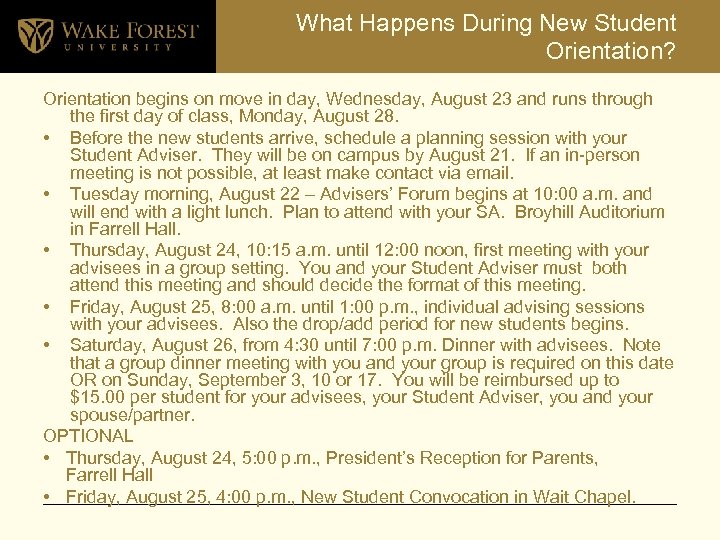 What Happens During New Student Orientation? Orientation begins on move in day, Wednesday, August 23 and runs through the first day of class, Monday, August 28. • Before the new students arrive, schedule a planning session with your Student Adviser. They will be on campus by August 21. If an in-person meeting is not possible, at least make contact via email. • Tuesday morning, August 22 – Advisers’ Forum begins at 10: 00 a. m. and will end with a light lunch. Plan to attend with your SA. Broyhill Auditorium in Farrell Hall. • Thursday, August 24, 10: 15 a. m. until 12: 00 noon, first meeting with your advisees in a group setting. You and your Student Adviser must both attend this meeting and should decide the format of this meeting. • Friday, August 25, 8: 00 a. m. until 1: 00 p. m. , individual advising sessions with your advisees. Also the drop/add period for new students begins. • Saturday, August 26, from 4: 30 until 7: 00 p. m. Dinner with advisees. Note that a group dinner meeting with you and your group is required on this date OR on Sunday, September 3, 10 or 17. You will be reimbursed up to $15. 00 per student for your advisees, your Student Adviser, you and your spouse/partner. OPTIONAL • Thursday, August 24, 5: 00 p. m. , President’s Reception for Parents, Farrell Hall • Friday, August 25, 4: 00 p. m. , New Student Convocation in Wait Chapel.
 Individual and Group Advising Sessions: Saturday and/or Monday Student Adviser assists with both meetings. Establish expectations of the adviser/advisee relationship. Ask students what they expect of you and tell them your expectations of them. Get acquainted with individual students: what are their interests? Do they already have an intended major in mind? Do they plan to go to medical school? Law school? Do they play a sport? Do they have challenges other students may not (financial or perhaps learning differences)? Are they concerned about being far away from home? Discuss schedules and possible needed (or wanted) changes. Stress the need to set realistic goals and start out with a cautious rather than overly ambitious schedule.
 Protecting Private Information Privacy Issues – what you can and cannot share. Family Educational Rights and Privacy Act (FERPA) Do not share lower division students’ academic records, including grades, with student advisers. You also cannot share academic information with parents without the student’s written permission.
 Break
Break
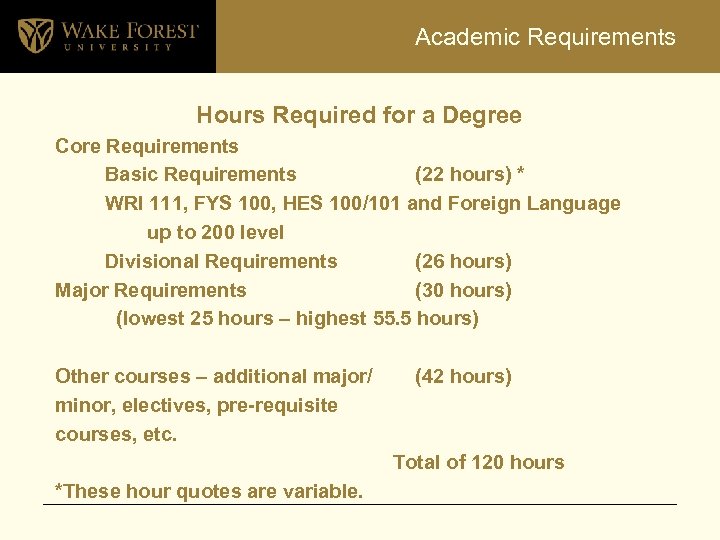 Academic Requirements Hours Required for a Degree Core Requirements Basic Requirements (22 hours) * WRI 111, FYS 100, HES 100/101 and Foreign Language up to 200 level Divisional Requirements (26 hours) Major Requirements (30 hours) (lowest 25 hours – highest 55. 5 hours) Other courses – additional major/ (42 hours) minor, electives, pre-requisite courses, etc. Total of 120 hours *These hour quotes are variable.
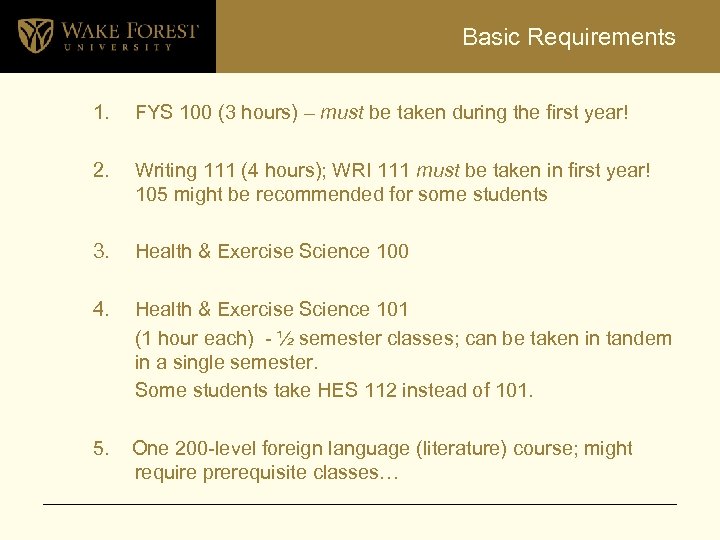 Basic Requirements 1. FYS 100 (3 hours) – must be taken during the first year! 2. Writing 111 (4 hours); WRI 111 must be taken in first year! 105 might be recommended for some students 3. Health & Exercise Science 100 4. Health & Exercise Science 101 (1 hour each) - ½ semester classes; can be taken in tandem in a single semester. Some students take HES 112 instead of 101. 5. One 200 -level foreign language (literature) course; might require prerequisite classes…
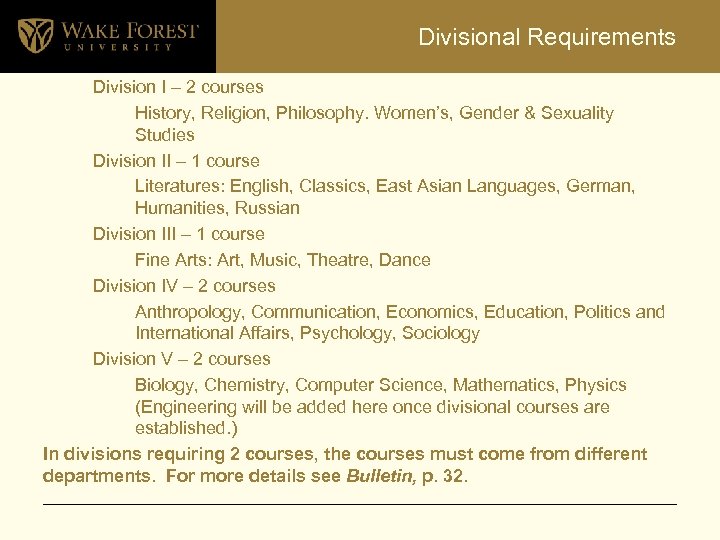 Divisional Requirements Division I – 2 courses History, Religion, Philosophy. Women’s, Gender & Sexuality Studies Division II – 1 course Literatures: English, Classics, East Asian Languages, German, Humanities, Russian Division III – 1 course Fine Arts: Art, Music, Theatre, Dance Division IV – 2 courses Anthropology, Communication, Economics, Education, Politics and International Affairs, Psychology, Sociology Division V – 2 courses Biology, Chemistry, Computer Science, Mathematics, Physics (Engineering will be added here once divisional courses are established. ) In divisions requiring 2 courses, the courses must come from different departments. For more details see Bulletin, p. 32.
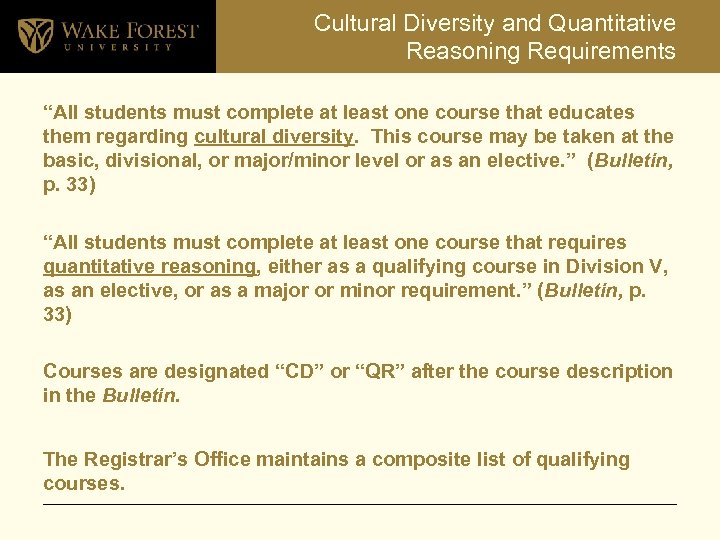 Cultural Diversity and Quantitative Reasoning Requirements “All students must complete at least one course that educates them regarding cultural diversity. This course may be taken at the basic, divisional, or major/minor level or as an elective. ” (Bulletin, p. 33) “All students must complete at least one course that requires quantitative reasoning, either as a qualifying course in Division V, as an elective, or as a major or minor requirement. ” (Bulletin, p. 33) Courses are designated “CD” or “QR” after the course description in the Bulletin. The Registrar’s Office maintains a composite list of qualifying courses.
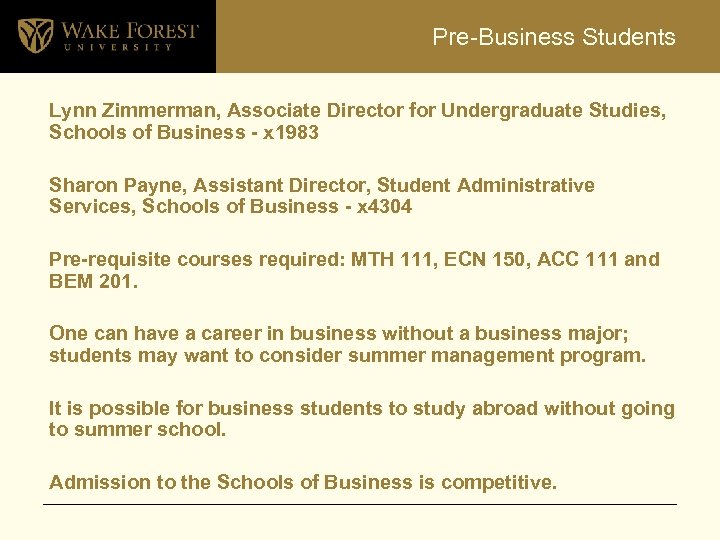 Pre-Business Students Lynn Zimmerman, Associate Director for Undergraduate Studies, Schools of Business - x 1983 Sharon Payne, Assistant Director, Student Administrative Services, Schools of Business - x 4304 Pre-requisite courses required: MTH 111, ECN 150, ACC 111 and BEM 201. One can have a career in business without a business major; students may want to consider summer management program. It is possible for business students to study abroad without going to summer school. Admission to the Schools of Business is competitive.
 Pre-Professional Advising Carole Gibson is the Director of Health Professions John Tomlinson is the Assistant Director of Health Professions (including medical school, dental school, veterinary medicine, physical therapy, nursing and physicians’ assistants programs) http: //college. wfu. edu/prehealth/ Please note that while we no longer routinely encourage first-year students to begin their studies by completing 2 laboratory science courses during their first semester, there are students, well prepared in the sciences, who can handle this load. Students should begin with CHM because of the sequential offerings of the department. Laura Graham, Wake Forest Law School, is the Pre-law Adviser. http: //groups. wfu. edu/prelaw/ Cecilia Solano, Pre-graduate School Adviser http: //career. opcd. wfu. edu/pre-graduate-school/
 Accessing Records and Information Finding information on WIN, Adviser Services: what’s available, how to use it. Know (and show students) how to find Degree. Works report. Ask students if all AP & IB credit shows up on their forms; if not, they need to make sure AP & IB scores are reported to registrar. For quick route to student schedule, use the Adviser’s Card.
 Student Services Office of Academic Advising Learning Assistance Center University Counseling Center for Global Programs and Studies Student Health Service Chemistry Center Math Center Writing Center Intercultural Center (formerly Office of Minority Affairs) LGBTQ Center Office of the University Chaplain Student Athlete Services Office of Personal and Career Development
 Office of Academic Advising Staff • Christy Buchanan, Senior Associate Dean for Academic Advising and Professor of Psychology • Karen Bennett, Assistant Dean for Academic Advising • • India Dunn, Academic Counselor (A-E) x 3102 Melissa Cumbia, Academic Counselor (F-K) x 3101 Shannon Mc. Kinney, Academic Counselor (L-R) x 3103 Shane Weimer, Academic Counselor (S-Z) x 3104 • Open Now, Administrative Assistant x 2973 • Debbie Lafferty, Administrative Secretary x 3320
 Advising Athletes Contacts in Student Athlete Services Jane Caldwell, Director (x 6010) Christia Fisher (x 3190) Ann Flynn (x 1827) Brooke Taylor (x 3191) Kristin Weisse (6464) Seth Youngblood (x 4611)
 Fall Registration for New Students All new incoming students will be registered for their fall courses this summer. You can see these schedules in WIN. Students will be allowed to see their schedule approximately one week before they arrive but will not be allowed to make changes until after they meet with you. Students will register themselves for up to 12 hours of credit during July using the same online process our continuing students use to register. After that Round One of registration, students will complete an extensive Academic Course Preference Survey. Based on the information provided in this survey, the staff of the OAA, along with advising volunteers and the assistance of the Registrar’s Office, complete each student’s schedule. You may access your advisees’ individual surveys using a link Dean Buchanan will send you in an email this summer (NOT THROUGH WIN. )
 Directed Self-Placement (DSP): beginning Spring 2013 At Wake Forest University, students make the decision about their first writing-intensive courses. The goal of the Directed Self-Placement (DSP) process is to help students make that decision in light of a universitylevel reading, writing, and reflection task designed by Wake Forest professors, which might be very different from students’ high school experiences. To complete the Directed Self-Placement, students are asked to read an article, write an academic essay in response to a writing prompt, submit their essay online via Sakai, and answer 10 reflective questions about their experiences as a reader and writer. As its name indicates, Directed Self-Placement is for students’ own reflection and placement. Students’ essays and reflective question responses will not be used to formally evaluate students or place them in a course. Rather, the DSP process simulates a college-level reading and writing task, through which students can reflect on what they feel prepared to do and what they want more help with. Because Wake Forest has many writing resources–from articular courses to the Writing Center–this reflection is especially valuable as students enroll so that they begin to think about the writing support they need from the start. Answers to students’ reflective questions are sent to the Office of Advising staff so that staff has some insight as to how the DSP process went for the students with whom they discussed course selection. Then, before the fall semester begins, students’ essays are sent to the professor the student will have for the fall semester in their first writing-intensive course. Each student’s essay thus serves as a first introduction of the student as a writer to her/his professor and will help the professor work with the student to identify strengths and areas for improvement Contact: Laura Denlinger, Writing Center
 Advising During the Semester Advising and Registration for the Spring semester occurs in October. Advising and Registration for Fall occurs in March. Summer school registration occurs in March. Each semester, prior to registration, meet with students individually, reconnect and give the PIN. Ask your SA to be involved. INSIST on face-to-face meeting; Do NOT email PINs without meeting Alert students to sign up.
 Break
Break
 Student Complaints Typically related to a grade dispute. • • • Students are encouraged to seek assistance from their advisers or another member of the faculty or staff in evaluating the nature of their complaints. A complaint should first be directed as soon as possible to the person or persons whose actions or inactions have given rise to the problem (not later than 3 months after the event). For complaints in the academic setting, the student should talk personally with the instructor. Should the student and instructor be unable to resolve the conflict, the student, if unsatisfied, should then turn to the chair of the involved department for assistance. The chair will meet with both parties, seek to understand their individual perspectives, and within a reasonable time, reach a conclusion and share it with both parties. Finally, a student may appeal to the Committee on Academic Affairs which will study the matter, work with the parties, and reach a final resolution. (Bulletin of Wake Forest College and the Schools of Business of Wake Forest University, 2016 -2017, page 14. )
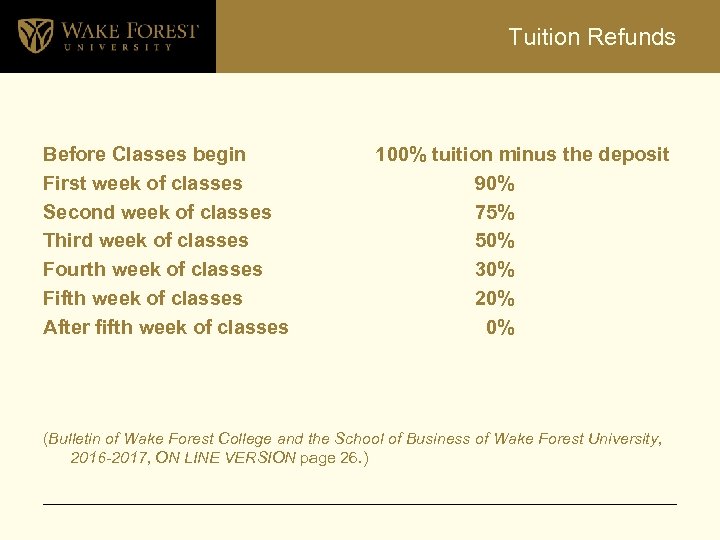 Tuition Refunds Before Classes begin First week of classes Second week of classes Third week of classes Fourth week of classes Fifth week of classes After fifth week of classes 100% tuition minus the deposit 90% 75% 50% 30% 20% 0% (Bulletin of Wake Forest College and the School of Business of Wake Forest University, 2016 -2017, ON LINE VERSION page 26. )
 Course Loads Average course load is 15 hours per semester. 17 hours is the maximum students may take without special permission. Registering for a course overload requires permission of instructor, adviser and approval from the Committee on Academic Affairs. (Bulletin of Wake Forest College and the Schools of Business of Wake Forest University, 2016 -2017, page 17. )
 Course Loads Part-time Status All students must be registered for at least 12 hours to be considered full-time students. Students who wish to register for less than 12 hours must apply for part-time status with the OAA before the last day to add a class. Students with significant financial aid must usually maintain full-time status to qualify for aid. If students do not apply for part-time status, they are charged full time tuition. (Bulletin of Wake Forest College and the School of Business of Wake Forest University, 2016 -2017, page 17. )
 Incomplete Grade Designation “Incompletes may be assigned only when a student fails to complete the work of a course because of illness or some other emergency that is beyond the student’s control. If the work recorded as ‘I’ is not completed within thirty days after the student begins his or her next semester, the grade is automatically changed to the grade of F. ” (Bulletin of Wake Forest College and the Schools of Business of Wake Forest University, 2016 -2017, page 20. )
 Repetition of Courses “A Wake Forest course can be repeated at Wake Forest if the grade earned is C- or lower. In this case, all grades received will appear on the transcript, but the course will be counted only one time for credit. ” Only the higher (or highest, in situations where the student takes the class more than twice) grade is factored into the GPA. (Bulletin of Wake Forest College and the School of Business of Wake Forest University, 2016 -2017, page 21. )
 Transfer Credit Students wishing to complete summer course work at other universities need approval from the University Registrar’s Office. Students need at least a 2. 0 GPA to transfer credit. http: //www. wfu. edu/registrar/sselsewhere. html “Of the 120 hours required for graduation, at least sixty must be earned in Wake Forest Programs. Once enrolled at Wake Forest, a student may subsequently count, at most, thirty hours of credit from sources other than Wake Forest programs toward the graduation requirement of 120 hours. ” Transferred credit after matriculation can be counted for divisional credit unless prohibited by individual departments. Exceptions are always evolving, refer students to the Registrar when unsure. (Bulletin of Wake Forest College and the School of Business of Wake Forest University, 2016 -2017, page 23. )
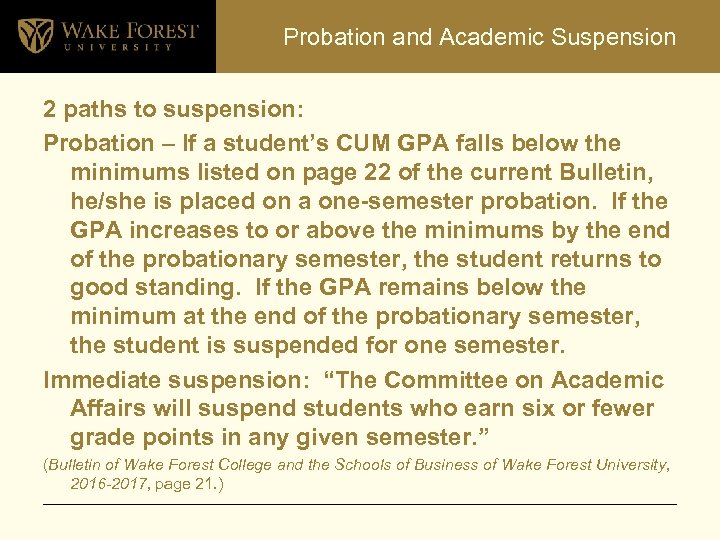 Probation and Academic Suspension 2 paths to suspension: Probation – If a student’s CUM GPA falls below the minimums listed on page 22 of the current Bulletin, he/she is placed on a one-semester probation. If the GPA increases to or above the minimums by the end of the probationary semester, the student returns to good standing. If the GPA remains below the minimum at the end of the probationary semester, the student is suspended for one semester. Immediate suspension: “The Committee on Academic Affairs will suspend students who earn six or fewer grade points in any given semester. ” (Bulletin of Wake Forest College and the Schools of Business of Wake Forest University, 2016 -2017, page 21. )
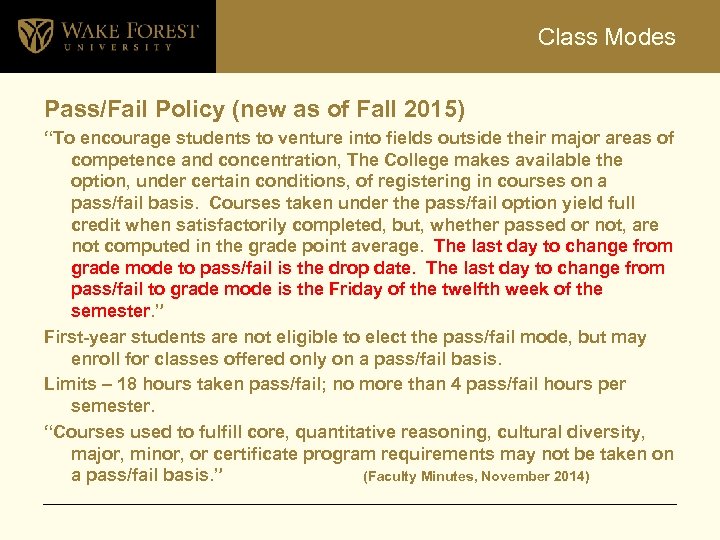 Class Modes Pass/Fail Policy (new as of Fall 2015) “To encourage students to venture into fields outside their major areas of competence and concentration, The College makes available the option, under certain conditions, of registering in courses on a pass/fail basis. Courses taken under the pass/fail option yield full credit when satisfactorily completed, but, whether passed or not, are not computed in the grade point average. The last day to change from grade mode to pass/fail is the drop date. The last day to change from pass/fail to grade mode is the Friday of the twelfth week of the semester. ” First-year students are not eligible to elect the pass/fail mode, but may enroll for classes offered only on a pass/fail basis. Limits – 18 hours taken pass/fail; no more than 4 pass/fail hours per semester. “Courses used to fulfill core, quantitative reasoning, cultural diversity, major, minor, or certificate program requirements may not be taken on a pass/fail basis. ” (Faculty Minutes, November 2014)
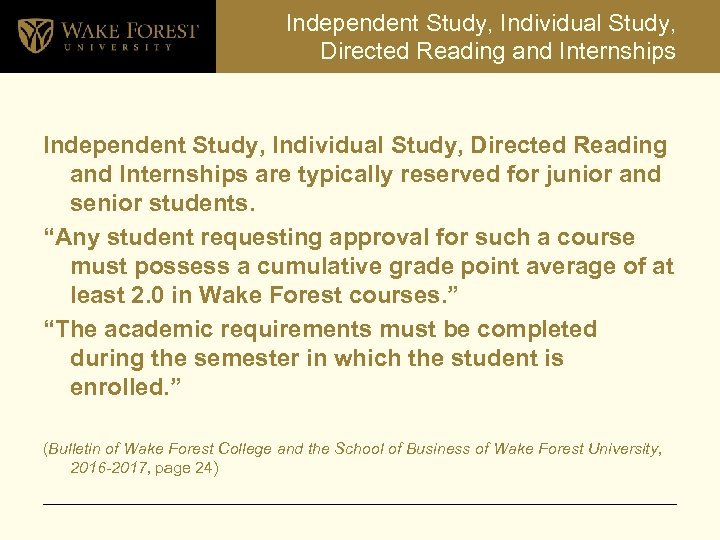 Independent Study, Individual Study, Directed Reading and Internships are typically reserved for junior and senior students. “Any student requesting approval for such a course must possess a cumulative grade point average of at least 2. 0 in Wake Forest courses. ” “The academic requirements must be completed during the semester in which the student is enrolled. ” (Bulletin of Wake Forest College and the School of Business of Wake Forest University, 2016 -2017, page 24)
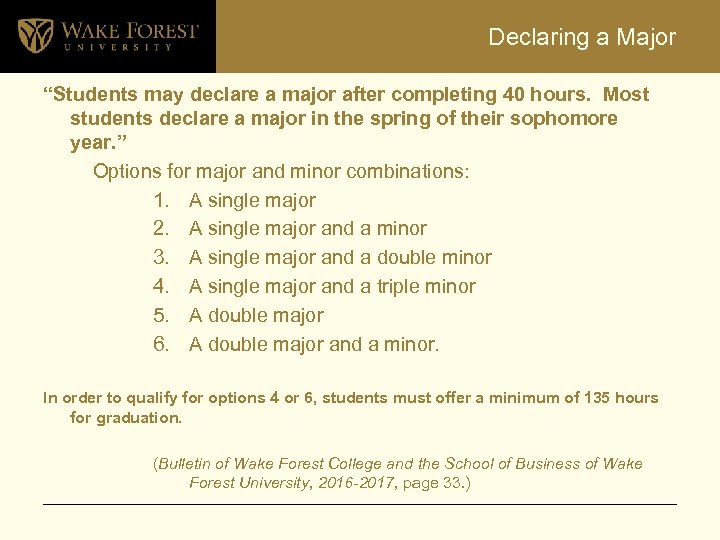 Declaring a Major “Students may declare a major after completing 40 hours. Most students declare a major in the spring of their sophomore year. ” Options for major and minor combinations: 1. A single major 2. A single major and a minor 3. A single major and a double minor 4. A single major and a triple minor 5. A double major 6. A double major and a minor. In order to qualify for options 4 or 6, students must offer a minimum of 135 hours for graduation. (Bulletin of Wake Forest College and the School of Business of Wake Forest University, 2016 -2017, page 33. )
 Thanks for Coming! Questions and Answers Office of Academic Advising 125 Reynolda Hall x 3320 undergraduateadvising@wfu. edu http: //advising. wfu. edu/