


 Скачать презентацию Advertising Principles and Practices Design and Production 1
b9498da8a501c4ff34be7c8b244e33c0.ppt
- Количество слайдов: 36
 Advertising Principles and Practices Design and Production 1
 Questions We’ll Answer • What is the role of visual communication in advertising? • How can we define layout and composition, and what’s the difference between the two? • How are art and color reproduced in print advertising? • Which steps in planning and producing broadcast commercials are most critical? • What are the basic techniques of Web design? Prentice Hall, © 2009 2
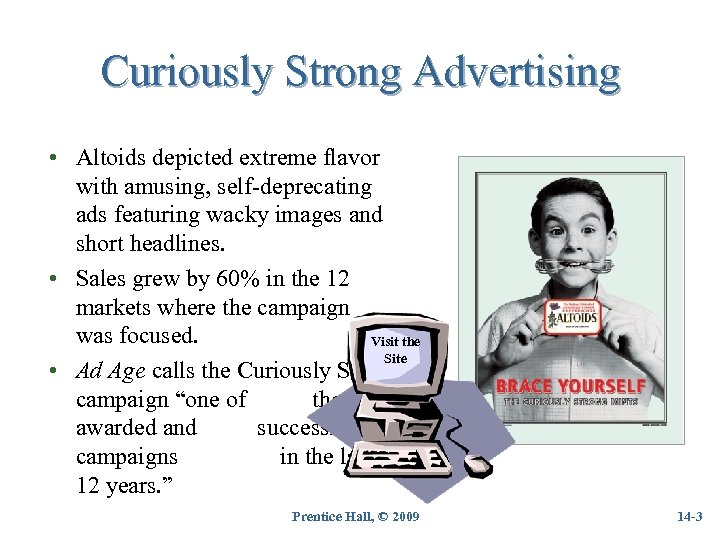 Curiously Strong Advertising • Altoids depicted extreme flavor with amusing, self-deprecating ads featuring wacky images and short headlines. • Sales grew by 60% in the 12 markets where the campaign was focused. Visit the Site • Ad Age calls the Curiously Strong campaign “one of the most awarded and successful campaigns in the last 12 years. ” Prentice Hall, © 2009 14 -3 3
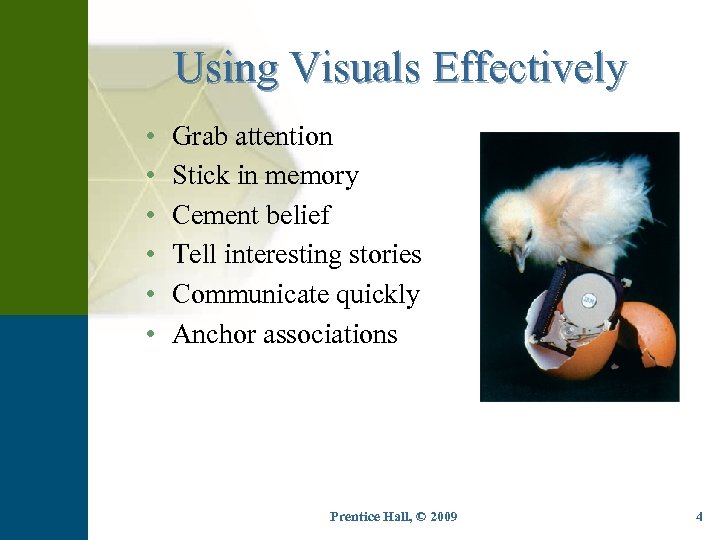 Using Visuals Effectively • • • Grab attention Stick in memory Cement belief Tell interesting stories Communicate quickly Anchor associations Prentice Hall, © 2009 4
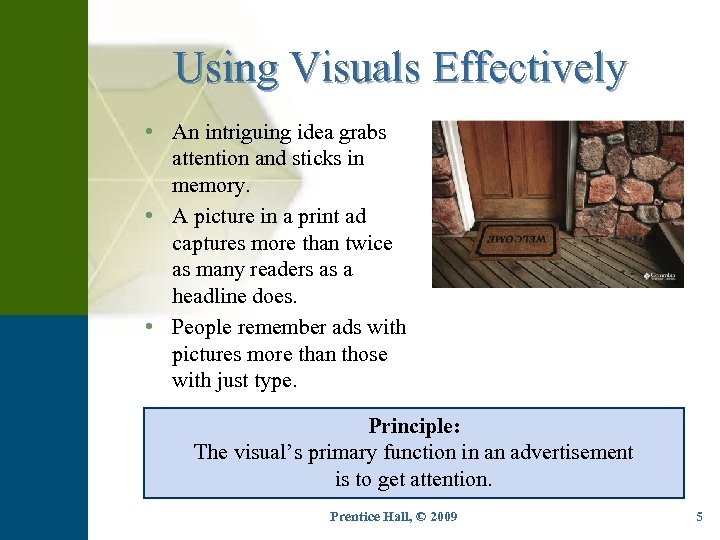 Using Visuals Effectively • An intriguing idea grabs attention and sticks in memory. • A picture in a print ad captures more than twice as many readers as a headline does. • People remember ads with pictures more than those with just type. Principle: The visual’s primary function in an advertisement is to get attention. Prentice Hall, © 2009 5
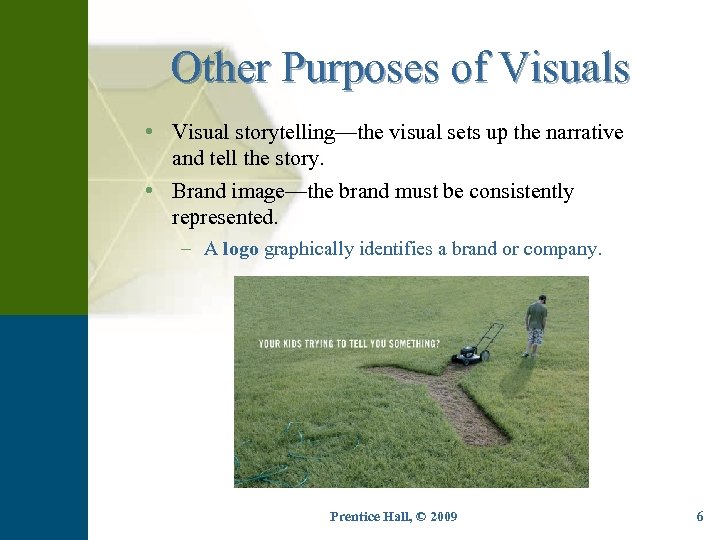 Other Purposes of Visuals • Visual storytelling—the visual sets up the narrative and tell the story. • Brand image—the brand must be consistently represented. – A logo graphically identifies a brand or company. Prentice Hall, © 2009 6
 The Art Director • In charge of the visual look of the ad how it communicates mood, product qualities, and psychological appeals. • They decide which type of visual to use—art, photography, film, animation, etc. for ads. • May also work on branding/corporate logo including office interiors, merchandising materials, delivery vehicles. Prentice Hall, © 2009 7
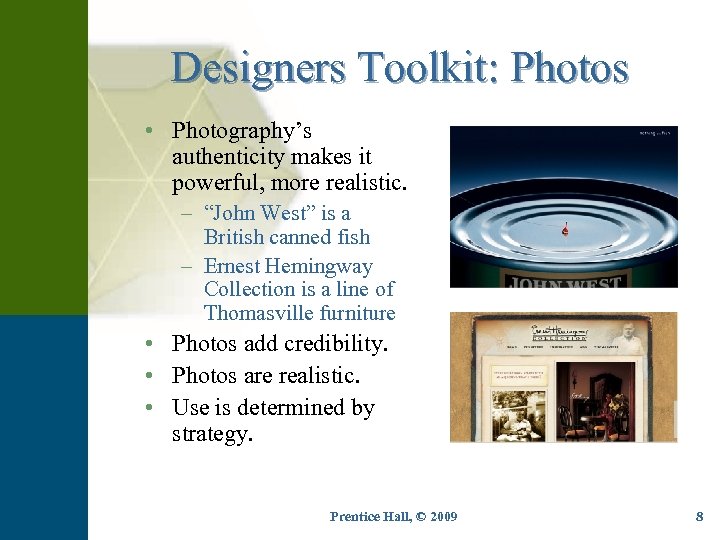 Designers Toolkit: Photos • Photography’s authenticity makes it powerful, more realistic. – “John West” is a British canned fish – Ernest Hemingway Collection is a line of Thomasville furniture • Photos add credibility. • Photos are realistic. • Use is determined by strategy. Prentice Hall, © 2009 8
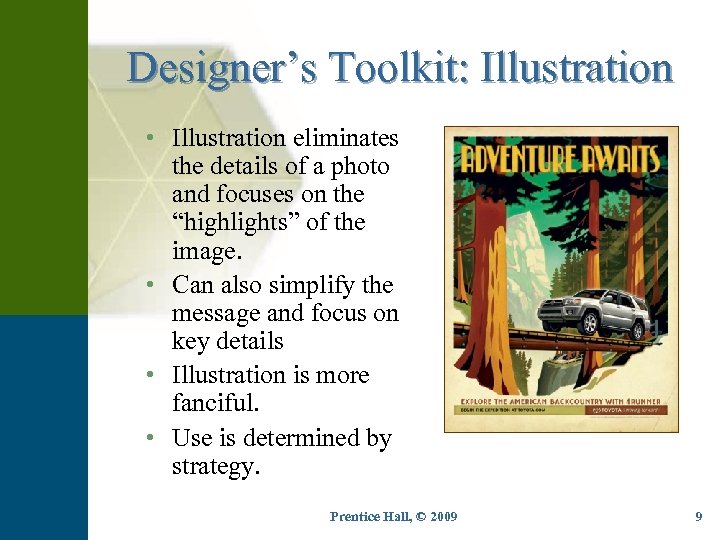 Designer’s Toolkit: Illustration • Illustration eliminates the details of a photo and focuses on the “highlights” of the image. • Can also simplify the message and focus on key details • Illustration is more fanciful. • Use is determined by strategy. Prentice Hall, © 2009 9
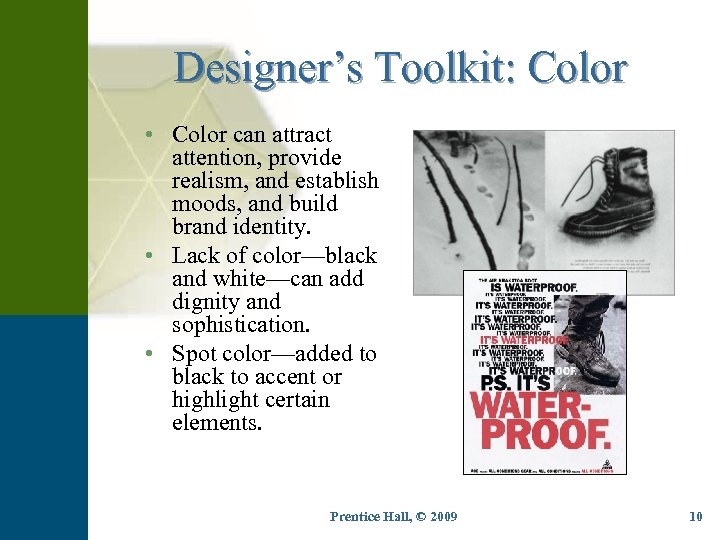 Designer’s Toolkit: Color • Color can attract attention, provide realism, and establish moods, and build brand identity. • Lack of color—black and white—can add dignity and sophistication. • Spot color—added to black to accent or highlight certain elements. Prentice Hall, © 2009 10
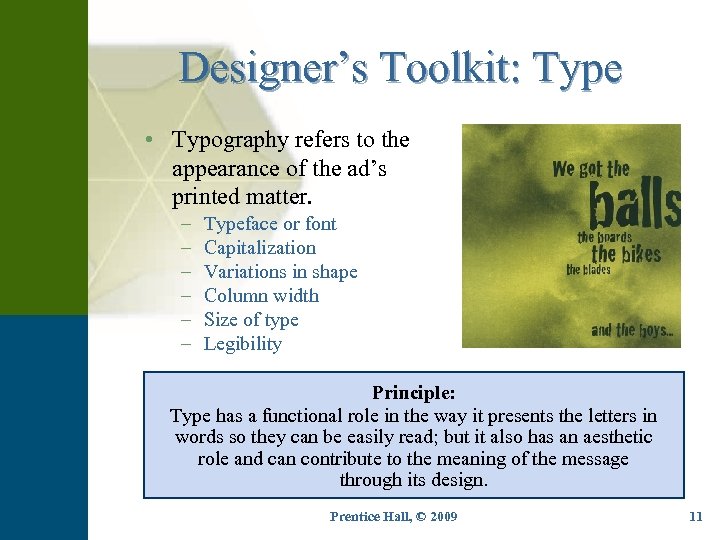 Designer’s Toolkit: Type • Typography refers to the appearance of the ad’s printed matter. – – – Typeface or font Capitalization Variations in shape Column width Size of type Legibility Principle: Type has a functional role in the way it presents the letters in words so they can be easily read; but it also has an aesthetic role and can contribute to the meaning of the message through its design. Prentice Hall, © 2009 11
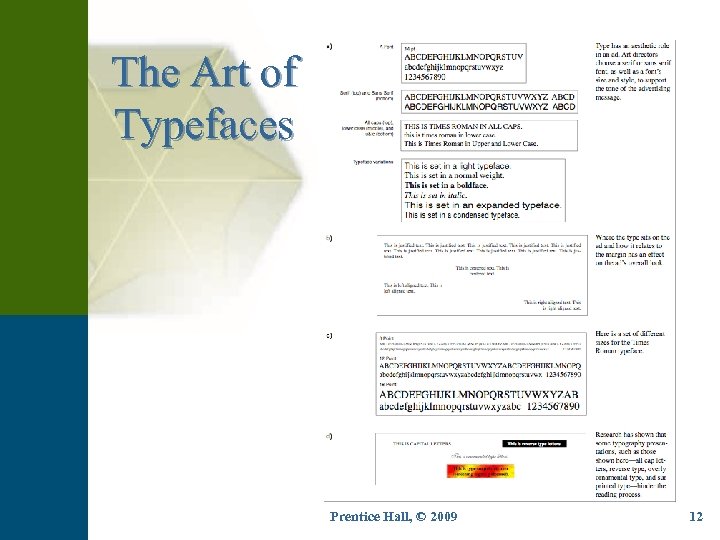 The Art of Typefaces Prentice Hall, © 2009 12
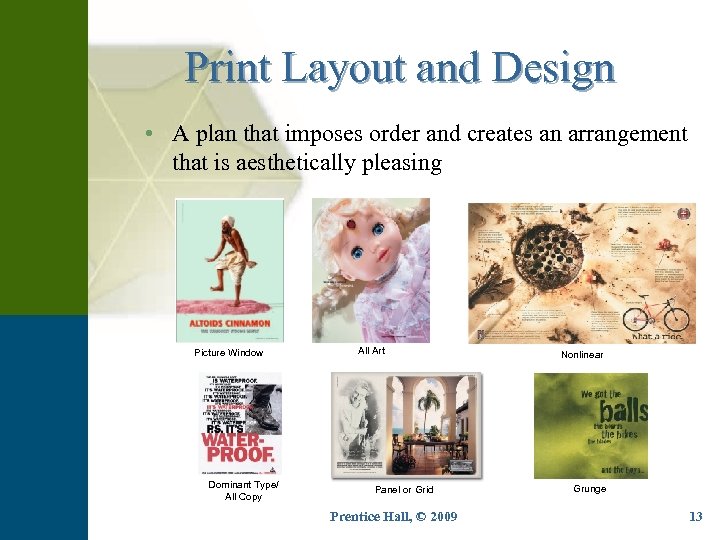 Print Layout and Design • A plan that imposes order and creates an arrangement that is aesthetically pleasing Picture Window Dominant Type/ All Copy All Art Panel or Grid Prentice Hall, © 2009 Nonlinear Grunge 13
 Design Principles • • • Direction—creating a visual path for the eye Dominance—the point of emphasis Unity—elements fuse into one coherent image White space—area not covered by art or type Contrast—makes elements stand out from one another Balance—formal and informal, symmetrical or asymmetrical • Proportion—equally proportions of elements are visually uninteresting • Simplify, simplify—the fewer the elements, the stronger the impact Prentice Hall, © 2009 14
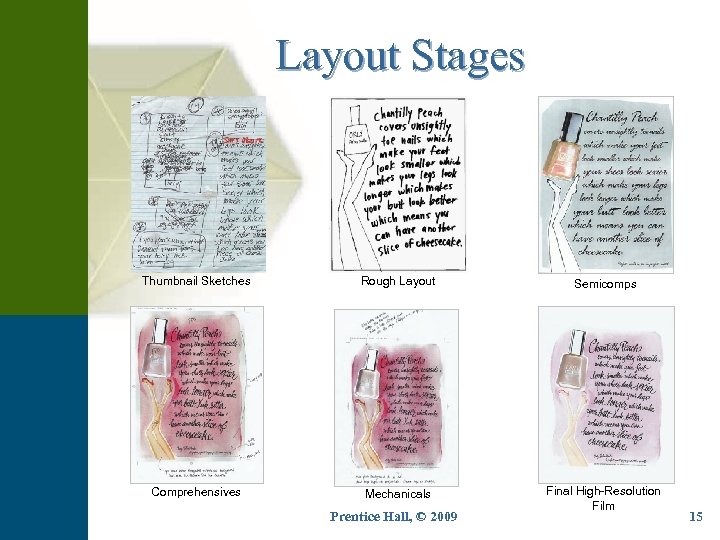 Layout Stages Thumbnail Sketches Rough Layout Semicomps Comprehensives Mechanicals Final High-Resolution Film Prentice Hall, © 2009 15
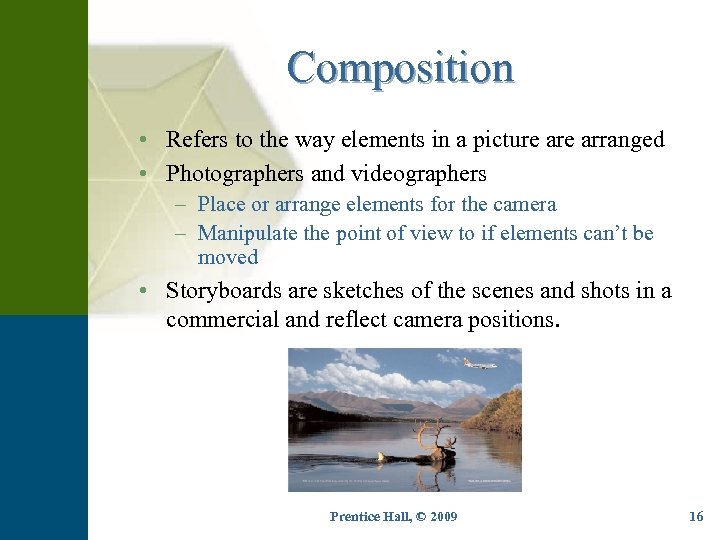 Composition • Refers to the way elements in a picture arranged • Photographers and videographers – Place or arrange elements for the camera – Manipulate the point of view to if elements can’t be moved • Storyboards are sketches of the scenes and shots in a commercial and reflect camera positions. Prentice Hall, © 2009 16
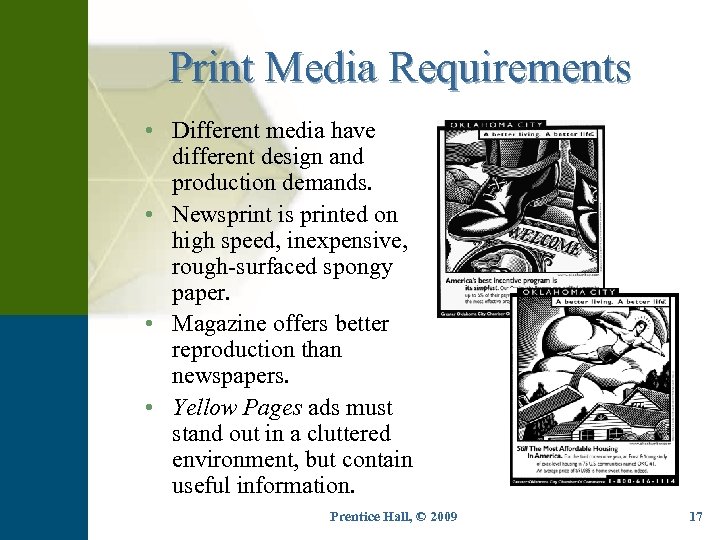 Print Media Requirements • Different media have different design and production demands. • Newsprint is printed on high speed, inexpensive, rough-surfaced spongy paper. • Magazine offers better reproduction than newspapers. • Yellow Pages ads must stand out in a cluttered environment, but contain useful information. Prentice Hall, © 2009 17
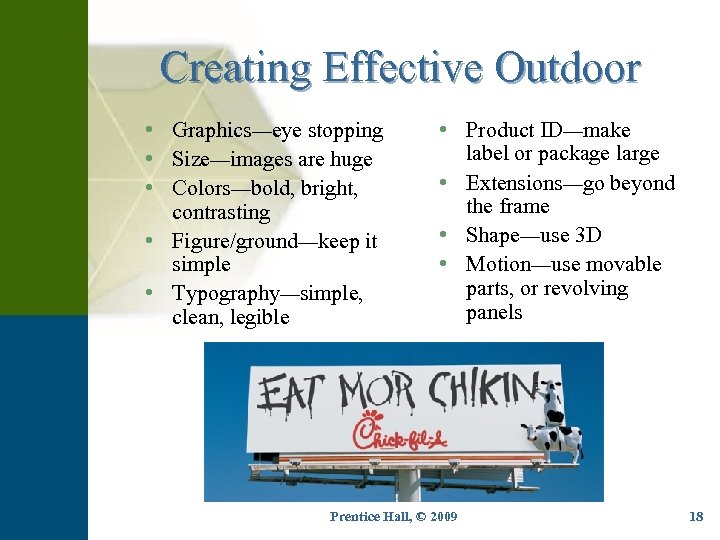 Creating Effective Outdoor • Graphics—eye stopping • Size—images are huge • Colors—bold, bright, contrasting • Figure/ground—keep it simple • Typography—simple, clean, legible • Product ID—make label or package large • Extensions—go beyond the frame • Shape—use 3 D • Motion—use movable parts, or revolving panels Prentice Hall, © 2009 18
 OAAA • The Outdoor Advertising Association of America is the trade association for the outdoor advertising industry. Visit the Site Prentice Hall, © 2009 19
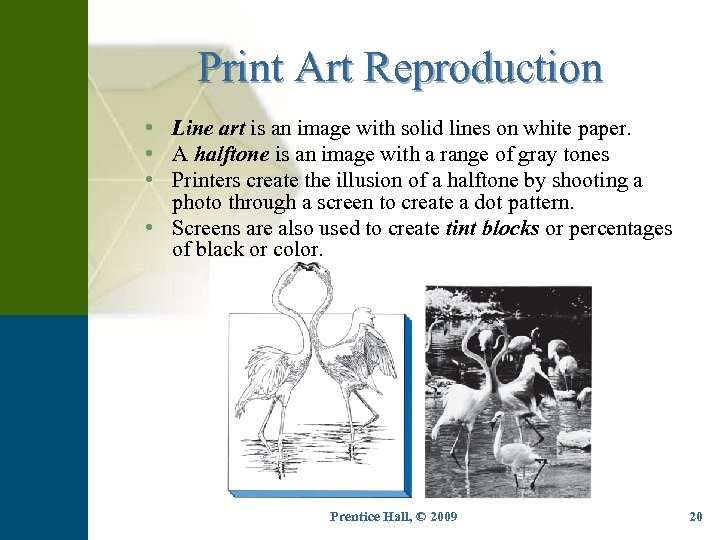 Print Art Reproduction • Line art is an image with solid lines on white paper. • A halftone is an image with a range of gray tones • Printers create the illusion of a halftone by shooting a photo through a screen to create a dot pattern. • Screens are also used to create tint blocks or percentages of black or color. Prentice Hall, © 2009 20
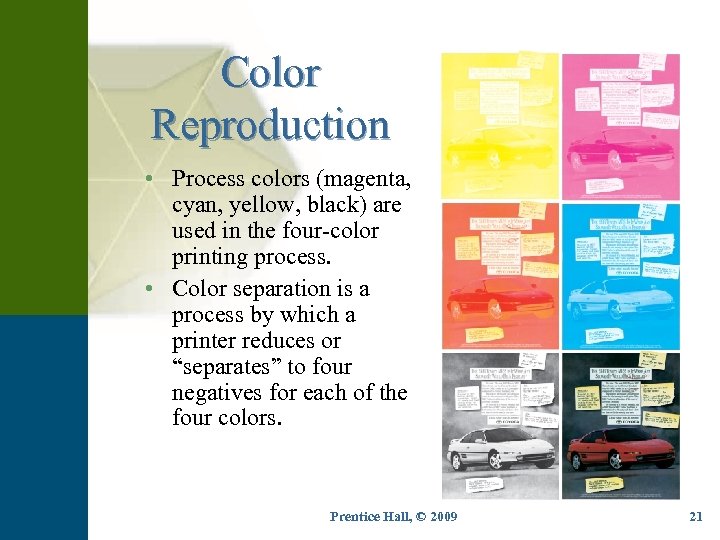 Color Reproduction • Process colors (magenta, cyan, yellow, black) are used in the four-color printing process. • Color separation is a process by which a printer reduces or “separates” to four negatives for each of the four colors. Prentice Hall, © 2009 21
 Digitization • Method for creating a reproducible form of an ad to distribute to a number of publications. • Also used by agencies to send ad proofs to clients. • A computer codes images electronically for tone or color; they can then be transmitted electronically to clients, printers, or newspaper printers. • Digitization is also used to create out-ofhome advertising with changing digital screens and moving images. Prentice Hall, © 2009 22
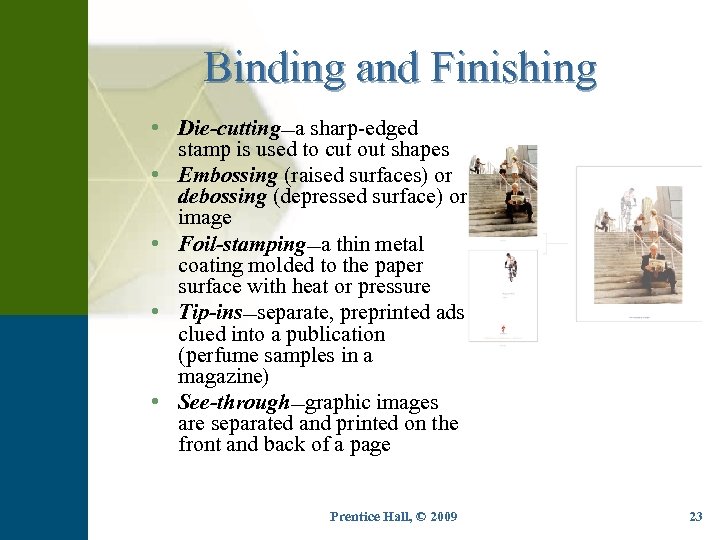 Binding and Finishing • Die-cutting—a sharp-edged stamp is used to cut out shapes • Embossing (raised surfaces) or debossing (depressed surface) or image • Foil-stamping—a thin metal coating molded to the paper surface with heat or pressure • Tip-ins—separate, preprinted ads clued into a publication (perfume samples in a magazine) • See-through—graphic images are separated and printed on the front and back of a page Prentice Hall, © 2009 23
 Broadcast Production • Stock footage – Previously recorded images, either video, still slides, or moving film • Crawl – Computer-generated letters that move across the bottom of a screen • Morphing – One image gradually changes into another Prentice Hall, © 2009 24
 Filming and Editing • Copywriter—writes the script, even if there are no words. • Art Director—in TV, develops the storyboard and establishes the look of the commercial, whether realistic, stylized, or fanciful. • Producer (can be an agency staff member)—handles production including bidding, all arrangements, specialists, casting talent, and budget. • Director–responsible for filming/taping, including scene length, action, how lines are spoken and characters played; in TV determines camera set up and records the flow of action. • Composer–writes original music and sometimes lyrics, too. • Arranger–orchestrates music for the various instruments and voices to make it fit a scene or copy line. • Editor–assembles all the pieces including audio, dialogue, and footage. Prentice Hall, © 2009 25
 Producing TV Commercials • Television ads create excitement and drama through the moving images. • Can be filmed live, prerecorded on film or tape, or animated. • Film-to-tape transfer—shot on film or video, digitized for editing, then transferred to videotape for distribution. Principle: Visual storytelling in television commercials is constructed through the careful design of individual shots and the sequencing of moving images. Prentice Hall, © 2009 26
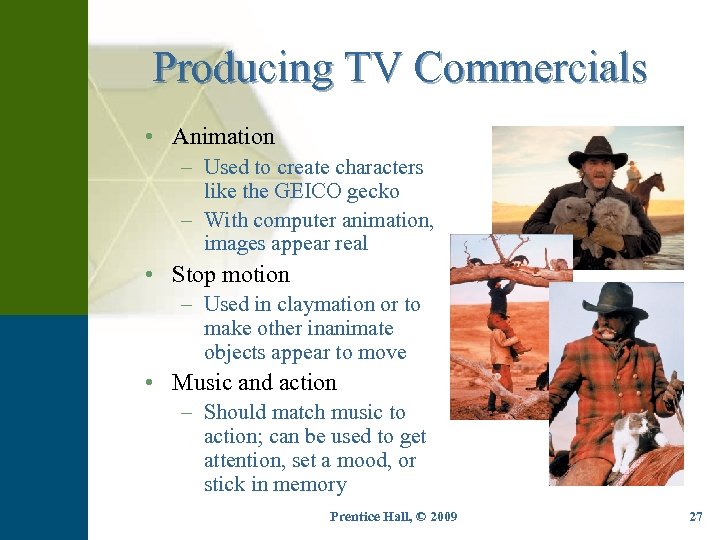 Producing TV Commercials • Animation – Used to create characters like the GEICO gecko – With computer animation, images appear real • Stop motion – Used in claymation or to make other inanimate objects appear to move • Music and action – Should match music to action; can be used to get attention, set a mood, or stick in memory Prentice Hall, © 2009 27
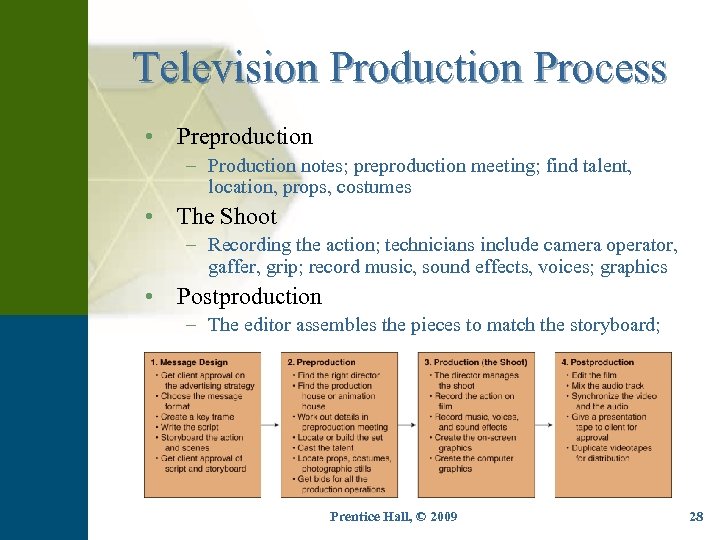 Television Production Process • Preproduction – Production notes; preproduction meeting; find talent, location, props, costumes • The Shoot – Recording the action; technicians include camera operator, gaffer, grip; record music, sound effects, voices; graphics • Postproduction – The editor assembles the pieces to match the storyboard; Prentice Hall, © 2009 28
 Effective Web Design • Web pages, especially first screens, should follow the same layout rules as posters. – Graphics should be attention-getting but quickly downloadable. – Type should be simple; avoid all caps. – Use high-contrast colors. • Web pages can combine elements and design styles from many different media including print, still photography, film, animation, sound, games. • Web designers use many tools including animation, complex navigation paths, and sophisticated design software. Prentice Hall, © 2009 29
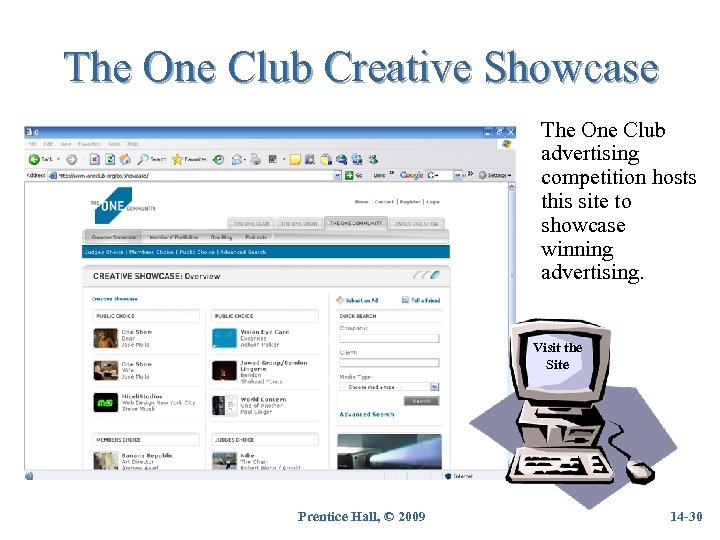 The One Club Creative Showcase The One Club advertising competition hosts this site to showcase winning advertising. Visit the Site Prentice Hall, © 2009 14 -30 30
 Action and Interaction • Web advertisers are continuing to find ways to make the imagery more engaging. – www. climbmeru. com • Sites should have clear navigation. – Users should be able to easily move through the site and find what they want. • Regular site visitors should be able to customize the site. • Minicomputers, PDAs, and cell phones present new opportunities and challenges for businesses to display products on the small screen. Prentice Hall, © 2009 31
 Discussion Questions 32
 Discussion Question 1 • One of the challenges for creative ad designers is to demonstrate a product whose main feature cannot be seen by the consumer. • Suppose you are an art director on an account that sells shower and bath mats with a patented system that ensures that the mat will not slide (the mat’s underside is covered with tiny suction cups that gently grip the tub’s surface). – Brainstorm some ways to demonstrate this feature in a television commercial. – Find a way that will satisfy the demands of originality, relevance, and impact. Prentice Hall, © 2009 33
 Discussion Question 2 • One approach to design says that a visual image in an ad should reflect the image of the brand. • Find a print ad that you think speaks effectively for the personality of the brand. Now compare the print ad with the brand’s Web site. – Does the same design style continue on the site? – Does the site present the brand personality in the same way as the print ad? Prentice Hall, © 2009 34
 Discussion Question 3 • • • Three-minute debate: Your team is assigned to a new client, which is a new hand lotion for men, one that is designed to help men whose hands take a beating in their jobs. One of your colleagues, a photographer, believes the only way to visualize the product and its use in an ad is through photography. Another colleague, an artist, argues that there are times when art is a much better way to illustrate a product than photography and that this production is a good example. Analyze the difference between using an illustration and using a photograph. What are their roles, and how do they create different types of effects? Are there certain product categories where you would want to use an illustration or a photograph? Which would work best for this new product? In class, organize into small teams with each team developing a case for using photography or artwork. Set up a series of three-minute debates with each team having half that time to argue its position. Every team of debaters has to present new points not covered in the previous teams’ presentations until there are no arguments left to present. Then, the class votes as a group on the winning point of view. Prentice Hall, © 2009 35
 All rights reserved. No part of this publication may be reproduced, stored in a retrieval system, or transmitted, in any form or by any means, electronic, mechanical, photocopying, recording, or otherwise, without the prior written permission of the publisher. Printed in the United States of America. Copyright © 2009 Pearson Education, Inc. Publishing as Prentice Hall, © 2009 36