


 Скачать презентацию Advertising Principles and Practices Copywriting 1 Questions
15d05e37e1f0f381a1c53c137ef610c9.ppt
- Количество слайдов: 41
 Advertising Principles and Practices Copywriting 1
 Questions We’ll Answer • What basic style of writing is used for advertising copy? • Which copy elements are essential to a print ad? • How can we characterize the message and tools of radio advertising? • What is the best way to summarize the major elements of television commercials? • How is Web advertising written? Prentice Hall, © 2009 2
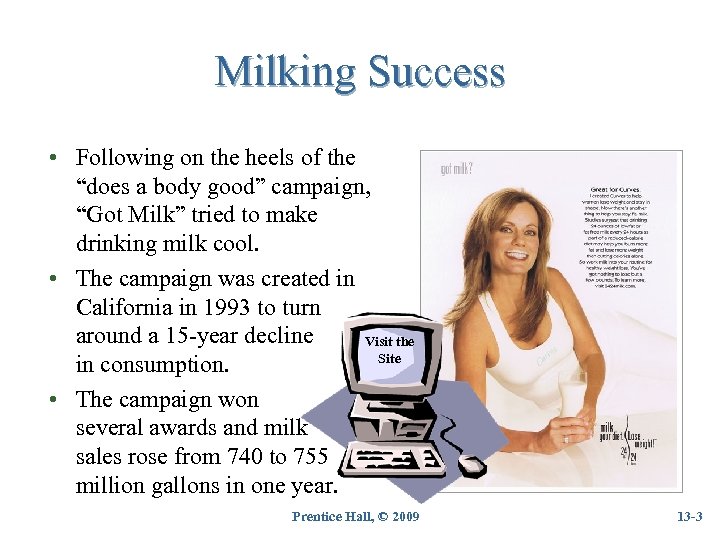 Milking Success • Following on the heels of the “does a body good” campaign, “Got Milk” tried to make drinking milk cool. • The campaign was created in California in 1993 to turn around a 15 -year decline Visit the Site in consumption. • The campaign won several awards and milk sales rose from 740 to 755 million gallons in one year. Prentice Hall, © 2009 13 -3 3
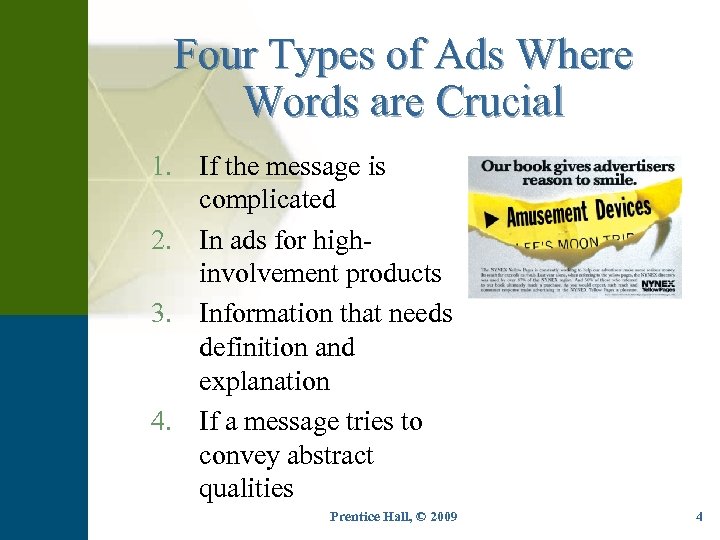 Four Types of Ads Where Words are Crucial 1. If the message is complicated 2. In ads for highinvolvement products 3. Information that needs definition and explanation 4. If a message tries to convey abstract qualities Prentice Hall, © 2009 4
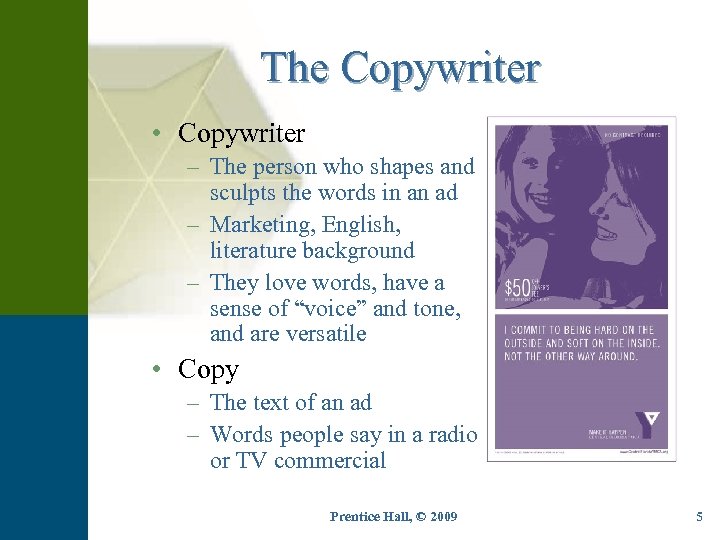 The Copywriter • Copywriter – The person who shapes and sculpts the words in an ad – Marketing, English, literature background – They love words, have a sense of “voice” and tone, and are versatile • Copy – The text of an ad – Words people say in a radio or TV commercial Prentice Hall, © 2009 5
 Advertising Writing Style • Copy should be as simple as possible. • Write the way your target audience thinks and talks, using direct address. Video Snippet Dunkin’ Donuts’ accessible brand conversational ad copy connects with consumers. Principle: Effective copy is succinct, single-minded, and tightly focused. Prentice Hall, © 2009 6
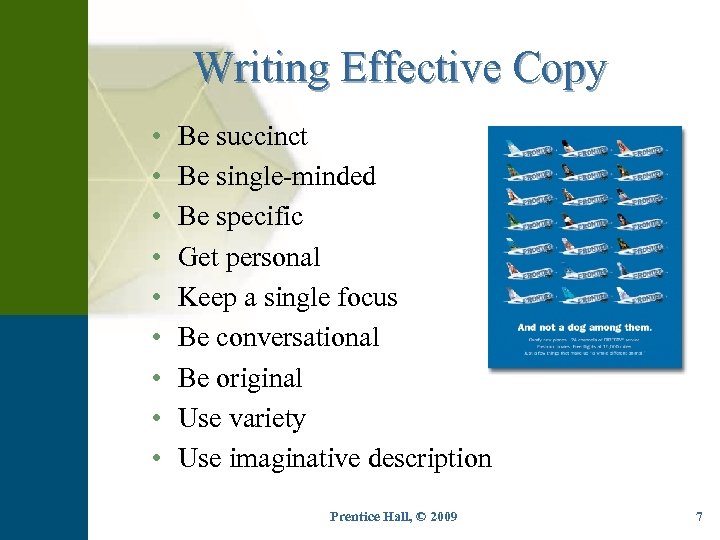 Writing Effective Copy • • • Be succinct Be single-minded Be specific Get personal Keep a single focus Be conversational Be original Use variety Use imaginative description Prentice Hall, © 2009 7
 Advertising Writing Style • Tone of Voice – Write to the target audience, as if in conversation with one person • Grammar – Sometimes use incorrect grammar for effect • Adese – Clichés, superlatives, stock phrases, and vague generalities that violate the guidelines for effective copy – Brag and boast copy—“we” focused and pompous Prentice Hall, © 2009 8
 Copywriting for Print • Display copy – Elements readers see in their initial scanning – Headlines, subheads, call-outs, taglines, and slogans • Body copy – Elements that are designed to be read and absorbed – Text of the ad message, captions, call to action Prentice Hall, © 2009 9
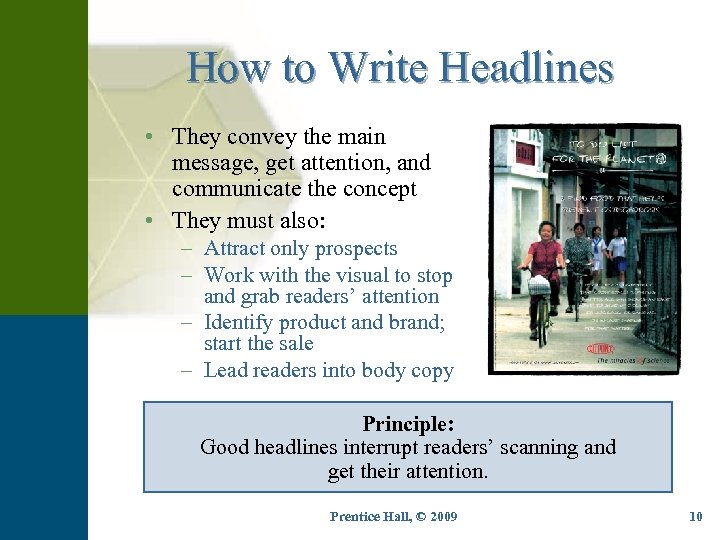 How to Write Headlines • They convey the main message, get attention, and communicate the concept • They must also: – Attract only prospects – Work with the visual to stop and grab readers’ attention – Identify product and brand; start the sale – Lead readers into body copy Principle: Good headlines interrupt readers’ scanning and get their attention. Prentice Hall, © 2009 10
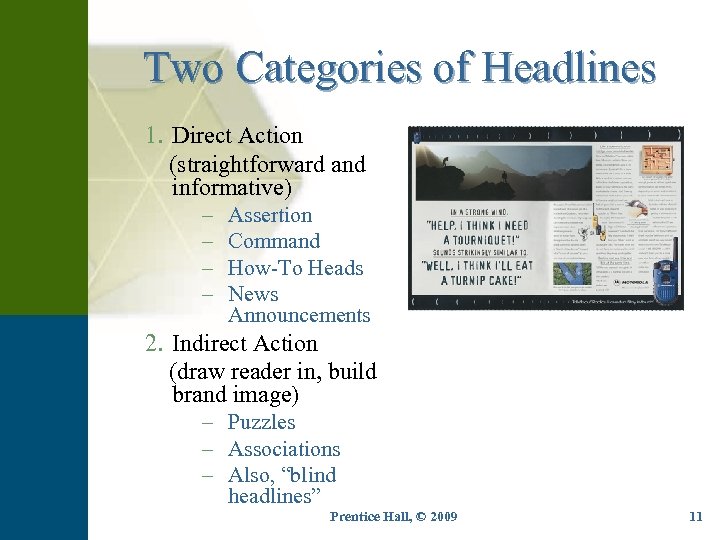 Two Categories of Headlines 1. Direct Action (straightforward and informative) – – Assertion Command How-To Heads News Announcements 2. Indirect Action (draw reader in, build brand image) – Puzzles – Associations – Also, “blind headlines” Prentice Hall, © 2009 11
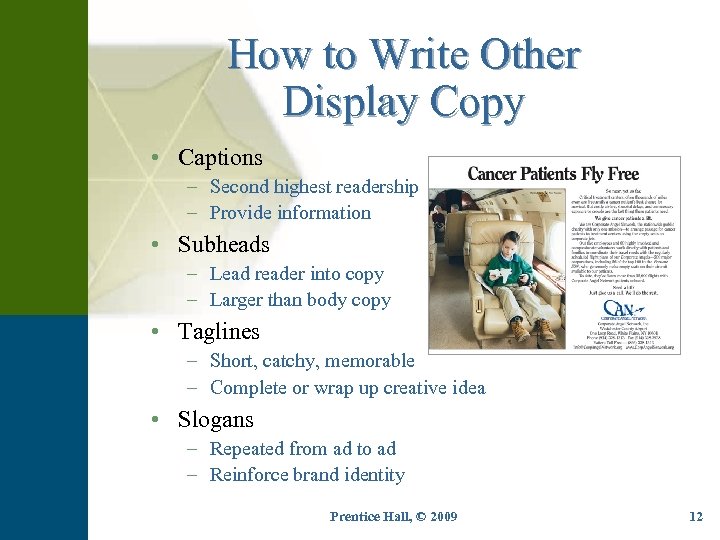 How to Write Other Display Copy • Captions – Second highest readership – Provide information • Subheads – Lead reader into copy – Larger than body copy • Taglines – Short, catchy, memorable – Complete or wrap up creative idea • Slogans – Repeated from ad to ad – Reinforce brand identity Prentice Hall, © 2009 12
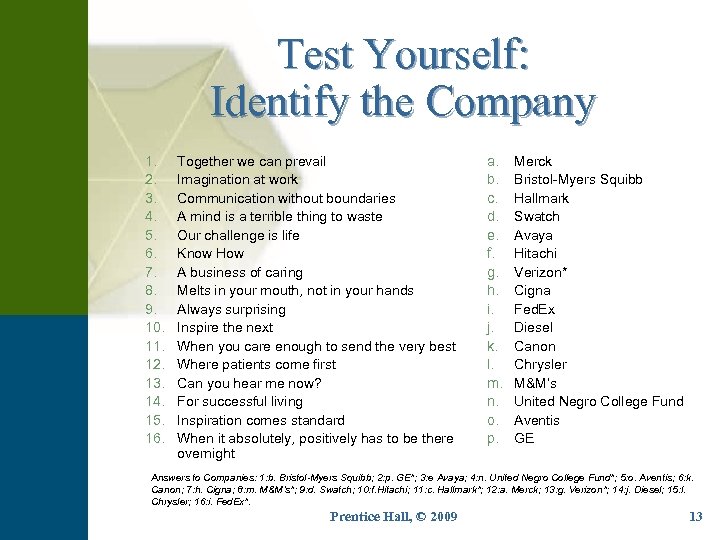 Test Yourself: Identify the Company 1. 2. 3. 4. 5. 6. 7. 8. 9. 10. 11. 12. 13. 14. 15. 16. Together we can prevail Imagination at work Communication without boundaries A mind is a terrible thing to waste Our challenge is life Know How A business of caring Melts in your mouth, not in your hands Always surprising Inspire the next When you care enough to send the very best Where patients come first Can you hear me now? For successful living Inspiration comes standard When it absolutely, positively has to be there overnight a. b. c. d. e. f. g. h. i. j. k. l. m. n. o. p. Merck Bristol-Myers Squibb Hallmark Swatch Avaya Hitachi Verizon* Cigna Fed. Ex Diesel Canon Chrysler M&M’s United Negro College Fund Aventis GE Answers to Companies: 1: b. Bristol-Myers Squibb; 2: p. GE*; 3: e Avaya; 4: n. United Negro College Fund*; 5: o. Aventis; 6: k. Canon; 7: h. Cigna; 8: m. M&M’s*; 9: d. Swatch; 10: f. Hitachi; 11: c. Hallmark*; 12: a. Merck; 13: g. Verizon*; 14: j. Diesel; 15: l. Chrysler; 16: i. Fed. Ex*. Prentice Hall, © 2009 13
 Advertising Week Winners • Advertising Week winning slogans every year and post them in their Walk of Fame. Visit the Site Prentice Hall, © 2009 14
 Techniques for Creating Catchy Slogans • Direct address: “Have it your way; “Think small. ” • A startling or unexpected phrase. The NYNEX campaign used, “If it’s out there, it’s in here, ” which is an example of a twist on a common phrase that makes it unexpected. • Rhyme, rhythm, alliteration. Uses repetition of sounds, as in the Wall Street Journal’s slogan—“The daily dairy of the American Dream. ” • Parallel construction. Uses repetition of the structure of a sentence or phrase; Morton Salt’s “When it rains, it pours. ” • Cue for the product: Folgers’ “Good to the last drop; ” John Deere’s “Nothing runs like a Deere, ” Wheaties’ “Breakfast of Champions” • Music: “In the valley of the Jolly, ho-ho-ho, Green Giant. ” • Combination (rhyme, rhythm, parallel): “It’s your land, lend a hand, ” slogan for Take Pride in America. Prentice Hall, © 2009 15
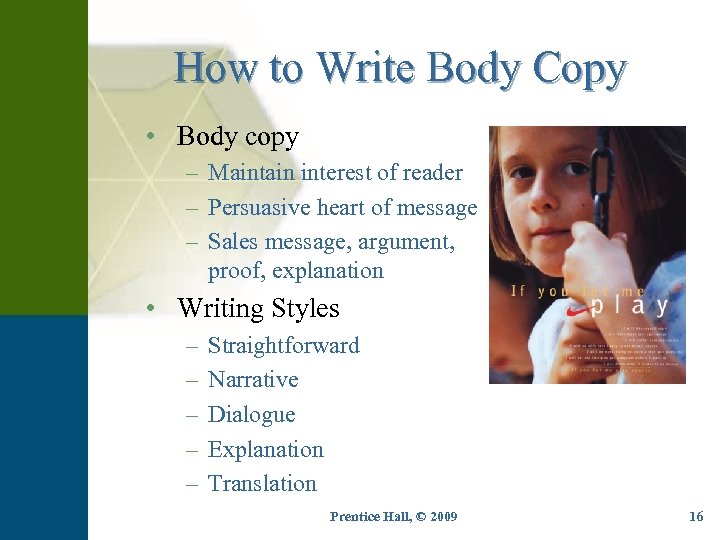 How to Write Body Copy • Body copy – Maintain interest of reader – Persuasive heart of message – Sales message, argument, proof, explanation • Writing Styles – – – Straightforward Narrative Dialogue Explanation Translation Prentice Hall, © 2009 16
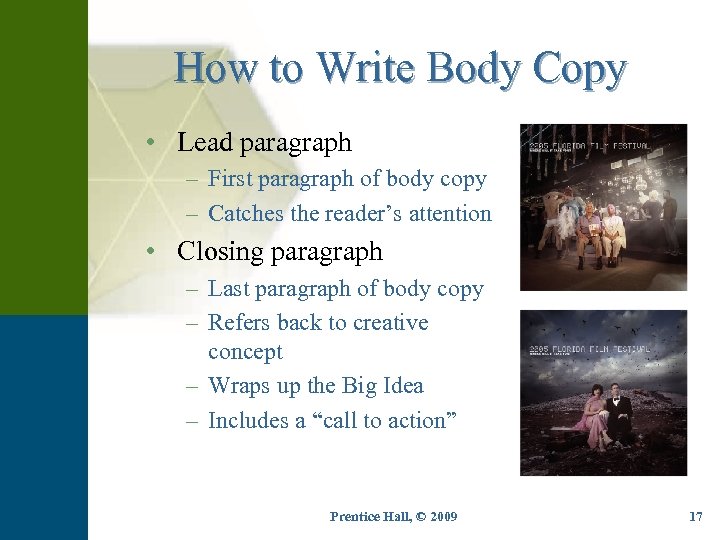 How to Write Body Copy • Lead paragraph – First paragraph of body copy – Catches the reader’s attention • Closing paragraph – Last paragraph of body copy – Refers back to creative concept – Wraps up the Big Idea – Includes a “call to action” Prentice Hall, © 2009 17
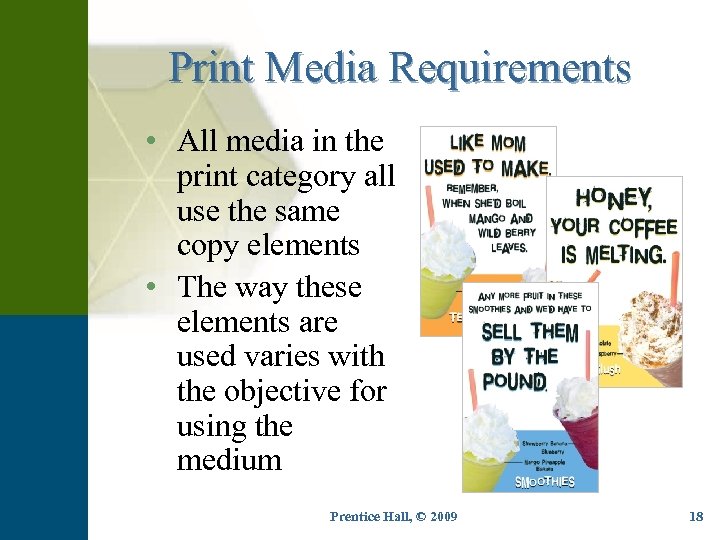 Print Media Requirements • All media in the print category all use the same copy elements • The way these elements are used varies with the objective for using the medium Prentice Hall, © 2009 18
 Print Media Requirements • Newspapers – Less intrusive medium – Ads more straightforward and informative • Magazines – Better ad production – More informative, longer copy • Directories – Focus on service or store personality – Little space for explanation; keep it simple • Posters and outdoor advertising – Creative concept marries words and visual • Product literature – Detailed copy about a product, company, or event Prentice Hall, © 2009 19
 Writing for Radio • Short: 10, 15, 30, or 60 seconds • Simple enough for consumers to grasp; intriguing enough to prevent switching • Creativity is key to breaking through clutter • Theater of the mind Prentice Hall, © 2009 20
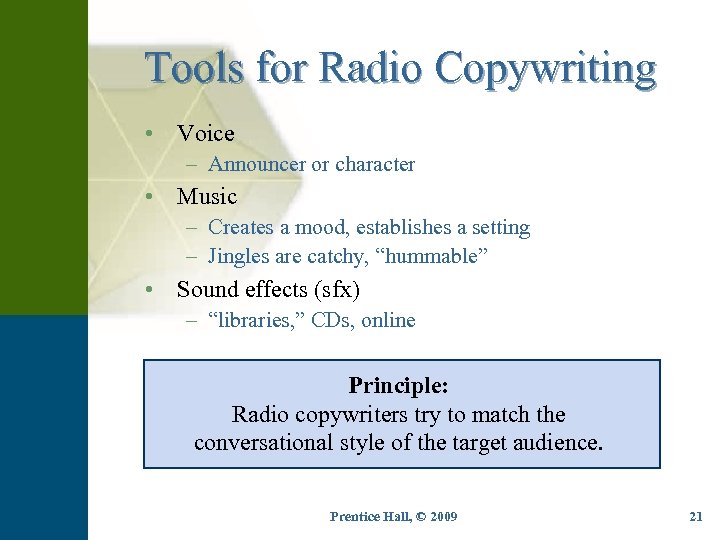 Tools for Radio Copywriting • Voice – Announcer or character • Music – Creates a mood, establishes a setting – Jingles are catchy, “hummable” • Sound effects (sfx) – “libraries, ” CDs, online Principle: Radio copywriters try to match the conversational style of the target audience. Prentice Hall, © 2009 21
 Guidelines for Writing Radio • • • Keep it personal Speak to listener’s interests Wake up the inattentive Make it memorable Include call to action Create image transfer Prentice Hall, © 2009 22
 The Radio Advertising Bureau • The RAB is the sales and marketing arm of the radio industry. Visit the Site Prentice Hall, © 2009 23
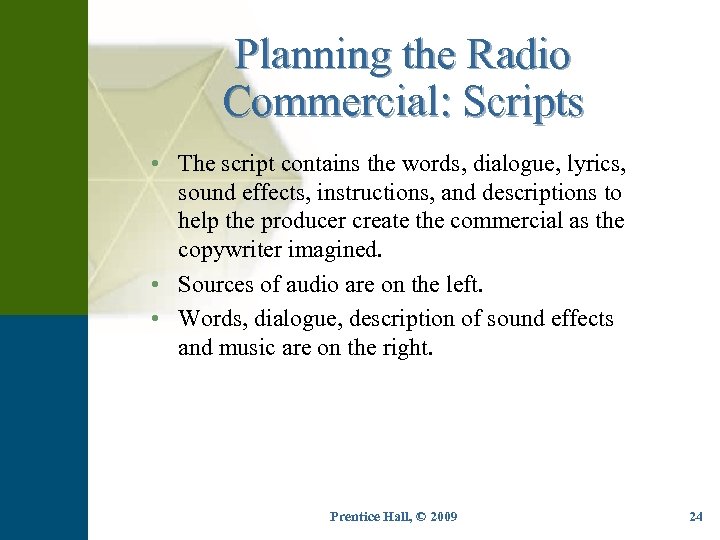 Planning the Radio Commercial: Scripts • The script contains the words, dialogue, lyrics, sound effects, instructions, and descriptions to help the producer create the commercial as the copywriter imagined. • Sources of audio are on the left. • Words, dialogue, description of sound effects and music are on the right. Prentice Hall, © 2009 24
 How to Write Television Copy • Moving images makes TV more engaging than print • The challenge is to fuse the images with the words to tell a story Principle: In great television commercials, words and pictures work together seamlessly to deliver the creative concept through sight, sound, and motion. Prentice Hall, © 2009 25
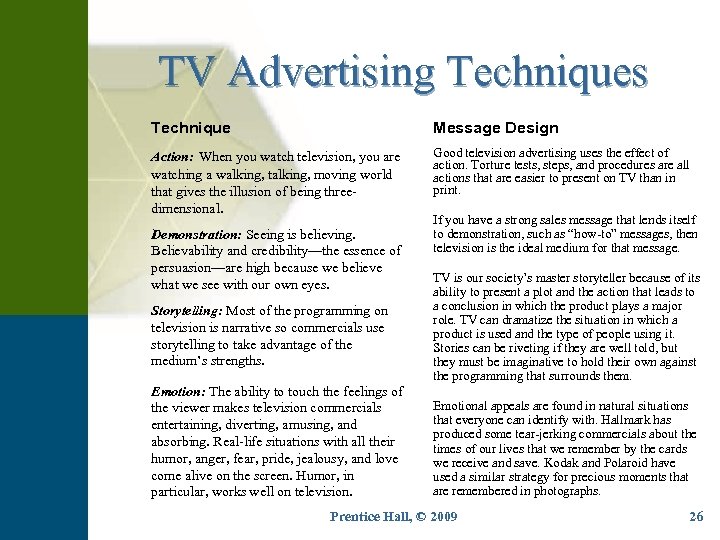 TV Advertising Techniques Technique Message Design Action: When you watch television, you are watching a walking, talking, moving world that gives the illusion of being threedimensional. Good television advertising uses the effect of action. Torture tests, steps, and procedures are all actions that are easier to present on TV than in print. Demonstration: Seeing is believing. Believability and credibility—the essence of persuasion—are high because we believe what we see with our own eyes. Storytelling: Most of the programming on television is narrative so commercials use storytelling to take advantage of the medium’s strengths. Emotion: The ability to touch the feelings of the viewer makes television commercials entertaining, diverting, amusing, and absorbing. Real-life situations with all their humor, anger, fear, pride, jealousy, and love come alive on the screen. Humor, in particular, works well on television. If you have a strong sales message that lends itself to demonstration, such as “how-to” messages, then television is the ideal medium for that message. TV is our society’s master storyteller because of its ability to present a plot and the action that leads to a conclusion in which the product plays a major role. TV can dramatize the situation in which a product is used and the type of people using it. Stories can be riveting if they are well told, but they must be imaginative to hold their own against the programming that surrounds them. Emotional appeals are found in natural situations that everyone can identify with. Hallmark has produced some tear-jerking commercials about the times of our lives that we remember by the cards we receive and save. Kodak and Polaroid have used a similar strategy for precious moments that are remembered in photographs. Prentice Hall, © 2009 26
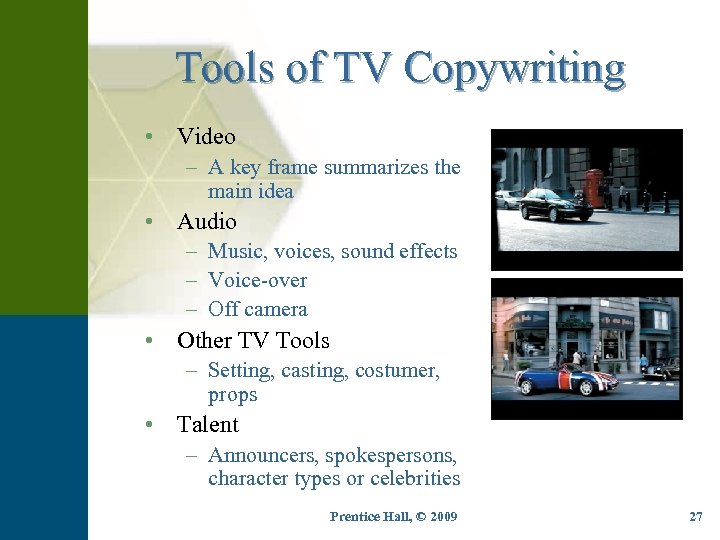 Tools of TV Copywriting • Video – A key frame summarizes the main idea • Audio – Music, voices, sound effects – Voice-over – Off camera • Other TV Tools – Setting, casting, costumer, props • Talent – Announcers, spokespersons, character types or celebrities Prentice Hall, © 2009 27
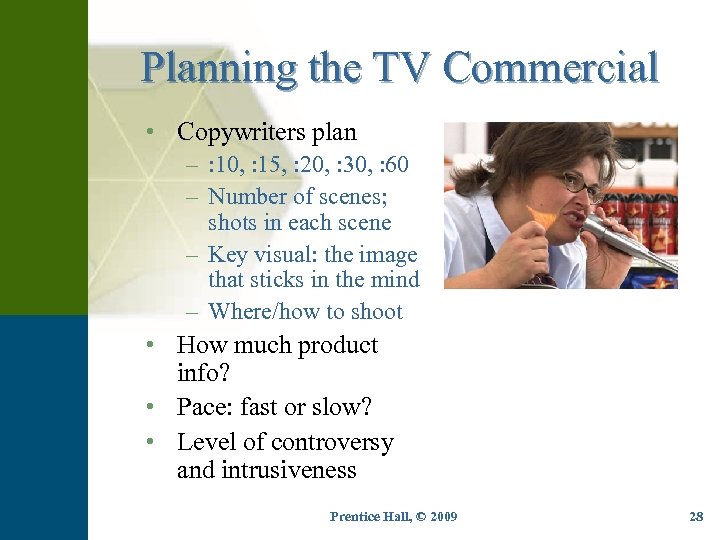 Planning the TV Commercial • Copywriters plan – : 10, : 15, : 20, : 30, : 60 – Number of scenes; shots in each scene – Key visual: the image that sticks in the mind – Where/how to shoot • How much product info? • Pace: fast or slow? • Level of controversy and intrusiveness Prentice Hall, © 2009 28
 Planning the TV Commercial • What’s the Big Idea? • What’s the benefit and who benefits? • How can you turn that benefit into a visual element? • How can you gain the viewer’s interest in the first three seconds? • How can you focus on a key visual? • Is the commercial single-minded? • Observe rules of good editing • Is the product identified and shown in close -up at the end? Prentice Hall, © 2009 29
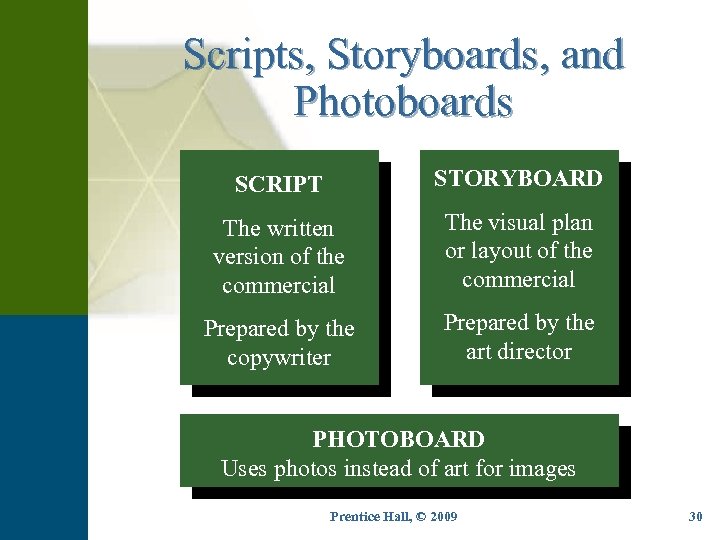 Scripts, Storyboards, and Photoboards SCRIPT STORYBOARD The written version of the commercial The visual plan or layout of the commercial Prepared by the copywriter Prepared by the art director PHOTOBOARD Uses photos instead of art for images Prentice Hall, © 2009 30
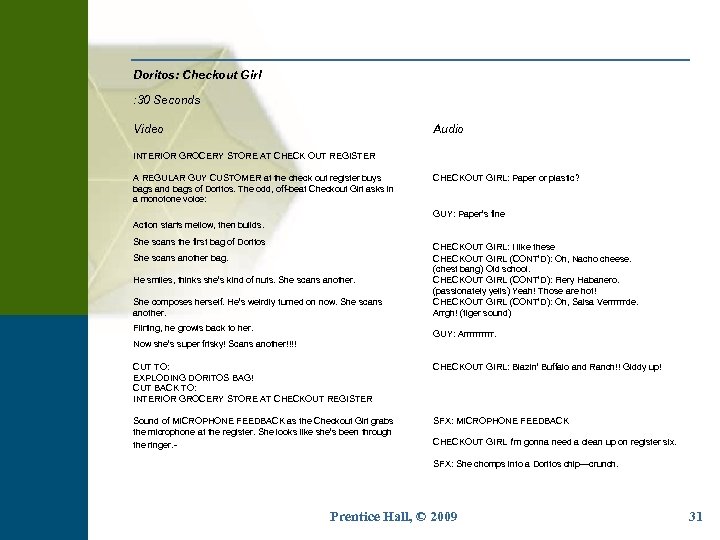 Doritos: Checkout Girl : 30 Seconds Video Audio INTERIOR GROCERY STORE AT CHECK OUT REGISTER A REGULAR GUY CUSTOMER at the check out register buys bags and bags of Doritos. The odd, off-beat Checkout Girl asks in a monotone voice: CHECKOUT GIRL: Paper or plastic? GUY: Paper’s fine Action starts mellow, then builds. She scans the first bag of Doritos She scans another bag. He smiles, thinks she’s kind of nuts. She scans another. She composes herself. He’s weirdly turned on now. She scans another. Flirting, he growls back to her. CHECKOUT GIRL: I like these CHECKOUT GIRL (CONT’D): Oh, Nacho cheese. (chest bang) Old school. CHECKOUT GIRL (CONT’D): Fiery Habanero. (passionately yells) Yeah! Those are hot! CHECKOUT GIRL (CONT’D): Oh, Salsa Verrrrrrde. Arrgh! (tiger sound) GUY: Arrrrr. Now she’s super frisky! Scans another!!!! CUT TO: EXPLODING DORITOS BAG! CUT BACK TO: INTERIOR GROCERY STORE AT CHECKOUT REGISTER CHECKOUT GIRL: Blazin’ Buffalo and Ranch!! Giddy up! Sound of MICROPHONE FEEDBACK as the Checkout Girl grabs the microphone at the register. She looks like she’s been through SFX: MICROPHONE FEEDBACK the ringer. - CHECKOUT GIRL I’m gonna need a clean up on register six. SFX: She chomps into a Doritos chip—crunch. Prentice Hall, © 2009 31
 Writing for the Web • More interactive than any other mass medium— more like two-way communication. • The copywriter’s challenge: to attract people to the site and manage dialogue-based communication. • The advertiser’s challenge: to understand the user’s situation and design messages that fit the user’s needs. Principle: To write great copy for the Web, copywriters must think of it as an interactive medium and open up opportunities for interaction with the consumer. Prentice Hall, © 2009 32
 Banner Ads • Ways copywriters make ads stand out amidst the clutter and grab attention. – – – Offering a deal like a discount or a freebie. Using an involvement device like a challenge or contest. Changing the offer frequently, even daily. Keeping the writing succinct for surfers short attention Focusing surfers’ attention by asking questions or offering knowledge they can use. – Use the ad to solicit information and opinions. • Banner ads can remind or invite viewers to click. • The product or brand should be immediately clear. Prentice Hall, © 2009 33
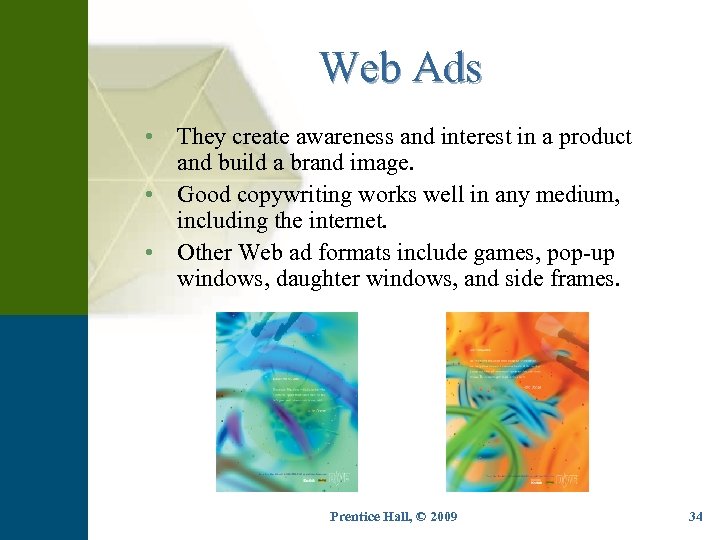 Web Ads • They create awareness and interest in a product and build a brand image. • Good copywriting works well in any medium, including the internet. • Other Web ad formats include games, pop-up windows, daughter windows, and side frames. Prentice Hall, © 2009 34
 Global Copywriting Challenges • Language affects the creation of the advertising. • Standardizing copy by translating for a foreign market is dangerous. • Solution—use bilingual copywriters – Use back translation Prentice Hall, © 2009 35
 Discussion Questions 36
 Discussion Question 1 • Creative directors say the copy and art must work together to create a concept. • Consider all the ads in this chapter and the preceding chapter and identify one that you believe demonstrates that principle? • Explain what the words contribute and how they work with the visual. Prentice Hall, © 2009 37
 Discussion Question 2 • One principle of print copywriting is that the headline catches the reader’s eye, but the body copy wins the reader’s heart and mind. • Find an ad that demonstrates that principle and explain how it works. Prentice Hall, © 2009 38
 Discussion Question 3 • A principle of TV message design is that television is primarily a visual medium. • However, very few television commercials are designed without a vocal element (actors or announcers). • Even the many commercials that visually demonstrate products in action use an off screen voice to provide information. • Why is there a need to use a voice in a television commercial? Prentice Hall, © 2009 39
 Discussion Question 4 • Three-minute debate: Professor Strong has set up a debate between the advertising sales director of the campus newspaper and the manager of the campus radio station, which is a commercial operation. • During the discussion, the newspaper representative says that most radio commercials sound like newspaper ads, but are harder to follow. The radio manager responds by claiming that radio creativity works with “the theater of the mind” and is more engaging than newspaper ads. • In class, organize into small teams with pairs of teams taking one side or the other. Set up a series of three-minute debates with each side having half the time to explain what these media selling points mean. In other words, make the case for either newspaper or radio advertising in a local market. Every team of debaters must present new points not covered in the previous teams’ presentations until there are no arguments left to present. Then the class votes as a group on the winning point of view. Prentice Hall, © 2009 40
 All rights reserved. No part of this publication may be reproduced, stored in a retrieval system, or transmitted, in any form or by any means, electronic, mechanical, photocopying, recording, or otherwise, without the prior written permission of the publisher. Printed in the United States of America. Copyright © 2009 Pearson Education, Inc. Publishing as Prentice Hall, © 2009 41