


ADVERB
• Adverb may express circumstances that attend an action/state, or point out characteristic features of an action/quality • The function of an adverb is that of an adverbial modifier An adverb may modify verbs/verbals, adjectives and adverbs
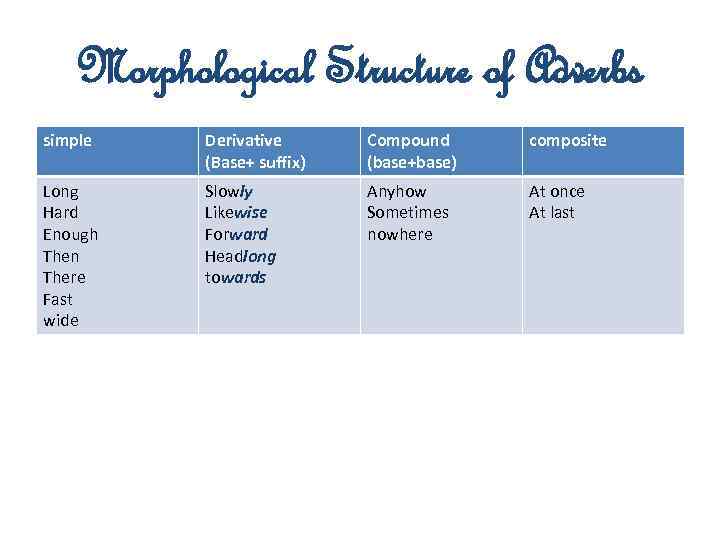
Morphological Structure of Adverbs simple Derivative (Base+ suffix) Compound (base+base) composite Long Hard Enough Then There Fast wide Slowly Likewise Forward Headlong towards Anyhow Sometimes nowhere At once At last
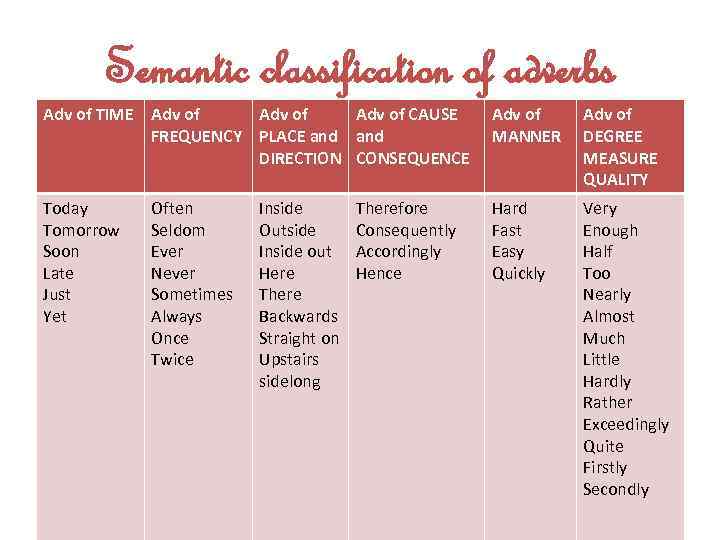
Semantic classification of adverbs Adv of TIME Adv of CAUSE FREQUENCY PLACE and DIRECTION CONSEQUENCE Adv of MANNER Adv of DEGREE MEASURE QUALITY Today Tomorrow Soon Late Just Yet Hard Fast Easy Quickly Very Enough Half Too Nearly Almost Much Little Hardly Rather Exceedingly Quite Firstly Secondly Often Seldom Ever Never Sometimes Always Once Twice Inside Outside Inside out Here There Backwards Straight on Upstairs sidelong Therefore Consequently Accordingly Hence
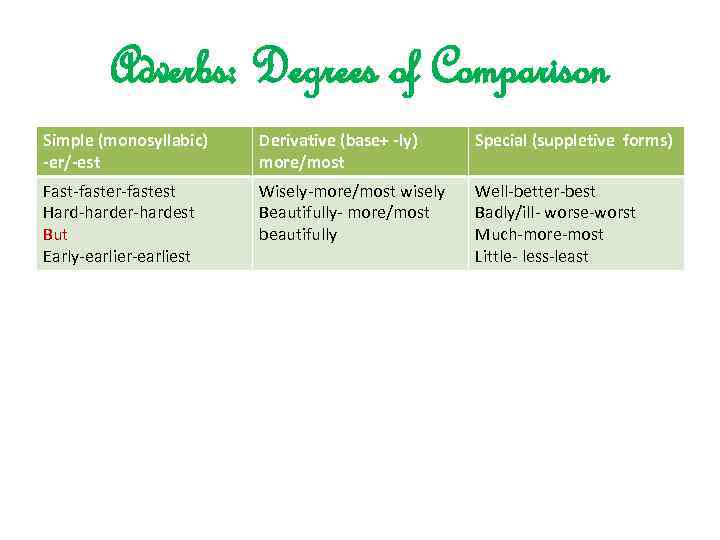
Adverbs: Degrees of Comparison Simple (monosyllabic) er/ est Derivative (base+ ly) more/most Special (suppletive forms) Fast faster fastest Hard harder hardest But Early earlier earliest Wisely more/most wisely Beautifully more/most beautifully Well better best Badly/ill worse worst Much more most Little less least
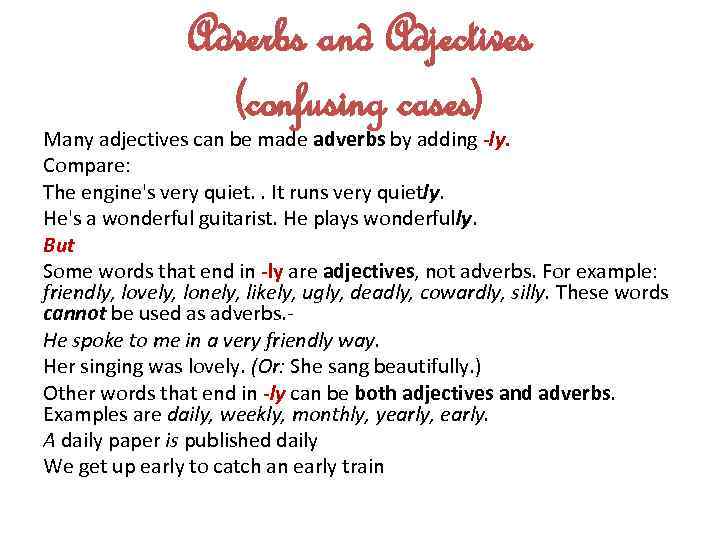
Adverbs and Adjectives (confusing cases) Many adjectives can be made adverbs by adding -ly. Compare: The engine's very quiet. . It runs very quietly. He's a wonderful guitarist. He plays wonderfully. But Some words that end in ly are adjectives, not adverbs. For example: friendly, lovely, lonely, likely, ugly, deadly, cowardly, silly. These words cannot be used as adverbs. He spoke to me in a very friendly way. Her singing was lovely. (Or: She sang beautifully. ) Other words that end in -ly can be both adjectives and adverbs. Examples are daily, weekly, monthly, yearly, early. A daily paper is published daily We get up early to catch an early train
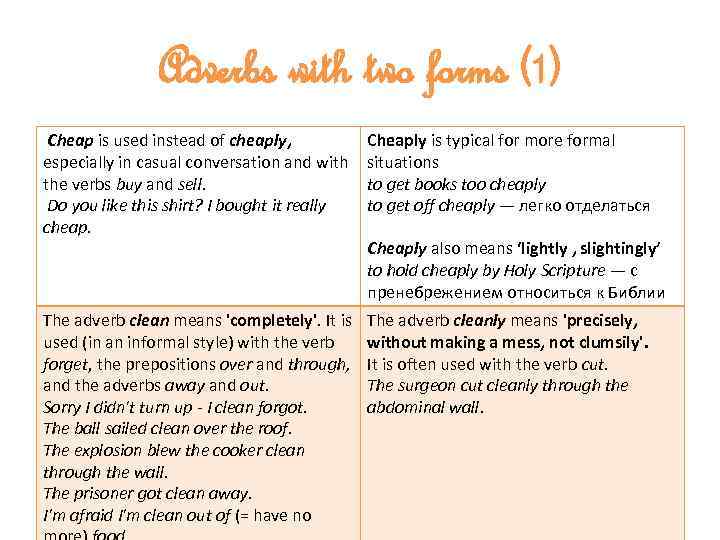
Adverbs with two forms (1) Cheap is used instead of cheaply, especially in casual conversation and with the verbs buy and sell. Do you like this shirt? I bought it really cheap. Cheaply is typical for more formal situations to get books too cheaply to get off cheaply — легко отделаться The adverb clean means 'completely'. It is used (in an informal style) with the verb forget, the prepositions over and through, and the adverbs away and out. Sorry I didn't turn up I clean forgot. The ball sailed clean over the roof. The explosion blew the cooker clean through the wall. The prisoner got clean away. I'm afraid I'm clean out of (= have no The adverb cleanly means 'precisely, without making a mess, not clumsily'. It is often used with the verb cut. The surgeon cut cleanly through the abdominal wall. Cheaply also means ‘lightly , slightingly’ to hold cheaply by Holy Scripture — с пренебрежением относиться к Библии
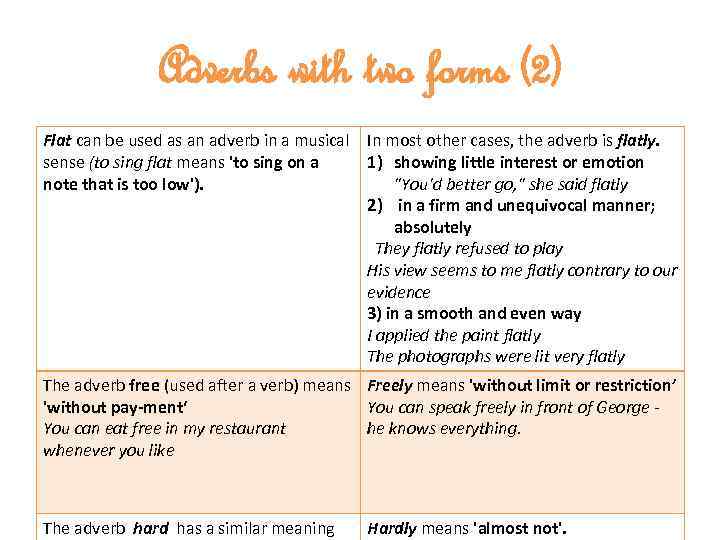
Adverbs with two forms (2) Flat can be used as an adverb in a musical In most other cases, the adverb is flatly. sense (to sing flat means 'to sing on a 1) showing little interest or emotion note that is too low'). "You'd better go, " she said flatly 2) in a firm and unequivocal manner; absolutely They flatly refused to play His view seems to me flatly contrary to our evidence 3) in a smooth and even way I applied the paint flatly The photographs were lit very flatly The adverb free (used after a verb) means Freely means 'without limit or restriction’ 'without pay ment‘ You can speak freely in front of George You can eat free in my restaurant he knows everything. whenever you like The adverb hard has a similar meaning Hardly means 'almost not'.
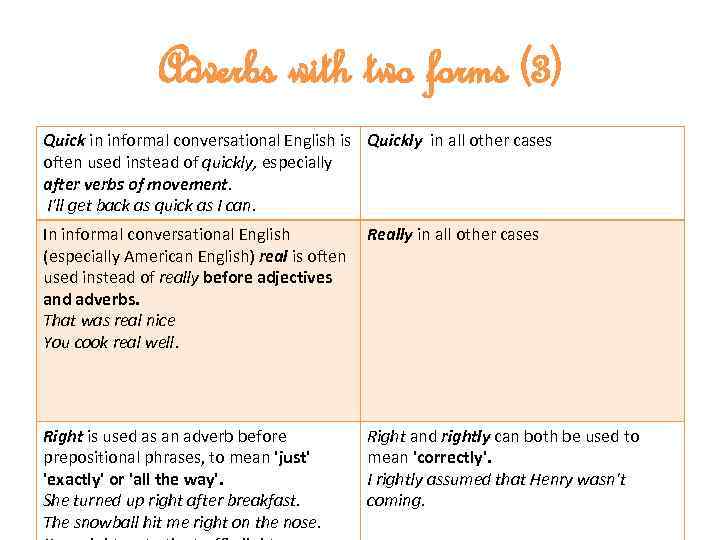
Adverbs with two forms (3) Quick in informal conversational English is Quickly in all other cases often used instead of quickly, especially after verbs of movement. I'll get back as quick as I can. In informal conversational English (especially American English) real is often used instead of really before adjectives and adverbs. That was real nice You cook real well. Really in all other cases Right is used as an adverb before prepositional phrases, to mean 'just' 'exactly' or 'all the way'. She turned up right after breakfast. The snowball hit me right on the nose. Right and rightly can both be used to mean 'correctly'. I rightly assumed that Henry wasn't coming.
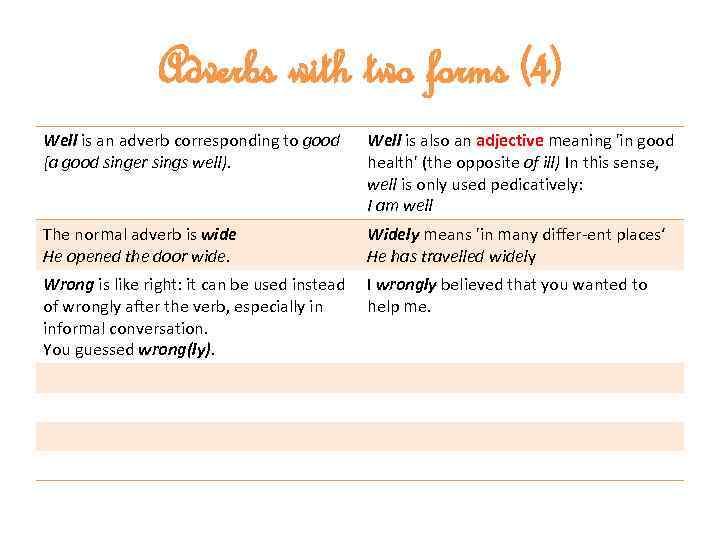
Adverbs with two forms (4) Well is an adverb corresponding to good {a good singer sings well). Well is also an adjective meaning 'in good health' (the opposite of ill) In this sense, well is only used pedicatively: I am well The normal adverb is wide He opened the door wide. Widely means 'in many differ ent places‘ He has travelled widely Wrong is like right: it can be used instead of wrongly after the verb, especially in informal conversation. You guessed wrong(ly). I wrongly believed that you wanted to help me.
