


 Скачать презентацию Advancing Leadership through Research Using Secondary Data for
2bac02435983b90da5da57b89a2dd29d.ppt
- Количество слайдов: 20
 Advancing Leadership through Research: Using Secondary Data for Understanding Avian Influenza (H 5 N 1) Attempting to Understand the Emergence of Avian Influenza in Viet Nam: urbanization, agricultural intensification, habitat alteration EWC/EWCA 50 th Anniversary International Conference Hawaii Convention Center, Room 317 B Honolulu, Hawai’i July 5, 2010 James H. Spencer Urban and Regional Planning, Political Science Globalization Research Center University of Hawai’i at Manoa (808) 956 -8835 jhs@hawaii. edu
 An Empirical Spatial Data Research Agenda for Understanding Risk • East West Center (Honolulu, HI) • University of Hawai’i Department of Urban and Regional Planning (DURP) and Globalization Research Center (GRC) • University of Hawai’i John A. Burns School of Medicine (JABSOM)
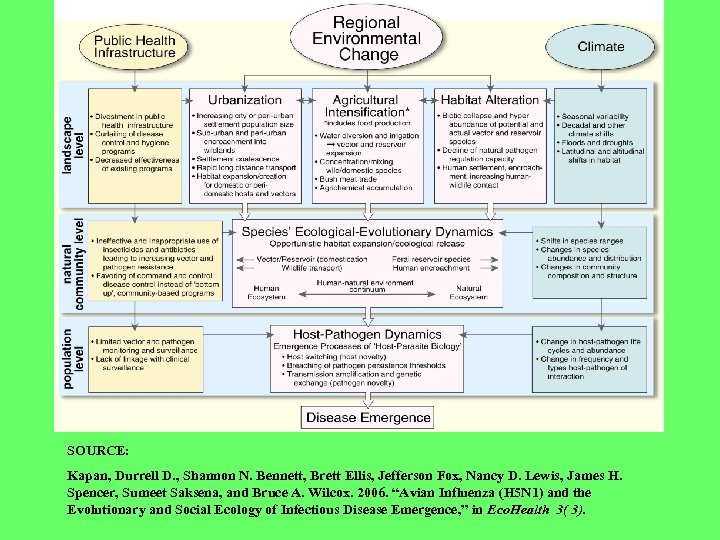 SOURCE: Kapan, Durrell D. , Shannon N. Bennett, Brett Ellis, Jefferson Fox, Nancy D. Lewis, James H. Spencer, Sumeet Saksena, and Bruce A. Wilcox. 2006. “Avian Influenza (H 5 N 1) and the Evolutionary and Social Ecology of Infectious Disease Emergence, ” in Eco. Health 3( 3).
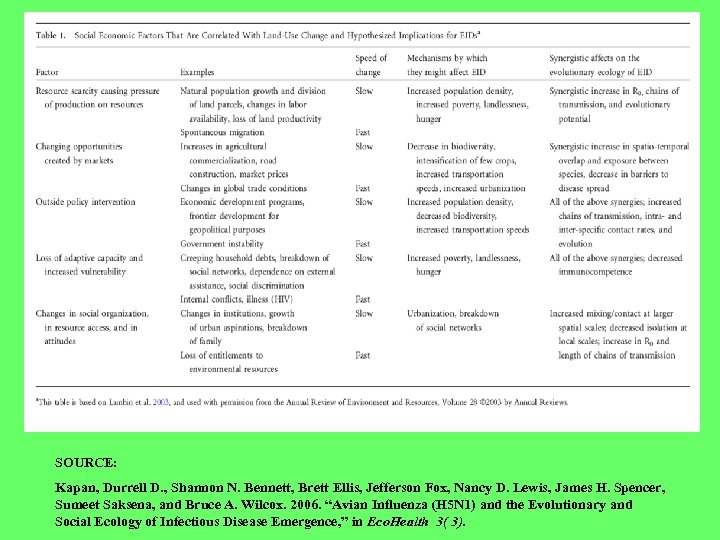 SOURCE: Kapan, Durrell D. , Shannon N. Bennett, Brett Ellis, Jefferson Fox, Nancy D. Lewis, James H. Spencer, Sumeet Saksena, and Bruce A. Wilcox. 2006. “Avian Influenza (H 5 N 1) and the Evolutionary and Social Ecology of Infectious Disease Emergence, ” in Eco. Health 3( 3).
 H 5 N 1 Risk as a Socio-Ecological “mixing bowl” • Scientific concerns about Avian Influenza – Reassortment (ducks, chickens, pigs, humans) – Contact between wild-birds, domesticated flocks, and humans • Spatial Analysis – These “points of contact” occur in socio-ecologically diverse localities – This calls for improved understanding of those localities and an integrated medical, social, and ecological research capacity for studying them.
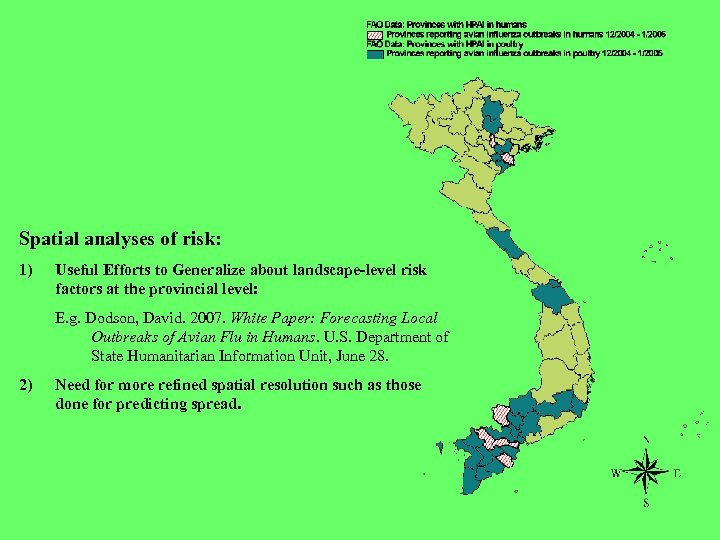 Spatial analyses of risk: 1) Useful Efforts to Generalize about landscape-level risk factors at the provincial level: E. g. Dodson, David. 2007. White Paper: Forecasting Local Outbreaks of Avian Flu in Humans. U. S. Department of State Humanitarian Information Unit, June 28. 2) Need for more refined spatial resolution such as those done for predicting spread.
 Empirical Evidence and the Ecosystem Approach to Research and Control of EID: Secondary Data Integration and Testing New Hypotheses on H 5 N 1 • Landscape Level factors (our current focus): – H 1: Disease Emergence = f(urbanization, agricultural intensification, habitat alteration) • Natural Community Level factors: – H 2: Disease Emergence = f(opportunistic habitat expansion, feral reservoir, vector reservoir, transport of species, domestication of species) • “Population” Level factors: – H 3: Disease Emergence = f(host-switching, breaching pathogen persistence levels, transmission amplification, genetic exchange)
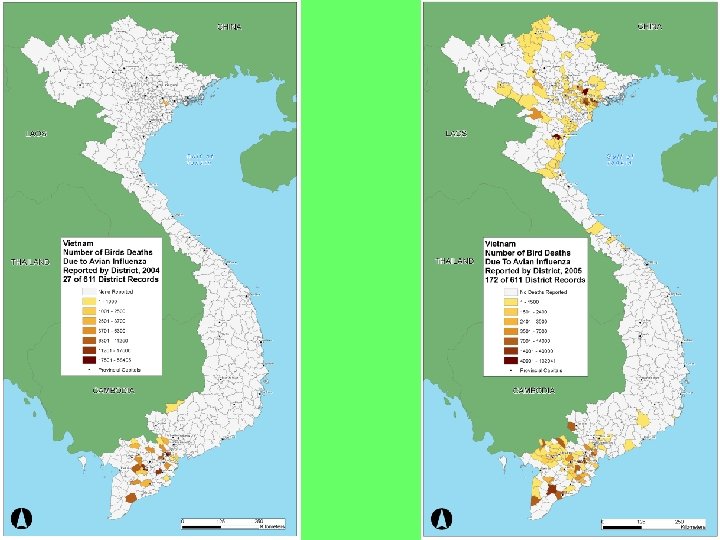
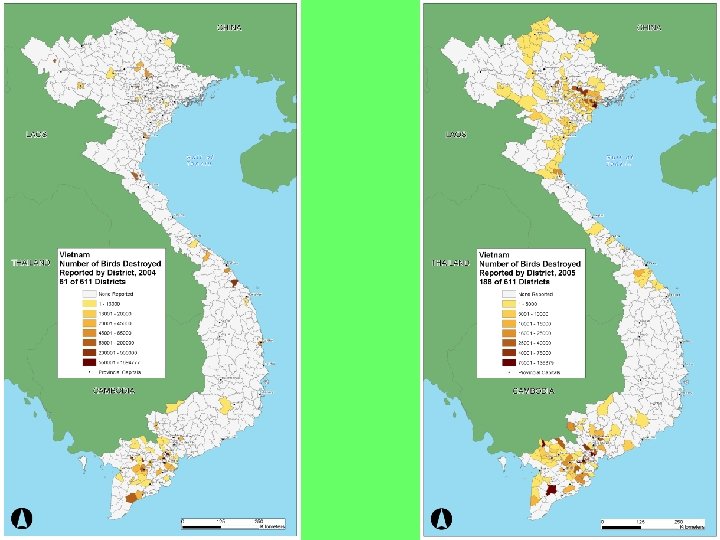
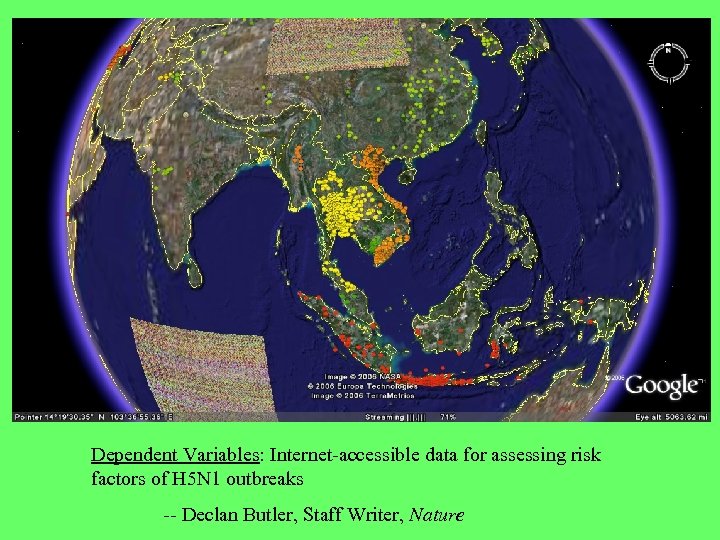 Dependent Variables: Internet-accessible data for assessing risk factors of H 5 N 1 outbreaks -- Declan Butler, Staff Writer, Nature
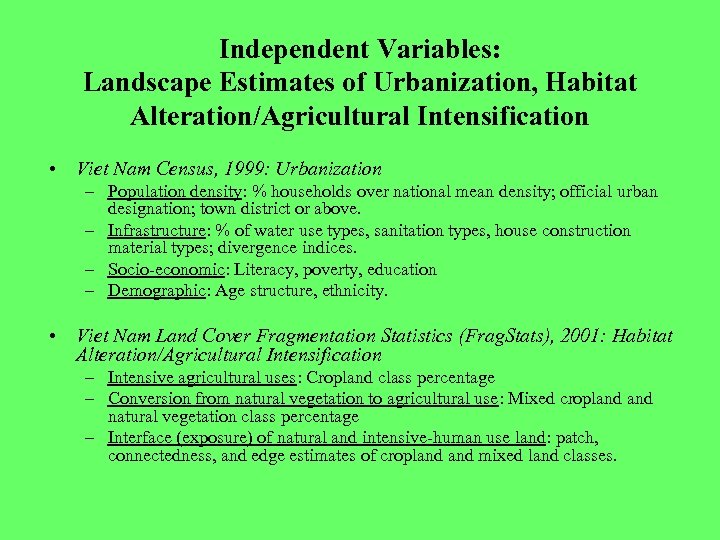 Independent Variables: Landscape Estimates of Urbanization, Habitat Alteration/Agricultural Intensification • Viet Nam Census, 1999: Urbanization – Population density: % households over national mean density; official urban designation; town district or above. – Infrastructure: % of water use types, sanitation types, house construction material types; divergence indices. – Socio-economic: Literacy, poverty, education – Demographic: Age structure, ethnicity. • Viet Nam Land Cover Fragmentation Statistics (Frag. Stats), 2001: Habitat Alteration/Agricultural Intensification – Intensive agricultural uses: Cropland class percentage – Conversion from natural vegetation to agricultural use: Mixed cropland natural vegetation class percentage – Interface (exposure) of natural and intensive-human use land: patch, connectedness, and edge estimates of cropland mixed land classes.
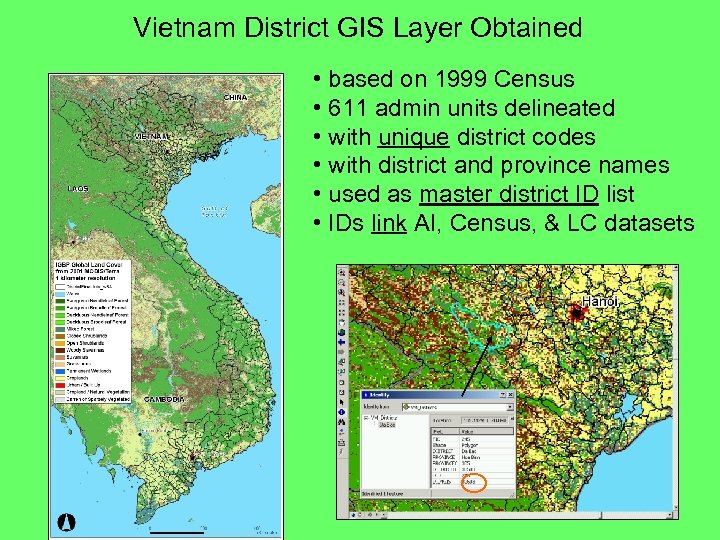 Vietnam District GIS Layer Obtained • based on 1999 Census • 611 admin units delineated • with unique district codes • with district and province names • used as master district ID list • IDs link AI, Census, & LC datasets
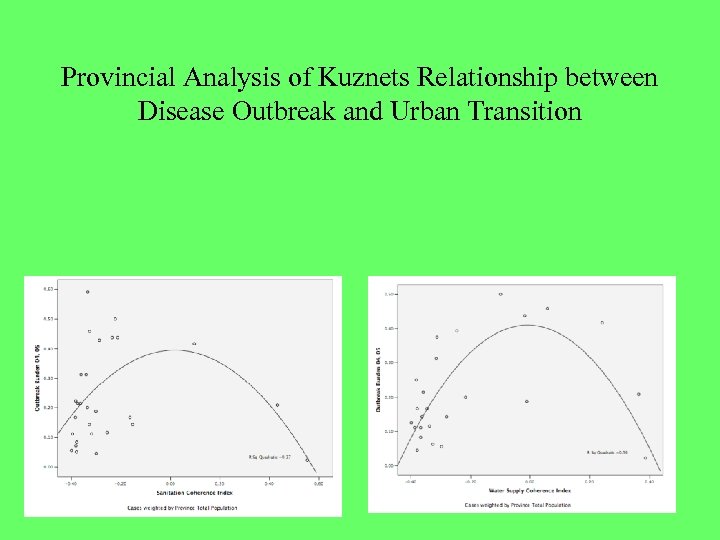 Provincial Analysis of Kuznets Relationship between Disease Outbreak and Urban Transition
 Exploring. Landscape Factors of H 5 N 1 Outbreak Occurrence and Outbreak Intensity, 2004, 2005 • n = 611 districts with complete data • Of the 96 tests on Urbanization/socioeconomic/demographic factors and H 5 N 1 outbreak intensity, 17 significant correlations (expected 5 by chance) • Of the 30 tests on agricultural intensification/habitat alteration and H 5 N 1 outbreak intensity, 5 significant correlations (expected 1. 5 by chance)
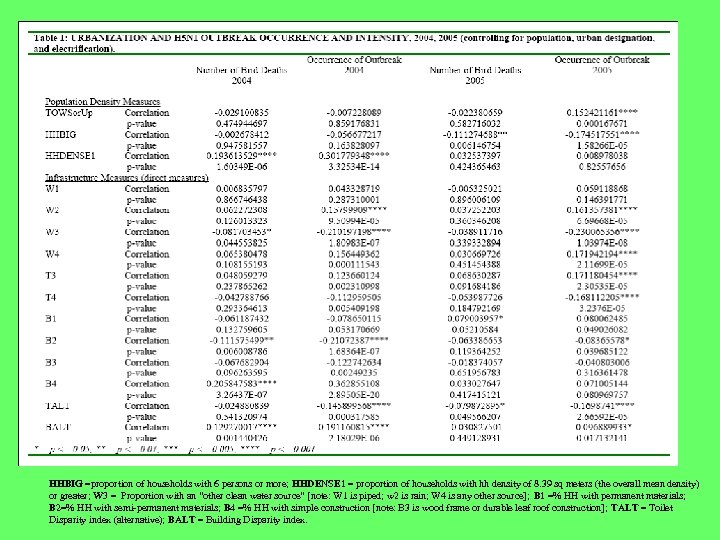 HHBIG =proportion of households with 6 persons or more; HHDENSE 1 = proportion of households with hh density of 8. 39 sq meters (the overall mean density) or greater; W 3 = Proportion with an “other clean water source” [note: W 1 is piped; w 2 is rain; W 4 is any other source]; B 1 =% HH with permanent materials; B 2=% HH with semi-permanent materials; B 4 =% HH with simple construction [note: B 3 is wood frame or durable leaf roof construction]; TALT = Toilet Disparity index (alternative); BALT = Building Disparity index.
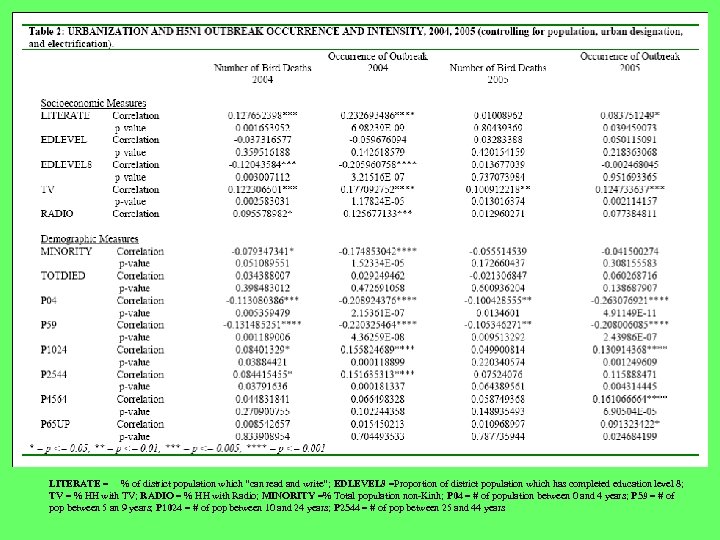 LITERATE = % of district population which “can read and write”; EDLEVEL 8 =Proportion of district population which has completed education level 8; TV = % HH with TV; RADIO = % HH with Radio; MINORITY =% Total population non-Kinh; P 04 = # of population between 0 and 4 years; P 59 = # of pop between 5 an 9 years; P 1024 = # of pop between 10 and 24 years; P 2544 = # of pop between 25 and 44 years
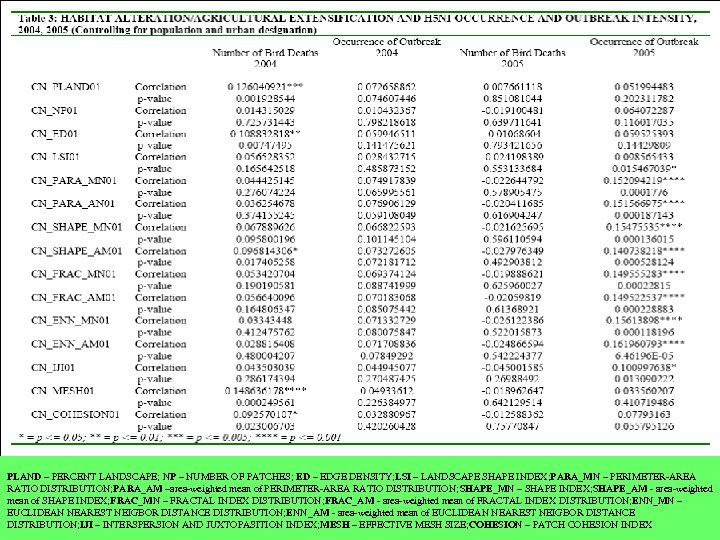 PLAND – PERCENT LANDSCAPE; NP – NUMBER OF PATCHES; ED – EDGE DENSITY; LSI – LANDSCAPE SHAPE INDEX; PARA_MN – PERIMETER-AREA RATIO DISTRIBUTION; PARA_AM –area-weighted mean of PERIMETER-AREA RATIO DISTRIBUTION; SHAPE_MN – SHAPE INDEX; SHAPE_AM - area-weighted mean of SHAPE INDEX; FRAC_MN – FRACTAL INDEX DISTRIBUTION; FRAC_AM - area-weighted mean of FRACTAL INDEX DISTRIBUTION; ENN_MN – EUCLIDEAN NEAREST NEIGBOR DISTANCE DISTRIBUTION; ENN_AM - area-weighted mean of EUCLIDEAN NEAREST NEIGBOR DISTANCE DISTRIBUTION; IJI – INTERSPERSION AND JUXTOPASITION INDEX; MESH – EFFECTIVE MESH SIZE; COHESION – PATCH COHESION INDEX
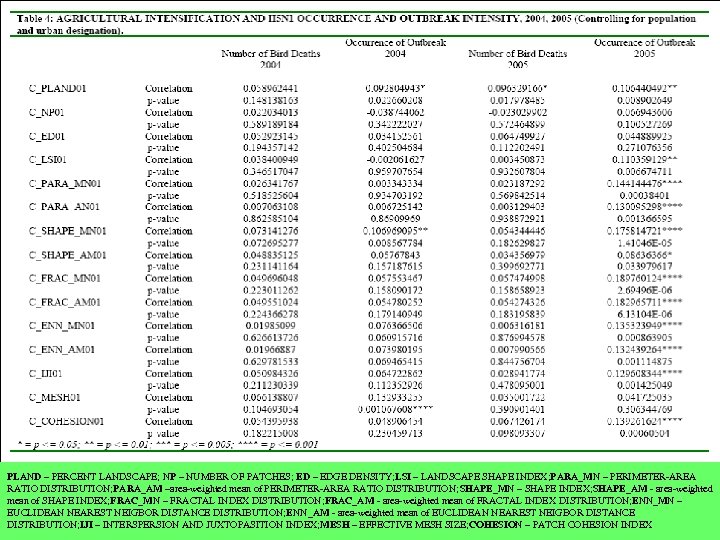 PLAND – PERCENT LANDSCAPE; NP – NUMBER OF PATCHES; ED – EDGE DENSITY; LSI – LANDSCAPE SHAPE INDEX; PARA_MN – PERIMETER-AREA RATIO DISTRIBUTION; PARA_AM –area-weighted mean of PERIMETER-AREA RATIO DISTRIBUTION; SHAPE_MN – SHAPE INDEX; SHAPE_AM - area-weighted mean of SHAPE INDEX; FRAC_MN – FRACTAL INDEX DISTRIBUTION; FRAC_AM - area-weighted mean of FRACTAL INDEX DISTRIBUTION; ENN_MN – EUCLIDEAN NEAREST NEIGBOR DISTANCE DISTRIBUTION; ENN_AM - area-weighted mean of EUCLIDEAN NEAREST NEIGBOR DISTANCE DISTRIBUTION; IJI – INTERSPERSION AND JUXTOPASITION INDEX; MESH – EFFECTIVE MESH SIZE; COHESION – PATCH COHESION INDEX
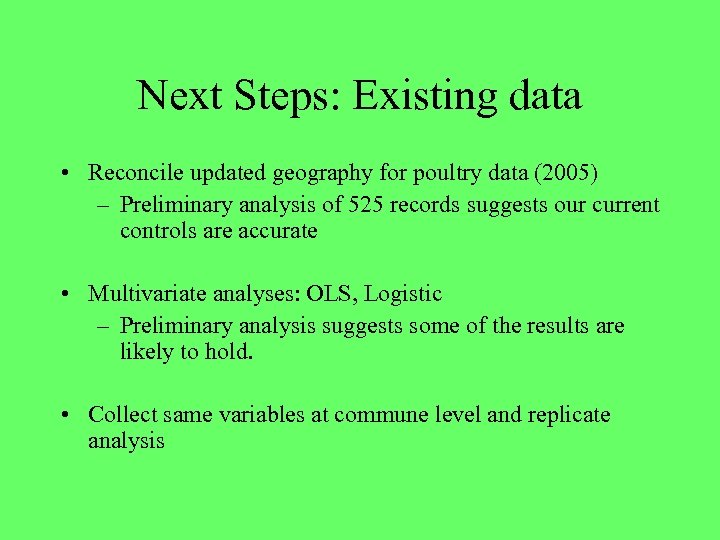 Next Steps: Existing data • Reconcile updated geography for poultry data (2005) – Preliminary analysis of 525 records suggests our current controls are accurate • Multivariate analyses: OLS, Logistic – Preliminary analysis suggests some of the results are likely to hold. • Collect same variables at commune level and replicate analysis
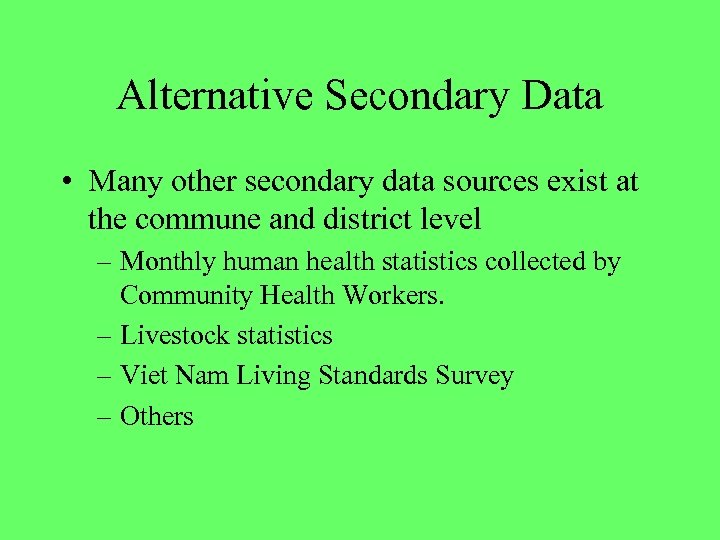 Alternative Secondary Data • Many other secondary data sources exist at the commune and district level – Monthly human health statistics collected by Community Health Workers. – Livestock statistics – Viet Nam Living Standards Survey – Others