


 Скачать презентацию Advances in Optical Networking Jeff Verrant Senior Engineer
ab68ccb17a3593d4ef0b049870ca461a.ppt
- Количество слайдов: 36
 Advances in Optical Networking Jeff Verrant Senior Engineer Research and Education Initiatives Ciena Government Solutions, Inc.
 Agenda Lightwave Technologies Core Transport OTN, G. 709, the “ Digital Wrapper “ Deployable Control Plane Technologies Optical Switching GFP w/ VCAT-LCAS 2
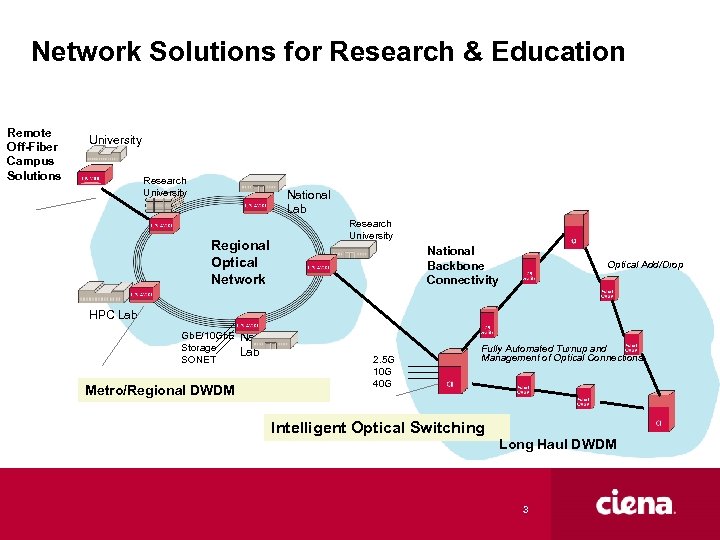 Network Solutions for Research & Education Remote Off-Fiber Campus Solutions University Research University National Lab Research University Regional Optical Network National Backbone Connectivity Optical Add/Drop HPC Lab Gb. E/10 Gb. E Storage SONET Metro/Regional DWDM National Lab 2. 5 G 10 G 40 G Fully Automated Turnup and Management of Optical Connections Intelligent Optical Switching Long Haul DWDM 3
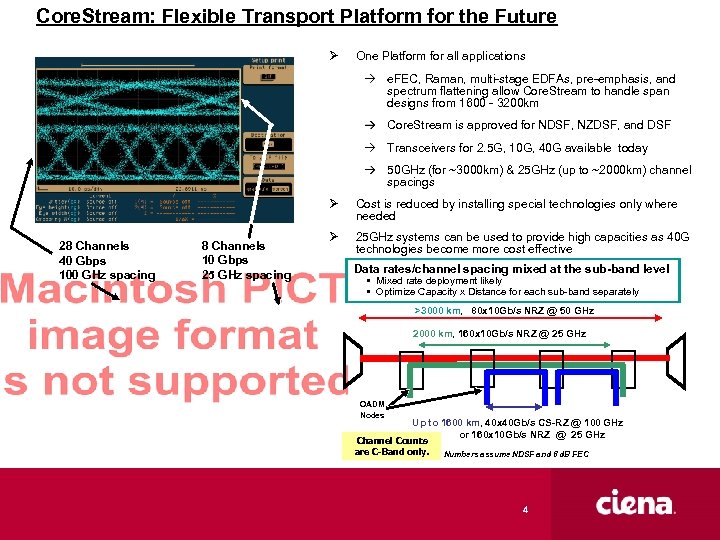 Core. Stream: Flexible Transport Platform for the Future Ø One Platform for all applications e. FEC, Raman, multi-stage EDFAs, pre-emphasis, and spectrum flattening allow Core. Stream to handle span designs from 1600 - 3200 km Core. Stream is approved for NDSF, NZDSF, and DSF Transceivers for 2. 5 G, 10 G, 40 G available today 50 GHz (for ~3000 km) & 25 GHz (up to ~2000 km) channel spacings Ø 28 Channels 40 Gbps 100 GHz spacing 8 Channels 10 Gbps 25 GHz spacing Cost is reduced by installing special technologies only where needed Ø 25 GHz systems can be used to provide high capacities as 40 G technologies become more cost effective Data rates/channel spacing mixed at the sub-band level • Mixed rate deployment likely • Optimize Capacity x Distance for each sub-band separately >3000 km, 80 x 10 Gb/s NRZ @ 50 GHz 2000 km, 160 x 10 Gb/s NRZ @ 25 GHz OADM Nodes Up to 1600 km, 40 x 40 Gb/s CS-RZ @ 100 GHz or 160 x 10 Gb/s NRZ @ 25 GHz Channel Counts are C-Band only. Numbers assume NDSF and 8 d. B FEC 4
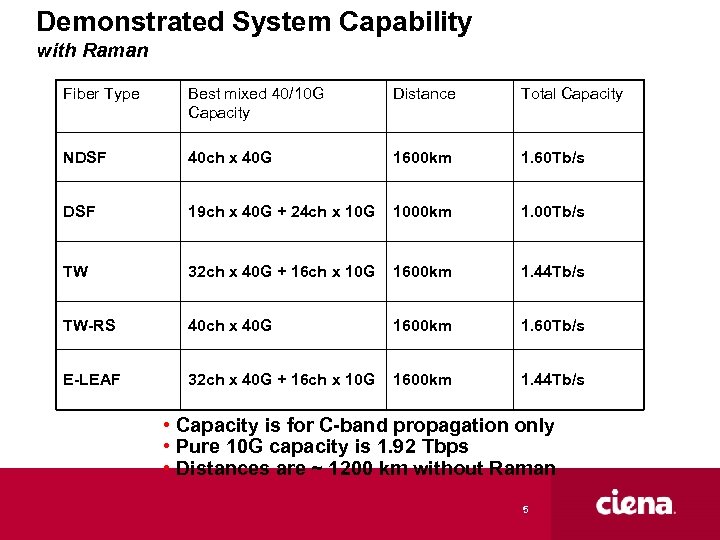 Demonstrated System Capability with Raman Fiber Type Best mixed 40/10 G Capacity Distance Total Capacity NDSF 40 ch x 40 G 1600 km 1. 60 Tb/s DSF 19 ch x 40 G + 24 ch x 10 G 1000 km 1. 00 Tb/s TW 32 ch x 40 G + 16 ch x 10 G 1600 km 1. 44 Tb/s TW-RS 40 ch x 40 G 1600 km 1. 60 Tb/s E-LEAF 32 ch x 40 G + 16 ch x 10 G 1600 km 1. 44 Tb/s • Capacity is for C-band propagation only • Pure 10 G capacity is 1. 92 Tbps • Distances are ~ 1200 km without Raman 5
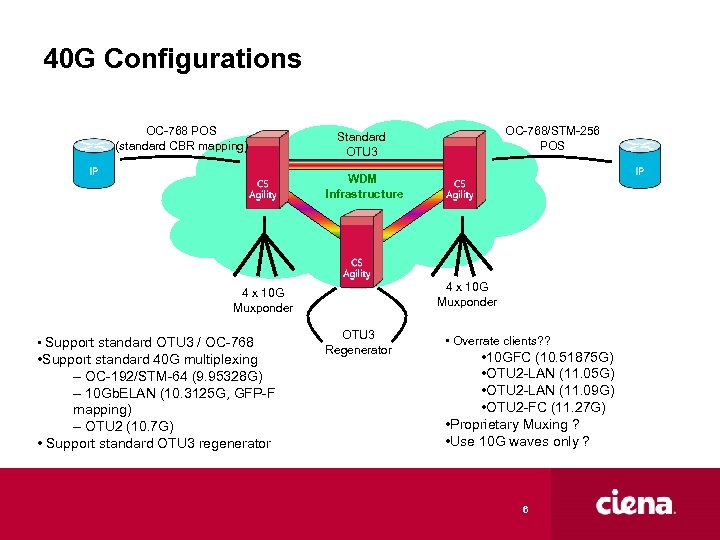 40 G Configurations OC-768 POS (standard CBR mapping) OC-768/STM-256 POS Standard OTU 3 WDM Infrastructure 4 x 10 G Muxponder • Support standard OTU 3 / OC-768 • Support standard 40 G multiplexing – OC-192/STM-64 (9. 95328 G) – 10 Gb. ELAN (10. 3125 G, GFP-F mapping) – OTU 2 (10. 7 G) • Support standard OTU 3 regenerator OTU 3 Regenerator • Overrate clients? ? • 10 GFC (10. 51875 G) • OTU 2 -LAN (11. 09 G) • OTU 2 -FC (11. 27 G) • Proprietary Muxing ? • Use 10 G waves only ? 6
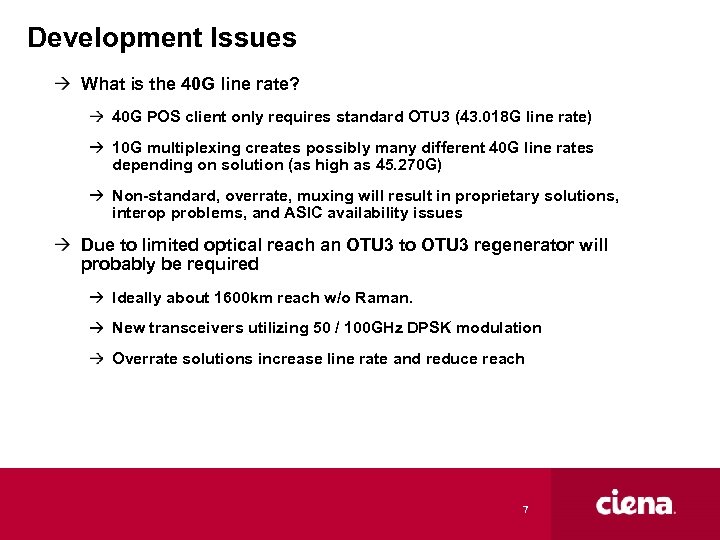 Development Issues What is the 40 G line rate? 40 G POS client only requires standard OTU 3 (43. 018 G line rate) 10 G multiplexing creates possibly many different 40 G line rates depending on solution (as high as 45. 270 G) Non-standard, overrate, muxing will result in proprietary solutions, interop problems, and ASIC availability issues Due to limited optical reach an OTU 3 to OTU 3 regenerator will probably be required Ideally about 1600 km reach w/o Raman. New transceivers utilizing 50 / 100 GHz DPSK modulation Overrate solutions increase line rate and reduce reach 7
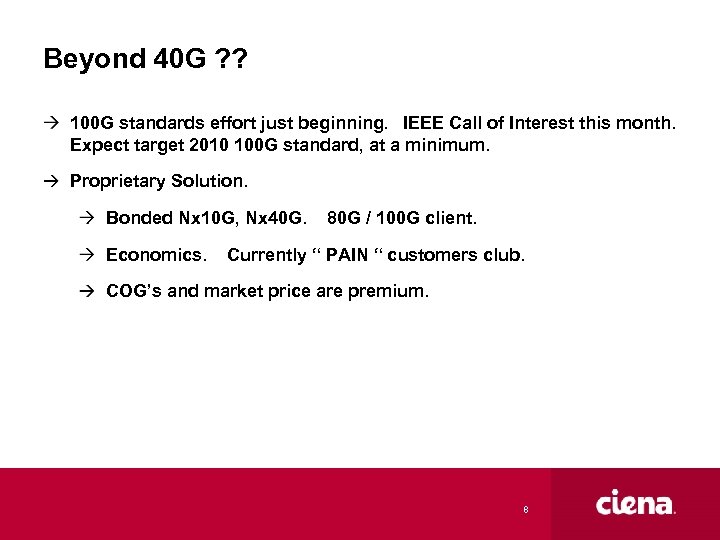 Beyond 40 G ? ? 100 G standards effort just beginning. IEEE Call of Interest this month. Expect target 2010 100 G standard, at a minimum. Proprietary Solution. Bonded Nx 10 G, Nx 40 G. Economics. 80 G / 100 G client. Currently “ PAIN “ customers club. COG’s and market price are premium. 8
 Agenda Lightwave Technologies Core Transport OTN, G. 709, the “ Digital Wrapper “ Deployable Control Plane Technologies Optical Switching GFP w/ VCAT-LCAS 9
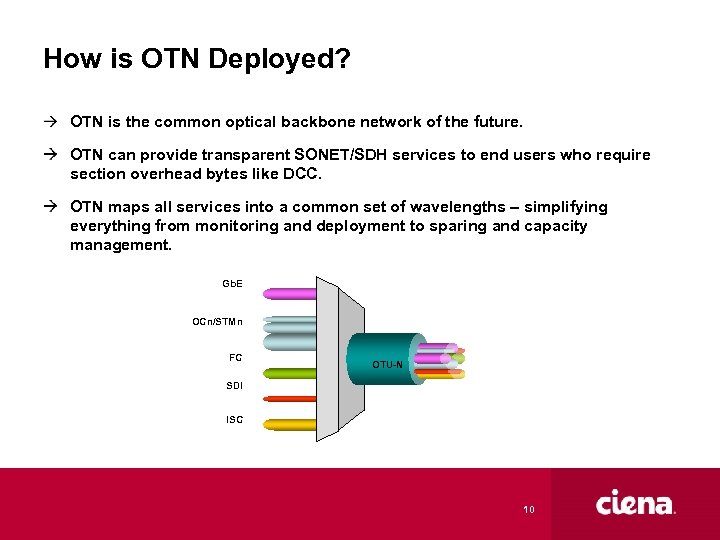 How is OTN Deployed? OTN is the common optical backbone network of the future. OTN can provide transparent SONET/SDH services to end users who require section overhead bytes like DCC. OTN maps all services into a common set of wavelengths – simplifying everything from monitoring and deployment to sparing and capacity management. Gb. E OCn/STMn FC OTU-N SDI ISC 10
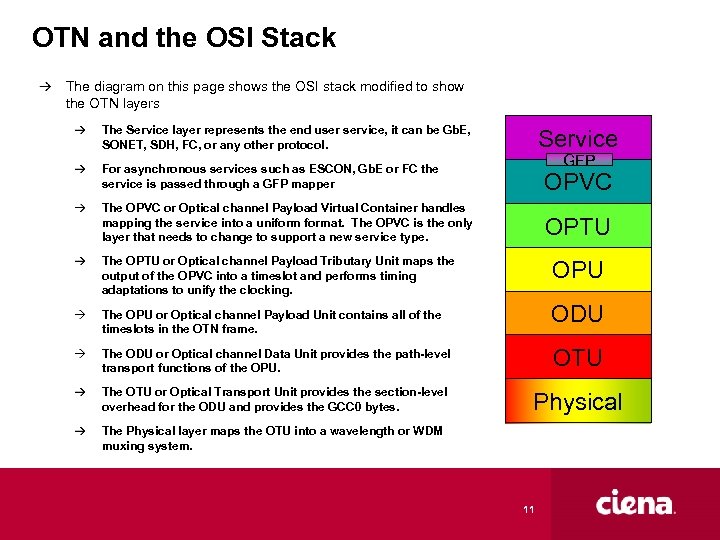 OTN and the OSI Stack The diagram on this page shows the OSI stack modified to show the OTN layers The Service layer represents the end user service, it can be Gb. E, SONET, SDH, FC, or any other protocol. Service GFP For asynchronous services such as ESCON, Gb. E or FC the service is passed through a GFP mapper OPVC The OPVC or Optical channel Payload Virtual Container handles mapping the service into a uniformat. The OPVC is the only layer that needs to change to support a new service type. OPTU The OPTU or Optical channel Payload Tributary Unit maps the output of the OPVC into a timeslot and performs timing adaptations to unify the clocking. OPU ODU The OPU or Optical channel Payload Unit contains all of the timeslots in the OTN frame. The ODU or Optical channel Data Unit provides the path-level transport functions of the OPU. OTU The OTU or Optical Transport Unit provides the section-level overhead for the ODU and provides the GCC 0 bytes. Physical The Physical layer maps the OTU into a wavelength or WDM muxing system. 11
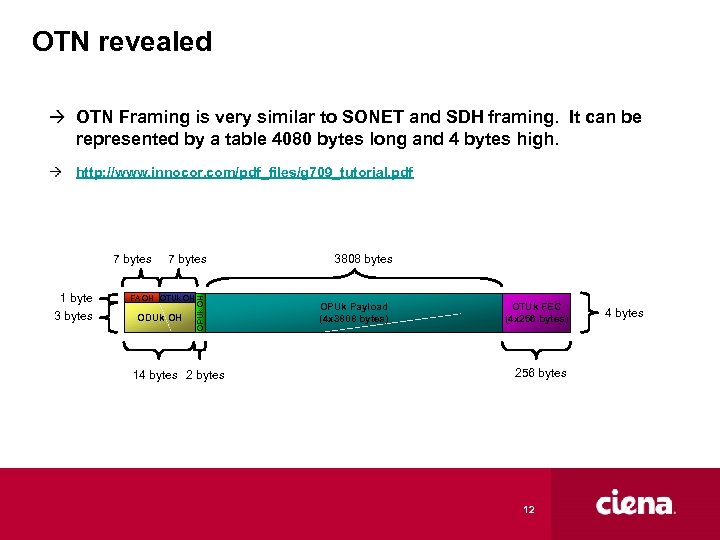 OTN revealed OTN Framing is very similar to SONET and SDH framing. It can be represented by a table 4080 bytes long and 4 bytes high. http: //www. innocor. com/pdf_files/g 709_tutorial. pdf 1 byte 3 bytes 7 bytes FA OH OTUk OH ODUk OH OPUk OH 7 bytes 14 bytes 2 bytes 3808 bytes OPUk Payload (4 x 3808 bytes) OTUk FEC (4 x 256 bytes) 256 bytes 12 4 bytes
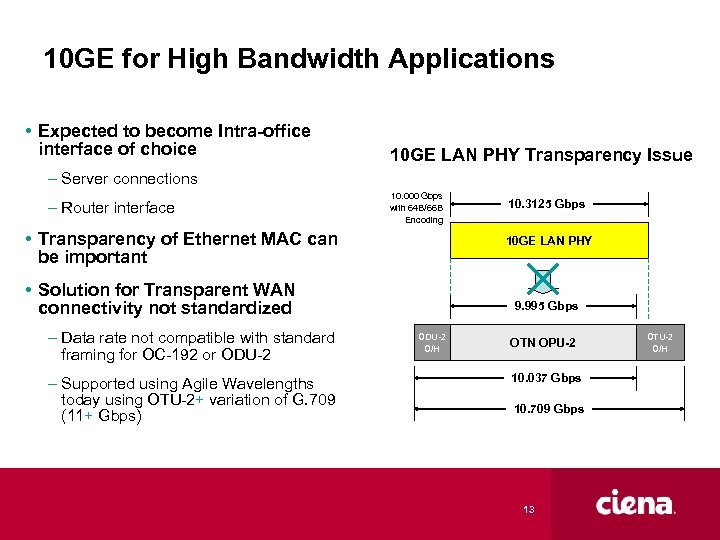 10 GE for High Bandwidth Applications • Expected to become Intra-office interface of choice 10 GE LAN PHY Transparency Issue – Server connections – Router interface 10. 000 Gbps with 64 B/66 B Encoding • Transparency of Ethernet MAC can be important 10 GE LAN PHY • Solution for Transparent WAN connectivity not standardized – Data rate not compatible with standard framing for OC-192 or ODU-2 – Supported using Agile Wavelengths today using OTU-2+ variation of G. 709 (11+ Gbps) 10. 3125 Gbps 9. 995 Gbps ODU-2 O/H OTN OPU-2 10. 037 Gbps 10. 709 Gbps 13 OTU-2 O/H
 Agenda Lightwave Technologies Core Transport OTN, G. 709, the “ Digital Wrapper “ Deployable Control Plane Technologies Optical Switching GFP w/ VCAT-LCAS 14
 Ciena’s Intelligent Control Plane: History Complete and deployed distributed routing and signaling mechanism for core mesh networks Topology discovery with available bandwidth updates Constraint based route calculation In-band signaling for end-to-end sub-network connection (SNC) setup and mesh restoration Standards based G. ASON compliant (G. 7713. 1, G. 7715. 1…) Mature, Scalable, and Reliable 20+ customers with control plane networks (largest has 100+ of nodes) 5 years of history; research, product, deployments Only distributed mesh control plane currently widely deployed in live operation 15 • Configuration • Provisioning • Restoration
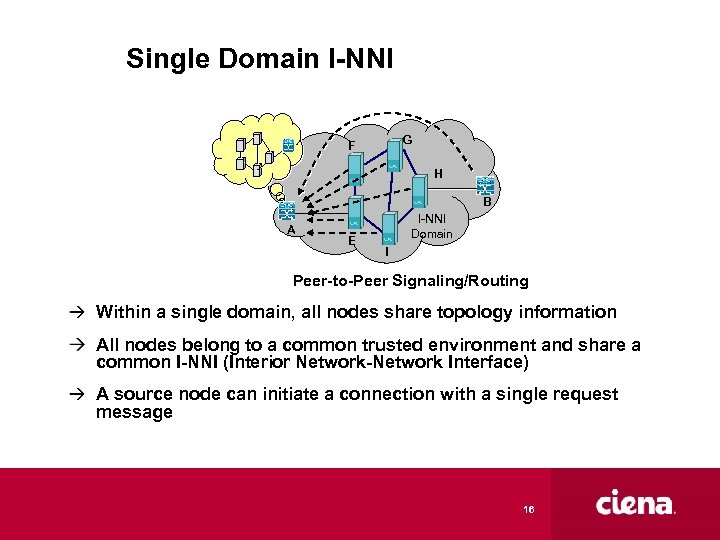 Single Domain I-NNI G F H B A E I-NNI Domain I Peer-to-Peer Signaling/Routing Within a single domain, all nodes share topology information All nodes belong to a common trusted environment and share a common I-NNI (Interior Network-Network Interface) A source node can initiate a connection with a single request message 16
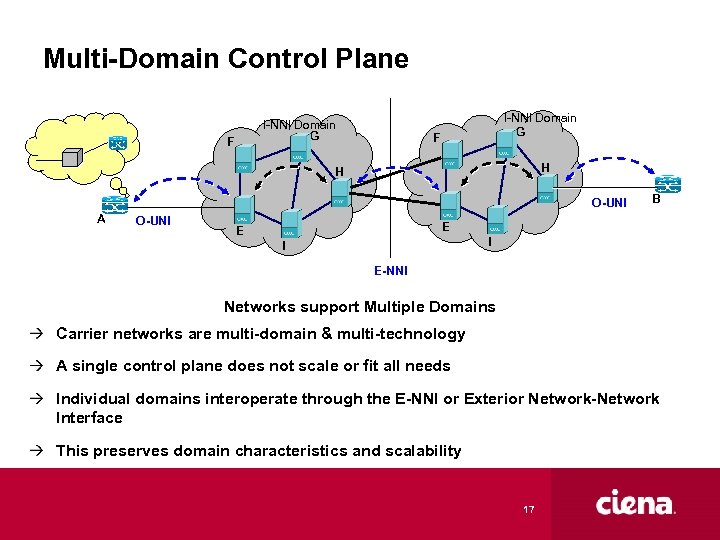 Multi-Domain Control Plane I-NNI Domain G F H H O-UNI A O-UNI B E E I I E-NNI Networks support Multiple Domains Carrier networks are multi-domain & multi-technology A single control plane does not scale or fit all needs Individual domains interoperate through the E-NNI or Exterior Network-Network Interface This preserves domain characteristics and scalability 17
 Ciena Standards Support Core. Director I-NNI optical control plane protocol (OSRP) is based on ITU ASON Recommendation G. 7713. 1, with extensions for value-add functionality Over 5 years of experience in live networks Proven to significantly reduce operational costs and service activation time Proven >99. 999% service reliability in up to 120 node network Available : OIF O-UNI 1. 0, based on ITU ASON Recommendation G. 7713. 2 OIF E-NNI (also based on ITU G. 7713. 2), O-UNI 2. 0 and IETF GMPLS (I-NNI) 18
 Ciena OIF Participation Co-Founder and strong supporter Co-founded with Cisco Currently President Participated in Supercomm and OFC demonstrations Participated in UNI 1. 0 and 2. 0 development Editor of UNI 1. 0 R 2, E-NNI Signaling and Routing specifications Keeping NNI aligned with ITU-T directions Implementation of UNI 1. 0 R 2, E-NNI 1. 0 20
 Ciena’s ITU-T Participation Strong supporter of ASON work Helped edit G. 7713. 1 and G. 7713. 2 Signaling Recommendations Editor of G. 7714. 1 (Discovery Mechanisms) Participated in editing of G. 7715 (Routing Arch. ) Supplied main text to G. 7715. 1 (Routing Requirements) Supporting ITU-T work on Management of ASON Provided input to new G. 7718 – ASON Management Framework Editor of G. 7718. 1 (to be completed) – ASON Management Object Model Implementation of G. 7713. 1/2, G. 7714, G. 7715. 1 21
 Ciena’s GMPLS Participation Co-author of: GMPLS framework GMPLS signaling functional spec GMPLS signaling for SONET/SDH GMPLS signaling extensions (RSVP, CR-LDP) GMPLS routing extensions (OSPF, IS-IS) GMPLS LMP specification GMPLS ASON requirements drafts Continued participation… Currently in Joint Design Team of experts to evaluate ASON-based routing extensions Implementation of GMPLS RSVP/OSPF-TE 22
 ASON/OIF Testing 2001, 2003, 2004, 2005 OIF Interops Tested ASON/OIF UNI, E-NNI Signaling and E-NNI Routing Testing venues include 7 carrier laboratories Vendors include 15 major switch and router vendors Tested Interoperable OSPF-based E-NNI routing Interoperable RSVP-based E-NNI signaling Support of Ethernet over SONET/SDH using GFP Support of VCAT/LCAS connections 23
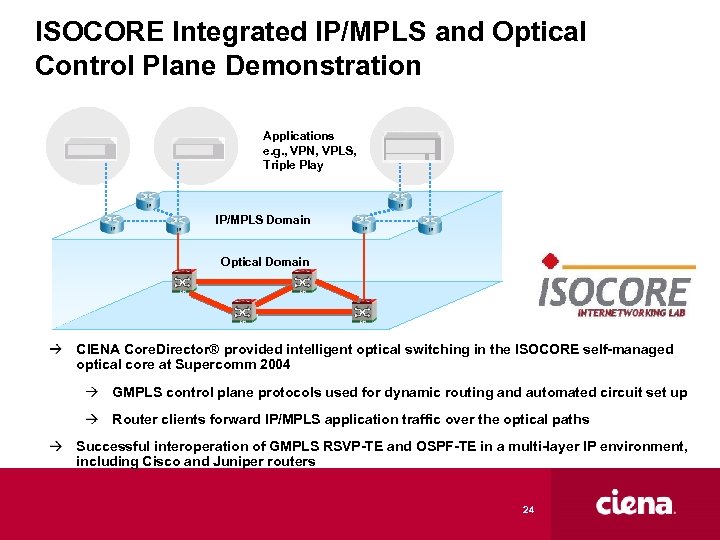 ISOCORE Integrated IP/MPLS and Optical Control Plane Demonstration Applications e. g. , VPN, VPLS, Triple Play IP/MPLS Domain Optical Domain CIENA Core. Director® provided intelligent optical switching in the ISOCORE self-managed optical core at Supercomm 2004 GMPLS control plane protocols used for dynamic routing and automated circuit set up Router clients forward IP/MPLS application traffic over the optical paths Successful interoperation of GMPLS RSVP-TE and OSPF-TE in a multi-layer IP environment, including Cisco and Juniper routers 24
 Agenda Lightwave Technologies Core Transport OTN, G. 709, the “ Digital Wrapper “ Deployable Control Plane Technologies Optical Switching GFP w/ VCAT-LCAS 25
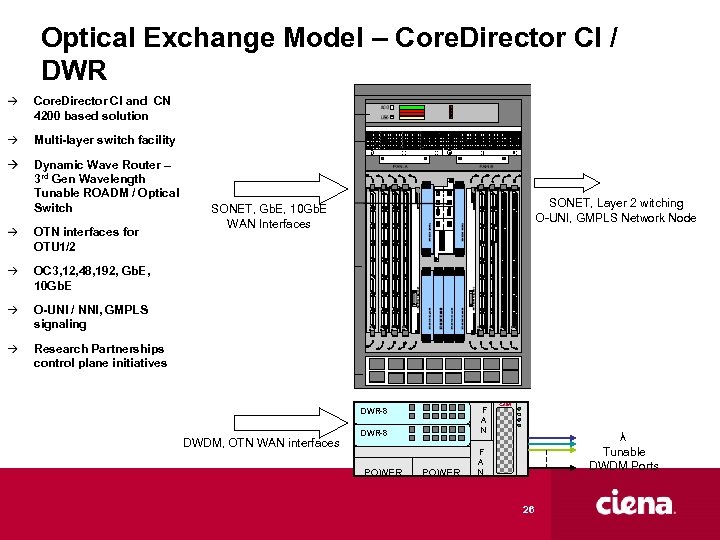 Optical Exchange Model – Core. Director CI / DWR Core. Director CI and CN 4200 based solution Multi-layer switch facility Dynamic Wave Router – 3 rd Gen Wavelength Tunable ROADM / Optical Switch OTN interfaces for OTU 1/2 SONET, Layer 2 witching O-UNI, GMPLS Network Node SONET, Gb. E, 10 Gb. E WAN Interfaces OC 3, 12, 48, 192, Gb. E, 10 Gb. E O-UNI / NNI, GMPLS signaling Research Partnerships control plane initiatives F A N DWR-8 DWDM, OTN WAN interfaces DWR-8 POWER λ Tunable DWDM Ports F A N 26
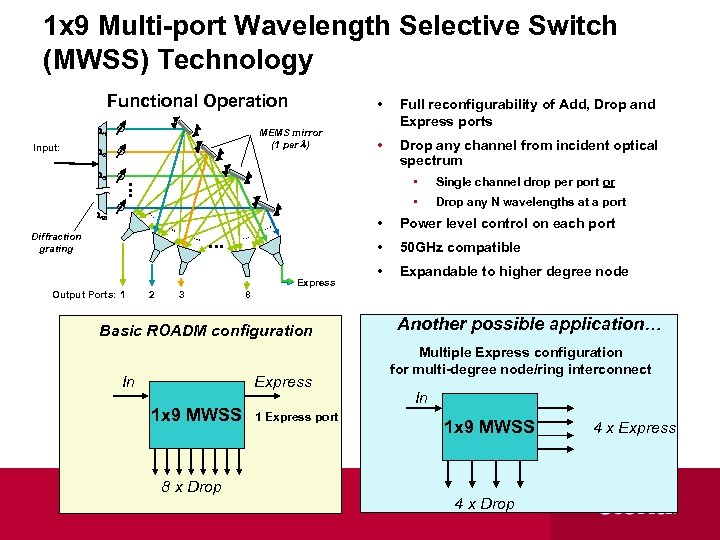 1 x 9 Multi-port Wavelength Selective Switch (MWSS) Technology Functional Operation l 1 Input: • MEMS mirror (1 per l) l 2 Full reconfigurability of Add, Drop and Express ports • Drop any channel from incident optical spectrum l 3 … l 96 … … 2 3 Express 1 x 9 MWSS 8 x Drop 50 GHz compatible • Expandable to higher degree node 8 Basic ROADM configuration In Power level control on each port • Express Output Ports: 1 Drop any N wavelengths at a port • … Diffraction grating Single channel drop per port or • … • 1 Express port Another possible application… Multiple Express configuration for multi-degree node/ring interconnect In 1 x 9 MWSS 4 x Drop 27 4 x Express
 Agenda Lightwave Technologies Core Transport OTN, G. 709, the “ Digital Wrapper “ Deployable Control Plane Technologies Optical Switching GFP w/ VCAT-LCAS 28
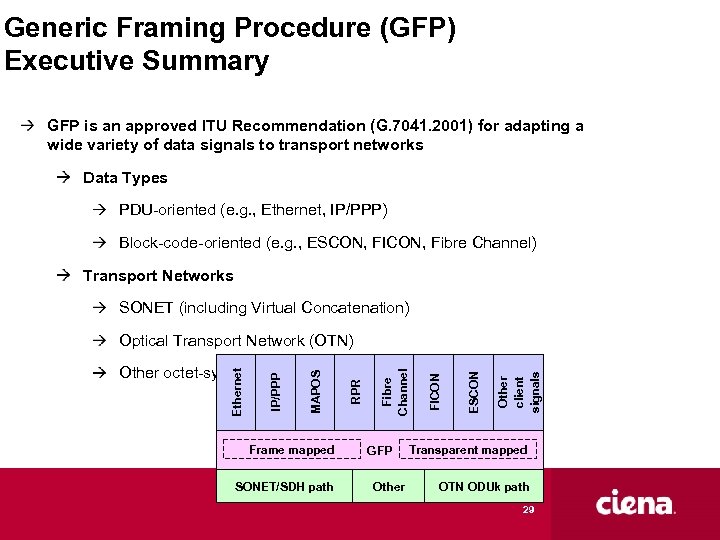 Generic Framing Procedure (GFP) Executive Summary GFP is an approved ITU Recommendation (G. 7041. 2001) for adapting a wide variety of data signals to transport networks Data Types PDU-oriented (e. g. , Ethernet, IP/PPP) Block-code-oriented (e. g. , ESCON, FICON, Fibre Channel) Transport Networks SONET (including Virtual Concatenation) Frame mapped SONET/SDH path GFP Other client signals ESCON FICON Fibre Channel MAPOS IP/PPP Ethernet Other octet-synchronous paths RPR Optical Transport Network (OTN) Transparent mapped OTN ODUk path 29
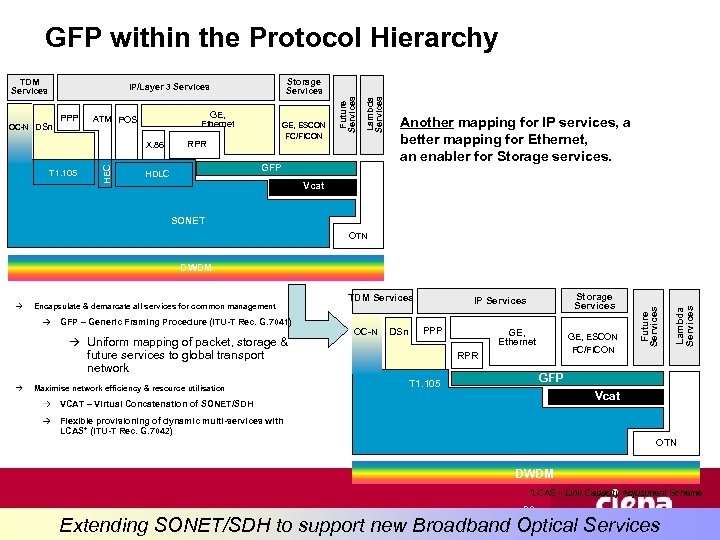 Storage Services IP/Layer 3 Services OC-N DSn PPP GE, Ethernet ATM POS T 1. 105 HEC X. 86 GE, ESCON FC/FICON RPR Future Services TDM Services Lambda Services GFP within the Protocol Hierarchy GFP HDLC Another mapping for IP services, a better mapping for Ethernet, an enabler for Storage services. Vcat SONET OTN GFP – Generic Framing Procedure (ITU-T Rec. G. 7041) Uniform mapping of packet, storage & future services to global transport network Maximise network efficiency & resource utilisation TDM Services OC-N DSn Storage Services IP Services PPP GE, Ethernet GE, ESCON FC/FICON RPR Lambda Services Encapsulate & demarcate all services for common management Future Services DWDM GFP T 1. 105 Vcat VCAT – Virtual Concatenation of SONET/SDH Flexible provisioning of dynamic multi-services with LCAS* (ITU-T Rec. G. 7042) OTN DWDM *LCAS – Link Capacity Adjustment Scheme 30 Extending SONET/SDH to support new Broadband Optical Services
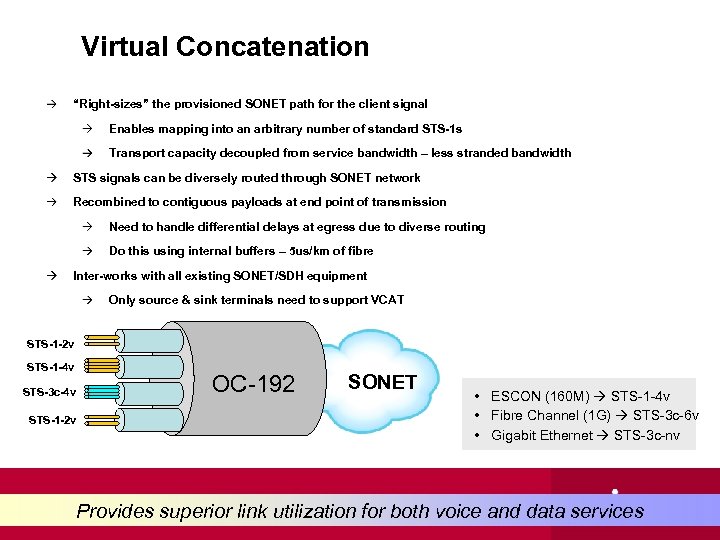 Virtual Concatenation “Right-sizes” the provisioned SONET path for the client signal Enables mapping into an arbitrary number of standard STS-1 s Transport capacity decoupled from service bandwidth – less stranded bandwidth STS signals can be diversely routed through SONET network Recombined to contiguous payloads at end point of transmission Need to handle differential delays at egress due to diverse routing Do this using internal buffers – 5 us/km of fibre Inter-works with all existing SONET/SDH equipment Only source & sink terminals need to support VCAT STS-1 -2 v STS-1 -4 v OC-192 STS-3 c-4 v STS-1 -2 v SONET • ESCON (160 M) STS-1 -4 v • Fibre Channel (1 G) STS-3 c-6 v • Gigabit Ethernet STS-3 c-nv Provides superior link utilization for both voice and 31 data services
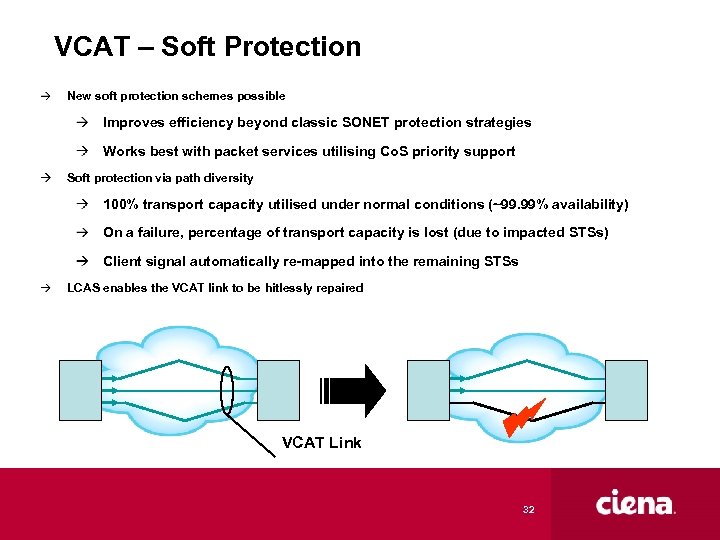 VCAT – Soft Protection New soft protection schemes possible Improves efficiency beyond classic SONET protection strategies Works best with packet services utilising Co. S priority support Soft protection via path diversity 100% transport capacity utilised under normal conditions (~99. 99% availability) On a failure, percentage of transport capacity is lost (due to impacted STSs) Client signal automatically re-mapped into the remaining STSs LCAS enables the VCAT link to be hitlessly repaired VCAT Link 32
 Link Capacity Adjustment Scheme (LCAS) Executive Summary An approved mechanism (ITU G. 7042. 2001) for dynamically adjusting the size of a Virtually Concatenated channel Allows services more flexibility for handling dynamic bandwidth demands Relies on the NMS/EMS or O-UNI to provision the bandwidth change Allows channel size adjustment to be hitless Provides mechanism for adjustment of bandwidth during STS-1 failure LCAS uses bit-oriented protocol encapsulated in control packets carried in SONET H 4 Payload Overhead (16 125μs frames per control packet) 33
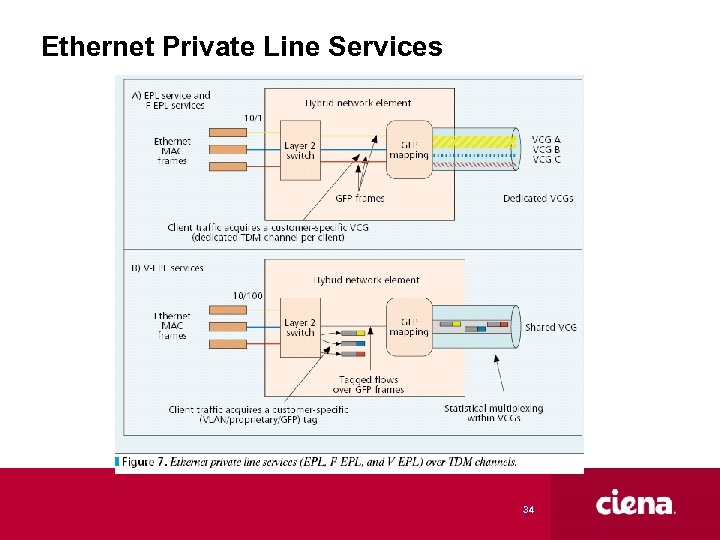 Ethernet Private Line Services 34
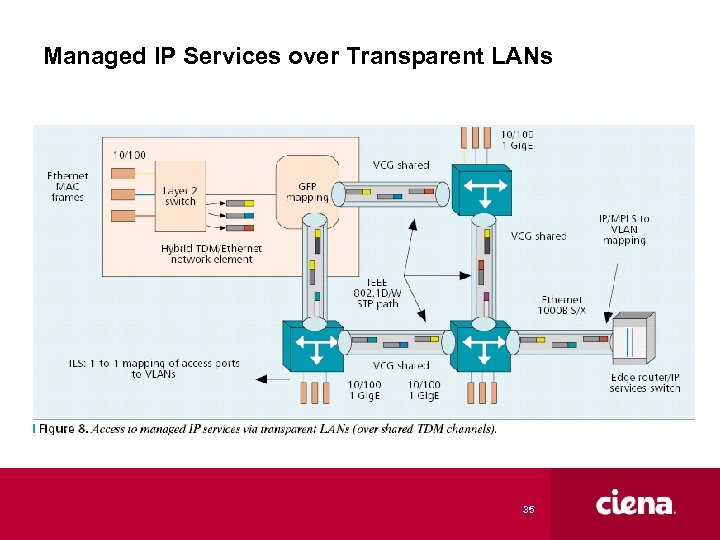 Managed IP Services over Transparent LANs 35
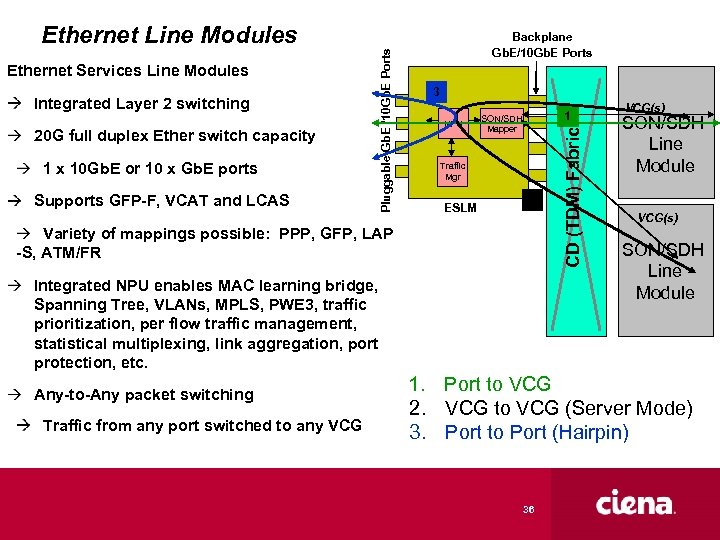 Integrated Layer 2 switching 20 G full duplex Ether switch capacity 1 x 10 Gb. E or 10 x Gb. E ports Supports GFP-F, VCAT and LCAS Backplane Gb. E/10 Gb. E Ports 3 NPU 1 SON/SDH Mapper Traffic Mgr ESLM 2 Variety of mappings possible: PPP, GFP, LAP -S, ATM/FR Integrated NPU enables MAC learning bridge, Spanning Tree, VLANs, MPLS, PWE 3, traffic prioritization, per flow traffic management, statistical multiplexing, link aggregation, port protection, etc. Any-to-Any packet switching Traffic from any port switched to any VCG CD (TDM) Fabric Ethernet Services Line Modules Pluggable Gb. E /10 Gb. E Ports Ethernet Line Modules VCG(s) SON/SDH Line Module 1. Port to VCG 2. VCG to VCG (Server Mode) 3. Port to Port (Hairpin) 36
 Ending slide 37