


 Скачать презентацию Advances in Mathematical Programming Models for Enterprise-wide Optimization
2631b22f82155931d7c077708317e95a.ppt
- Количество слайдов: 58
 Advances in Mathematical Programming Models for Enterprise-wide Optimization Ignacio E. Grossmann Center for Advanced Process Decision-making Department of Chemical Engineering Carnegie Mellon University Pittsburgh, PA 15213, U. S. A. FOCAPO 2012 Savannah, GA January 9, 2012
 Motivation for Enterprise-wide Optimization US chemical industry: 19 % of the world’s chemical output US$689 billion revenues 10% of US exports Facing stronger international competition Pressure for reducing costs, inventories and ecological footprint Major goal: Enterprise-wide Optimization Recent research area in Process Systems Engineering: Grossmann (2005); Varma, Reklaitis, Blau, Pekny (2007) A major challenge: optimization models and solution methods
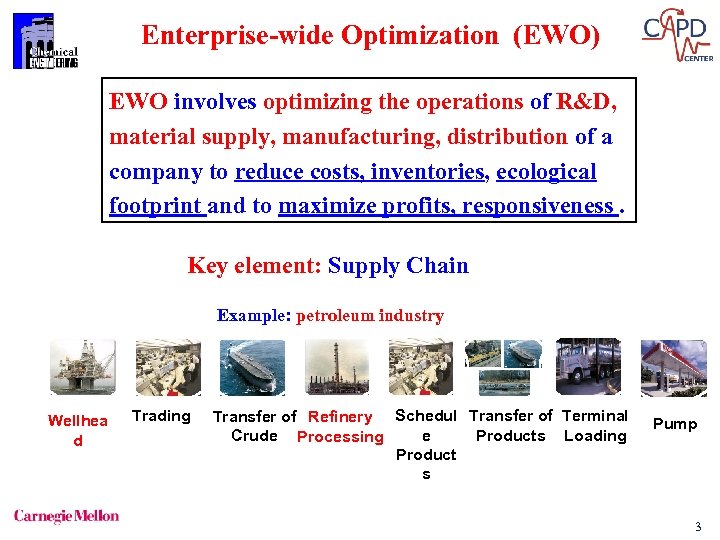 Enterprise-wide Optimization (EWO) EWO involves optimizing the operations of R&D, material supply, manufacturing, distribution of a company to reduce costs, inventories, ecological footprint and to maximize profits, responsiveness. Key element: Supply Chain Example: petroleum industry Wellhea d Trading Transfer of Refinery Schedul Transfer of Terminal e Products Loading Crude Processing Product s Pump 3
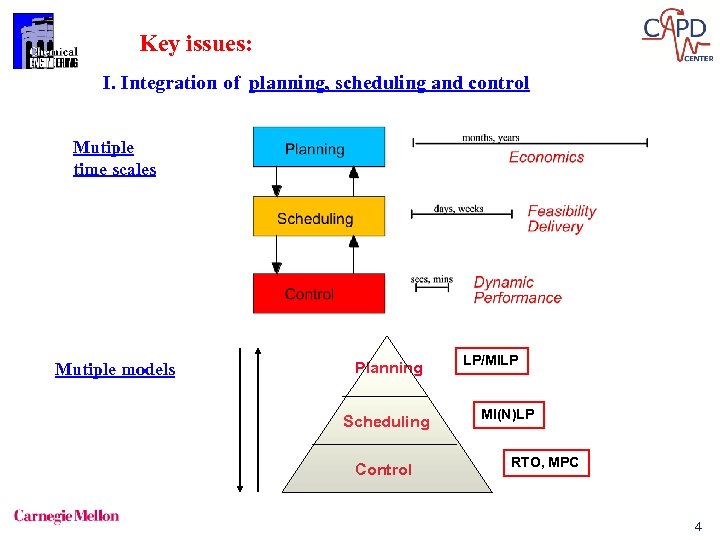 Key issues: I. Integration of planning, scheduling and control Mutiple time scales Mutiple models Planning Scheduling Control LP/MILP MI(N)LP RTO, MPC 4
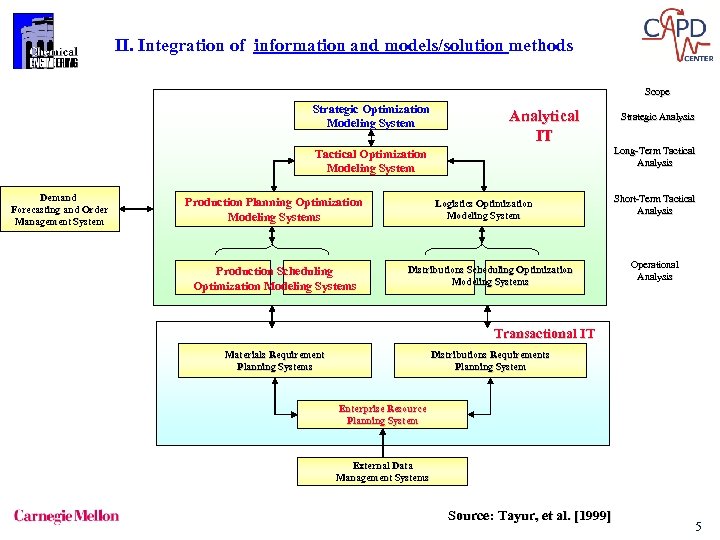 II. Integration of information and models/solution methods Scope Strategic Optimization Modeling System Analytical IT Long-Term Tactical Analysis Tactical Optimization Modeling System Demand Forecasting and Order Management System Production Planning Optimization Modeling Systems Production Scheduling Optimization Modeling Systems Strategic Analysis Logistics Optimization Modeling System Distributions Scheduling Optimization Modeling Systems Short-Term Tactical Analysis Operational Analysis Transactional IT Materials Requirement Planning Systems Distributions Requirements Planning System Enterprise Resource Planning System External Data Management Systems Source: Tayur, et al. [1999] 5
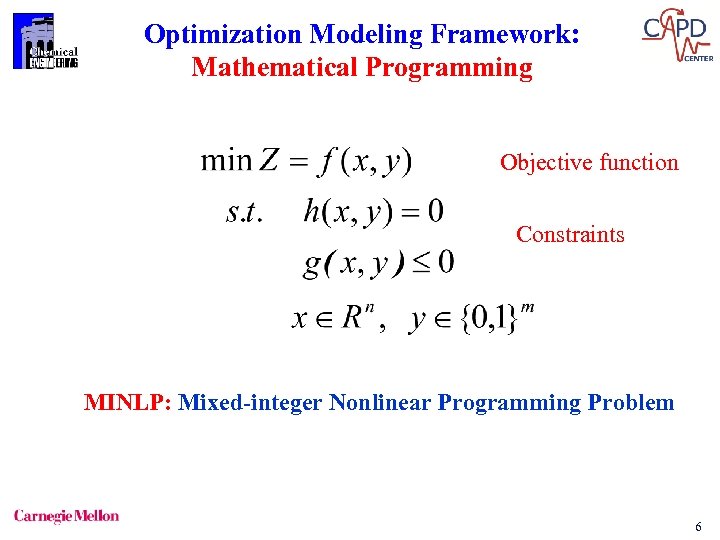 Optimization Modeling Framework: Mathematical Programming Objective function Constraints MINLP: Mixed-integer Nonlinear Programming Problem 6
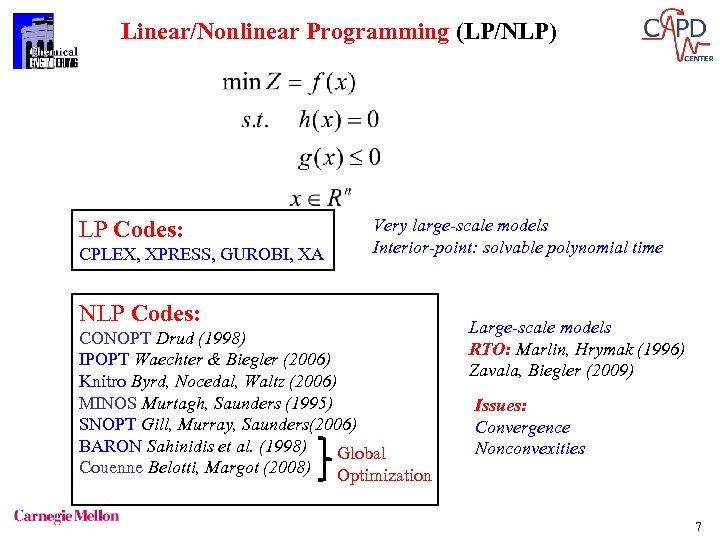 Linear/Nonlinear Programming (LP/NLP) LP Codes: CPLEX, XPRESS, GUROBI, XA Very large-scale models Interior-point: solvable polynomial time NLP Codes: CONOPT Drud (1998) IPOPT Waechter & Biegler (2006) Knitro Byrd, Nocedal, Waltz (2006) MINOS Murtagh, Saunders (1995) SNOPT Gill, Murray, Saunders(2006) BARON Sahinidis et al. (1998) Global Couenne Belotti, Margot (2008) Optimization Large-scale models RTO: Marlin, Hrymak (1996) Zavala, Biegler (2009) Issues: Convergence Nonconvexities 7
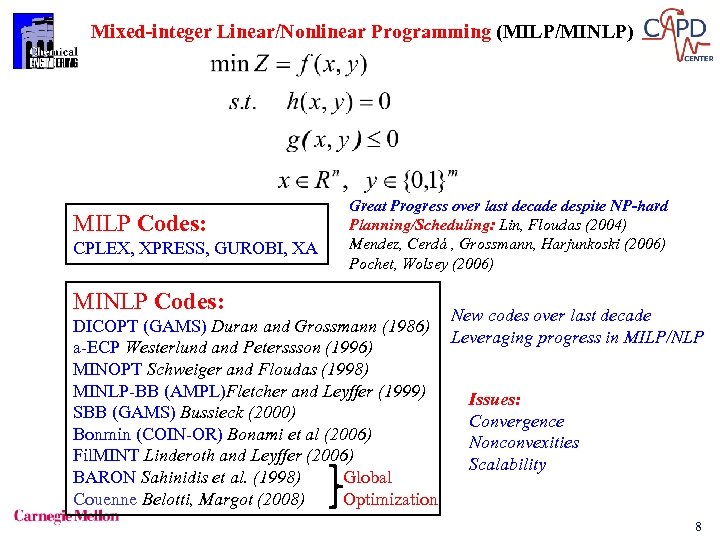 Mixed-integer Linear/Nonlinear Programming (MILP/MINLP) MILP Codes: CPLEX, XPRESS, GUROBI, XA Great Progress over last decade despite NP-hard Planning/Scheduling: Lin, Floudas (2004) Mendez, Cerdá , Grossmann, Harjunkoski (2006) Pochet, Wolsey (2006) MINLP Codes: New codes over last decade DICOPT (GAMS) Duran and Grossmann (1986) Leveraging progress in MILP/NLP a-ECP Westerlund and Peterssson (1996) MINOPT Schweiger and Floudas (1998) MINLP-BB (AMPL)Fletcher and Leyffer (1999) Issues: SBB (GAMS) Bussieck (2000) Convergence Bonmin (COIN-OR) Bonami et al (2006) Nonconvexities Fil. MINT Linderoth and Leyffer (2006) Scalability BARON Sahinidis et al. (1998) Global Optimization Couenne Belotti, Margot (2008) 8
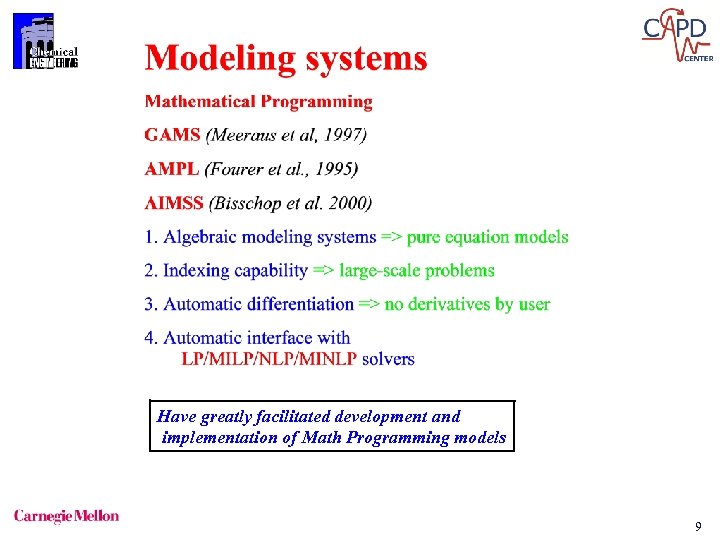 Have greatly facilitated development and Have greatly facilitated implementation of Math Programming models 9
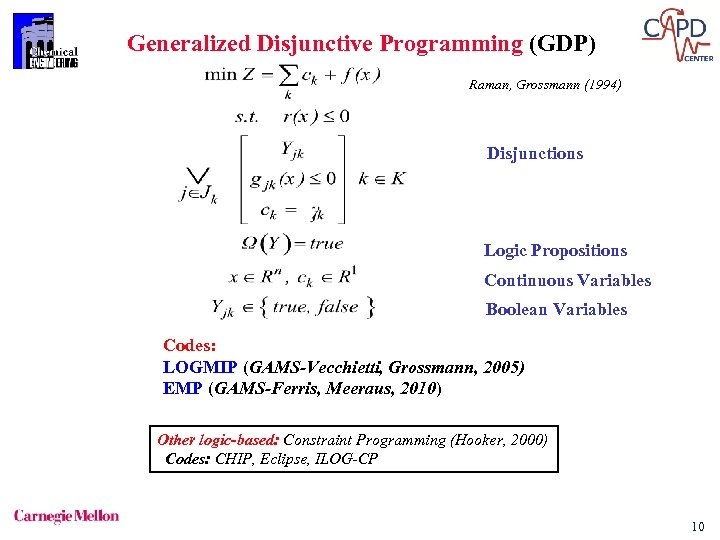 Generalized Disjunctive Programming (GDP) Raman, Grossmann (1994) Disjunctions Logic Propositions Continuous Variables Boolean Variables Codes: LOGMIP (GAMS-Vecchietti, Grossmann, 2005) EMP (GAMS-Ferris, Meeraus, 2010) Other logic-based: Constraint Programming (Hooker, 2000) Codes: CHIP, Eclipse, ILOG-CP 10
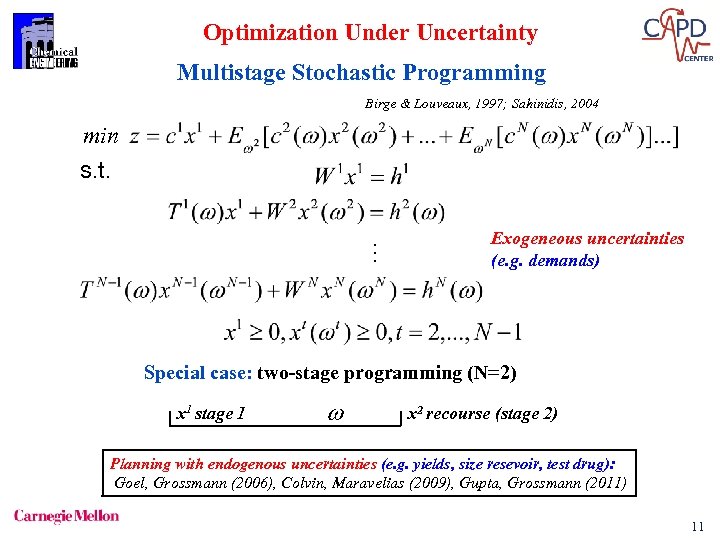 Optimization Under Uncertainty Multistage Stochastic Programming Birge & Louveaux, 1997; Sahinidis, 2004 min s. t. … Exogeneous uncertainties (e. g. demands) Special case: two-stage programming (N=2) x 1 stage 1 x 2 recourse (stage 2) Planning with endogenous uncertainties (e. g. yields, size resevoir, test drug): Goel, Grossmann (2006), Colvin, Maravelias (2009), Gupta, Grossmann (2011) 11
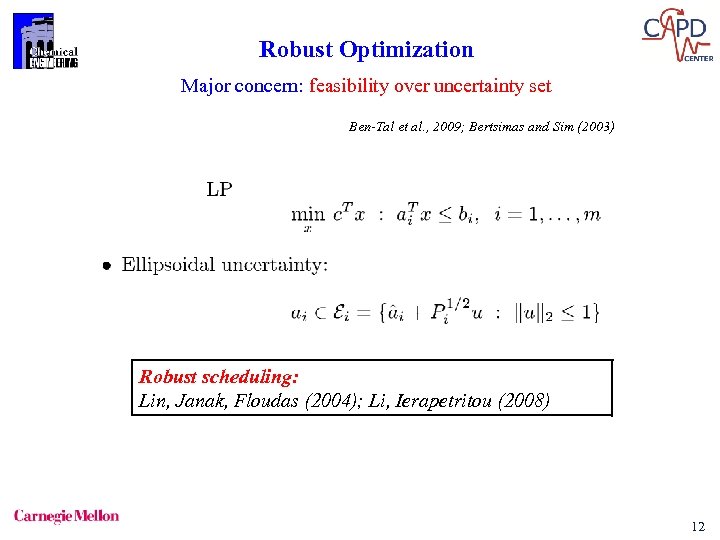 Robust Optimization Major concern: feasibility over uncertainty set Ben-Tal et al. , 2009; Bertsimas and Sim (2003) Robust scheduling: Lin, Janak, Floudas (2004); Li, Ierapetritou (2008) 12
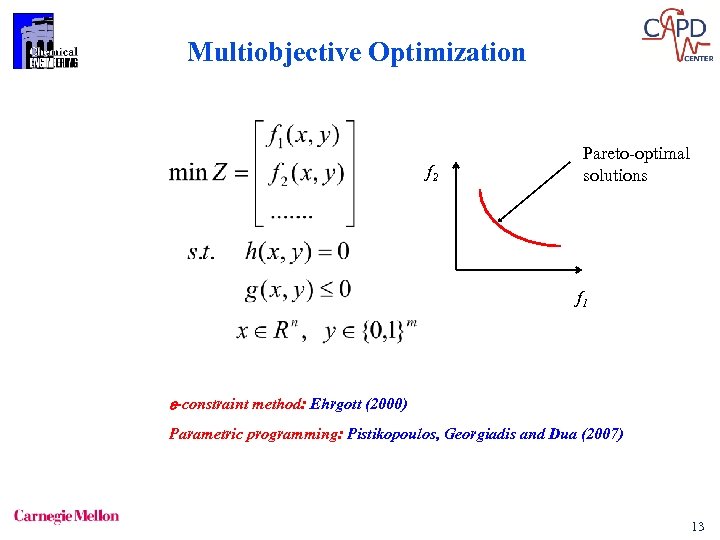 Multiobjective Optimization f 2 Pareto-optimal solutions f 1 -constraint method: Ehrgott (2000) Parametric programming: Pistikopoulos, Georgiadis and Dua (2007) 13
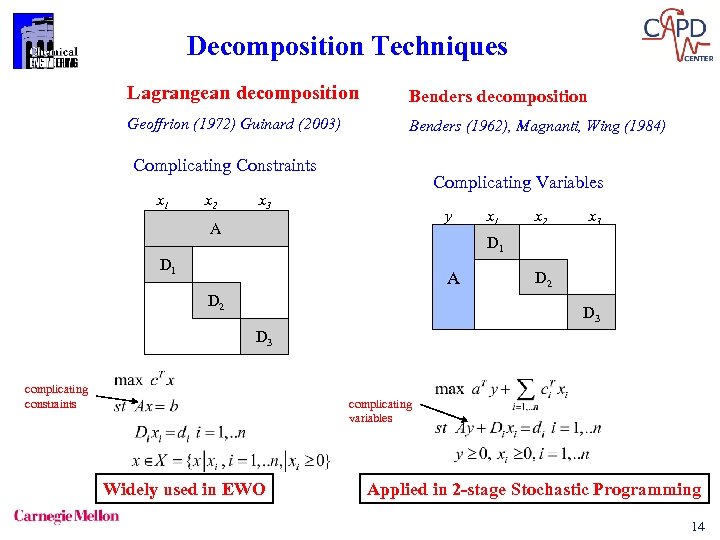 Decomposition Techniques Lagrangean decomposition Benders decomposition Geoffrion (1972) Guinard (2003) Benders (1962), Magnanti, Wing (1984) Complicating Constraints x 1 x 2 Complicating Variables x 3 y A x 1 x 2 x 3 D 1 A D 2 D 3 complicating constraints complicating variables Widely used in EWO Applied in 2 -stage Stochastic Programming 14
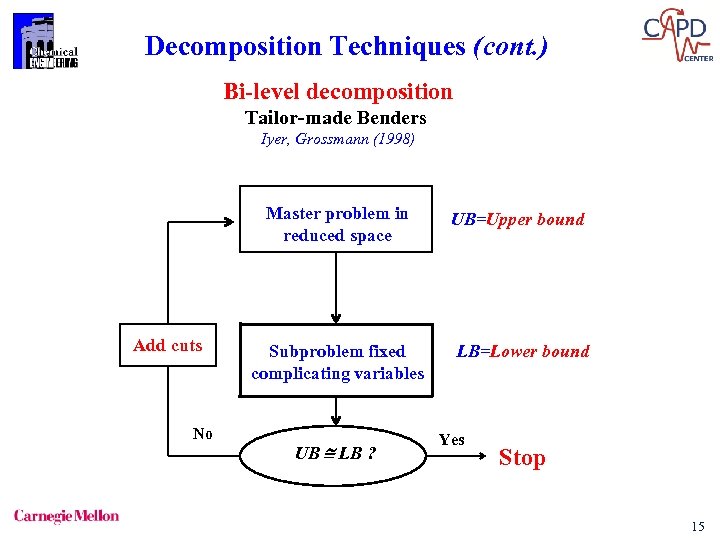 Decomposition Techniques (cont. ) Bi-level decomposition Tailor-made Benders Iyer, Grossmann (1998) Master problem in reduced space Add cuts No Subproblem fixed complicating variables UB LB ? UB=Upper bound LB=Lower bound Yes Stop 15
 PITA Project Special industrial interest group in CAPD: “Enterprise-wide Optimization for Process Industries” http: //egon. cheme. cmu. edu/ewocp/ Multidisciplinary team: Chemical engineers, Operations Research, Industrial Engineering Researchers: Carnegie Mellon: Lehigh University: Ignacio Grossmann (Ch. E) Larry Biegler (Ch. E) Nicola Secomandi (OR) John Hooker (OR) Katya Scheinberg (Ind. Eng) Larry Snyder (Ind. Eng. ) Jeff Linderoth (Ind. Eng. ) 16
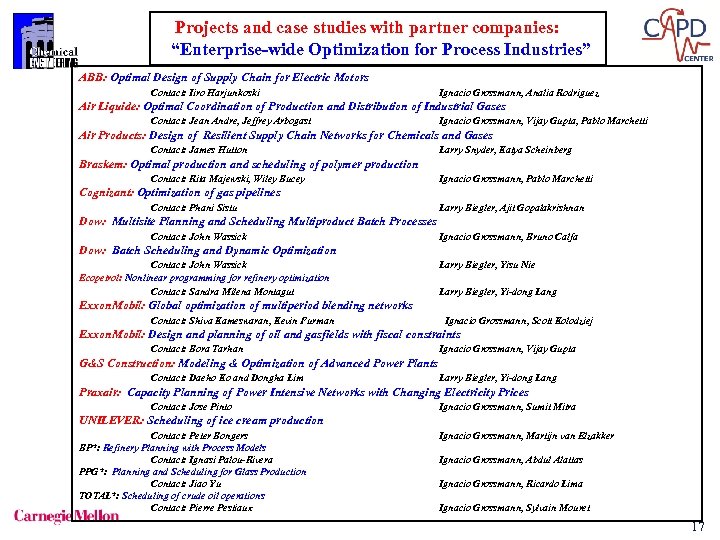 Projects and case studies with partner companies: “Enterprise-wide Optimization for Process Industries” ABB: Optimal Design of Supply Chain for Electric Motors Contact: Iiro Harjunkoski Ignacio Grossmann, Analia Rodriguez Air Liquide: Optimal Coordination of Production and Distribution of Industrial Gases Contact: Jean Andre, Jeffrey Arbogast Ignacio Grossmann, Vijay Gupta, Pablo Marchetti Air Products: Design of Resilient Supply Chain Networks for Chemicals and Gases Contact: James Hutton Larry Snyder, Katya Scheinberg Braskem: Optimal production and scheduling of polymer production Contact: Rita Majewski, Wiley Bucey Ignacio Grossmann, Pablo Marchetti Cognizant: Optimization of gas pipelines Contact: Phani Sistu Larry Biegler, Ajit Gopalakrishnan Dow: Multisite Planning and Scheduling Multiproduct Batch Processes Contact: John Wassick Ignacio Grossmann, Bruno Calfa Dow: Batch Scheduling and Dynamic Optimization Contact: John Wassick Ecopetrol: Nonlinear programming for refinery optimization Contact: Sandra Milena Montagut Larry Biegler, Yisu Nie Larry Biegler, Yi-dong Lang Exxon. Mobil: Global optimization of multiperiod blending networks Contact: Shiva Kameswaran, Kevin Furman Ignacio Grossmann, Scott Kolodziej Exxon. Mobil: Design and planning of oil and gasfields with fiscal constraints Contact: Bora Tarhan Ignacio Grossmann, Vijay Gupta G&S Construction: Modeling & Optimization of Advanced Power Plants Contact: Daeho Ko and Dongha Lim Larry Biegler, Yi-dong Lang Praxair: Capacity Planning of Power Intensive Networks with Changing Electricity Prices Contact: Jose Pinto Ignacio Grossmann, Sumit Mitra UNILEVER: Scheduling of ice cream production Contact: Peter Bongers BP*: Refinery Planning with Process Models Contact: Ignasi Palou-Rivera PPG*: Planning and Scheduling for Glass Production Contact: Jiao Yu TOTAL*: Scheduling of crude oil operations Contact: Pierre Pestiaux Ignacio Grossmann, Martijn van Elzakker Ignacio Grossmann, Abdul Alattas Ignacio Grossmann, Ricardo Lima Ignacio Grossmann, Sylvain Mouret 17
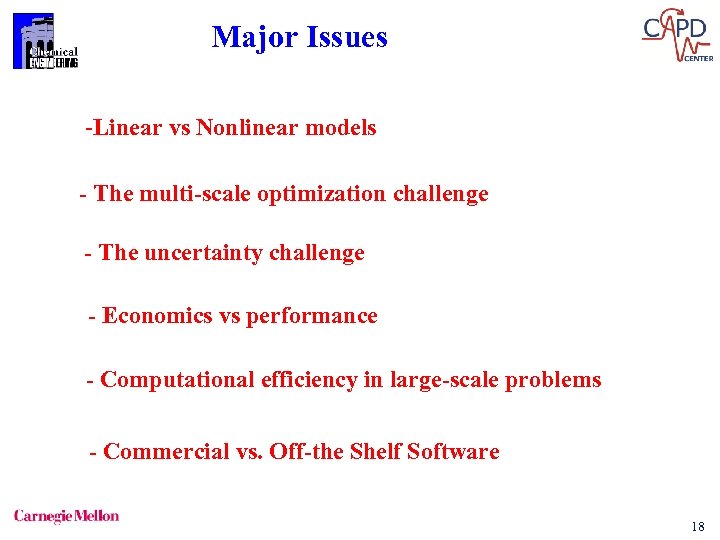 Major Issues -Linear vs Nonlinear models - The multi-scale optimization challenge - The uncertainty challenge - Economics vs performance - Computational efficiency in large-scale problems - Commercial vs. Off-the Shelf Software 18
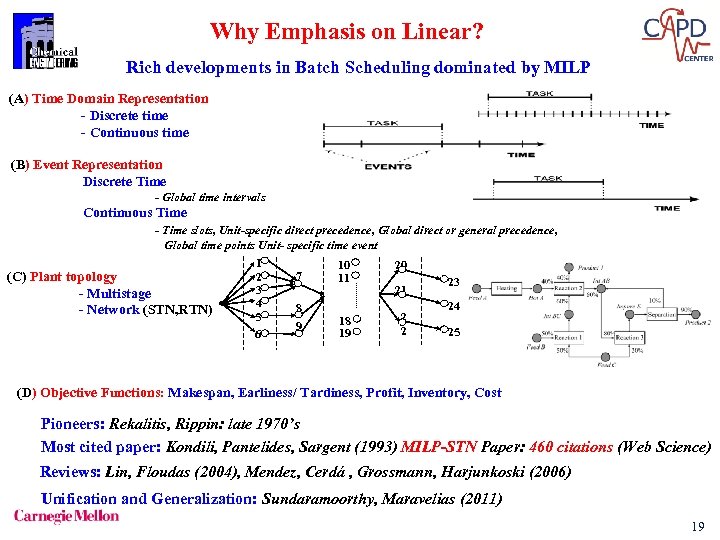 Why Emphasis on Linear? Rich developments in Batch Scheduling dominated by MILP (A) Time Domain Representation - Discrete time - Continuous time (B) Event Representation Discrete Time - Global time intervals Continuous Time - Time slots, Unit-specific direct precedence, Global direct or general precedence, Global time points Unit- specific time event 1 20 10 7 (C) Plant topology 2 11 23 21 3 - Multistage 4 24 8 - Network (STN, RTN) 2 5 18 9 2 25 19 6 (D) Objective Functions: Makespan, Earliness/ Tardiness, Profit, Inventory, Cost Pioneers: Rekalitis, Rippin: late 1970’s Most cited paper: Kondili, Pantelides, Sargent (1993) MILP-STN Paper: 460 citations (Web Science) Reviews: Lin, Floudas (2004), Mendez, Cerdá , Grossmann, Harjunkoski (2006) Unification and Generalization: Sundaramoorthy, Maravelias (2011) 19
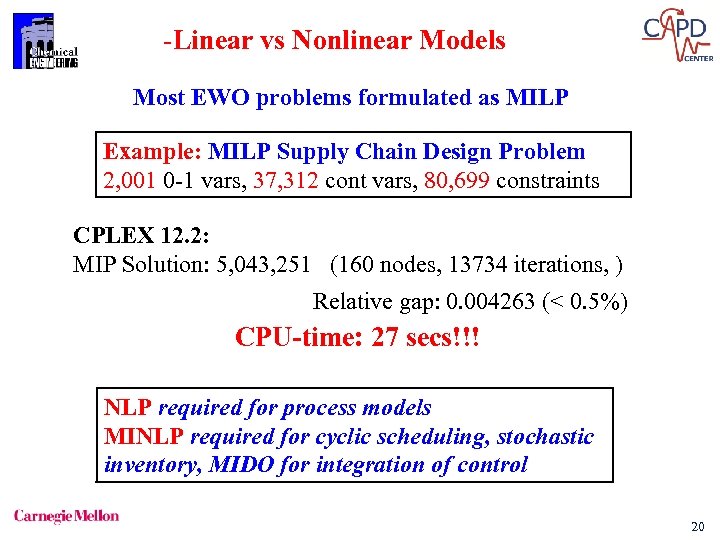 -Linear vs Nonlinear Models Most EWO problems formulated as MILP Example: MILP Supply Chain Design Problem 2, 001 0 -1 vars, 37, 312 cont vars, 80, 699 constraints CPLEX 12. 2: MIP Solution: 5, 043, 251 (160 nodes, 13734 iterations, ) Relative gap: 0. 004263 (< 0. 5%) CPU-time: 27 secs!!! NLP required for process models MINLP required for cyclic scheduling, stochastic inventory, MIDO for integration of control 20
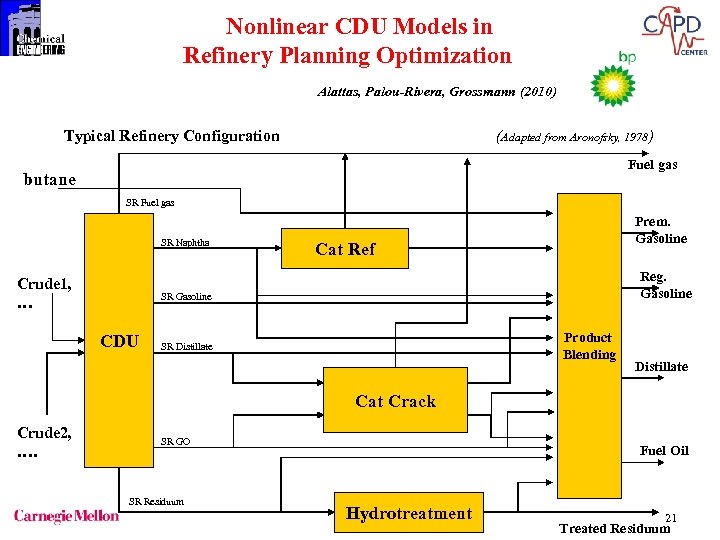 Nonlinear CDU Models in Refinery Planning Optimization Alattas, Palou-Rivera, Grossmann (2010) Typical Refinery Configuration (Adapted from Aronofsky, 1978) Fuel gas butane SR Fuel gas SR Naphtha Crude 1, … Cat Ref Reg. Gasoline SR Gasoline CDU SR Distillate Cat Crack Crude 2, …. Prem. Gasoline SR GO SR Residuum Product Blending Distillate blending Gas oil blending Hydrotreatment Distillate Fuel Oil 21 Treated Residuum
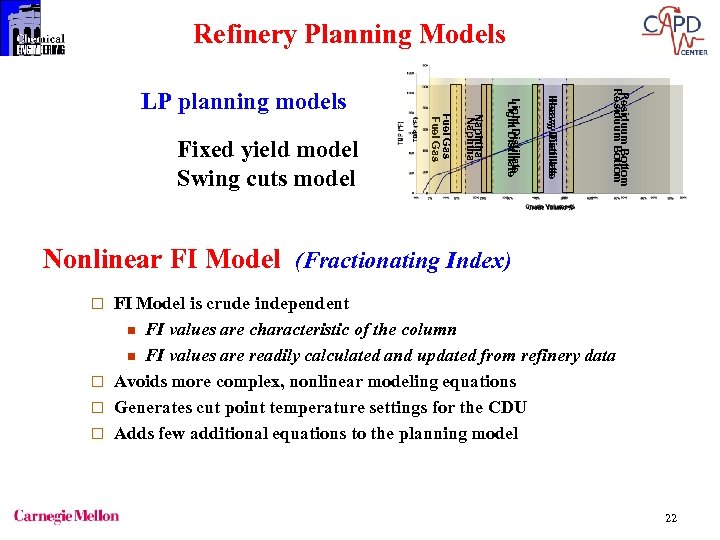 Refinery Planning Models Residuum Bottom Heavy Distillate Light Distillate Naphtha Fixed yield model Swing cuts model Fuel Gas LP planning models Nonlinear FI Model (Fractionating Index) FI Model is crude independent n FI values are characteristic of the column n FI values are readily calculated and updated from refinery data ¨ Avoids more complex, nonlinear modeling equations ¨ Generates cut point temperature settings for the CDU ¨ Adds few additional equations to the planning model ¨ 22
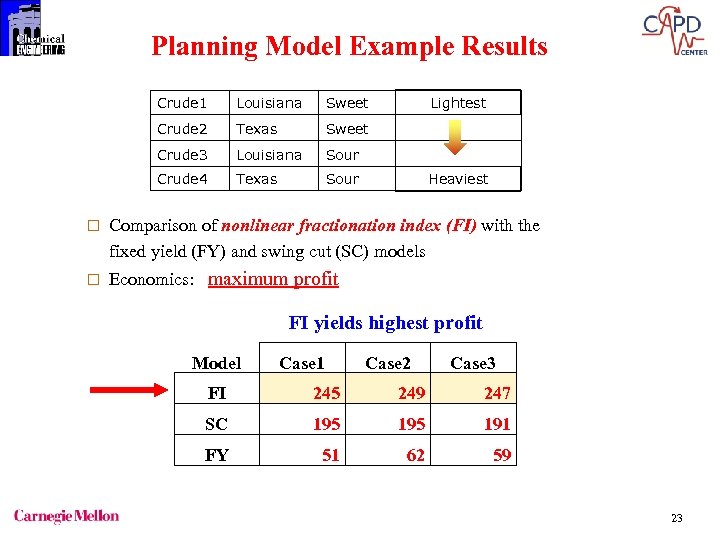 Planning Model Example Results Crude 1 Louisiana Sweet Crude 2 Texas Sweet Crude 3 Louisiana Sour Crude 4 Texas Lightest Sour Heaviest ¨ Comparison of nonlinear fractionation index (FI) with the fixed yield (FY) and swing cut (SC) models ¨ Economics: maximum profit FI yields highest profit Model Case 1 Case 2 Case 3 FI 245 249 247 SC 195 191 FY 51 62 59 23
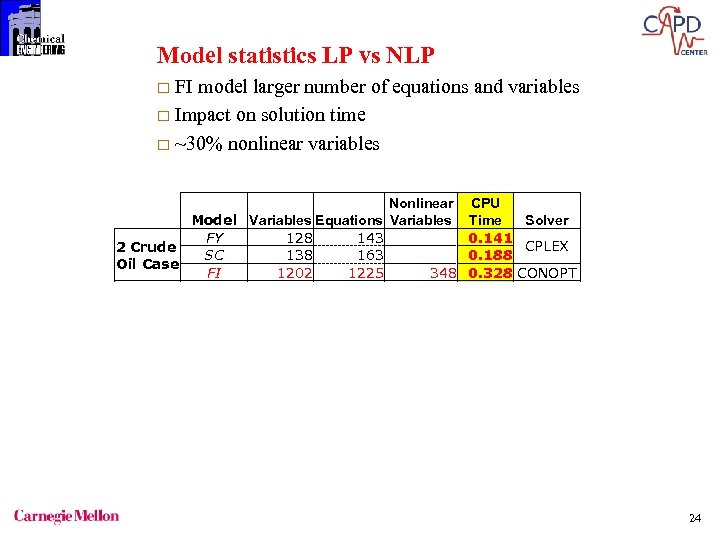 Model statistics LP vs NLP FI model larger number of equations and variables ¨ Impact on solution time ¨ ~30% nonlinear variables ¨ Nonlinear Model Variables Equations Variables FY 128 143 2 Crude SC 138 163 Oil Case FI 1202 1225 348 FY 159 185 3 Crude SC 174 215 Oil Case FI 1770 1808 522 FY 192 231 4 Crude SC 212 271 Oil Case FI 2340 2395 696 CPU Time 0. 141 0. 188 0. 328 0. 250 0. 281 0. 439 0. 218 0. 241 0. 860 Solver CPLEX CONOPT 24
 - Solution large-scale problems: Strategy 1: Exploit problem structure (TSP) Strategy 2: Decomposition Strategy 3: Heuristic methods to obtain “good feasible solutions” 25
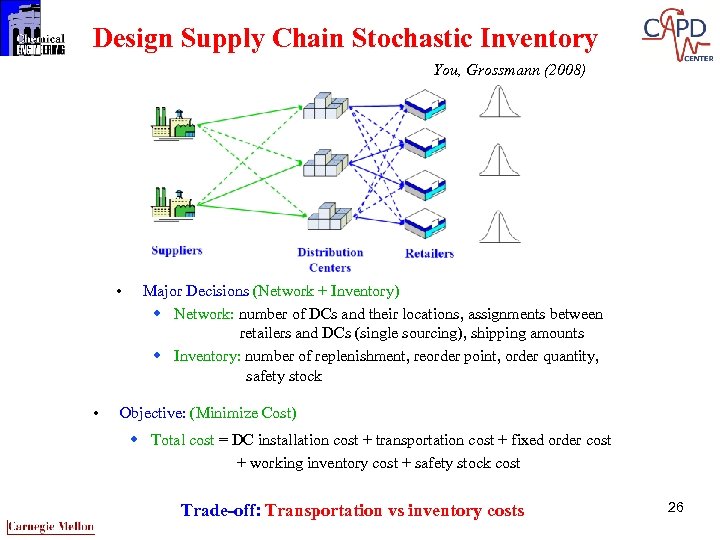 Design Supply Chain Stochastic Inventory You, Grossmann (2008) • • Major Decisions (Network + Inventory) w Network: number of DCs and their locations, assignments between retailers and DCs (single sourcing), shipping amounts w Inventory: number of replenishment, reorder point, order quantity, safety stock Objective: (Minimize Cost) w Total cost = DC installation cost + transportation cost + fixed order cost + working inventory cost + safety stock cost Trade-off: Transportation vs inventory costs 26
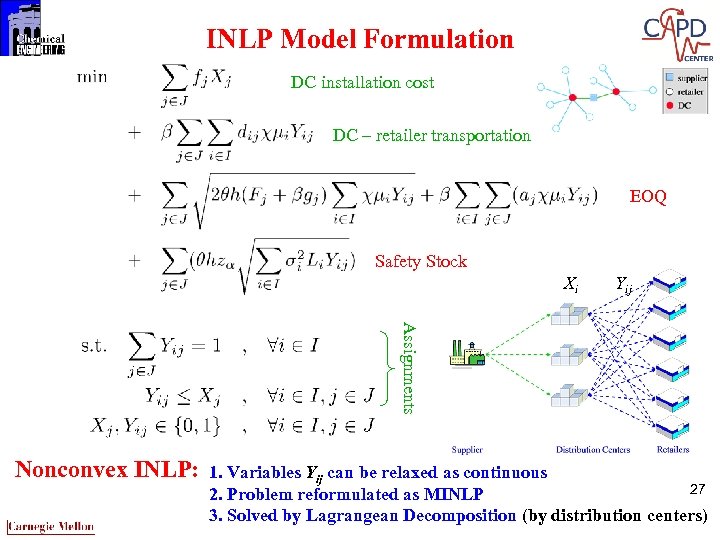 INLP Model Formulation DC installation cost DC – retailer transportation EOQ Safety Stock Xi Yij Assignments Nonconvex INLP: 1. Variables Yij can be relaxed as continuous 27 2. Problem reformulated as MINLP 3. Solved by Lagrangean Decomposition (by distribution centers)
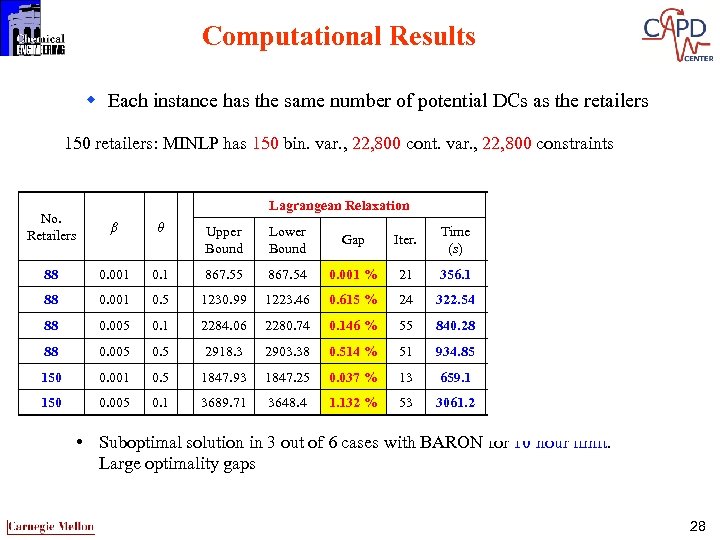 Computational Results w Each instance has the same number of potential DCs as the retailers 150 retailers: MINLP has 150 bin. var. , 22, 800 cont. var. , 22, 800 constraints Lagrangean Relaxation BARON (global optimum) No. Retailers β θ Upper Bound Lower Bound Gap Iter. Time (s) Upper Bound Lower Bound Gap 88 0. 001 0. 1 867. 55 867. 54 0. 001 % 21 356. 1 867. 55 837. 68 3. 566 % 88 0. 001 0. 5 1230. 99 1223. 46 0. 615 % 24 322. 54 1295. 02* 1165. 15 11. 146 % 88 0. 005 0. 1 2284. 06 2280. 74 0. 146 % 55 840. 28 2297. 80* 2075. 51 10. 710 % 88 0. 005 0. 5 2918. 3 2903. 38 0. 514 % 51 934. 85 3022. 67* 2417. 06 25. 056 % 150 0. 001 0. 5 1847. 93 1847. 25 0. 037 % 13 659. 1 1847. 93 1674. 08 10. 385 % 150 0. 005 0. 1 3689. 71 3648. 4 1. 132 % 53 3061. 2 3689. 71 3290. 18 12. 143 % • Suboptimal solution in 3 out of 6 cases with BARON for 10 hour limit. Large optimality gaps 28
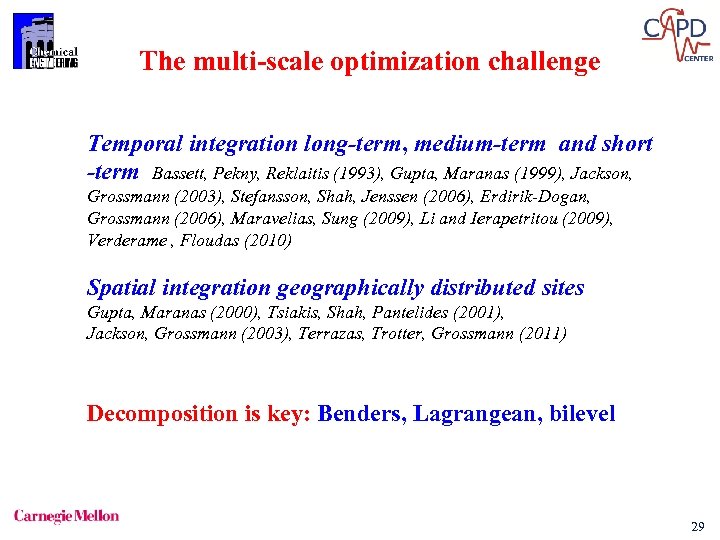 The multi-scale optimization challenge Temporal integration long-term, medium-term and short -term Bassett, Pekny, Reklaitis (1993), Gupta, Maranas (1999), Jackson, Grossmann (2003), Stefansson, Shah, Jenssen (2006), Erdirik-Dogan, Grossmann (2006), Maravelias, Sung (2009), Li and Ierapetritou (2009), Verderame , Floudas (2010) Spatial integration geographically distributed sites Gupta, Maranas (2000), Tsiakis, Shah, Pantelides (2001), Jackson, Grossmann (2003), Terrazas, Trotter, Grossmann (2011) Decomposition is key: Benders, Lagrangean, bilevel 29
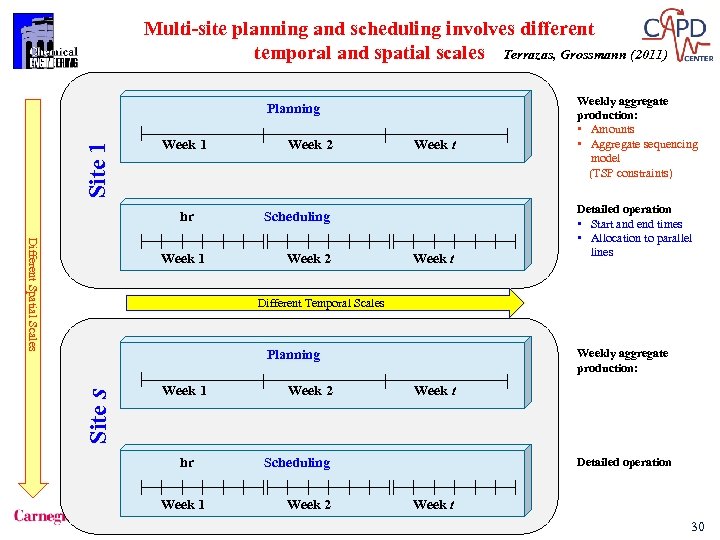 Multi-site planning and scheduling involves different temporal and spatial scales Terrazas, Grossmann (2011) Site 1 Planning Week 1 hr Different Spatial Scales Week 1 Week 2 Week t Scheduling Week 2 Week t Weekly aggregate production: • Amounts • Aggregate sequencing model (TSP constraints) Detailed operation • Start and end times • Allocation to parallel lines Different Temporal Scales Weekly aggregate production: Site s Planning Week 1 hr Week 1 Week 2 Week t Scheduling Week 2 Detailed operation Week t 30
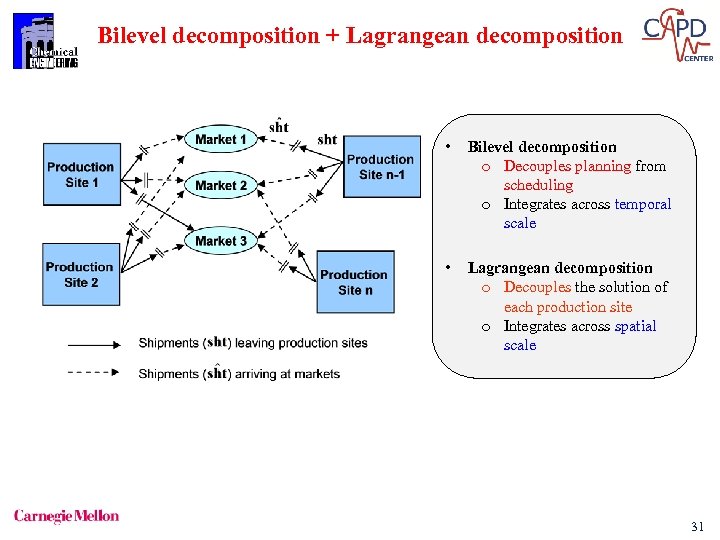 Bilevel decomposition + Lagrangean decomposition • Bilevel decomposition o Decouples planning from scheduling o Integrates across temporal scale • Lagrangean decomposition o Decouples the solution of each production site o Integrates across spatial scale 31
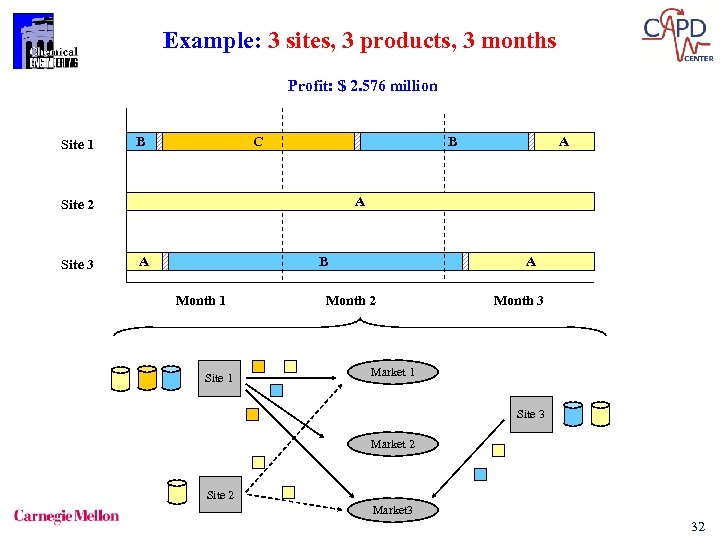 Example: 3 sites, 3 products, 3 months Profit: $ 2. 576 million Site 1 B C B A Site 2 Site 3 A A B Month 1 Site 1 A Month 2 Month 3 Market 1 Site 3 Market 2 Site 2 Market 3 32
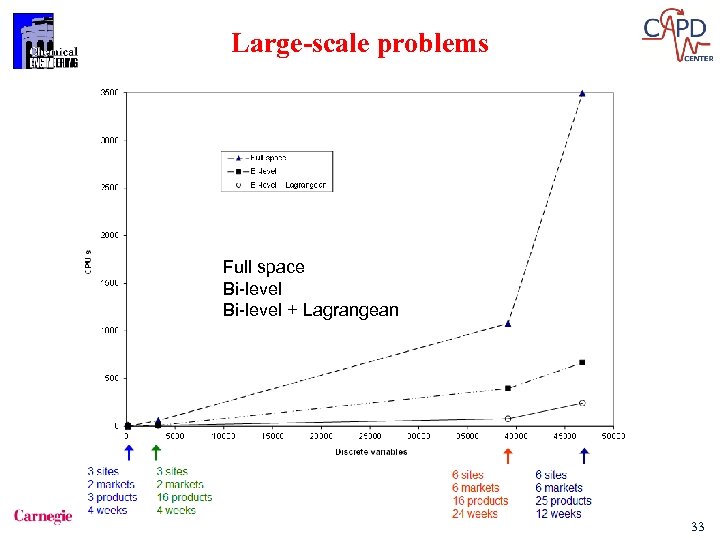 Large-scale problems Full space Bi-level + Lagrangean 33
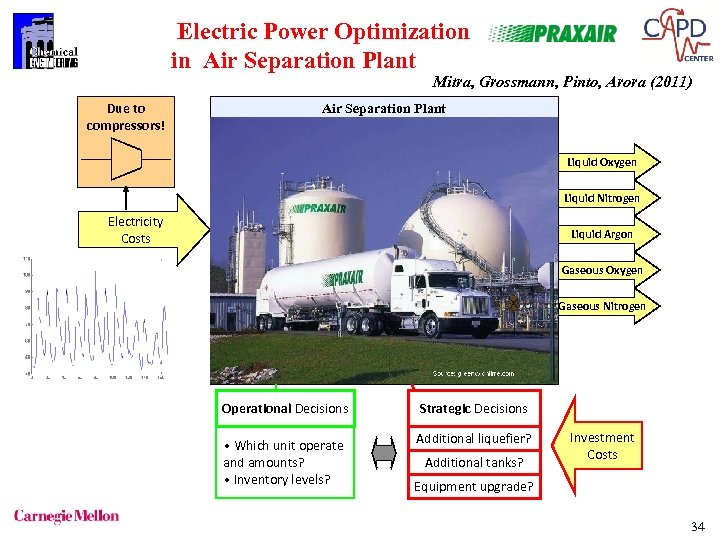 Electric Power Optimization in Air Separation Plant Mitra, Grossmann, Pinto, Arora (2011) Due to compressors! Air Separation Plant Liquid Oxygen Liquid Nitrogen Electricity Costs Liquid Argon Gaseous Oxygen Gaseous Nitrogen Operational Decisions Strategic Decisions • Which unit operate and amounts? • Inventory levels? Additional liquefier? Additional tanks? Investment Costs Equipment upgrade? 34
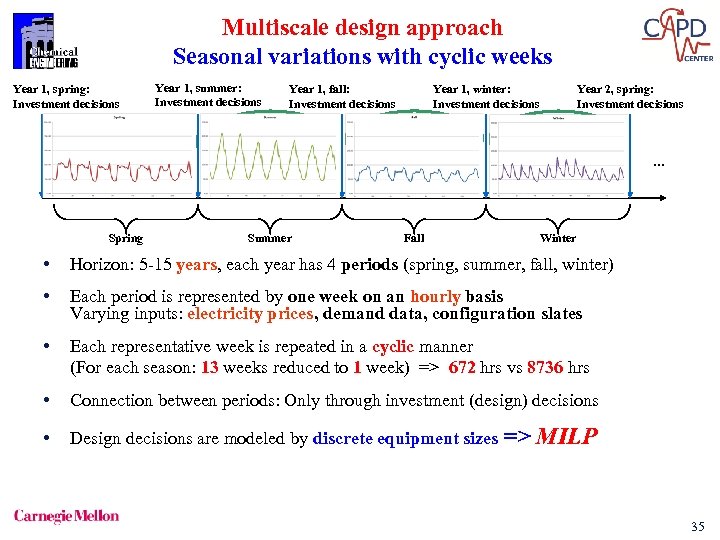 Multiscale design approach Seasonal variations with cyclic weeks Year 1, spring: Investment decisions Year 1, summer: Investment decisions Mo Tu We Th Fr Sa Su Spring Mo Tu Year 1, fall: Investment decisions … Summer Su Mo Tu Year 1, winter: Investment decisions … Su Mo Tu Fall Year 2, spring: Investment decisions … Su … Winter • Horizon: 5 -15 years, each year has 4 periods (spring, summer, fall, winter) • Each period is represented by one week on an hourly basis Varying inputs: electricity prices, demand data, configuration slates • Each representative week is repeated in a cyclic manner (For each season: 13 weeks reduced to 1 week) => 672 hrs vs 8736 hrs • Connection between periods: Only through investment (design) decisions • Design decisions are modeled by discrete equipment sizes => MILP 35
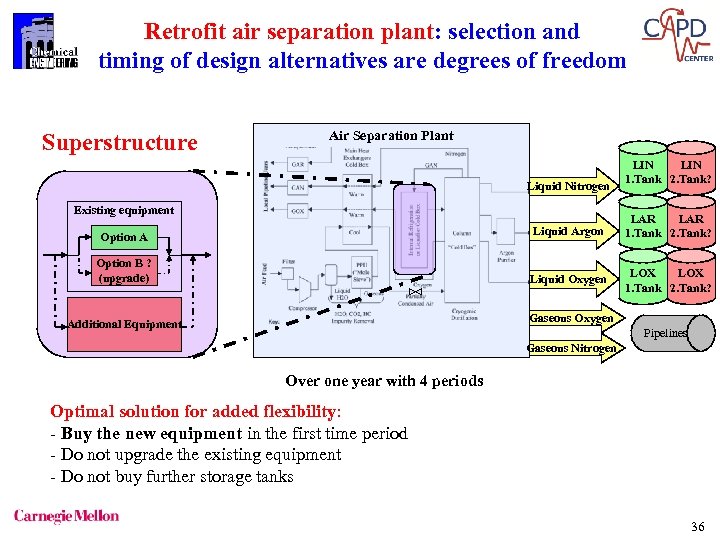 Retrofit air separation plant: selection and timing of design alternatives are degrees of freedom Superstructure Air Separation Plant Liquid Nitrogen Existing equipment LIN 1. Tank 2. Tank? Option A Liquid Argon LAR 1. Tank 2. Tank? Option B ? (upgrade) Liquid Oxygen LOX 1. Tank 2. Tank? Additional Equipment Gaseous Oxygen Pipelines Gaseous Nitrogen Over one year with 4 periods Optimal solution for added flexibility: - Buy the new equipment in the first time period - Do not upgrade the existing equipment - Do not buy further storage tanks 36
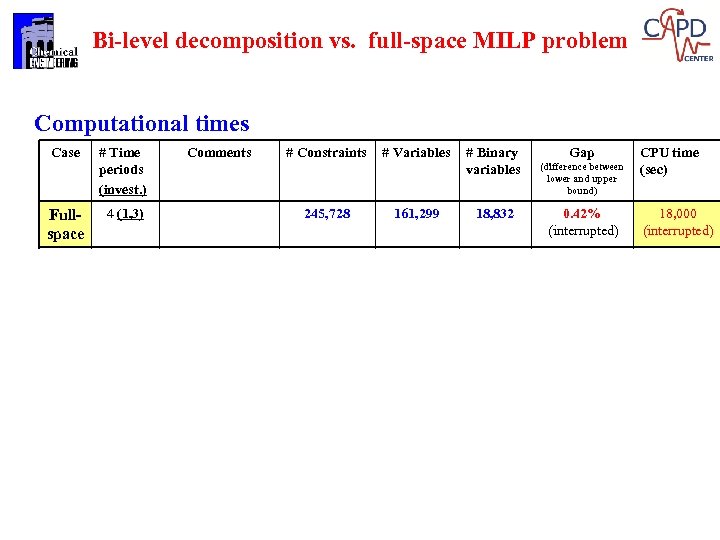 Bi-level decomposition vs. full-space MILP problem Computational times Case # Time periods (invest. ) Comments Fullspace 4 (1, 3) Bilevel 4 (1, 3) 1 st iter, no cuts DP 4 • • • 245, 728 # Variables 161, 299 # Binary variables 1 major iteration: Only AP is solved a 2 nd time (w cuts) to prove LB AP # Constraints 18, 832 Gap (difference between lower and upper bound) CPU time (sec) 0. 42% (interrupted) 18, 000 (interrupted) 0% Between AP+DP 3814 124, 768 137, 107 8, 752 0. 08% 841 61, 351 40, 330 4, 704 0. 07% 503 Allowed integrality gap is 0. 1% MIP Solvers: CPLEX 11. 2. 1, XPRESS (version: Aug 13 2009 for GAMS) Machine: Intel Centrino Duo, 2 Ghz 37 37
 - The uncertainty challenge: Short term uncertainties: robust optimization Computation time comparable to deterministic models Long term uncertainties: stochastic programming Computation time one to two orders of magnitude larger than deterministic models 38
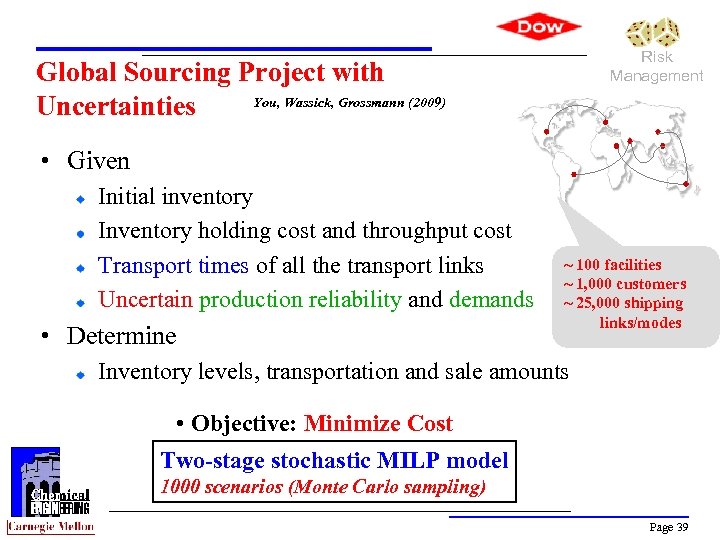 Risk Management Global Sourcing Project with You, Wassick, Grossmann (2009) Uncertainties • Given Initial inventory Inventory holding cost and throughput cost Transport times of all the transport links Uncertain production reliability and demands • Determine ~ 100 facilities ~ 1, 000 customers ~ 25, 000 shipping links/modes Inventory levels, transportation and sale amounts • Objective: Minimize Cost Two-stage stochastic MILP model 1000 scenarios (Monte Carlo sampling) Page 39
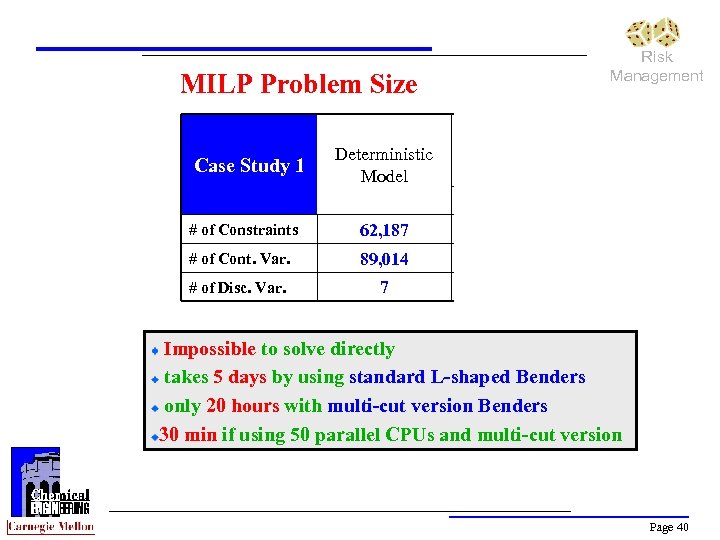 Risk Management MILP Problem Size Case Study 1 Deterministic Model Stochastic Programming Model 1, 000 scenarios # of Constraints 62, 187 52, 684, 187 # of Cont. Var. 89, 014 75, 356, 014 # of Disc. Var. 7 7 Impossible to solve directly takes 5 days by using standard L-shaped Benders only 20 hours with multi-cut version Benders 30 min if using 50 parallel CPUs and multi-cut version Page 40
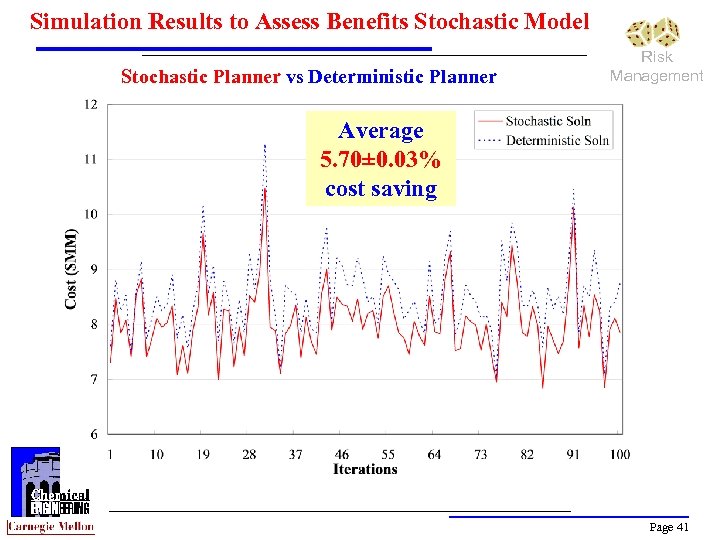 Simulation Results to Assess Benefits Stochastic Model Stochastic Planner vs Deterministic Planner Risk Management Average 5. 70± 0. 03% cost saving Page 41
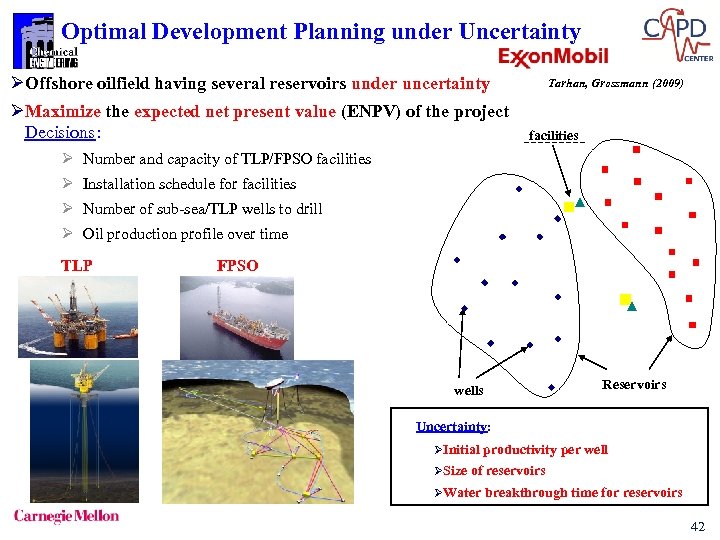 Optimal Development Planning under Uncertainty ØOffshore oilfield having several reservoirs under uncertainty ØMaximize the expected net present value (ENPV) of the project Decisions: Tarhan, Grossmann (2009) facilities Ø Number and capacity of TLP/FPSO facilities Ø Installation schedule for facilities Ø Number of sub-sea/TLP wells to drill Ø Oil production profile over time TLP FPSO wells Reservoirs Uncertainty: ØInitial productivity per well ØSize of reservoirs ØWater breakthrough time for reservoirs 42
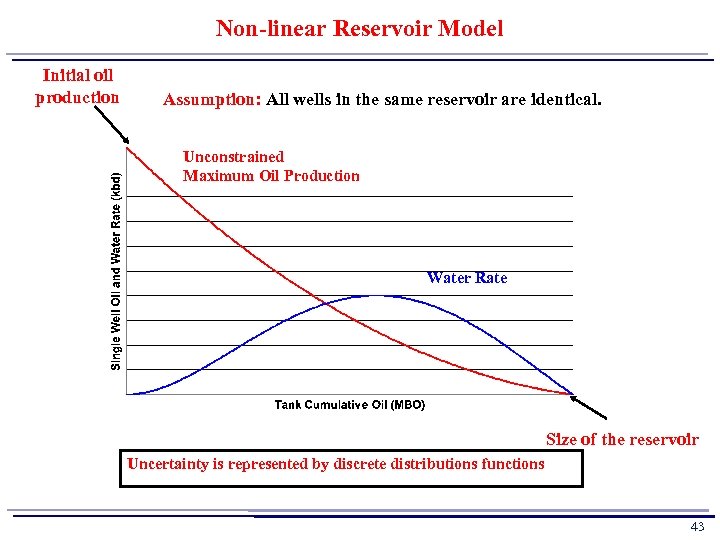 Non-linear Reservoir Model Initial oil production Assumption: All wells in the same reservoir are identical. Unconstrained Maximum Oil Production Water Rate Size of the reservoir Uncertainty is represented by discrete distributions functions 43
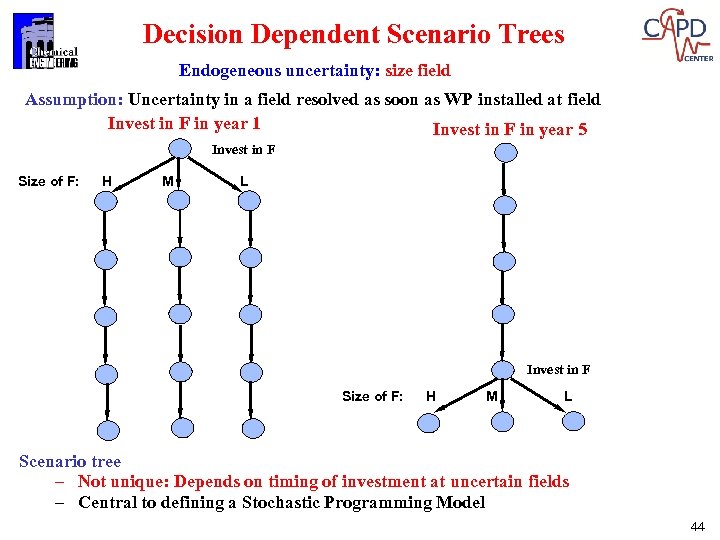 Decision Dependent Scenario Trees Endogeneous uncertainty: size field Assumption: Uncertainty in a field resolved as soon as WP installed at field Invest in F in year 1 Invest in F in year 5 Invest in F Size of F: H M L Scenario tree – Not unique: Depends on timing of investment at uncertain fields – Central to defining a Stochastic Programming Model 44
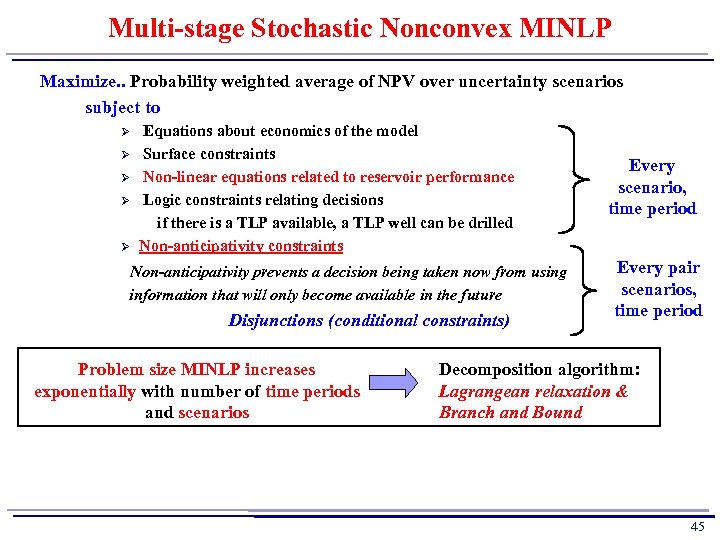 Multi-stage Stochastic Nonconvex MINLP Maximize. . Probability weighted average of NPV over uncertainty scenarios subject to Ø Ø Ø Equations about economics of the model Surface constraints Non-linear equations related to reservoir performance Logic constraints relating decisions if there is a TLP available, a TLP well can be drilled Non-anticipativity constraints Non-anticipativity prevents a decision being taken now from using information that will only become available in the future Disjunctions (conditional constraints) Problem size MINLP increases exponentially with number of time periods and scenarios Every scenario, time period Every pair scenarios, time period Decomposition algorithm: Lagrangean relaxation & Branch and Bound 45
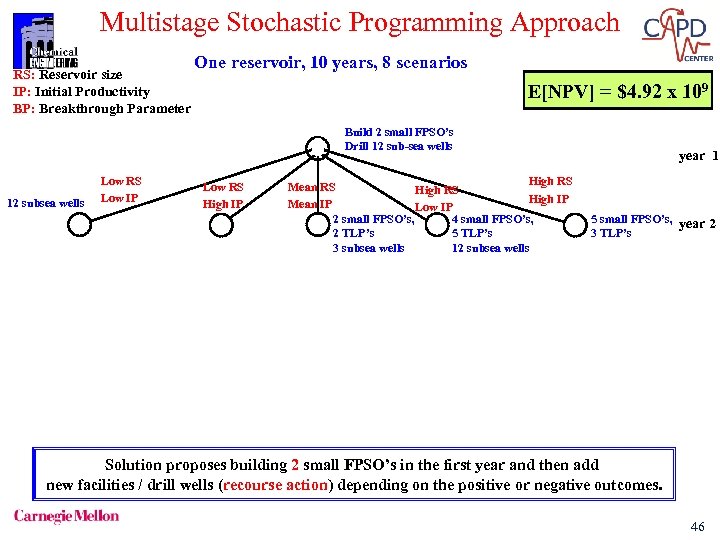 Multistage Stochastic Programming Approach RS: Reservoir size IP: Initial Productivity BP: Breakthrough Parameter One reservoir, 10 years, 8 scenarios E[NPV] = $4. 92 x 109 Build 2 small FPSO’s Drill 12 sub-sea wells 12 subsea wells Low RS Low IP Low RS High IP High RS Mean RS High IP Mean IP Low IP 2 small FPSO’s, 4 small FPSO’s, 2 TLP’s 5 TLP’s 3 subsea wells 12 subsea wells year 1 5 small FPSO’s, year 2 3 TLP’s Solution proposes building 2 small FPSO’s in the first year and then add new facilities / drill wells (recourse action) depending on the positive or negative outcomes. 46
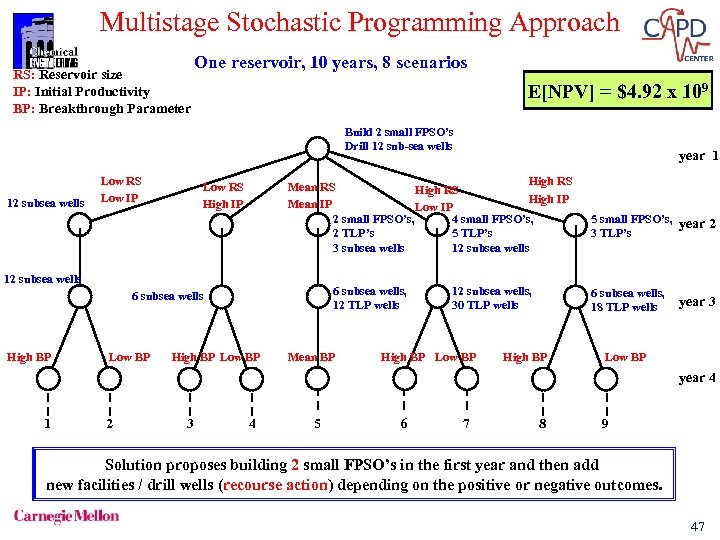 Multistage Stochastic Programming Approach RS: Reservoir size IP: Initial Productivity BP: Breakthrough Parameter One reservoir, 10 years, 8 scenarios E[NPV] = $4. 92 x 109 Build 2 small FPSO’s Drill 12 sub-sea wells 12 subsea wells Low RS Low IP High RS Mean RS High IP Mean IP Low IP 2 small FPSO’s, 4 small FPSO’s, 2 TLP’s 5 TLP’s 3 subsea wells 12 subsea wells Low RS High IP 12 subsea wells 6 subsea wells, 12 TLP wells 6 subsea wells High BP Low BP year 1 High BP Low BP Mean BP 12 subsea wells, 30 TLP wells High BP Low BP 5 small FPSO’s, year 2 3 TLP’s 6 subsea wells, 18 TLP wells High BP year 3 Low BP year 4 1 2 3 4 5 6 7 8 9 Solution proposes building 2 small FPSO’s in the first year and then add new facilities / drill wells (recourse action) depending on the positive or negative outcomes. 47
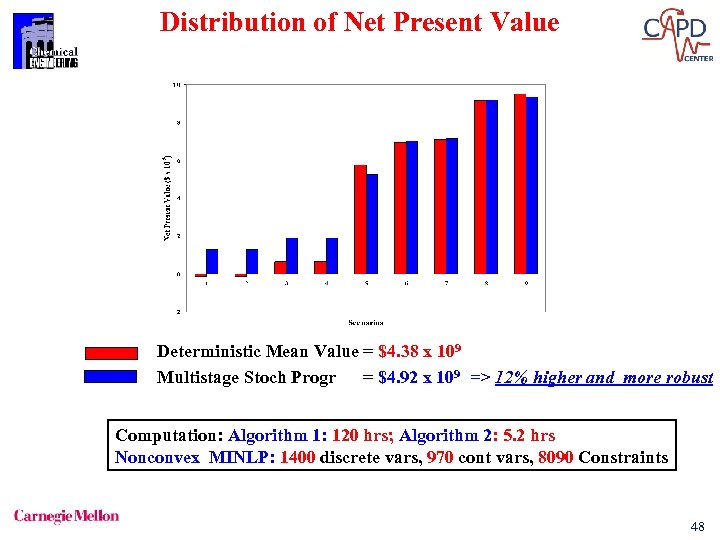 Distribution of Net Present Value Deterministic Mean Value = $4. 38 x 109 Multistage Stoch Progr = $4. 92 x 109 => 12% higher and more robust Computation: Algorithm 1: 120 hrs; Algorithm 2: 5. 2 hrs Nonconvex MINLP: 1400 discrete vars, 970 cont vars, 8090 Constraints 48
 Economics vs. performance? Multiobjective Optimization Approach 49
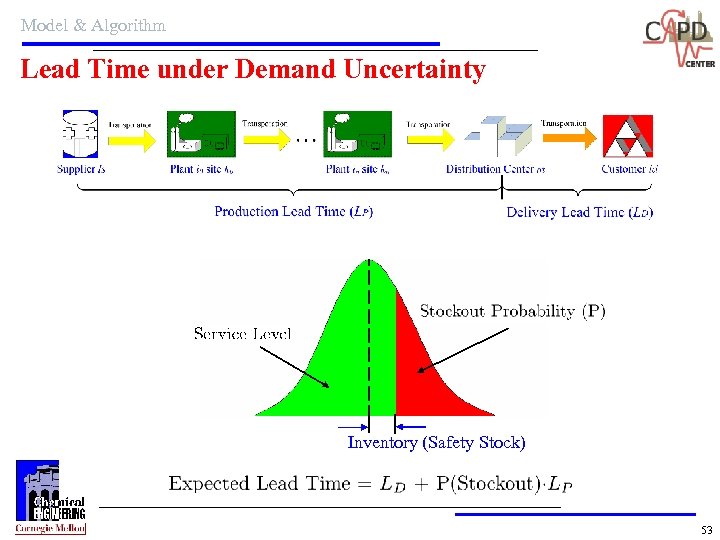
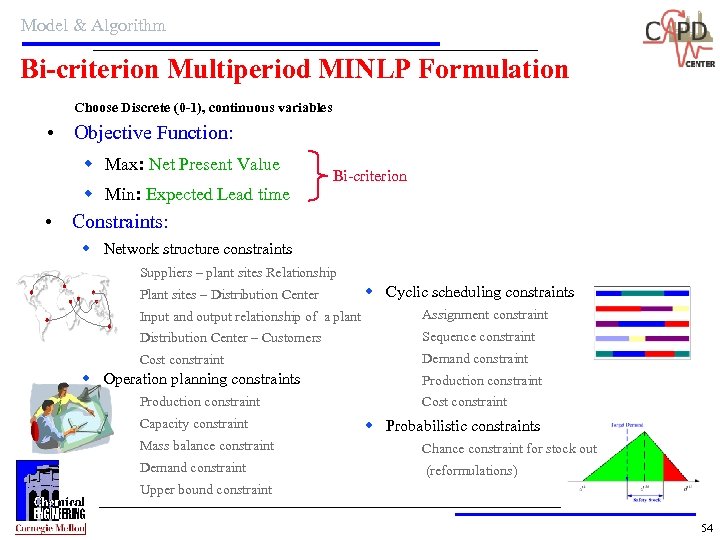
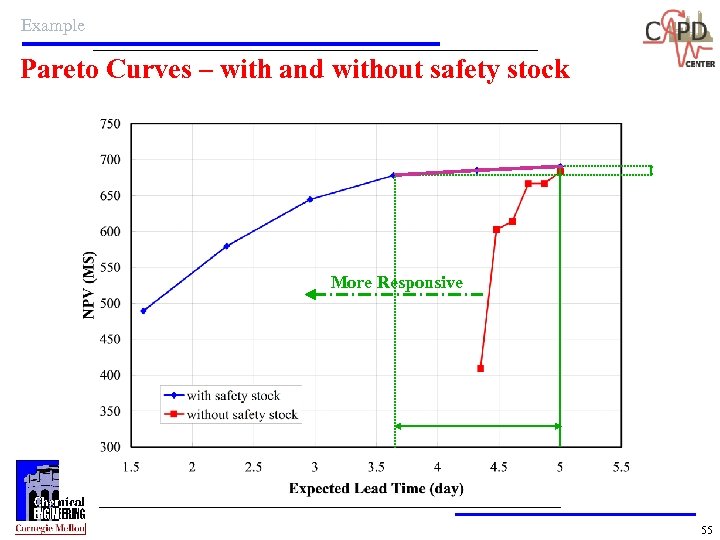
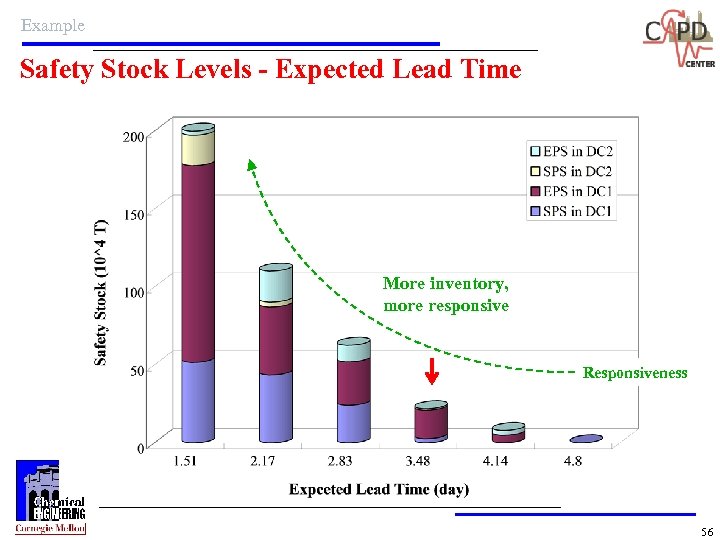
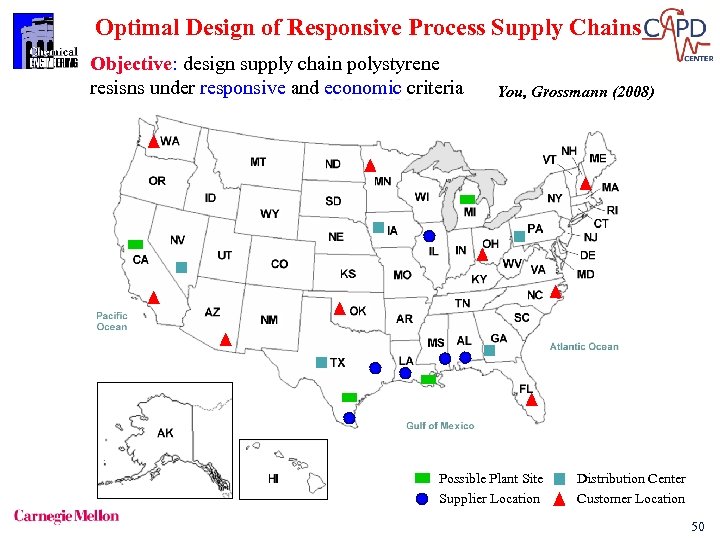 Optimal Design of Responsive Process Supply Chains Objective: design supply chain polystyrene resisns under responsive and economic criteria You, Grossmann (2008) Possible Plant Site Supplier Location Distribution Center Customer Location 50
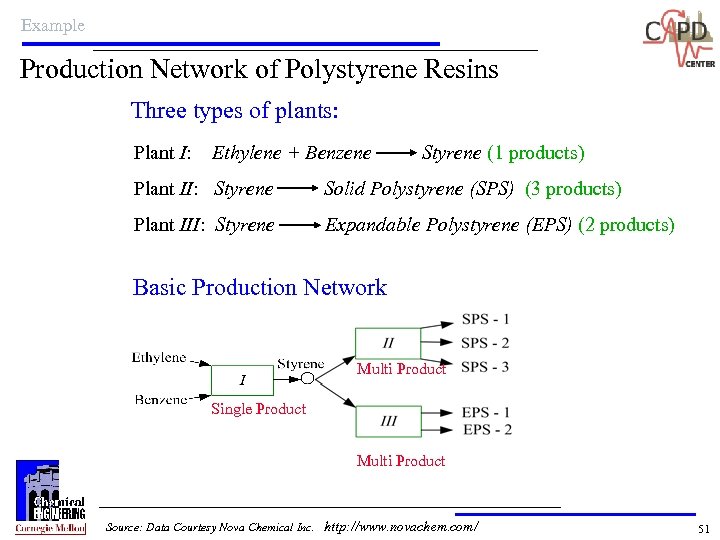 Example Production Network of Polystyrene Resins Three types of plants: Plant I: Ethylene + Benzene Styrene (1 products) Plant II: Styrene Solid Polystyrene (SPS) (3 products) Plant III: Styrene Expandable Polystyrene (EPS) (2 products) Basic Production Network Multi Product Single Product Multi Product Source: Data Courtesy Nova Chemical Inc. http: //www. novachem. com/ 51
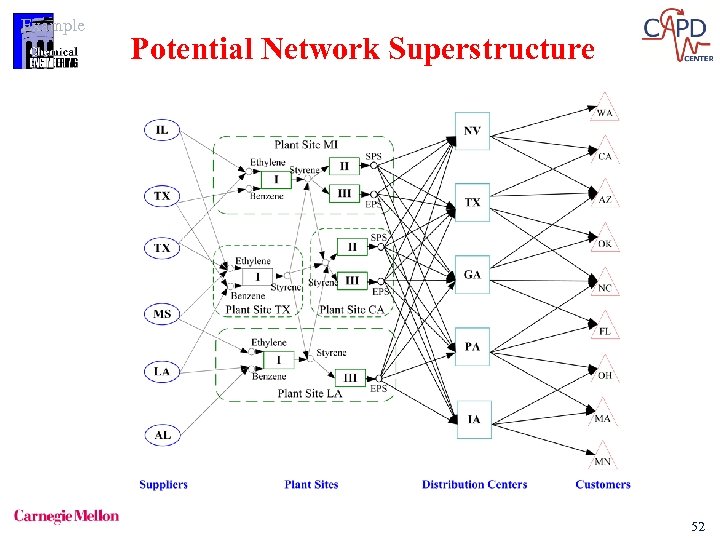 Example Potential Network Superstructure 52
 Model & Algorithm Lead Time under Demand Uncertainty Inventory (Safety Stock) 53
 Model & Algorithm Bi-criterion Multiperiod MINLP Formulation Choose Discrete (0 -1), continuous variables • Objective Function: w Max: Net Present Value w Min: Expected Lead time Bi-criterion • Constraints: w Network structure constraints Suppliers – plant sites Relationship Plant sites – Distribution Center w Cyclic scheduling constraints Input and output relationship of a plant Assignment constraint Distribution Center – Customers Sequence constraint Cost constraint Demand constraint w Operation planning constraints Production constraint Capacity constraint Production constraint Cost constraint w Probabilistic constraints Mass balance constraint Chance constraint for stock out Demand constraint (reformulations) Upper bound constraint 54
 Example Pareto Curves – with and without safety stock More Responsive 55
 Example Safety Stock Levels - Expected Lead Time More inventory, more responsive Responsiveness 56
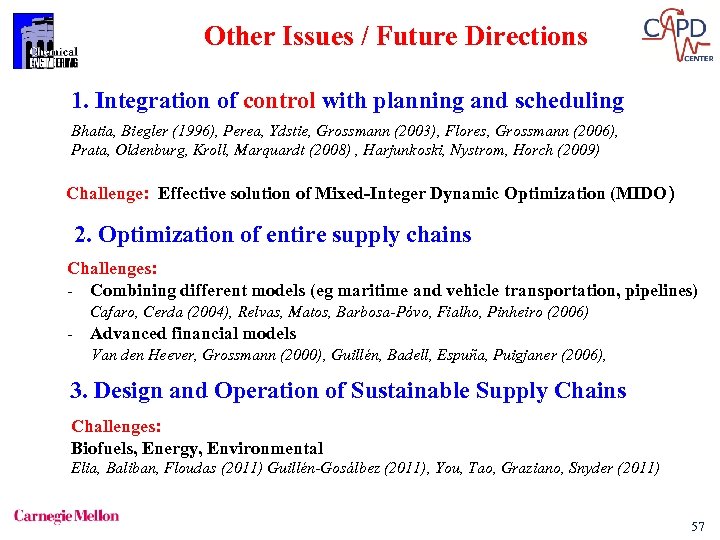 Other Issues / Future Directions 1. Integration of control with planning and scheduling Bhatia, Biegler (1996), Perea, Ydstie, Grossmann (2003), Flores, Grossmann (2006), Prata, Oldenburg, Kroll, Marquardt (2008) , Harjunkoski, Nystrom, Horch (2009) Challenge: Effective solution of Mixed-Integer Dynamic Optimization (MIDO) 2. Optimization of entire supply chains Challenges: - Combining different models (eg maritime and vehicle transportation, pipelines) Cafaro, Cerda (2004), Relvas, Matos, Barbosa-Póvo, Fialho, Pinheiro (2006) - Advanced financial models Van den Heever, Grossmann (2000), Guillén, Badell, Espuña, Puigjaner (2006), 3. Design and Operation of Sustainable Supply Chains Challenges: Biofuels, Energy, Environmental Elia, Baliban, Floudas (2011) Guillén-Gosálbez (2011), You, Tao, Graziano, Snyder (2011) 57
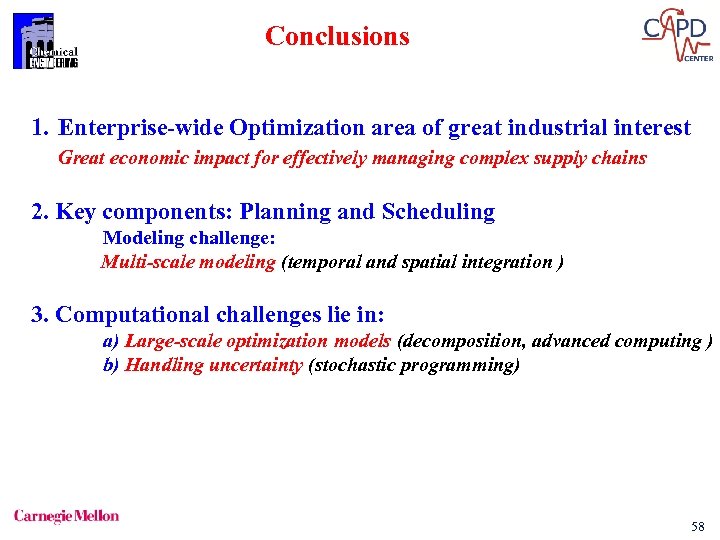 Conclusions 1. Enterprise-wide Optimization area of great industrial interest Great economic impact for effectively managing complex supply chains 2. Key components: Planning and Scheduling Modeling challenge: Multi-scale modeling (temporal and spatial integration ) 3. Computational challenges lie in: a) Large-scale optimization models (decomposition, advanced computing ) b) Handling uncertainty (stochastic programming) 58