


 Скачать презентацию Advances in Logical Programming Environments Stuart Allen Richard
cfaf7ee693ae1c4778bbb13374b74319.ppt
- Количество слайдов: 21

 Advances in Logical Programming Environments Stuart Allen Richard Eaton Mark Bickford Christoph Kreitz Programming Logic Communications Secure software infrastructure Robert Constable Lorigo
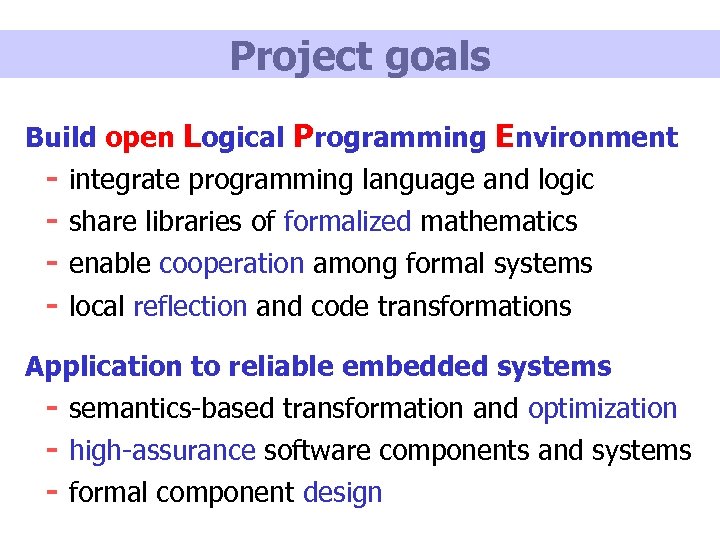 Project goals Build open Logical Programming Environment - integrate programming language and logic share libraries of formalized mathematics enable cooperation among formal systems local reflection and code transformations Application to reliable embedded systems - semantics-based transformation and optimization - high-assurance software components and systems - formal component design
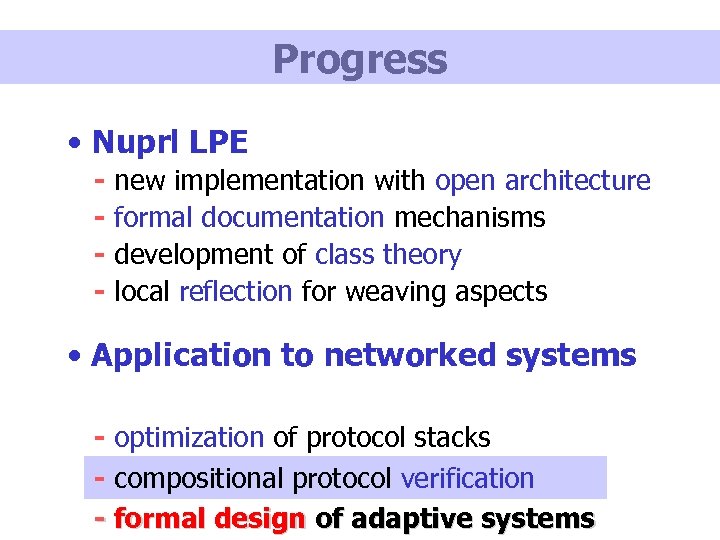 Progress • Nuprl LPE - new implementation with open architecture - formal documentation mechanisms - development of class theory - local reflection for weaving aspects • Application to networked systems - optimization of protocol stacks - compositional protocol verification - formal design of adaptive systems
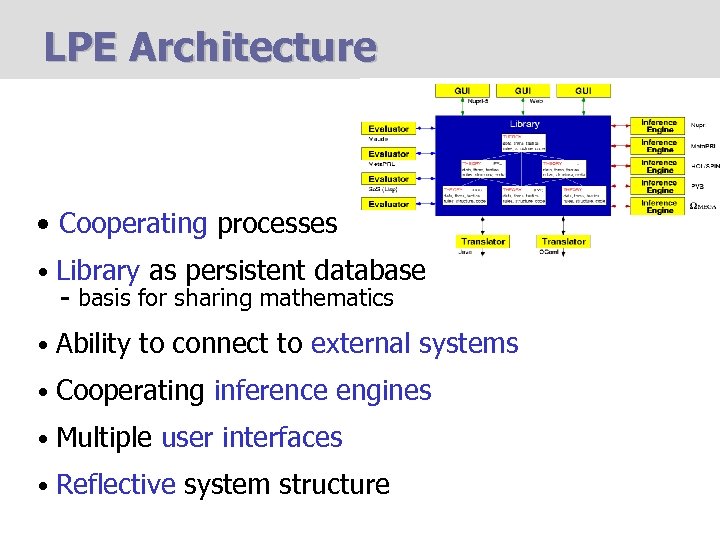 LPE Architecture • Cooperating processes • Library as persistent database - basis for sharing mathematics • Ability to connect to external systems • Cooperating inference engines • Multiple user interfaces • Reflective system structure
 Formal Documentation • Create documentation from formal objects - formal design expertise in “readable” form - screen display, La. Te. X articles, HTML documents • Comments contain references to objects - formal content browsable while reading text • Display objects determine term presentation - print representation (screen/La. Te. X macros) - suppressing formal parameters - preferences vs. parentheses
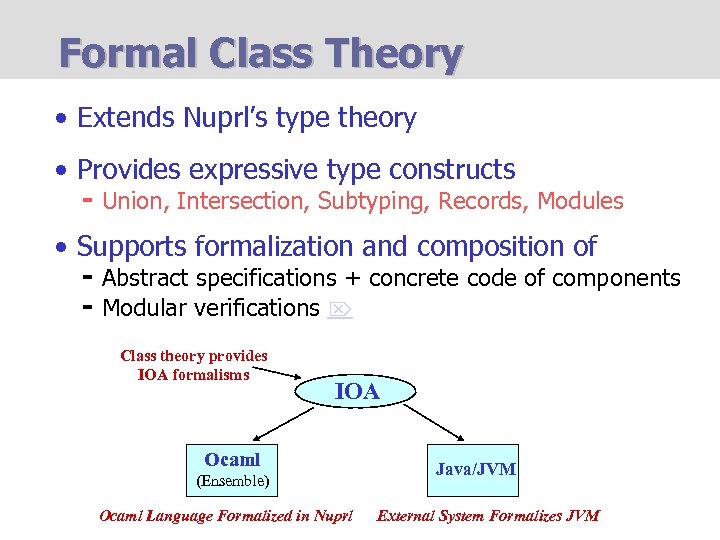 Formal Class Theory • Extends Nuprl’s type theory • Provides expressive type constructs - Union, Intersection, Subtyping, Records, Modules • Supports formalization and composition of - Abstract specifications + concrete code of components - Modular verifications Class theory provides IOA formalisms IOA Ocaml (Ensemble) Ocaml Language Formalized in Nuprl Java/JVM External System Formalizes JVM
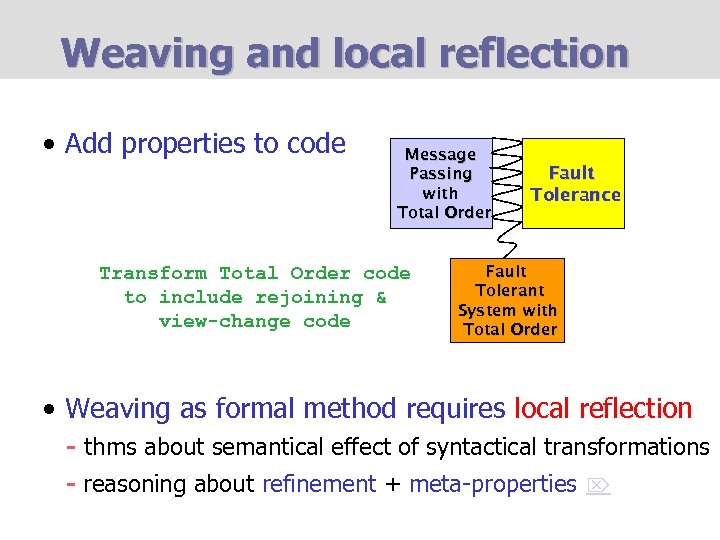 Weaving and local reflection • Add properties to code Message Passing with Total Order Transform Total Order code to include rejoining & view-change code Fault Tolerance Fault Tolerant System with Total Order • Weaving as formal method requires local reflection - thms about semantical effect of syntactical transformations - reasoning about refinement + meta-properties
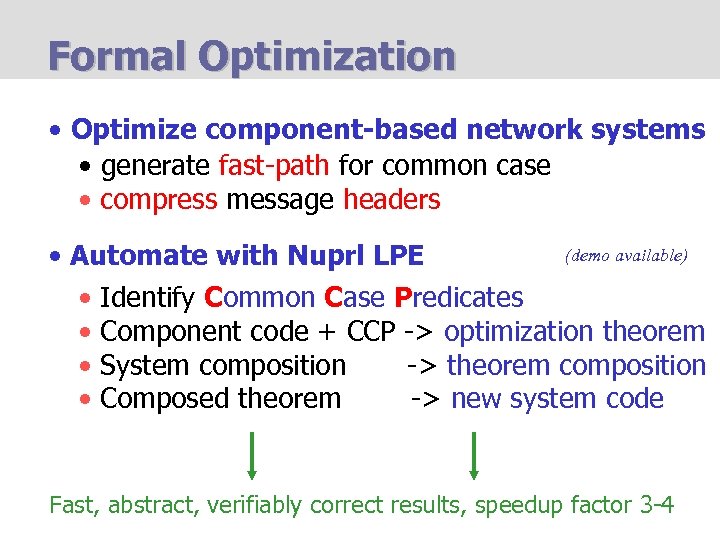 Formal Optimization • Optimize component-based network systems • generate fast-path for common case • compress message headers (demo available) • Automate with Nuprl LPE • Identify Common Case Predicates • Component code + CCP -> optimization theorem • System composition -> theorem composition • Composed theorem -> new system code Fast, abstract, verifiably correct results, speedup factor 3 -4
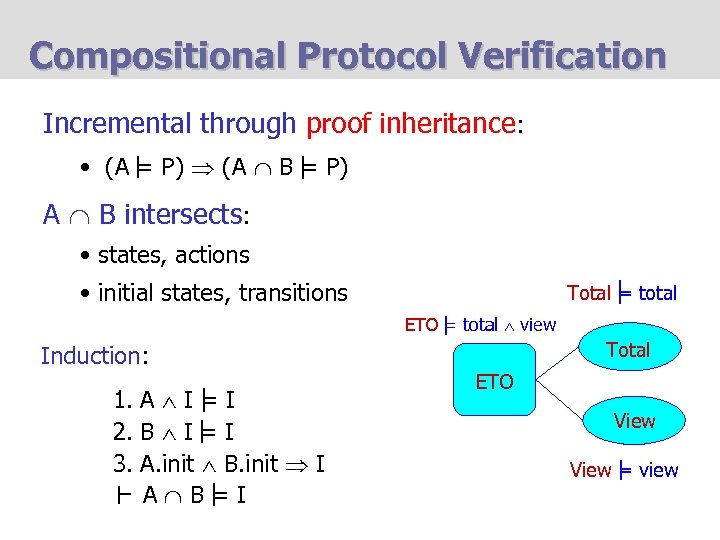 Compositional Protocol Verification Incremental through proof inheritance: • (A = P) (A B = P) A B intersects: • states, actions • initial states, transitions Total = total ETO = total view Induction: 1. A I = I 2. B I = I 3. A. init B. init I A B=I Total ETO View = view
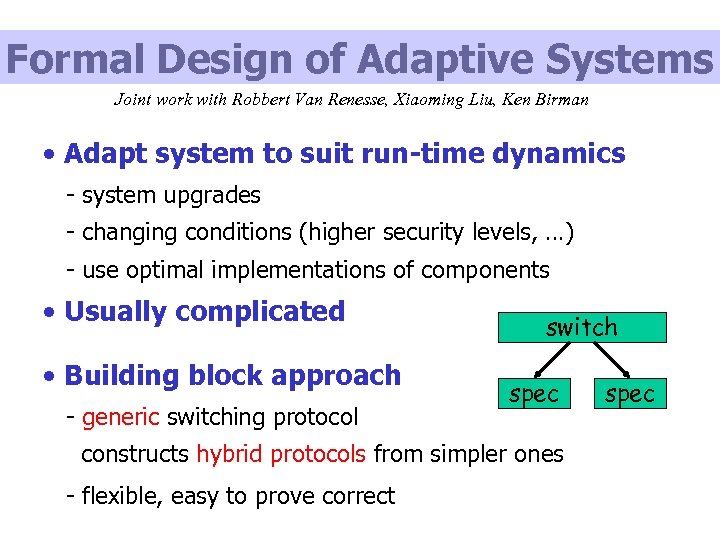 Formal Design of Adaptive Systems Joint work with Robbert Van Renesse, Xiaoming Liu, Ken Birman • Adapt system to suit run-time dynamics - system upgrades - changing conditions (higher security levels, …) - use optimal implementations of components • Usually complicated • Building block approach - generic switching protocol switch spec constructs hybrid protocols from simpler ones - flexible, easy to prove correct spec
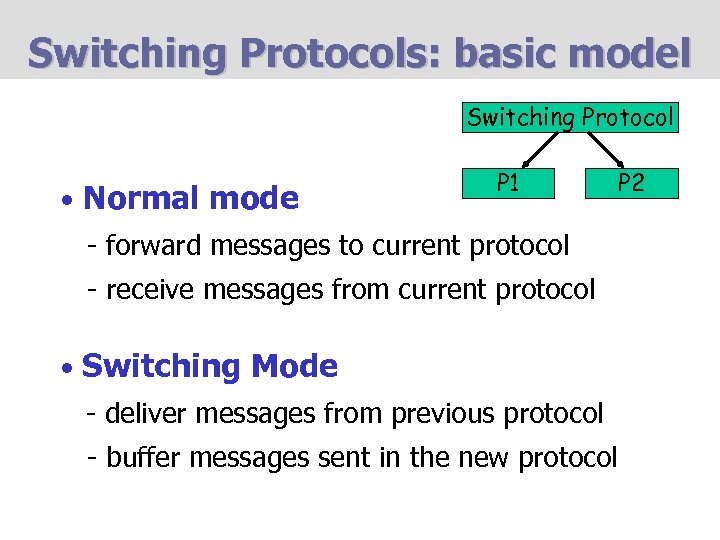 Switching Protocols: basic model Switching Protocol • Normal mode P 1 - forward messages to current protocol - receive messages from current protocol • Switching Mode - deliver messages from previous protocol - buffer messages sent in the new protocol P 2
 What kind of properties will be preserved by switching? Reliability? Integrity? Confidentiality? Prioritized Delivery? Total Order? Virtual Synchrony? In other words, what are the metaproperties of these properties ? Inject formal methods at earliest design stage
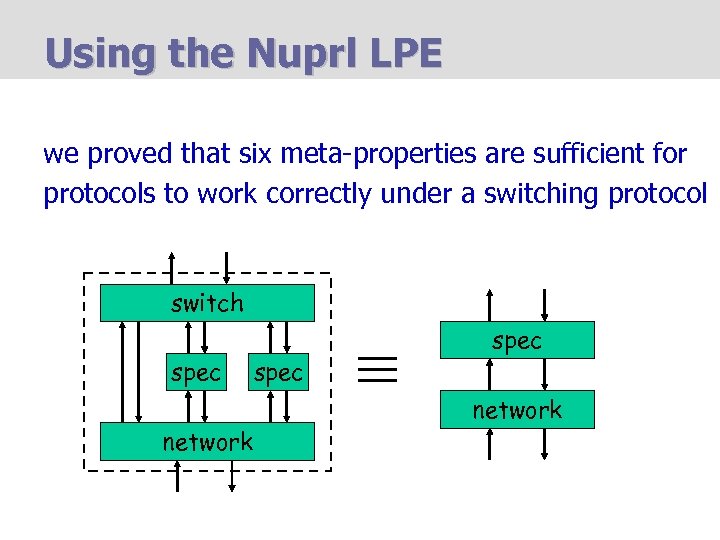 Using the Nuprl LPE we proved that six meta-properties are sufficient for protocols to work correctly under a switching protocol switch spec network
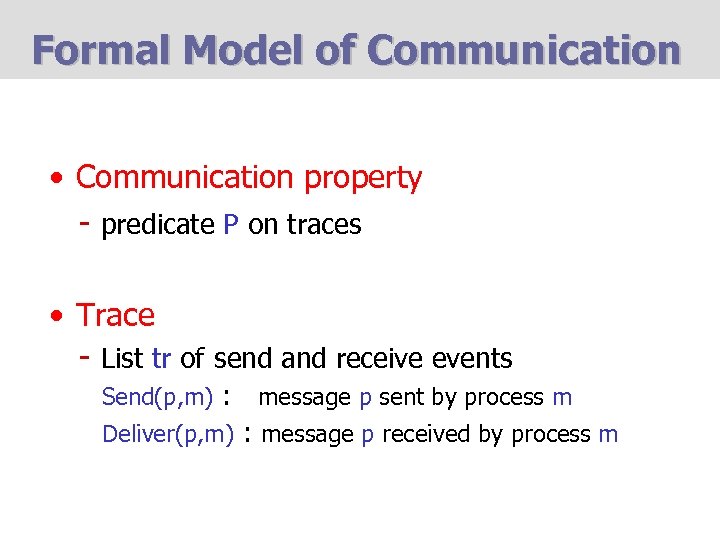 Formal Model of Communication • Communication property - predicate P on traces • Trace - List tr of send and receive events Send(p, m) : message p sent by process m Deliver(p, m) : message p received by process m
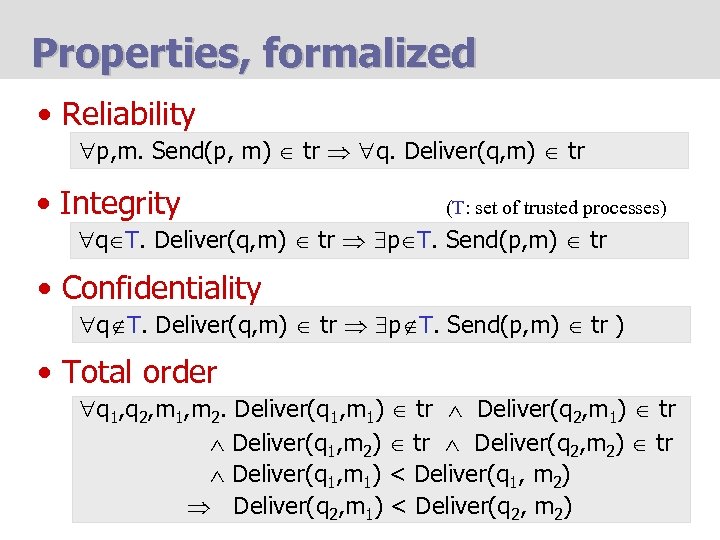 Properties, formalized • Reliability p, m. Send(p, m) tr q. Deliver(q, m) tr • Integrity (T: set of trusted processes) q T. Deliver(q, m) tr p T. Send(p, m) tr • Confidentiality q T. Deliver(q, m) tr p T. Send(p, m) tr ) • Total order q 1, q 2, m 1, m 2. Deliver(q 1, m 1) tr Deliver(q 2, m 1) tr Deliver(q 1, m 2) tr Deliver(q 2, m 2) tr Deliver(q 1, m 1) < Deliver(q 1, m 2) Deliver(q 2, m 1) < Deliver(q 2, m 2)
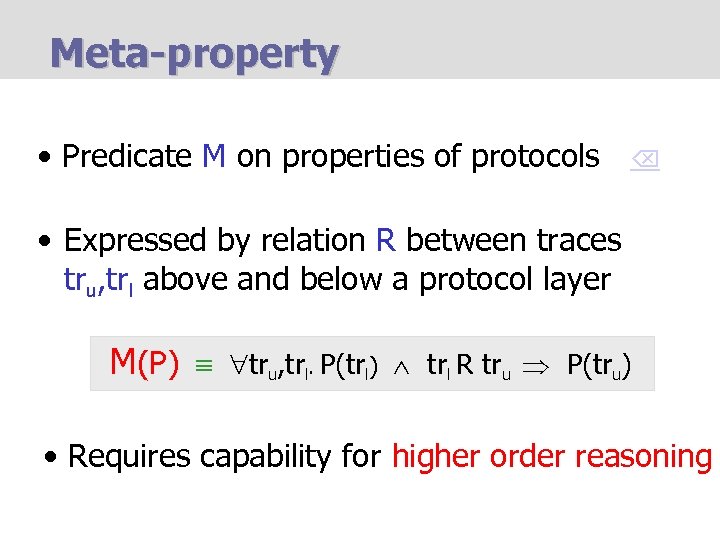 Meta-property • Predicate M on properties of protocols • Expressed by relation R between traces tru, trl above and below a protocol layer M(P) tru, trl. P(trl) trl R tru P(tru) • Requires capability for higher order reasoning
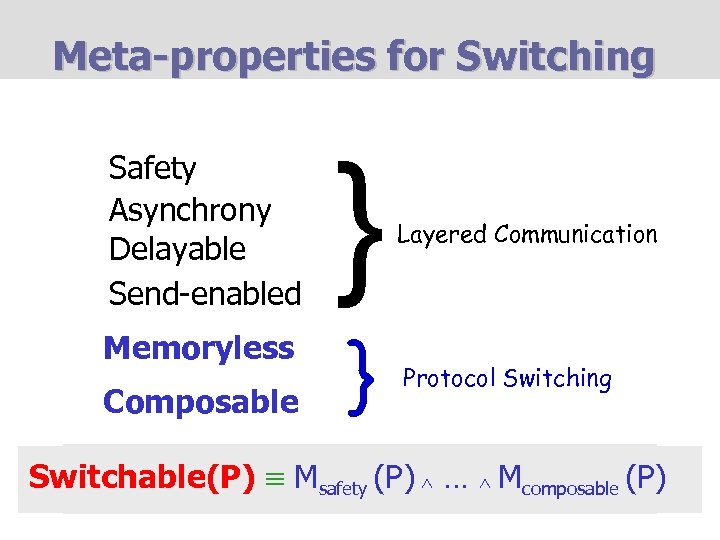 Meta-properties for Switching Safety Asynchrony Delayable Send-enabled } Memoryless } Composable Layered Communication Protocol Switching RRasync(tr , tr ) ) ) = tr = [Send(p, trtr ) for ee, e 2 with ) )]… R swap-adjacent(trmsg(e) {m , tr , , m delay (tr , tr l u RRsend-e (tru u, trll)l)l 1, tr. Rsafety (trlu trtr=[] |interleave(tr 1 u, e 2 l 1 with(P) (tru , l 2 swap-adjacent(trll , mu 1), . . , Send(pntrln}] , tr tr trul 1 @ l) l - [etr … for 1 1, . . , m 2 n tr , tr 2 (P) 1, tr)u M composable u memoryless Switchable(P) process(e ) )process(e )composable ) Msafety e 1=Send(p, m 1 e 2 = Deliver(p, m 2 1 2
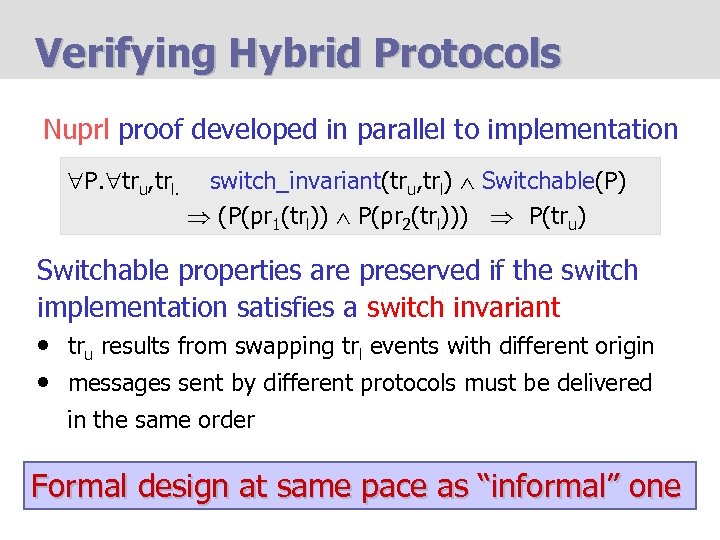 Verifying Hybrid Protocols Nuprl proof developed in parallel to implementation P. tru, trl. switch_invariant(tru, trl) Switchable(P) (P(pr 1(trl)) P(pr 2(trl))) P(tru) Switchable properties are preserved if the switch implementation satisfies a switch invariant • tru results from swapping trl events with different origin • messages sent by different protocols must be delivered in the same order Formal design at same pace as “informal” one
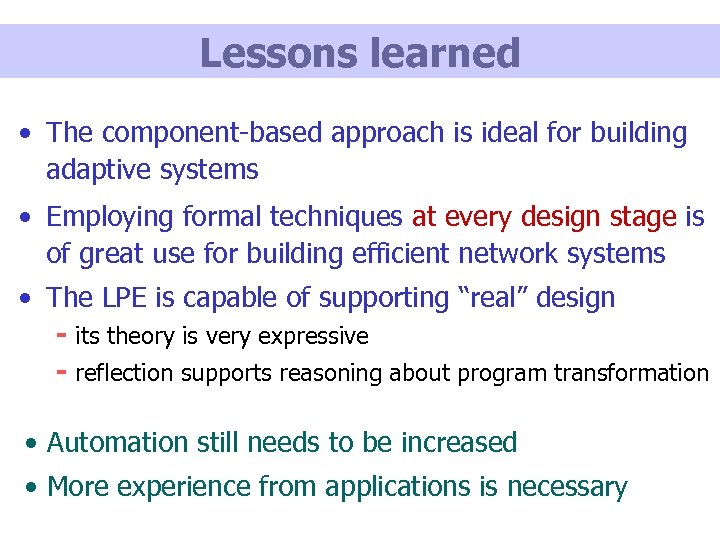 Lessons learned • The component-based approach is ideal for building adaptive systems • Employing formal techniques at every design stage is of great use for building efficient network systems • The LPE is capable of supporting “real” design - its theory is very expressive - reflection supports reasoning about program transformation • Automation still needs to be increased • More experience from applications is necessary
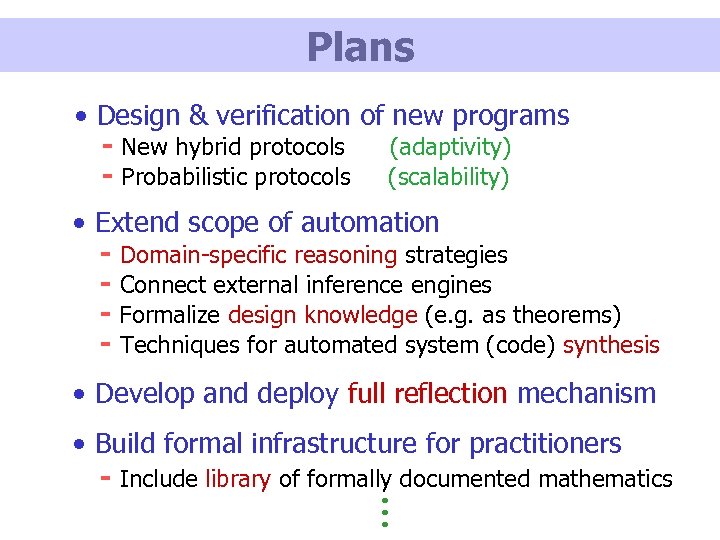 Plans • Design & verification of new programs - New hybrid protocols (adaptivity) - Probabilistic protocols (scalability) • Extend scope of automation - Domain-specific reasoning strategies - Connect external inference engines - Formalize design knowledge (e. g. as theorems) - Techniques for automated system (code) synthesis • Develop and deploy full reflection mechanism • Build formal infrastructure for practitioners - Include library of formally documented mathematics