


 Скачать презентацию Advances in Designing Clockless Digital Systems Prof Steven
5abe926d239e4d66e15c9cd737e4a603.ppt
- Количество слайдов: 29
 Advances in Designing Clockless Digital Systems Prof. Steven M. Nowick nowick@cs. columbia. edu Department of Computer Science Columbia University New York, NY, USA
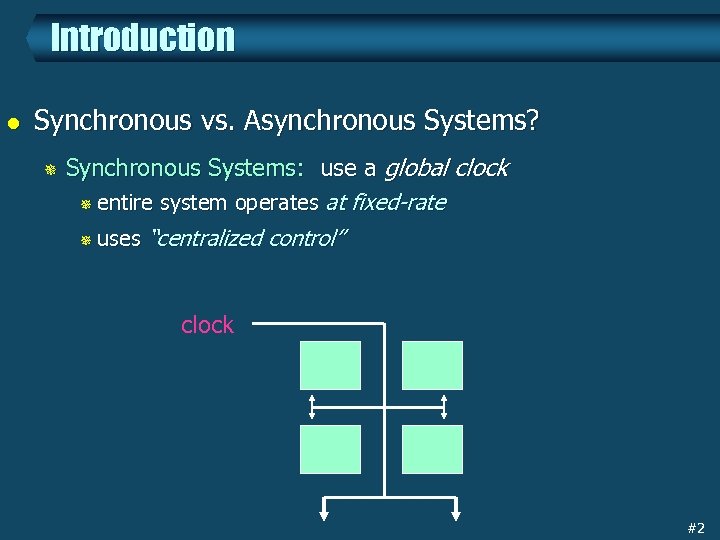 Introduction l Synchronous vs. Asynchronous Systems? ¯ Synchronous Systems: use a global clock ¯ entire system operates at fixed-rate ¯ uses “centralized control” clock #2
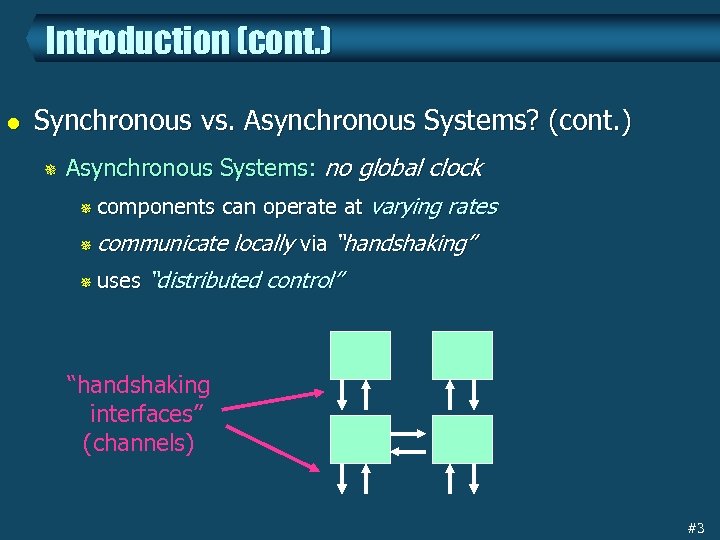 Introduction (cont. ) l Synchronous vs. Asynchronous Systems? (cont. ) ¯ Asynchronous Systems: no global clock ¯ components can operate at varying rates ¯ communicate ¯ uses locally via “handshaking” “distributed control” “handshaking interfaces” (channels) #3
 Trends and Challenges Trends in Chip Design: next decade ¯ “Semiconductor Industry Association (SIA) Roadmap” (97 -8) Unprecedented Challenges: ¯ complexity and scale (= size of systems) ¯ clock speeds ¯ power management ¯ reusability & scalability ¯ “time-to-market” Design becoming unmanageable using a centralized single clock (synchronous) approach…. #4
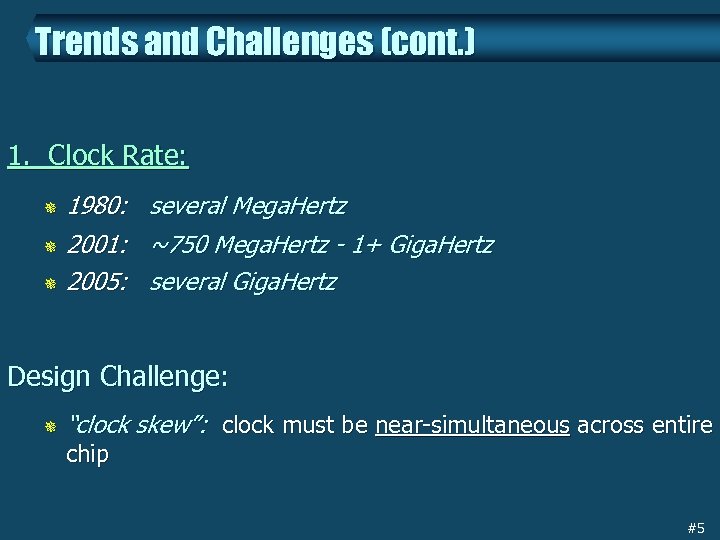 Trends and Challenges (cont. ) 1. Clock Rate: 1980: several Mega. Hertz ¯ 2001: ~750 Mega. Hertz - 1+ Giga. Hertz ¯ 2005: several Giga. Hertz ¯ Design Challenge: ¯ “clock skew”: clock must be near-simultaneous across entire chip #5
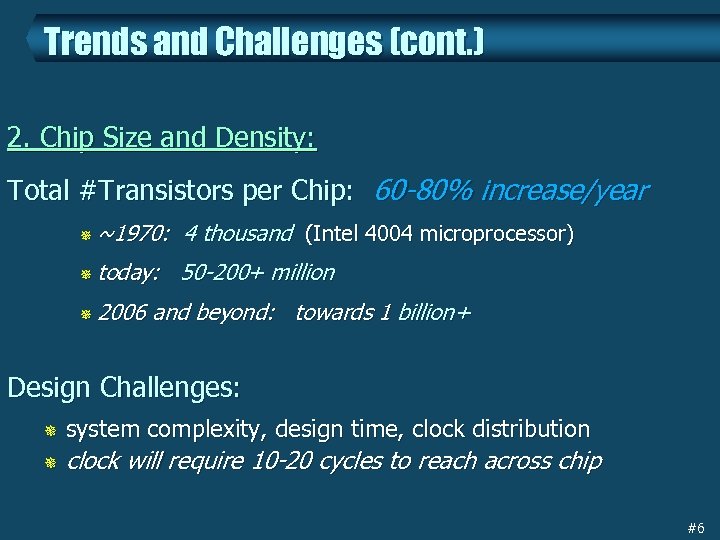 Trends and Challenges (cont. ) 2. Chip Size and Density: Total #Transistors per Chip: 60 -80% increase/year ¯ ~1970: 4 thousand (Intel 4004 microprocessor) ¯ today: 50 -200+ million ¯ 2006 and beyond: towards 1 billion+ Design Challenges: ¯ system complexity, design time, clock distribution ¯ clock will require 10 -20 cycles to reach across chip #6
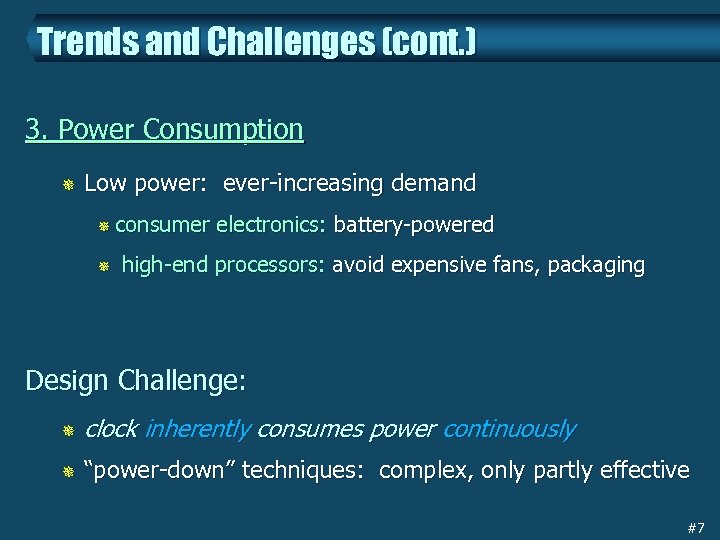 Trends and Challenges (cont. ) 3. Power Consumption ¯ Low power: ever-increasing demand ¯ consumer ¯ electronics: battery-powered high-end processors: avoid expensive fans, packaging Design Challenge: ¯ clock inherently consumes power continuously ¯ “power-down” techniques: complex, only partly effective #7
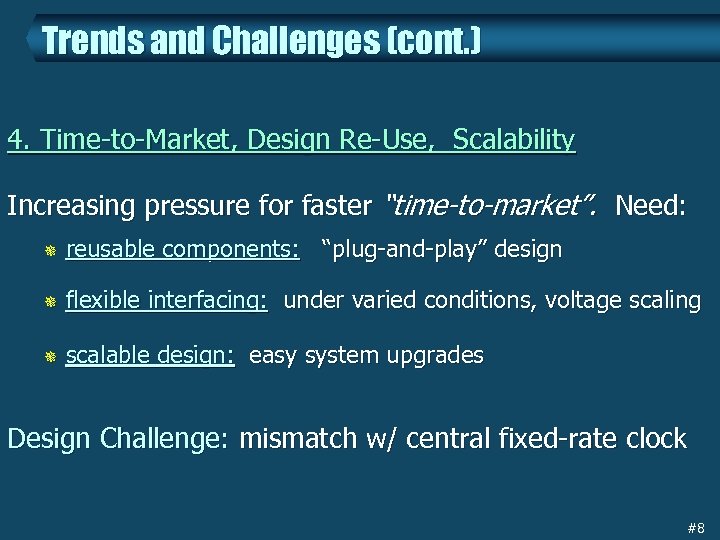 Trends and Challenges (cont. ) 4. Time-to-Market, Design Re-Use, Scalability Increasing pressure for faster “time-to-market”. Need: ¯ reusable components: “plug-and-play” design ¯ flexible interfacing: under varied conditions, voltage scaling ¯ scalable design: easy system upgrades Design Challenge: mismatch w/ central fixed-rate clock #8
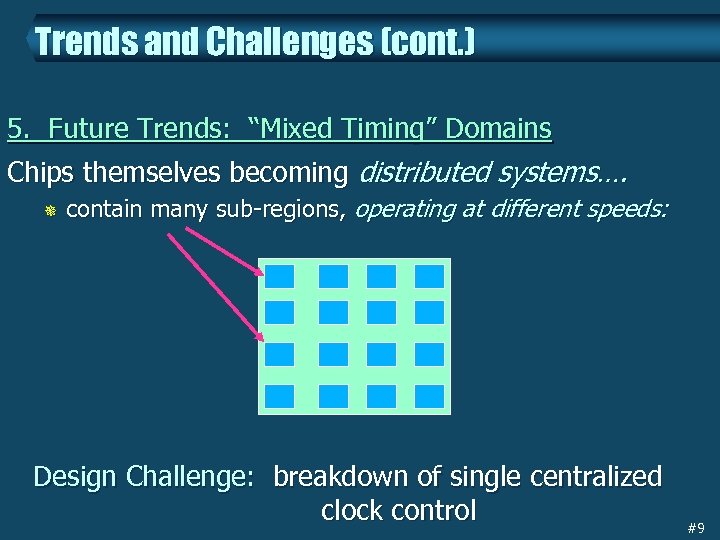 Trends and Challenges (cont. ) 5. Future Trends: “Mixed Timing” Domains Chips themselves becoming distributed systems…. ¯ contain many sub-regions, operating at different speeds: Design Challenge: breakdown of single centralized clock control #9
 Asynchronous Design: Potential Advantages Several Potential Advantages: ¯ Lower Power ¯ no clock components use power only “on demand” ¯ Robustness, Scalability ¯ no global timing “mix-and-match” variable-speed components ¯ composable/modular ¯ design style “object-oriented” Higher Performance ¯ systems not limited to “worst-case” clock rate #10
 Asynchronous Design: Some Recent Developments 1. Philips Semiconductors: ¯ ¯ commercial use: 100 million async chips for consumer electronics: pagers, cell phones, smart cards, digital passports, automotive 3 -4 x lower power, less electromagnetic interference (“EMI”) 2. Intel: ¯ ¯ experimental: Pentium instruction-length decoder = “RAPPID” (1990’s) 3 -4 x faster than synchronous subsystem 3. Sun Labs: ¯ commercial use: high-speed FIFO’s in recent “Ultra’s” (memory access) 4. IBM Research: ¯ experimental: high-speed pipelines, filters, mixed-timing systems Recent Startups: Fulcrum, Theseus Logic, Handshake Solutions, Silistrix #11
 Asynchronous CAD Tools: Recent Developments DARPA’s “CLASS” Program: Clockless Initiative (2003 -07) Goals: - CAD tool: produce viable commercial-grade async tool flow - demonstration: a complex Boeing ASIC chip Participants: ¯ ¯ ¯ Lead (PI): Boeing Industrial participants: ¯ Philips (via async incubated startup, “Handshake Solutions”) ¯ Theseus Logic, Codetronix Academic participants: ¯ Columbia, UNC, UW, Yale, OSU Targets: cover wide “design space” – very robust to high-speed circuits Columbia’s role: (i) high-speed pipelines, (ii) CAD optimizations #12
 Asynchronous Design: Challenges l Critical Design Issues: ¯ ¯ l components must communicate cleanly: ‘hazard-free’ design highly-concurrent designs: much harder to verify! Lack of Automated “Computer-Aided Design” Tools: ¯ most commercial “CAD” tools targeted to synchronous #13
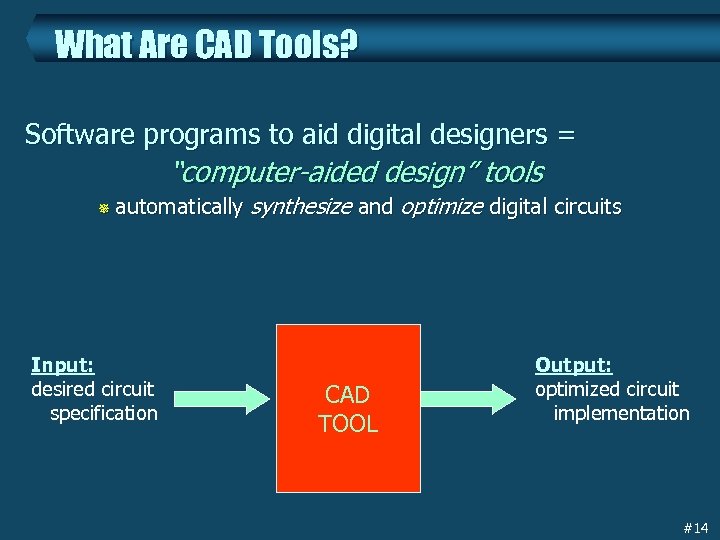 What Are CAD Tools? Software programs to aid digital designers = “computer-aided design” tools ¯ automatically Input: desired circuit specification synthesize and optimize digital circuits CAD TOOL Output: optimized circuit implementation #14
 Asynchronous Design Challenge Lack of Existing Asynchronous Design Tools: ¯ Most commercial “CAD” tools targeted to synchronous ¯ Synchronous CAD tools: ¯ major ¯ drivers of growth in microelectronics industry Asynchronous “chicken-and-egg” problem: ¯ few CAD tools less commercial use of async design ¯ especially lacking: tools for designing/optmzng. large systems #15
 Overview: My Research Areas l CAD Tools for Asynchronous Controllers (FSM’s) ¯ l “MINIMALIST” Package: for synthesis + optimization Other Research Areas: ¯ CAD Tools for Designing Large-Scale Async Systems ¯ Mixed-Timing Interface Circuits: ¯ for ¯ interfacing sync/async systems High-Speed Asynchronous Pipelines #16
![CAD Tools for Async Controllers MINIMALIST: developed at Columbia University [1994 -] ¯ ¯](https://present5.com/presentation/5abe926d239e4d66e15c9cd737e4a603/image-17.jpg "CAD Tools for Async Controllers MINIMALIST: developed at Columbia University [1994 -] ¯ ¯") CAD Tools for Async Controllers MINIMALIST: developed at Columbia University [1994 -] ¯ ¯ extensible CAD package for synthesis of asynchronous controllers integrates synthesis, optimization and verification tools used in 80+ sites/17+ countries (being taught in IIT Bombay) URL: http: //www. cs. columbia. edu/async Includes several optimization tools: ¯ ¯ State Minimization CHASM: optimal state encoding 2 -Level Hazard-Free Logic Minimization Verilog back-end Key goal: facilitate design-space exploration #17
CAD Tools for Async Controllers MINIMALIST: developed at Columbia University [1994 -] ¯ ¯ extensible CAD package for synthesis of asynchronous controllers integrates synthesis, optimization and verification tools used in 80+ sites/17+ countries (being taught in IIT Bombay) URL: http: //www. cs. columbia. edu/async Includes several optimization tools: ¯ ¯ State Minimization CHASM: optimal state encoding 2 -Level Hazard-Free Logic Minimization Verilog back-end Key goal: facilitate design-space exploration #17
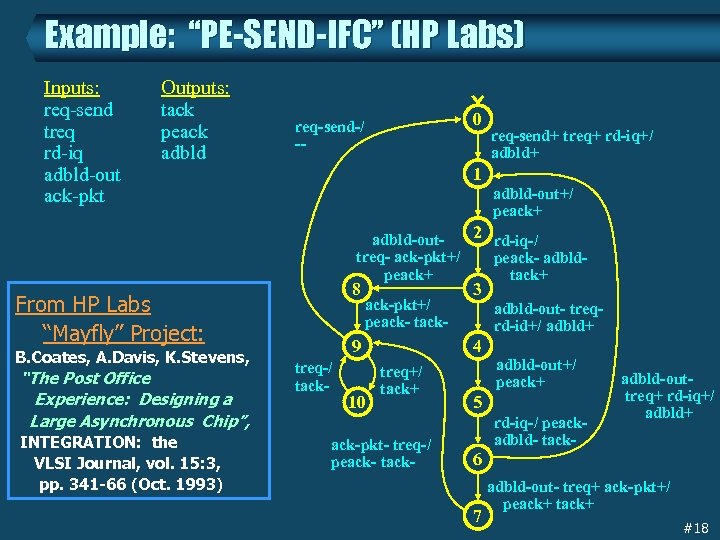 Example: “PE-SEND-IFC” (HP Labs) Inputs: req-send treq rd-iq adbld-out ack-pkt Outputs: tack peack adbld 0 req-send-/ -- req-send+ treq+ rd-iq+/ adbld+ 1 adbld-out+/ peack+ 2 rd-iq-/ adbld-outtreq- ack-pkt+/ peack- adbldpeack+ tack+ 8 From HP Labs “Mayfly” Project: B. Coates, A. Davis, K. Stevens, “The Post Office Experience: Designing a Large Asynchronous Chip”, INTEGRATION: the VLSI Journal, vol. 15: 3, pp. 341 -66 (Oct. 1993) ack-pkt+/ peack- tack- 9 treq-/ tack- 10 3 adbld-out- treqrd-id+/ adbld+ 4 treq+/ tack+ ack-pkt- treq-/ peack- tack- adbld-out+/ peack+ 5 rd-iq-/ peackadbld- tack- adbld-outtreq+ rd-iq+/ adbld+ 6 7 adbld-out- treq+ ack-pkt+/ peack+ tack+ #18
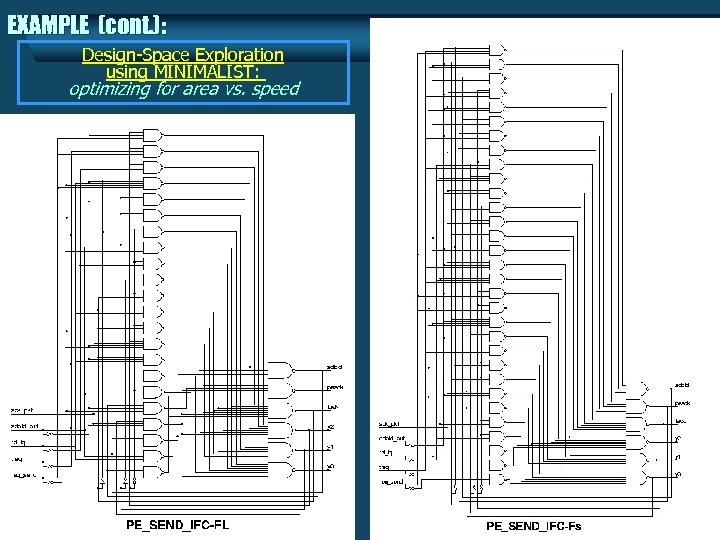 EXAMPLE (cont. ): Design-Space Exploration using MINIMALIST: optimizing for area vs. speed Examples: #19
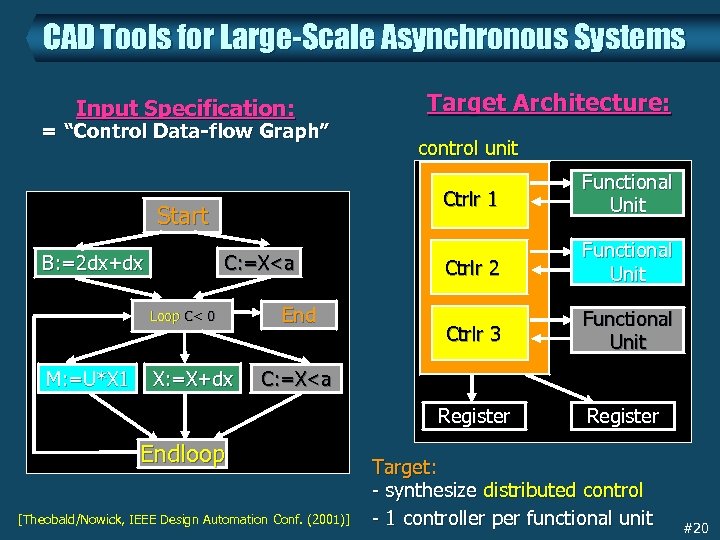 CAD Tools for Large-Scale Asynchronous Systems Input Specification: = “Control Data-flow Graph” Target Architecture: control unit Ctrlr 1 C: =X
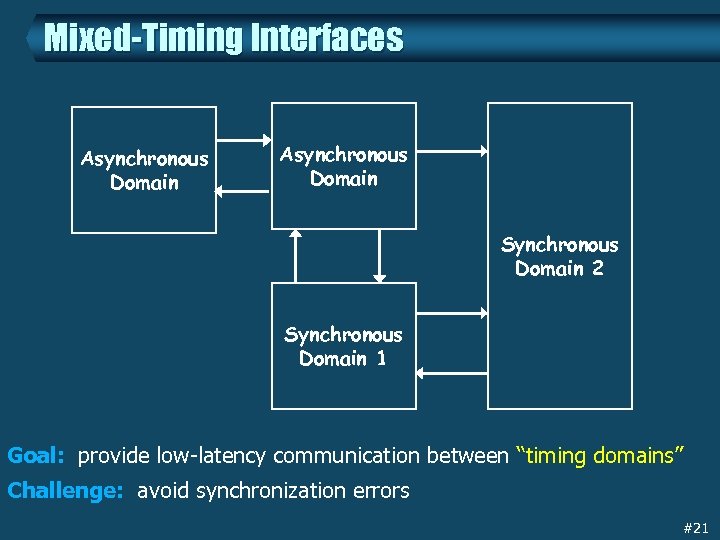 Mixed-Timing Interfaces Asynchronous Domain Synchronous Domain 2 Synchronous Domain 1 Goal: provide low-latency communication between “timing domains” Challenge: avoid synchronization errors #21
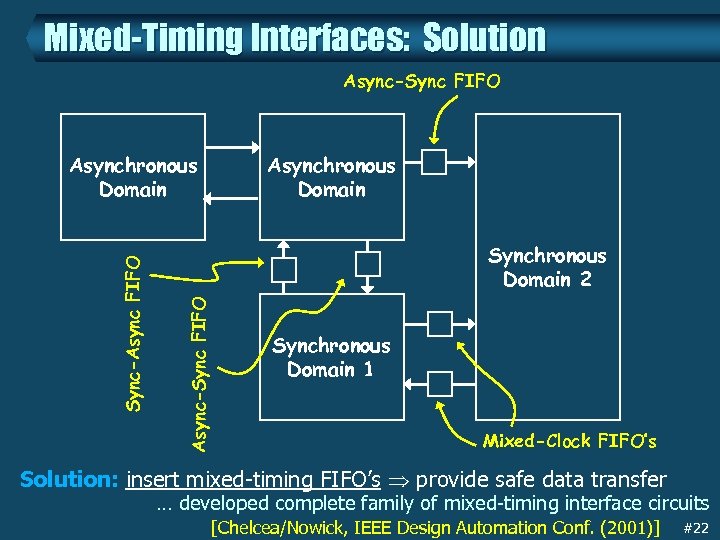 Mixed-Timing Interfaces: Solution Async-Sync FIFO Asynchronous Domain Synchronous Domain 2 Async-Sync FIFO Sync-Async FIFO Asynchronous Domain Synchronous Domain 1 Mixed-Clock FIFO’s Solution: insert mixed-timing FIFO’s provide safe data transfer … developed complete family of mixed-timing interface circuits [Chelcea/Nowick, IEEE Design Automation Conf. (2001)] #22
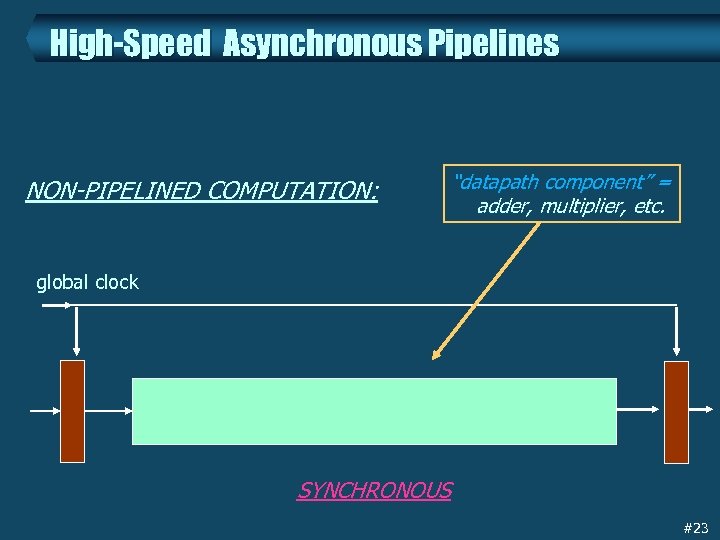 High-Speed Asynchronous Pipelines NON-PIPELINED COMPUTATION: “datapath component” = adder, multiplier, etc. global clock SYNCHRONOUS #23
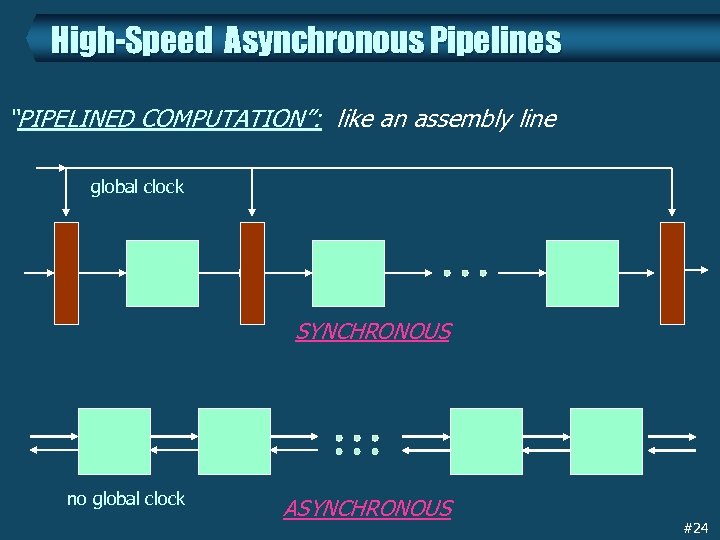 High-Speed Asynchronous Pipelines “PIPELINED COMPUTATION”: like an assembly line global clock SYNCHRONOUS no global clock ASYNCHRONOUS #24
 High-Speed Asynchronous Pipelines Goal: extremely fast async datapath components ¯ speed: comparable to fastest existing synchronous designs ¯ additional benefits: ¯ dynamically adapt to variable-speed interfaces: voltage scaling! ¯ “elastic” processing of data in pipeline ¯ no clock distribution Contributions: 3 new async pipeline styles ¯ ¯ MOUSETRAP: High-Capacity/Lookahead: [SINGH/NOWICK] static logic dynamic logic Obtain multi-Giga. Hertz speeds Used by IBM, currently incorporated into Philips tool flow #25
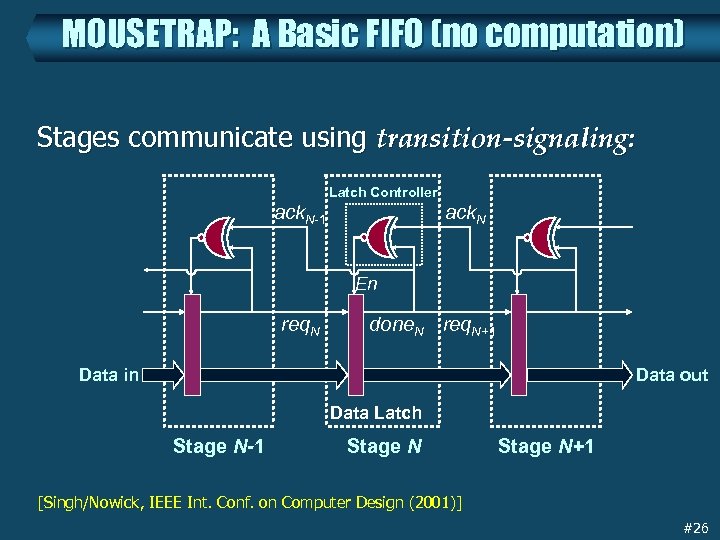 MOUSETRAP: A Basic FIFO (no computation) Stages communicate using transition-signaling: Latch Controller ack. N-1 ack. N En req. N done. N req. N+1 Data in Data out Data Latch Stage N-1 Stage N+1 [Singh/Nowick, IEEE Int. Conf. on Computer Design (2001)] #26
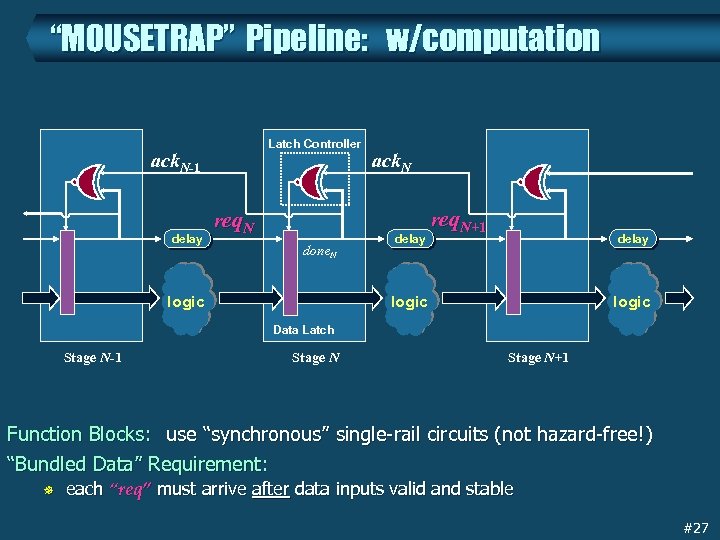 “MOUSETRAP” Pipeline: w/computation Latch Controller ack. N-1 delay req. N done. N logic ack. N delay req. N+1 delay logic Data Latch Stage N-1 Stage N+1 Function Blocks: use “synchronous” single-rail circuits (not hazard-free!) “Bundled Data” Requirement: ¯ each “req” must arrive after data inputs valid and stable #27
 #28
#28
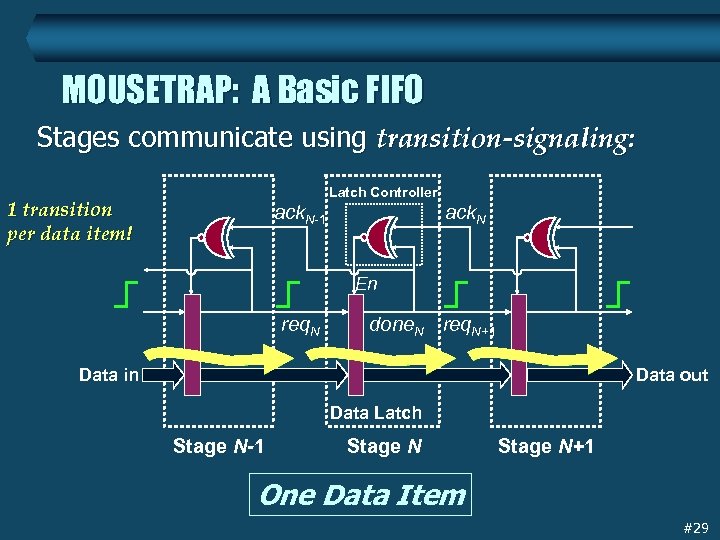 MOUSETRAP: A Basic FIFO Stages communicate using transition-signaling: Latch Controller 1 transition per data item! ack. N-1 ack. N En req. N done. N req. N+1 Data in Data out Data Latch Stage N-1 Stage N+1 One Data Item #29