


 Скачать презентацию Advanced Variance Reduction Strategies for Optimizing Mesh Tallies
acc41dea7bdd1c75188af96585b81294.ppt
- Количество слайдов: 33
 Advanced Variance Reduction Strategies for Optimizing Mesh Tallies in MAVRIC Douglas E. Peplow, Edward D. Blakeman, and John C. Wagner Nuclear Science and Technology Division Oak Ridge National Laboratory Session: The SCALE Code System American Nuclear Society Winter Meeting November 14, 2007 Washington, DC
 Problem · Analog Monte Carlo tallies tend to have uncertainties inversely proportional to flux - Low flux areas hardest to converge - Computation time is controlled by worst uncertainty · Biasing (typically weight windows) helps move particles to areas of interest - Spend more time on “important” particles - Sacrifice results in unimportant areas · Mesh tallies are used to get answers everywhere - Wide range in relative uncertainties between voxels OAK RIDGE NATIONAL LABORATORY U. S. DEPARTMENT OF ENERGY 2
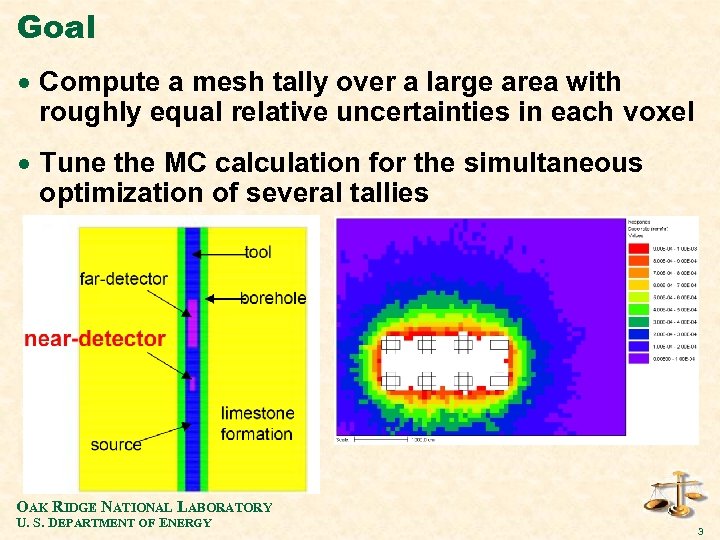 Goal · Compute a mesh tally over a large area with roughly equal relative uncertainties in each voxel · Tune the MC calculation for the simultaneous optimization of several tallies OAK RIDGE NATIONAL LABORATORY U. S. DEPARTMENT OF ENERGY 3
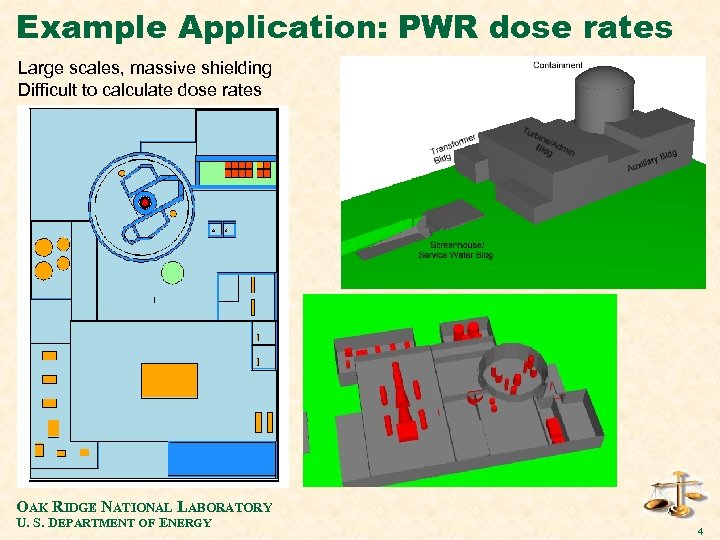 Example Application: PWR dose rates Large scales, massive shielding Difficult to calculate dose rates OAK RIDGE NATIONAL LABORATORY U. S. DEPARTMENT OF ENERGY 4
 Advanced Variance Reduction · MC weight windows inversely proportional to the adjoint flux determined by discrete ordinates - SAS 4, AVATAR, ADVANTG, MCNP 5/PARTISN, MAVRIC - CADIS (Wagner): WW and biased source - Focus on one specific response at one location · Global variance reduction – Cooper & Larsen - Construct MC weight windows proportional to the forward flux determined by discrete ordinates - Focus on getting equal uncertainties in MC flux everywhere – space and energy · Weight windows are based on an approximate adjoint or forward DO solution OAK RIDGE NATIONAL LABORATORY U. S. DEPARTMENT OF ENERGY 5
 SCALE 6 · Monaco – 3 D, multi-group, fixed source MC - Based on MORSE/KENO physics - Same cross sections and geometry as KENO-VI - Variety of sources and tallies · MAVRIC – Automated sequence for CADIS - SCALE cross section processing - GTRUNCL 3 D and TORT · Computes the adjoint flux for a given response - Use CADIS methodology to compute: · Importance map (weight windows for splitting/roulette) · Biased source distribution - Monaco for Monte Carlo calculation OAK RIDGE NATIONAL LABORATORY U. S. DEPARTMENT OF ENERGY 6
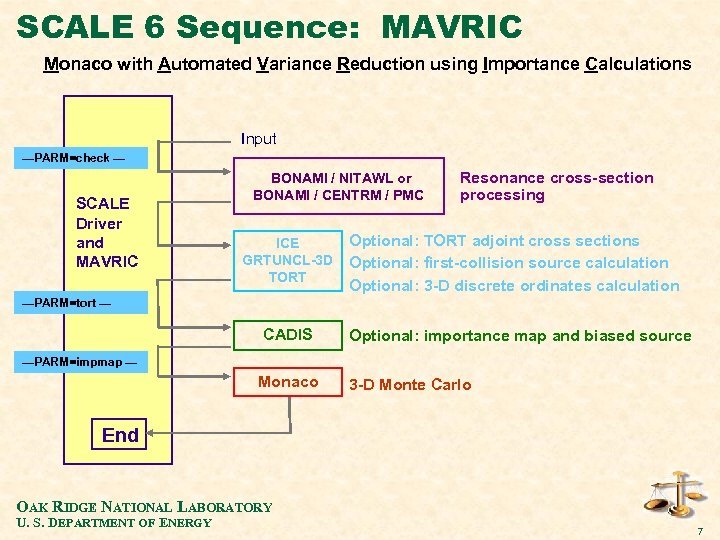 SCALE 6 Sequence: MAVRIC Monaco with Automated Variance Reduction using Importance Calculations Input —PARM=check — SCALE Driver and MAVRIC BONAMI / NITAWL or BONAMI / CENTRM / PMC ICE GRTUNCL-3 D TORT Resonance cross-section processing Optional: TORT adjoint cross sections Optional: first-collision source calculation Optional: 3 -D discrete ordinates calculation —PARM=tort — CADIS Optional: importance map and biased source —PARM=impmap — Monaco 3 -D Monte Carlo End OAK RIDGE NATIONAL LABORATORY U. S. DEPARTMENT OF ENERGY 7
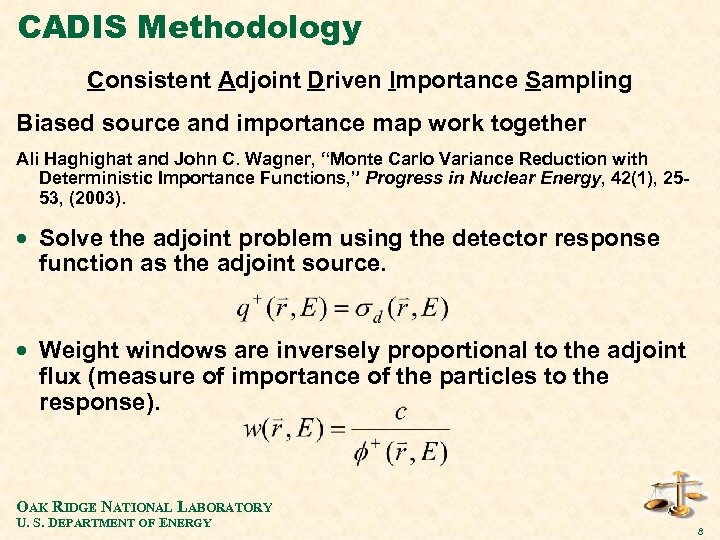 CADIS Methodology Consistent Adjoint Driven Importance Sampling Biased source and importance map work together Ali Haghighat and John C. Wagner, “Monte Carlo Variance Reduction with Deterministic Importance Functions, ” Progress in Nuclear Energy, 42(1), 2553, (2003). · Solve the adjoint problem using the detector response function as the adjoint source. · Weight windows are inversely proportional to the adjoint flux (measure of importance of the particles to the response). OAK RIDGE NATIONAL LABORATORY U. S. DEPARTMENT OF ENERGY 8
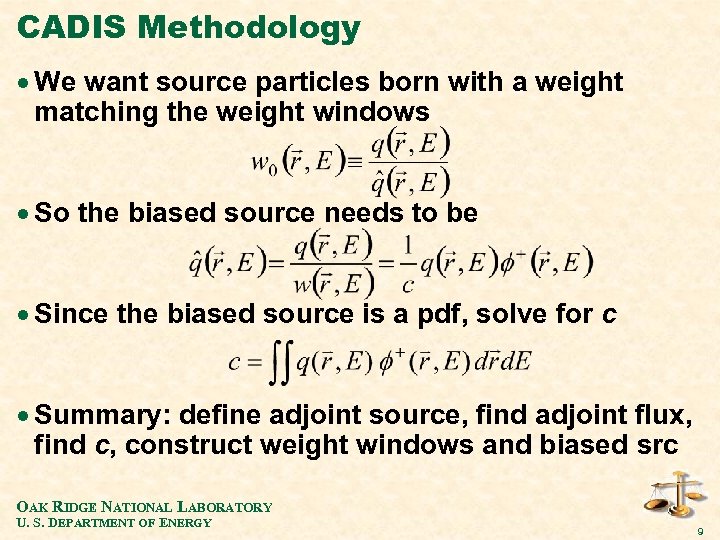 CADIS Methodology · We want source particles born with a weight matching the weight windows · So the biased source needs to be · Since the biased source is a pdf, solve for c · Summary: define adjoint source, find adjoint flux, find c, construct weight windows and biased src OAK RIDGE NATIONAL LABORATORY U. S. DEPARTMENT OF ENERGY 9
 Cooper’s Method for Global Var. Red. · The physical particle density, Monte Carlo particle density, weight. , is related to the , by the average · For uniform relative uncertainties, make constant. So, the weight windows need to be proportional to the physical particle density, or the estimate of forward flux , OAK RIDGE NATIONAL LABORATORY U. S. DEPARTMENT OF ENERGY 10
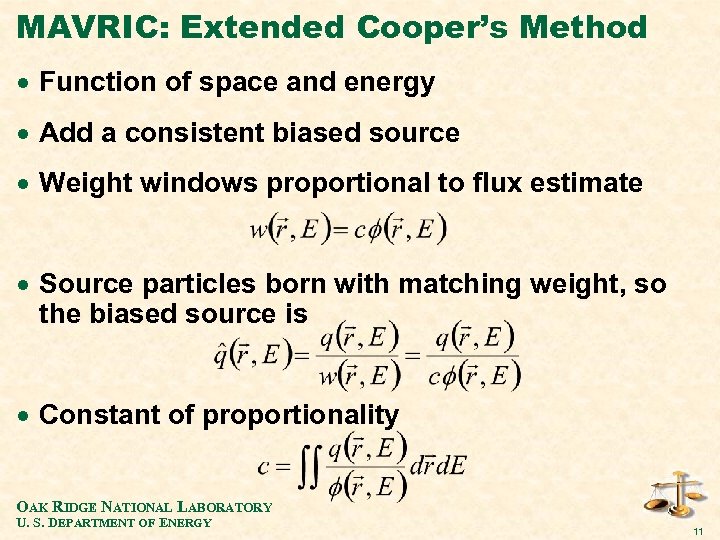 MAVRIC: Extended Cooper’s Method · Function of space and energy · Add a consistent biased source · Weight windows proportional to flux estimate · Source particles born with matching weight, so the biased source is · Constant of proportionality OAK RIDGE NATIONAL LABORATORY U. S. DEPARTMENT OF ENERGY 11
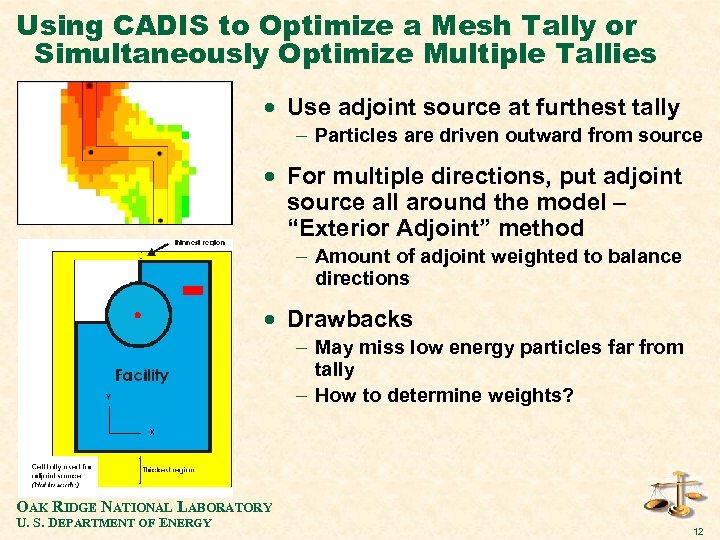 Using CADIS to Optimize a Mesh Tally or Simultaneously Optimize Multiple Tallies · Use adjoint source at furthest tally - Particles are driven outward from source · For multiple directions, put adjoint source all around the model – “Exterior Adjoint” method - Amount of adjoint weighted to balance directions · Drawbacks - May miss low energy particles far from tally - How to determine weights? OAK RIDGE NATIONAL LABORATORY U. S. DEPARTMENT OF ENERGY 12
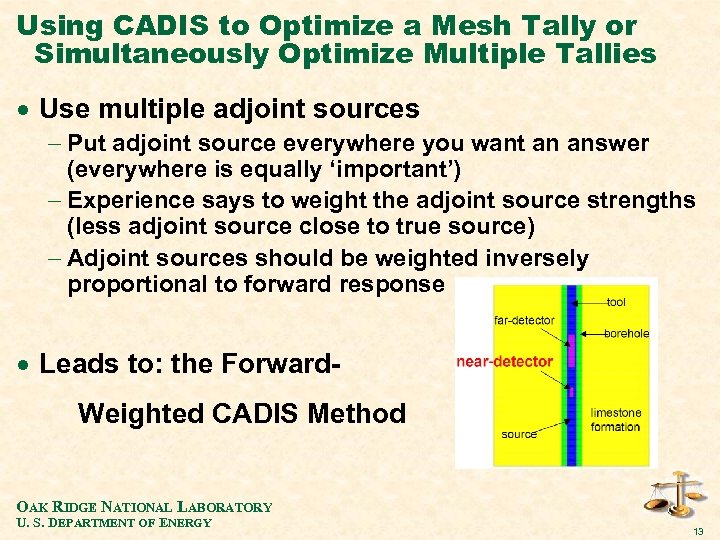 Using CADIS to Optimize a Mesh Tally or Simultaneously Optimize Multiple Tallies · Use multiple adjoint sources - Put adjoint source everywhere you want an answer (everywhere is equally ‘important’) - Experience says to weight the adjoint source strengths (less adjoint source close to true source) - Adjoint sources should be weighted inversely proportional to forward response · Leads to: the Forward. Weighted CADIS Method OAK RIDGE NATIONAL LABORATORY U. S. DEPARTMENT OF ENERGY 13
 Forward-Weighted CADIS · Perform a forward discrete ordinates calculation · Estimate the response of interest R(r, E) everywhere · Construct a volumetric adjoint source - Using the response function (as the energy component) - where the source strength is weighted by 1/R(r, E) · Perform the adjoint discrete ordinates calculation · Create the weight windows and biased source · Perform the Monte Carlo calculation OAK RIDGE NATIONAL LABORATORY U. S. DEPARTMENT OF ENERGY 14
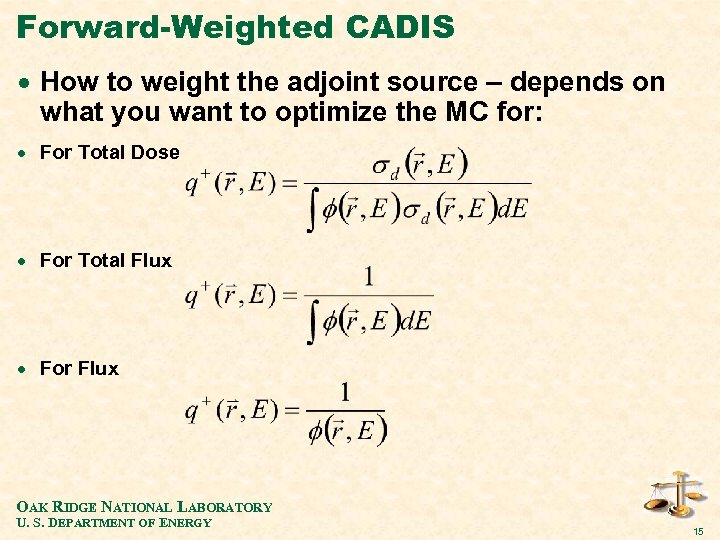 Forward-Weighted CADIS · How to weight the adjoint source – depends on what you want to optimize the MC for: · For Total Dose · For Total Flux · For Flux OAK RIDGE NATIONAL LABORATORY U. S. DEPARTMENT OF ENERGY 15
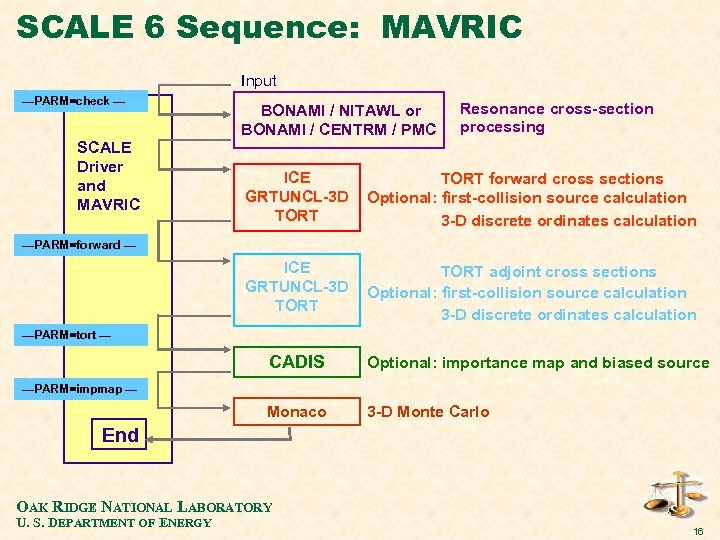 SCALE 6 Sequence: MAVRIC Input —PARM=check — SCALE Driver and MAVRIC BONAMI / NITAWL or BONAMI / CENTRM / PMC Resonance cross-section processing ICE GRTUNCL-3 D TORT forward cross sections Optional: first-collision source calculation 3 -D discrete ordinates calculation ICE GRTUNCL-3 D TORT adjoint cross sections Optional: first-collision source calculation 3 -D discrete ordinates calculation —PARM=forward — —PARM=tort — CADIS Optional: importance map and biased source Monaco 3 -D Monte Carlo —PARM=impmap — End OAK RIDGE NATIONAL LABORATORY U. S. DEPARTMENT OF ENERGY 16
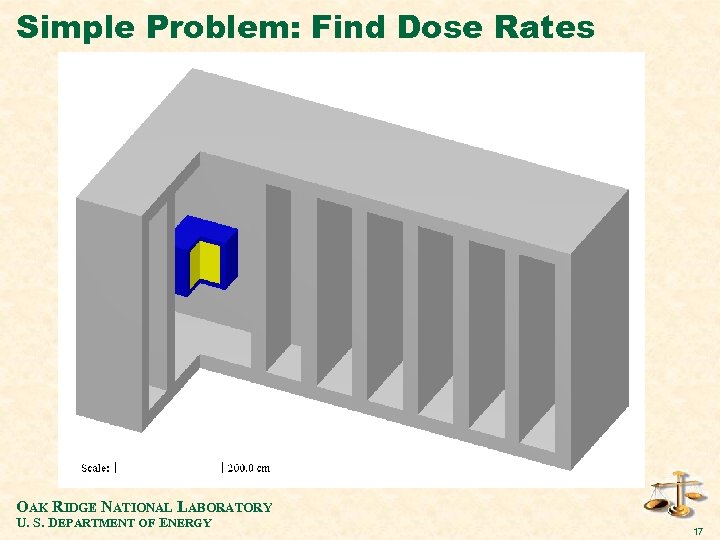 Simple Problem: Find Dose Rates OAK RIDGE NATIONAL LABORATORY U. S. DEPARTMENT OF ENERGY 17
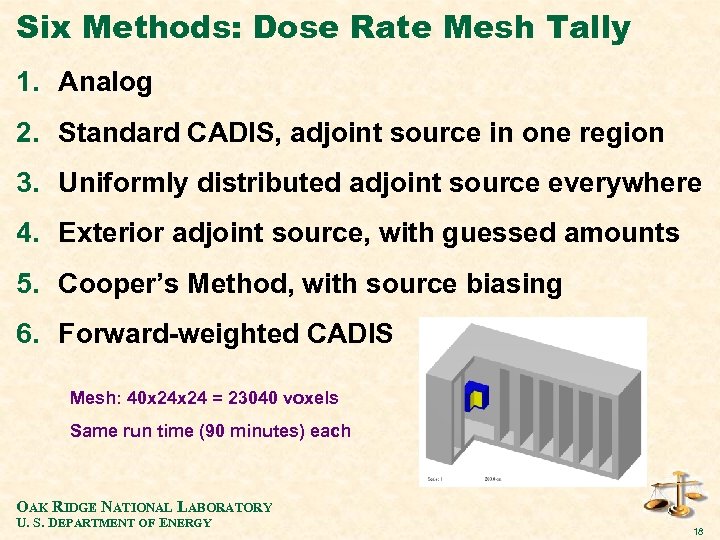 Six Methods: Dose Rate Mesh Tally 1. Analog 2. Standard CADIS, adjoint source in one region 3. Uniformly distributed adjoint source everywhere 4. Exterior adjoint source, with guessed amounts 5. Cooper’s Method, with source biasing 6. Forward-weighted CADIS Mesh: 40 x 24 = 23040 voxels Same run time (90 minutes) each OAK RIDGE NATIONAL LABORATORY U. S. DEPARTMENT OF ENERGY 18
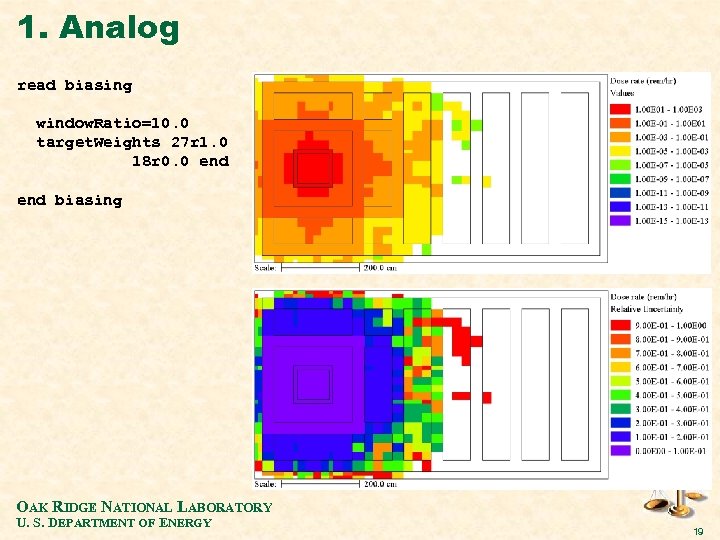 1. Analog read biasing window. Ratio=10. 0 target. Weights 27 r 1. 0 18 r 0. 0 end biasing OAK RIDGE NATIONAL LABORATORY U. S. DEPARTMENT OF ENERGY 19
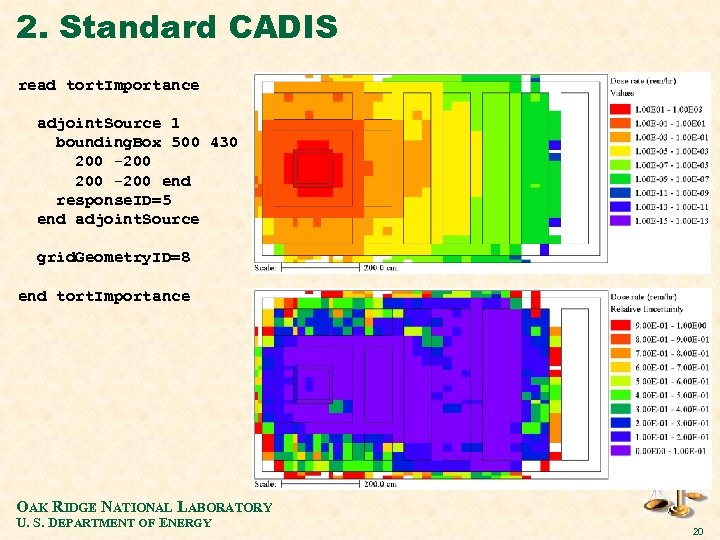 2. Standard CADIS read tort. Importance adjoint. Source 1 bounding. Box 500 430 200 -200 end response. ID=5 end adjoint. Source grid. Geometry. ID=8 end tort. Importance OAK RIDGE NATIONAL LABORATORY U. S. DEPARTMENT OF ENERGY 20
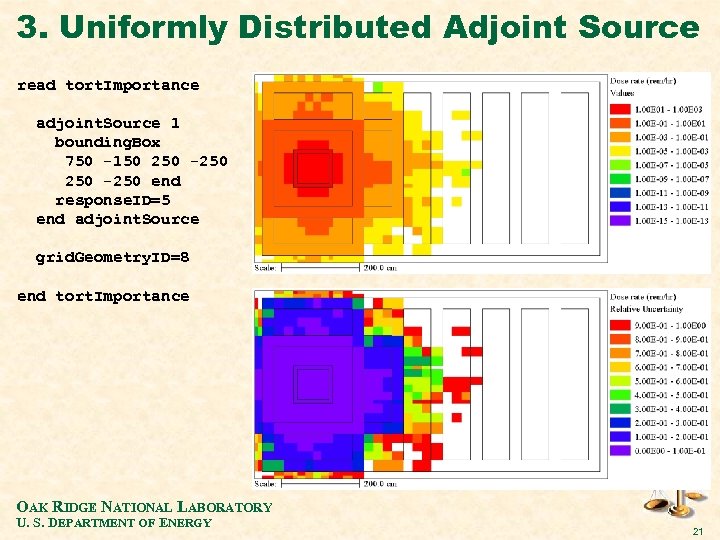 3. Uniformly Distributed Adjoint Source read tort. Importance adjoint. Source 1 bounding. Box 750 -150 250 -250 end response. ID=5 end adjoint. Source grid. Geometry. ID=8 end tort. Importance OAK RIDGE NATIONAL LABORATORY U. S. DEPARTMENT OF ENERGY 21
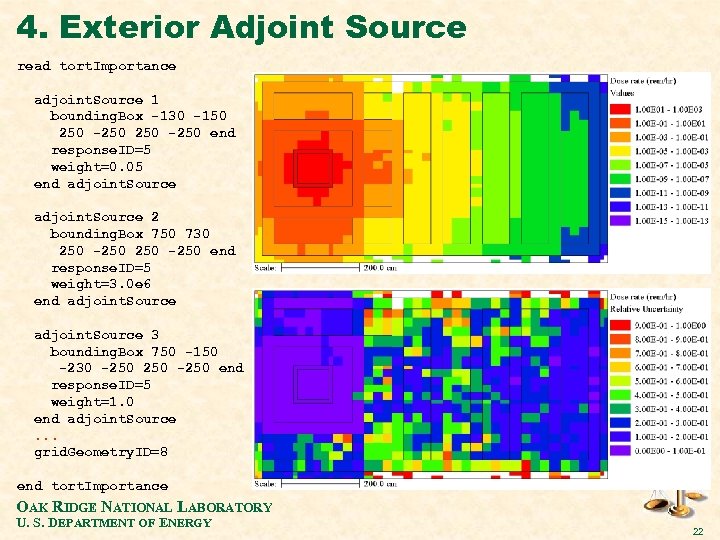 4. Exterior Adjoint Source read tort. Importance adjoint. Source 1 bounding. Box -130 -150 250 -250 end response. ID=5 weight=0. 05 end adjoint. Source 2 bounding. Box 750 730 250 -250 end response. ID=5 weight=3. 0 e 6 end adjoint. Source 3 bounding. Box 750 -150 -230 -250 end response. ID=5 weight=1. 0 end adjoint. Source. . . grid. Geometry. ID=8 end tort. Importance OAK RIDGE NATIONAL LABORATORY U. S. DEPARTMENT OF ENERGY 22
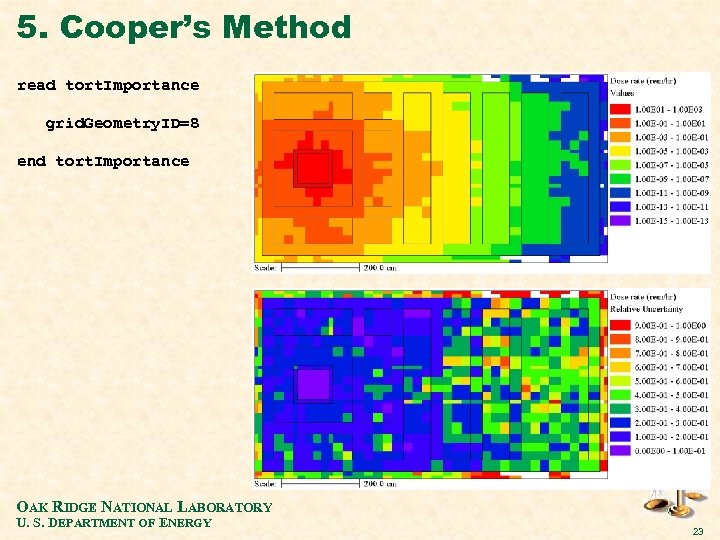 5. Cooper’s Method read tort. Importance grid. Geometry. ID=8 end tort. Importance OAK RIDGE NATIONAL LABORATORY U. S. DEPARTMENT OF ENERGY 23
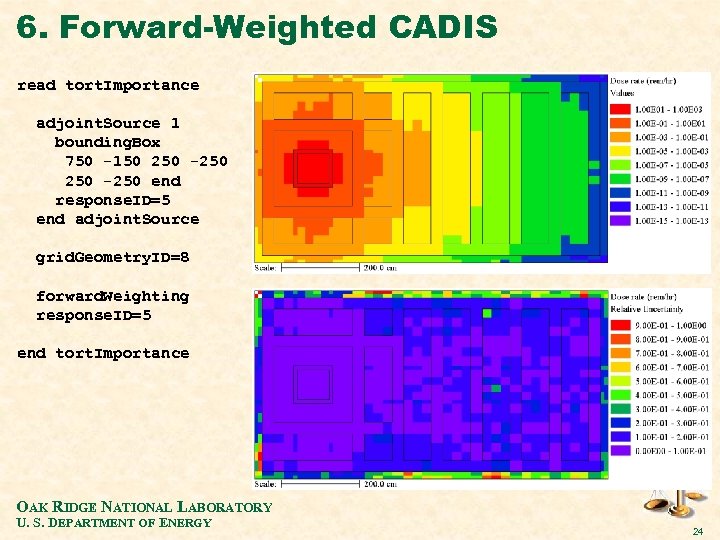 6. Forward-Weighted CADIS read tort. Importance adjoint. Source 1 bounding. Box 750 -150 250 -250 end response. ID=5 end adjoint. Source grid. Geometry. ID=8 forward. Weighting response. ID=5 end tort. Importance OAK RIDGE NATIONAL LABORATORY U. S. DEPARTMENT OF ENERGY 24
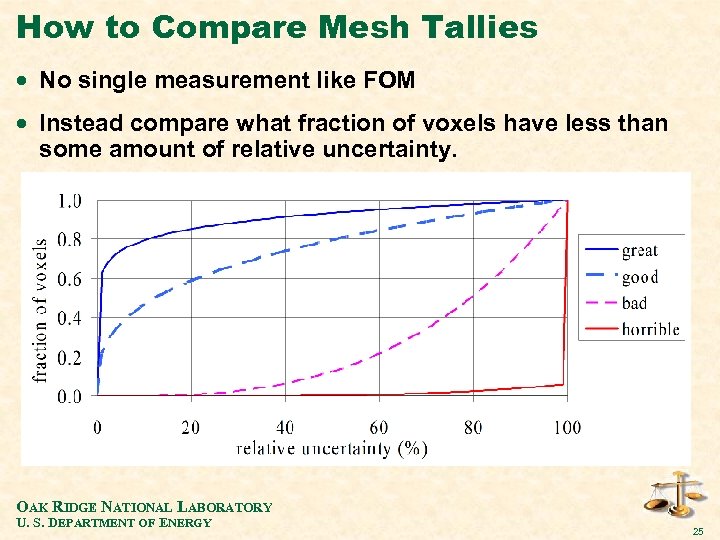 How to Compare Mesh Tallies · No single measurement like FOM · Instead compare what fraction of voxels have less than some amount of relative uncertainty. OAK RIDGE NATIONAL LABORATORY U. S. DEPARTMENT OF ENERGY 25
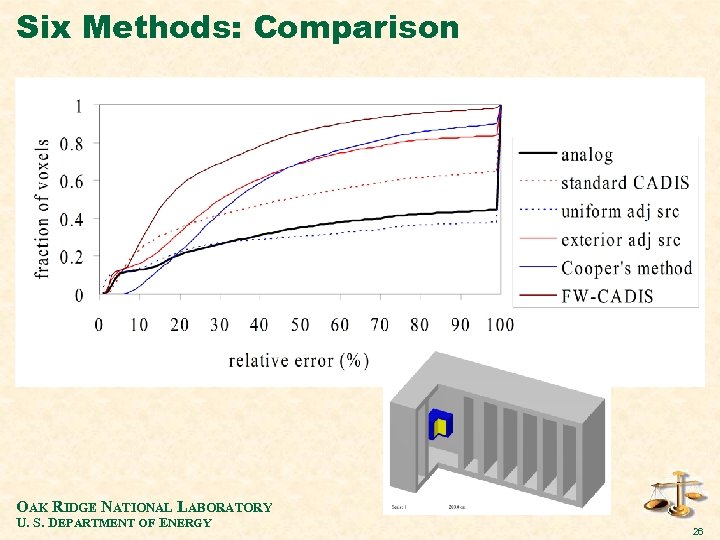 Six Methods: Comparison OAK RIDGE NATIONAL LABORATORY U. S. DEPARTMENT OF ENERGY 26
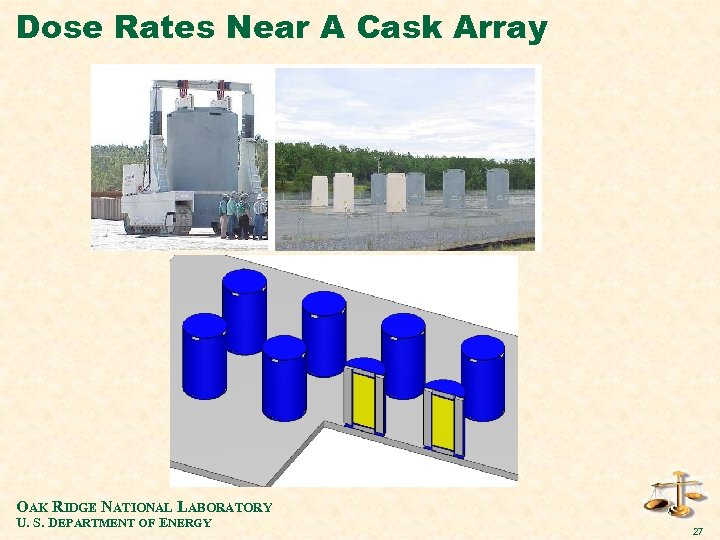 Dose Rates Near A Cask Array OAK RIDGE NATIONAL LABORATORY U. S. DEPARTMENT OF ENERGY 27
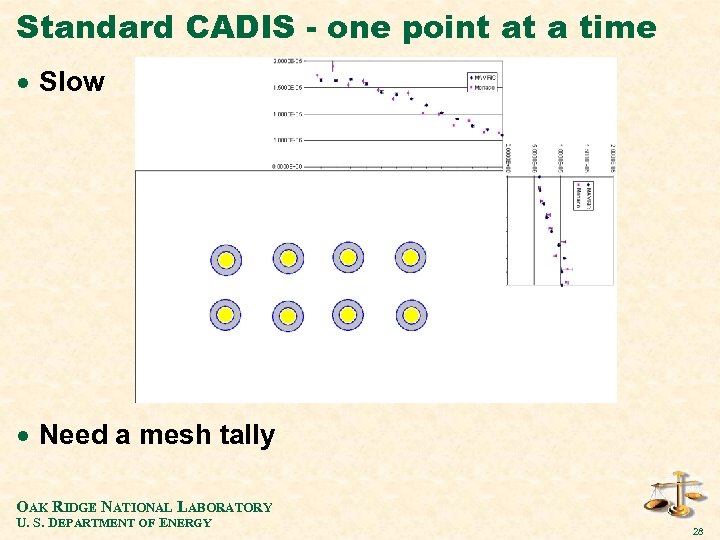 Standard CADIS - one point at a time · Slow · Need a mesh tally OAK RIDGE NATIONAL LABORATORY U. S. DEPARTMENT OF ENERGY 28
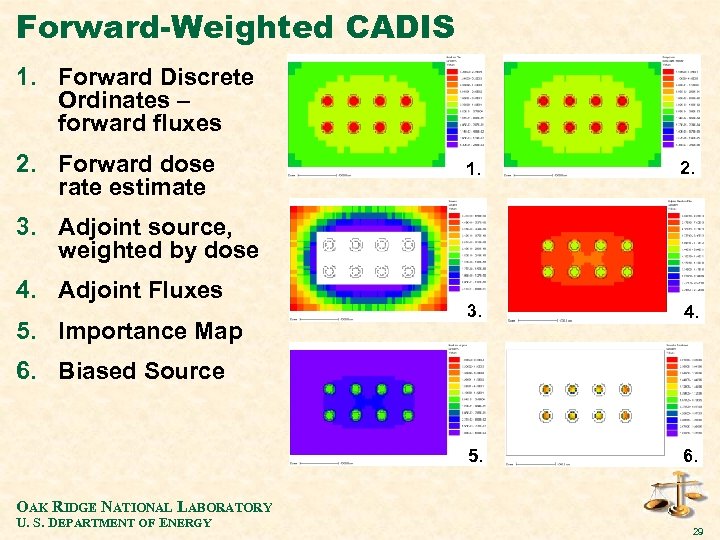 Forward-Weighted CADIS 1. Forward Discrete Ordinates – forward fluxes 2. Forward dose rate estimate 1. 2. 3. 4. 5. 6. 3. Adjoint source, weighted by dose 4. Adjoint Fluxes 5. Importance Map 6. Biased Source OAK RIDGE NATIONAL LABORATORY U. S. DEPARTMENT OF ENERGY 29
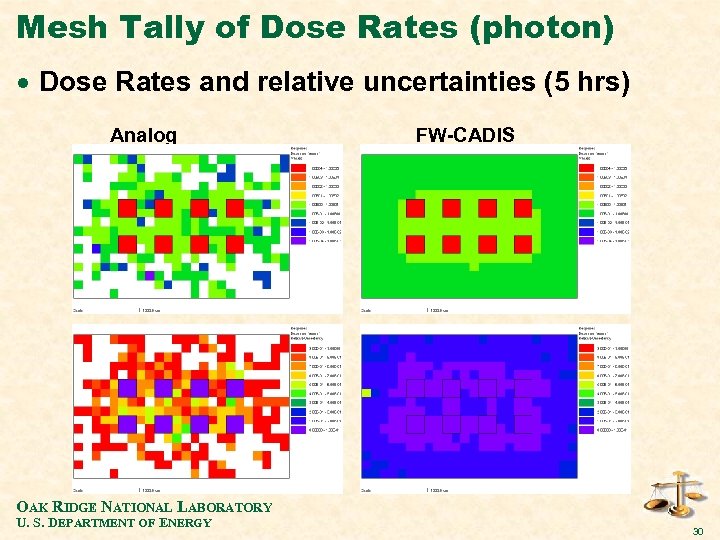 Mesh Tally of Dose Rates (photon) · Dose Rates and relative uncertainties (5 hrs) Analog FW-CADIS OAK RIDGE NATIONAL LABORATORY U. S. DEPARTMENT OF ENERGY 30
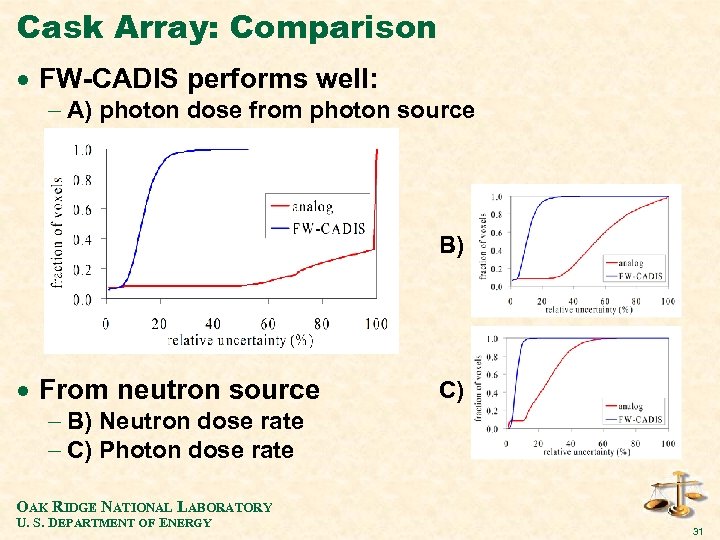 Cask Array: Comparison · FW-CADIS performs well: - A) photon dose from photon source B) · From neutron source C) - B) Neutron dose rate - C) Photon dose rate OAK RIDGE NATIONAL LABORATORY U. S. DEPARTMENT OF ENERGY 31
 Summary · MAVRIC offers many ways for automated, advanced variance reduction - Standard CADIS method – for optimizing a specific response at a specific location - Forward-Weighted CADIS – for optimizing multiple tallies or mesh tallies over large areas · Easy to use - In addition to standard MC input description, user provides mesh for DO calc. - For CADIS, user specifies source position or box - For FW-CADIS, user adds a single keyword OAK RIDGE NATIONAL LABORATORY U. S. DEPARTMENT OF ENERGY 32
 Discussion & Questions Special thanks to our sponsors: DTRA and NRC