


 Скачать презентацию Advanced Trademark Law Seminar Parallel Imports Extraterritoriality Famous Marks
c5d29cdfe20e0210d1464ec1d0699f04.ppt
- Количество слайдов: 39
 Advanced Trademark Law Seminar: Parallel Imports Extraterritoriality/Famous Marks and Geographic Indications Paul W. Reidl Associate General Counsel E. & J. Gallo Winery March 10, 2008 George Washington University School of Law
 Parallel Imports: Generally • What’s the big deal? • Who benefits? • Who loses? Who wins?
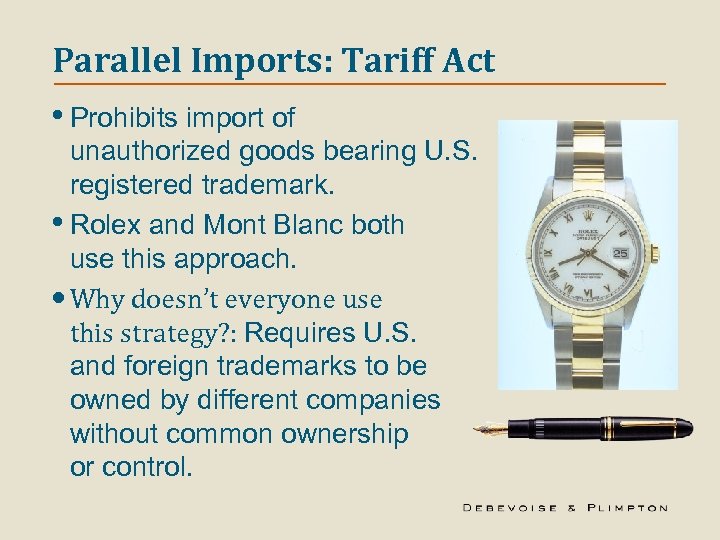 Parallel Imports: Tariff Act • Prohibits import of unauthorized goods bearing U. S. registered trademark. • Rolex and Mont Blanc both use this approach. • Why doesn’t everyone use this strategy? : Requires U. S. and foreign trademarks to be owned by different companies without common ownership or control.
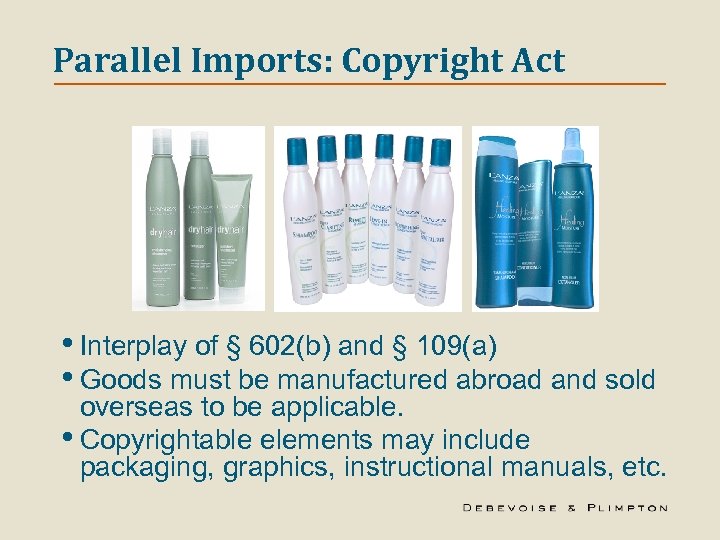 Parallel Imports: Copyright Act • Interplay of § 602(b) and § 109(a) • Goods must be manufactured abroad and sold overseas to be applicable. • Copyrightable elements may include packaging, graphics, instructional manuals, etc.
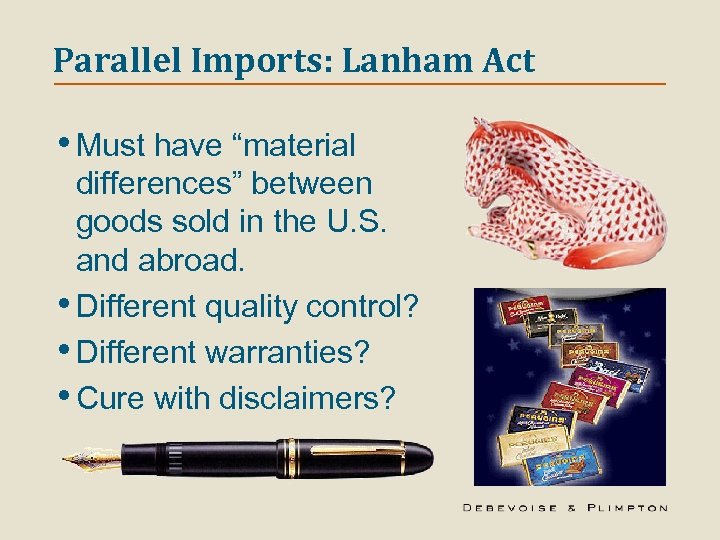 Parallel Imports: Lanham Act • Must have “material differences” between goods sold in the U. S. and abroad. • Different quality control? • Different warranties? • Cure with disclaimers?
 Extraterritoriality in the USA • Trademark rights are territorial. • Rights must be established in each country of interest. • A United States court cannot enjoin purely foreign commerce. • The Commerce Clause applies only to commerce in or affecting the United States. • United States trademark rights are based on use, not registration, and are a reflection of the goodwill of the symbol.
 Extraterritoriality: Two Scenarios • What happens when a US company is engaged in conduct overseas that affects a US competitor in an overseas market? • What happens when the holder of a non-US trademark is “knocked off” in the United States?
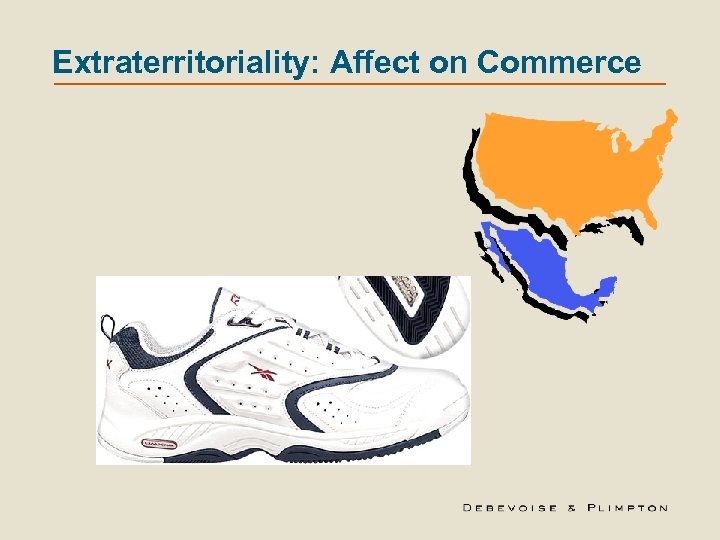 Extraterritoriality: Affect on Commerce
 Extraterritoriality: Non-US Mark • Hypothetical: Your client, a German company, uses the mark GESUNDHEIT for facial tissues in the EU. The mark is a registered CTM. It has never used the mark in the US. A US company registers and uses an identical mark in the United States for the identical goods. Your client wants to sue them in the USA. • Traditional analysis: your client is out of luck due to the territoriality principle. • 9 th Circuit, Federal Circuit, and 2 d Circuit views.
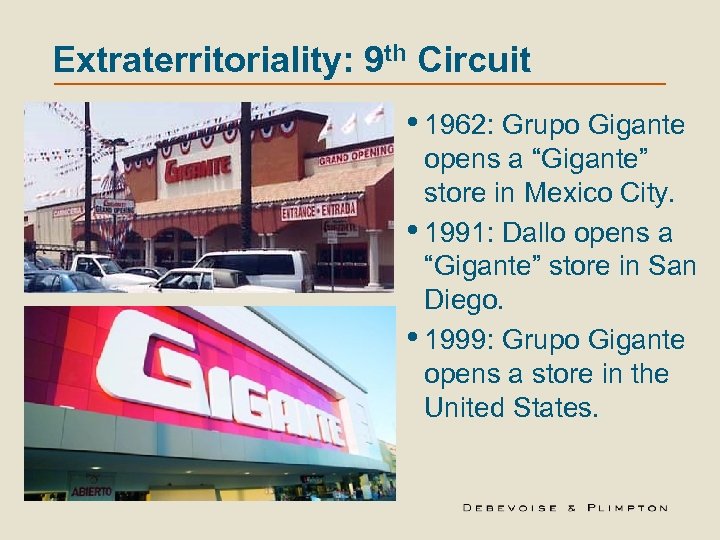 Extraterritoriality: 9 th Circuit • 1962: Grupo Gigante opens a “Gigante” store in Mexico City. • 1991: Dallo opens a “Gigante” store in San Diego. • 1999: Grupo Gigante opens a store in the United States.
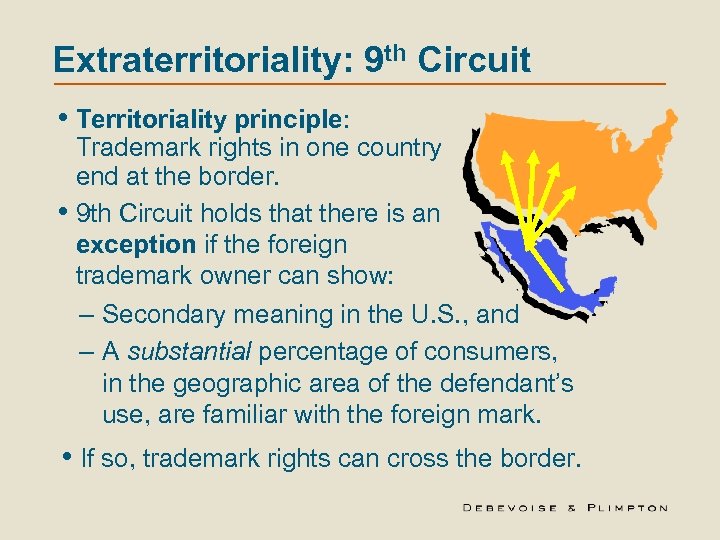 Extraterritoriality: 9 th Circuit • Territoriality principle: Trademark rights in one country end at the border. • 9 th Circuit holds that there is an exception if the foreign trademark owner can show: – Secondary meaning in the U. S. , and – A substantial percentage of consumers, in the geographic area of the defendant’s use, are familiar with the foreign mark. • If so, trademark rights can cross the border.
 Extraterritoriality: 9 th Circuit By casting its holding in terms of secondary meaning, is the 9 th Circuit essentially saying that Grupe Gigante can sue if it proves that it has the equivalent of trademark rights? Doesn’t “secondary meaning” mean that the symbol is recognized by consumers as a single source identifier? Inwood Laboratories, Inc. v. Ives Laboratories, 456 U. S. 844 (1982. )
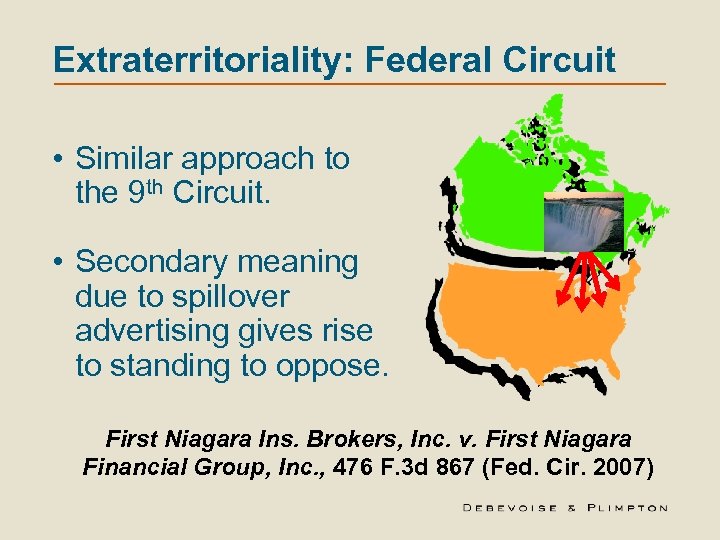 Extraterritoriality: Federal Circuit • Similar approach to the 9 th Circuit. • Secondary meaning due to spillover advertising gives rise to standing to oppose. First Niagara Ins. Brokers, Inc. v. First Niagara Financial Group, Inc. , 476 F. 3 d 867 (Fed. Cir. 2007)
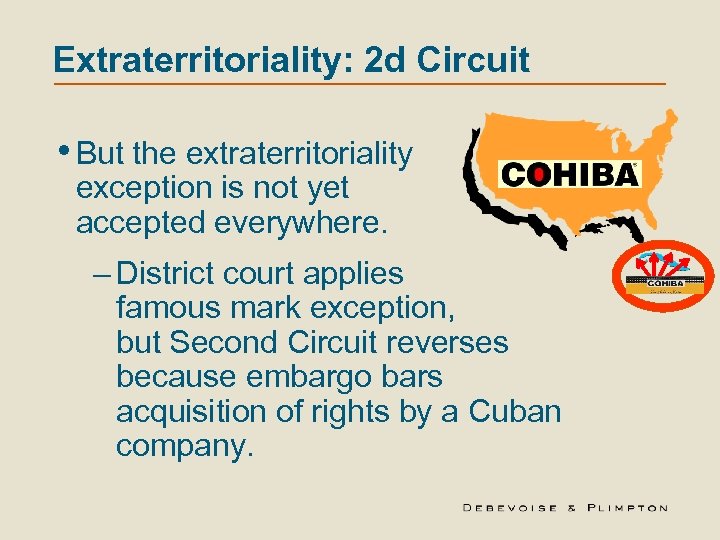 Extraterritoriality: 2 d Circuit • But the extraterritoriality exception is not yet accepted everywhere. – District court applies famous mark exception, but Second Circuit reverses because embargo bars acquisition of rights by a Cuban company.
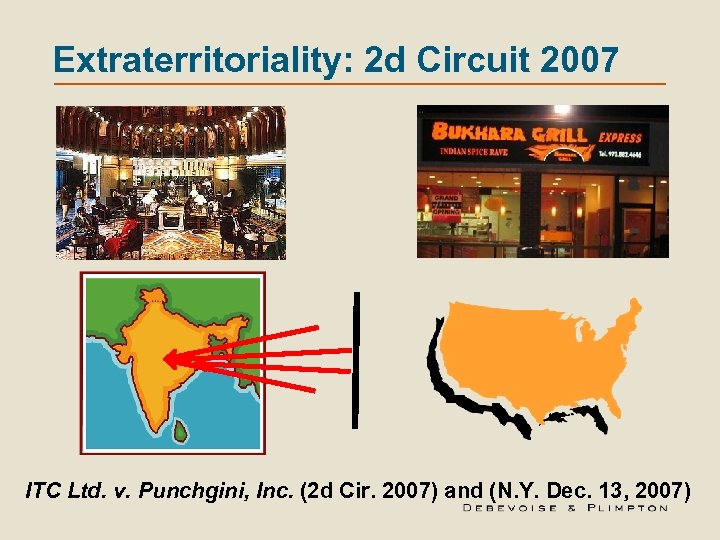 Extraterritoriality: 2 d Circuit 2007 ITC Ltd. v. Punchgini, Inc. (2 d Cir. 2007) and (N. Y. Dec. 13, 2007)
 Extraterritoriality: 2 d Circuit 2008 • Affirms that Federal law provides no basis for the claim. • Agrees that there was sufficient basis for a finding of deliberate copying under New York state law. • Insufficient evidence to survive summary judgment on the state law claim because there was no genuine issue of fact that the Bukhara mark did not have secondary meaning in New York. ITS Limited v. Punchigini, Inc. , Docket No. 05 -0933 -cv (2 d Cir. February 26, 2008. )
 Extraterritoriality: Proof? • Is the prospect of proving secondary meaning for a mark not in use in the United States a Pyrrhic victory for potential plaintiffs? • Would global sales and promotional efforts be admissible? • What is the proper survey universe? Geographic scope? Respondents? • Can you reasonably expect to get 50% + 1 absent use and promotion in the United States?
 Extraterritoriality Outside of the United States: Famous Marks Doctrine • This is truly an emerging issue. • Article 6 bis of the Paris Convention: Well known marks must be protected even though there is no registration. • Article 16 of TRIPS: Re-states the principle. • Don’t bet the farm on this theory; tough to prove; judicial reluctance to recognize. • Registration is the only insurance.
 Extraterritoriality: Non-US • Varies by Country; all rest on Paris 6 bis grounds. • Many of these cases have some evidence of intent. • Examples: – – – – Canada: Spillover advertising (SPANADA case) Brazil: GORE-TEX Chile: KITCHEN AID, IKEA Israel: CARTIER Venezuela: LAFEYETTE (lighting) South Africa: Mc. DONALD’S Spain: NIKE
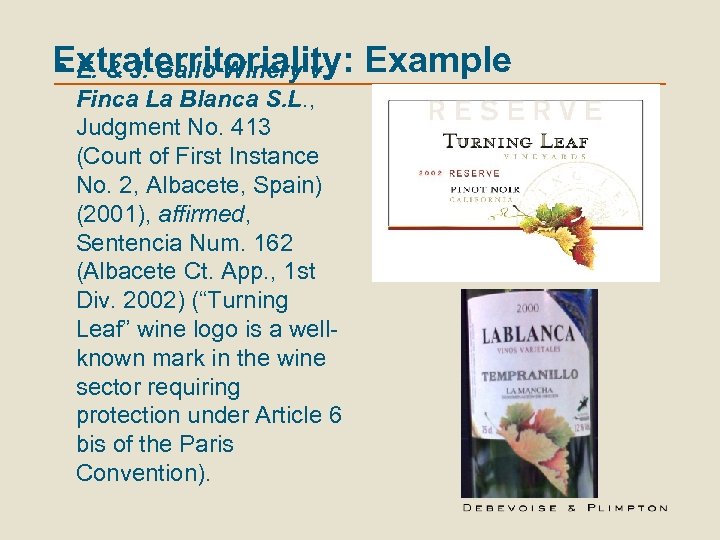 Extraterritoriality: Example • E. & J. Gallo Winery v. Finca La Blanca S. L. , Judgment No. 413 (Court of First Instance No. 2, Albacete, Spain) (2001), affirmed, Sentencia Num. 162 (Albacete Ct. App. , 1 st Div. 2002) (“Turning Leaf” wine logo is a wellknown mark in the wine sector requiring protection under Article 6 bis of the Paris Convention).
 DOWN THE RABBIT HOLE: The Alice in Wonderland World of Geographic Indications and Their Collision With Trademark Rights
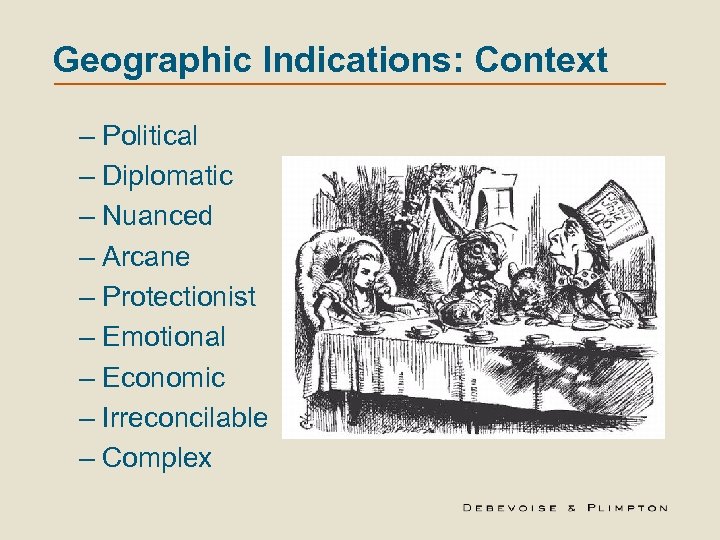 Geographic Indications: Context – Political – Diplomatic – Nuanced – Arcane – Protectionist – Emotional – Economic – Irreconcilable – Complex Sherry, Spain
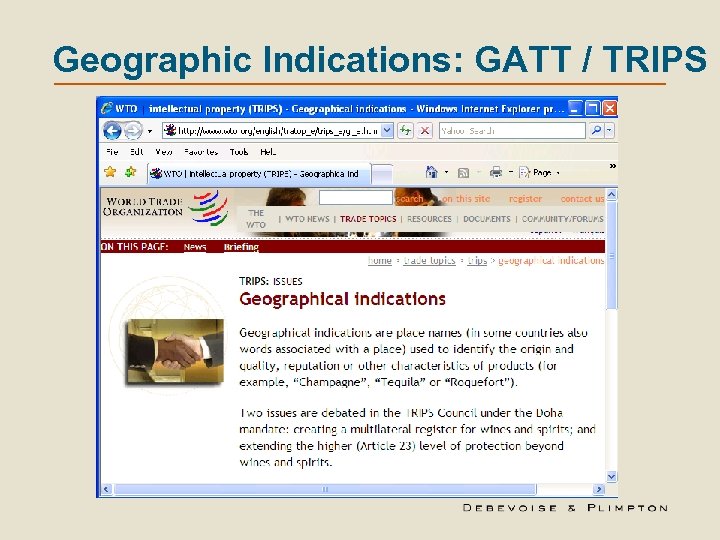 Geographic Indications: GATT / TRIPS Sherry, Spain
 Geographic Indications: GATT / TRIPS “Geographical indications are, for the purposes of this Agreement, indications Sherry, Spain which identify a good as originating in the territory of a Member, or a region or locality in that territory, where a given quality, reputation or other characteristic of the good is essentially attributable to its geographic origin. ” (TRIPS Article 22. )
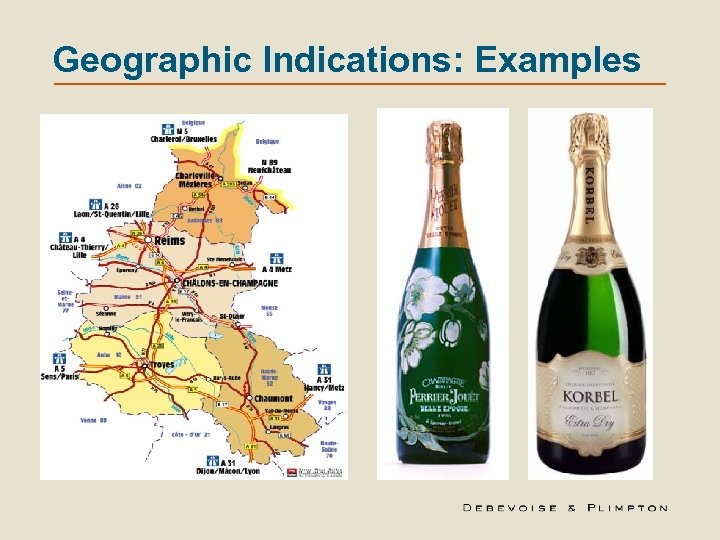 Geographic Indications: Examples Sherry, Spain
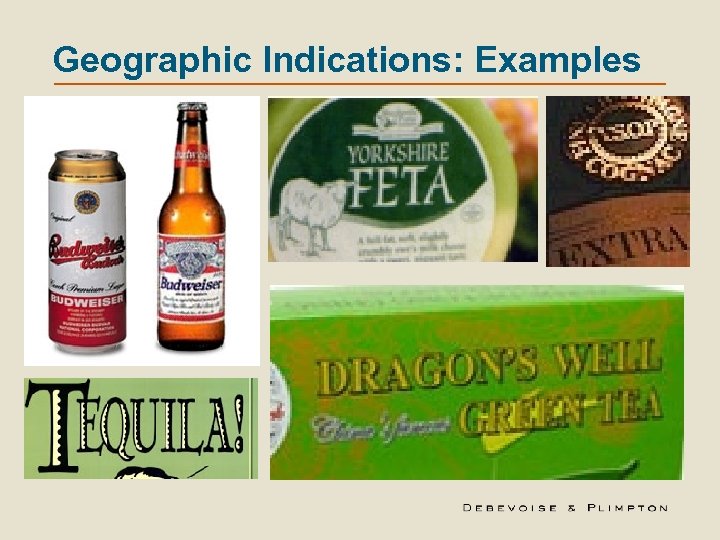 Geographic Indications: Examples
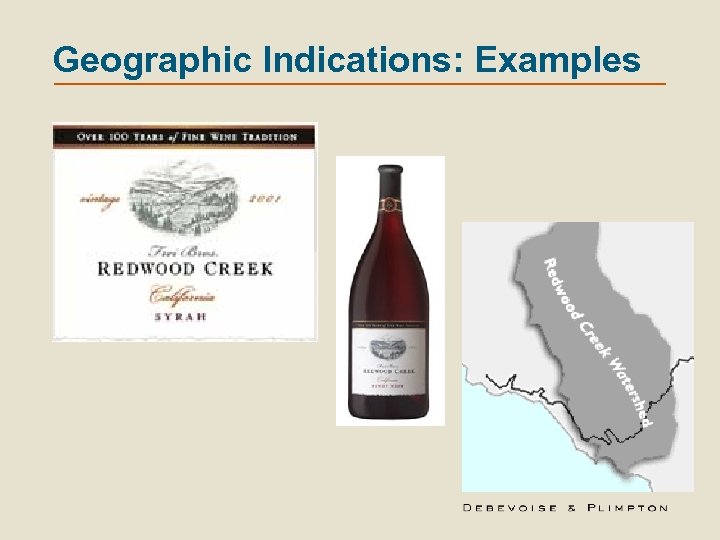 Geographic Indications: Examples
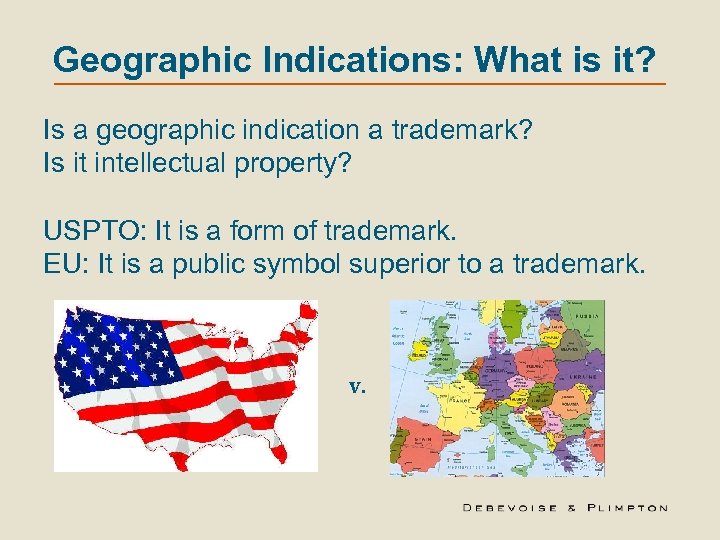 Geographic Indications: What is it? Is a geographic indication a trademark? Is it intellectual property? USPTO: It is a form of trademark. EU: It is a public symbol superior to a trademark. v.
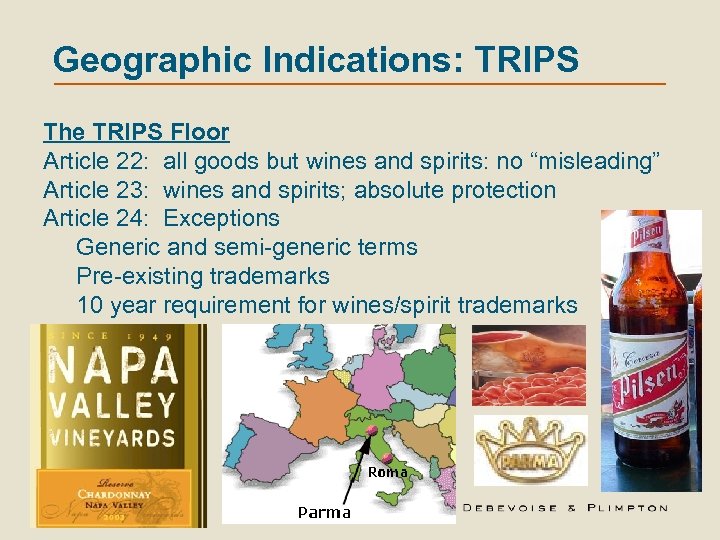 Geographic Indications: TRIPS The TRIPS Floor Article 22: all goods but wines and spirits: no “misleading” Article 23: wines and spirits; absolute protection Article 24: Exceptions Generic and semi-generic terms Pre-existing trademarks 10 year requirement for wines/spirit trademarks
 Geographic Indications: TRIPS What can be inferred from TRIPS (non-wine/spirits): • “No misleading” = territoriality requirement. • “No misleading” = goods-place association. • Does it therefore follow that if there is no goods-place association in the minds of consumers that there is no requirement to protect the GI? That there really isn’t a global protection scheme?
 Geographic Indications: TRIPS PILSEN PARMA BUDWEISER
 Geographic Indications: Clawback? • What do you do with terms that have become generic or semi-generic for the goods? • Parmesan cheese; swiss cheese; port wine; chablis wine. • Strähl Käse AG v. Valais Dairy Association & Swiss Federal Department of Agriculture (Case 61/20033)(Board of Appeal, Department of Economy)(raclette is generic for a type of cheese and is not a geographic indication for cheese from the Canton of Valais, Switzerland). • EU/US Wine Accords – No new semi-generics.
 Geographic Indications: Creation
 Geographic Indications: Divination How do you know that a term is a GI? • Government registries. • Government regulations. • “Could become a GI someday. ”
 Geographic Indications: Trademarks What happens if my trademark becomes a GI? Amstel, Cadbury, Cadillac, Cartier, Chivas, Coca Cola Crocker, Evian, Fox, Gallo, Guiness, Honda, La. Coste, Lauder, Mac. Gregor, Marlboro, Mars, Mercedes, Nestle, Nike, Nissan, Pillsbury, Remy, Sanyo, Toyo Wines You are SOL The Torres/Torres Vedras Exception Other goods - It depends on the country: US: ? INTA: First in time, first in right EU: Coexistence
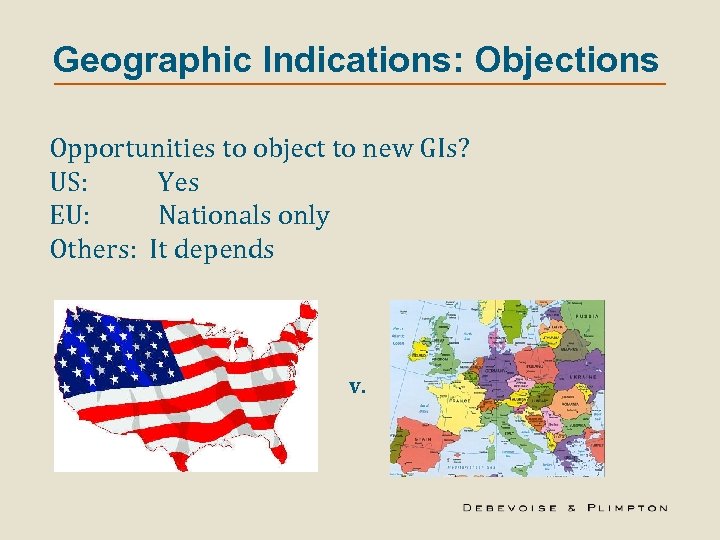 Geographic Indications: Objections Opportunities to object to new GIs? US: Yes EU: Nationals only Others: It depends v.
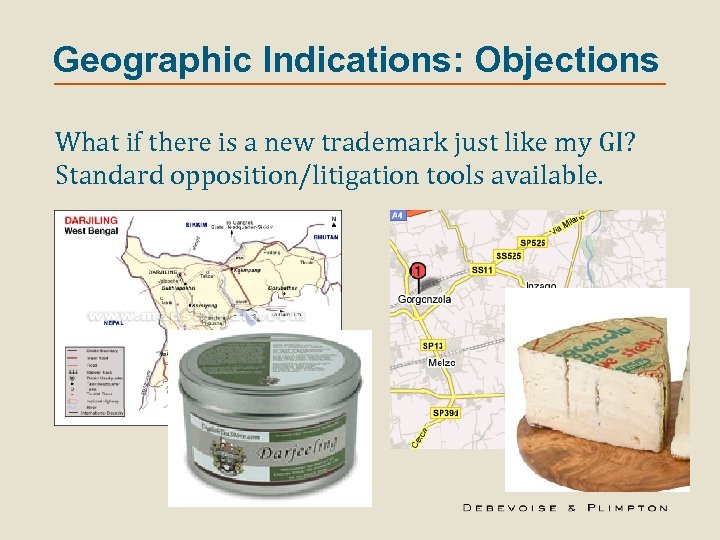 Geographic Indications: Objections What if there is a new trademark just like my GI? Standard opposition/litigation tools available.
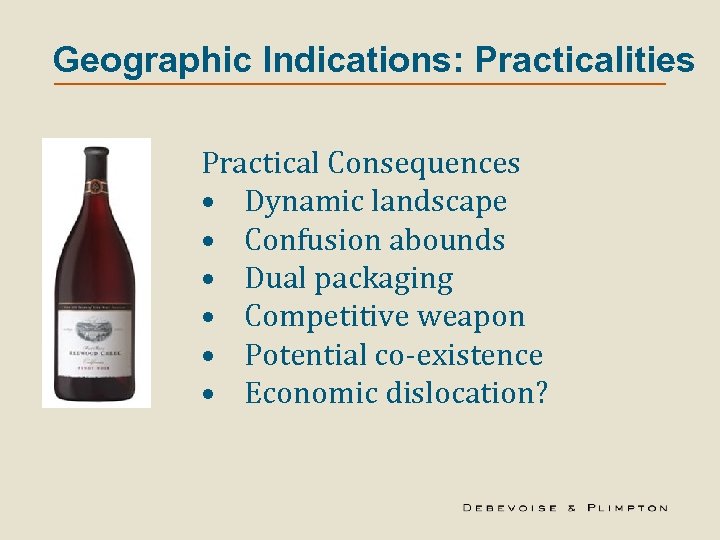 Geographic Indications: Practicalities Practical Consequences • Dynamic landscape • Confusion abounds • Dual packaging • Competitive weapon • Potential co-existence • Economic dislocation?
 TTB Rulemaking on AVA’s • Current grandfather provision – 1986. • Proposed five year rule. • What do you do now if your client proposes a geographic term as a trademark? How do you advise them?