


 Скачать презентацию Advanced Tokamak Modes in FIRE Dale Meade Charles
b5f752eb9fcc360015fcf587c1127948.ppt
- Количество слайдов: 19
 Advanced Tokamak Modes in FIRE Dale Meade, Charles Kessel and Steve Jardin ITPA MHD Task Group Meeting St. Petersburg, Russia July 15, 2003 FIRE Collaboration http: //fire. pppl. gov AES, ANL, Boeing, Columbia U. , CTD, GA, GIT, LLNL, INEEL, MIT, ORNL, PPPL, SNL, SRS, UCLA, UCSD, UIIC, UWisc,
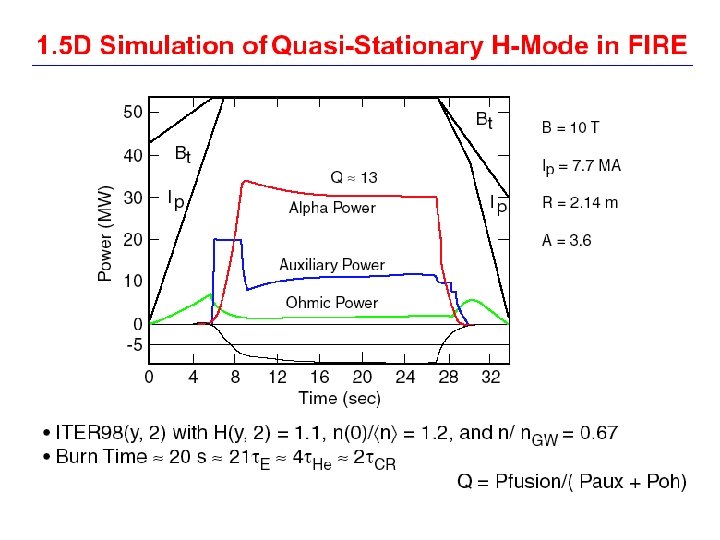
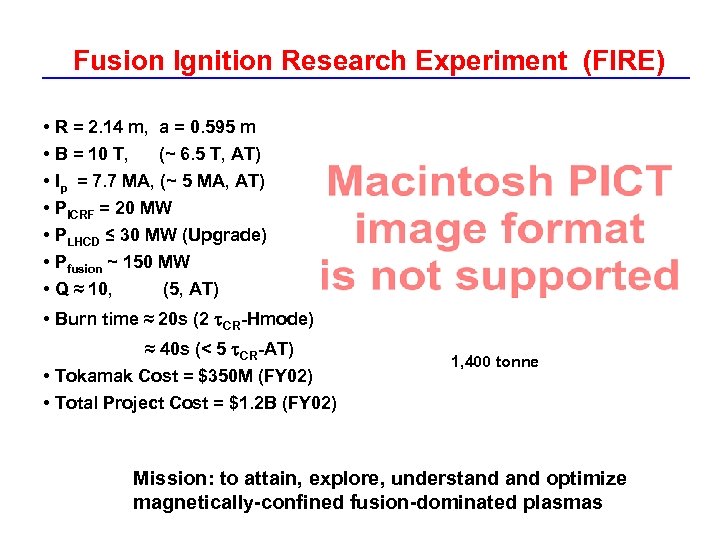 Fusion Ignition Research Experiment (FIRE) • R = 2. 14 m, a = 0. 595 m • B = 10 T, (~ 6. 5 T, AT) • Ip = 7. 7 MA, (~ 5 MA, AT) • PICRF = 20 MW • PLHCD ≤ 30 MW (Upgrade) • Pfusion ~ 150 MW • Q ≈ 10, (5, AT) • Burn time ≈ 20 s (2 t. CR-Hmode) ≈ 40 s (< 5 t. CR-AT) • Tokamak Cost = $350 M (FY 02) • Total Project Cost = $1. 2 B (FY 02) 1, 400 tonne Mission: to attain, explore, understand optimize magnetically-confined fusion-dominated plasmas
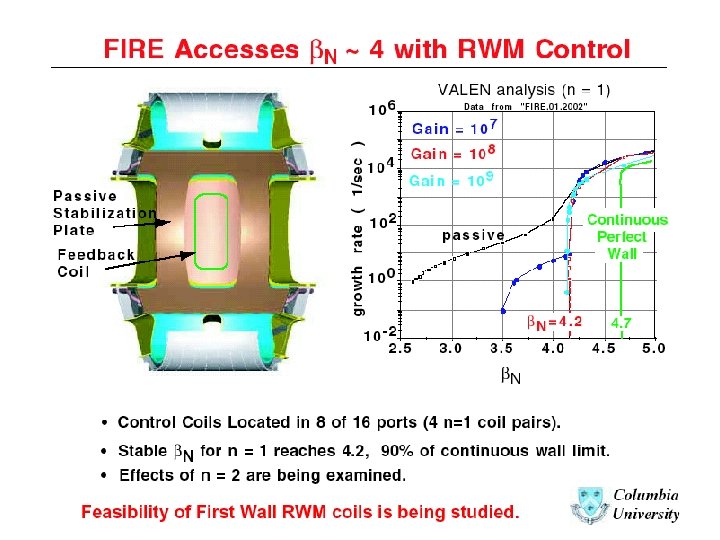
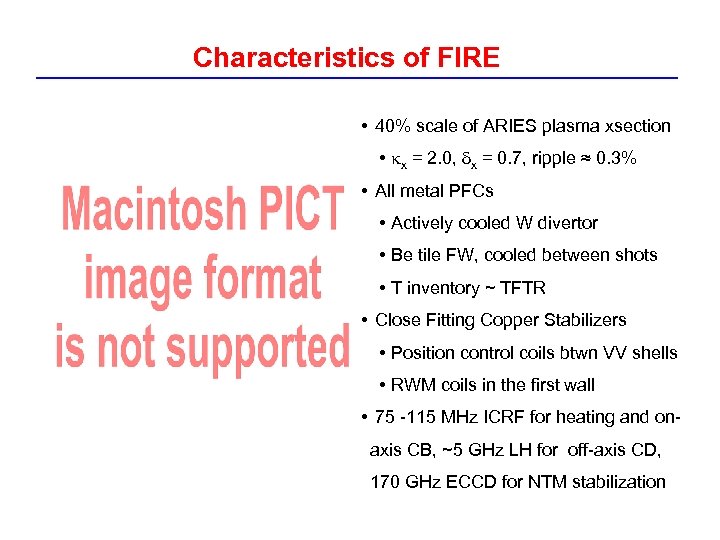 Characteristics of FIRE • 40% scale of ARIES plasma xsection • kx = 2. 0, dx = 0. 7, ripple ≈ 0. 3% • All metal PFCs • Actively cooled W divertor • Be tile FW, cooled between shots • T inventory ~ TFTR • Close Fitting Copper Stabilizers • Position control coils btwn VV shells • RWM coils in the first wall • 75 -115 MHz ICRF for heating and onaxis CB, ~5 GHz LH for off-axis CD, 170 GHz ECCD for NTM stabilization

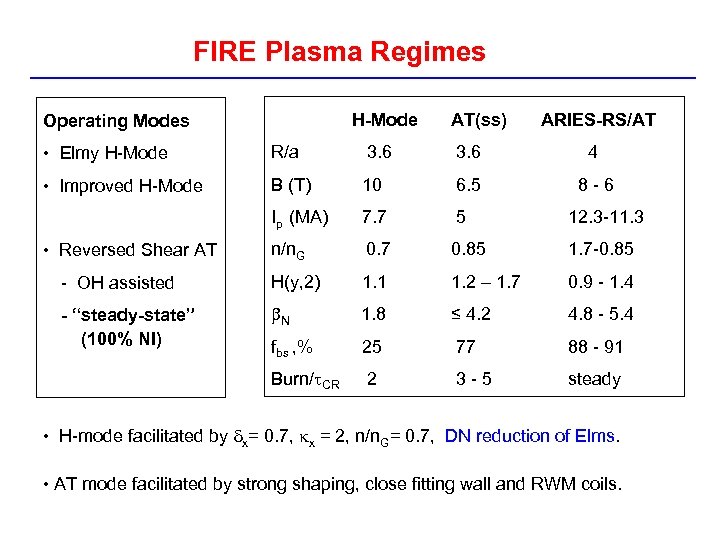 FIRE Plasma Regimes H-Mode Operating Modes AT(ss) ARIES-RS/AT • Elmy H-Mode R/a 3. 6 4 • Improved H-Mode B (T) 10 6. 5 8 -6 Ip (MA) 7. 7 5 12. 3 -11. 3 n/n. G 0. 7 0. 85 1. 7 -0. 85 - OH assisted H(y, 2) 1. 1 1. 2 – 1. 7 0. 9 - 1. 4 - “steady-state” (100% NI) N 1. 8 ≤ 4. 2 4. 8 - 5. 4 fbs , % 25 77 88 - 91 Burn/ CR 2 3 -5 steady • Reversed Shear AT • H-mode facilitated by dx= 0. 7, kx = 2, n/n. G= 0. 7, DN reduction of Elms. • AT mode facilitated by strong shaping, close fitting wall and RWM coils.
 Simulation of a Standard H-mode in FIRE - TSC • CTM ≈ GLF 23 • m = 1 sawtooth Model - Jardin et al • other effects to be added - Jardin et al FIRE, the Movie
 How Hard should the AT be Pushed? • Reactor studies ARIES and SSTR/CREST have determined requirements for a reactor. • Existing experiments, KSTAR and JT-SC would expand high N region at low field. • ITER would expand region to N ≈ 3 and fbs ≈ 50% at moderate magnetic field. • FIRE would expand region to N≈ 4 and fbs ≈ 80% at reactor-like magnetic field. 12
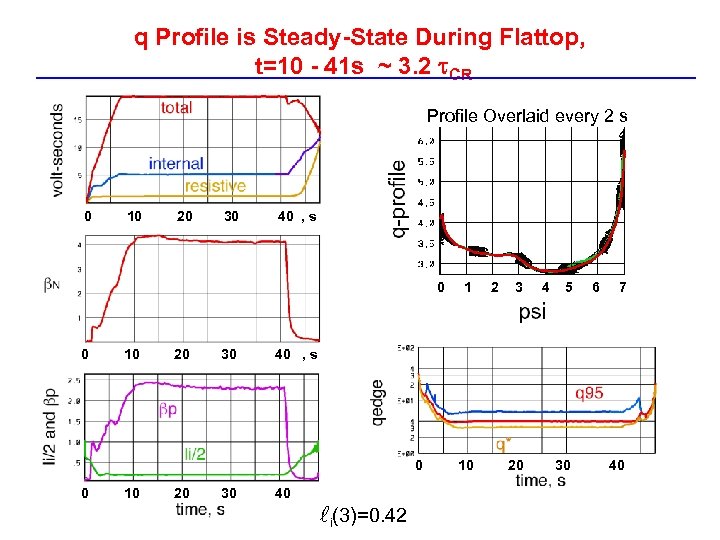
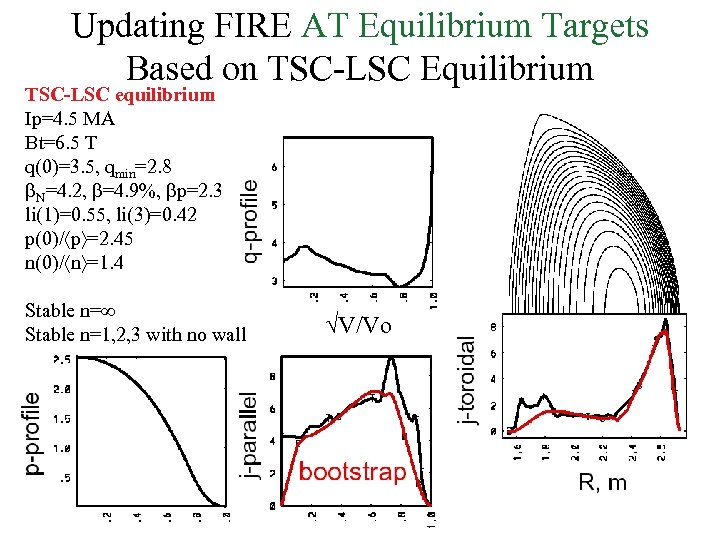 Updating FIRE AT Equilibrium Targets Based on TSC-LSC Equilibrium TSC-LSC equilibrium Ip=4. 5 MA Bt=6. 5 T q(0)=3. 5, qmin=2. 8 N=4. 2, =4. 9%, p=2. 3 li(1)=0. 55, li(3)=0. 42 p(0)/ p =2. 45 n(0)/ n =1. 4 Stable n=1, 2, 3 with no wall √V/Vo
 “Steady-State” High- b Advanced Tokamak Discharge on FIRE 0 1 2 3 4 time, (current redistributions)
 q Profile is Steady-State During Flattop, t=10 - 41 s ~ 3. 2 t. CR Profile Overlaid every 2 s 0 10 20 30 40 , s 0 0 10 20 30 2 3 4 5 6 7 40 , s 0 0 1 40 li(3)=0. 42 10 20 30 40
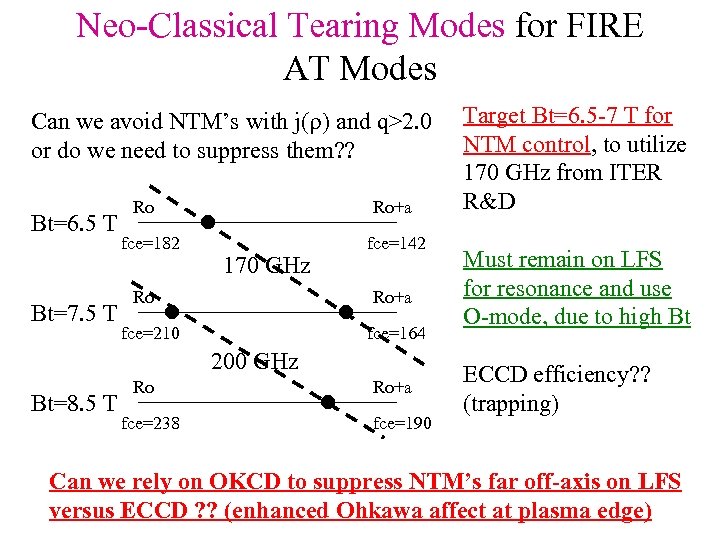 Neo-Classical Tearing Modes for FIRE AT Modes Can we avoid NTM’s with j( ) and q>2. 0 or do we need to suppress them? ? Bt=6. 5 T Bt=7. 5 T Ro fce=182 Ro Ro+a fce=142 170 GHz fce=210 Ro+a fce=164 200 GHz Bt=8. 5 T Ro fce=238 Ro+a fce=190 Target Bt=6. 5 -7 T for NTM control, to utilize 170 GHz from ITER R&D Must remain on LFS for resonance and use O-mode, due to high Bt ECCD efficiency? ? (trapping) Can we rely on OKCD to suppress NTM’s far off-axis on LFS versus ECCD ? ? (enhanced Ohkawa affect at plasma edge)
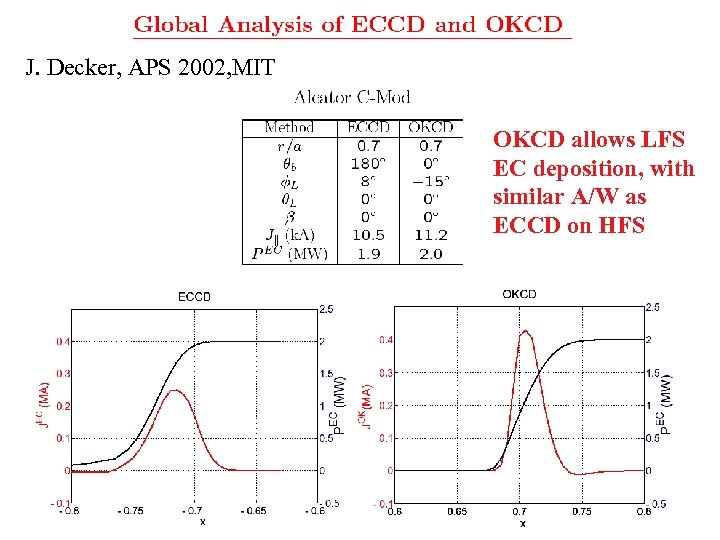 J. Decker, APS 2002, MIT OKCD allows LFS EC deposition, with similar A/W as ECCD on HFS
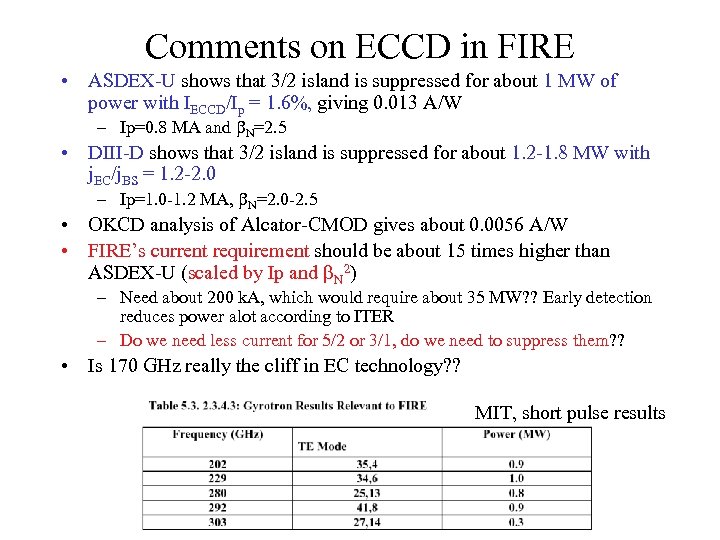 Comments on ECCD in FIRE • ASDEX-U shows that 3/2 island is suppressed for about 1 MW of power with IECCD/Ip = 1. 6%, giving 0. 013 A/W – Ip=0. 8 MA and N=2. 5 • DIII-D shows that 3/2 island is suppressed for about 1. 2 -1. 8 MW with j. EC/j. BS = 1. 2 -2. 0 – Ip=1. 0 -1. 2 MA, N=2. 0 -2. 5 • OKCD analysis of Alcator-CMOD gives about 0. 0056 A/W • FIRE’s current requirement should be about 15 times higher than ASDEX-U (scaled by Ip and N 2) – Need about 200 k. A, which would require about 35 MW? ? Early detection reduces power alot according to ITER – Do we need less current for 5/2 or 3/1, do we need to suppress them? ? • Is 170 GHz really the cliff in EC technology? ? MIT, short pulse results
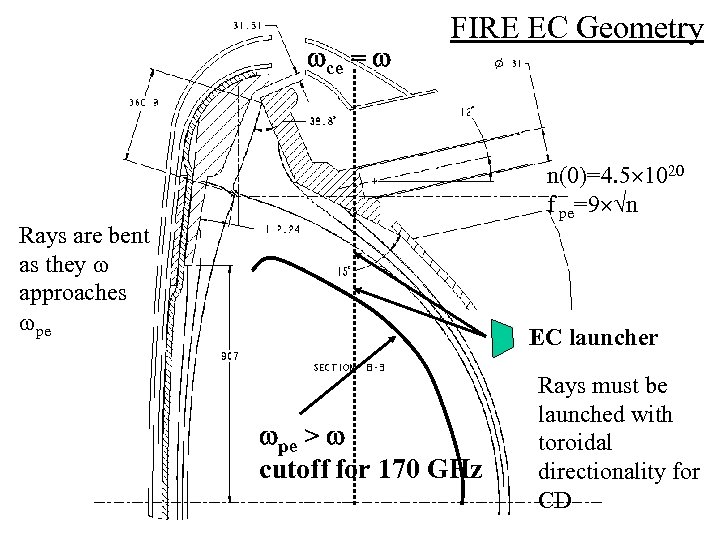 ce = FIRE EC Geometry n(0)=4. 5 1020 f pe=9 √n Rays are bent as they approaches pe EC launcher pe > cutoff for 170 GHz Rays must be launched with toroidal directionality for CD
 Disruptions in FIRE • • Adhere to ITER disruption guidelines - any major modifications envisioned? – quench = 0. 1 -0. 5 ms – d. Ip/dt(max) = 3 MA/ms – Ihalo(max) = 0. 25 Ip (peaking factors are to be used in Opera or VV analysis) Vertical disruption modeled by TSC to give dynamics and eddy currents – d. Ip/dt = 3 MA/ms – Ihalo = 2 MA Near midplane disruption – d. Ip/dt = 3 MA/ms – Ihalo = 2 MA Structure model (TSC-simplified, Opera-Sandia-Ulrickson, ORNL-Nelson) • Are neutrally stable DN disruptions different? , less violent? , less frequent? • Could a fast internal coil system help ameliorate VDE disruptions?
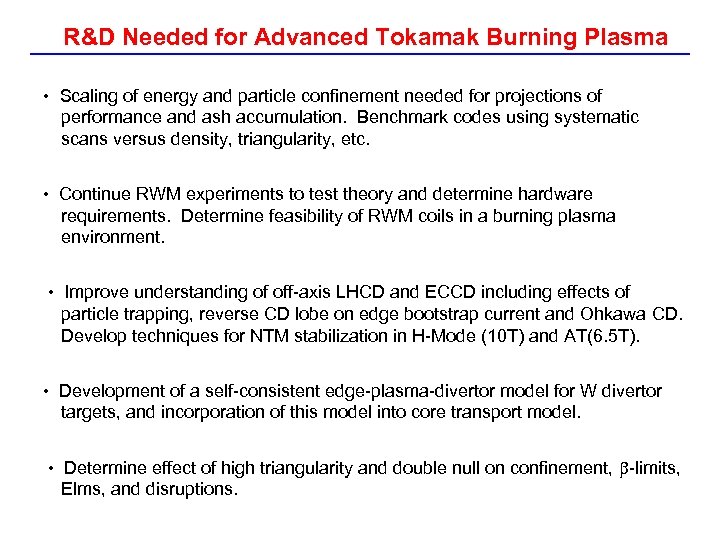 R&D Needed for Advanced Tokamak Burning Plasma • Scaling of energy and particle confinement needed for projections of performance and ash accumulation. Benchmark codes using systematic scans versus density, triangularity, etc. • Continue RWM experiments to test theory and determine hardware requirements. Determine feasibility of RWM coils in a burning plasma environment. • Improve understanding of off-axis LHCD and ECCD including effects of particle trapping, reverse CD lobe on edge bootstrap current and Ohkawa CD. Develop techniques for NTM stabilization in H-Mode (10 T) and AT(6. 5 T). • Development of a self-consistent edge-plasma-divertor model for W divertor targets, and incorporation of this model into core transport model. • Determine effect of high triangularity and double null on confinement, -limits, Elms, and disruptions.
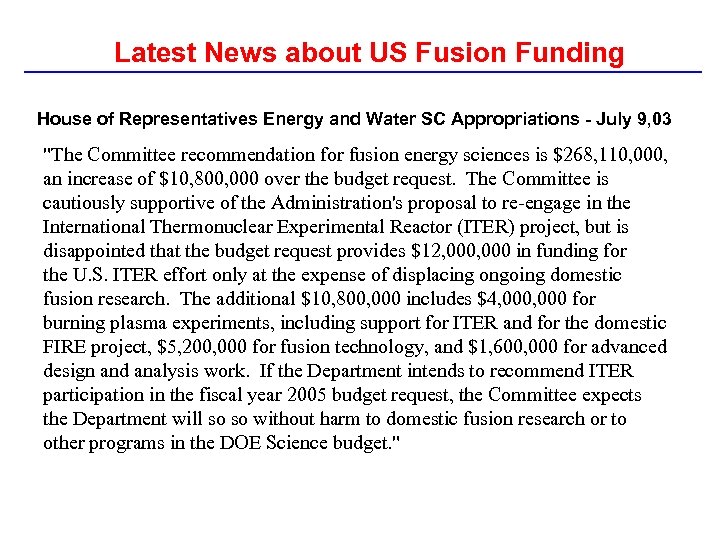 Latest News about US Fusion Funding House of Representatives Energy and Water SC Appropriations - July 9, 03 "The Committee recommendation for fusion energy sciences is $268, 110, 000, an increase of $10, 800, 000 over the budget request. The Committee is cautiously supportive of the Administration's proposal to re-engage in the International Thermonuclear Experimental Reactor (ITER) project, but is disappointed that the budget request provides $12, 000 in funding for the U. S. ITER effort only at the expense of displacing ongoing domestic fusion research. The additional $10, 800, 000 includes $4, 000 for burning plasma experiments, including support for ITER and for the domestic FIRE project, $5, 200, 000 for fusion technology, and $1, 600, 000 for advanced design and analysis work. If the Department intends to recommend ITER participation in the fiscal year 2005 budget request, the Committee expects the Department will so so without harm to domestic fusion research or to other programs in the DOE Science budget. "