


 Скачать презентацию Advanced safety technologies Contents 1 Car crash
Contents.pptx
- Количество слайдов: 14
 Advanced safety technologies
 Contents: 1 Car crash data 2 Advanced safety technologies: a) Electronic co-pilot b) Volvo city safety c) Biomimetic car robot drive

 Electronic co-pilot This is system of devises to support automated driven in specific situations It include: BMV Track Trainer Emergency Stop Assistant Parking Assistant Traffic Jam Accistent
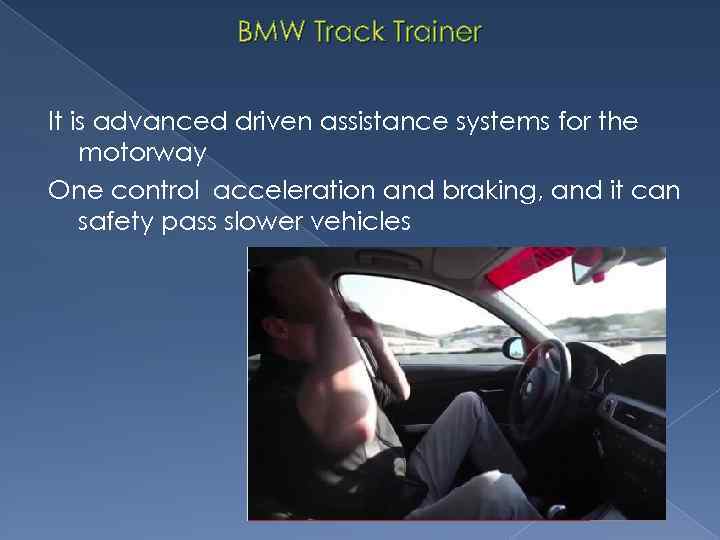 BMW Track Trainer It is advanced driven assistance systems for the motorway One control acceleration and braking, and it can safety pass slower vehicles
 Track Trainer uses a combination of GPS and INS data to create a precision position estimate of the vehicle states in real-time. Vehicle control is commanded to an ideal line recorded by a manually driven reference lap
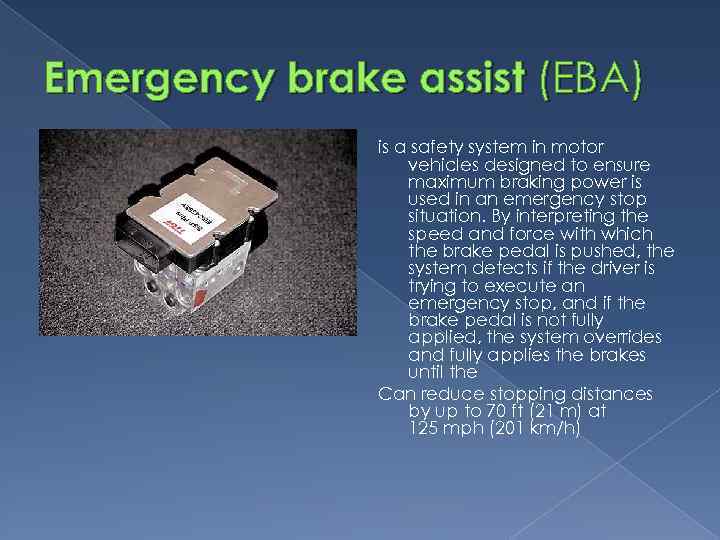 Emergency brake assist (EBA) is a safety system in motor vehicles designed to ensure maximum braking power is used in an emergency stop situation. By interpreting the speed and force with which the brake pedal is pushed, the system detects if the driver is trying to execute an emergency stop, and if the brake pedal is not fully applied, the system overrides and fully applies the brakes until the Can reduce stopping distances by up to 70 ft (21 m) at 125 mph (201 km/h)
 Volvo City Safety is an autonomous emergency braking system designed to help a driver avoid a low-speed crash or to reduce its severity. At vehicle speeds between 3. 6 km/h and 30 km/h, City Safety uses a lidar (Light Detection And Ranging) sensor positioned at the top of the windscreen to monitor an area 10 m ahead of the car for vehicles which might present a threat of collision.
 What is the safety benefit Volvo City Safety is a technology designed to mitigate and, in certain circumstances, avoid low speed rear-end collisions with vehicles which are stationary or travelling in the same direction. Rear end collisions are extremely common. According to some estimates, around a half of all accidents involve a rear-end collision. City Safety operates only up to 30 km/h so focuses on the sorts of rear end collisions which take place during urban driving. Fatal and severe injuries are not common for car occupants in accidents below 30 km/h. However, soft tissue ‘whiplash’ injuries are frequent, not only for the occupants of cars struck from behind but also for those in the striking vehicle. It is estimated that City Safety could provide a useful benefit (i. e. avert or mitigate the accident) in more than a half of all rear end collisions, and almost a fifth of all car to car collisions.
 What are limitations City Safety is turned on by default at the start of each new journey but can be switched off by the driver. If it switched off, the system defaults on again at the beginning of the next journey. City Safety functions only between 3. 6 km/h and 30 km/h, so will not assist in accidents at ‘highway’ speeds. Its lidar can detect vehicles which are at a standstill or which are travelling in the same direction and works at night as well as during the day. However, the sensor is compromised if it is covered by dirt or snow, or in adverse weather conditions such as thick fog or heavy rain. To mitigate this, the sensor is sited in the area which is swept by the windscreen wipers.
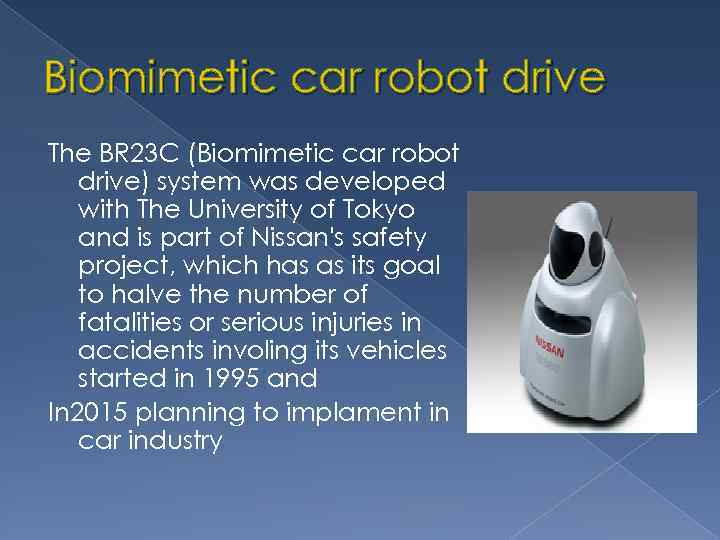 Biomimetic car robot drive The BR 23 C (Biomimetic car robot drive) system was developed with The University of Tokyo and is part of Nissan's safety project, which has as its goal to halve the number of fatalities or serious injuries in accidents involing its vehicles started in 1995 and In 2015 planning to implament in car industry
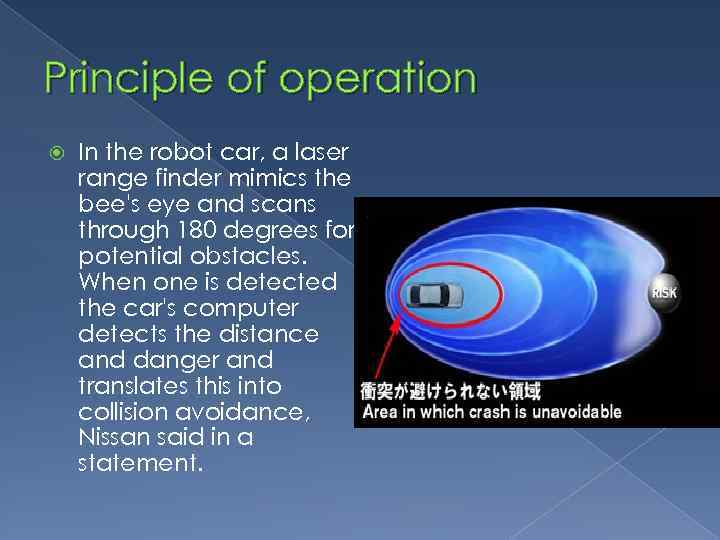 Principle of operation In the robot car, a laser range finder mimics the bee's eye and scans through 180 degrees for potential obstacles. When one is detected the car's computer detects the distance and danger and translates this into collision avoidance, Nissan said in a statement.
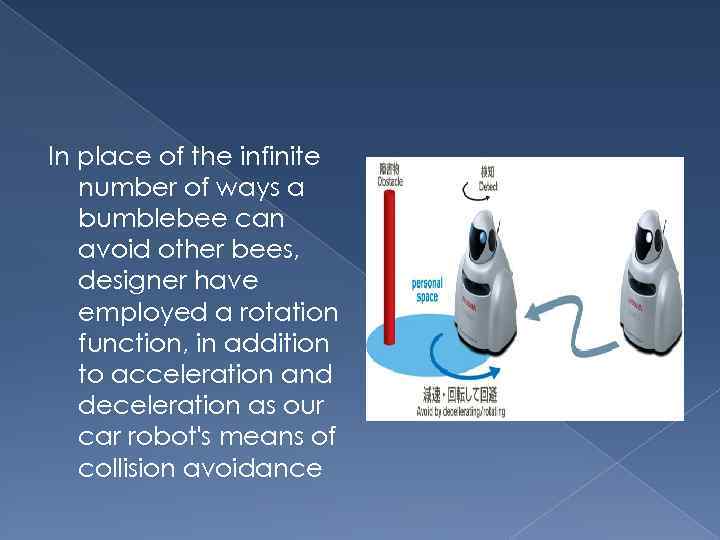 In place of the infinite number of ways a bumblebee can avoid other bees, designer have employed a rotation function, in addition to acceleration and deceleration as our car robot's means of collision avoidance
 Thank you for attention.