


 Скачать презентацию Advanced Range Technology Working Group July 2002 Contact
09fc27380c321aaff7e9307bc6af68e1.ppt
- Количество слайдов: 15
 Advanced Range Technology Working Group July 2002 Contact information: Kevin Brown Vice President, Business Development Command Control Technologies Corp. (321) 264 -1193 brownkr@cctcorp. com Copyright (c) 2002 Command Control Technologies Corporation. All rights reserved. PI-ARTWG-071502
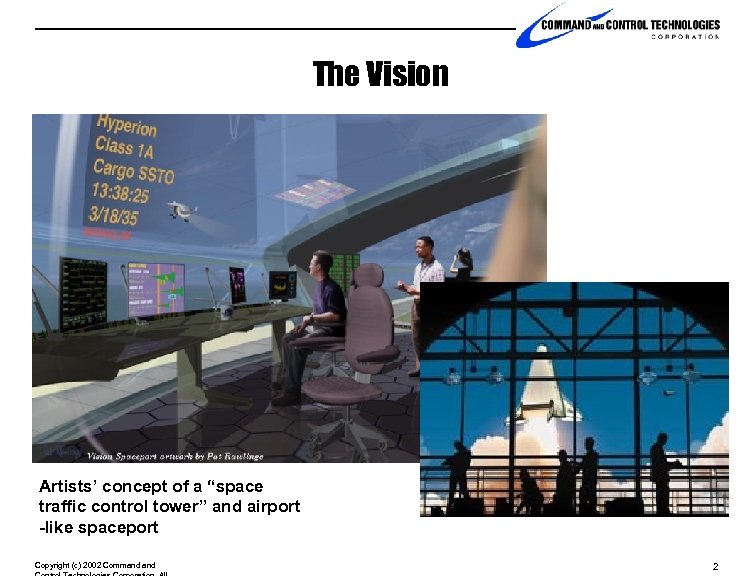 The Vision Artists’ concept of a “space traffic control tower” and airport -like spaceport Copyright (c) 2002 Command 2
 Next. Range™ Overview n n A comprehensive campaign to solving key technical, business, and regulatory challenges associated with creating new commercial launch ranges Built around an entrepreneurial approach to business planning Parallels NASA’s Advanced Space Transportation Plan initiative An investment in 2 nd generation range technology – 2010 Timeframe – 10 x cheaper – 100 x safer n n A key step toward 2 nd generation spaceports Pathway to 3 rd generation goals and an “aerospace traffic control system” Copyright 3/17/2018 (c) 2002 Command Page 3
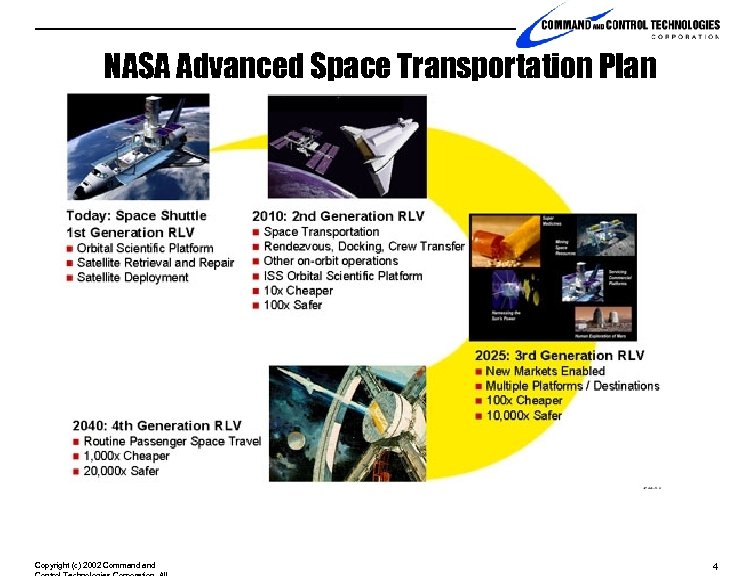 NASA Advanced Space Transportation Plan Copyright (c) 2002 Command 4
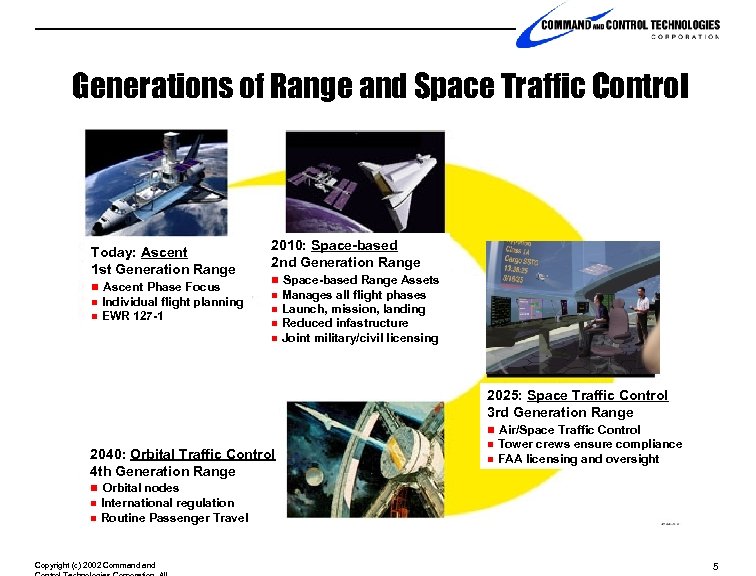 Generations of Range and Space Traffic Control Today: Ascent 1 st Generation Range n Ascent Phase Focus Individual flight planning n EWR 127 -1 n 2010: Space-based 2 nd Generation Range n Space-based Range Assets Manages all flight phases n Launch, mission, landing n Reduced infastructure n Joint military/civil licensing n 2025: Space Traffic Control 3 rd Generation Range n Air/Space Traffic Control 2040: Orbital Traffic Control 4 th Generation Range n n Tower crews ensure compliance FAA licensing and oversight n Orbital nodes International regulation n Routine Passenger Travel n Copyright (c) 2002 Command 5
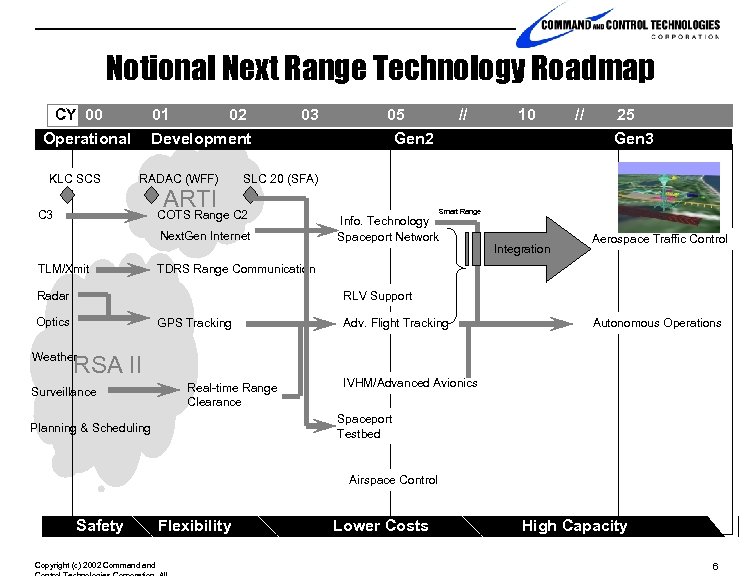 Notional Next Range Technology Roadmap CY 00 01 Operational KLC SCS 02 03 05 Development RADAC (WFF) C 3 ARTI 10 Gen 2 // 25 Gen 3 SLC 20 (SFA) COTS Range C 2 Next. Gen Internet TLM/Xmit // Info. Technology Spaceport Network Smart Range Integration Aerospace Traffic Control TDRS Range Communication Radar RLV Support Optics GPS Tracking Adv. Flight Tracking Autonomous Operations Weather RSA II Surveillance Real-time Range Clearance IVHM/Advanced Avionics Spaceport Testbed Planning & Scheduling Airspace Control Safety Copyright (c) 2002 Command Flexibility Lower Costs High Capacity 6
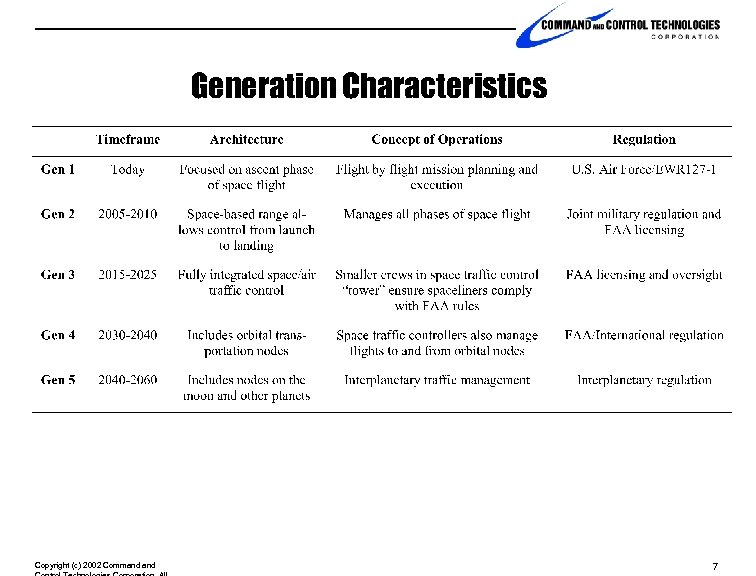 Generation Characteristics Copyright (c) 2002 Command 7
 2 nd Generation Copyright (c) 2002 Command 8
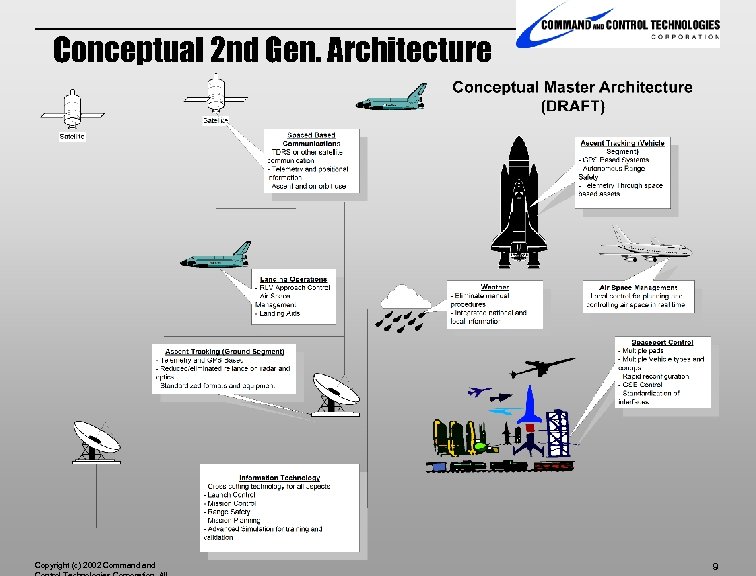 Conceptual 2 nd Gen. Architecture Copyright (c) 2002 Command 9
 “Smart Range” Introduction Problem • Current range technology is inadequate to create spaceports that, operating more like airports, could enable revolutionary long-term missions such as space solar power and public space access. • Little advanced automation technology is used in range operations. Rather, today’s ranges rely on a vast network of highly manual systems. Efforts to replace currently-used 1960’s technology with 1980’s-era systems are insufficient to support high flight rates and dramatic cost reductions. • Applying intelligent systems technology to range operations could produce revolutionary advances in operational capacity and affordability. Proposal - The “Smart Range” - a key part of the Next Generation Range • Develop a system of software and hardware components that are capable of making range configuration decisions and supporting range safety decisionmaking. This would apply intelligent systems technology to the most manpower-intensive elements of range operations, resulting in a demonstration of the feasibility of automated configuration and operations support. Copyright (c) 2002 Command 10
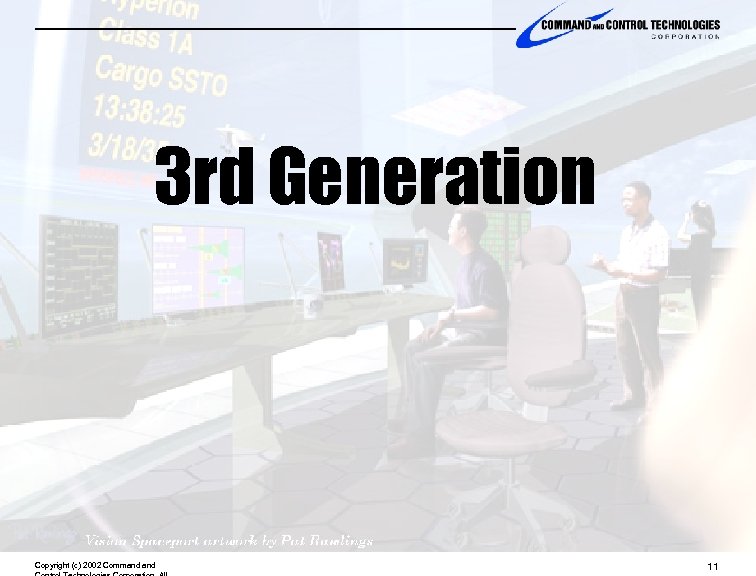 3 rd Generation Copyright (c) 2002 Command 11
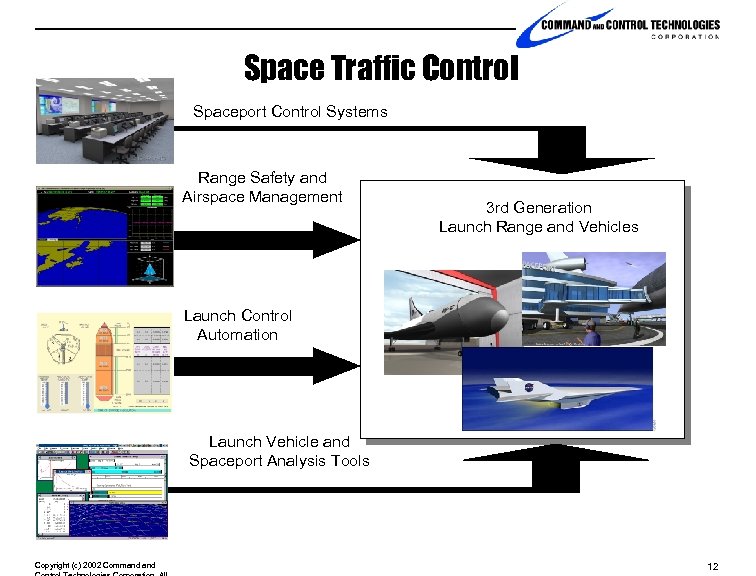 Space Traffic Control Spaceport Control Systems Range Safety and Airspace Management 3 rd Generation Launch Range and Vehicles Launch Control Automation Launch Vehicle and Spaceport Analysis Tools Copyright (c) 2002 Command 12
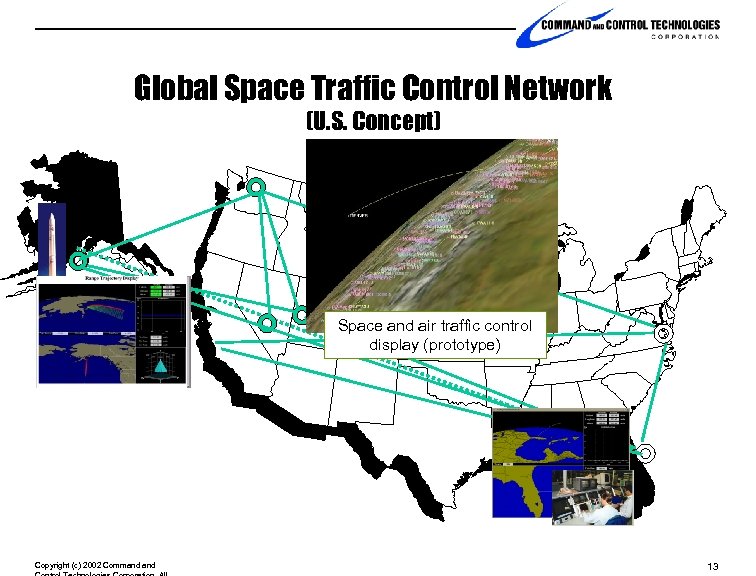 Global Space Traffic Control Network (U. S. Concept) Space and air traffic control display (prototype) Copyright (c) 2002 Command 13
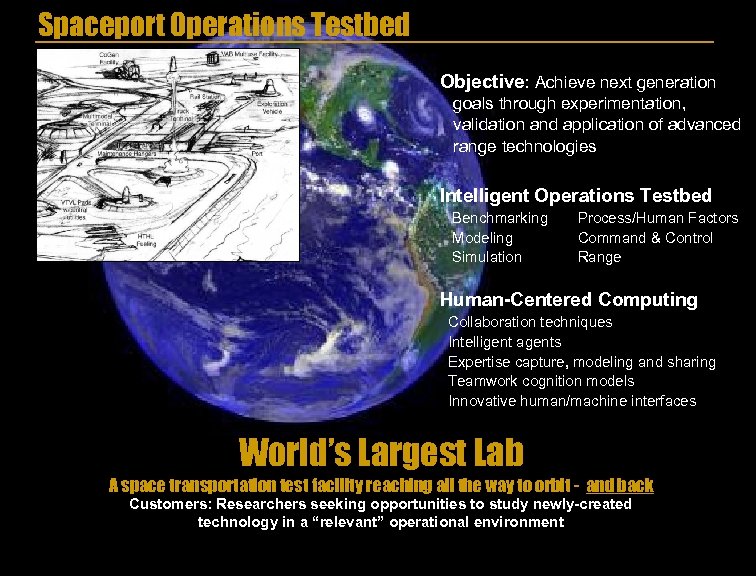 Spaceport Operations Testbed Objective: Achieve next generation goals through experimentation, validation and application of advanced range technologies Intelligent Operations Testbed Benchmarking Modeling Simulation Process/Human Factors Command & Control Range Human-Centered Computing Collaboration techniques Intelligent agents Expertise capture, modeling and sharing Teamwork cognition models Innovative human/machine interfaces World’s Largest Lab A space transportation test facility reaching all the way to orbit - and back Customers: Researchers seeking opportunities to study newly-created technology in a “relevant” operational environment Copyright (c) 2002 Command 14
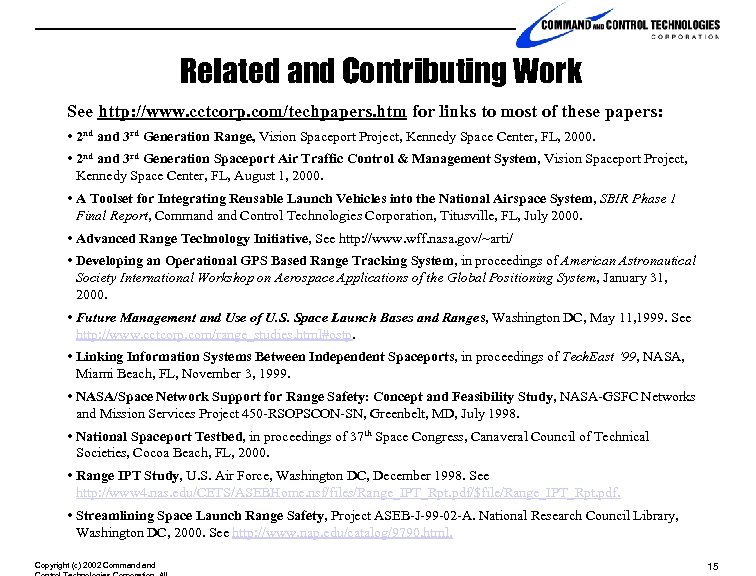 Related and Contributing Work See http: //www. cctcorp. com/techpapers. htm for links to most of these papers: • 2 nd and 3 rd Generation Range, Vision Spaceport Project, Kennedy Space Center, FL, 2000. • 2 nd and 3 rd Generation Spaceport Air Traffic Control & Management System, Vision Spaceport Project, Kennedy Space Center, FL, August 1, 2000. • A Toolset for Integrating Reusable Launch Vehicles into the National Airspace System, SBIR Phase 1 Final Report, Command Control Technologies Corporation, Titusville, FL, July 2000. • Advanced Range Technology Initiative, See http: //www. wff. nasa. gov/~arti/ • Developing an Operational GPS Based Range Tracking System, in proceedings of American Astronautical Society International Workshop on Aerospace Applications of the Global Positioning System, January 31, 2000. • Future Management and Use of U. S. Space Launch Bases and Ranges, Washington DC, May 11, 1999. See http: //www. cctcorp. com/range_studies. html#ostp. • Linking Information Systems Between Independent Spaceports, in proceedings of Tech. East ’ 99, NASA, Miami Beach, FL, November 3, 1999. • NASA/Space Network Support for Range Safety: Concept and Feasibility Study, NASA-GSFC Networks and Mission Services Project 450 -RSOPSCON-SN, Greenbelt, MD, July 1998. • National Spaceport Testbed, in proceedings of 37 th Space Congress, Canaveral Council of Technical Societies, Cocoa Beach, FL, 2000. • Range IPT Study, U. S. Air Force, Washington DC, December 1998. See http: //www 4. nas. edu/CETS/ASEBHome. nsf/files/Range_IPT_Rpt. pdf/$file/Range_IPT_Rpt. pdf. • Streamlining Space Launch Range Safety, Project ASEB-J-99 -02 -A. National Research Council Library, Washington DC, 2000. See http: //www. nap. edu/catalog/9790. html. Copyright (c) 2002 Command 15