


 Скачать презентацию Advanced Power Point Presentation 2009 The National
234d05ceb92e9ebef60e2c42873458b4.ppt
- Количество слайдов: 26
 Advanced Power. Point Presentation © 2009 The National Underwriter Company 1
 This Advanced Power. Point Presentation accompanies the “Tools & Techniques of Risk Management & Insurance” textbook. Each of the 28 chapters in the textbook are presented here in the following sections: Outline Key concepts Major sections Chapter summary © 2009 The National Underwriter Company 2
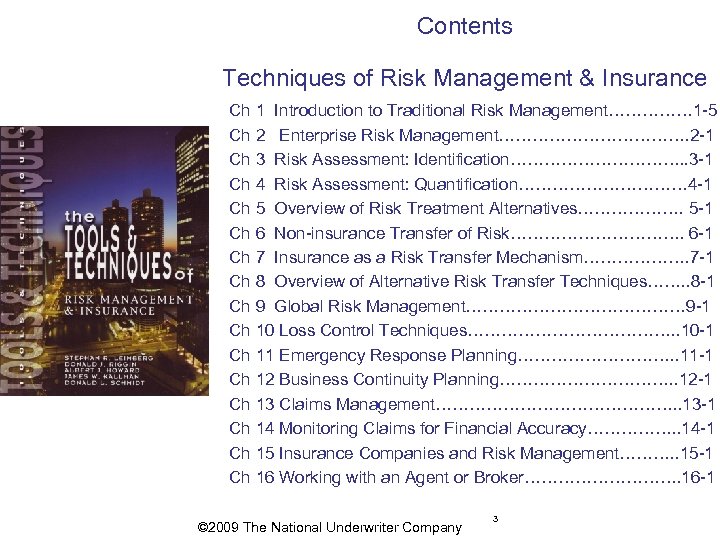 Contents Techniques of Risk Management & Insurance Ch 1 Introduction to Traditional Risk Management…………… 1 -5 Ch 2 Enterprise Risk Management………………. 2 -1 Ch 3 Risk Assessment: Identification……………. . 3 -1 Ch 4 Risk Assessment: Quantification…………… 4 -1 Ch 5 Overview of Risk Treatment Alternatives………………. 5 -1 Ch 6 Non-insurance Transfer of Risk……………. 6 -1 Ch 7 Insurance as a Risk Transfer Mechanism………………. 7 -1 Ch 8 Overview of Alternative Risk Transfer Techniques……. . 8 -1 Ch 9 Global Risk Management………………… 9 -1 Ch 10 Loss Control Techniques………………. . 10 -1 Ch 11 Emergency Response Planning……………. . 11 -1 Ch 12 Business Continuity Planning……………. . 12 -1 Ch 13 Claims Management…………………. . 13 -1 Ch 14 Monitoring Claims for Financial Accuracy……………. . 14 -1 Ch 15 Insurance Companies and Risk Management………. . 15 -1 Ch 16 Working with an Agent or Broker……………. 16 -1 © 2009 The National Underwriter Company 3
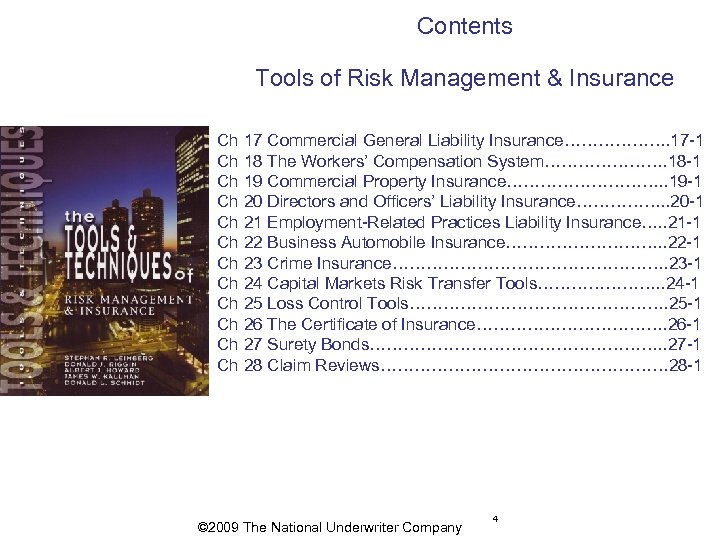 Contents Tools of Risk Management & Insurance Ch 17 Commercial General Liability Insurance………………. 17 -1 Ch 18 The Workers’ Compensation System…………………. 18 -1 Ch 19 Commercial Property Insurance……………. . 19 -1 Ch 20 Directors and Officers’ Liability Insurance……………. . 20 -1 Ch 21 Employment-Related Practices Liability Insurance…. . 21 -1 Ch 22 Business Automobile Insurance……………. . 22 -1 Ch 23 Crime Insurance……………………. 23 -1 Ch 24 Capital Markets Risk Transfer Tools…………………. . 24 -1 Ch 25 Loss Control Tools……………………. 25 -1 Ch 26 The Certificate of Insurance………………. 26 -1 Ch 27 Surety Bonds………………………. . 27 -1 Ch 28 Claim Reviews……………………… 28 -1 © 2009 The National Underwriter Company 4
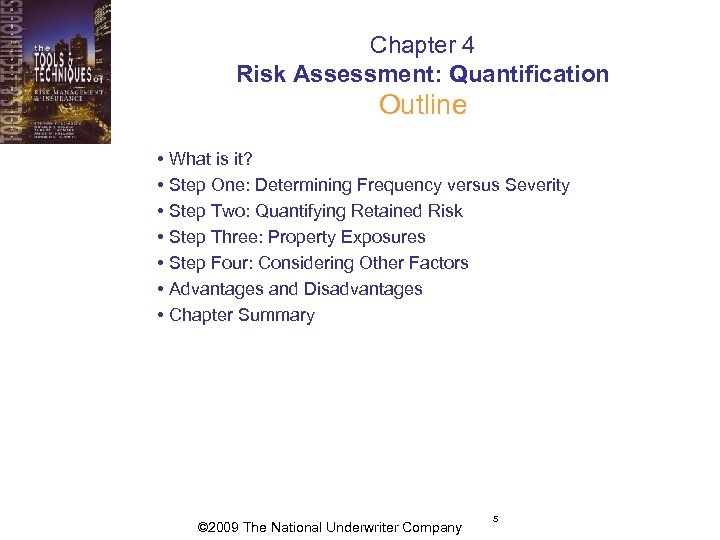 Chapter 4 Risk Assessment: Quantification Outline • What is it? • Step One: Determining Frequency versus Severity • Step Two: Quantifying Retained Risk • Step Three: Property Exposures • Step Four: Considering Other Factors • Advantages and Disadvantages • Chapter Summary © 2009 The National Underwriter Company 5
 Chapter 4 Risk Assessment: Quantification What is it? • Risk assessment includes risk identification and quantification • Risk quantification is an extremely inexact science • The purpose of risk quantification is to determine the optimal amount of retained losses • Optimization assumes: • Insurance costs are optimized, and • retained loss costs are reasonably predictable • The risk quantification process compares exposure values to : • loss frequency and loss severity, and • the cost of insurance © 2009 The National Underwriter Company 6
 Chapter 4 Risk Assessment: Quantification What is it? Supplement • Two types of risk assessment • Quantitative • Qualitative • Quantitative • Measures exposure’s value • expected outcome • associated possible changes in value • likelihood of each possibility over time © 2009 The National Underwriter Company 7
 Chapter 4 Risk Assessment: Quantification What is it? Supplement • Valuable information obtained • Time of the occurrence • Length or duration • Expected outcome (arithmetic mean) • Mode • Median • Standard deviation from the mean • Range • Coefficient of variation © 2009 The National Underwriter Company 8
 Chapter 4 Risk Assessment: Quantification What is it? Supplement • Loss triangulation • An important tool in forecasting ultimate loss values • Different meaning for “terms of art” across disciplines • To avoid confusion… • Exposures – changing the E in COPE to “”environment” • Replacing “guaranteed cost” with “guaranteed rate” • Using “self-funding” in place of “self insurance” © 2009 The National Underwriter Company 9
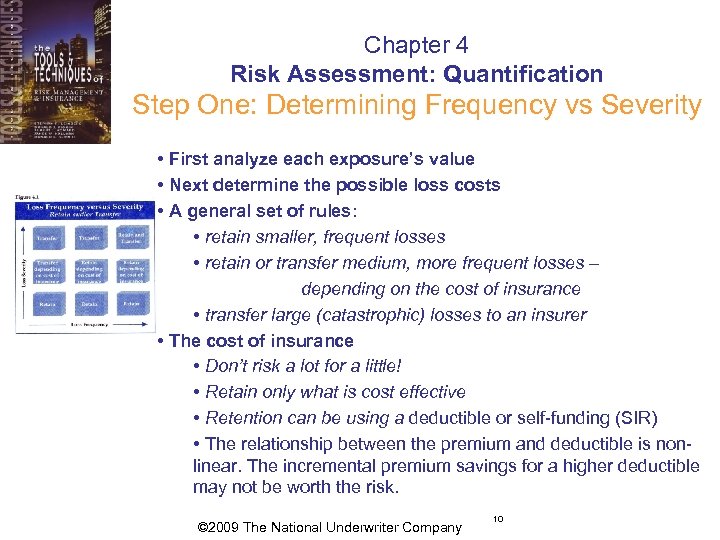 Chapter 4 Risk Assessment: Quantification Step One: Determining Frequency vs Severity • First analyze each exposure’s value • Next determine the possible loss costs • A general set of rules: • retain smaller, frequent losses • retain or transfer medium, more frequent losses – depending on the cost of insurance • transfer large (catastrophic) losses to an insurer • The cost of insurance • Don’t risk a lot for a little! • Retain only what is cost effective • Retention can be using a deductible or self-funding (SIR) • The relationship between the premium and deductible is nonlinear. The incremental premium savings for a higher deductible may not be worth the risk. © 2009 The National Underwriter Company 10
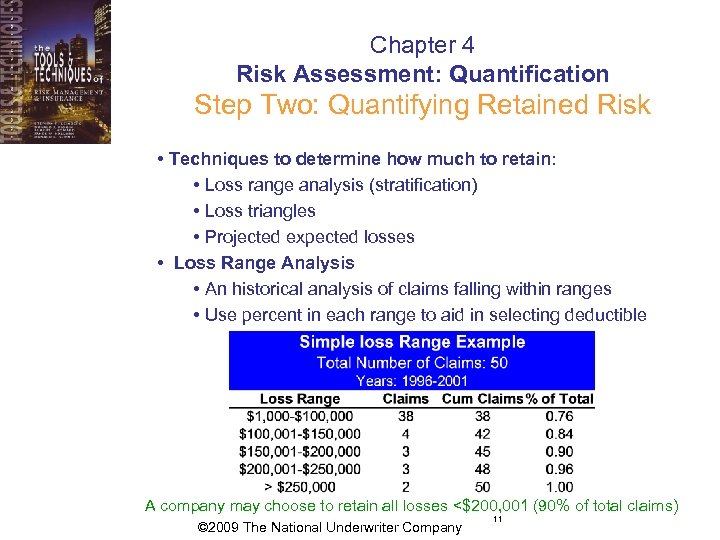 Chapter 4 Risk Assessment: Quantification Step Two: Quantifying Retained Risk • Techniques to determine how much to retain: • Loss range analysis (stratification) • Loss triangles • Projected expected losses • Loss Range Analysis • An historical analysis of claims falling within ranges • Use percent in each range to aid in selecting deductible A company may choose to retain all losses <$200, 001 (90% of total claims) © 2009 The National Underwriter Company 11
 Chapter 4 Risk Assessment: Quantification Step Two: Quantifying Retained Risk • Loss Triangles • The purpose is to determine the ultimate loss value (payment) • The process is called loss development • Historic data is used to determine loss development factors • The factors are used to grow historic data to a forecast date © 2009 The National Underwriter Company 12
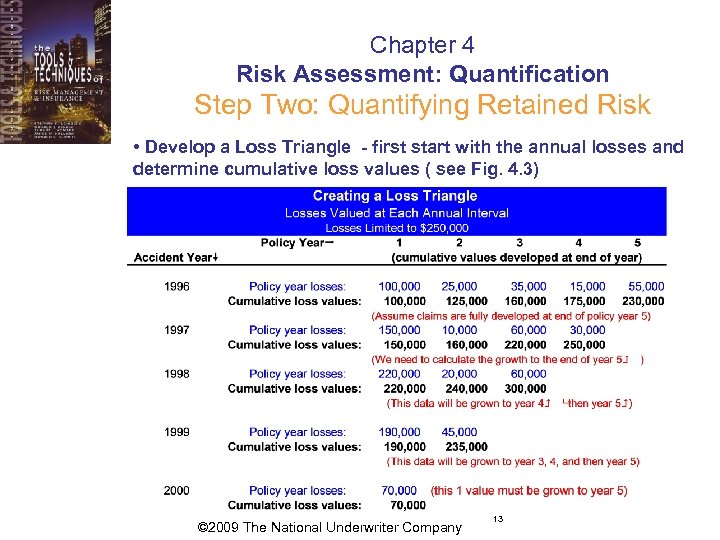 Chapter 4 Risk Assessment: Quantification Step Two: Quantifying Retained Risk • Develop a Loss Triangle - first start with the annual losses and determine cumulative loss values ( see Fig. 4. 3) © 2009 The National Underwriter Company 13
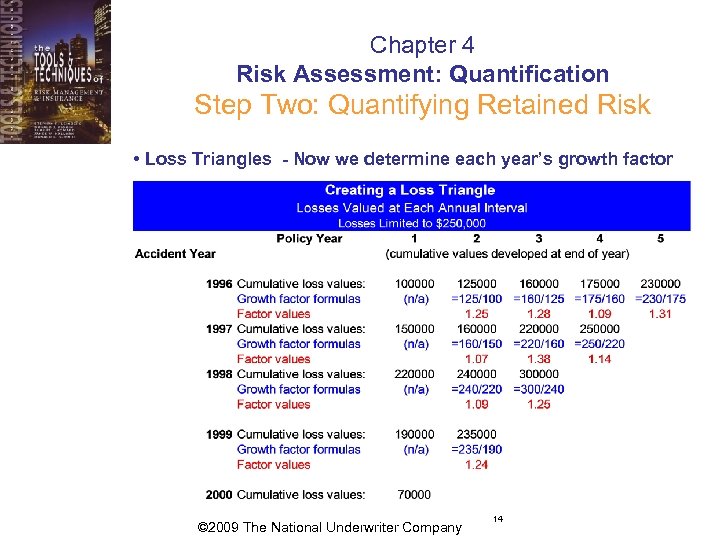 Chapter 4 Risk Assessment: Quantification Step Two: Quantifying Retained Risk • Loss Triangles - Now we determine each year’s growth factor © 2009 The National Underwriter Company 14
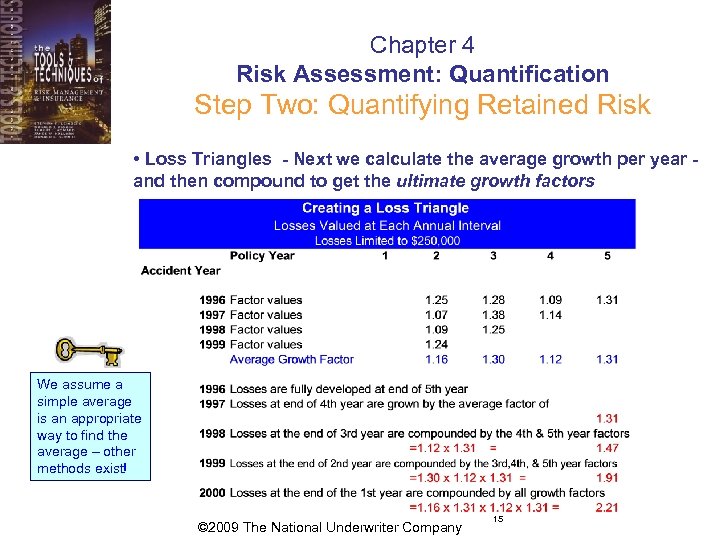 Chapter 4 Risk Assessment: Quantification Step Two: Quantifying Retained Risk • Loss Triangles - Next we calculate the average growth per year and then compound to get the ultimate growth factors We assume a simple average is an appropriate way to find the average – other methods exist! © 2009 The National Underwriter Company 15
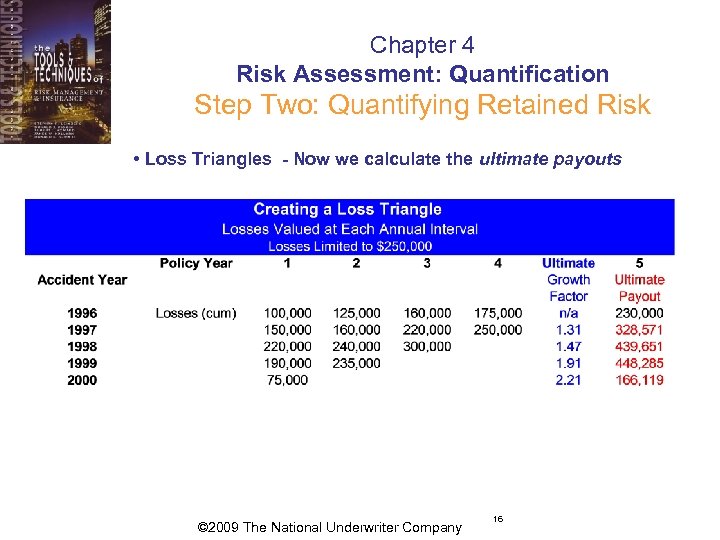 Chapter 4 Risk Assessment: Quantification Step Two: Quantifying Retained Risk • Loss Triangles - Now we calculate the ultimate payouts © 2009 The National Underwriter Company 16
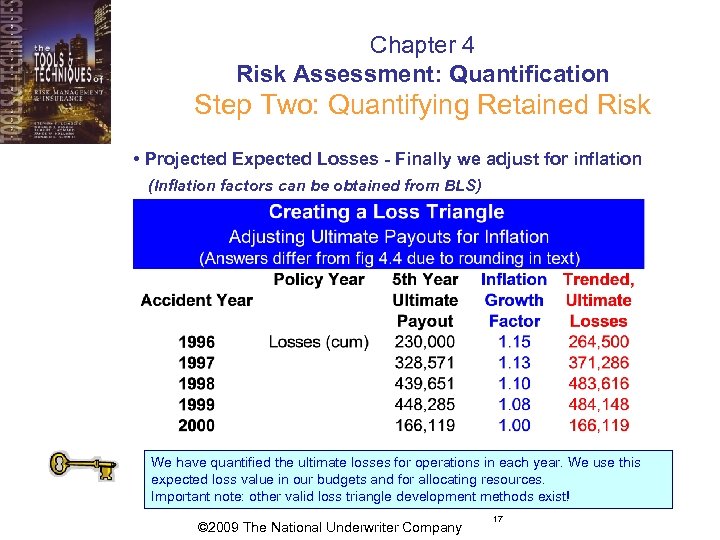 Chapter 4 Risk Assessment: Quantification Step Two: Quantifying Retained Risk • Projected Expected Losses - Finally we adjust for inflation (Inflation factors can be obtained from BLS) We have quantified the ultimate losses for operations in each year. We use this expected loss value in our budgets and for allocating resources. Important note: other valid loss triangle development methods exist! © 2009 The National Underwriter Company 17
 Chapter 4 Risk Assessment: Quantification Step Three: Property Exposures • Property exposure loss quantification uses a different method to quantify the loss values • Property losses usually develop to their ultimate value within one operating period • Three loss values are estimated: • mean value ( E(L), , ) (or mode or median loss value from historic data) • Maximum possible loss (MPL) (worst case scenario – building burns to the ground!) • Probably maximum loss (PML) (realistic worst case scenario –the fire department will respond) • Prior to 9/11 the MPL was rarely considered © 2009 The National Underwriter Company 18
 Chapter 4 Risk Assessment: Quantification Step Four: Considering Other Factors • Three additional factors should be considered in quantifying the risks: • Impact of Actuarial Credibility on Insurance Pricing • Cash flow Analysis • Benchmarking © 2009 The National Underwriter Company 19
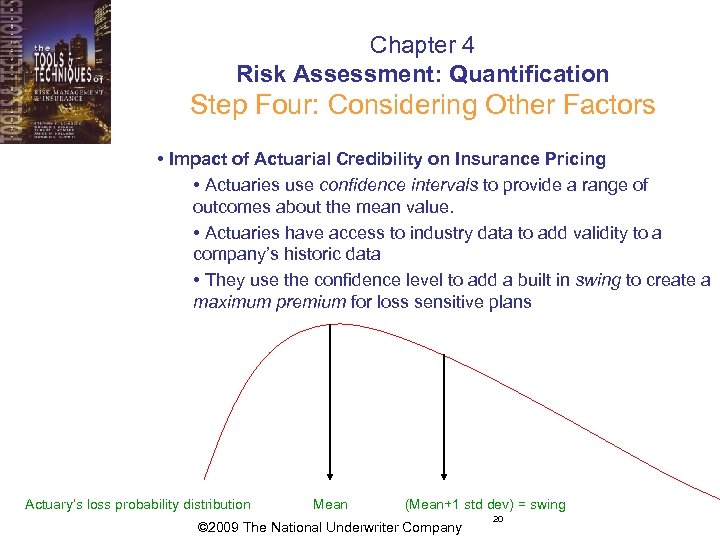 Chapter 4 Risk Assessment: Quantification Step Four: Considering Other Factors • Impact of Actuarial Credibility on Insurance Pricing • Actuaries use confidence intervals to provide a range of outcomes about the mean value. • Actuaries have access to industry data to add validity to a company’s historic data • They use the confidence level to add a built in swing to create a maximum premium for loss sensitive plans Actuary’s loss probability distribution Mean (Mean+1 std dev) = swing © 2009 The National Underwriter Company 20
 Chapter 4 Risk Assessment: Quantification Step Four: Considering Other Factors • Cash flow Analysis • A CF analysis represents the true long-term value (NPV) • An analysis is done on the two main types of risk financing • Guaranteed Rate Insurance • Self-funded combined with Excess Insurance Guaranteed Rate Insurance The rate per exposure unit is guaranteed at the policy inception. At expiration an audit on the exposure basis is done. The guaranteed rate is applied to the actual exposure basis (also called a guaranteed cost). The deposit premium paid at inception has no cash flow benefits. If paid over time the cash flows are discounted to the present value – creating a CF benefit © 2009 The National Underwriter Company 21
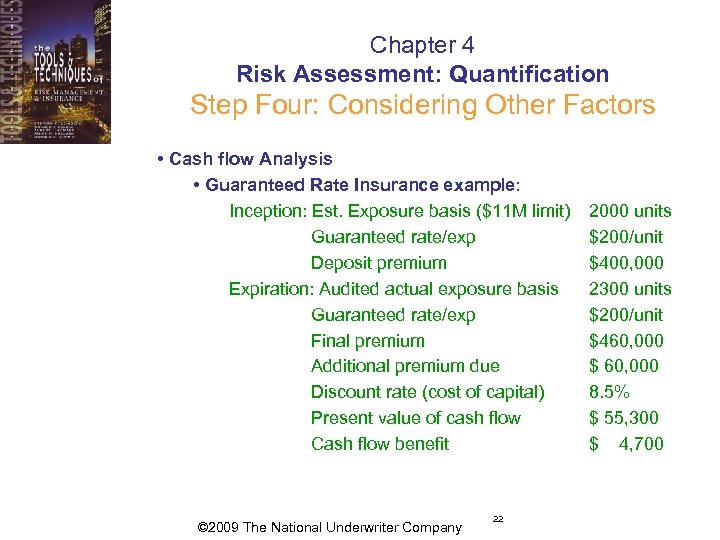 Chapter 4 Risk Assessment: Quantification Step Four: Considering Other Factors • Cash flow Analysis • Guaranteed Rate Insurance example: Inception: Est. Exposure basis ($11 M limit) Guaranteed rate/exp Deposit premium Expiration: Audited actual exposure basis Guaranteed rate/exp Final premium Additional premium due Discount rate (cost of capital) Present value of cash flow Cash flow benefit © 2009 The National Underwriter Company 22 2000 units $200/unit $400, 000 2300 units $200/unit $460, 000 $ 60, 000 8. 5% $ 55, 300 $ 4, 700
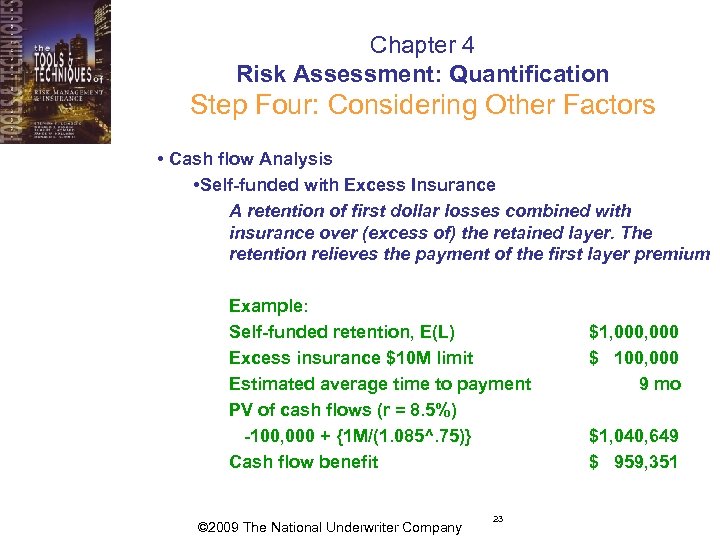 Chapter 4 Risk Assessment: Quantification Step Four: Considering Other Factors • Cash flow Analysis • Self-funded with Excess Insurance A retention of first dollar losses combined with insurance over (excess of) the retained layer. The retention relieves the payment of the first layer premium Example: Self-funded retention, E(L) Excess insurance $10 M limit Estimated average time to payment PV of cash flows (r = 8. 5%) -100, 000 + {1 M/(1. 085^. 75)} Cash flow benefit © 2009 The National Underwriter Company 23 $1, 000 $ 100, 000 9 mo $1, 040, 649 $ 959, 351
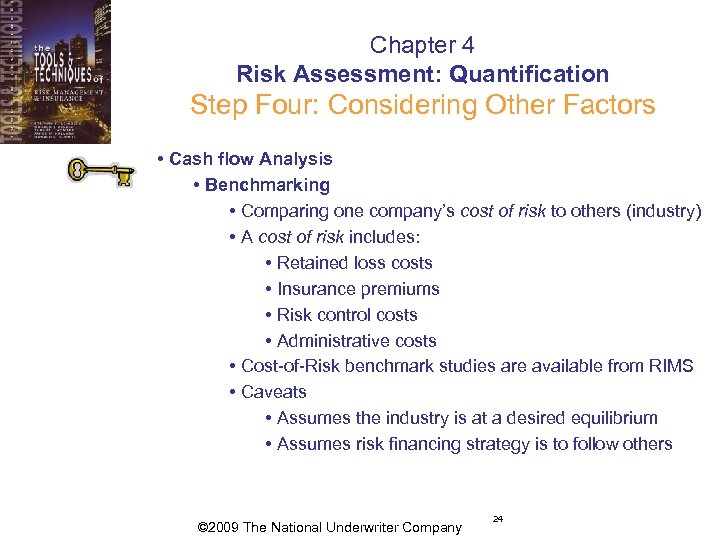 Chapter 4 Risk Assessment: Quantification Step Four: Considering Other Factors • Cash flow Analysis • Benchmarking • Comparing one company’s cost of risk to others (industry) • A cost of risk includes: • Retained loss costs • Insurance premiums • Risk control costs • Administrative costs • Cost-of-Risk benchmark studies are available from RIMS • Caveats • Assumes the industry is at a desired equilibrium • Assumes risk financing strategy is to follow others © 2009 The National Underwriter Company 24
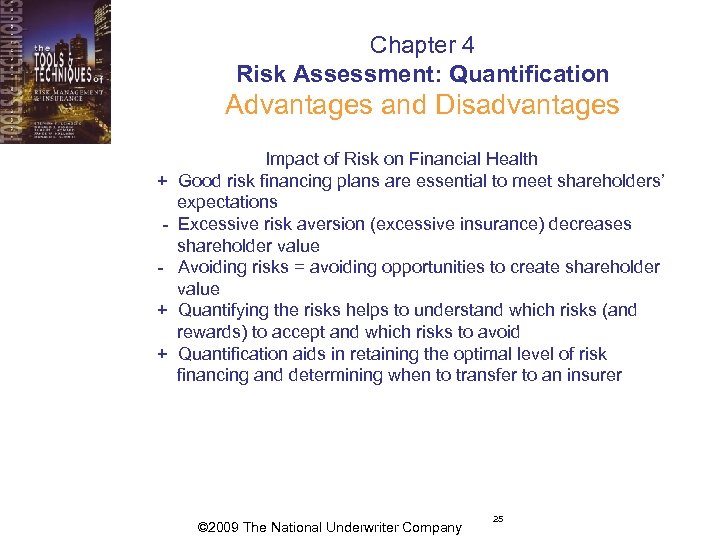 Chapter 4 Risk Assessment: Quantification Advantages and Disadvantages + + + Impact of Risk on Financial Health Good risk financing plans are essential to meet shareholders’ expectations Excessive risk aversion (excessive insurance) decreases shareholder value Avoiding risks = avoiding opportunities to create shareholder value Quantifying the risks helps to understand which risks (and rewards) to accept and which risks to avoid Quantification aids in retaining the optimal level of risk financing and determining when to transfer to an insurer © 2009 The National Underwriter Company 25
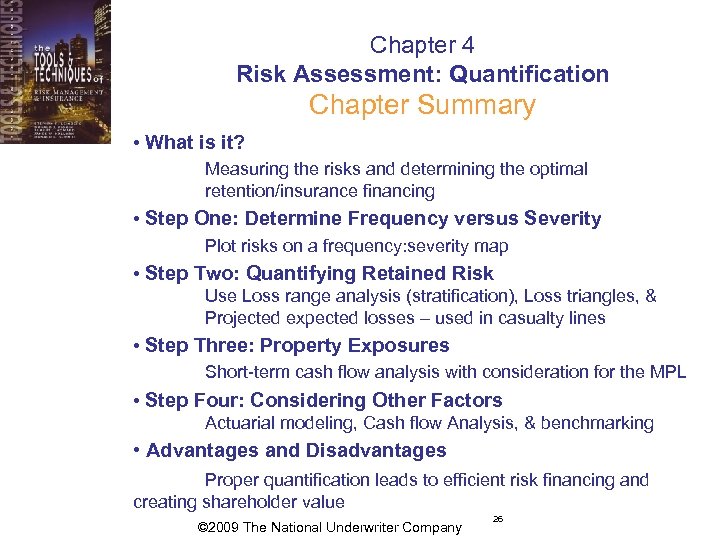 Chapter 4 Risk Assessment: Quantification Chapter Summary • What is it? Measuring the risks and determining the optimal retention/insurance financing • Step One: Determine Frequency versus Severity Plot risks on a frequency: severity map • Step Two: Quantifying Retained Risk Use Loss range analysis (stratification), Loss triangles, & Projected expected losses – used in casualty lines • Step Three: Property Exposures Short-term cash flow analysis with consideration for the MPL • Step Four: Considering Other Factors Actuarial modeling, Cash flow Analysis, & benchmarking • Advantages and Disadvantages Proper quantification leads to efficient risk financing and creating shareholder value © 2009 The National Underwriter Company 26