


 Скачать презентацию Advanced Power Point Presentation 2009 The National
4ff80f01e3b4f4569ef95c24b8f4d8ac.ppt
- Количество слайдов: 32
 Advanced Power. Point Presentation © 2009 The National Underwriter Company 1
 This Advanced Power. Point Presentation accompanies the “Tools & Techniques of Risk Management & Insurance” textbook. Each of the 28 chapters in the textbook are presented here in the following sections: Outline Key concepts Major sections Chapter summary © 2009 The National Underwriter Company 2
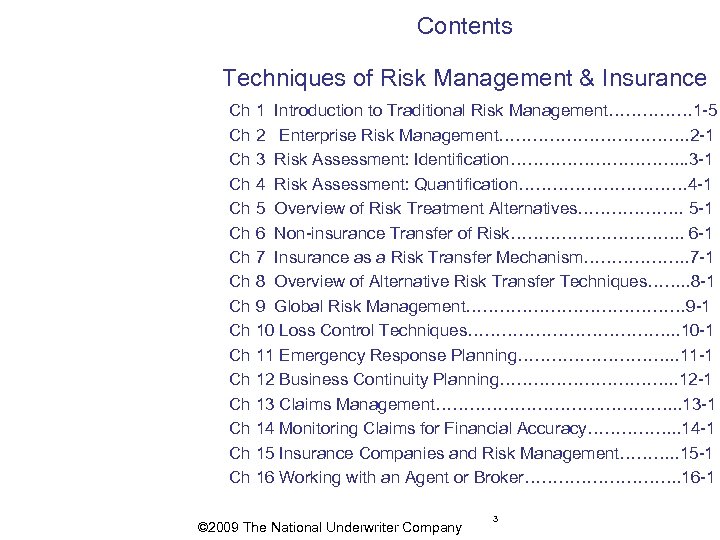 Contents Techniques of Risk Management & Insurance Ch 1 Introduction to Traditional Risk Management…………… 1 -5 Ch 2 Enterprise Risk Management………………. 2 -1 Ch 3 Risk Assessment: Identification……………. . 3 -1 Ch 4 Risk Assessment: Quantification…………… 4 -1 Ch 5 Overview of Risk Treatment Alternatives………………. 5 -1 Ch 6 Non-insurance Transfer of Risk……………. 6 -1 Ch 7 Insurance as a Risk Transfer Mechanism………………. 7 -1 Ch 8 Overview of Alternative Risk Transfer Techniques……. . 8 -1 Ch 9 Global Risk Management………………… 9 -1 Ch 10 Loss Control Techniques………………. . 10 -1 Ch 11 Emergency Response Planning……………. . 11 -1 Ch 12 Business Continuity Planning……………. . 12 -1 Ch 13 Claims Management…………………. . 13 -1 Ch 14 Monitoring Claims for Financial Accuracy……………. . 14 -1 Ch 15 Insurance Companies and Risk Management………. . 15 -1 Ch 16 Working with an Agent or Broker……………. 16 -1 © 2009 The National Underwriter Company 3
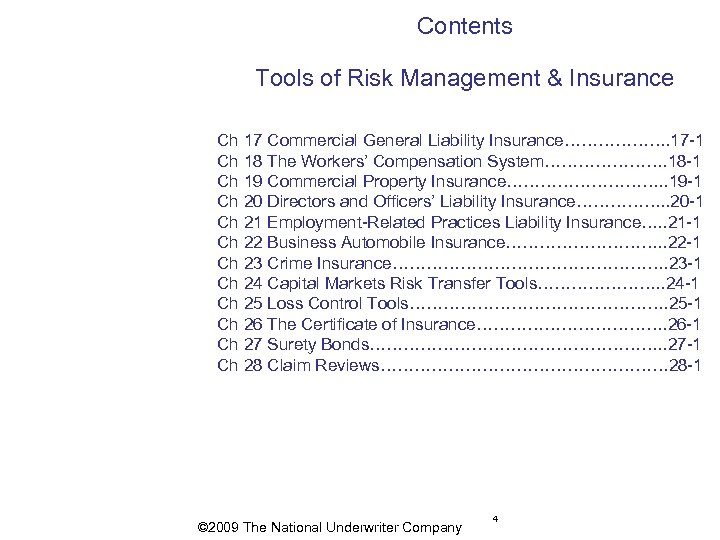 Contents Tools of Risk Management & Insurance Ch 17 Commercial General Liability Insurance………………. 17 -1 Ch 18 The Workers’ Compensation System…………………. 18 -1 Ch 19 Commercial Property Insurance……………. . 19 -1 Ch 20 Directors and Officers’ Liability Insurance……………. . 20 -1 Ch 21 Employment-Related Practices Liability Insurance…. . 21 -1 Ch 22 Business Automobile Insurance……………. . 22 -1 Ch 23 Crime Insurance……………………. 23 -1 Ch 24 Capital Markets Risk Transfer Tools…………………. . 24 -1 Ch 25 Loss Control Tools……………………. 25 -1 Ch 26 The Certificate of Insurance………………. 26 -1 Ch 27 Surety Bonds………………………. . 27 -1 Ch 28 Claim Reviews……………………… 28 -1 © 2009 The National Underwriter Company 4
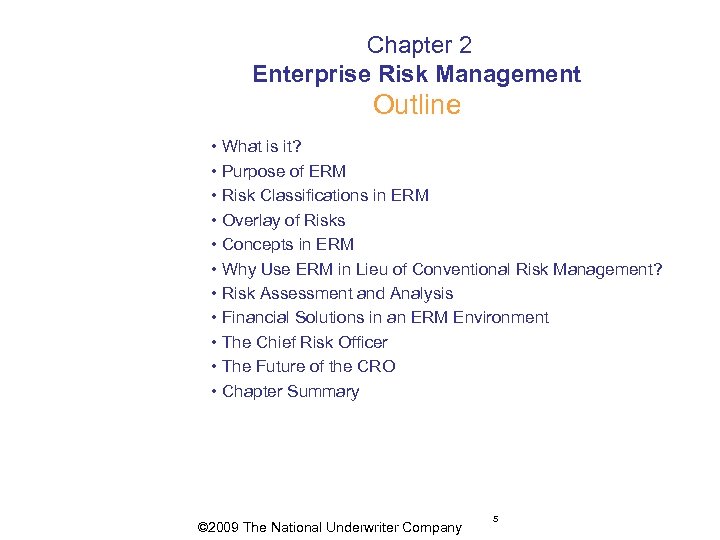 Chapter 2 Enterprise Risk Management Outline • What is it? • Purpose of ERM • Risk Classifications in ERM • Overlay of Risks • Concepts in ERM • Why Use ERM in Lieu of Conventional Risk Management? • Risk Assessment and Analysis • Financial Solutions in an ERM Environment • The Chief Risk Officer • The Future of the CRO • Chapter Summary © 2009 The National Underwriter Company 5
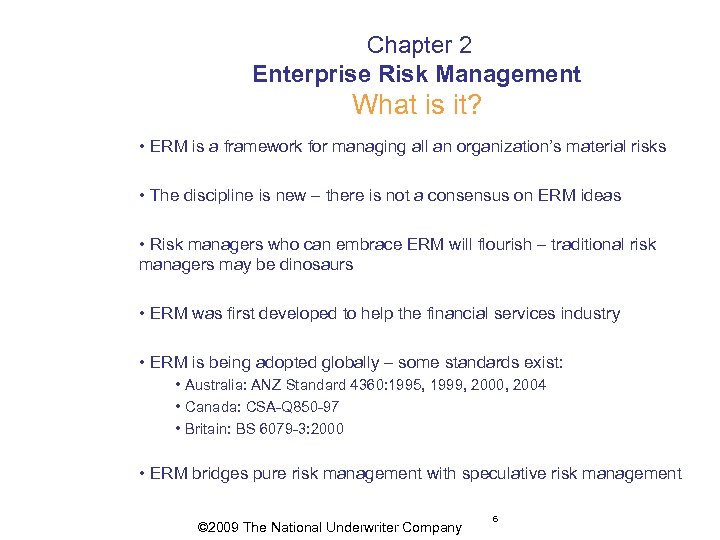 Chapter 2 Enterprise Risk Management What is it? • ERM is a framework for managing all an organization’s material risks • The discipline is new – there is not a consensus on ERM ideas • Risk managers who can embrace ERM will flourish – traditional risk managers may be dinosaurs • ERM was first developed to help the financial services industry • ERM is being adopted globally – some standards exist: • Australia: ANZ Standard 4360: 1995, 1999, 2000, 2004 • Canada: CSA-Q 850 -97 • Britain: BS 6079 -3: 2000 • ERM bridges pure risk management with speculative risk management © 2009 The National Underwriter Company 6
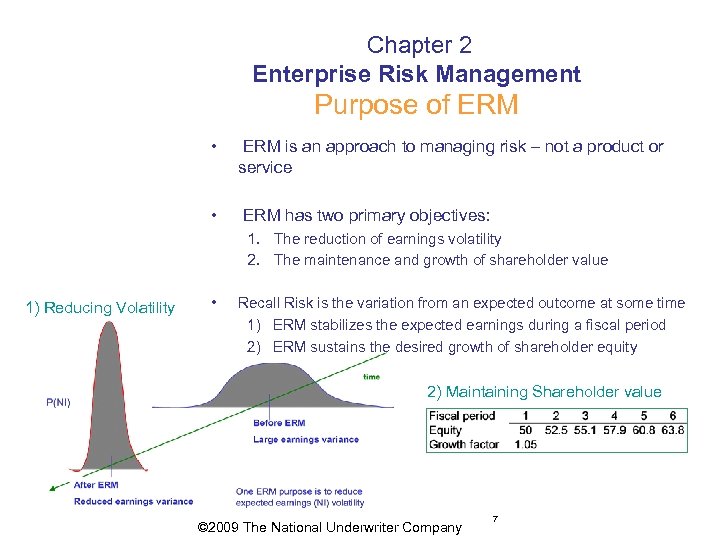 Chapter 2 Enterprise Risk Management Purpose of ERM • ERM is an approach to managing risk – not a product or service • ERM has two primary objectives: 1. The reduction of earnings volatility 2. The maintenance and growth of shareholder value 1) Reducing Volatility • Recall Risk is the variation from an expected outcome at some time 1) ERM stabilizes the expected earnings during a fiscal period 2) ERM sustains the desired growth of shareholder equity 2) Maintaining Shareholder value © 2009 The National Underwriter Company 7
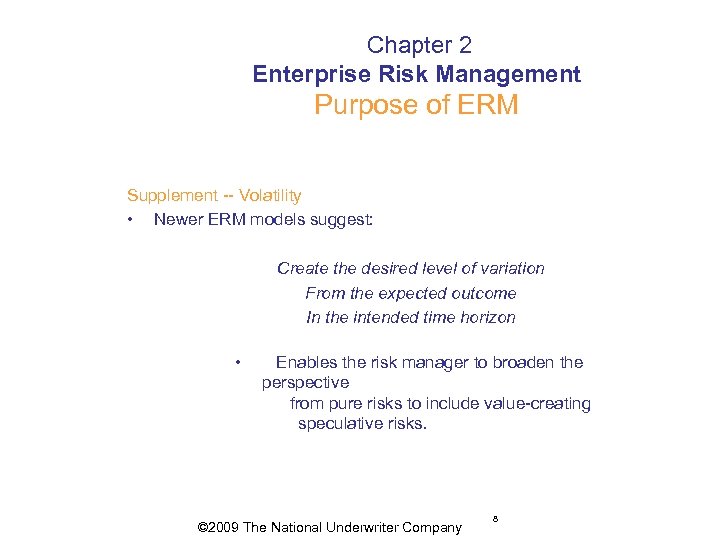 Chapter 2 Enterprise Risk Management Purpose of ERM Supplement -- Volatility • Newer ERM models suggest: Create the desired level of variation From the expected outcome In the intended time horizon • Enables the risk manager to broaden the perspective from pure risks to include value-creating speculative risks. © 2009 The National Underwriter Company 8
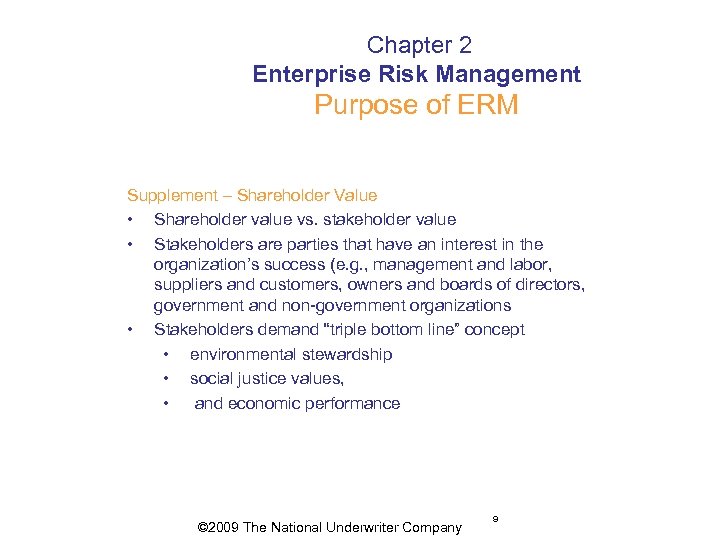 Chapter 2 Enterprise Risk Management Purpose of ERM Supplement – Shareholder Value • Shareholder value vs. stakeholder value • Stakeholders are parties that have an interest in the organization’s success (e. g. , management and labor, suppliers and customers, owners and boards of directors, government and non-government organizations • Stakeholders demand “triple bottom line” concept • environmental stewardship • social justice values, • and economic performance © 2009 The National Underwriter Company 9
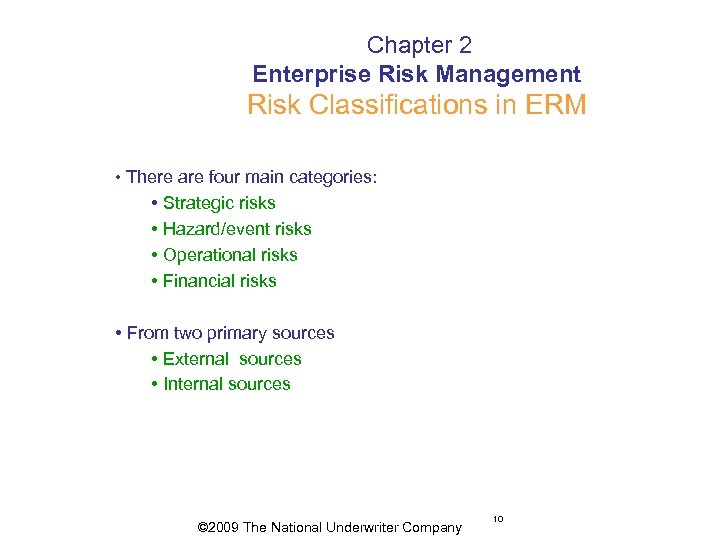 Chapter 2 Enterprise Risk Management Risk Classifications in ERM • There are four main categories: • Strategic risks • Hazard/event risks • Operational risks • Financial risks • From two primary sources • External sources • Internal sources © 2009 The National Underwriter Company 10
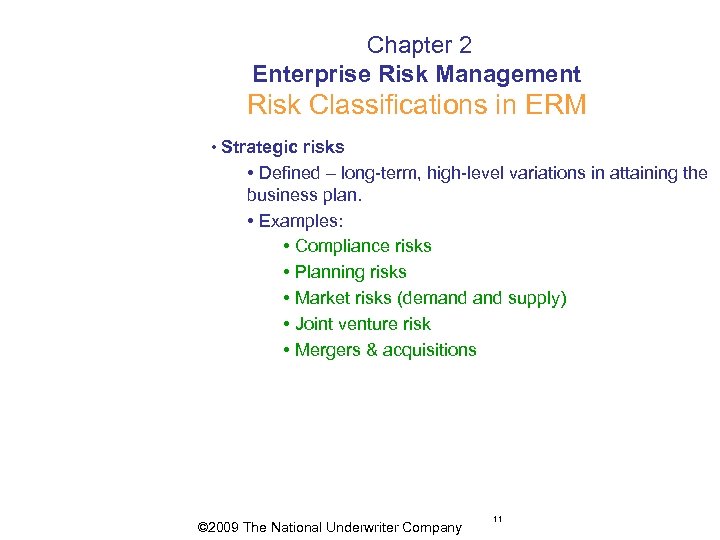 Chapter 2 Enterprise Risk Management Risk Classifications in ERM • Strategic risks • Defined – long-term, high-level variations in attaining the business plan. • Examples: • Compliance risks • Planning risks • Market risks (demand supply) • Joint venture risk • Mergers & acquisitions © 2009 The National Underwriter Company 11
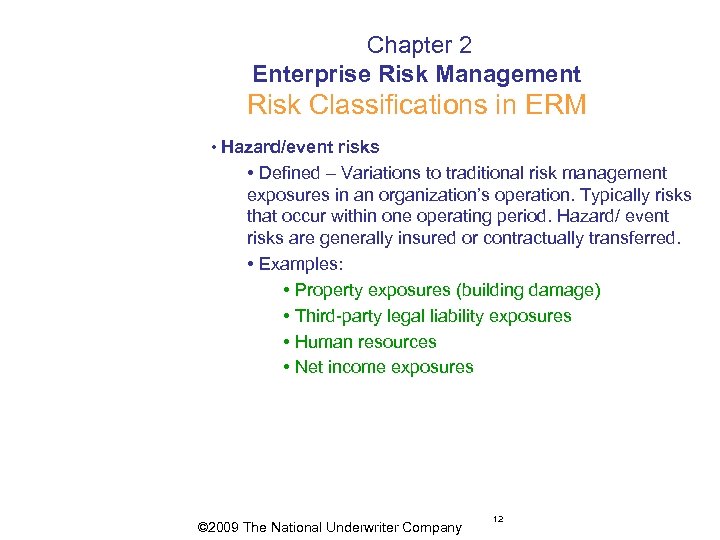 Chapter 2 Enterprise Risk Management Risk Classifications in ERM • Hazard/event risks • Defined – Variations to traditional risk management exposures in an organization’s operation. Typically risks that occur within one operating period. Hazard/ event risks are generally insured or contractually transferred. • Examples: • Property exposures (building damage) • Third-party legal liability exposures • Human resources • Net income exposures © 2009 The National Underwriter Company 12
 Chapter 2 Enterprise Risk Management Risk Classifications in ERM • Operational risks • Defined – Variations to an organization’s operations (other than traditional hazard/event risks). • Examples: • Quality control • Hiring practices • Customer satisfaction • Reputational risks © 2009 The National Underwriter Company 13
 Chapter 2 Enterprise Risk Management Risk Classifications in ERM • Financial risks • Defined – Variations to an organization’s expected financial asset and financial liability values. These values may be expressed in the balance sheet, income statement, statement of cash flows, or notes. All financial risks are externally derived. • Examples: • Earnings risk • Interest rate risk • Investment risk • Credit risk • Liquidity risk © 2009 The National Underwriter Company 14
 Chapter 2 Enterprise Risk Management Risk Classifications in ERM Supplement • Contemporary and simplifying update – reduces the number of risk classifications to three • strategic risks – reputation, compliance, market position • operational risks – event/hazard risks • economic risks – include traditional finance risks (exchange rate, interest, and credit risks) © 2009 The National Underwriter Company 15
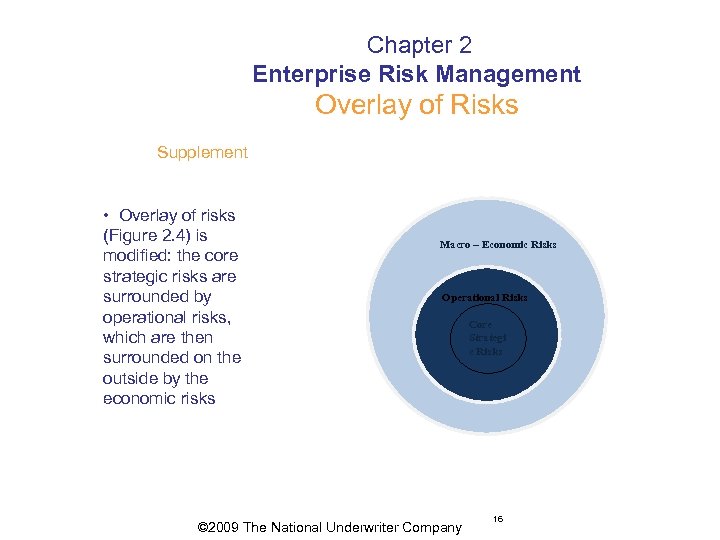 Chapter 2 Enterprise Risk Management Overlay of Risks Supplement • Overlay of risks (Figure 2. 4) is modified: the core strategic risks are surrounded by operational risks, which are then surrounded on the outside by the economic risks Macro – Economic Risks Operational Risks © 2009 The National Underwriter Company Core Strategi c Risks 16
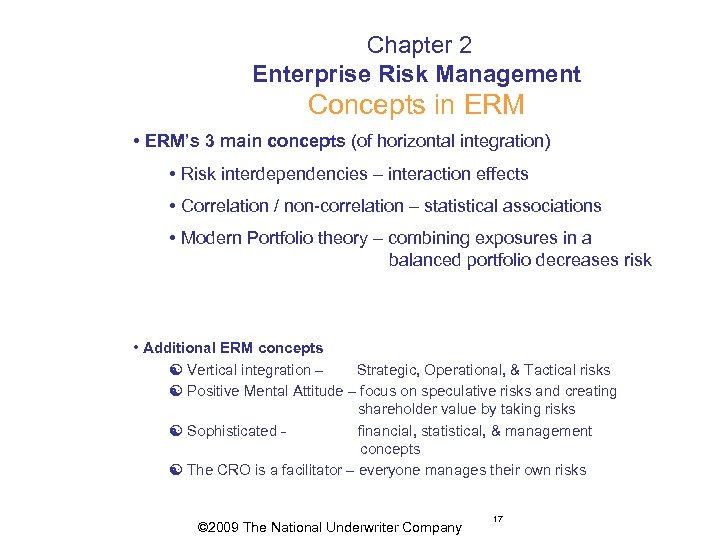 Chapter 2 Enterprise Risk Management Concepts in ERM • ERM’s 3 main concepts (of horizontal integration) • Risk interdependencies – interaction effects • Correlation / non-correlation – statistical associations • Modern Portfolio theory – combining exposures in a balanced portfolio decreases risk • Additional ERM concepts [ Vertical integration – Strategic, Operational, & Tactical risks [ Positive Mental Attitude – focus on speculative risks and creating shareholder value by taking risks [ Sophisticated - financial, statistical, & management concepts [ The CRO is a facilitator – everyone manages their own risks © 2009 The National Underwriter Company 17
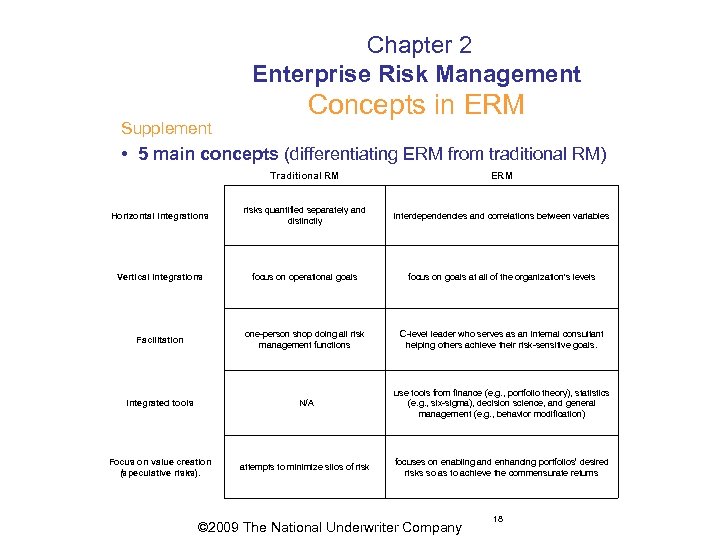 Chapter 2 Enterprise Risk Management Supplement Concepts in ERM • 5 main concepts (differentiating ERM from traditional RM) Traditional RM ERM Horizontal integrations risks quantified separately and distinctly interdependencies and correlations between variables Vertical integrations focus on operational goals focus on goals at all of the organization's levels Facilitation one-person shop doing all risk management functions C-level leader who serves as an internal consultant helping others achieve their risk-sensitive goals. Integrated tools N/A use tools from finance (e. g. , portfolio theory), statistics (e. g. , six-sigma), decision science, and general management (e. g. , behavior modification) Focus on value creation (speculative risks). attempts to minimize silos of risk focuses on enabling and enhancing portfolios’ desired risks so as to achieve the commensurate returns © 2009 The National Underwriter Company 18
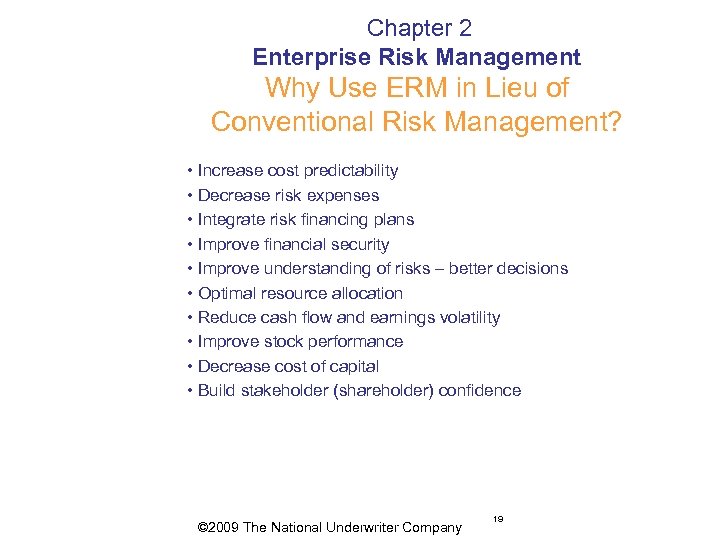 Chapter 2 Enterprise Risk Management Why Use ERM in Lieu of Conventional Risk Management? • Increase cost predictability • Decrease risk expenses • Integrate risk financing plans • Improve financial security • Improve understanding of risks – better decisions • Optimal resource allocation • Reduce cash flow and earnings volatility • Improve stock performance • Decrease cost of capital • Build stakeholder (shareholder) confidence © 2009 The National Underwriter Company 19
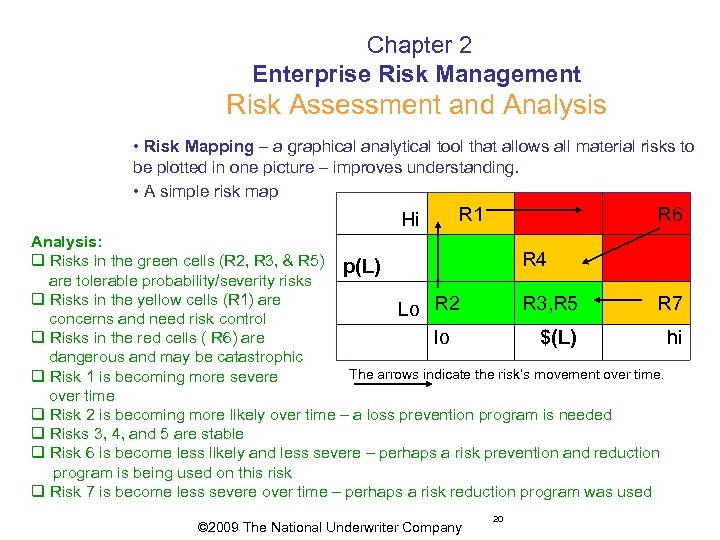 Chapter 2 Enterprise Risk Management Risk Assessment and Analysis • Risk Mapping – a graphical analytical tool that allows all material risks to be plotted in one picture – improves understanding. • A simple risk map Hi R 1 R 6 Analysis: R 4 q Risks in the green cells (R 2, R 3, & R 5) p(L) are tolerable probability/severity risks q Risks in the yellow cells (R 1) are R 3, R 5 R 7 Lo R 2 concerns and need risk control q Risks in the red cells ( R 6) are lo $(L) hi dangerous and may be catastrophic The arrows indicate the risk’s movement over time. q Risk 1 is becoming more severe over time q Risk 2 is becoming more likely over time – a loss prevention program is needed q Risks 3, 4, and 5 are stable q Risk 6 is become less likely and less severe – perhaps a risk prevention and reduction program is being used on this risk q Risk 7 is become less severe over time – perhaps a risk reduction program was used © 2009 The National Underwriter Company 20
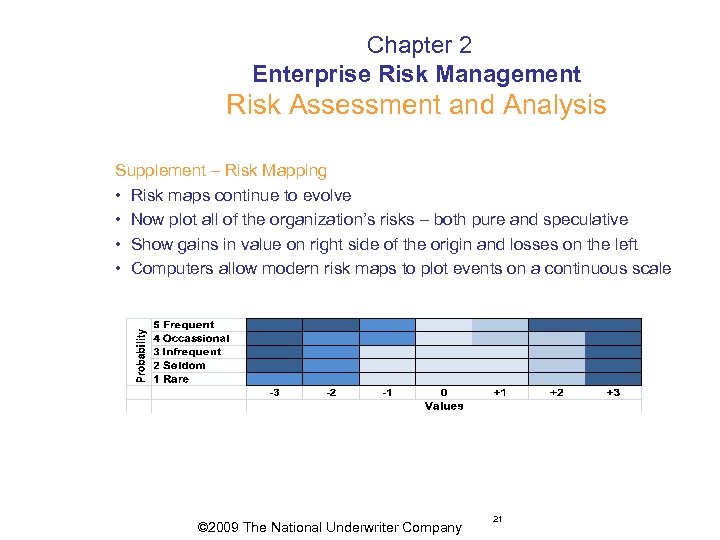 Chapter 2 Enterprise Risk Management Risk Assessment and Analysis Supplement – Risk Mapping • Risk maps continue to evolve • Now plot all of the organization’s risks – both pure and speculative • Show gains in value on right side of the origin and losses on the left • Computers allow modern risk maps to plot events on a continuous scale © 2009 The National Underwriter Company 21
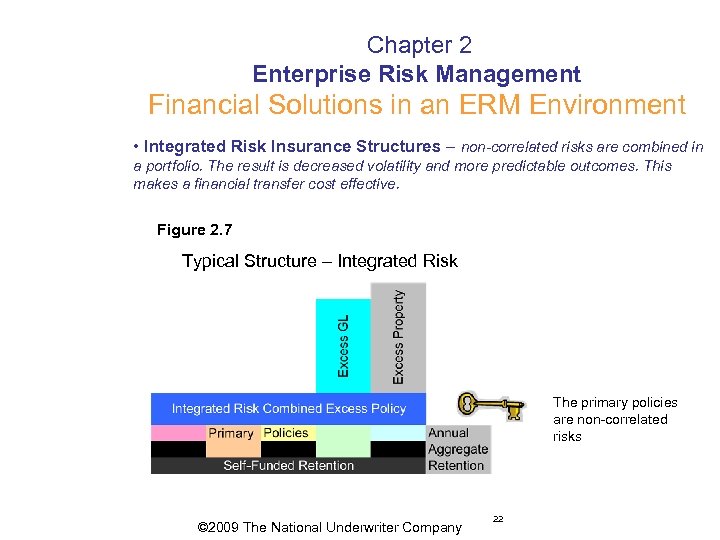 Chapter 2 Enterprise Risk Management Financial Solutions in an ERM Environment • Integrated Risk Insurance Structures – non-correlated risks are combined in a portfolio. The result is decreased volatility and more predictable outcomes. This makes a financial transfer cost effective. Figure 2. 7 Typical Structure – Integrated Risk The primary policies are non-correlated risks © 2009 The National Underwriter Company 22
 Chapter 2 Enterprise Risk Management Financial Solutions in an ERM Environment • Impact of Financial Accounting Standard 133 on IR • A directive on the accounting for derivative contracts • Derivatives derive their value from an underlying asset • E. g. , Forward, Futures, Swap, Option contracts • Derivatives used for risk management must be hedge instruments • A hedge stabilizes the variation from the expected outcome over time • Hedge accounting means a derivative’s gains or losses are recorded in the same period as the underlying hedged item’s income effects • Hedge instruments are ‘marked to market’ on the balance sheet; gains and losses are recorded on the income statement • The event risk and financial risk must not be bifurcatible • Bifurcatable means the risks can be separated without the integrated risk program collapsing © 2009 The National Underwriter Company 23
 Chapter 2 Enterprise Risk Management Financial Solutions in an ERM Environment • Theoretical Benefits of Integrated Risk Structures • The portfolio reduces variability – which allows for lower risk transfer costs • Fewer insurers are used – reducing credit risk • Reduced administrative costs • Decreases potential claims disputes among insurers • Improved protection for balance sheet risks • Overall risk management is more efficient © 2009 The National Underwriter Company 24
 Chapter 2 Enterprise Risk Management Financial Solutions in an ERM Environment Perceived Disadvantages of Integrated Risk Structures • Lack of expertise and experience • Multi-line insurers and reinsurers may not support integrated risk - especially in a hard market • Corporate treasury personnel may be unwilling to cooperate with risk managers over financial risk issues • Integrated risk management is a new and untested area – it may meet resistance © 2009 The National Underwriter Company 25
 Chapter 2 Enterprise Risk Management Financial Solutions in an ERM Environment Types of Integrated Risk Structures • Multi-line insurance packages • Multi-year insurance policies • Multiline-multiyear insurance program (cross-class program) • Multiple Trigger Programs • Combines (often independent) risks into program that protects against catastrophic combinations of losses • e. g. , a Dual Trigger program: • property loss from climate event + decrease in stock price from financial event © 2009 The National Underwriter Company 26
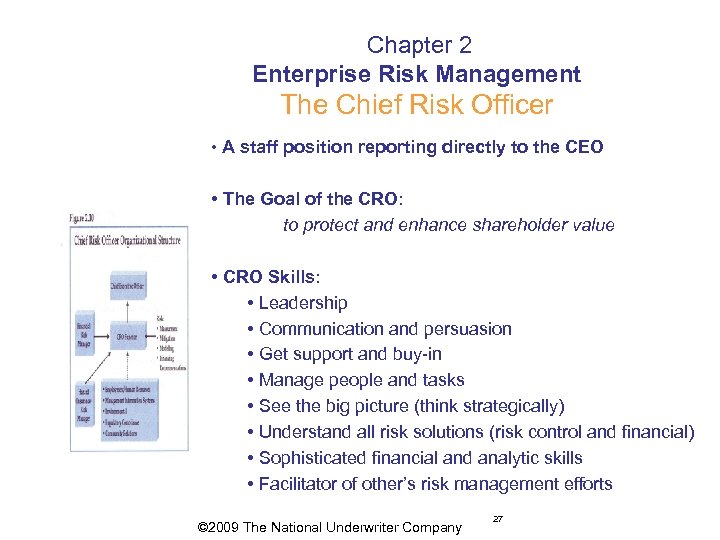 Chapter 2 Enterprise Risk Management The Chief Risk Officer • A staff position reporting directly to the CEO • The Goal of the CRO: to protect and enhance shareholder value • CRO Skills: • Leadership • Communication and persuasion • Get support and buy-in • Manage people and tasks • See the big picture (think strategically) • Understand all risk solutions (risk control and financial) • Sophisticated financial and analytic skills • Facilitator of other’s risk management efforts © 2009 The National Underwriter Company 27
 Chapter 2 Enterprise Risk Management The Chief Risk Officer • Who reports to the Chief Risk Officer? © 2009 The National Underwriter Company 28
 Chapter 2 Enterprise Risk Management The Chief Risk Officer • Benefits and Advantages + Able to make better decisions + Thorough and cost effective treatment of all risks + Consistent goals across the entire enterprise • Drawbacks and Disadvantages – Lack of buy-in – Concentrates responsibility in one position – Absence of managerial controls – Disrupts established business relationships – Requires a change in corporate culture © 2009 The National Underwriter Company 29
 Chapter 2 Enterprise Risk Management The Future of the CRO • Audit committees are proactively enhancing the corporate governance recommendation relative to the management of financial, operational, and strategic risks • The CRO must develop sophisticated skills to be capable of this senior management position responsibilities © 2009 The National Underwriter Company 30
 Chapter 2 Enterprise Risk Management Chapter Summary • • • What is it? • a framework for managing all an organization’s material risks Purpose of ERM • Reduce earnings volatility & Maintain shareholder value Risk Classifications in ERM • Strategic, Operational, Hazard, & Financial Overlay of Risks • A portfolio of integrated risks Concepts in ERM • Risk interdependencies, Correlation, Portfolio theory © 2009 The National Underwriter Company 31
 Chapter 2 Enterprise Risk Management Chapter Summary • • • Why Use ERM in Lieu of Conventional Risk Management? • Increase cost predictability • Decrease risk expenses • Integrate risk financing plans • Improve financial security • Improve understanding of risks – better decisions • Optimal resource allocation • Reduce cash flow and earnings volatility • Improve stock performance • Decrease cost of capital • Build stakeholder (shareholder) confidence Risk Assessment and Analysis • Risk Mapping Financial Solutions in an ERM Environment • Integrated Risk Structures The Chief Risk Officer • A leader facilitating the enhancement of shareholder value The Future of the CRO © 2009 The National Underwriter Company 32