


 Скачать презентацию Advanced Payload Strategies What is new what works
14e84fdfb73861c70c0b8c51175b3931.ppt
- Количество слайдов: 61
 Advanced Payload Strategies: What is new, what works and what is hoax? Rodrigo Rubira Branco (BSDaemon) Senior Vulnerability Researcher Vulnerability Research Labs (VRL) – COSEINC rodrigo_branco *no. SPAM* research. coseinc. com © 2009 COSEINC. All rights reserved. CONFIDENTIAL
 Who Am I? Rodrigo Rubira Branco aka BSDaemon; Senior Vulnerability Researcher/COSEINC Was Security Expert @Check Point & Linux Developer in the Advanced Linux Response Team of IBM; Mainteiner of many open-source projects; Some interesting researchs: Free. BSD/Net. BSD/Trusted. BSD/Dragon. Fly. BSD all version kernel integer overflow Free. BSD 5. x Kernel Integer Overflow Vulnerability Apple Mac OS X 10. 4. x kernel memory corruption vulnerability X 11 R 6 XKEYBOARD extension Strcmp() buffer overflow vulnerability (Solaris all versions, including 10) Remote exploit for Borland Interbase 7. 1 SP 2 and lower Remote root exploit for Apple. File. Server Mac. OSX Directory. Service local root exploit Halflife <= 1. 1. 1. 0 , 3. 1. 1. 1 c 1 and 4. 1. 1. 1 a remote exploit Mac OS X v 10. 3. 8, Mac OS X Server v 10. 3. 8 env overflow 2 security bugs reported to Microsoft (affects ISA Server) 2 Phrack Articles: “SMM rootkits” and “Cell Platform Software Exploitation” RISE Security member SANS Instructor: Mastering Packet Analysis, Cutting Edge Hacking Techniques, Reverse Engineering Malwares Member of the GIAC Board for the Reverse Engineering Malwares Certification Organizer: H 2 HC Conference (http: //www. h 2 hc. com. br/en/) © 2009 COSEINC. All rights reserved. CONFIDENTIAL 2
 DISCLAIMER Altought I’m a company employee and I’m using my work time to come here, everything that I’m presenting was completely created by me and are not supported, reviewed, guaranteed or whatever by my employer – The protection part of this presentation is my master thesis and was started many years ago Some technologies analysed in this work are patented so if you wish to use, expand or whatever the ideas mentionated here it’s a good idea to contact me or the companies who are holding the patents first I’m using whenever possible Check Point’s terminology, since they hold a patent on the matter © 2009 COSEINC. All rights reserved. CONFIDENTIAL 3
 Agenda Objectives / Introduction PART I Modern Payloads – Polymorphic Shellcodes » Context-keyed decoders » Target-based decoders – Camouflage – Bypassing context recognition – Syscall proxying and remote code interpreter/compiler PART II How intrusion prevention/detection system works Actual limitations and proposals – Network traffic disassembly – Virtual execution challenges Future © 2009 COSEINC. All rights reserved. CONFIDENTIAL 4
 Objectives Show the added value of Hacking Demonstrate how prevention systems works, and why/when they are useful (or not) Explain what changed in the world of payloads without focusing in the assembly language because it became boring Most important: Start a discussion regarding possible solutions on how to detect this advanced payloads in a generic way, without caring about other problems we are actually suffering (like SSL sites for example) – All the live demonstrations are a master project which will be released together with a paper on this subject later on this year © 2009 COSEINC. All rights reserved. CONFIDENTIAL 5
 Introduction Evolution of exploitation frameworks made possible for newbies to use advanced encoding techniques Assembly knowledge or advanced skills are not anymore a pre-req for the usage of advanced payloads (are you sure it was in the past? ) There is a huge gap of what actually exists in those frameworks and what is been formaly documented (yeah, we are all guilt) Detection/Prevention systems have not evolved as well (they tried, but they are loosing miserably the competition) Old-school vulnerabilities (let’s say, system-level, low-level, or whatever that involves code injection) are still not generically prevented by those systems – can you expect them to prevent web 2. 0 attacks? ? © 2009 COSEINC. All rights reserved. CONFIDENTIAL 6
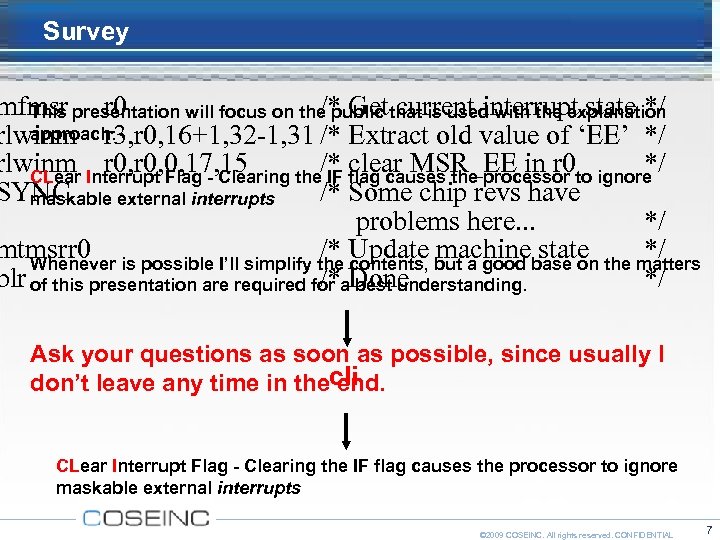 Survey mfmsr presentation will focus on the public that is used with the explanation r 0 /* Get current interrupt state */ This approach: rlwinm r 3, r 0, 16+1, 32 -1, 31 /* Extract old value of ‘EE’ */ rlwinm Interrupt Flag - Clearing the/* flag causes the processor to ignore r 0, 0, 17, 15 clear MSR_EE in r 0 */ CLear IF SYNC /* Some chip revs have maskable external interrupts problems here. . . */ mtmsrr 0 is possible I’ll simplify the Update but a good base on the matters /* contents, machine state */ Whenever blr of this presentation are required for a. Done /* best understanding. */ Ask your questions as soon as possible, since usually I don’t leave any time in thecli end. CLear Interrupt Flag - Clearing the IF flag causes the processor to ignore maskable external interrupts © 2009 COSEINC. All rights reserved. CONFIDENTIAL 7
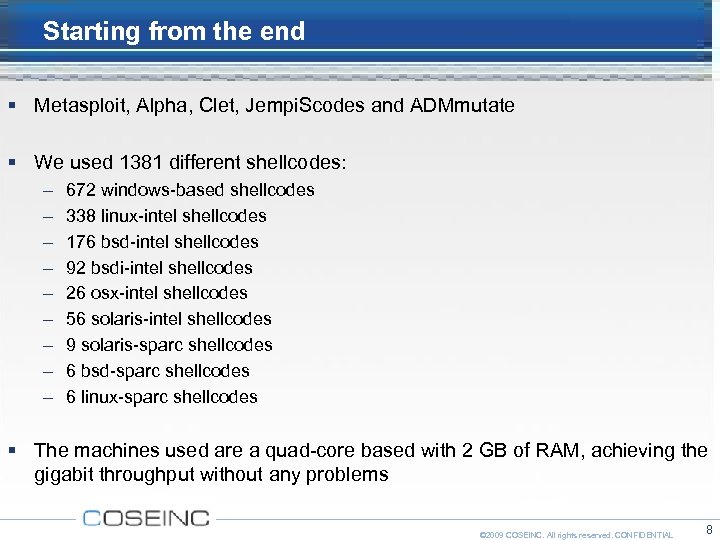 Starting from the end Metasploit, Alpha, Clet, Jempi. Scodes and ADMmutate We used 1381 different shellcodes: – – – – – 672 windows-based shellcodes 338 linux-intel shellcodes 176 bsd-intel shellcodes 92 bsdi-intel shellcodes 26 osx-intel shellcodes 56 solaris-intel shellcodes 9 solaris-sparc shellcodes 6 bsd-sparc shellcodes 6 linux-sparc shellcodes The machines used are a quad-core based with 2 GB of RAM, achieving the gigabit throughput without any problems © 2009 COSEINC. All rights reserved. CONFIDENTIAL 8
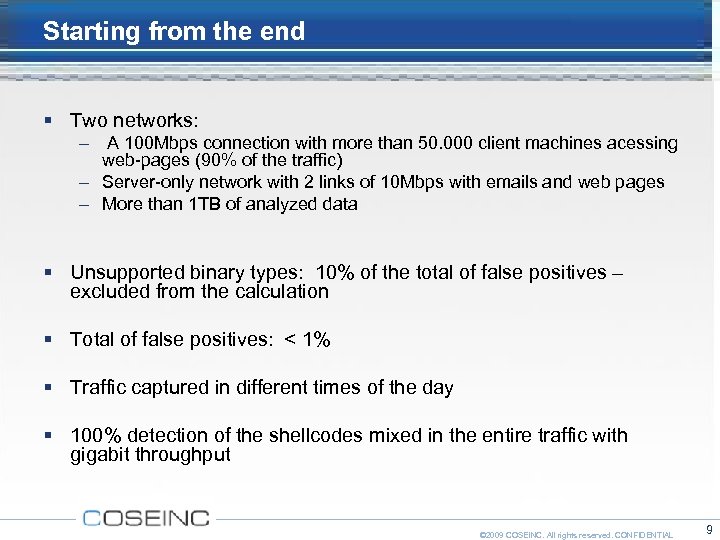 Starting from the end Two networks: – A 100 Mbps connection with more than 50. 000 client machines acessing web-pages (90% of the traffic) – Server-only network with 2 links of 10 Mbps with emails and web pages – More than 1 TB of analyzed data Unsupported binary types: 10% of the total of false positives – excluded from the calculation Total of false positives: < 1% Traffic captured in different times of the day 100% detection of the shellcodes mixed in the entire traffic with gigabit throughput © 2009 COSEINC. All rights reserved. CONFIDENTIAL 9
 PART I © 2009 COSEINC. All rights reserved. CONFIDENTIAL 10
 Modern Payloads They try (or they do) to avoid detection (channel encryption, code encoding) – CLET uses advanced heuristics to bypass traffic recognition systems Usually they are more advanced, which means, bigger, which means staged (they ‘download’ in someway more portions of their own code) The idea is not just have a remote ‘/bin/sh’, but provide a complete environment without leave any forensics evidences © 2009 COSEINC. All rights reserved. CONFIDENTIAL 11
 What is a polymorphic shellcode? Is a code with the ability to automatically transform itself into a semantically equivalent variant, frustrating attempts to have a verifiable representation. – They avoid detection – They help to bypass application-specific filters (tollower, toupper, isascii. . . ) © 2009 COSEINC. All rights reserved. CONFIDENTIAL 12
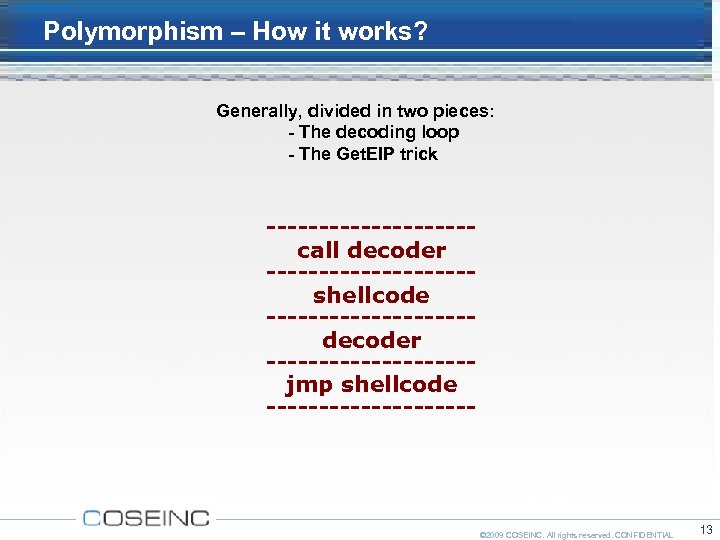 Polymorphism – How it works? Generally, divided in two pieces: - The decoding loop - The Get. EIP trick ----------call decoder ----------shellcode ----------decoder ----------jmp shellcode ---------- © 2009 COSEINC. All rights reserved. CONFIDENTIAL 13
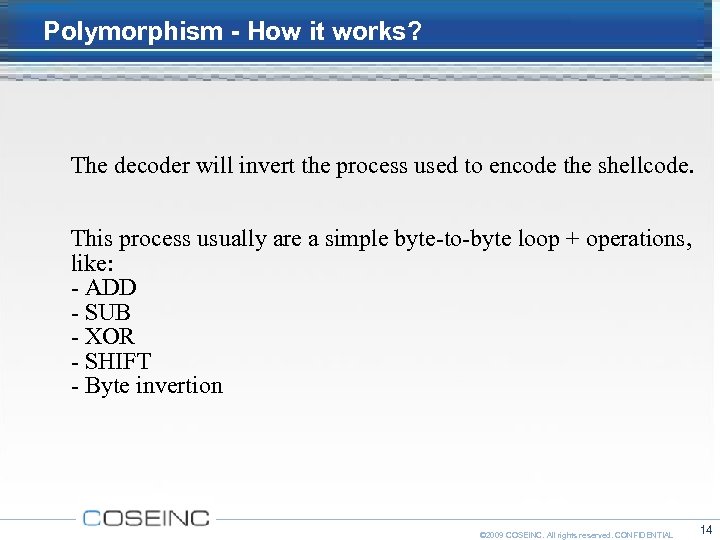 Polymorphism - How it works? The decoder will invert the process used to encode the shellcode. This process usually are a simple byte-to-byte loop + operations, like: - ADD - SUB - XOR - SHIFT - Byte invertion © 2009 COSEINC. All rights reserved. CONFIDENTIAL 14
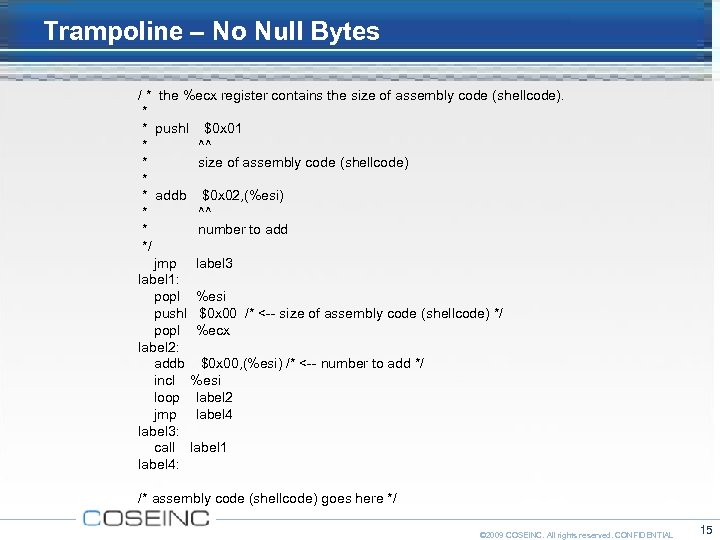 Trampoline – No Null Bytes / * the %ecx register contains the size of assembly code (shellcode). * * pushl $0 x 01 * ^^ * size of assembly code (shellcode) * * addb $0 x 02, (%esi) * ^^ * number to add */ jmp label 3 label 1: popl %esi pushl $0 x 00 /* <-- size of assembly code (shellcode) */ popl %ecx label 2: addb $0 x 00, (%esi) /* <-- number to add */ incl %esi loop label 2 jmp label 4 label 3: call label 1 label 4: /* assembly code (shellcode) goes here */ © 2009 COSEINC. All rights reserved. CONFIDENTIAL 15
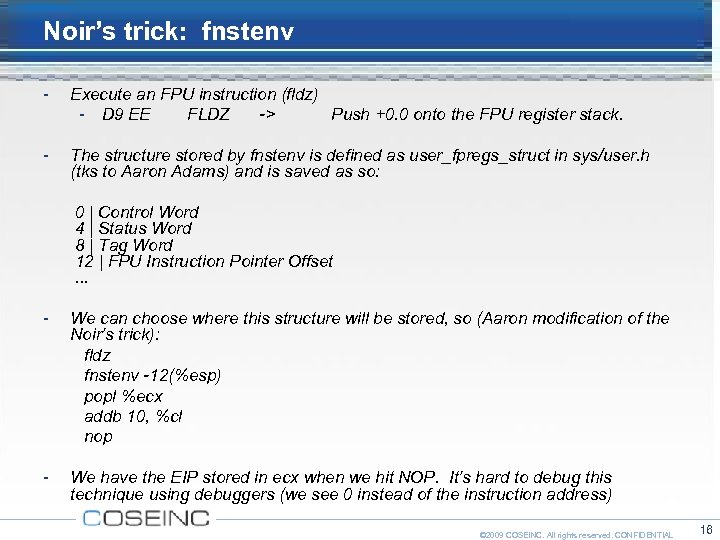 Noir’s trick: fnstenv - Execute an FPU instruction (fldz) - D 9 EE FLDZ -> Push +0. 0 onto the FPU register stack. - The structure stored by fnstenv is defined as user_fpregs_struct in sys/user. h (tks to Aaron Adams) and is saved as so: 0 | Control Word 4 | Status Word 8 | Tag Word 12 | FPU Instruction Pointer Offset. . . - We can choose where this structure will be stored, so (Aaron modification of the Noir’s trick): fldz fnstenv -12(%esp) popl %ecx addb 10, %cl nop - We have the EIP stored in ecx when we hit NOP. It’s hard to debug this technique using debuggers (we see 0 instead of the instruction address) © 2009 COSEINC. All rights reserved. CONFIDENTIAL 16
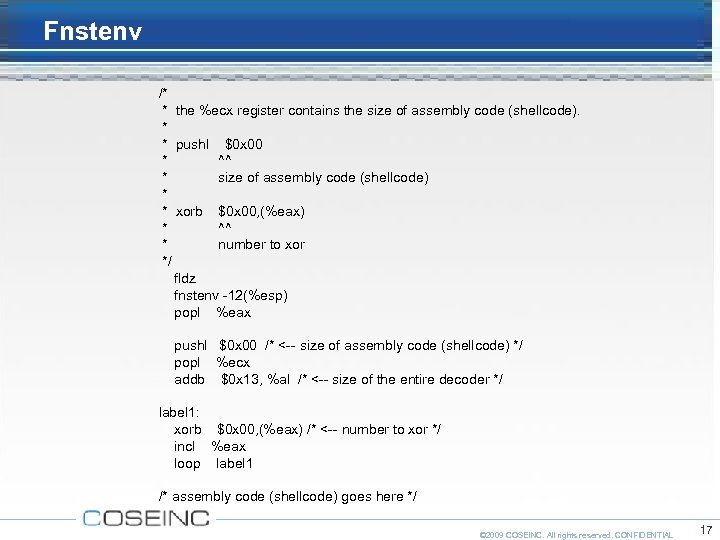 Fnstenv /* * the %ecx register contains the size of assembly code (shellcode). * * pushl $0 x 00 * ^^ * size of assembly code (shellcode) * * xorb $0 x 00, (%eax) * ^^ * number to xor */ fldz fnstenv -12(%esp) popl %eax pushl $0 x 00 /* <-- size of assembly code (shellcode) */ popl %ecx addb $0 x 13, %al /* <-- size of the entire decoder */ label 1: xorb $0 x 00, (%eax) /* <-- number to xor */ incl %eax loop label 1 /* assembly code (shellcode) goes here */ © 2009 COSEINC. All rights reserved. CONFIDENTIAL 17
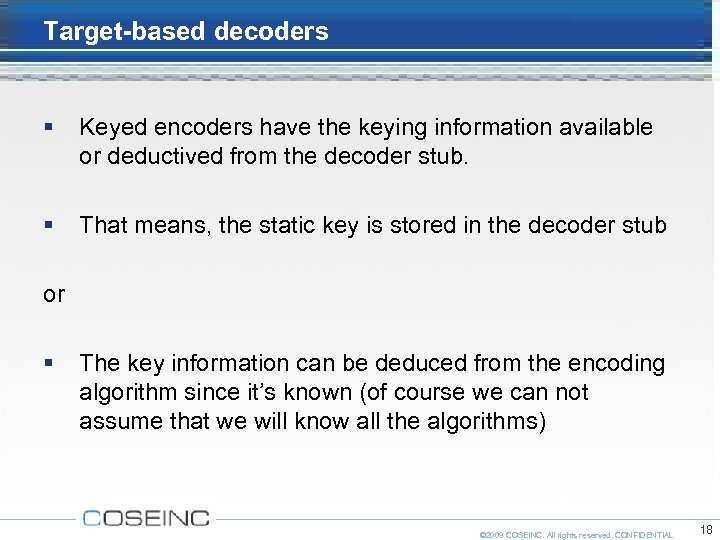 Target-based decoders Keyed encoders have the keying information available or deductived from the decoder stub. That means, the static key is stored in the decoder stub or The key information can be deduced from the encoding algorithm since it’s known (of course we can not assume that we will know all the algorithms) © 2009 COSEINC. All rights reserved. CONFIDENTIAL 18
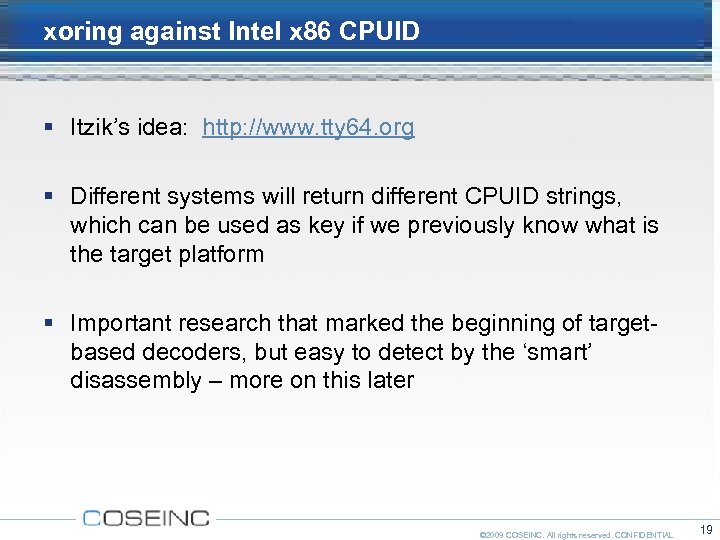 xoring against Intel x 86 CPUID Itzik’s idea: http: //www. tty 64. org Different systems will return different CPUID strings, which can be used as key if we previously know what is the target platform Important research that marked the beginning of targetbased decoders, but easy to detect by the ‘smart’ disassembly – more on this later © 2009 COSEINC. All rights reserved. CONFIDENTIAL 19
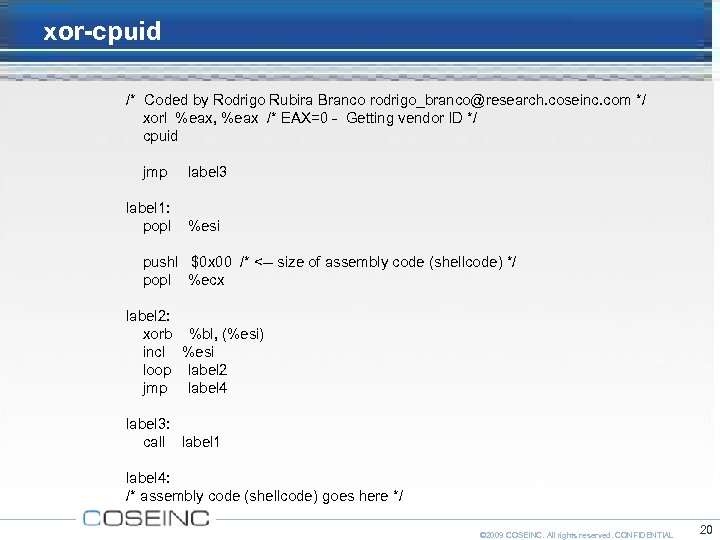 xor-cpuid /* Coded by Rodrigo Rubira Branco rodrigo_branco@research. coseinc. com */ xorl %eax, %eax /* EAX=0 - Getting vendor ID */ cpuid jmp label 1: popl label 3 %esi pushl $0 x 00 /* <-- size of assembly code (shellcode) */ popl %ecx label 2: xorb %bl, (%esi) incl %esi loop label 2 jmp label 4 label 3: call label 1 label 4: /* assembly code (shellcode) goes here */ © 2009 COSEINC. All rights reserved. CONFIDENTIAL 20
 Context-keyed decoders I)ruid’s idea: http: //www. uninformed. org/? v=9&a=3&t=txt Instead of use a fixed key, use an application-specific one: – Static Application Data (fixed portions of memory analysis) – Event and Supplied Data – Temporal Keys Already implemented in Metasploit. . . © 2009 COSEINC. All rights reserved. CONFIDENTIAL 21
 Camouflage – Bypassing context My big friend Itzik Kotler showed in Hackers 2 Hackers Conference III The idea is to create a shellcode that looks like a specific type of file (for example, a. zip file) This will bypass some systems, because they will identify it’s a binary file and will not trigger an alert – Interesting is that some systems uses file identification to avoid false-positivies © 2009 COSEINC. All rights reserved. CONFIDENTIAL 22
 Syscall Proxying When a process need any resource it must perform a system call in order to ask the operating system for the needed resource. Syscall interface are generally offered by the libc (the programmer doesn’t need to care about system calls) Syscall proxying under Linux environment will be shown, so some aspects must be understood: – Homogeneous way for calling syscalls (by number) – Arguments are passed via registers (or a pointer to the stack) – Little number of system calls exists. © 2009 COSEINC. All rights reserved. CONFIDENTIAL 23
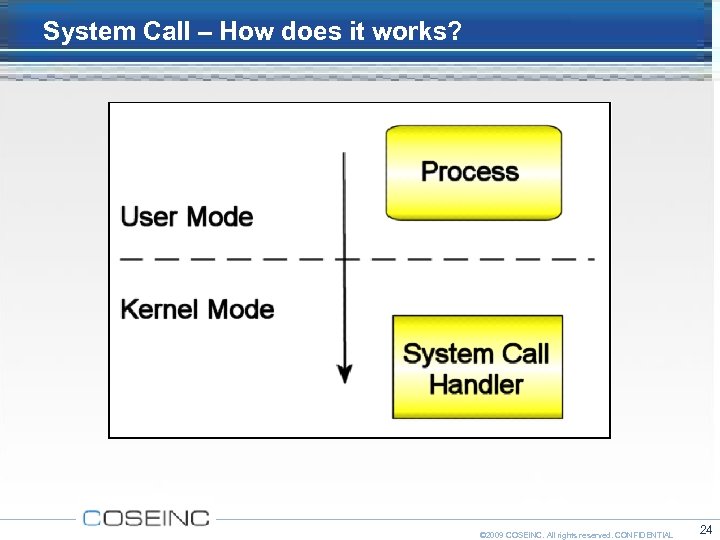 System Call – How does it works? © 2009 COSEINC. All rights reserved. CONFIDENTIAL 24
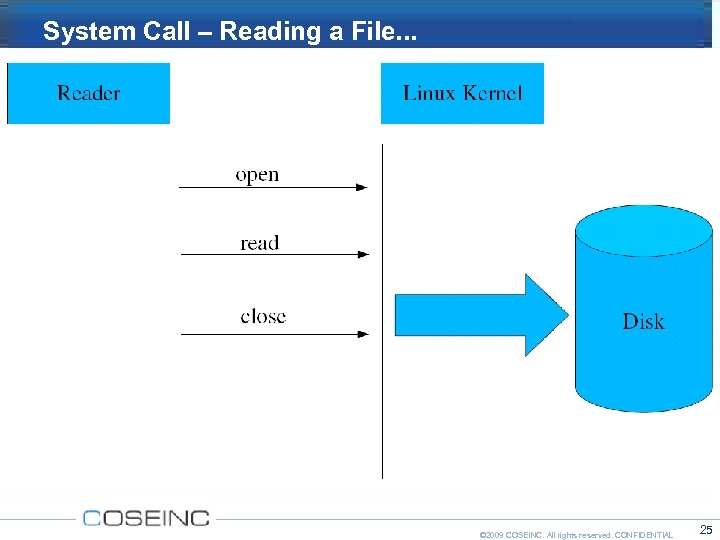 System Call – Reading a File. . . © 2009 COSEINC. All rights reserved. CONFIDENTIAL 25
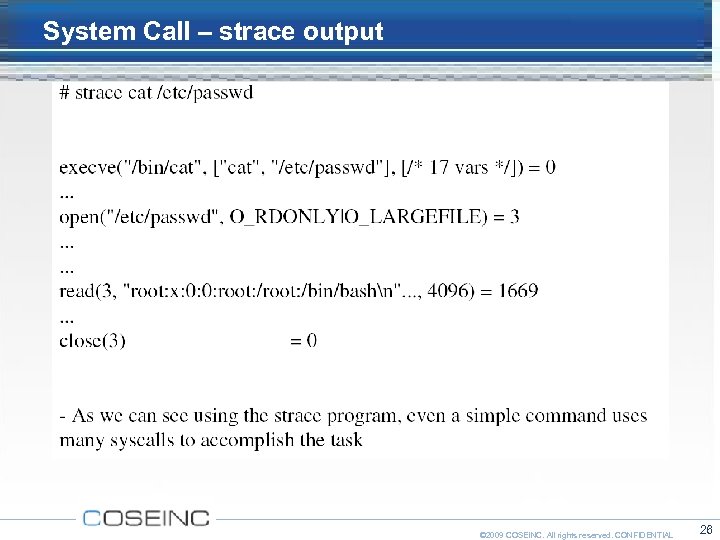 System Call – strace output © 2009 COSEINC. All rights reserved. CONFIDENTIAL 26
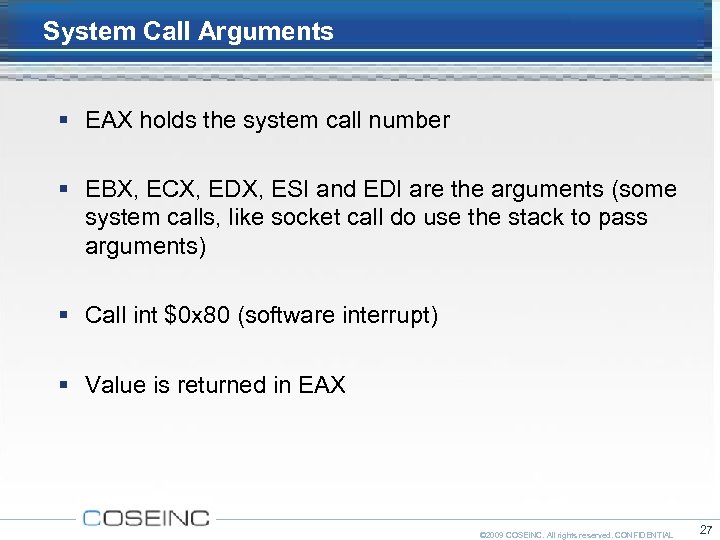 System Call Arguments EAX holds the system call number EBX, ECX, EDX, ESI and EDI are the arguments (some system calls, like socket call do use the stack to pass arguments) Call int $0 x 80 (software interrupt) Value is returned in EAX © 2009 COSEINC. All rights reserved. CONFIDENTIAL 27
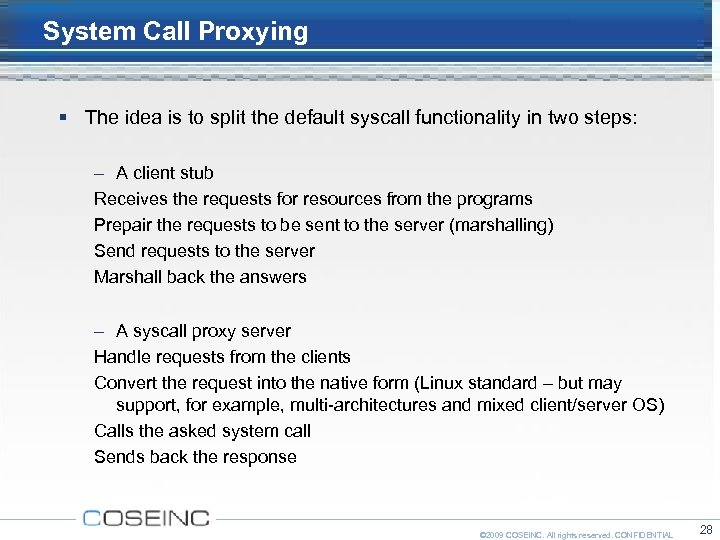 System Call Proxying The idea is to split the default syscall functionality in two steps: – A client stub Receives the requests for resources from the programs Prepair the requests to be sent to the server (marshalling) Send requests to the server Marshall back the answers – A syscall proxy server Handle requests from the clients Convert the request into the native form (Linux standard – but may support, for example, multi-architectures and mixed client/server OS) Calls the asked system call Sends back the response © 2009 COSEINC. All rights reserved. CONFIDENTIAL 28
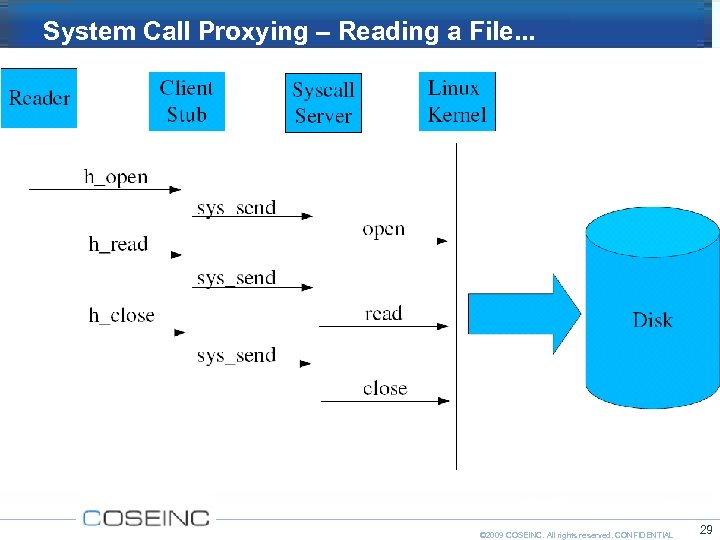 System Call Proxying – Reading a File. . . © 2009 COSEINC. All rights reserved. CONFIDENTIAL 29
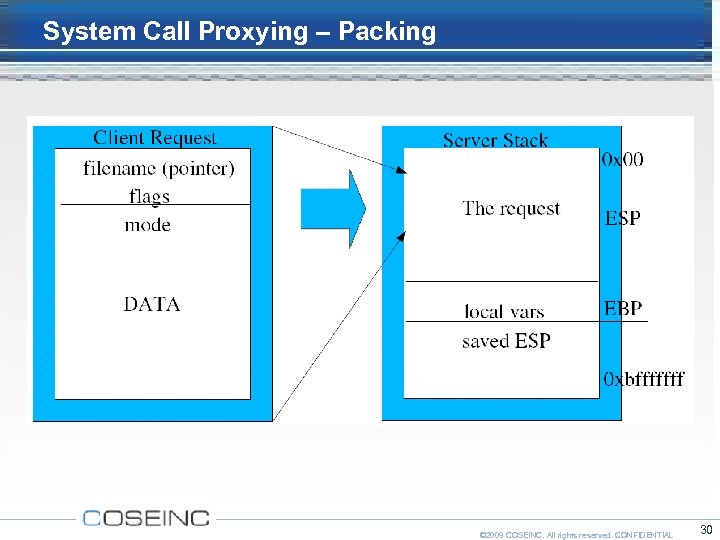 System Call Proxying – Packing © 2009 COSEINC. All rights reserved. CONFIDENTIAL 30
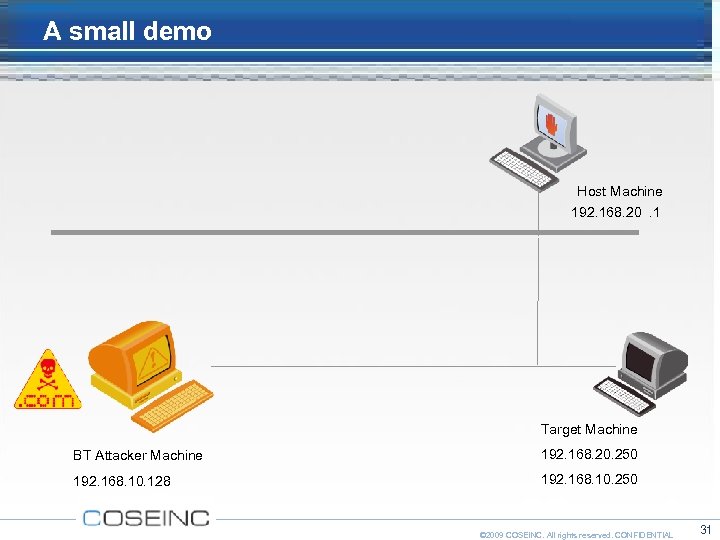 A small demo Host Machine 192. 168. 20. 1 Target Machine BT Attacker Machine 192. 168. 20. 250 192. 168. 10. 128 192. 168. 10. 250 © 2009 COSEINC. All rights reserved. CONFIDENTIAL 31
 MOSDEF (mose-def) is short for “Most Definately” MOSDEF is a retargetable, position independent code, C compiler that supports dynamic remote code linking written in pure python In short, after you’ve overflowed a process you can compile programs to run inside that process and report back to you » Source: http: //www. immunityinc. com/downloads/MOSDEF. ppt © 2009 COSEINC. All rights reserved. CONFIDENTIAL 32
 PART II © 2009 COSEINC. All rights reserved. CONFIDENTIAL 33
 How IDS/IPS works Capture the traffic Normalize it (session/fragment reassembly) Inspect – Pattern matching – Protocol validation (some does just basic protocol validation, like ip, tcp and udp only, some others are doing more advanced validations, like RPC implementations, SMB, DNS, HTTP. . . But that really does not matter here) – Payload verification -> Here we are interested in © 2009 COSEINC. All rights reserved. CONFIDENTIAL 34
 0 day protection Every vendor in the market claims polymorphic shellcode detection Every vendor in the market are lieing? THIS IS A JOKE © 2009 COSEINC. All rights reserved. CONFIDENTIAL 35
 Methods for detecting malicious code Signatures/Patterns – Reactive – can only detect known attacks. – Require analysis of each vulnerability/exploit. – Vulnerable to obfuscation & polymorphic attacks. Anomaly Detection – Baseline profiles need to be accumulated over time » Protocols, Destinations, Applications, etc. – High maintenance costs » Need highly experienced personnel to analyze logs – If the exploit looks like normal traffic – it will go undetected. © 2009 COSEINC. All rights reserved. CONFIDENTIAL 36
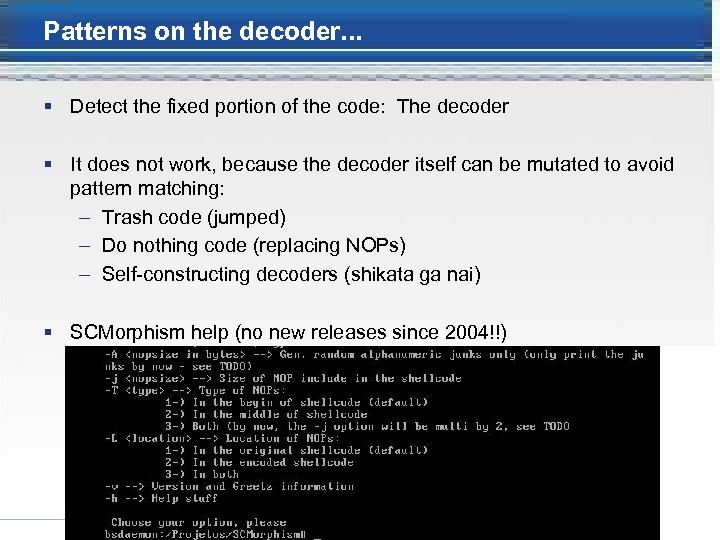 Patterns on the decoder. . . Detect the fixed portion of the code: The decoder It does not work, because the decoder itself can be mutated to avoid pattern matching: – Trash code (jumped) – Do nothing code (replacing NOPs) – Self-constructing decoders (shikata ga nai) SCMorphism help (no new releases since 2004!!) © 2009 COSEINC. All rights reserved. CONFIDENTIAL 37
 Shikata ga nai Created by spoonm for Metasploit Uses FPU Get. EIP trick: – – – 102 FPU instructions available + fnstenv 4 clear ECX instructions (ECX used as counter) 1 pop EBX 1 move key 6 loop blocks 1 loop instruction No-interation between some portions permits then to be randomly exchangeable (difficult to find patterns) © 2009 COSEINC. All rights reserved. CONFIDENTIAL 38
 Actual limitations and proposals The truth is: It’s impossible to detect this kind of shellcode just using pattern matching – I’m not saying that it is useful in anyway What about behavioural analysis? Network traffic disassembly? Code emulation? – Assuming the perfect world, where the computational power is unlimited maybe it is easy. . . But in the real world, is it possible? © 2009 COSEINC. All rights reserved. CONFIDENTIAL 39
 So, how it can be detected? Disassembling of the network traffic – Lots of false positives – Are you sure you are really analysing the payload? » What if the vuln. affects the underlying protocol layer? » What about session reassembly? » What if. . -> I DON’T CARE, anyway an IPS need to know about that To avoid the false positives we need a ‘simulator’ to follow the actual code logic: – Support to multi-architectures © 2009 COSEINC. All rights reserved. CONFIDENTIAL 40
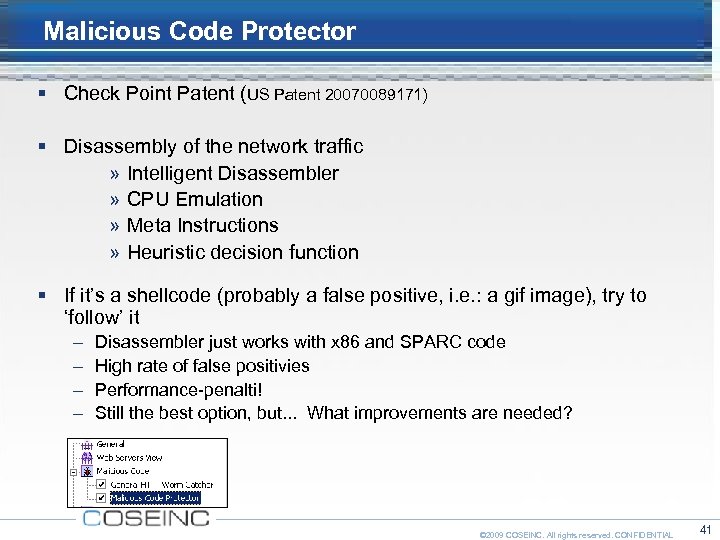 Malicious Code Protector Check Point Patent (US Patent 20070089171) Disassembly of the network traffic » Intelligent Disassembler » CPU Emulation » Meta Instructions » Heuristic decision function If it’s a shellcode (probably a false positive, i. e. : a gif image), try to ‘follow’ it – – Disassembler just works with x 86 and SPARC code High rate of false positivies Performance-penalti! Still the best option, but. . . What improvements are needed? © 2009 COSEINC. All rights reserved. CONFIDENTIAL 41
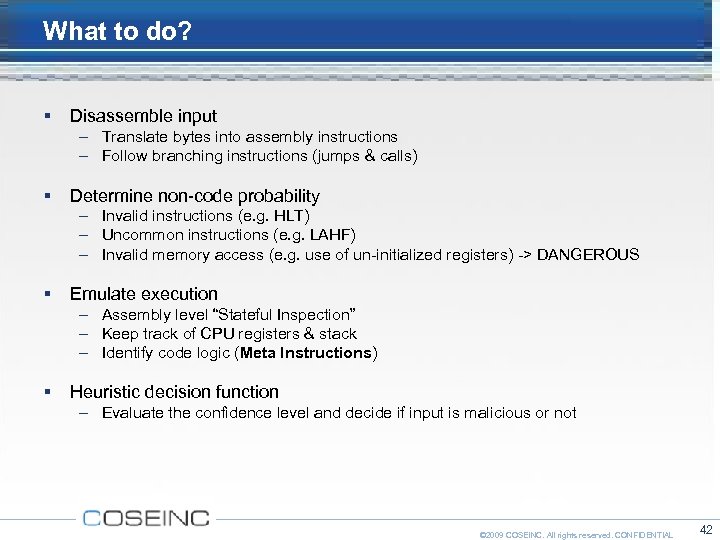 What to do? Disassemble input – Translate bytes into assembly instructions – Follow branching instructions (jumps & calls) Determine non-code probability – Invalid instructions (e. g. HLT) – Uncommon instructions (e. g. LAHF) – Invalid memory access (e. g. use of un-initialized registers) -> DANGEROUS Emulate execution – Assembly level “Stateful Inspection” – Keep track of CPU registers & stack – Identify code logic (Meta Instructions) Heuristic decision function – Evaluate the confidence level and decide if input is malicious or not © 2009 COSEINC. All rights reserved. CONFIDENTIAL 42
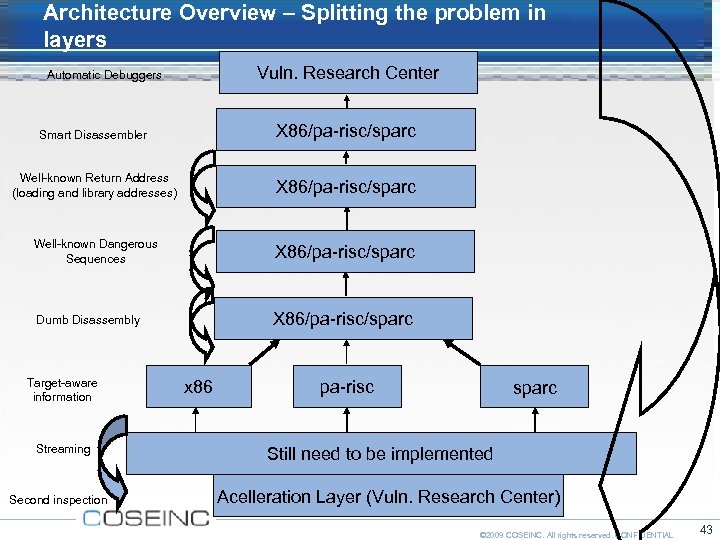 Architecture Overview – Splitting the problem in layers Vuln. Research Center Automatic Debuggers Smart Disassembler X 86/pa-risc/sparc Well-known Return Address (loading and library addresses) X 86/pa-risc/sparc Well-known Dangerous Sequences X 86/pa-risc/sparc Dumb Disassembly X 86/pa-risc/sparc Target-aware information Streaming Second inspection x 86 pa-risc sparc Still need to be implemented Acelleration Layer (Vuln. Research Center) © 2009 COSEINC. All rights reserved. CONFIDENTIAL 43
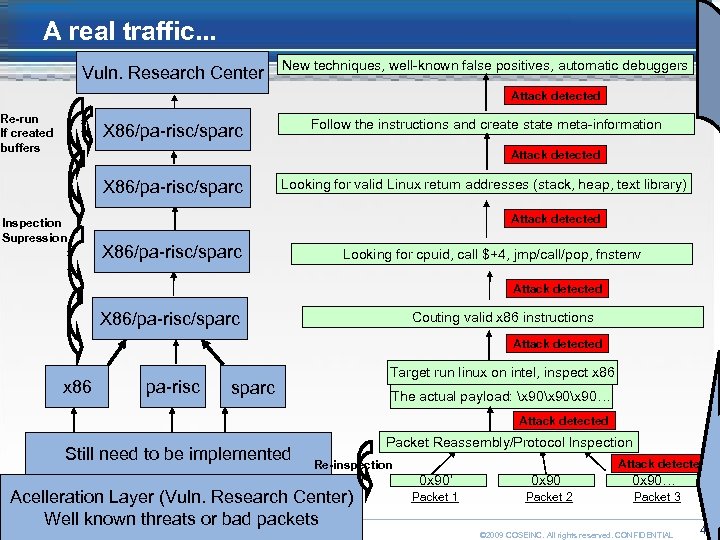 A real traffic. . . Vuln. Research Center New techniques, well-known false positives, automatic debuggers Attack detected Re-run If created buffers Follow the instructions and create state meta-information X 86/pa-risc/sparc Attack detected X 86/pa-risc/sparc Inspection Supression Looking for valid Linux return addresses (stack, heap, text library) Attack detected X 86/pa-risc/sparc Looking for cpuid, call $+4, jmp/call/pop, fnstenv Attack detected X 86/pa-risc/sparc Couting valid x 86 instructions Attack detected x 86 pa-risc Target run linux on intel, inspect x 86 sparc The actual payload: x 90x 90… Attack detected Still need to be implemented Packet Reassembly/Protocol Inspection Attack detected Re-inspection Acelleration Layer (Vuln. Research Center) Well known threats or bad packets 0 x 90’ 0 x 90… Packet 1 Packet 2 Packet 3 © 2009 COSEINC. All rights reserved. CONFIDENTIAL 44
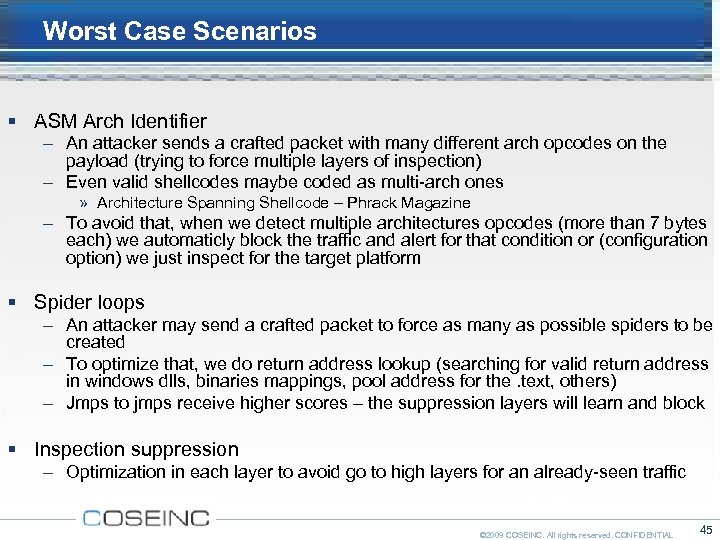 Worst Case Scenarios ASM Arch Identifier – An attacker sends a crafted packet with many different arch opcodes on the payload (trying to force multiple layers of inspection) – Even valid shellcodes maybe coded as multi-arch ones » Architecture Spanning Shellcode – Phrack Magazine – To avoid that, when we detect multiple architectures opcodes (more than 7 bytes each) we automaticly block the traffic and alert for that condition or (configuration option) we just inspect for the target platform Spider loops – An attacker may send a crafted packet to force as many as possible spiders to be created – To optimize that, we do return address lookup (searching for valid return address in windows dlls, binaries mappings, pool address for the. text, others) – Jmps to jmps receive higher scores – the suppression layers will learn and block Inspection suppression – Optimization in each layer to avoid go to high layers for an already-seen traffic © 2009 COSEINC. All rights reserved. CONFIDENTIAL 45
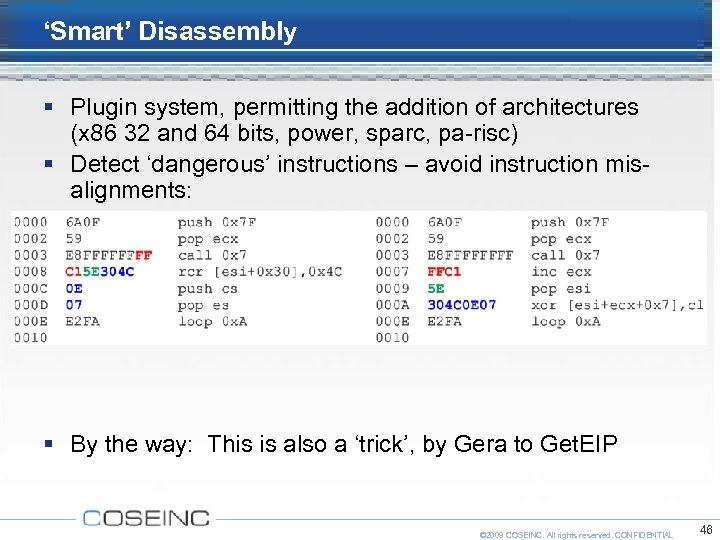 ‘Smart’ Disassembly Plugin system, permitting the addition of architectures (x 86 32 and 64 bits, power, sparc, pa-risc) Detect ‘dangerous’ instructions – avoid instruction misalignments: By the way: This is also a ‘trick’, by Gera to Get. EIP © 2009 COSEINC. All rights reserved. CONFIDENTIAL 46
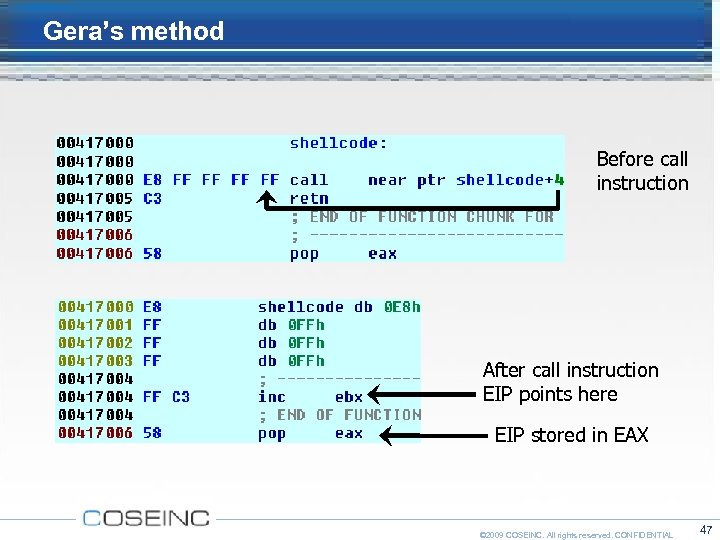 Gera’s method Before call instruction After call instruction EIP points here EIP stored in EAX © 2009 COSEINC. All rights reserved. CONFIDENTIAL 47
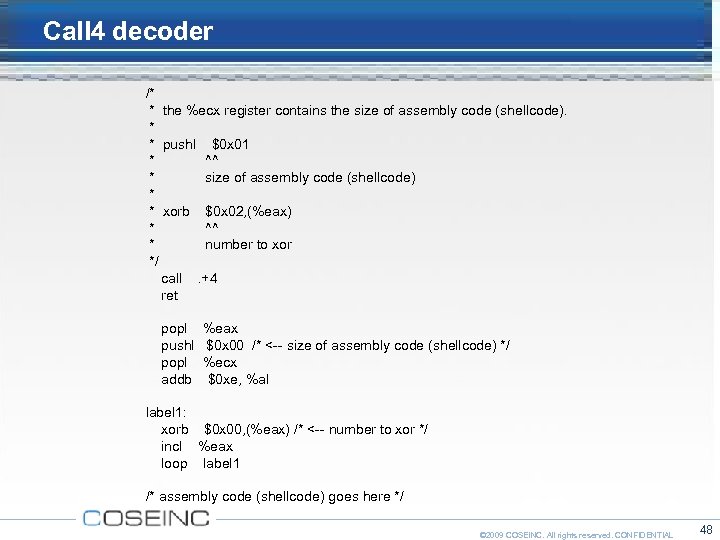 Call 4 decoder /* * the %ecx register contains the size of assembly code (shellcode). * * pushl $0 x 01 * ^^ * size of assembly code (shellcode) * * xorb $0 x 02, (%eax) * ^^ * number to xor */ call. +4 ret popl pushl popl addb %eax $0 x 00 /* <-- size of assembly code (shellcode) */ %ecx $0 xe, %al label 1: xorb $0 x 00, (%eax) /* <-- number to xor */ incl %eax loop label 1 /* assembly code (shellcode) goes here */ © 2009 COSEINC. All rights reserved. CONFIDENTIAL 48
 ‘Smart’ Disassembly We can make use of the inherent functionality of the decoder stub to decode the payload of the network traffic. This is possible, but not needed in this case, since we already spoted a valid code, marking it for further examination (to avoid false-positives) The ‘smart’ disassembly is also layered, each layer avoiding deeper inspection, and doing that, keeping the performance in a high-level (still need to be better tested in real world networks – volunteers? ) – Emulator inspection supression -> IMPORTANT -> Each layer will identify attackers forcing the cpu-consumption paths © 2009 COSEINC. All rights reserved. CONFIDENTIAL 49
 ‘Smart’ Disassembly Fpu instruction + fnstenv + pop = Dangerous sequence = Detection in a lower-layer of the Shikata ga nai decoder Even if not (some changes in the Shikata ga nai decoder can avoid it), the Smart disassembly will: – Detect the meta-construction: fpu instruction + fnstenv + pop and know where is the EIP – Will follow the clear ecx + loop to know what is the block condition – Will see the loop and will re-inspect the generated buffer after decoding © 2009 COSEINC. All rights reserved. CONFIDENTIAL 50
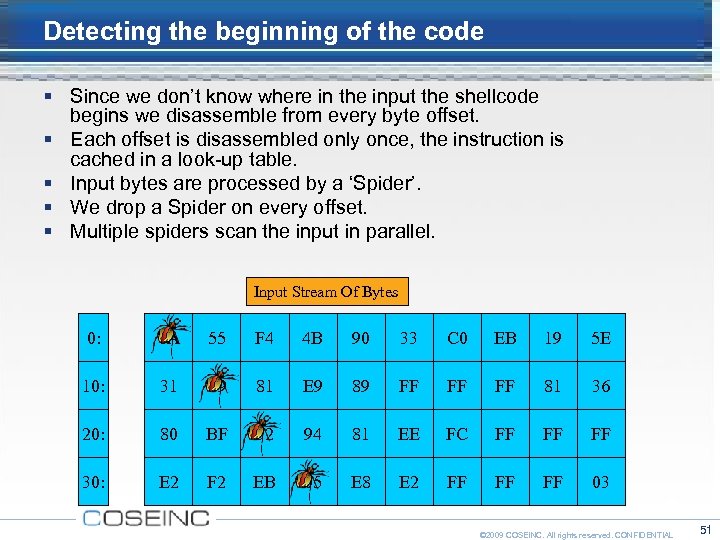 Detecting the beginning of the code Since we don’t know where in the input the shellcode begins we disassemble from every byte offset. Each offset is disassembled only once, the instruction is cached in a look-up table. Input bytes are processed by a ‘Spider’. We drop a Spider on every offset. Multiple spiders scan the input in parallel. Input Stream Of Bytes 0: 6 A 55 F 4 4 B 90 33 C 0 EB 19 5 E 10: 31 C 9 81 E 9 89 FF FF FF 81 36 20: 80 BF 32 94 81 EE FC FF FF FF 30: E 2 F 2 EB 05 E 8 E 2 FF FF FF 03 © 2009 COSEINC. All rights reserved. CONFIDENTIAL 51
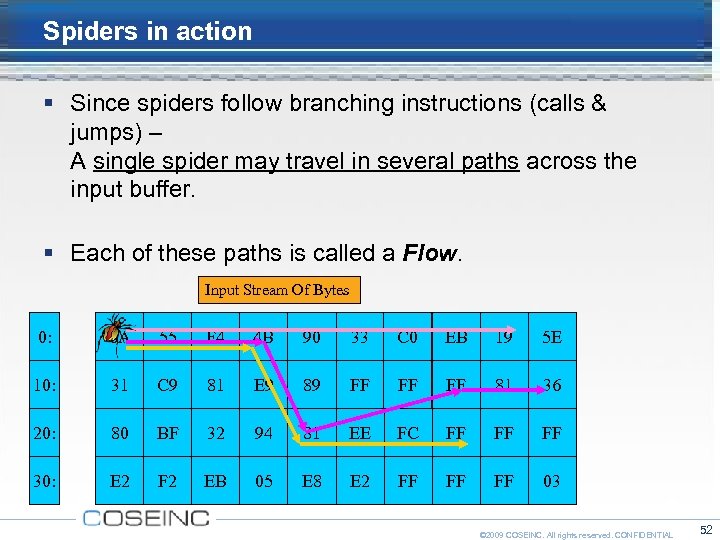 Spiders in action Since spiders follow branching instructions (calls & jumps) – A single spider may travel in several paths across the input buffer. Each of these paths is called a Flow. Input Stream Of Bytes 0: 6 A 55 F 4 4 B 90 33 C 0 EB 19 5 E 10: 31 C 9 81 E 9 89 FF FF FF 81 36 20: 80 BF 32 94 81 EE FC FF FF FF 30: E 2 F 2 EB 05 E 8 E 2 FF FF FF 03 © 2009 COSEINC. All rights reserved. CONFIDENTIAL 52
 Meta Instructions Process each instruction in the context of previous instructions. Identify code logic common to malicious code: – – Decryption Loop EIP Calculation PEB Access SEH Access Also, target-OS aware – Interrupts » ‘INT 0 x 80’: Linux System Call » Invalid in Windows © 2009 COSEINC. All rights reserved. CONFIDENTIAL 53
 Confidence indexing Configured in a per-rule, per-protection way, extended to the disassembler – Per instruction – Per meta-construction If the ‘dumb’ disassembler detects a valid instruction number (configured by the user) it will add for example, 10% to the chances of this being an attack – This value is proportional to the size of the payload itself (smaller payloads smaller the chances to have valid instructions) -> Tks to Julio Auto for the idea If the ‘smart’ disassembler detects a dangerous construction forcing misaligment for example, it will add 70% to the chances of this being an attack (so the total now is 80%) Let’s assume a company who defined that, for the company to be considered an attack, we need to be 90% sure of that. . . It’s still not an attack A fragmented packet may receive 5%. . . It’s still not an attack © 2009 COSEINC. All rights reserved. CONFIDENTIAL 54
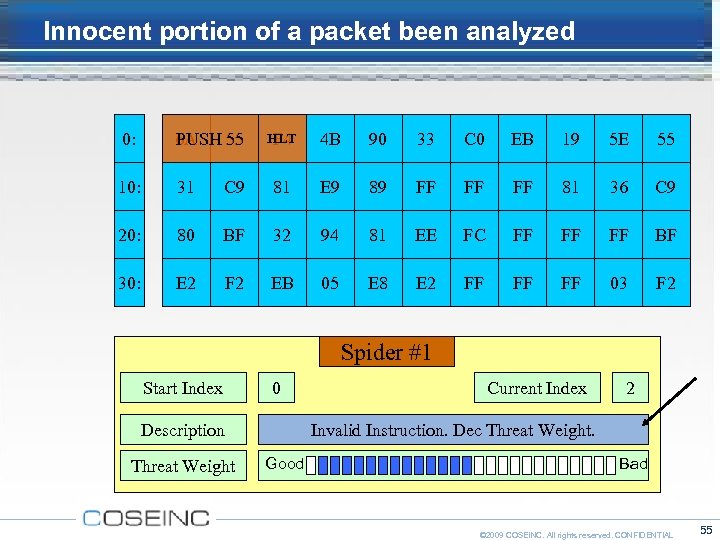 Innocent portion of a packet been analyzed 0: 6 A PUSH 55 HLT F 4 4 B 90 33 C 0 EB 19 5 E 55 10: 31 C 9 81 E 9 89 FF FF FF 81 36 C 9 20: 80 BF 32 94 81 EE FC FF FF FF BF 30: E 2 F 2 EB 05 E 8 E 2 FF FF FF 03 F 2 Spider #1 Start Index 0 Description Threat Weight Current Index 2 0 - Invalid Instruction. Inc Threat Weight. Valid Instruction. Dec Threat Weight. Ready Good Bad © 2009 COSEINC. All rights reserved. CONFIDENTIAL 55
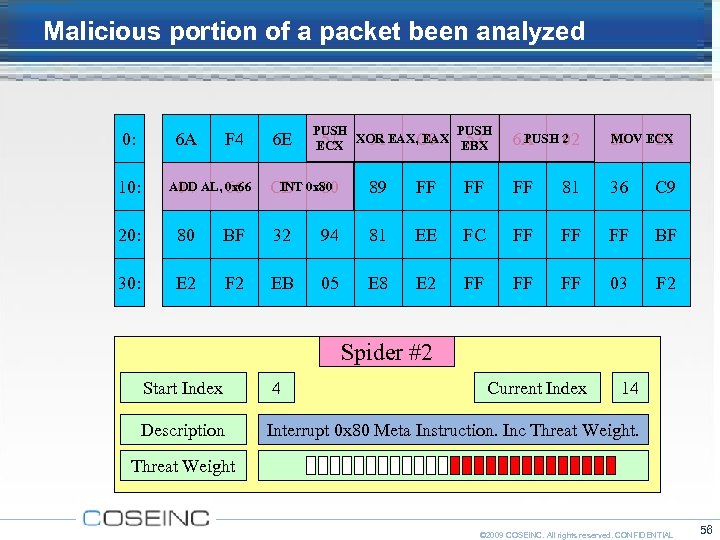 Malicious portion of a packet been analyzed 0: 10: 6 A F 4 ADD AL, 66 0 x 66 04 6 E PUSH EAX 53 51 XOR EAX, C 0 EBX 31 ECX PUSH 02 2 6 A MOV E 1 89 ECX INT 80 CD 0 x 80 89 FF FF FF 81 36 C 9 20: 80 BF 32 94 81 EE FC FF FF FF BF 30: E 2 F 2 EB 05 E 8 E 2 FF FF FF 03 F 2 Spider #2 Start Index 4 Current Index 14 12 10 8 7 5 4 - Description Interrupt 0 x 80 Meta Instruction. Inc Weight. Valid Instruction. Inc Threat Weight. Ready Threat Weight © 2009 COSEINC. All rights reserved. CONFIDENTIAL 56
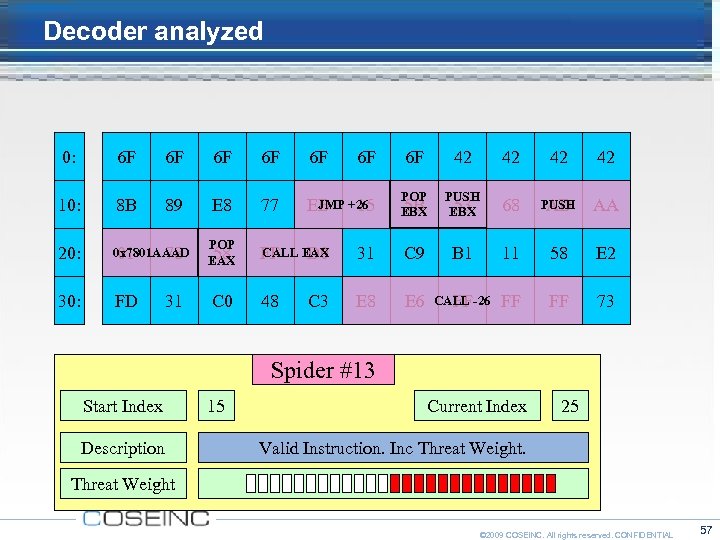 Decoder analyzed 0: 6 F 6 F 42 42 10: 8 B 89 E 8 77 JMP +26 JMP 15 EB +21 POP 5 B EBX PUSH 53 EBX 68 PUSH AD AA 20: 0 x 7801 AAAD 01 78 POP 58 EAX CALL D 0 FF EAX 31 C 9 B 1 11 58 E 2 30: FD C 0 48 E 6 CALL -26 FF FF FF 73 31 C 3 Spider #13 Start Index Description 15 Current Index 25 19 18 17 38 15 24 - Copy. Valid. Meta Instruction. Threat. Weight. Normal. Instruction. Inc Threat Weight. EIP Instruction. Inc Threat Weight. Ready Threat Weight © 2009 COSEINC. All rights reserved. CONFIDENTIAL 57
 Vulnerability Research Center Create a distributed analysing machines for each architecture used in the company seens interesting to really debug the payload execution – Can be offered as a service, avoiding false-positivies and new exploiting mechanisms Easy to do further automated investigation to validate shellcodes and detecting new wide-spreeding malwares, encoding techniques and false positives – No performance penalti, since the smart disassembly will guarantee that just a small portion of the traffic will trigger this inspection level – Emulator inspection supression -> IMPORTANT! -> REMEMBER that in the previous slides? It’s because otherwise an attacker can just generate code that will force a lot of traffic to go to the vulnerability research center © 2009 COSEINC. All rights reserved. CONFIDENTIAL 58
 Implementation: Cell Architecture Powerful hybrid multi-core technology 128 registers files of 128 bits each: – Since each SPU register can hold multiple fixed (or floating) point values of different sizes, GDB offers to us a data structure that can be accessed with different formats: (gdb) ptype $r 70 type = union __gdb_builtin_type_vec 128 { int 128_t uint 128; float v 4_float[4]; int 32_t v 4_int 32[4]; int 16_t v 8_int 16[8]; int 8_t v 16_int 8[16]; } – So, specifying the field in the data structure, we can update it: (gdb) p $r 70. uint 128 $1 = 0 x 00018 ff 000018 ff 0 (gdb) set $r 70. v 4_int 32[2]=0 xdeadbeef (gdb) p $r 70. uint 128 $2 = 0 x 00018 ff 0 deadbeef 00018 ff 0 256 KB Local Storage -> Mainly used for log suppression and caching (avoiding calls to the PPU) Threads managed by the PPU, which handles the traffic and chooses the SPU to process it (the spiders) -> Resident threads to avoid the thread creation overhead Thread abstraction – Easy to port (here I’m using a x 86 binary instead of a Cell simulator for instance) © 2009 COSEINC. All rights reserved. CONFIDENTIAL 59
 Future I can’t foresee the future! My guess is this kind of technology will be improved, mainly after some disasters: – Conficker worm was really successful even exploiting an already patched vulnerability (for which most vendors had signatures too) – This worm used a piece of payload taken from a public tool (Metasploit unreliable remote way to differentiate between XP SP 1 and SP 2) We all are aware that this kind of protection will not prevent everything, but will give a good level of protection against well-known payload strategies Still missing performance numbers, since all the Cell-related stuff are being developed in a Playstation 3 (I don’t have high-performance network cards for testing) Need to define the confidence level defaults © 2009 COSEINC. All rights reserved. CONFIDENTIAL 60
 End! Really !? Rodrigo Rubira Branco (BSDaemon) Senior Vulnerability Researcher Vulnerability Research Labs (VRL) – COSEINC rodrigo_branco *no. SPAM* research. coseinc. com © 2009 COSEINC. All rights reserved. CONFIDENTIAL