


 Скачать презентацию Advanced Patterns and Frameworks SS 2005 Peter Sommerlad
85a6cf53a08ee0498181a7731fdf11e3.ppt
- Количество слайдов: 23
 Advanced Patterns and Frameworks SS 2005 Peter Sommerlad 1
 Voraussetzungen und Planung § Eine Prüfung am 15. 07. 2005 8 -10 Uhr o Wissens- und Verständnisfragen § Keine Übungen aber o Selbststudium, z. B. Lesen von Patterns o Hausaufgaben zum Selbststudium § Aktive Mitarbeit in Vorlesung o schwierig bei 70 Studenten. . . trotzdem o Abfrage der Hausaufgaben! Ø kein "Vorkauen" durch mich § Eventueller Ausfall am 29. 04. oder Gastreferent (TBA) 2
 Introducing Patterns Prof. Peter Sommerlad HSR - Hochschule für Technik Rapperswil Institute for Software Oberseestrasse 10, CH-8640 Rapperswil 3
 What are Patterns? § Descriptions of successful engineering § § § stories Address recurring problems Describe generic solutions that worked o Nothing new Tell about the forces of the problem o What makes the problem addressed hard? Tell about the engineering trade-offs to take o Benefits and Liabilities Give us names to talk with and about A thing (solution) and how to get it (process for implementation) 4
 Example: Buy the first round Kevlin Henney, kevlin@curbralan. com, April 2001, revised July 2001 Context: Meeting colleagues for a few drinks in a bar or pub that expects payment for drinks. Problem: How do you maximise your drinking, whilst both minimising expenditure and maintaining good will with your drinking colleagues? 5
 Buy the First Round (2) Forces: o You have limited money, or at least limited desire to spend it. o The drinks are not free. o You want to drink (possibly lots). o Your colleagues will not all turn up on time, but there will be quite a few of them eventually. o You do not want your colleagues to think (or perhaps notice) that you are being tight git. Solution: Buy the first round of drinks before all your colleagues have arrived. 6
 Buy the First Round (3) Consequences: § You need to get to the bar early, preferably first and with a couple of colleagues in tow. + Volunteering to buy the first drink shows good nature and enthusiasm, and spreads good will. + You get free drinks for the rest of the evening, assuming a reasonable increase in the number of colleagues and a steady rotation of round buying. + If there is enough drinking, others will notice your use of this pattern or recall any other known uses. This supports repeatability in future as only your generous nature will be remembered. 7
 What are no patterns? § General Principles, e. g. , o KIS – Keep it simple o DRY – Don't repeat yourself Ø(aka OAOO: once and only once) § § o Need to Know (confidentiality) Things that worked only once or twice or never: o “I did it this way” o “I invented this pattern” Problems without solutions Description of Solutions without problems Algorithms, Processes, cooking recipes 8
 What patterns are not? § A panacea § A silver bullet § A novices' tool § A ready made component § A means to turn off your brain But § Patterns proved to be useful engineering tools, especially for discussing and considering alternatives and different tradeoffs. 9
 What kinds of Patterns exist? § Architecture Patterns (Christopher § § § Alexander) Software Patterns: o Design Patterns (Gamma, Johnson, Helm, Vlissides) o Pattern-oriented Software Architecture (Buschmann, Meunier, Rohnert, Sommerlad, Stal) o Many more. . . Organizational Patterns Learning and Teaching Patterns Documentation Patterns Process Patterns 10
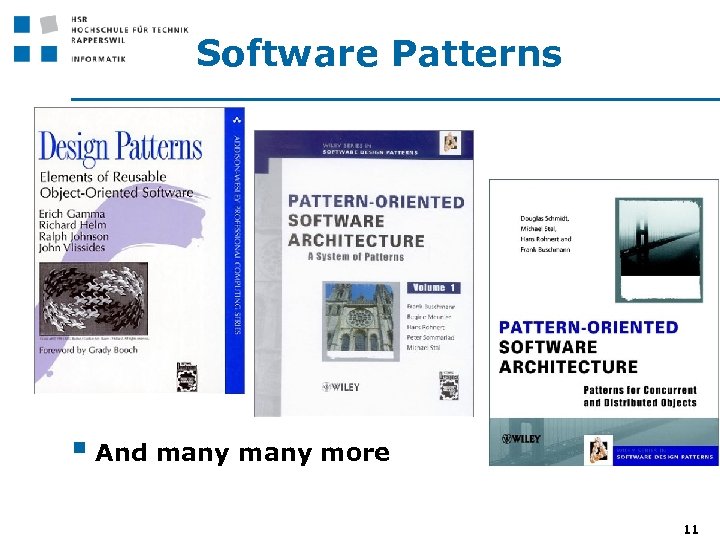 Software Patterns § And many more 11
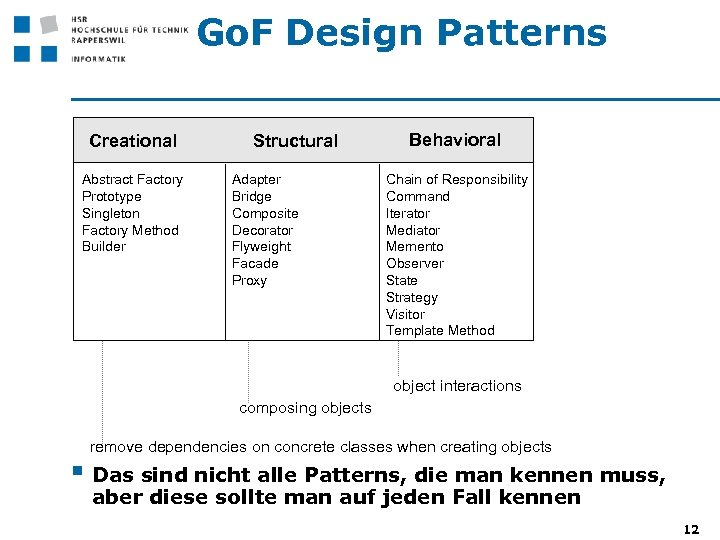 Go. F Design Patterns Creational Abstract Factory Prototype Singleton Factory Method Builder Structural Adapter Bridge Composite Decorator Flyweight Facade Proxy Behavioral Chain of Responsibility Command Iterator Mediator Memento Observer State Strategy Visitor Template Method object interactions composing objects remove dependencies on concrete classes when creating objects § Das sind nicht alle Patterns, die man kennen muss, aber diese sollte man auf jeden Fall kennen 12
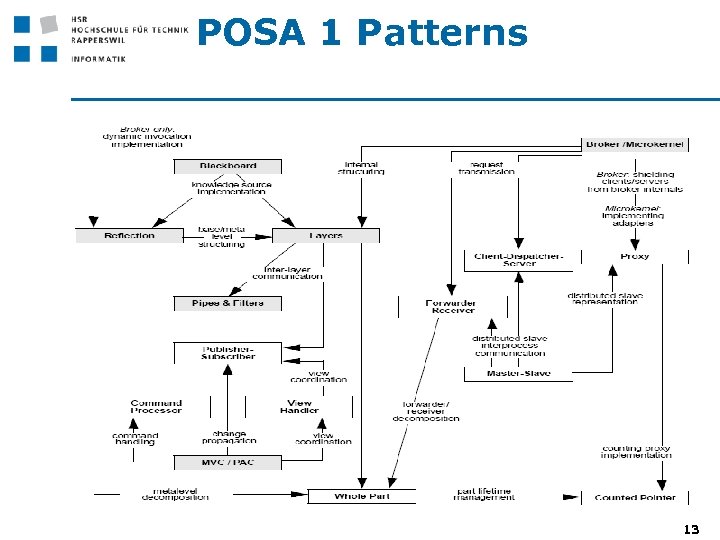 POSA 1 Patterns 13
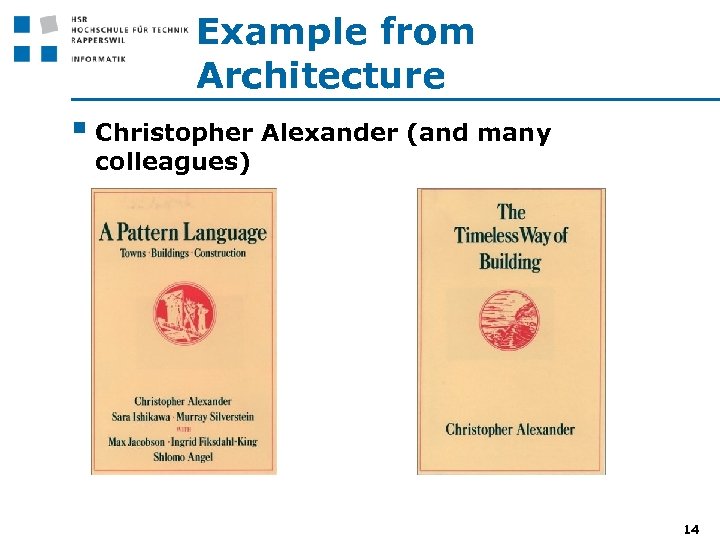 Example from Architecture § Christopher Alexander (and many colleagues) 14
 150 A Place to Wait (Alexander et al: A Pattern Language) The process of waiting has inherent conflicts in it. On the one hand, whatever people are waiting for - the doctor, an airplane, a business appointment has built-in uncertainties, which make it inevitable that they must spend a long time hanging around, waiting, doing nothing. On the other hand, they cannot usually afford to enjoy this time. Because it is unpredictable, they must hang at the very door. Since they never know exactly when their turn will come, they cannot even take a stroll or sit outside. . . 15
 150 A Place to Wait (2) (Alexander et al: A Pattern Language) Therefore: In places where people end up waiting, create a situation which makes the waiting positive. Fuse the waiting with some other activity - newspaper, coffee, pool tables, horseshoes; something which draws people in who are not simply waiting. And also the opposite: make a place which can draw a person waiting into a reverie; quiet; a positive silence. 16
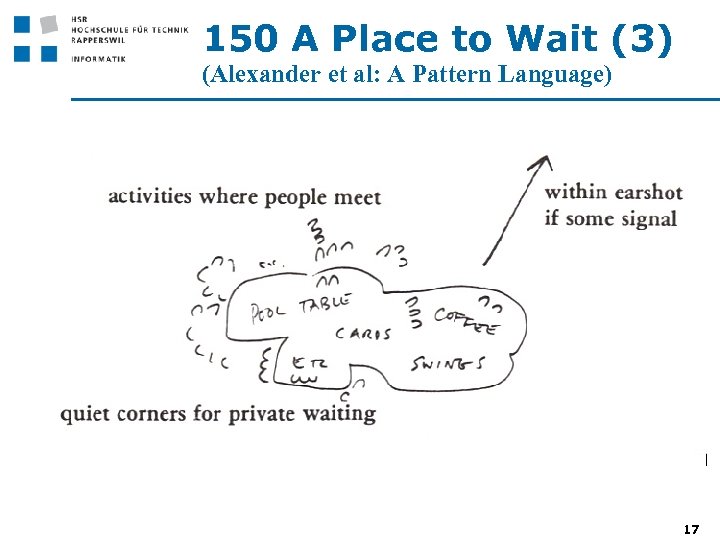 150 A Place to Wait (3) (Alexander et al: A Pattern Language) 17
 150 A Place to Wait (4) (Alexander et al: A Pattern Language) The active part might be a window on the street – STREET WINDOWS (164), a café – STREET CAFE (88), games, positive engagements with the people passing by – OPENING TO THE STREET (165). The quiet part might have quiet garden seat – GARDEN SEAT (176), a place for people to doze – SLEEPING IN PUBLIC (94), perhaps a pond with fish in it – STILL WATER (71). To the extent that this waiting space is a room, a group of rooms, it gets its detailed shape from LIGHT ON TWO SIDES OF EVERY ROOM (159) and THE SHAPE OF INDOOR SPACE (191)…. (Alexander et al. , 1977: pp. 707 711) 18
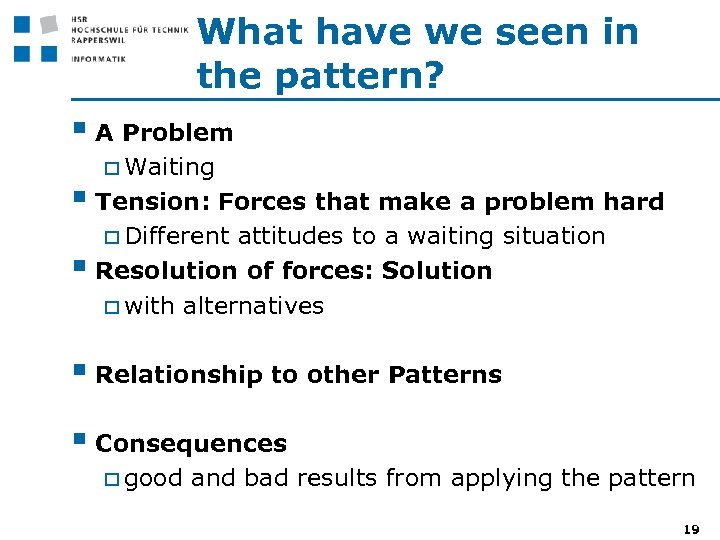 What have we seen in the pattern? § A Problem o Waiting § Tension: Forces that make a problem hard § o Different attitudes to a waiting situation Resolution of forces: Solution o with alternatives § Relationship to other Patterns § Consequences o good and bad results from applying the pattern 19
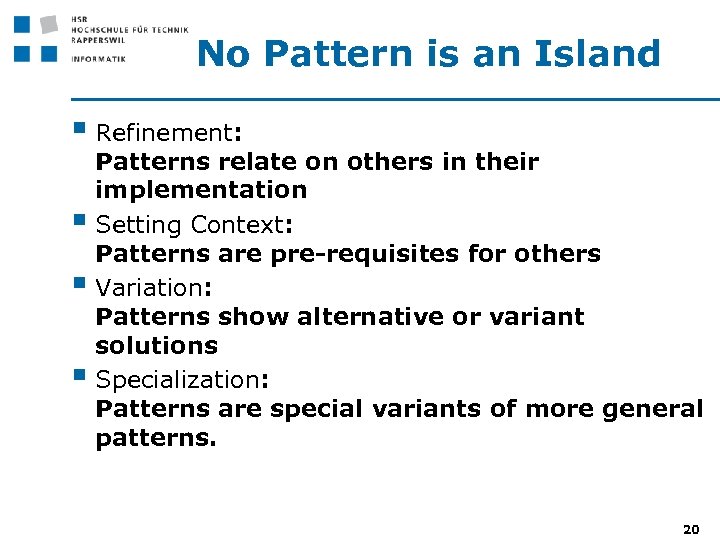 No Pattern is an Island § Refinement: § § § Patterns relate on others in their implementation Setting Context: Patterns are pre-requisites for others Variation: Patterns show alternative or variant solutions Specialization: Patterns are special variants of more general patterns. 20
 The Pattern Community § Yearly conferences on patterns o Euro. PLo. P § § § (Germany) o PLo. P (USA) o Viking. PLo. P (Scandinavia) o Koala. PLo. P, Sugar. Loaf. PLo. P, . . . Improve skills in pattern writing Produce pattern papers and books Learning culture that will help you to improve your patterns and your attempts to apply patterns 21
 Wrap up § Patterns tell stories of repeatedly successful engineering § Honest pattern descriptions tell you the drawbacks as well as the benefits § Applying patterns is never mechanical § Patterns allow more concious and efficient engineering by discussing alternatives § Patterns give a common vocabulary which makes communication about design more efficient 22
 Hausaufgabe § 23 Go. F Patterns anschauen (z. B. Bibliothek) § § § 10 Gruppen a 2 -3 Patterns Problem Statement formulieren! o was ist das Problem, das vom Pattern gelöst wird o Formulierungsidee: "How do you. . ? " Go. F Format hat kein explizites Problem Statement o "versteckt" sich oft im Intent Abgabe via Wiki. Web o http: //wiki. hsr. ch/APF o mit eigenem Vorname. Nachname "anmelden" o Formulierung "signieren" --Vorname. Nachname o Teamarbeit, mehrere Probelm. Statements pro Pattern möglich o Abgabe bis Mittwoch Abend 6. 4. o 23