 Скачать презентацию Advanced Nutrition Energy balance Margi Anne Isaia MD
7e2d18f87609d522bef1ea514ea8b4ba.ppt
- Количество слайдов: 23



Advanced Nutrition Energy balance Margi. Anne Isaia, MD MPH
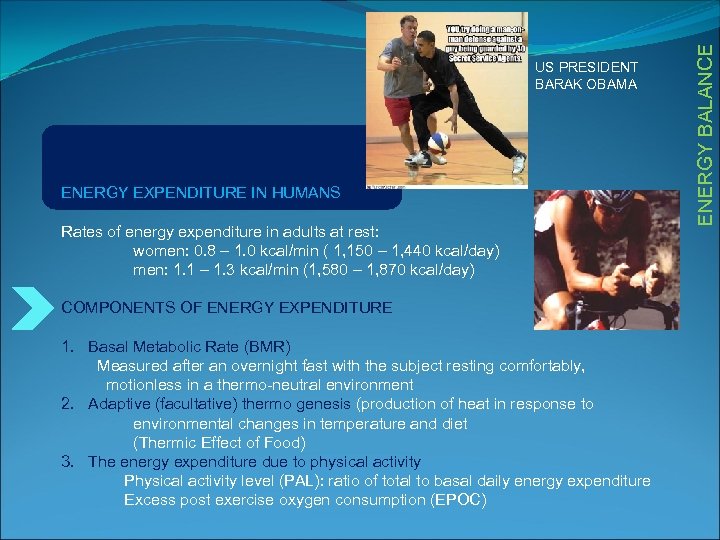
ENERGY EXPENDITURE IN HUMANS Rates of energy expenditure in adults at rest: women: 0. 8 – 1. 0 kcal/min ( 1, 150 – 1, 440 kcal/day) men: 1. 1 – 1. 3 kcal/min (1, 580 – 1, 870 kcal/day) COMPONENTS OF ENERGY EXPENDITURE 1. Basal Metabolic Rate (BMR) Measured after an overnight fast with the subject resting comfortably, motionless in a thermo-neutral environment 2. Adaptive (facultative) thermo genesis (production of heat in response to environmental changes in temperature and diet (Thermic Effect of Food) 3. The energy expenditure due to physical activity Physical activity level (PAL): ratio of total to basal daily energy expenditure Excess post exercise oxygen consumption (EPOC) ENERGY BALANCE US PRESIDENT BARAK OBAMA
Body composition : the size of the fat-free mass (FFM) explains about 70 -80% of the variance in the resting metabolic rate FFM = LEAN BODY MASS = BODY WEIGHT – FAT STORAGE Body weight, physical activity level, gender, genetics, ethnicity Physiological state (growth, pregnancy, older age), Endocrine (hypo- or hyper- thyroidism) Environment (climate, altitude) Nutritional state (overfeeding, underfeeding) ENERGY BALANCE FACTORS WHICH INFLUENCE ENERGY EXPENDITURE AND BMR
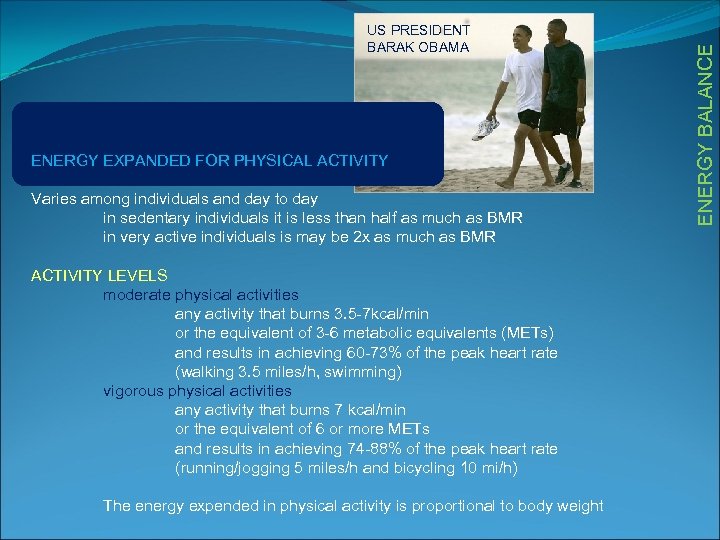
ENERGY EXPANDED FOR PHYSICAL ACTIVITY Varies among individuals and day to day in sedentary individuals it is less than half as much as BMR in very active individuals is may be 2 x as much as BMR ACTIVITY LEVELS moderate physical activities any activity that burns 3. 5 -7 kcal/min or the equivalent of 3 -6 metabolic equivalents (METs) and results in achieving 60 -73% of the peak heart rate (walking 3. 5 miles/h, swimming) vigorous physical activities any activity that burns 7 kcal/min or the equivalent of 6 or more METs and results in achieving 74 -88% of the peak heart rate (running/jogging 5 miles/h and bicycling 10 mi/h) The energy expended in physical activity is proportional to body weight ENERGY BALANCE US PRESIDENT BARAK OBAMA
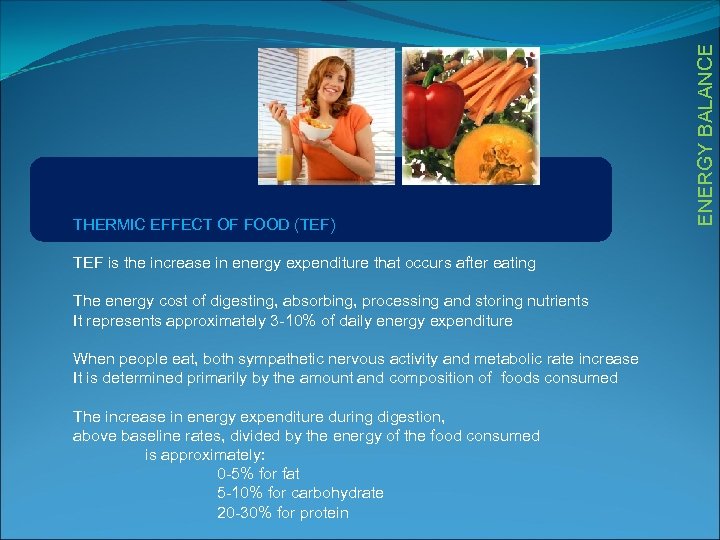
TEF is the increase in energy expenditure that occurs after eating The energy cost of digesting, absorbing, processing and storing nutrients It represents approximately 3 -10% of daily energy expenditure When people eat, both sympathetic nervous activity and metabolic rate increase It is determined primarily by the amount and composition of foods consumed The increase in energy expenditure during digestion, above baseline rates, divided by the energy of the food consumed is approximately: 0 -5% for fat 5 -10% for carbohydrate 20 -30% for protein ENERGY BALANCE THERMIC EFFECT OF FOOD (TEF)
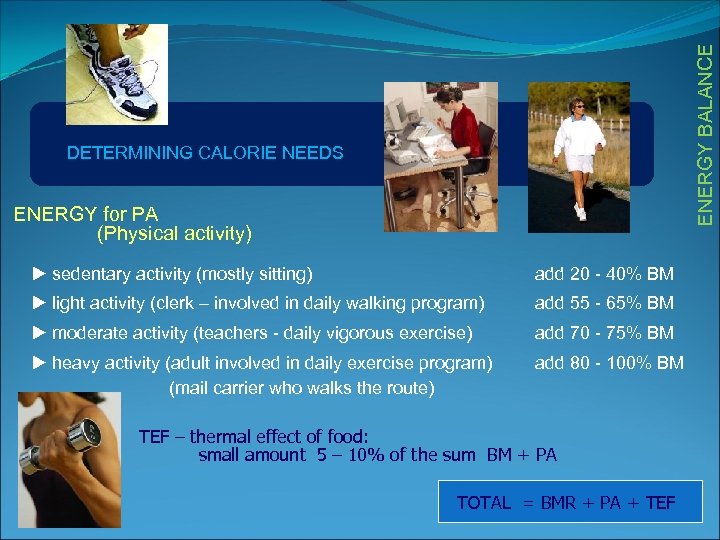
ENERGY BALANCE DETERMINING CALORIE NEEDS ENERGY for PA (Physical activity) u sedentary activity (mostly sitting) add 20 - 40% BM u light activity (clerk – involved in daily walking program) add 55 - 65% BM u moderate activity (teachers - daily vigorous exercise) add 70 - 75% BM u heavy activity (adult involved in daily exercise program) (mail carrier who walks the route) add 80 - 100% BM TEF – thermal effect of food: small amount 5 – 10% of the sum BM + PA TOTAL = BMR + PA + TEF
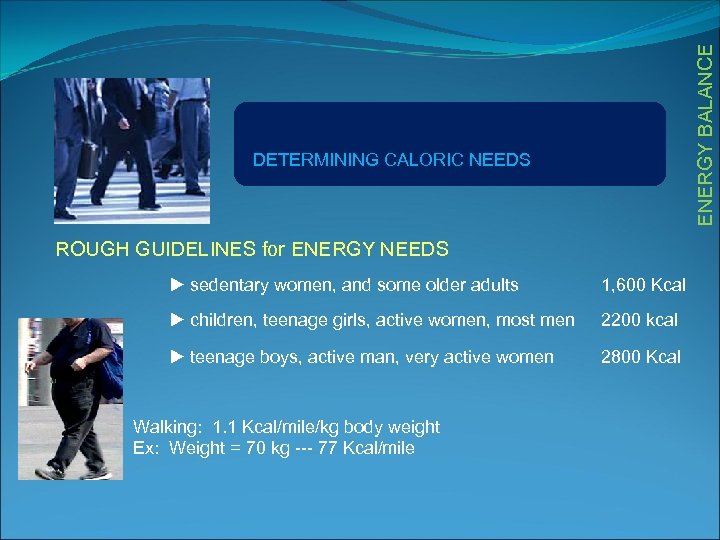
ENERGY BALANCE DETERMINING CALORIC NEEDS ROUGH GUIDELINES for ENERGY NEEDS u sedentary women, and some older adults 1, 600 Kcal u children, teenage girls, active women, most men 2200 kcal u teenage boys, active man, very active women 2800 Kcal Walking: 1. 1 Kcal/mile/kg body weight Ex: Weight = 70 kg --- 77 Kcal/mile
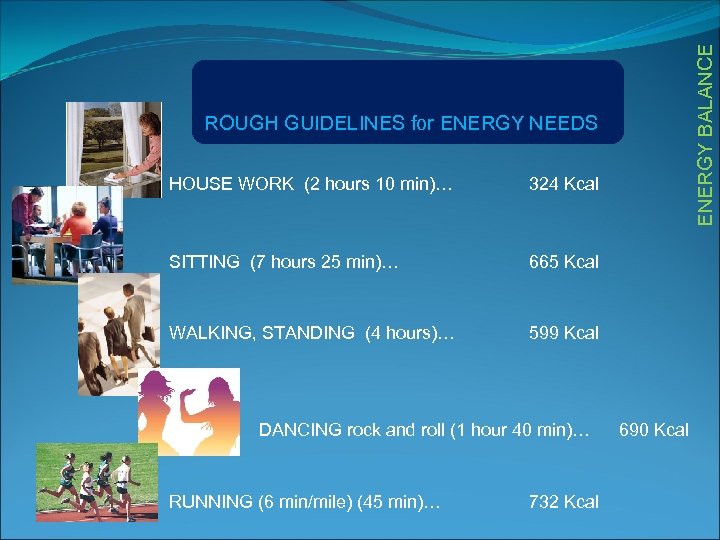
ENERGY BALANCE ROUGH GUIDELINES for ENERGY NEEDS HOUSE WORK (2 hours 10 min)… 324 Kcal SITTING (7 hours 25 min)… 665 Kcal WALKING, STANDING (4 hours)… 599 Kcal DANCING rock and roll (1 hour 40 min)… RUNNING (6 min/mile) (45 min)… 732 Kcal 690 Kcal
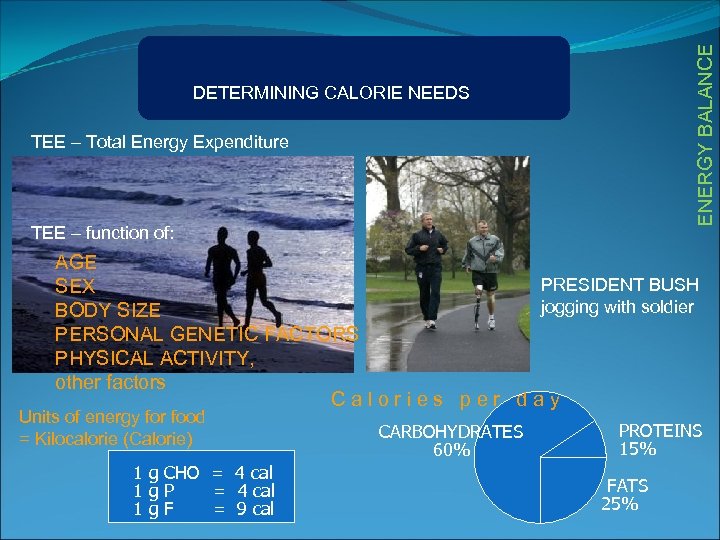
ENERGY BALANCE DETERMINING CALORIE NEEDS TEE – Total Energy Expenditure TEE – function of: AGE PRESIDENT BUSH SEX jogging with soldier BODY SIZE PERSONAL GENETIC FACTORS PHYSICAL ACTIVITY, other factors Calories per day Units of energy for food = Kilocalorie (Calorie) 1 g CHO = 4 cal 1 g. P = 4 cal 1 g. F = 9 cal CARBOHYDRATES 60% PROTEINS 15% FATS 25%
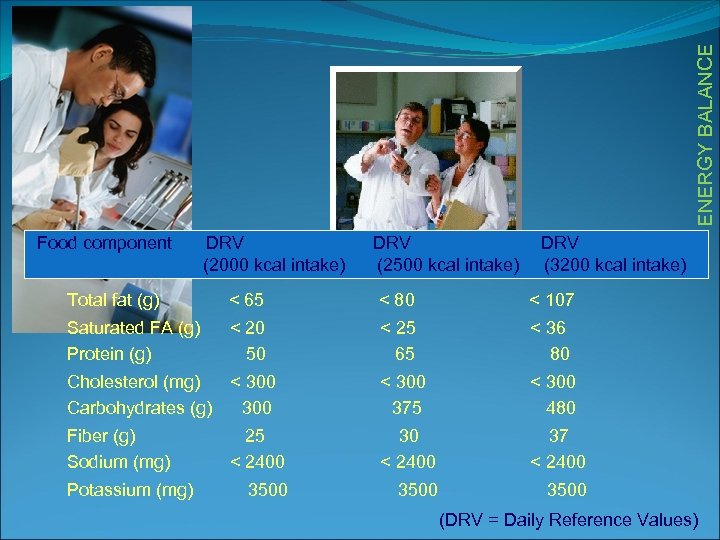
ENERGY BALANCE Food component DRV (2000 kcal intake) DRV (2500 kcal intake) DRV (3200 kcal intake) Total fat (g) < 65 < 80 < 107 Saturated FA (g) Protein (g) < 20 50 < 25 65 < 36 80 Cholesterol (mg) < 300 Carbohydrates (g) 300 < 300 375 < 300 480 Fiber (g) Sodium (mg) 25 < 2400 30 < 2400 37 < 2400 3500 Potassium (mg) (DRV = Daily Reference Values)
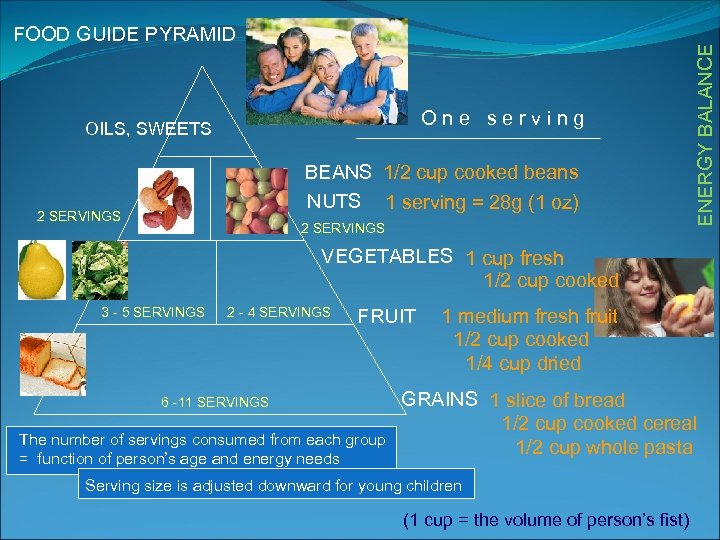
One serving OILS, SWEETS BEANS 1/2 cup cooked beans NUTS 1 serving = 28 g (1 oz) 2 SERVINGS ENERGY BALANCE FOOD GUIDE PYRAMID VEGETABLES 1 cup fresh 1/2 cup cooked 3 - 5 SERVINGS 2 - 4 SERVINGS FRUIT 6 -11 SERVINGS The number of servings consumed from each group = function of person’s age and energy needs 1 medium fresh fruit 1/2 cup cooked 1/4 cup dried GRAINS 1 slice of bread 1/2 cup cooked cereal 1/2 cup whole pasta Serving size is adjusted downward for young children (1 cup = the volume of person’s fist)
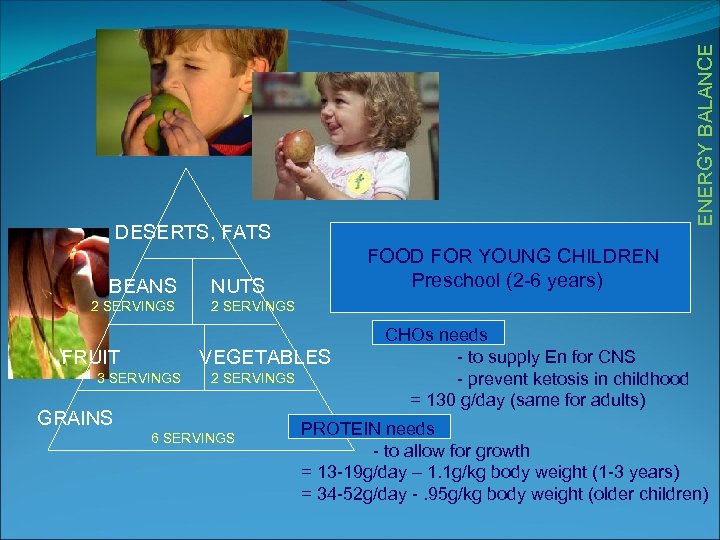
ENERGY BALANCE DESERTS, FATS BEANS 2 SERVINGS FRUIT FOOD FOR YOUNG CHILDREN Preschool (2 -6 years) NUTS 2 SERVINGS VEGETABLES 3 SERVINGS 2 SERVINGS GRAINS 6 SERVINGS CHOs needs - to supply En for CNS - prevent ketosis in childhood = 130 g/day (same for adults) PROTEIN needs - to allow for growth = 13 -19 g/day – 1. 1 g/kg body weight (1 -3 years) = 34 -52 g/day -. 95 g/kg body weight (older children)
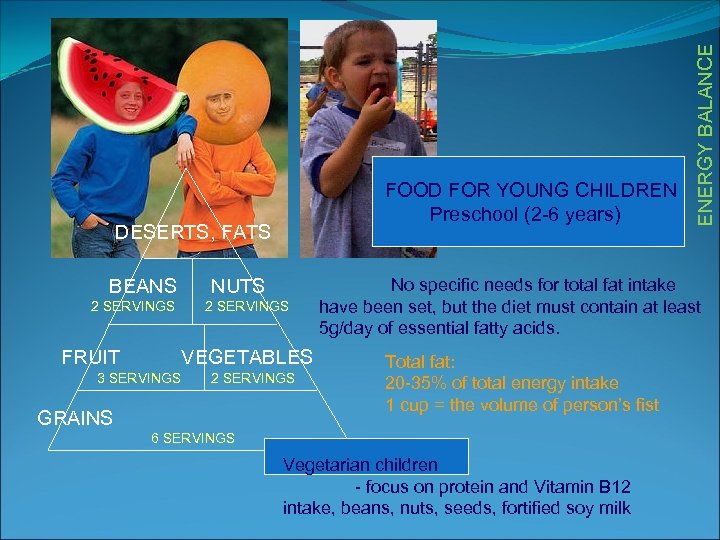
DESERTS, FATS BEANS 2 SERVINGS FRUIT NUTS 2 SERVINGS VEGETABLES 3 SERVINGS 2 SERVINGS GRAINS ENERGY BALANCE FOOD FOR YOUNG CHILDREN Preschool (2 -6 years) No specific needs for total fat intake have been set, but the diet must contain at least 5 g/day of essential fatty acids. Total fat: 20 -35% of total energy intake 1 cup = the volume of person’s fist 6 SERVINGS Vegetarian children - focus on protein and Vitamin B 12 intake, beans, nuts, seeds, fortified soy milk
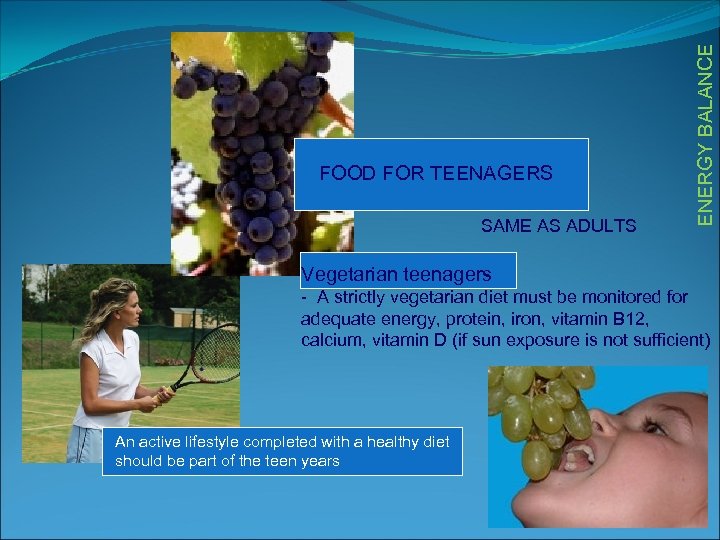
SAME AS ADULTS ENERGY BALANCE FOOD FOR TEENAGERS Vegetarian teenagers - A strictly vegetarian diet must be monitored for adequate energy, protein, iron, vitamin B 12, calcium, vitamin D (if sun exposure is not sufficient) An active lifestyle completed with a healthy diet should be part of the teen years
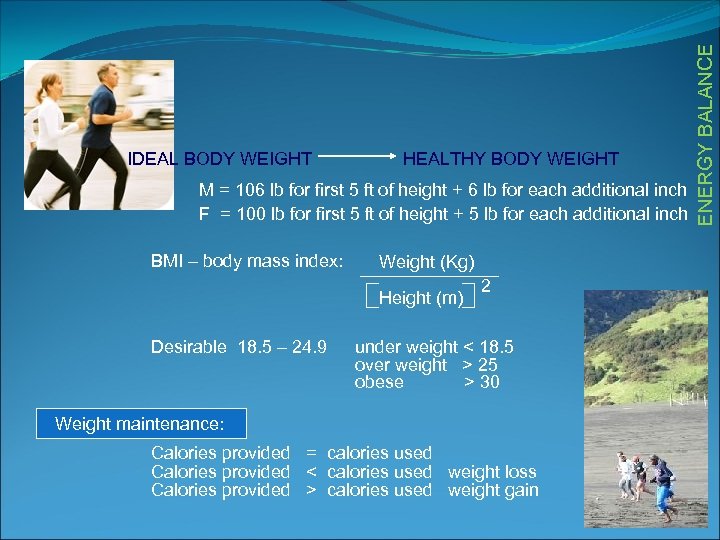
HEALTHY BODY WEIGHT M = 106 lb for first 5 ft of height + 6 lb for each additional inch F = 100 lb for first 5 ft of height + 5 lb for each additional inch BMI – body mass index: Weight (Kg) Height (m) Desirable 18. 5 – 24. 9 2 under weight < 18. 5 over weight > 25 obese > 30 Weight maintenance: Calories provided = calories used Calories provided < calories used weight loss Calories provided > calories used weight gain ENERGY BALANCE IDEAL BODY WEIGHT
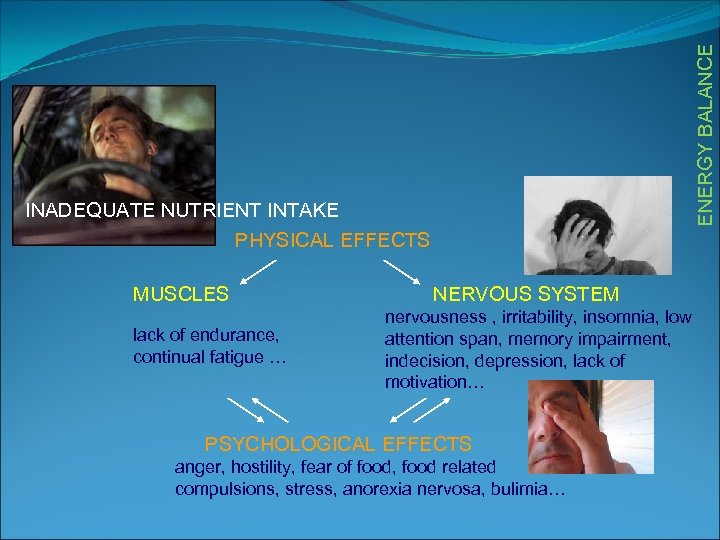
ENERGY BALANCE INADEQUATE NUTRIENT INTAKE PHYSICAL EFFECTS MUSCLES lack of endurance, continual fatigue … NERVOUS SYSTEM nervousness , irritability, insomnia, low attention span, memory impairment, indecision, depression, lack of motivation… PSYCHOLOGICAL EFFECTS anger, hostility, fear of food, food related compulsions, stress, anorexia nervosa, bulimia…
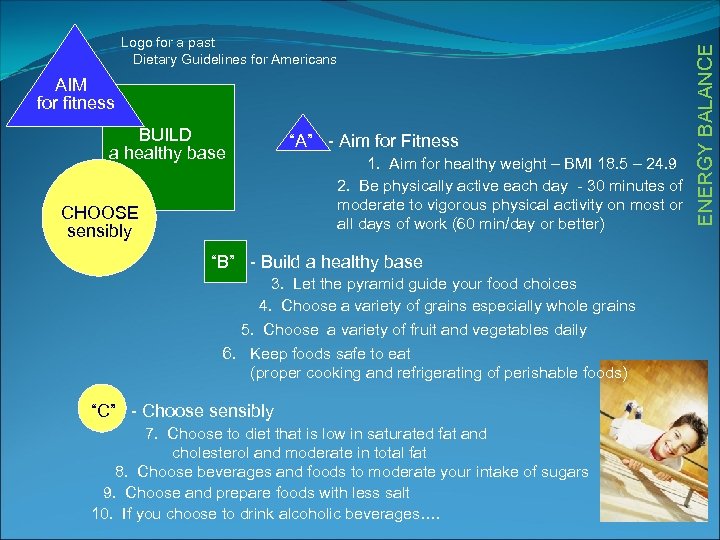
AIM for fitness BUILD a healthy base CHOOSE sensibly “A” - Aim for Fitness 1. Aim for healthy weight – BMI 18. 5 – 24. 9 2. Be physically active each day - 30 minutes of moderate to vigorous physical activity on most or all days of work (60 min/day or better) “B” - Build a healthy base 3. Let the pyramid guide your food choices 4. Choose a variety of grains especially whole grains 5. Choose a variety of fruit and vegetables daily 6. Keep foods safe to eat (proper cooking and refrigerating of perishable foods) “C” - Choose sensibly 7. Choose to diet that is low in saturated fat and cholesterol and moderate in total fat 8. Choose beverages and foods to moderate your intake of sugars 9. Choose and prepare foods with less salt 10. If you choose to drink alcoholic beverages…. ENERGY BALANCE Logo for a past Dietary Guidelines for Americans

AMERICAN DIETETIC ASSOCIATION 5 BASIC PRINCIPLES WITH REGARD TO DIET AND HEALTH u Be realistic, making small changes over time u Be adventurous, trying new foods regularely u Be flexible, balancing some sweet and fatty foods with physical activity u Be sensible, including favorite foods in smaller portion u Be active, including physical activity in daily life
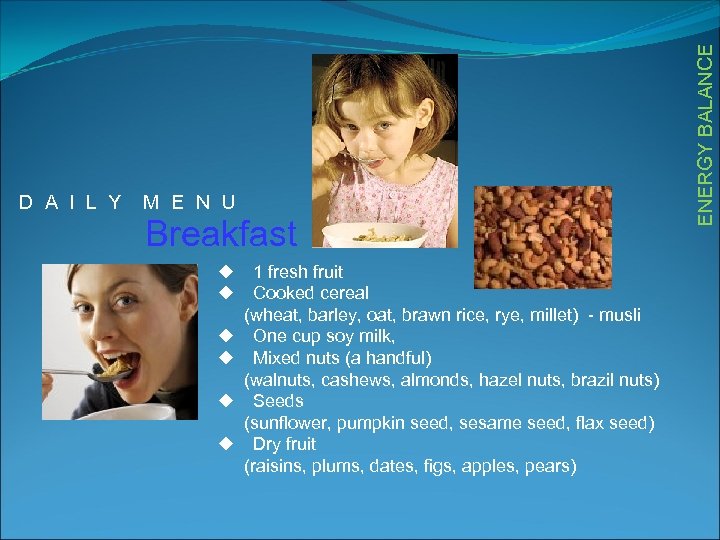
M E N U Breakfast u u u 1 fresh fruit Cooked cereal (wheat, barley, oat, brawn rice, rye, millet) - musli One cup soy milk, Mixed nuts (a handful) (walnuts, cashews, almonds, hazel nuts, brazil nuts) Seeds (sunflower, pumpkin seed, sesame seed, flax seed) Dry fruit (raisins, plums, dates, figs, apples, pears) ENERGY BALANCE D A I L Y
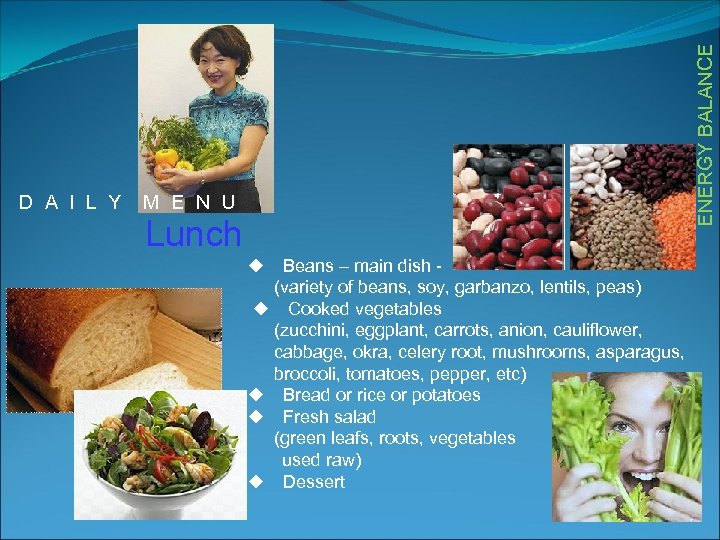
ENERGY BALANCE D A I L Y M E N U Lunch Beans – main dish (variety of beans, soy, garbanzo, lentils, peas) u Cooked vegetables (zucchini, eggplant, carrots, anion, cauliflower, cabbage, okra, celery root, mushrooms, asparagus, broccoli, tomatoes, pepper, etc) u Bread or rice or potatoes u Fresh salad (green leafs, roots, vegetables used raw) u Dessert u
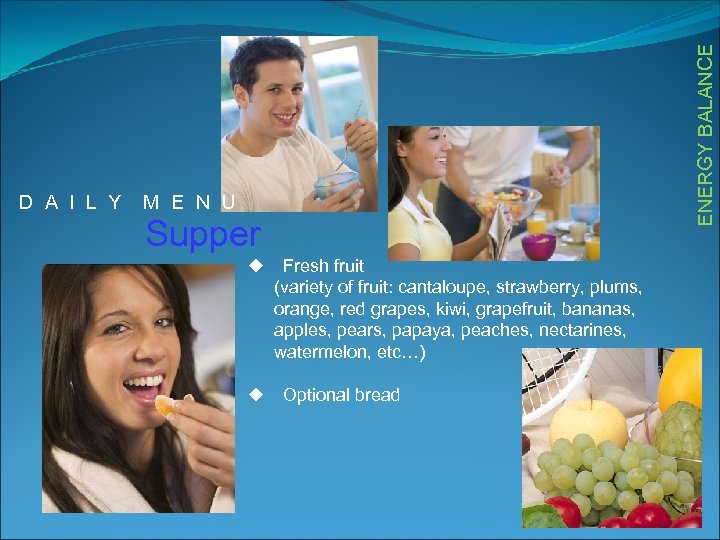
ENERGY BALANCE D A I L Y M E N U Supper u u Fresh fruit (variety of fruit: cantaloupe, strawberry, plums, orange, red grapes, kiwi, grapefruit, bananas, apples, pears, papaya, peaches, nectarines, watermelon, etc…) Optional bread
ENERGY BALANCE REFERENCES Shils M et al, Modern Nutrition in Health and Disease, 10 th Edition www. Pubmed. org www. nhlbi. nih. gov
QUESTIONS? QUESTIONS? QUESTIONS?
Скачать презентацию Advanced Nutrition Energy balance Margi Anne Isaia MD
7e2d18f87609d522bef1ea514ea8b4ba.ppt