 Скачать презентацию Advanced Materials Solutions Silicon Carbide Tritium Permeation Barriers
58aad7757747b5e5484990e86c7f22b3.ppt
- Количество слайдов: 20



Advanced Materials Solutions Silicon Carbide Tritium Permeation Barriers for Steel Structural Components, Phase II Ultramet Matt Wright(PI) Test Support: Sandia Rion Causey, Rob Kolasinski Design and Modeling and Test Support: Sandia Dennis Youchison DOE Technical Monitor Gene Nardella Program Duration: 2 Years (August, 2008 – August, 2010) FNST Meeting August 12 -14, 2008
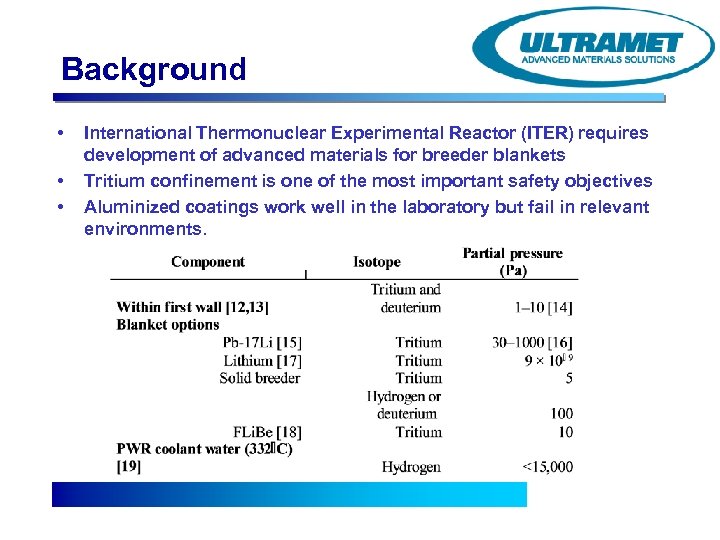
Background • • • Advanced Materials Solutions International Thermonuclear Experimental Reactor (ITER) requires development of advanced materials for breeder blankets Tritium confinement is one of the most important safety objectives Aluminized coatings work well in the laboratory but fail in relevant environments.
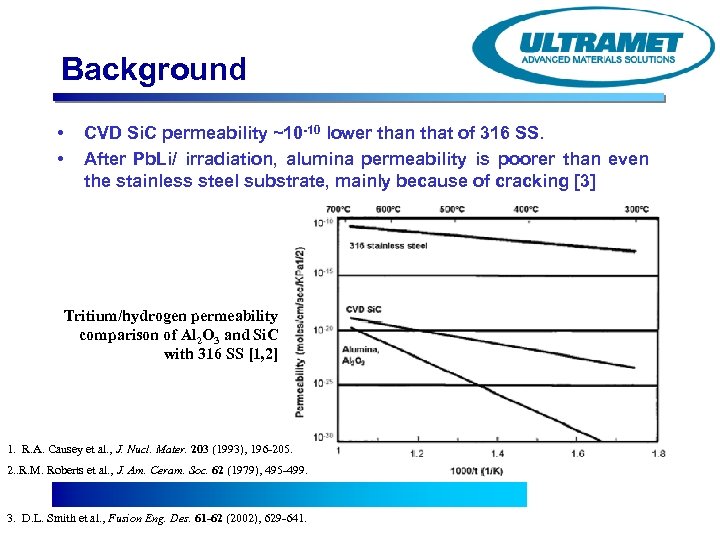
Background • • Advanced Materials Solutions CVD Si. C permeability ~10 -10 lower than that of 316 SS. After Pb. Li/ irradiation, alumina permeability is poorer than even the stainless steel substrate, mainly because of cracking [3] Tritium/hydrogen permeability comparison of Al 2 O 3 and Si. C with 316 SS [1, 2] 1. R. A. Causey et al. , J. Nucl. Mater. 203 (1993), 196 -205. 2. . R. M. Roberts et al. , J. Am. Ceram. Soc. 62 (1979), 495 -499. 3. D. L. Smith et al. , Fusion Eng. Des. 61 -62 (2002), 629 -641.
Background • • Advanced Materials Solutions Aluminized coatings are NOT chemically compatible with Pb. Li Al 2 O 3 + 2 Li → 2 Li. Al. O 2 + O CVD Si. C has no reaction with Pb. Li. Large differences in tritium barrier coating performance have been attributed to superficial coating damage, i. e. , microcracks [4]. However, because of CTE mismatch, Si. C cannot be directly applied to steel (microcracking). CTEs: – CVD Si. C: 4. 5 ppm/K – ferritic steel F 82 H: 10. 37 ppm/K – Alumina range: 5. 50 ppm/K - 9. 60 ppm/K • Avoidance of microcrack formation in tritium barrier coatings is therefore of utmost importance. 4. A. Aiello et al. , Fusion Eng. Des. 58 -59 (2001), 737 -742.
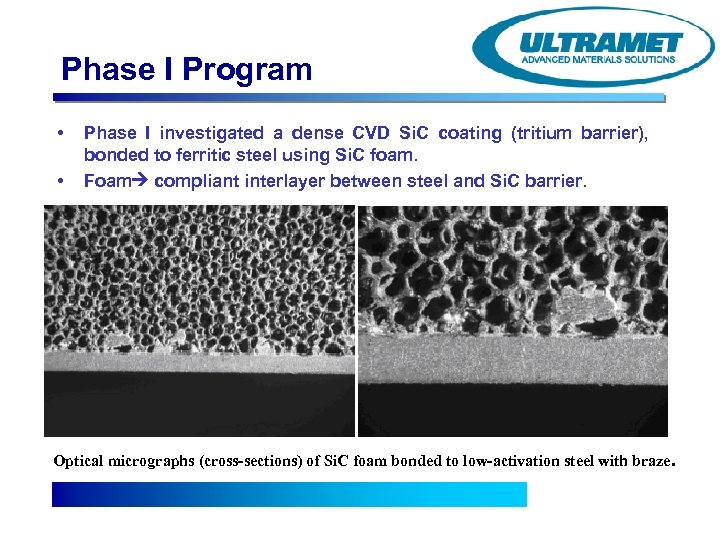
Phase I Program • • Advanced Materials Solutions Phase I investigated a dense CVD Si. C coating (tritium barrier), bonded to ferritic steel using Si. C foam. Foam compliant interlayer between steel and Si. C barrier. Optical micrographs (cross-sections) of Si. C foam bonded to low-activation steel with braze.
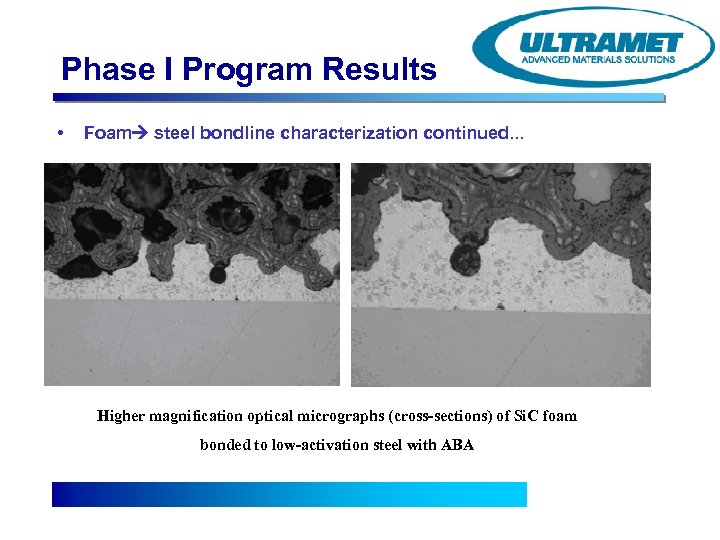
Phase I Program Results • Foam steel bondline characterization continued. . . Higher magnification optical micrographs (cross-sections) of Si. C foam bonded to low-activation steel with ABA Advanced Materials Solutions
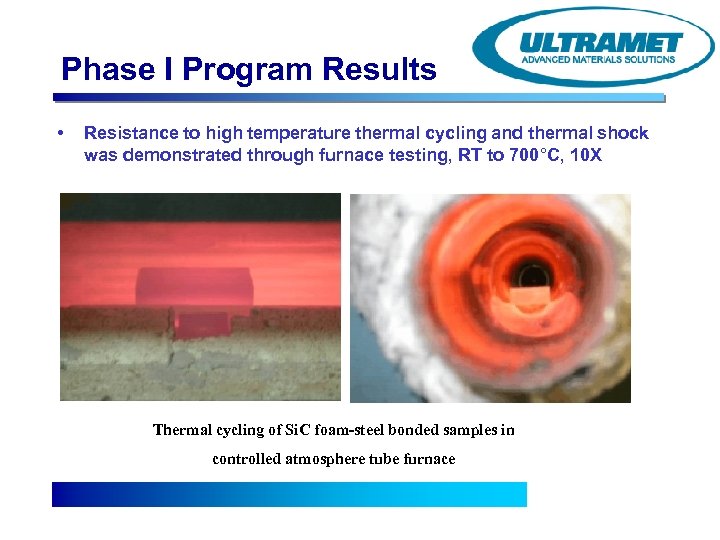
Phase I Program Results • Advanced Materials Solutions Resistance to high temperature thermal cycling and thermal shock was demonstrated through furnace testing, RT to 700°C, 10 X Thermal cycling of Si. C foam-steel bonded samples in controlled atmosphere tube furnace
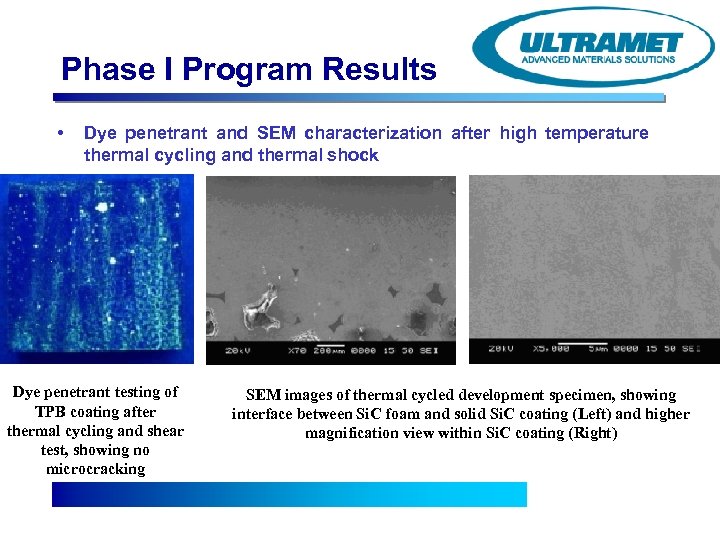
Phase I Program Results • Advanced Materials Solutions Dye penetrant and SEM characterization after high temperature thermal cycling and thermal shock Dye penetrant testing of TPB coating after thermal cycling and shear test, showing no microcracking SEM images of thermal cycled development specimen, showing interface between Si. C foam and solid Si. C coating (Left) and higher magnification view within Si. C coating (Right)
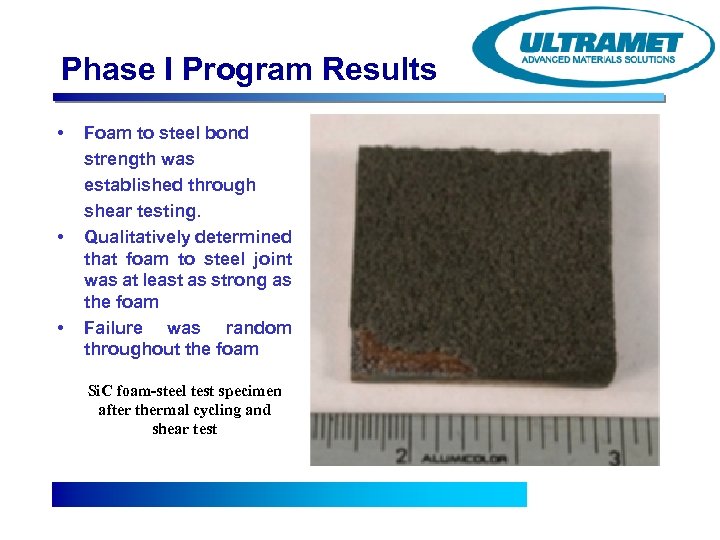
Phase I Program Results • • • Foam to steel bond strength was established through shear testing. Qualitatively determined that foam to steel joint was at least as strong as the foam Failure was random throughout the foam Si. C foam-steel test specimen after thermal cycling and shear test Advanced Materials Solutions
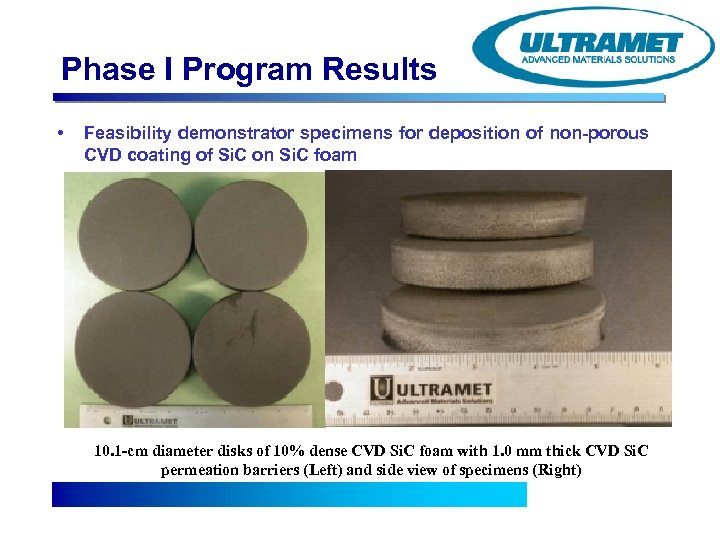
Phase I Program Results • Advanced Materials Solutions Feasibility demonstrator specimens for deposition of non-porous CVD coating of Si. C on Si. C foam 10. 1 -cm diameter disks of 10% dense CVD Si. C foam with 1. 0 mm thick CVD Si. C permeation barriers (Left) and side view of specimens (Right)
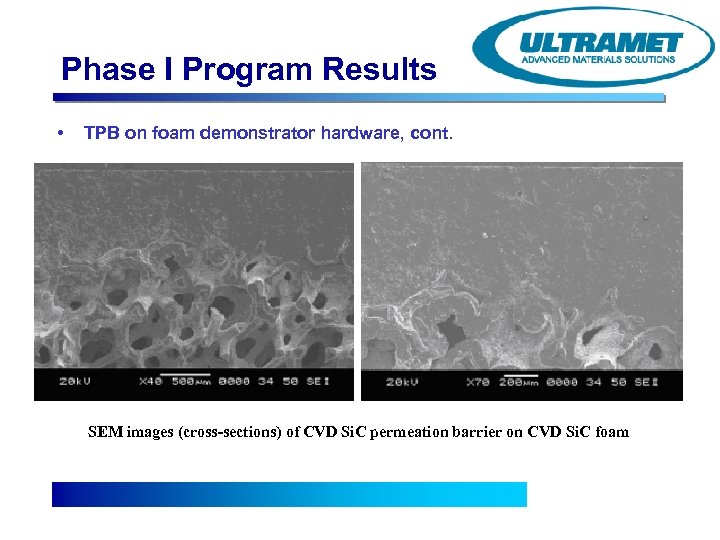
Phase I Program Results • Advanced Materials Solutions TPB on foam demonstrator hardware, cont. SEM images (cross-sections) of CVD Si. C permeation barrier on CVD Si. C foam
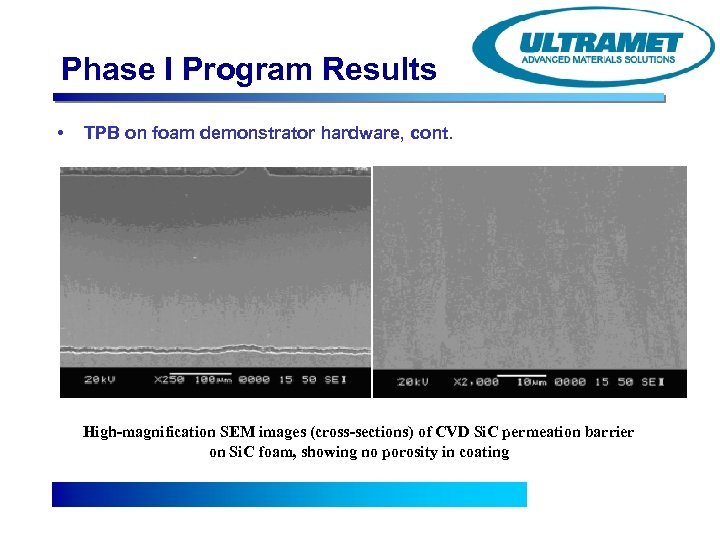
Phase I Program Results • Advanced Materials Solutions TPB on foam demonstrator hardware, cont. High-magnification SEM images (cross-sections) of CVD Si. C permeation barrier on Si. C foam, showing no porosity in coating
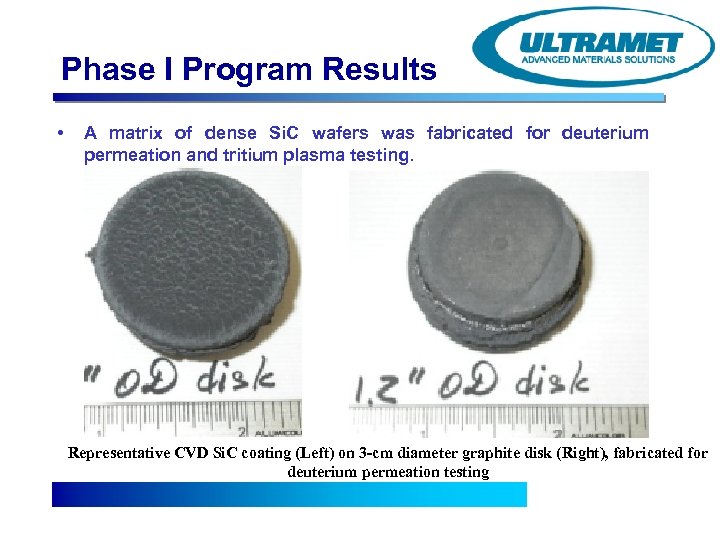
Phase I Program Results • Advanced Materials Solutions A matrix of dense Si. C wafers was fabricated for deuterium permeation and tritium plasma testing. Representative CVD Si. C coating (Left) on 3 -cm diameter graphite disk (Right), fabricated for deuterium permeation testing
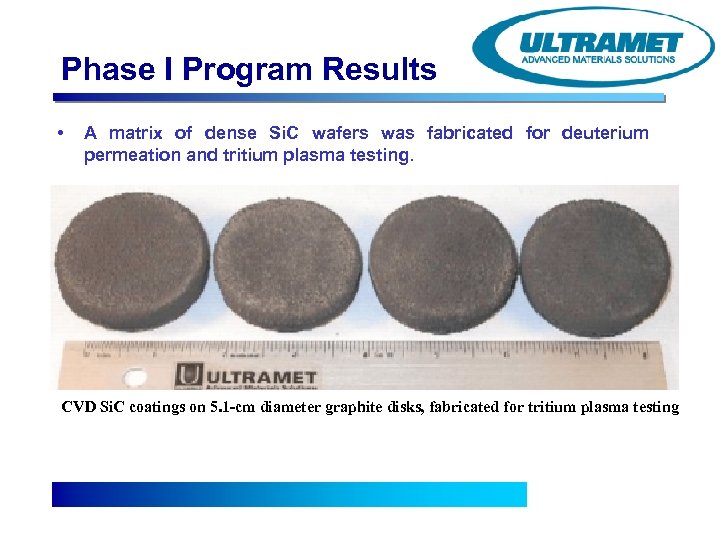
Phase I Program Results • Advanced Materials Solutions A matrix of dense Si. C wafers was fabricated for deuterium permeation and tritium plasma testing. CVD Si. C coatings on 5. 1 -cm diameter graphite disks, fabricated for tritium plasma testing
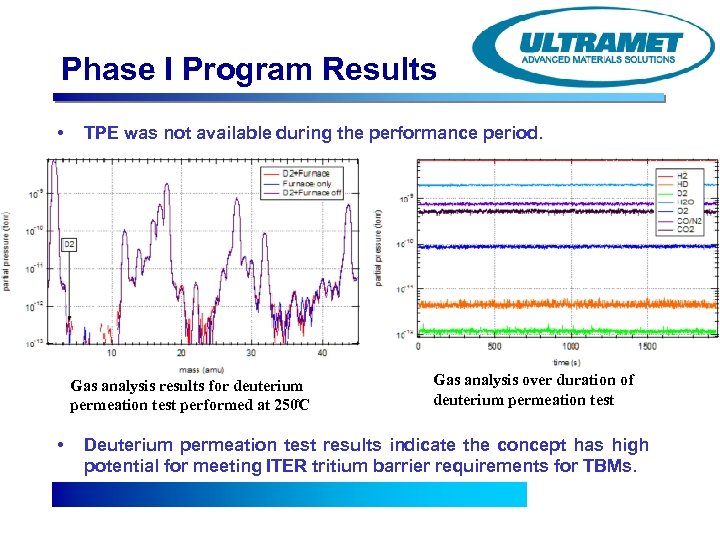
Phase I Program Results • TPE was not available during the performance period. Gas analysis results for deuterium permeation test performed at 250 C • Advanced Materials Solutions Gas analysis over duration of deuterium permeation test Deuterium permeation test results indicate the concept has high potential for meeting ITER tritium barrier requirements for TBMs.
Phase I Conclusions • • Advanced Materials Solutions The primary objective of bonding solid CVD Si. C tritium barrier coating to low-activation steel through use of a compliant Si. C foam interlayer, was clearly achieved. Thermal and mechanical test results showed good potential for the structure to meet TPB requirements. Initial bonding procedures were established and thermal cycling tests were performed. The results showed no degradation of the foam-to-steel bond or the solid Si. C coating. Without the foam interlayer, Si. C coatings bonded directly to steel would microcrack severely during thermal cycling as a result of CTE mismatch. Preliminary D permeation testing performed at Sandia showed promising results, demonstrating a hermetic boundary.
Phase II Plans • • Advanced Materials Solutions TPB Process Optimization and Property Characterization: Expand the scope to include compliant open-cell Mo and V metallic foam interlayer- thereby minimizing thermally induced stress that would otherwise damage the Si. C permeation barrier coating. TPB Modeling and Model Validation: Sandia will perform detailed thermostructural modeling of a tubular TPB structure consisting of a ferritic steel outer tube, an open-cell foam interlayer, and a CVD Si. C internal tritium barrier. – Validated by producing strain gauge-instrumented rectangular coupons of the most promising multilayered barrier structures and applying a temperature gradient between the TPB coating and the steel substrate using the EB-60 electron beam at the Sandia Plasma Materials Test Facility (PMTF).
Phase II Plans Advanced Materials Solutions • Mechanical and thermal property testing: performed as required to support the modeling and design • High temperature permeation rig construction– High temperature furnace, control system, mass spectrometer assembled and fitted with molybdenum tubes on each side of the seal. – allowing testing to 1000°C • Surface roughness was a factor in sealing samples to the gasket material, will be addressed by – – Surface polishing by magnetorheological finishing (MRF) – Sample surface metallization-Ti/Pt/Au for brazing/soldering to copper gaskets. – Sputtering or evaporation of gold
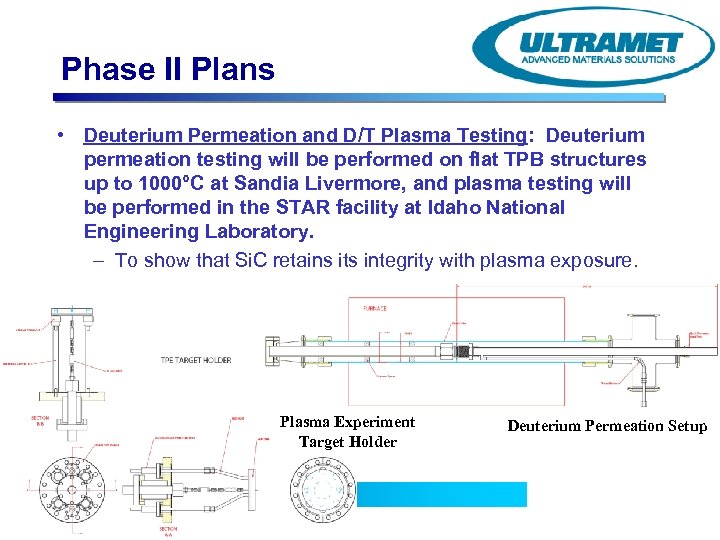
Advanced Materials Solutions Phase II Plans • Deuterium Permeation and D/T Plasma Testing: Deuterium permeation testing will be performed on flat TPB structures up to 1000°C at Sandia Livermore, and plasma testing will be performed in the STAR facility at Idaho National Engineering Laboratory. – To show that Si. C retains its integrity with plasma exposure. Plasma Experiment Target Holder Deuterium Permeation Setup
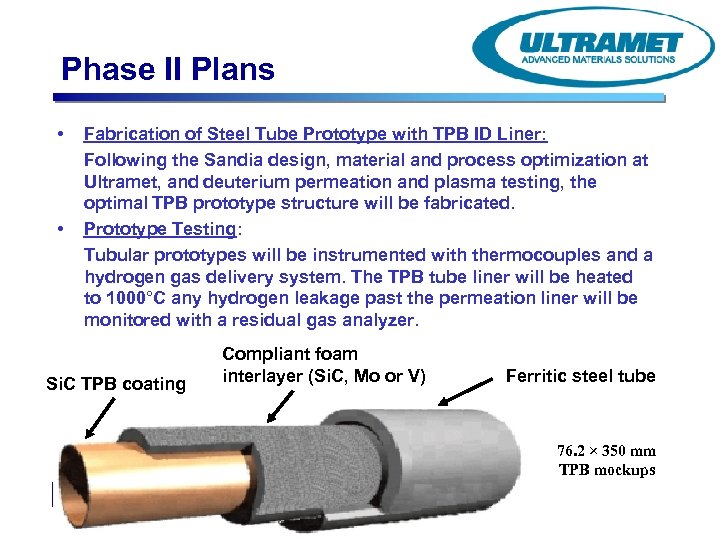
Phase II Plans • • Advanced Materials Solutions Fabrication of Steel Tube Prototype with TPB ID Liner: Following the Sandia design, material and process optimization at Ultramet, and deuterium permeation and plasma testing, the optimal TPB prototype structure will be fabricated. Prototype Testing: Tubular prototypes will be instrumented with thermocouples and a hydrogen gas delivery system. The TPB tube liner will be heated to 1000°C any hydrogen leakage past the permeation liner will be monitored with a residual gas analyzer. Si. C TPB coating Compliant foam interlayer (Si. C, Mo or V) Ferritic steel tube 76. 2 × 350 mm TPB mockups
Скачать презентацию Advanced Materials Solutions Silicon Carbide Tritium Permeation Barriers
58aad7757747b5e5484990e86c7f22b3.ppt