


 Скачать презентацию Advanced LIGO David Shoemaker NSF LIGO Review 23
3eb36f0f059a6cc271a12c18a08a2ec3.ppt
- Количество слайдов: 26
 Advanced LIGO David Shoemaker NSF LIGO Review 23 October 2002 LIGO Laboratory G 020477 -00 -R 1
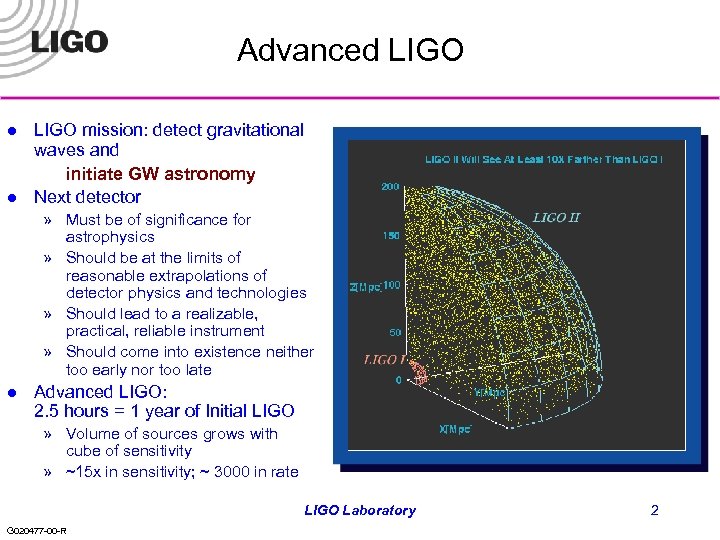 Advanced LIGO l l LIGO mission: detect gravitational waves and initiate GW astronomy Next detector » Must be of significance for astrophysics » Should be at the limits of reasonable extrapolations of detector physics and technologies » Should lead to a realizable, practical, reliable instrument » Should come into existence neither too early nor too late l Advanced LIGO: 2. 5 hours = 1 year of Initial LIGO » Volume of sources grows with cube of sensitivity » ~15 x in sensitivity; ~ 3000 in rate LIGO Laboratory G 020477 -00 -R 2
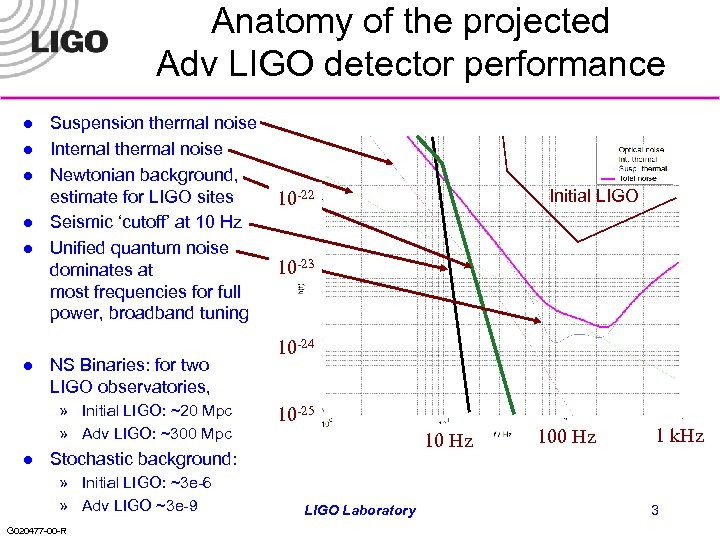 Anatomy of the projected Adv LIGO detector performance l l l Suspension thermal noise Internal thermal noise Newtonian background, estimate for LIGO sites Seismic ‘cutoff’ at 10 Hz Unified quantum noise dominates at most frequencies for full power, broadband tuning NS Binaries: for two LIGO observatories, » Initial LIGO: ~20 Mpc » Adv LIGO: ~300 Mpc l 10 -23 10 -24 10 -25 10 Hz Stochastic background: » Initial LIGO: ~3 e-6 » Adv LIGO ~3 e-9 G 020477 -00 -R Initial LIGO 10 -22 LIGO Laboratory 100 Hz 1 k. Hz 3
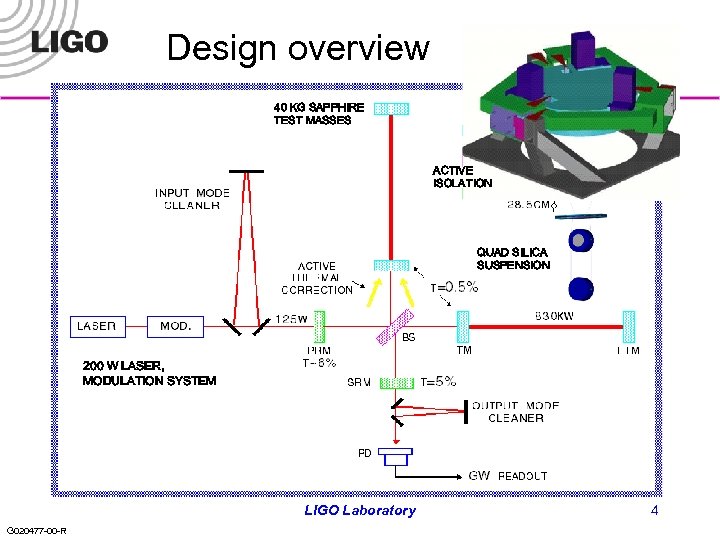 Design overview 40 KG SAPPHIRE TEST MASSES ACTIVE ISOLATION QUAD SILICA SUSPENSION 200 W LASER, MODULATION SYSTEM LIGO Laboratory G 020477 -00 -R 4
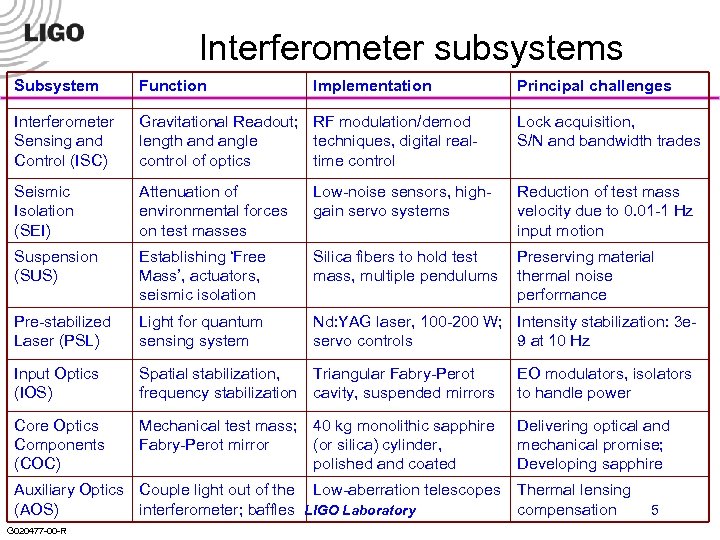 Interferometer subsystems Subsystem Function Implementation Interferometer Sensing and Control (ISC) Gravitational Readout; RF modulation/demod length and angle techniques, digital realcontrol of optics time control Lock acquisition, S/N and bandwidth trades Seismic Isolation (SEI) Attenuation of environmental forces on test masses Low-noise sensors, highgain servo systems Reduction of test mass velocity due to 0. 01 -1 Hz input motion Suspension (SUS) Establishing ‘Free Mass’, actuators, seismic isolation Silica fibers to hold test mass, multiple pendulums Preserving material thermal noise performance Pre-stabilized Laser (PSL) Light for quantum sensing system Nd: YAG laser, 100 -200 W; Intensity stabilization: 3 eservo controls 9 at 10 Hz Input Optics (IOS) Spatial stabilization, Triangular Fabry-Perot frequency stabilization cavity, suspended mirrors EO modulators, isolators to handle power Core Optics Components (COC) Mechanical test mass; 40 kg monolithic sapphire Fabry-Perot mirror (or silica) cylinder, polished and coated Delivering optical and mechanical promise; Developing sapphire Auxiliary Optics Couple light out of the Low-aberration telescopes (AOS) interferometer; baffles LIGO Laboratory G 020477 -00 -R Principal challenges Thermal lensing compensation 5
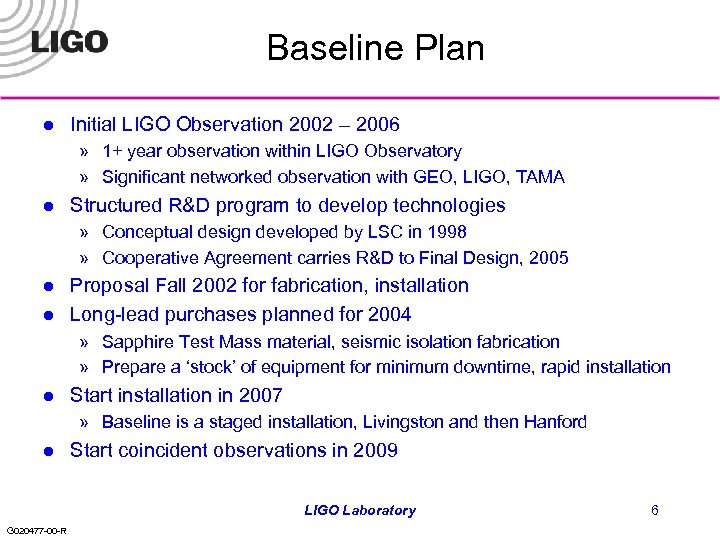 Baseline Plan l Initial LIGO Observation 2002 – 2006 » 1+ year observation within LIGO Observatory » Significant networked observation with GEO, LIGO, TAMA l Structured R&D program to develop technologies » Conceptual design developed by LSC in 1998 » Cooperative Agreement carries R&D to Final Design, 2005 l l Proposal Fall 2002 for fabrication, installation Long-lead purchases planned for 2004 » Sapphire Test Mass material, seismic isolation fabrication » Prepare a ‘stock’ of equipment for minimum downtime, rapid installation l Start installation in 2007 » Baseline is a staged installation, Livingston and then Hanford l Start coincident observations in 2009 LIGO Laboratory G 020477 -00 -R 6
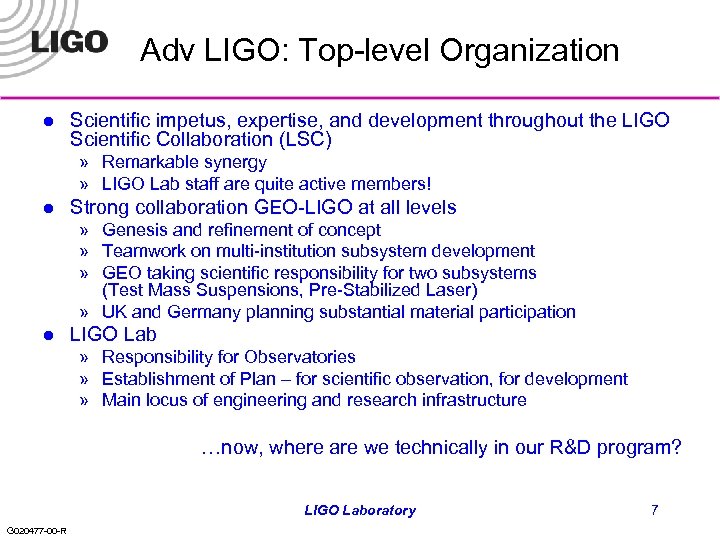 Adv LIGO: Top-level Organization l Scientific impetus, expertise, and development throughout the LIGO Scientific Collaboration (LSC) » Remarkable synergy » LIGO Lab staff are quite active members! l Strong collaboration GEO-LIGO at all levels » Genesis and refinement of concept » Teamwork on multi-institution subsystem development » GEO taking scientific responsibility for two subsystems (Test Mass Suspensions, Pre-Stabilized Laser) » UK and Germany planning substantial material participation l LIGO Lab » Responsibility for Observatories » Establishment of Plan – for scientific observation, for development » Main locus of engineering and research infrastructure …now, where are we technically in our R&D program? LIGO Laboratory G 020477 -00 -R 7
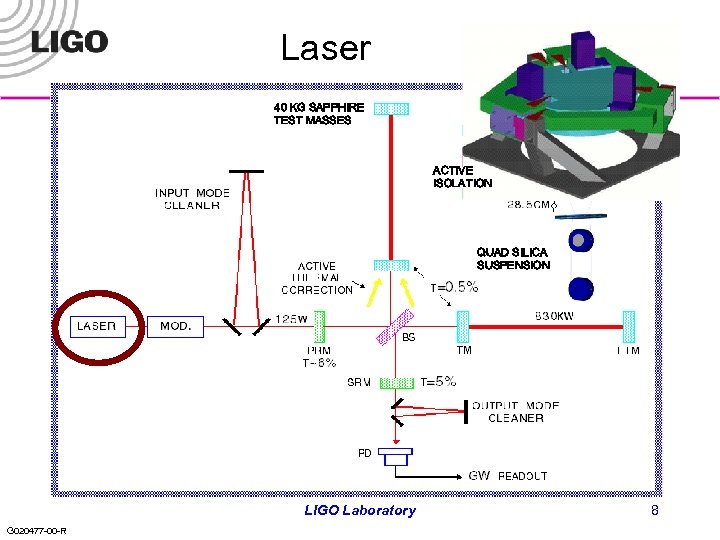 Laser 40 KG SAPPHIRE TEST MASSES ACTIVE ISOLATION QUAD SILICA SUSPENSION LIGO Laboratory G 020477 -00 -R 8
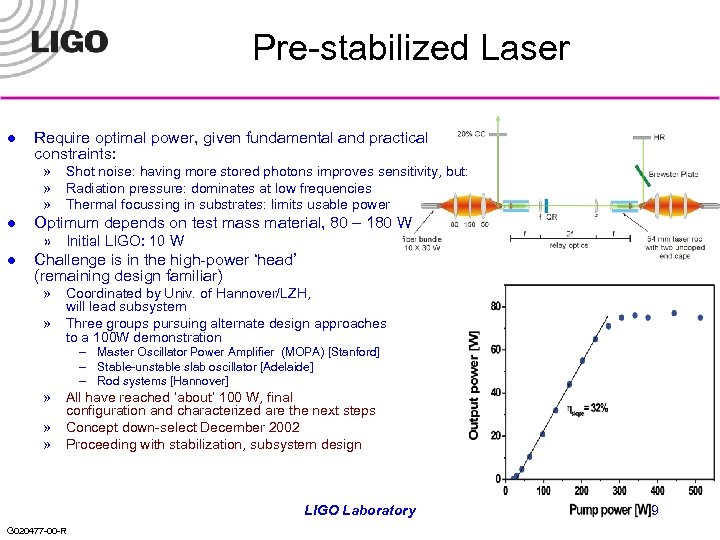 Pre-stabilized Laser l Require optimal power, given fundamental and practical constraints: » Shot noise: having more stored photons improves sensitivity, but: » Radiation pressure: dominates at low frequencies » Thermal focussing in substrates: limits usable power l l Optimum depends on test mass material, 80 – 180 W » Initial LIGO: 10 W Challenge is in the high-power ‘head’ (remaining design familiar) » Coordinated by Univ. of Hannover/LZH, will lead subsystem » Three groups pursuing alternate design approaches to a 100 W demonstration – Master Oscillator Power Amplifier (MOPA) [Stanford] – Stable-unstable slab oscillator [Adelaide] – Rod systems [Hannover] » All have reached ‘about’ 100 W, final configuration and characterized are the next steps » Concept down-select December 2002 » Proceeding with stabilization, subsystem design LIGO Laboratory G 020477 -00 -R 9
 Input Optics, Modulation 40 KG SAPPHIRE TEST MASSES ACTIVE ISOLATION QUAD SILICA SUSPENSION LIGO Laboratory G 020477 -00 -R 10
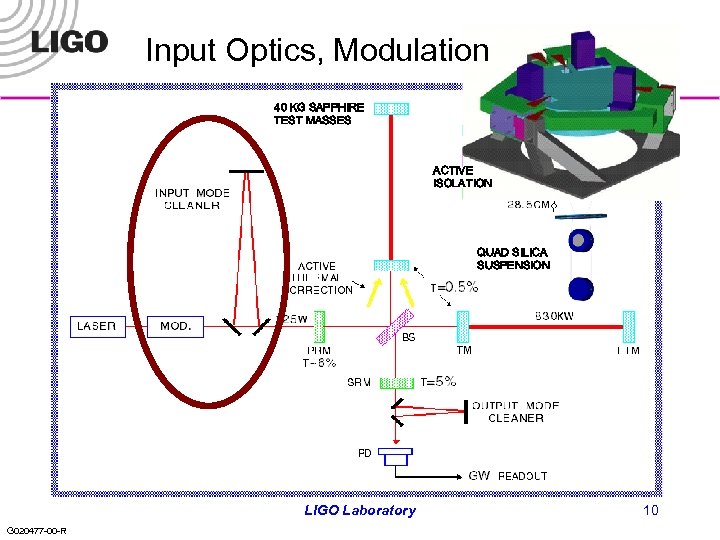
 Input Optics l l l l l Subsystem interfaces laser light to main interferometer » Modulation sidebands applied for sensing system » Beam cleaned and stabilized by transmission though cavity » Precision mode matching from ~0. 5 cm to ~10 cm beam Challenges in handling high power » isolators, modulators » Mirror mass and intensity stabilization (technical radiation pressure) University of Florida takes lead Design is based on initial LIGO system Design Requirements Review held in May 2001: very successful Many incremental innovations due to » Initial design flaws (mostly unforeseeable) » Changes in requirements LIGO 1 LIGO II » Just Plain Good Ideas! New Faraday isolator materials: 45 d. B, 150 W Larger masses (radiation pressure), vacuum tubes (layout) Thermal mode matching Preliminary design underway LIGO Laboratory G 020477 -00 -R 11
 Test Masses 40 KG SAPPHIRE TEST MASSES ACTIVE ISOLATION QUAD SILICA SUSPENSION 200 W LASER, MODULATION SYSTEM LIGO Laboratory G 020477 -00 -R 12
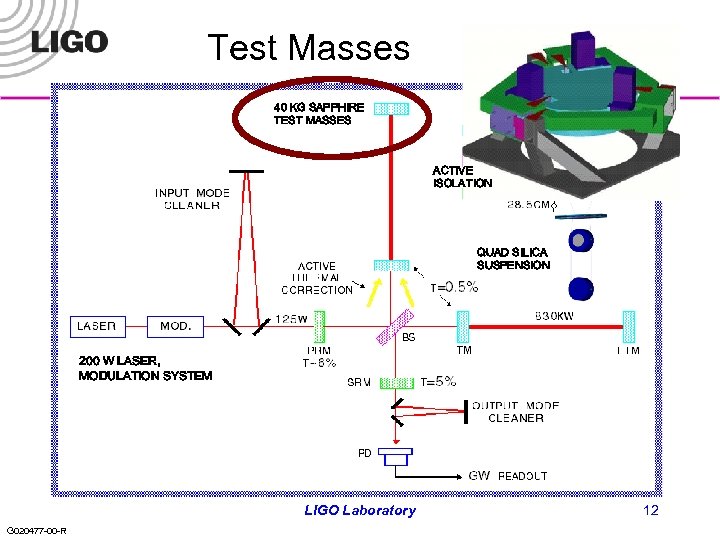
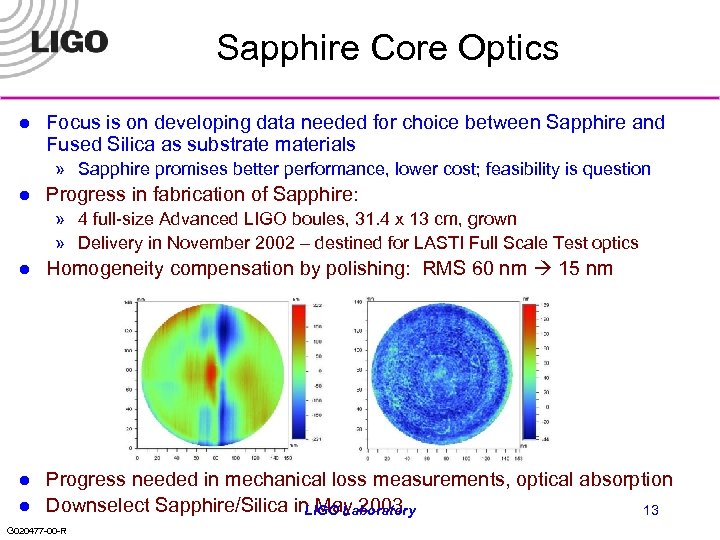 Sapphire Core Optics l Focus is on developing data needed for choice between Sapphire and Fused Silica as substrate materials » Sapphire promises better performance, lower cost; feasibility is question l Progress in fabrication of Sapphire: » 4 full-size Advanced LIGO boules, 31. 4 x 13 cm, grown » Delivery in November 2002 – destined for LASTI Full Scale Test optics l Homogeneity compensation by polishing: RMS 60 nm 15 nm l Progress needed in mechanical loss measurements, optical absorption Downselect Sapphire/Silica in May 2003 LIGO Laboratory 13 l G 020477 -00 -R
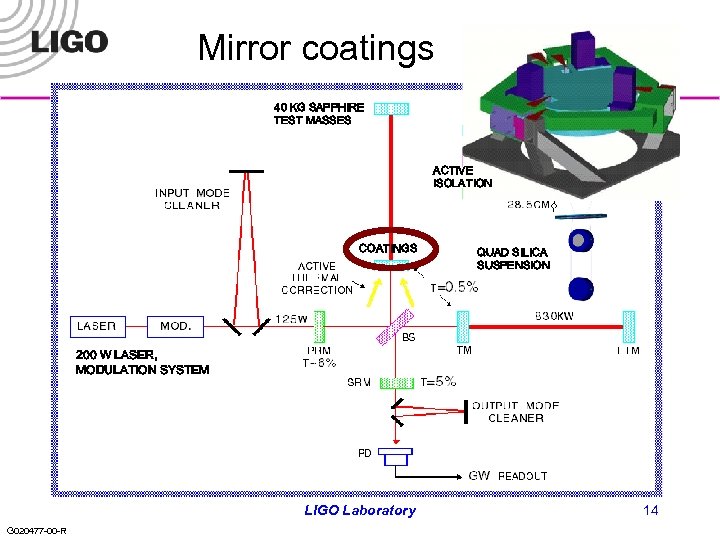 Mirror coatings 40 KG SAPPHIRE TEST MASSES ACTIVE ISOLATION COATINGS QUAD SILICA SUSPENSION 200 W LASER, MODULATION SYSTEM LIGO Laboratory G 020477 -00 -R 14
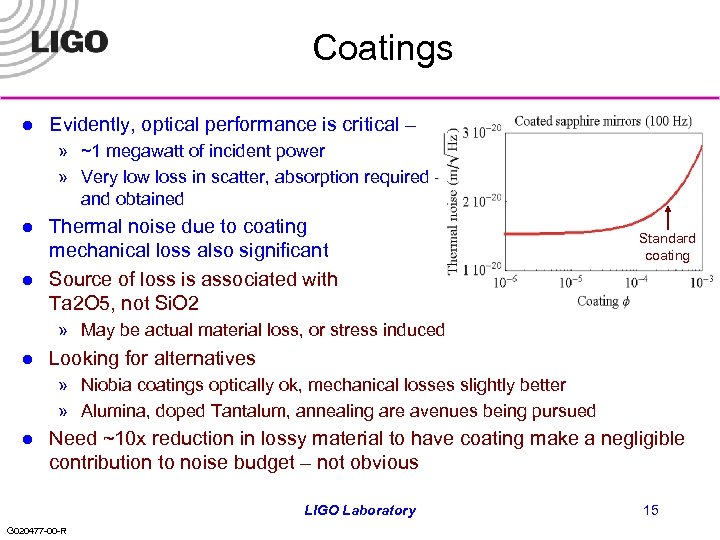 Coatings l Evidently, optical performance is critical – » ~1 megawatt of incident power » Very low loss in scatter, absorption required – and obtained l l Thermal noise due to coating mechanical loss also significant Source of loss is associated with Ta 2 O 5, not Si. O 2 Standard coating » May be actual material loss, or stress induced l Looking for alternatives » Niobia coatings optically ok, mechanical losses slightly better » Alumina, doped Tantalum, annealing are avenues being pursued l Need ~10 x reduction in lossy material to have coating make a negligible contribution to noise budget – not obvious LIGO Laboratory G 020477 -00 -R 15
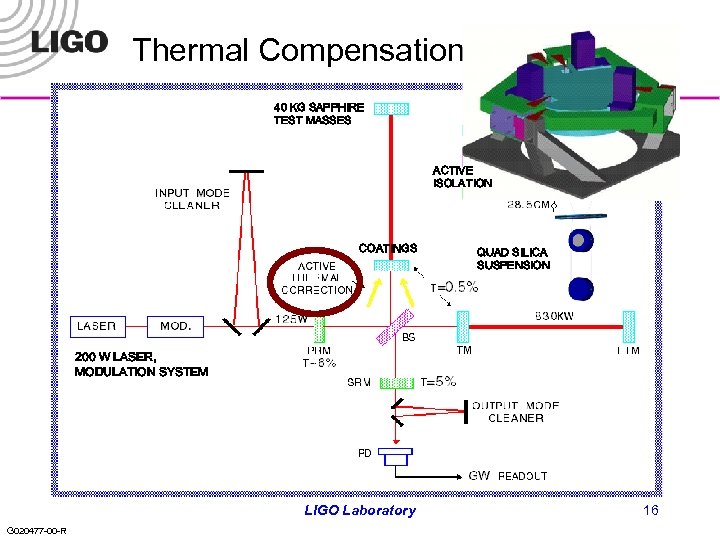 Thermal Compensation 40 KG SAPPHIRE TEST MASSES ACTIVE ISOLATION COATINGS QUAD SILICA SUSPENSION 200 W LASER, MODULATION SYSTEM LIGO Laboratory G 020477 -00 -R 16
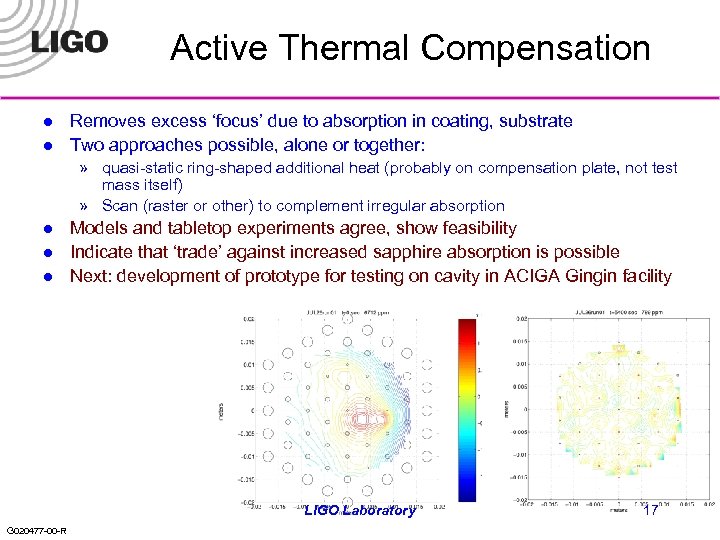 Active Thermal Compensation l l Removes excess ‘focus’ due to absorption in coating, substrate Two approaches possible, alone or together: » quasi-static ring-shaped additional heat (probably on compensation plate, not test mass itself) » Scan (raster or other) to complement irregular absorption l l l Models and tabletop experiments agree, show feasibility Indicate that ‘trade’ against increased sapphire absorption is possible Next: development of prototype for testing on cavity in ACIGA Gingin facility LIGO Laboratory G 020477 -00 -R 17
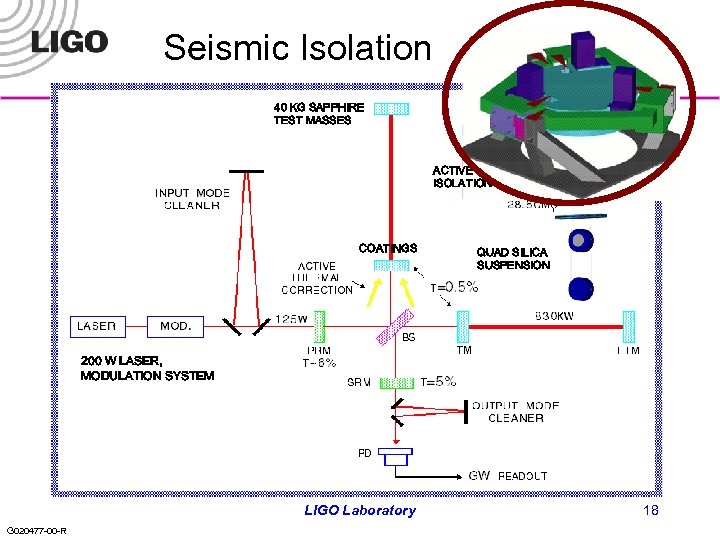 Seismic Isolation 40 KG SAPPHIRE TEST MASSES ACTIVE ISOLATION COATINGS QUAD SILICA SUSPENSION 200 W LASER, MODULATION SYSTEM LIGO Laboratory G 020477 -00 -R 18
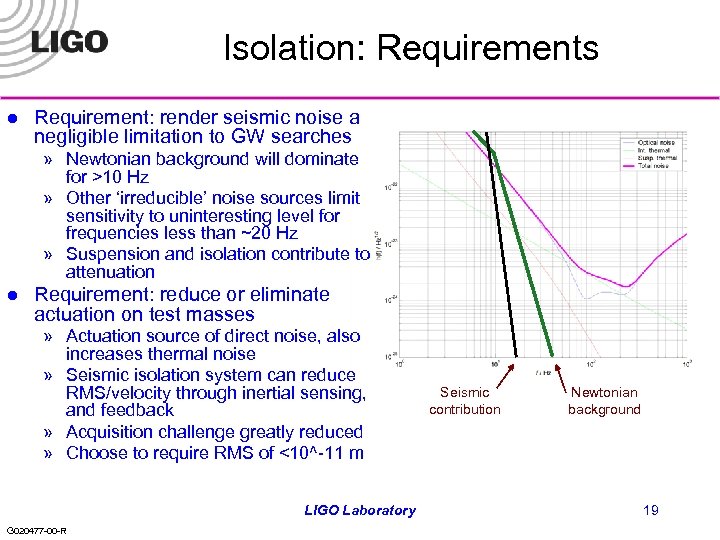 Isolation: Requirements l Requirement: render seismic noise a negligible limitation to GW searches » Newtonian background will dominate for >10 Hz » Other ‘irreducible’ noise sources limit sensitivity to uninteresting level for frequencies less than ~20 Hz » Suspension and isolation contribute to attenuation l Requirement: reduce or eliminate actuation on test masses » Actuation source of direct noise, also increases thermal noise » Seismic isolation system can reduce RMS/velocity through inertial sensing, and feedback » Acquisition challenge greatly reduced » Choose to require RMS of <10^-11 m LIGO Laboratory G 020477 -00 -R Seismic contribution Newtonian background 19
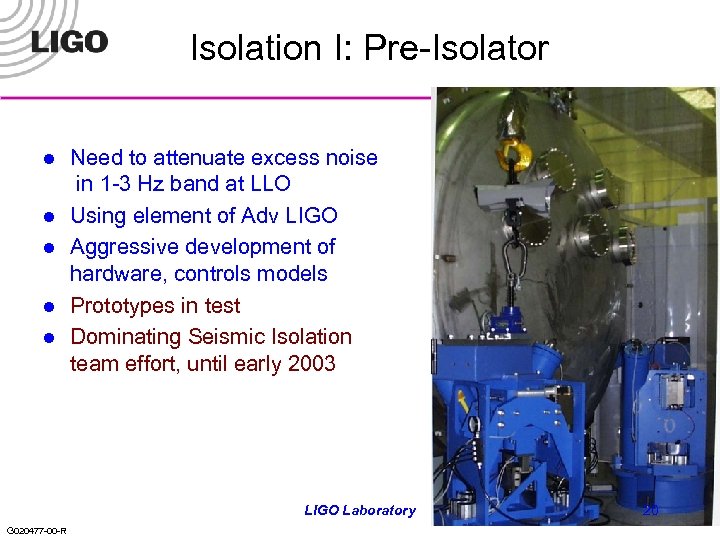 Isolation I: Pre-Isolator l l l Need to attenuate excess noise in 1 -3 Hz band at LLO Using element of Adv LIGO Aggressive development of hardware, controls models Prototypes in test Dominating Seismic Isolation team effort, until early 2003 LIGO Laboratory G 020477 -00 -R 20
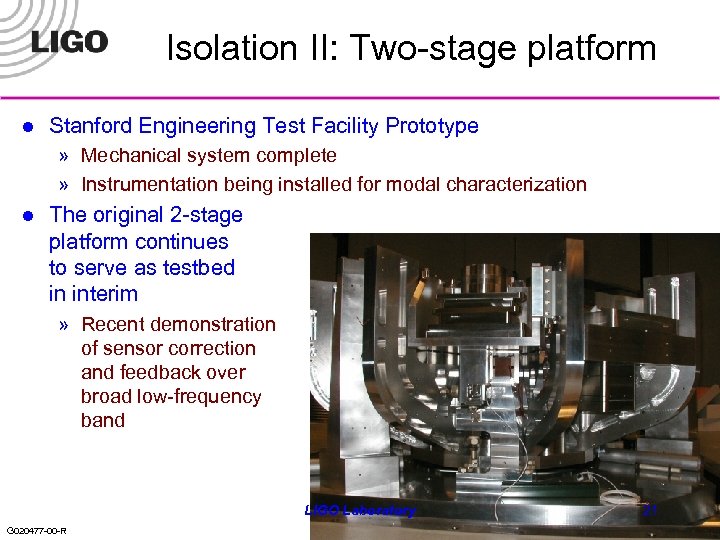 Isolation II: Two-stage platform l Stanford Engineering Test Facility Prototype » Mechanical system complete » Instrumentation being installed for modal characterization l The original 2 -stage platform continues to serve as testbed in interim » Recent demonstration of sensor correction and feedback over broad low-frequency band LIGO Laboratory G 020477 -00 -R 21
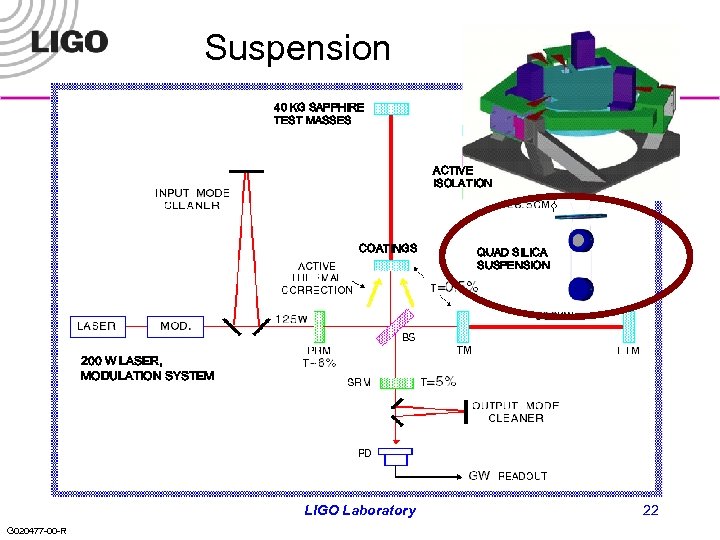 Suspension 40 KG SAPPHIRE TEST MASSES ACTIVE ISOLATION COATINGS QUAD SILICA SUSPENSION 200 W LASER, MODULATION SYSTEM LIGO Laboratory G 020477 -00 -R 22
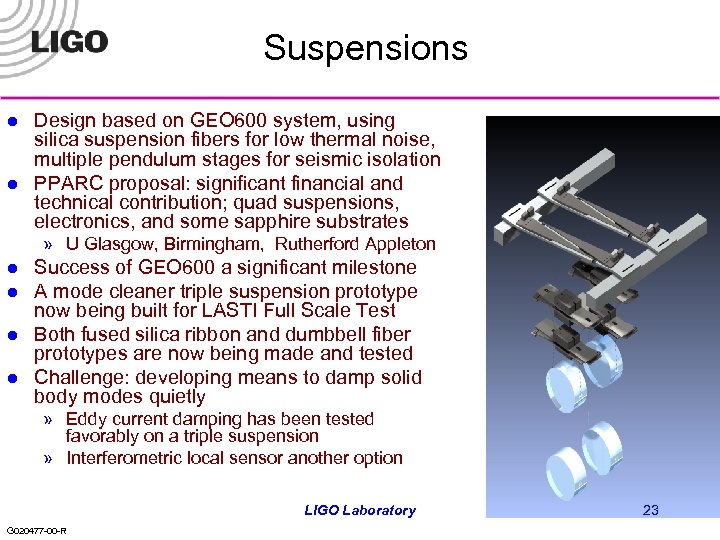 Suspensions l l Design based on GEO 600 system, using silica suspension fibers for low thermal noise, multiple pendulum stages for seismic isolation PPARC proposal: significant financial and technical contribution; quad suspensions, electronics, and some sapphire substrates » U Glasgow, Birmingham, Rutherford Appleton l l Success of GEO 600 a significant milestone A mode cleaner triple suspension prototype now being built for LASTI Full Scale Test Both fused silica ribbon and dumbbell fiber prototypes are now being made and tested Challenge: developing means to damp solid body modes quietly » Eddy current damping has been tested favorably on a triple suspension » Interferometric local sensor another option LIGO Laboratory G 020477 -00 -R 23
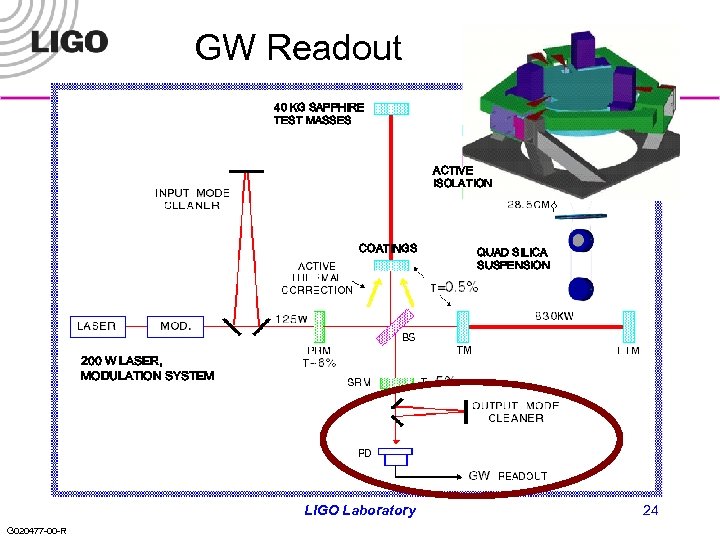 GW Readout 40 KG SAPPHIRE TEST MASSES ACTIVE ISOLATION COATINGS QUAD SILICA SUSPENSION 200 W LASER, MODULATION SYSTEM LIGO Laboratory G 020477 -00 -R 24
 GW readout, Systems l l Responsible for the GW sensing and overall control systems Addition of signal recycling mirror increases complexity » Permits ‘tuning’ of response to optimize for noise and astrophysical source characteristics » Requires additional sensing and control for length and alignment l Glasgow 10 m prototype, Caltech 40 m prototype in construction, early testing » Mode cleaner together and in locking tests at 40 m l Calculations continue for best strain sensing approach » DC readout (slight fringe offset from minimum) or ‘traditional’ RF readout » Hard question: which one shows better practical performance in a full quantum-mechanical analysis with realistic parameters? l Technical noise propagation also being refined LIGO Laboratory G 020477 -00 -R 25
 Advanced LIGO l A great deal of momentum and real progress in every subsystem » Details available in breakout presentations/Q&A l l l No fundamental surprises as we move forward; concept and realization remain intact with adiabatic changes When there is ‘competition’ for resources with Initial LIGO commissioning, Initial LIGO always wins, as it should Study of costs in progress » Rough figure: $100 M, for 3 full interferometers, materials and manpower, assuming no cost sharing with international partners l Schedule for operation in 2009 requires good progress on » Technical front: return to Adv LIGO focus for Seismic team » Funding front: submission this year, possible early funding for long-lead items LIGO Laboratory G 020477 -00 -R 26