


 Скачать презентацию Advanced Institutional Economics Lecture 2 Property rights and
26e419782403d390677e126c51e33f7f.ppt
- Количество слайдов: 24
 Advanced Institutional Economics. Lecture 2. Property rights and institutional change. Richard N. Langlois
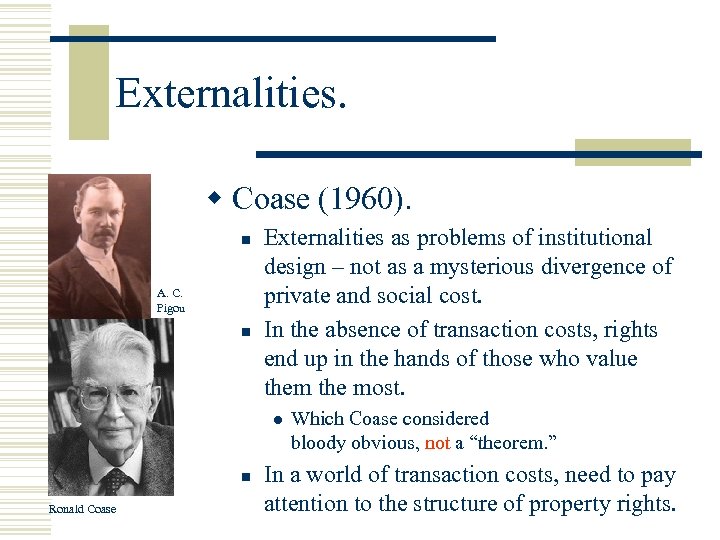 Externalities. w Coase (1960). n A. C. Pigou n Externalities as problems of institutional design – not as a mysterious divergence of private and social cost. In the absence of transaction costs, rights end up in the hands of those who value them the most. l n Ronald Coase Which Coase considered bloody obvious, not a “theorem. ” In a world of transaction costs, need to pay attention to the structure of property rights.
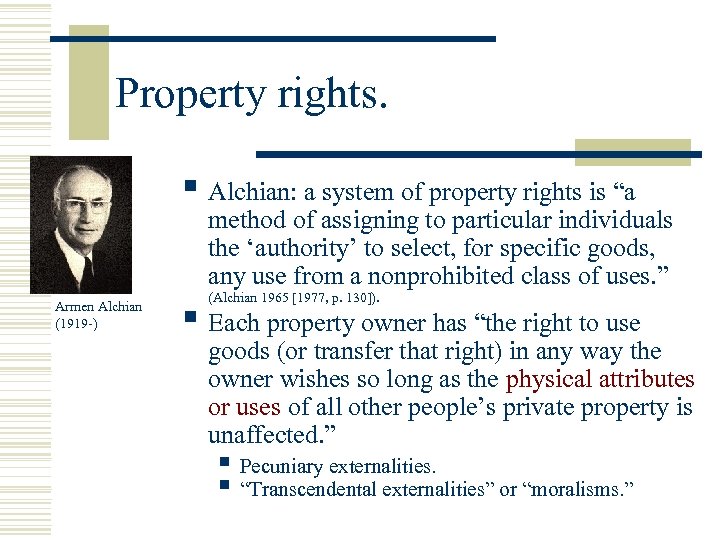 Property rights. § Alchian: a system of property rights is “a method of assigning to particular individuals the ‘authority’ to select, for specific goods, any use from a nonprohibited class of uses. ” Armen Alchian (1919 -) (Alchian 1965 [1977, p. 130]). § Each property owner has “the right to use goods (or transfer that right) in any way the owner wishes so long as the physical attributes or uses of all other people’s private property is unaffected. ” § Pecuniary externalities. § “Transcendental externalities” or “moralisms. ”
 Property rights as an institution. w Instantiated in explicit rules. w Enforced by an organization with a local monopoly on the use of force. Armen Alchian (1919 -) w But also – importantly – a social convention. w Key to extended anonymous cooperation and the division of labor.
 Partitioning and ownership. w Property rights as a bundle: n n n Use, income, alienation, etc. But also the right to exclude. Rights in rem vs. bundle of sticks. w Fee simple ownership: n Right to use and right to exclude vested in a single decision-making unit.
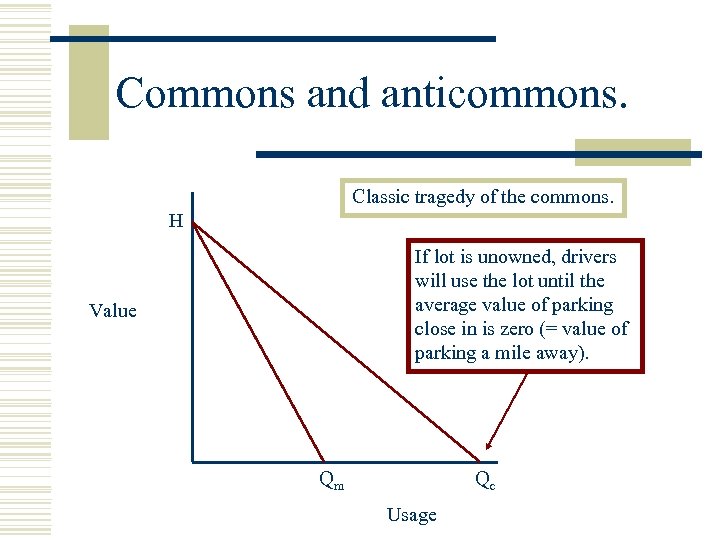
 Partitioning and ownership. w Common pool: n n n Everyone has use rights. No one has exclusion rights. Common pool a function of scheme of property rights, not (just) technology. w Tragedy of the commons: n n Overuse of resources. In the limit, full dissipation of rents. w Correctives: n n Create and enforce exclusion rights. Collective management schemes (Ostrom).
 Partitioning and ownership. w Anticommons: n Many entities have exclusion rights (veto power). w Tragedy of the anticommons: n n Underuse of resources. In the limit, full dissipation of rents. w Examples: n n Bureaucracy, especially in post. Soviet/developing countries. Patents in complex systems products.
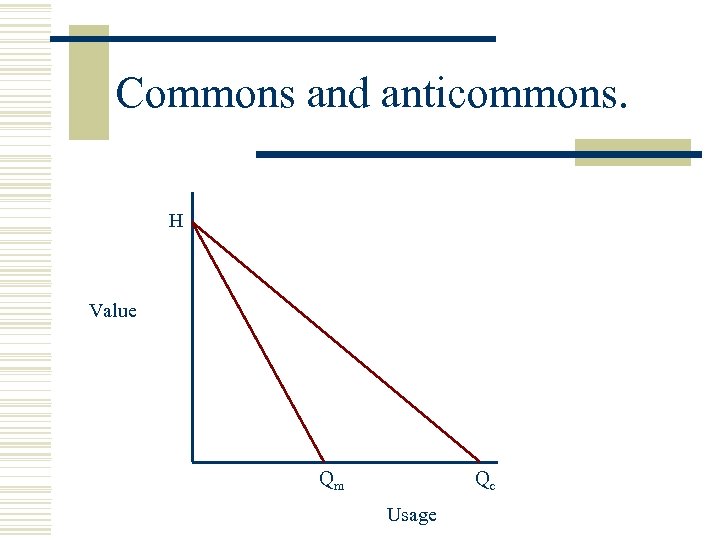
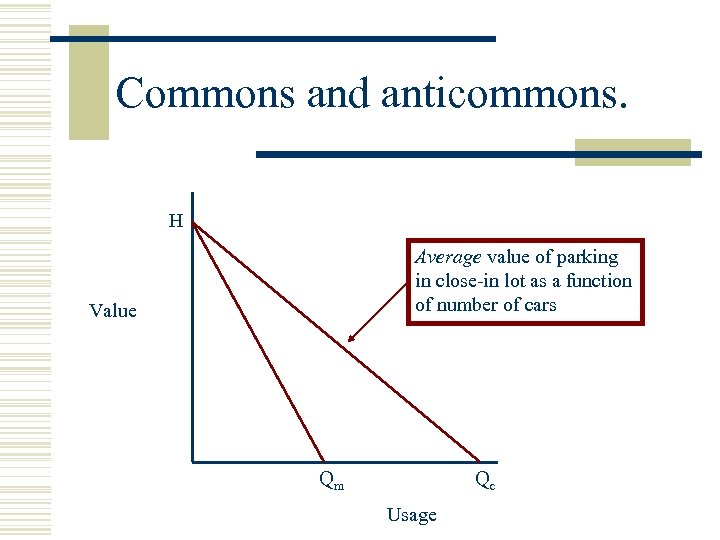
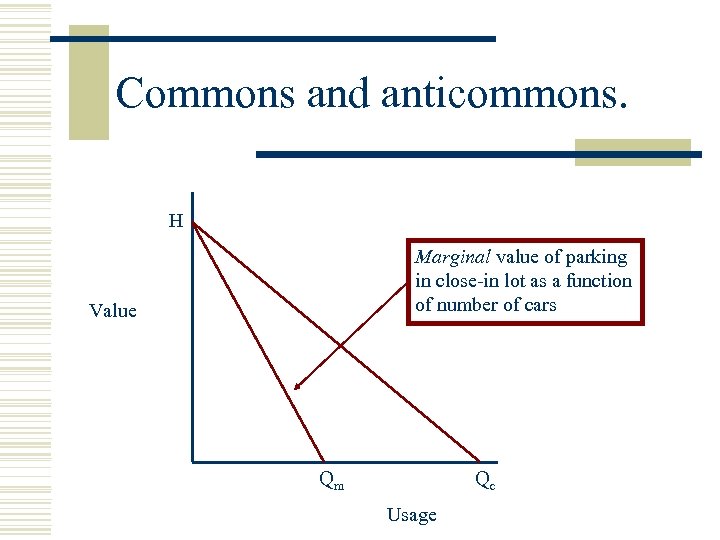
 Commons and anticommons. Buchanan and Yoon (2000) James Buchanan w Imagine a vacant lot near a village. n n n Can be used for parking, but capacity less than open-access demand. Ample parking 1 mile away. Because of congestion, value of parking in close-in lot is monotonically and inversely related to number of users.
 Commons and anticommons. H Value Qm Qc Usage
 Commons and anticommons. H Average value of parking in close-in lot as a function of number of cars Value Qm Qc Usage
 Commons and anticommons. H Marginal value of parking in close-in lot as a function of number of cars Value Qm Qc Usage
 Commons and anticommons. Classic tragedy of the commons. H If lot is unowned, drivers will use the lot until the average value of parking close in is zero (= value of parking a mile away). Value Qm Qc Usage
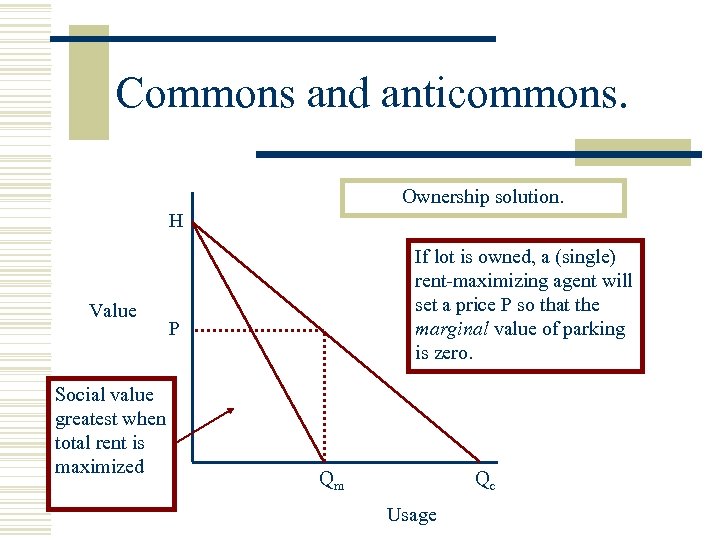 Commons and anticommons. Ownership solution. H Value Social value greatest when total rent is maximized If lot is owned, a (single) rent-maximizing agent will set a price P so that the marginal value of parking is zero. P Qm Qc Usage
 Commons and anticommons. Buchanan and Yoon (2000) James Buchanan w Now assume that, instead of a single owner, two parties are granted rights of exclusion. w Drivers must buy a green ticket and a red ticket to park. w In Nash equilibrium, the price of parking P 2* will be greater than P.
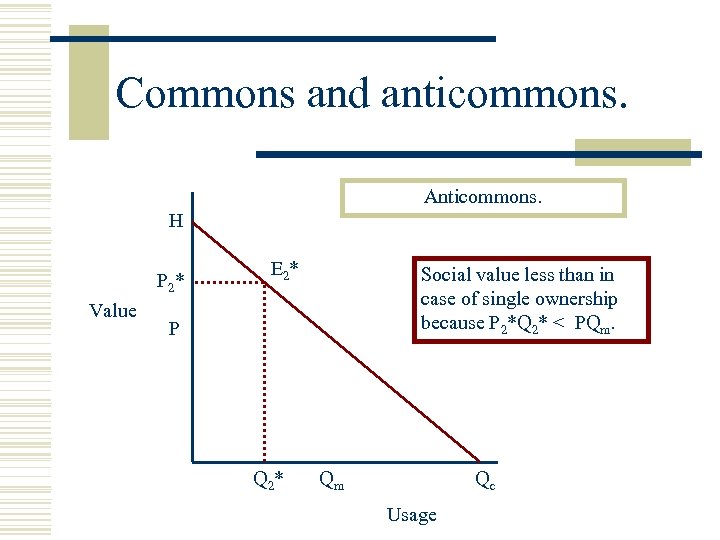 Commons and anticommons. Anticommons. H P 2 * Value E 2 * Social value less than in case of single ownership because P 2*Q 2* < PQm. P Q 2 * Qm Qc Usage
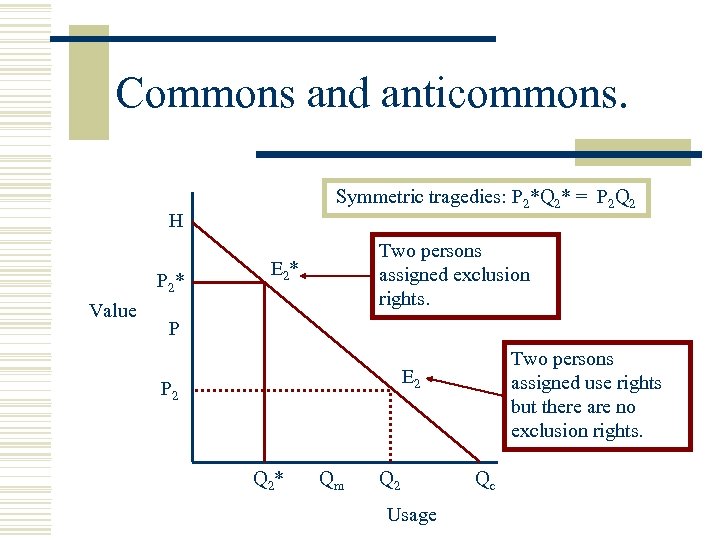 Commons and anticommons. Symmetric tragedies: P 2*Q 2* = P 2 Q 2 H P 2 * Value Two persons assigned exclusion rights. E 2 * P Two persons assigned use rights but there are no exclusion rights. E 2 P 2 Q 2 * Qm Q 2 Usage Qc
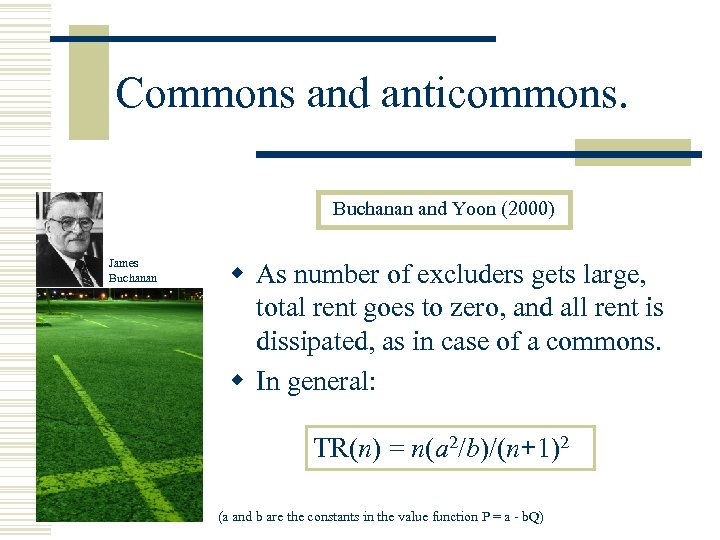 Commons and anticommons. Buchanan and Yoon (2000) James Buchanan w As number of excluders gets large, total rent goes to zero, and all rent is dissipated, as in case of a commons. w In general: TR(n) = n(a 2/b)/(n+1)2 (a and b are the constants in the value function P = a - b. Q)
 Transaction costs. w “Coase theorem”: in the absence of transaction costs, rights end up in the hands of those who value them the most. Ronald Coase n No gains from trade unexploited. w Example: monopoly.
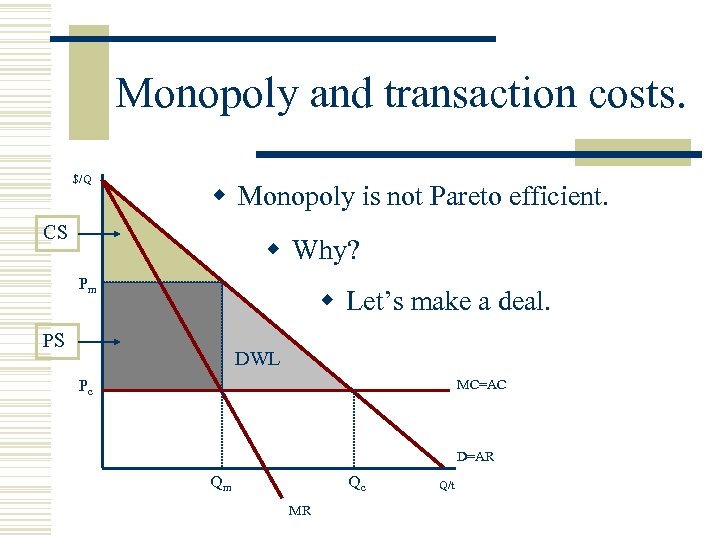 Monopoly and transaction costs. $/Q w Monopoly is not Pareto efficient. CS w Why? Pm w Let’s make a deal. PS DWL MC=AC Pc D=AR Qm Qc MR Q/t
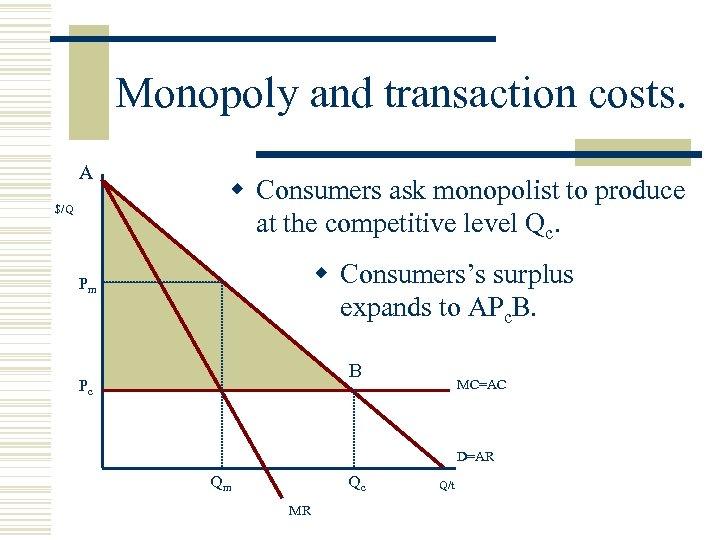 Monopoly and transaction costs. A $/Q w Consumers ask monopolist to produce at the competitive level Qc. w Consumers’s surplus expands to APc. B. Pm B Pc MC=AC D=AR Qm Qc MR Q/t
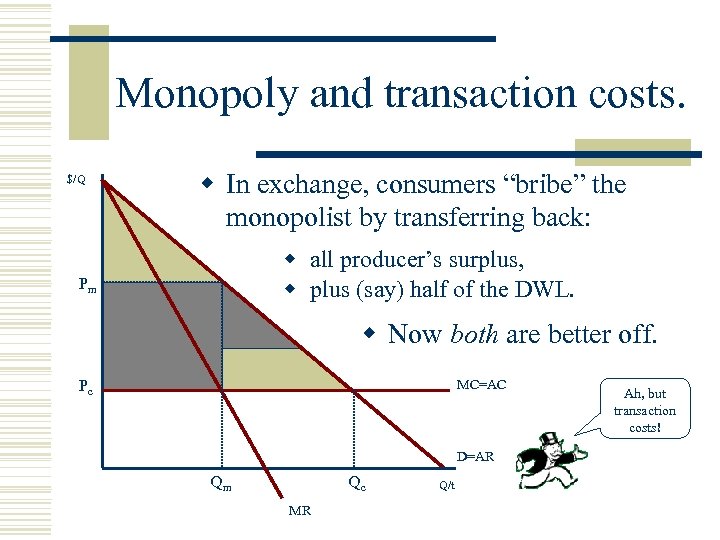 Monopoly and transaction costs. $/Q w In exchange, consumers “bribe” the monopolist by transferring back: w all producer’s surplus, w plus (say) half of the DWL. Pm w Now both are better off. MC=AC Pc D=AR Qm Qc MR Q/t Ah, but transaction costs!
 Emergence of property rights. w “Coase theorem”: in the absence of transaction costs, rights end up in the hands of those who value them the most. n No gains from trade unexploited. w But this also applies to the emergence of property rights in the first place. n n n Barzel: Ownership of attributes of assets not assets themselves. Because of measurement costs, it may not pay to specify all attributes. Why restaurants put salt “in the public domain. ”
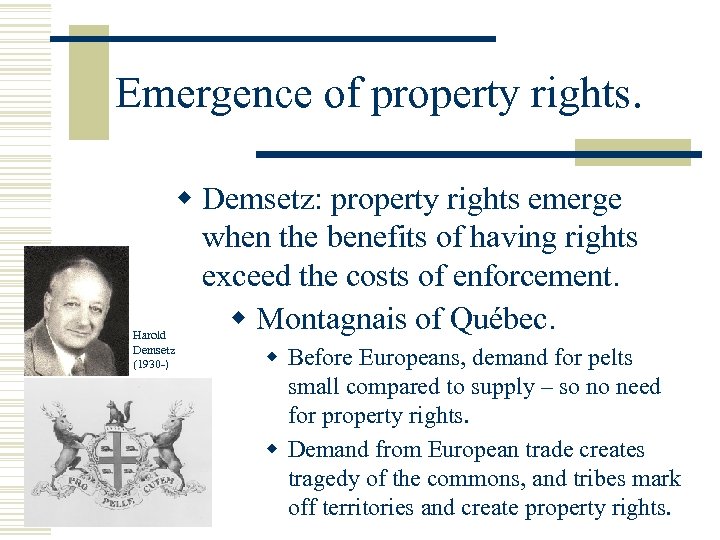 Emergence of property rights. Harold Demsetz (1930 -) w Demsetz: property rights emerge when the benefits of having rights exceed the costs of enforcement. w Montagnais of Québec. w Before Europeans, demand for pelts small compared to supply – so no need for property rights. w Demand from European trade creates tragedy of the commons, and tribes mark off territories and create property rights.
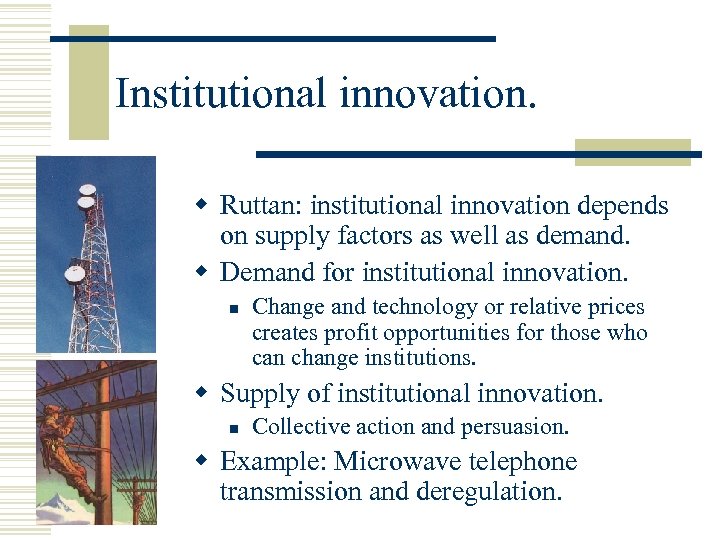 Institutional innovation. w Ruttan: institutional innovation depends on supply factors as well as demand. w Demand for institutional innovation. n Change and technology or relative prices creates profit opportunities for those who can change institutions. w Supply of institutional innovation. n Collective action and persuasion. w Example: Microwave telephone transmission and deregulation.