 Скачать презентацию Advanced English Book I Unit Six Mark Twain—Mirror
253b80e93b0e55c42bd8cd070b8ad9fb.ppt
- Количество слайдов: 127



Advanced English Book I Unit Six Mark Twain---Mirror of America Noel Grove
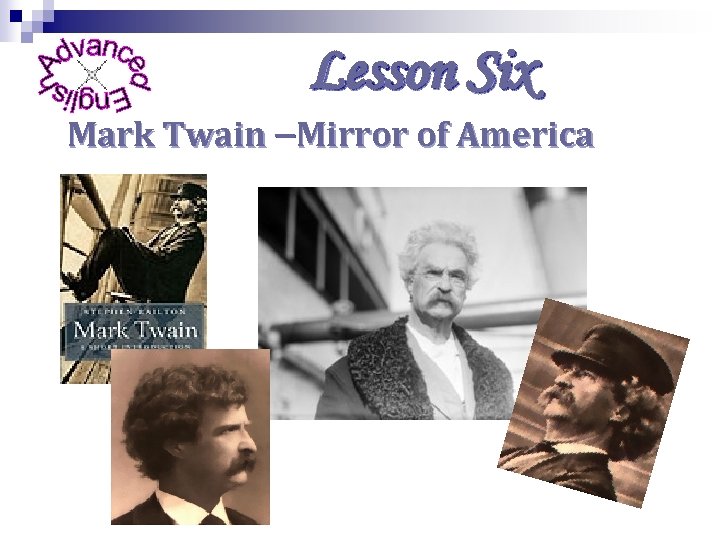
Lesson Six Mark Twain —Mirror of America
I. Teaching Objectives Get to know Mark Twain’s life experience and his remarkable works n Identify and appreciate rhetoric devices aptly employed in the text n Learn to write the elliptical, short, loose sentences and the compound-complex sentences to achieve certain effect To acquaint students with the writing of biography. n
II. Teaching Tasks 1. Pre-reading questions 2. Background knowledge 3. Type of literature 4. Macro-structure of the text 5. Detailed Study of the text 6. Rhetoric devices 7. Follow-up discussion 8. Exercise and Homework
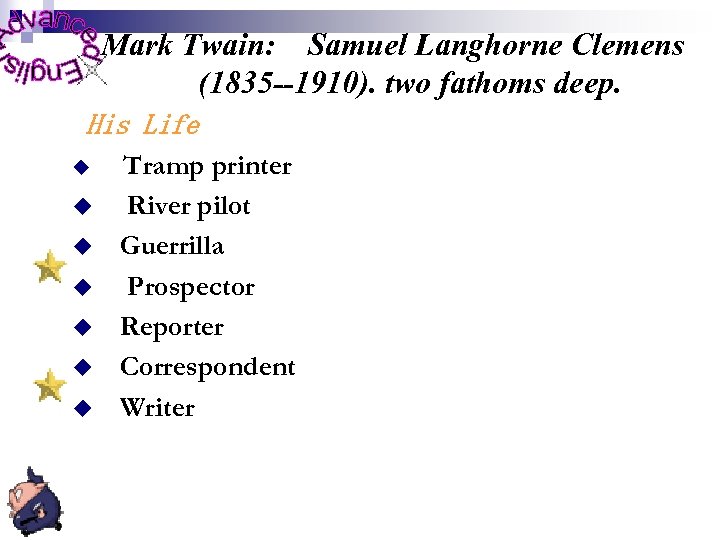
Mark Twain: Samuel Langhorne Clemens (1835 --1910). two fathoms deep. His Life u u u u Tramp printer River pilot Guerrilla Prospector Reporter Correspondent Writer
1. Pre-reading questions n How do you understand the title? Mark Twain--- Mirror of America
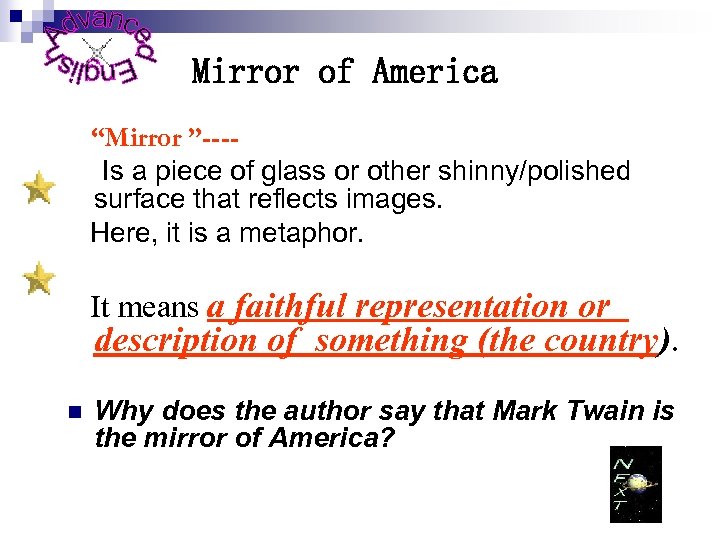
Mirror of America “Mirror ”--- Is a piece of glass or other shinny/polished surface that reflects images. Here, it is a metaphor. It means a faithful representation or description of something (the country). n Why does the author say that Mark Twain is the mirror of America?
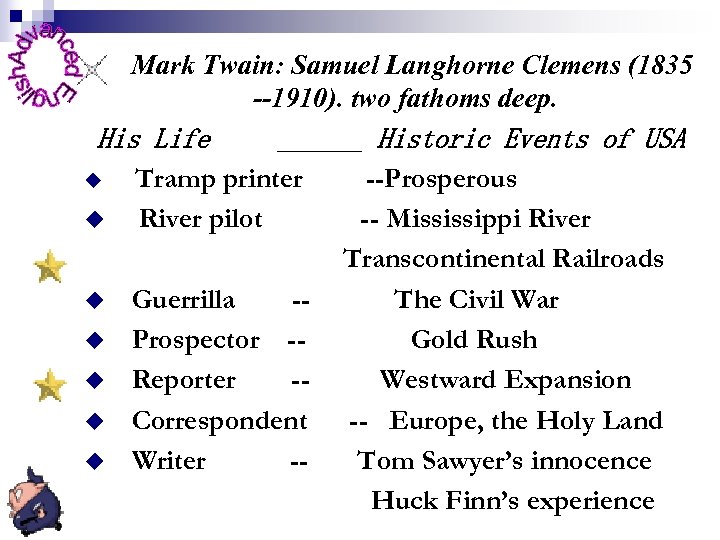
Mark Twain: Samuel Langhorne Clemens (1835 --1910). two fathoms deep. His Life u u u u ______ Historic Events of USA Tramp printer River pilot Guerrilla -Prospector -Reporter -Correspondent Writer -- --Prosperous -- Mississippi River Transcontinental Railroads The Civil War Gold Rush Westward Expansion -- Europe, the Holy Land Tom Sawyer’s innocence Huck Finn’s experience
The assertion that Mark Twain is the mirror o America made in two senses. is ★ ★Mark Twain’s exciting, adventuresome life stories themselves mirror part of true American history, and the life of ordinary American people. ★ ★Second, his life experience furnished him with a wide knowledge of humanity, as well as with the perfect grasp of local customs and speech, which Mark Twain has manifested so well in his writing. His works mirror the real society of his time.
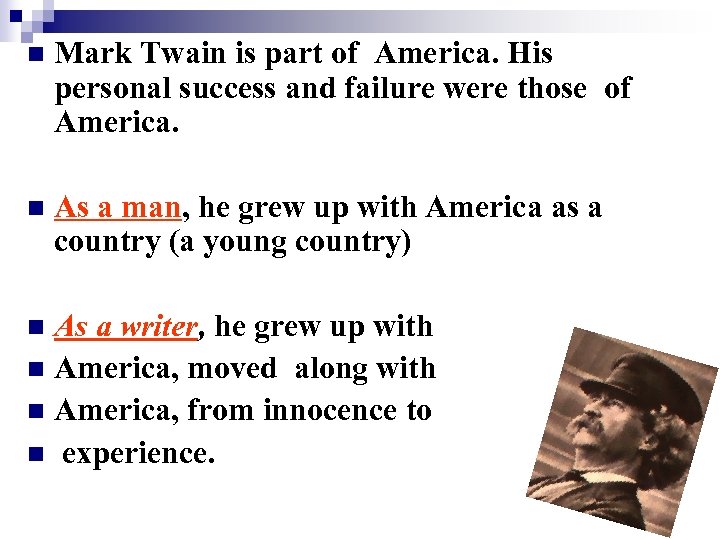
n Mark Twain is part of America. His personal success and failure were those of America. n As a man, he grew up with America as a country (a young country) As a writer, he grew up with n America, moved along with n America, from innocence to n experience. n
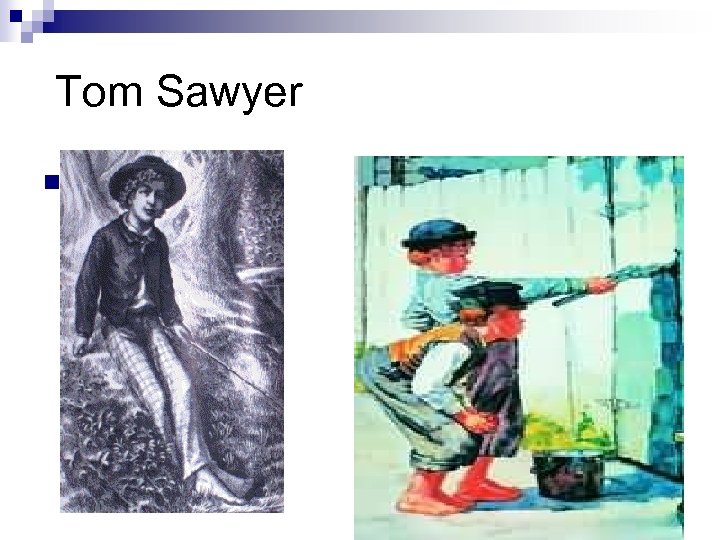
Tom Sawyer n
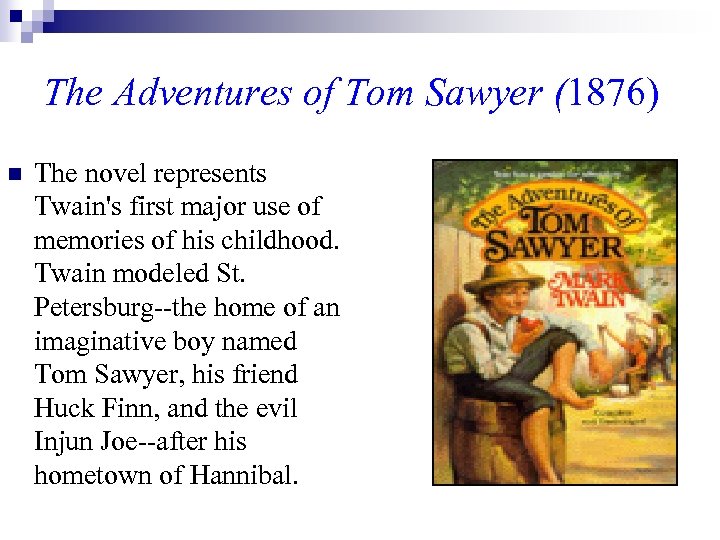
The Adventures of Tom Sawyer (1876) n The novel represents Twain's first major use of memories of his childhood. Twain modeled St. Petersburg--the home of an imaginative boy named Tom Sawyer, his friend Huck Finn, and the evil Injun Joe--after his hometown of Hannibal.
Life on the Mississippi (1883) n Life on the Mississippi (1883) describes the history, sights, people, and legends of the steamboats and towns of the Mississippi River region. In the most vivid passages, chapters 4 through 17, Twain recalled his own piloting days. These chapters had originally been published in the Atlantic Monthly in 1875 as "Old Times on the Mississippi. "
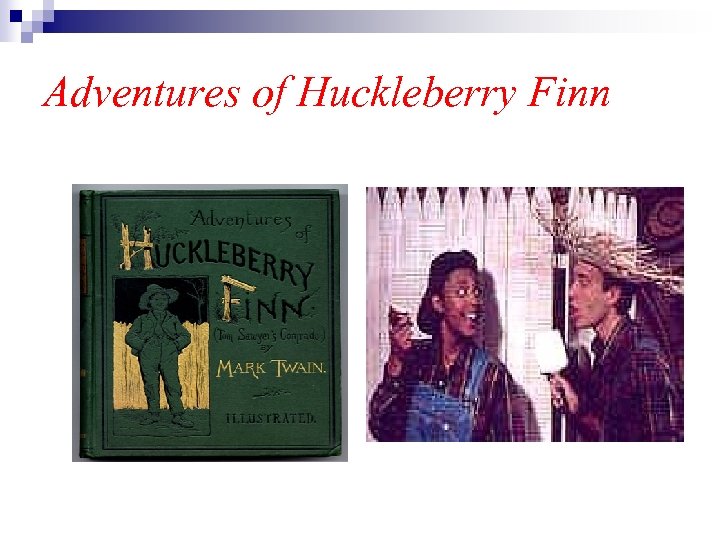
Adventures of Huckleberry Finn
Adventures of Huckleberry Finn n Adventures of Huckleberry Finn, generally considered Twain's greatest work, was published in Great Britain in 1884 and in the United States in 1885. Twain had begun the book in 1876 as a sequel to Tom Sawyer. It describes the adventures of two runaways--the boy Huck Finn and the black slave Jim--and is told from the point of view of Huck himself. Twain used realistic language in the novel, making Huck's speech sound like actual conversation and imitating a variety of dialects to bring the other characters to life. Tom Sawyer also reappears in certain chapters, and his antics( mischievous behavior) provide the familiar humor for which Twain was known.
n Contribution One of his greatest accomplishments was the development of a writing style that was distinctly American, rather thanimitation the style of an of English writers. n Twain made a more extensive combination of American folk humor and serious literatureprevious writers than had done. n (local colorismdominant fashion from 1860 s’— , a 1900 s’) The loose rhythms of the language in his bo give the impression of real speech. n Twain's realistic prose style has influenced numerous American writers. n
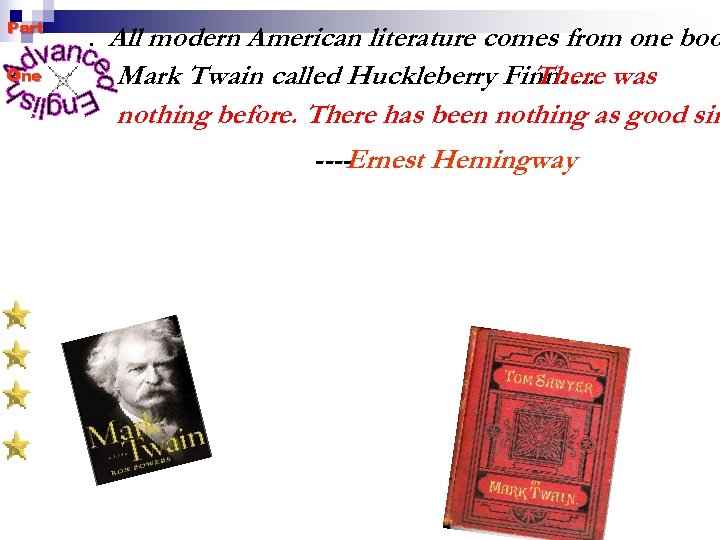
Part One . All modern American literature comes from one boo Mark Twain called Huckleberry Finn. . was There nothing before. There has been nothing as good sin ----Ernest Hemingway
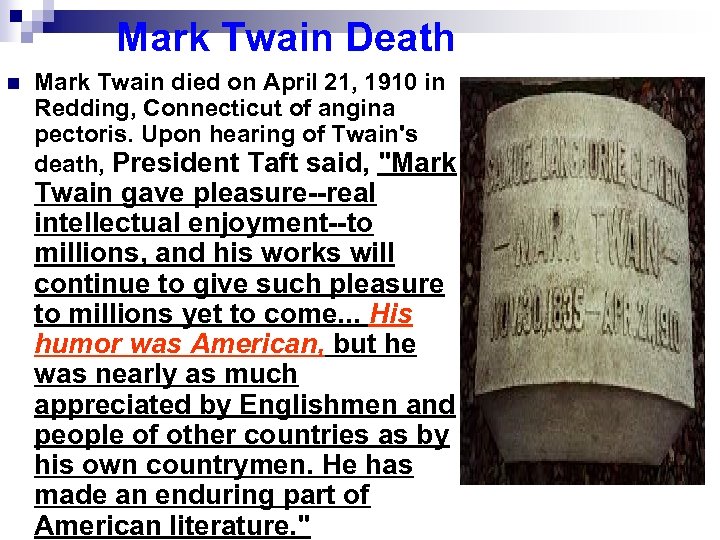
Mark Twain Death n Mark Twain died on April 21, 1910 in Redding, Connecticut of angina pectoris. Upon hearing of Twain's death, President Taft said, "Mark Twain gave pleasure--real intellectual enjoyment--to millions, and his works will continue to give such pleasure to millions yet to come. . . His humor was American, but he was nearly as much appreciated by Englishmen and people of other countries as by his own countrymen. He has made an enduring part of American literature. "
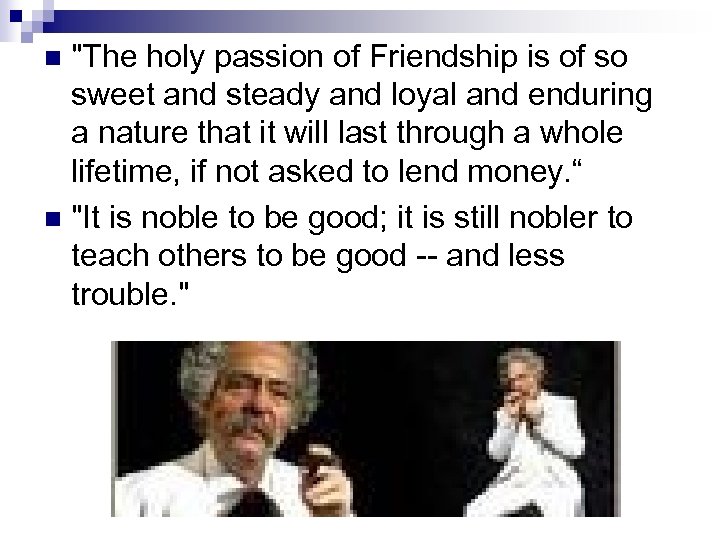
"The holy passion of Friendship is of so sweet and steady and loyal and enduring a nature that it will last through a whole lifetime, if not asked to lend money. “ n "It is noble to be good; it is still nobler to teach others to be good -- and less trouble. " n
n Be careful about reading health books. You may die of a misprint.
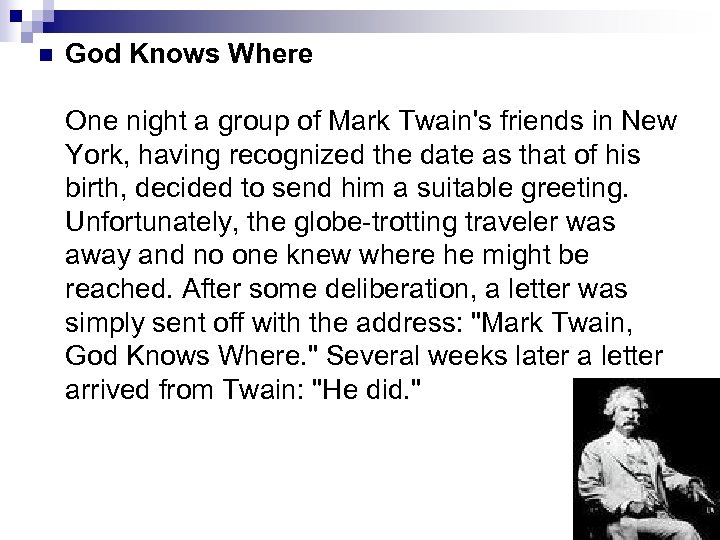
n God Knows Where One night a group of Mark Twain's friends in New York, having recognized the date as that of his birth, decided to send him a suitable greeting. Unfortunately, the globe-trotting traveler was away and no one knew where he might be reached. After some deliberation, a letter was simply sent off with the address: "Mark Twain, God Knows Where. " Several weeks later a letter arrived from Twain: "He did. "
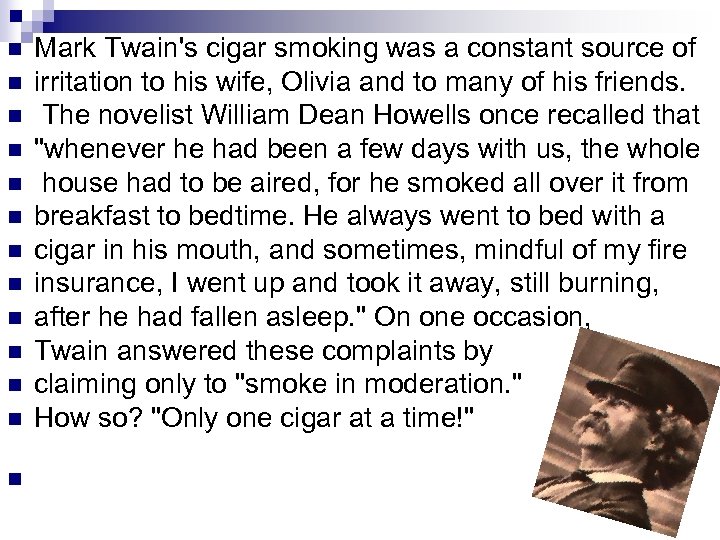
n n n n Mark Twain's cigar smoking was a constant source of irritation to his wife, Olivia and to many of his friends. The novelist William Dean Howells once recalled that "whenever he had been a few days with us, the whole house had to be aired, for he smoked all over it from breakfast to bedtime. He always went to bed with a cigar in his mouth, and sometimes, mindful of my fire insurance, I went up and took it away, still burning, after he had fallen asleep. " On one occasion, Twain answered these complaints by claiming only to "smoke in moderation. " How so? "Only one cigar at a time!"
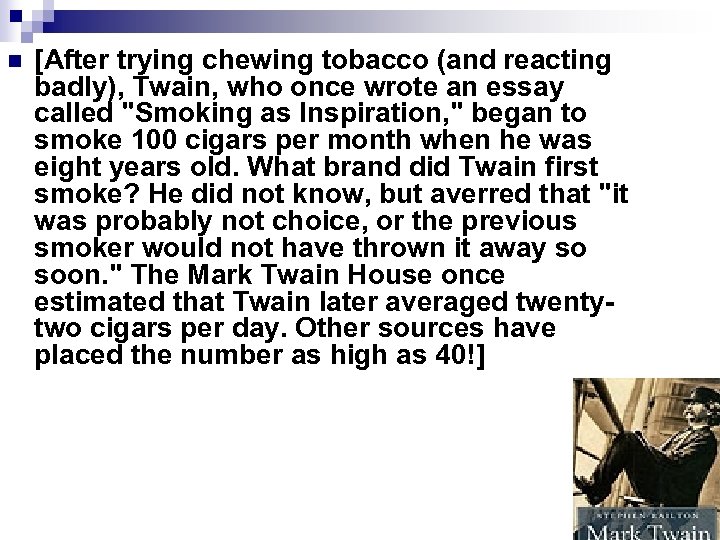
n [After trying chewing tobacco (and reacting badly), Twain, who once wrote an essay called "Smoking as Inspiration, " began to smoke 100 cigars per month when he was eight years old. What brand did Twain first smoke? He did not know, but averred that "it was probably not choice, or the previous smoker would not have thrown it away so soon. " The Mark Twain House once estimated that Twain later averaged twentytwo cigars per day. Other sources have placed the number as high as 40!]
"Every one is a moon, n and has a dark side n which he never n shows to anybody. " n
Detailed Study of the text Para. 1 . 1. . What is the implication of the two adjectives "eternal" and "endless"? 2. Why was Twain said to be adventurous, patriotic, romantic, and humorous? 3. what did the author mean by " I found another Twain. . . "?

Part One Words and Expressions . remember…as … 鲁迅创造了阿Q, 这是大多数的中国人所熟知的. Most Chinese people remember Luxun as the father of Ah Qu. (every bit ) as… as anyone has ever imagined 她的美丽无与伦比. She is as beautiful as any one has ever imagined. I am every bit as sorry about it as you are 鲁迅, 这位最受中国人民喜爱的作家之一, 他的爱国 热情、尖刻而幽默的笔调都达到了登峰造极的地步。 Luxun, one of best-loved authors in China, was every bit as patriotic, acid-tongued and humorous as anyone has ever imagined.
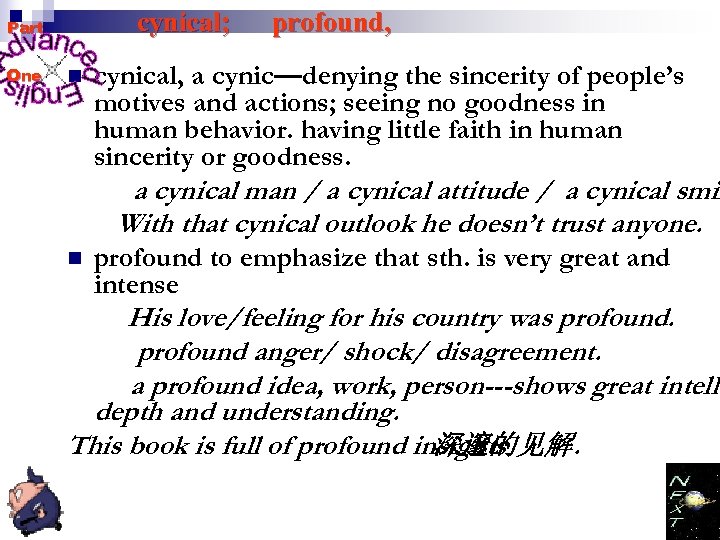
cynical; Part One n profound, cynical, a cynic—denying the sincerity of people’s motives and actions; seeing no goodness in human behavior. having little faith in human sincerity or goodness. a cynical man / a cynical attitude / a cynical smil With that cynical outlook he doesn’t trust anyone. n profound to emphasize that sth. is very great and intense His love/feeling for his country was profound anger/ shock/ disagreement. a profound idea, work, person---shows great intelle depth and understanding. This book is full of profound insights 深邃的见解.
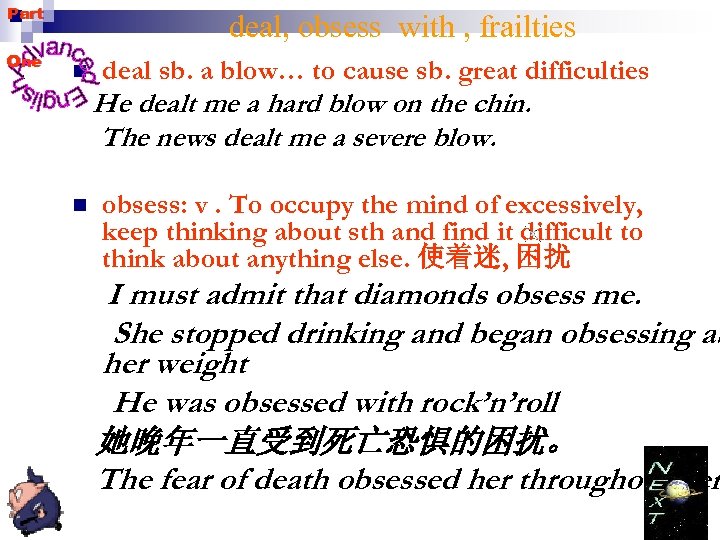
Part One deal, obsess with , frailties n deal sb. a blow… to cause sb. great difficulties He dealt me a hard blow on the chin. The news dealt me a severe blow. n obsess: v. To occupy the mind of excessively, keep thinking about sth and find it difficult to think about anything else. 使着迷, 困扰 I must admit that diamonds obsess me. She stopped drinking and began obsessing ab her weight He was obsessed with rock’n’roll 她晚年一直受到死亡恐惧的困扰。 The fear of death obsessed her throughout her
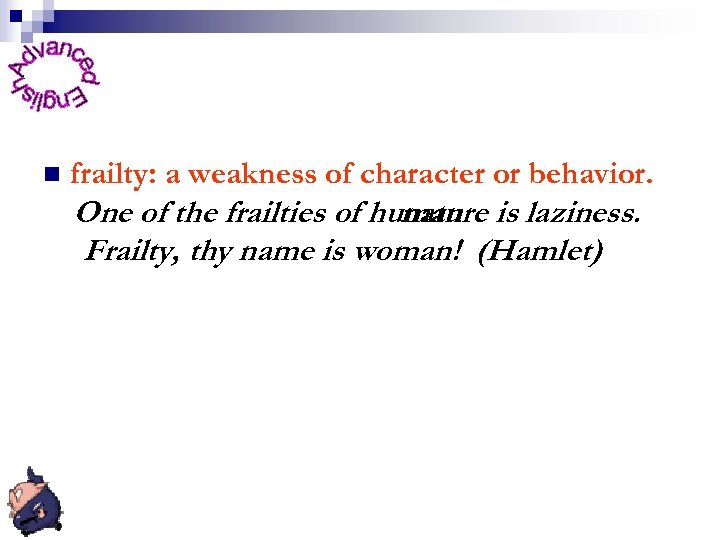
n frailty: a weakness of character or behavior. One of the frailties of human is laziness. nature Frailty, thy name is woman! (Hamlet)
n n the first sentence. Mark Twain was known as the writer of the Adventures of Tom Sawyer and the Adventures of Huckberry Finn. In the first book, he described Tom’s free and adventurous activities in a long summer that seems endless. In the latter, he depicted Huck Finn’s simple and pleasant voyage through Fin’s boyhood that seems eternal.
“Adventurous” n ----Mark Twain liked to try something new, new life, new place, new writing skill, etc. n “patriotic” n ----shows his strong passion or love for his country, countrymen and natural scenery. n “romantic” n ----idealistic , emotional and artistic. n “humorous” n ---- he made people laugh, brought them fun and joy, his writing is full of witty languages. n
the metaphor in the last sentence “A black wall of night”, n the color “black” or “dark” and “night” n ---implies something hopeless. n opposite to “day” and “daybreak’ and “light” n ---- “hope” or “hopefulness”. n “a black wall of night” n ---- “despair and hopelessness”. n He did not see a bright future but a dark one and a hopeless one. n
Hyperbole(夸张) n n n n ※ Hyperbole or overstatement is a figure of speech in which exaggeration is used to emphasize a point, to create humor, or to achieve some similar effects. 1. She was scared to death. 2. I told you a thousand times that you shouldn’t behave like that. 3. Belinda smiled, and the entire world was gay. 4. Her beauty made the bright dim. 5. I could sleep for a whole year. 6. My back kills me.
Para 2 ◆Give a brief account of Twain’s experience before he became a writer. n He used to move here and there, and he first worked as a printer, then a river pilot, a Confederate guerrilla, a gold miner. n When he was young, he embodied hope and beautiful dreams, so he was quite optimistic. n But later he became more cynical and sarcastic. n
Please note sometimes when two or more professional statues are introduced, the author does not use articles like “ an” or “a”. n This we have seen in the first sentence and in the phrase “ as writer and lecturer”. n
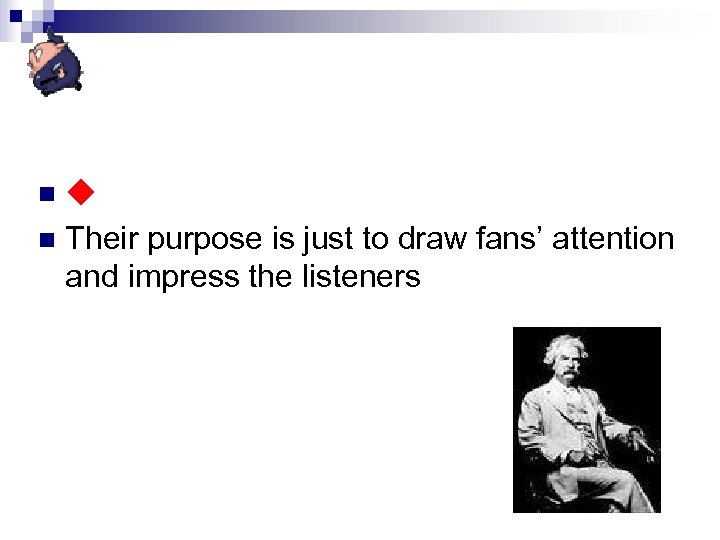
◆ How did he adopt his pen name? n Their purpose is just to draw fans’ attention and impress the listeners n
Para 3 ◆ What was the main channel of transportation in Twain’s childhood? n (the Mississippi River) it played a very important role in linking the north and south in trade and transportation. The Native Americans of different tribes who originally lived near the Mississippi and used it for canoe transportation, n
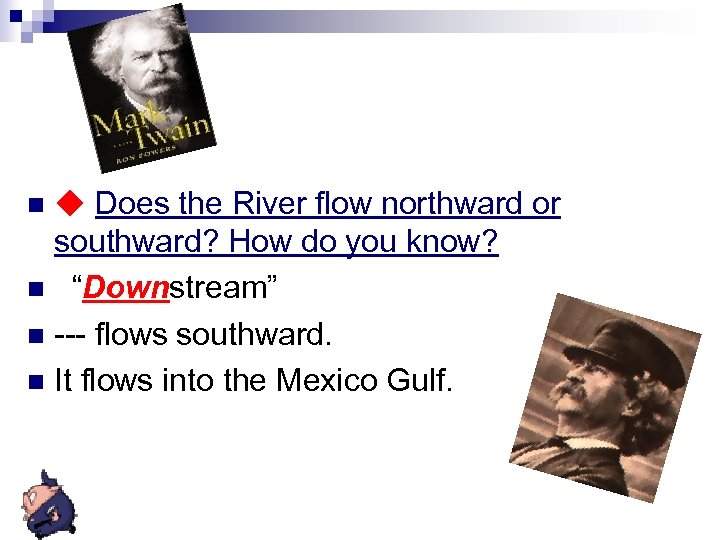
◆ Does the River flow northward or southward? How do you know? n “Downstream” n --- flows southward. n It flows into the Mexico Gulf. n
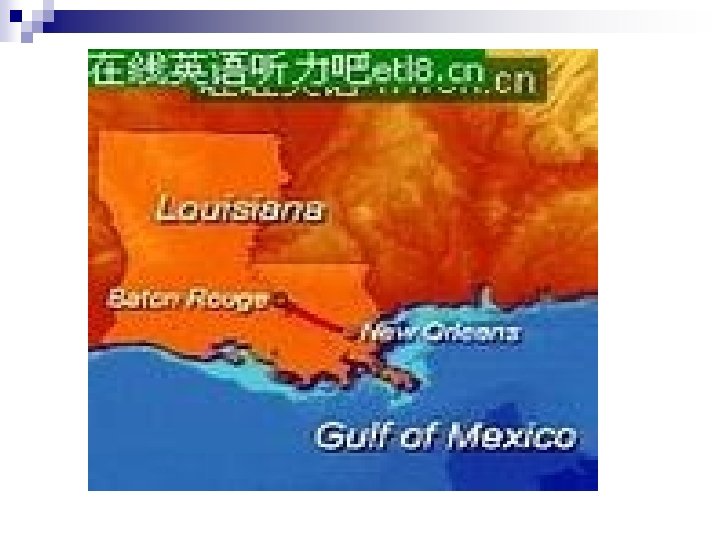
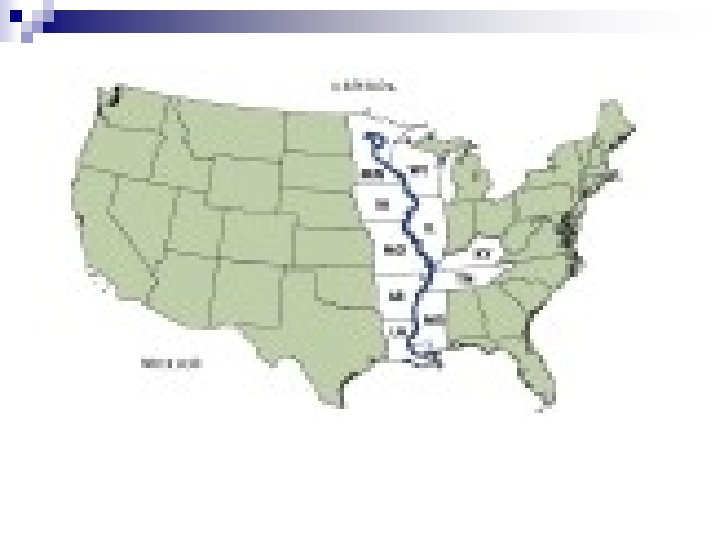

n ◆ What does “major commerce” refer to? n ◆ What do you know about the westward expansion?
independent, 13 states along the Atlantic Ocean. n By 1850, expanded to the Pacific coast. n includes the Louisiana Purchase (1803), Texas Annexation (1845), the push into Oregon (1846), Mexican Cession (1848), and the Gadsden Purchase n In 1848 gold --in California. The news spread far and wide. -- arose the Gold rush, --reached its peaks in the 1860 s. n During the Civil War, President Lincoln passed Homestead Act that also enabled many courageous and hardworking people to develop the west. n driving and killing the native Indians. n
language Points artery and heart : n metapher n “ artery” --- “ channel or means”. n “heart” ---- “ the central part or center”. n drain—“ to cause liquid flow away”(排走). n it literally means the Mississippi River drained the vast area along its banks. n The Mississippi valley takes up or covers three quarters of the populated area of the U. S. A of that time. n
Part 4 n n n n n ◆ explain the metaphorical meaning of “the cast of characters” and “ a cosmos” “The cast of characters” ---- all the actors in a play or movie “people of all sorts”. “a cosmos” ---- “ universe”, a place where one can see all types of people When he was working on the steamboat, he met people of all kinds. The steamboat is a world where he can perceive and observe different types of people.
n n n n ◆ What does it mean by “participated abundantly in this life”? He spent most of his time observing people and enjoying the steamboat life. ◆ The stories he heard on the steamboat? Feuds---how families or persons quarrel with each other for a long period. piracies---how pirates robber people on the sea lynchings---how the guilty was killed or hanged without public trial, medicine shows---how the quack or mountebank tried to sell their pills. (curealls ) Savage waterside slums---how some people built their shabby house on the riverbank without permission.
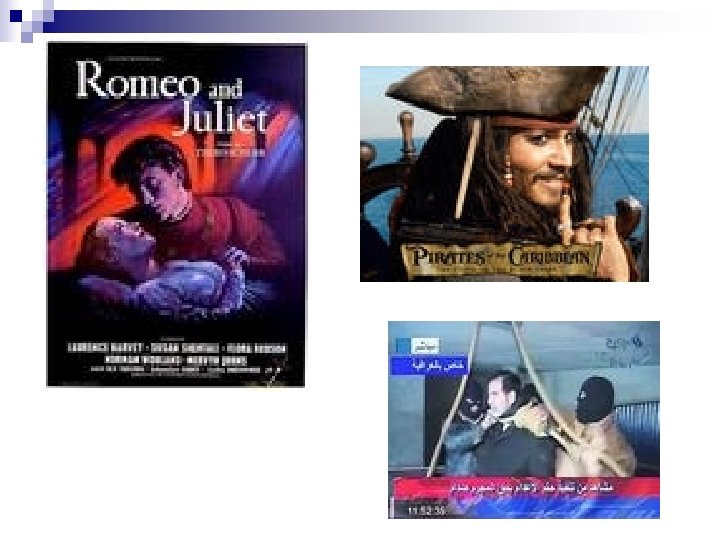
n n n n ◆ the figure of speech in the last sentence “resurface” --- “ come to surface again”. Metapher. “reappear or be retold”. “Phonographic” gramophone, phonograph show the accuracy of his memory. His memory is as accurate as a phonograph or gramophone. All the stories would reappear in his books, together with the rich and colorful language that he absorbed or took in with a memory that was as accurate as a phonograph.
◆“ the main current” “ flotsam” Para 5 n “the main current” n --- the main stream n the majority of the passengers board the steamboat. n pioneers or people with pioneering spirit. n “Flotsam” n ----the wreckage of a ship or its cargo found floating on the sea. n hustlers (streetwalkers), gamblers and thugs (criminals) -----social outcasts. n metaphorically used. n
n n n ◆“difference between what people claim to be and what they really are. ” The difference between what they preach and what they practice between what people say and what they do, between words and deeds. anti-thesis.
Antithesis n n n Antithesis is a figure of speech which is a contrast of ideas expressed by parallelism of strongly contrasted words, generally for a tuneful rhythm and wisdom of brevity. Speech is silver, silence is golden. There is only one difference between an old man and a young man. The young man has a glorious future before him and the old has a splendid future behind him. The wise man knows he knows nothing; the fool thinks he knows all.
◆What effect does Twain’s experience on the steamboat have on his writing? n --a good chance to get to know different people and listen to different stories n →His close examination and meticulous observation of the people and the difference between their words and actions help him accumulate a large number of materials for his later writing n the most manifest effect resides in his most successful writing should be attributed to his vivid description of the people along the Mississippi River. n
Points: n n n teem with--- be full of. trade---occupation. acknowledge—admit. acquaint sb with something, acquaintance, acquaintanceship. His four and a half years in the steamboat trade marked the real beginning of his education, and the most lasting part of it. During the four and a half years when he was working on the steamboat, he began his real education, which was the most important or significant part of the education he had in his life.
Para 6 ◆ Why did Twain leave the river country? n ◆ Why did he quit the guerrillas? n ◆“who diligently avoided contact with the enemy” figure of speech? n “who frequently retreated and retreated carefully. ” n It is a mild way or a roundabout way to say “ retreat”. n This kind of figure of speech is known as Euphemism. n
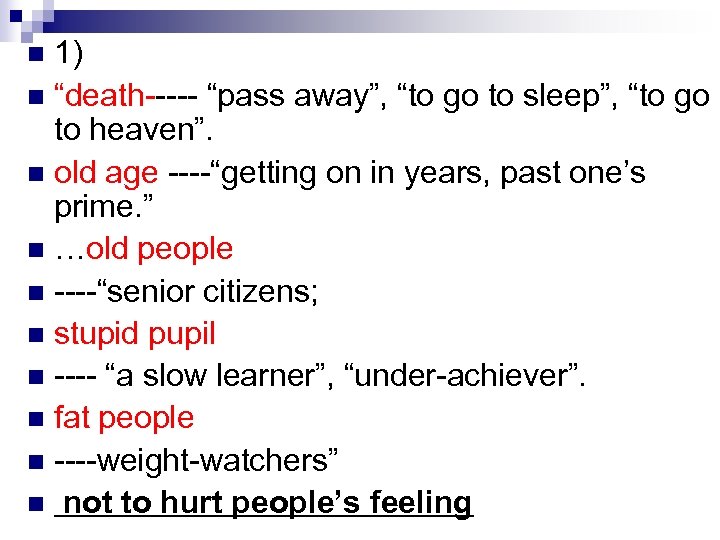
1) Death, illness, old age, etc. n “death----- “pass away”, “to go to sleep”, “to go to heaven”. n old age ----“getting on in years, past one’s prime. ” n …old people n ----“senior citizens; n stupid pupil n ---- “a slow learner”, “under-achiever”. n fat people n ----weight-watchers” n not to hurt people’s feeling n
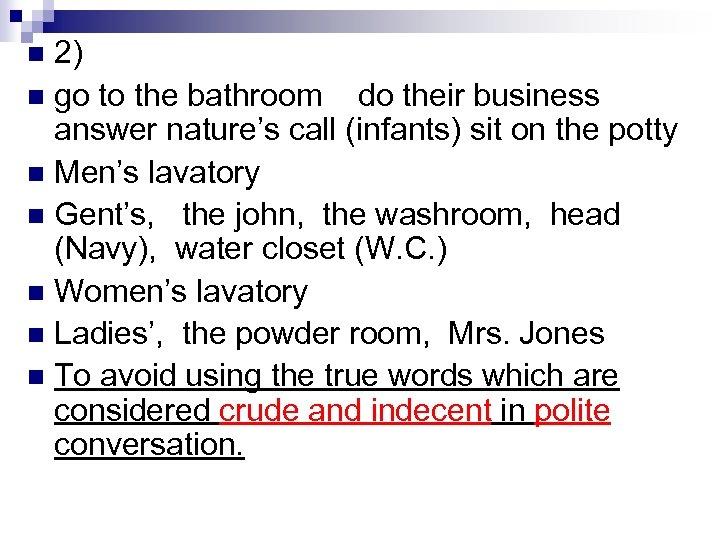
2) Toilet Habits, etc. n go to the bathroom do their business answer nature’s call (infants) sit on the potty n Men’s lavatory n Gent’s, the john, the washroom, head (Navy), water closet (W. C. ) n Women’s lavatory n Ladies’, the powder room, Mrs. Jones n To avoid using the true words which are considered crude and indecent in polite conversation. n
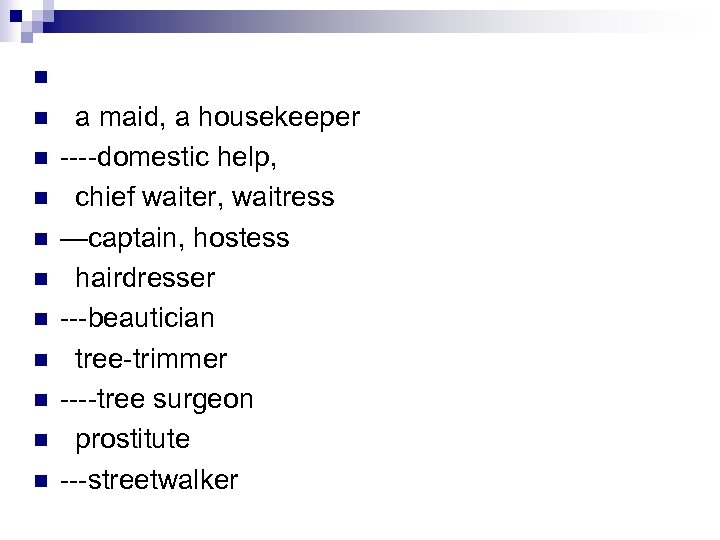
n n n 3)Menial jobs or professions of low social standing a maid, a housekeeper ----domestic help, chief waiter, waitress —captain, hostess hairdresser ---beautician tree-trimmer ----tree surgeon prostitute ---streetwalker
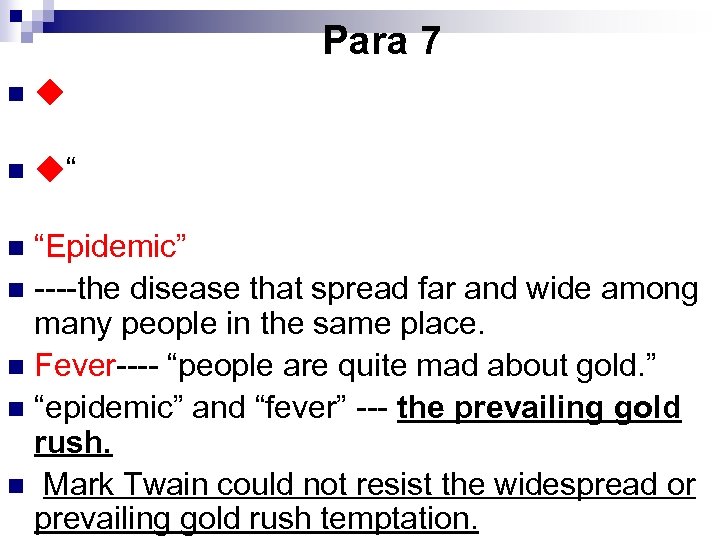
Para 7 ◆ Where did Mark Twain go after he quit the guerrilla? n ◆“succumbed to the epidemic of gold and silver fever”. n “Epidemic” n ----the disease that spread far and wide among many people in the same place. n Fever---- “people are quite mad about gold. ” n “epidemic” and “fever” --- the prevailing gold rush. n Mark Twain could not resist the widespread or prevailing gold rush temptation. n
◆ What is the figurative meaning in “flirt with”? n “Flirt with” n --- “one is not serious when making love or one plays at love”. n “Mark Twain did not take mining seriously, he did not work as hard as he could. ” n
n n n ◆ Why did he fail as a prospector? (3) he did not work as hard as he could; he did not hold on or persist in working as hard as other miners did; perhaps he was not lucky, he could not find the gold mine. ◆ How to understand this sentence? He worked on the goldfields for eight months, during which he did not work as hard as he could and did not persist in his work, thus he failed in getting a large quantity of wealth that could be obtained by the lucky miners and the miners who persisted.
n n n n ◆“to literature’s enduring gratitude”? All his achievements were the consequences of his important decision—accepting the offer as a reporter with the Virginal City Territorial Enterprise. This decision is a turning point in his career. In this sense, the world literature should thank him for his decision and should be grateful to his decision. “to+noun” is an adverbial used to show the result or consequence of something. to one’s surprise, to one’s satisfaction, to one’s disappointment,
◆ metaphors in this paragraph: n Rebuff n —refuse or reject one’s proposal for love. n Mark Twain was described as a man who seemed to try to win the affection of a woman but was rejected. n Mark Twain was rejected by wealth not women. n its figurative meaning is “ fail”, Mark Twain failed in gold mining. n
Points: n 1. succumb to n ----yield, give way to, submit to, can not resist the temptation of; die of n 2. broke n ---penniless, bankrupt. n broker(经纪人) n
Para 8 n n n ◆ Paraphrase the second sentence and identify the figure of speech used in “his pen would prove mightier than his pickax. ” In gold ming, some miners could become rich overnight if they could discover a gold vein. In the reporting trade, though Mark Twain could not become rich overnight as some miners, yet his reporting brought him much more money than his mining or prospecting. “his pen” and “ pickax” are two metonymies. “his pen” --- “ reporting” “ pickax” ---- “mining
◆“hotbed”? n “hotbed” n ---- a place where the environment is so nice that plants or animals or people can grow rapidly and mushroom. n San Francisco was a place (cradle) that nurtures or fosters promising young writers. n
n n n Points: 1. dig one’s way edge one’s way(侧身前进) feel one’s way thread one’s way(从穿过) fight one’s way(冲出去) push one’s way(挤过去) shoulder one’s way(用肩开路挤了出去) worm one’s way(缓慢而艰难的爬行或蠕动) 2.Then and now …. . in the past and at present now and then----occasionally to and fro up and down back and forth
n n n n n Para 9 ◆“honed” and “muscles”? “hone”, verb, “ to sharpen”. In the text, “to exercise”. “Muscle” --- “abilities or skills”. We do not say “sharpen one’s ability or skills”, but we can say “exercise one’s writing skills”. ◆ Why did Mark Twain have to leave San Francisco? Mark Twain wrote some articles that contained harsh or severe or sharp criticism. Those harsh articles include attacks on the city government for such issues as mistreatment of Chinese.
n n n ◆“His descriptions of the rough country…. the West Coast. ” His descriptions of the settlers in the wild Sacramento Valley sound familiar to the modern people who are used to taking the lead on the West Coast. ◆ What was Twain’s opinion on the settlers in the west? Why? He highly praised them by saying “ it was a splendid population…. . it was that splendid people that gave California a fame…”. What is more, he used contrast to show this. He said “ all the slow, sleepy, sluggish-brained sloths stayed at home…” those who went west are the quick, energetic, quick -minded or clever, hardworking people.
n n ◆ Explain “for getting up astounding enterprises and rushing them through with a magnificent dash and daring and a recklessness of cost or consequences, which she bears unto this day--and when she projects a new surprise, the grave world smiles as usual, . . ” Whenever Californians start or launch surprising/amazing enterprises, they would carry them out with great energy and courage, regardless of cost or results. California carries the fame until this day. And when California plans to launch a new enterprise, the serious/ solemn people in other states smile as usual….
n n ◆‘well, that is California all over. ” “well, that is typical of California. ”
n ◆ the figures of speech used in this paragraph. Alliteration(slow, sleepy…. . ) (dash and daring) n Personification n ( the grave world, modern world) ---- a figure of speech which attributes human qualities to inanimate objects or abstract ideas. ★The wind whistled through the trees. ★She listened to the brook murmuring through the hills. ★The gentle breeze caressed my cheeks and soothed my anger. ★Overhead the stars winked mischievously at us. n n n
n n n Para 10 ◆ What was the story Mark Twain kept in his notebook? Was it important for him? A Coleman had a jumping frog with him. He betted a stranger $ 50 on the jumping frog. But the stranger had no frog. So Coleman had to get one for him. In the meantime (when Coleman went to look for frogs) the stranger filled Coleman’s frog with tiny balls of lead. The Coleman’s frog couldn’t jump. Finally the stranger’s frog won. This record is very important for Mark Twain, for it would determine his later development or career. / it would have an determinate effect on his career.
Para 11 ◆ How do you understand “the wild” in the “ wild humorist”? n “Wild” should be interpreted as “the language he adopted is wild”, that is, He used many dialects and colloquial languages. n Perhaps another interpretation: he wrote something that happened in the Wild West. n ◆ What is the main idea of Para 10 -11? n The origin of his work “The celebrated Jumping Frog of Calaveras County”. n
Para 12 n n n n ◆ Explain“ to take a distinctly American look at the Old World” “to take a typical American look at the European Continent. / to look at the European Continent through American eyes. ” ◆ What does “the Holy Land” refer to? Palestine, region on the east coast of the Mediterranean, (the country of the Jews in Biblical times, the region where Jesus Christ preached and lived. ) ◆ Why was the voyage called a “milestone”? Because it is the first time that a fairly large number of American people were organized to travel abroad. It marks a new stage in history and may have some
◆ What task was assigned to Mark Twain? n To go abroad with the tourists and to report to Californian newspaper what he had seen or heard. n ◆ What does “glowing travelogue” mean? n It means articles or travel narratives full of praising words and expressions. n Often people expect the things mentioned in the travelogue are beautifully introduced and highly praised. n
Para 13 ◆ What was Twain’s impression about the king of Turkey? n He was not impressed. he could not feel any admiration or respect for the king. n On the contrary, he thought the king was incapable and incompetent. n
◆ his attitude toward revered artists and art treasures? n To the artists: n exposed and criticized/ disclosed some artists’ pretensions and hinted that they did not deserve respect. n As for art treasures: n there are few works that could be rated as the genuine, mostly were imitations or fakes. n He treated revered artists and art treasures with a contempt. n
◆ What did he do about the Holy Land? n He ridiculed or attacked with harsh languages. n ◆ the figure of speech in “America laughed with him” n Personification. “America” --- “American people”. n ◆ How did Americans feel about the book “The Innocents Abroad “? And why? n They liked it. Because shortly after its publication, it became a best-seller. n He wrote the story and sights in a unique manner. he did not beautify what he saw, instead, he was contemptuous of them. This attracted readers attention and drew their interest. n
Para 14 -15 ◆ How did Tom Sawyer come into being? n As early as 1870, he wrote a story about a boy he named Billy Rogers. Soon he changed the name to Tom and tried to make it into a stage play. n Then he stopped. n It was not until 1874 that he began to develop the story seriously and wholeheartedly. n It was published in 1876. n
◆ How is the book evaluated? n It is a classic tale of American boyhood. n Like the Declaration of independence, it is the compulsory material to be studied in American schools. It is almost as important or popular as the Declaration of independence. n ◆ “Tom’s mischievous daring, ingenuity, and the sweet innocence of his affection for Becky Thatcher” n (Tom’s mischief and bravery, cleverness and originality as well as his sweet and innocent love for his girl friend Becky Thatcher. ) n
Para 16 ◆ How is Para 16 linked with Para 15? n They are linked through the same phrase “ declaration of independence”. The same phrase does not convey the same meaning. But it makes the text quite cohesive. n ◆ What can you see from Huck Finn’s language? n broken and ungrammatical sentences. n This is typical of Mark Twain. He employed non-standard language in his novels. This colloquial style made his writing unique. He thus established his literary position. n
◆ How do you understand “Mark Twain’s own declaration of independence”? n He experimented a new writing skill — colloquial style. He broke away from the traditional ones; this is a kind of independence. n He expressed his desire to escape from life and reality through the successful depiction of Huck Finn. This is another kind of independence. n
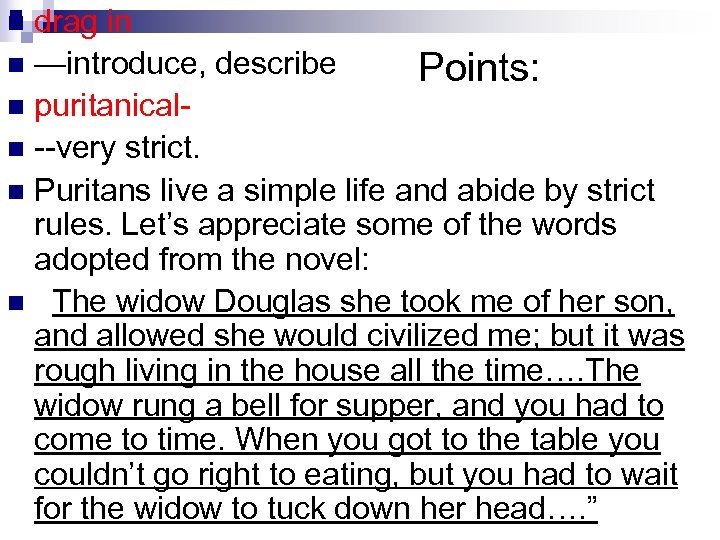
drag in n —introduce, describe Points: n puritanicaln --very strict. n Puritans live a simple life and abide by strict rules. Let’s appreciate some of the words adopted from the novel: n The widow Douglas she took me of her son, and allowed she would civilized me; but it was rough living in the house all the time…. The widow rung a bell for supper, and you had to come to time. When you got to the table you couldn’t go right to eating, but you had to wait for the widow to tuck down her head…. ” n
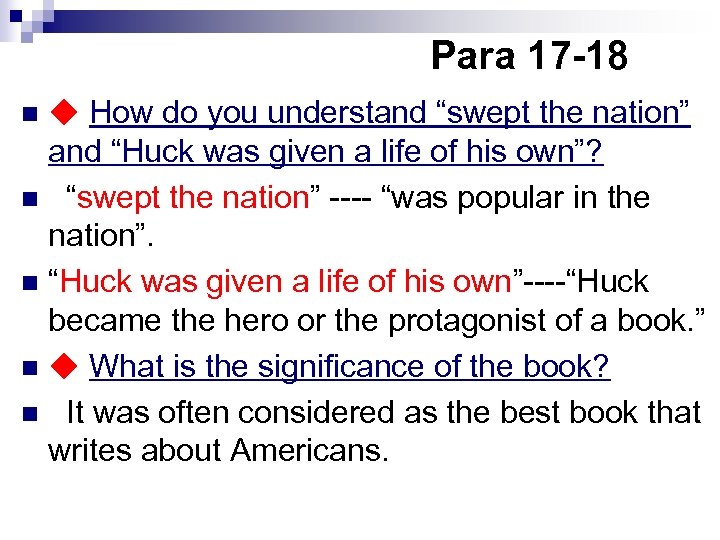
Para 17 -18 ◆ How do you understand “swept the nation” and “Huck was given a life of his own”? n “swept the nation” ---- “was popular in the nation”. n “Huck was given a life of his own”----“Huck became the hero or the protagonist of a book. ” n ◆ What is the significance of the book? n It was often considered as the best book that writes about Americans. n
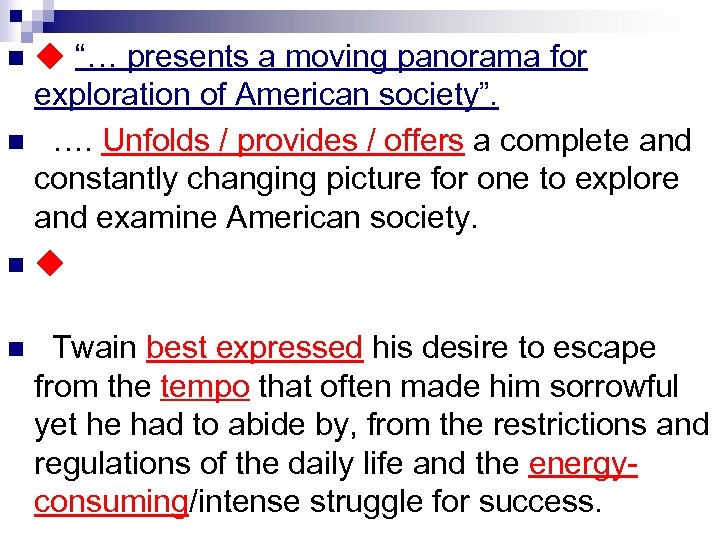
◆ “… presents a moving panorama for exploration of American society”. n …. Unfolds / provides / offers a complete and constantly changing picture for one to explore and examine American society. n ◆ “Twain found the ultimate expression of escape from the pace he lived by…for success” n Twain best expressed his desire to escape from the tempo that often made him sorrowful yet he had to abide by, from the restrictions and regulations of the daily life and the energyconsuming/intense struggle for success. n
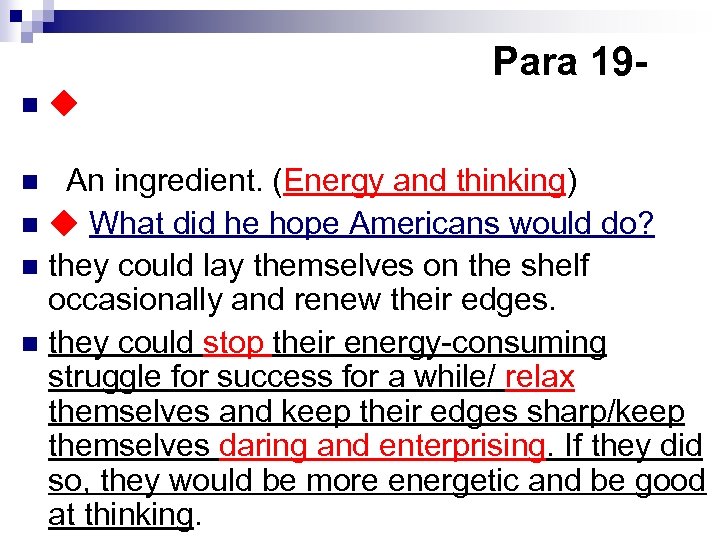
Para 19◆ What was missing in American ambition according to Mark Twain? n An ingredient. (Energy and thinking) n ◆ What did he hope Americans would do? n they could lay themselves on the shelf occasionally and renew their edges. n they could stop their energy-consuming struggle for success for a while/ relax themselves and keep their edges sharp/keep themselves daring and enterprising. If they did so, they would be more energetic and be good at thinking. n
Para 20 n n ◆ What were Mark Twain’s personal tragedies? How might these tragedies influence his writing? He lost beloved ones one by one. Firstly his father died, followed by the death of his brother, his son, his eldest daughter, his wife and his youngest daughter. n n n All these might have made his writing colored with despair and sadness. But he maintained his humorous tone from the beginning to the end. The only difference between his early writing and late writing is the latter is more overt in sarcasm and satire. (This can be seen from “ the moralizing of his earlier writing had been well padded with humor. Now the gloves came off with biting satire…. ”)
Para 21 ◆ Identify the figure of speech used in the first sentence. n ◆ “ now the gloves came off with biting satire” n What is under the gloves? According to an idiom, “an iron hand in a velvet glove’ n when the cover -gloves come off, the hard and sharp things are shown. n if in the past, Twain’s critical writings were covered with humor, now he became merciless in satirizing and criticizing. He no longer covered his severe or harsh criticism. n
◆ In his book The Mysterious Stranger, what idea did he express? n He lost his confidence in God. He began to doubt the religion. /he was skeptical/ sceptic about religion. (skepticism) n
Para 22 ◆ When did his own illusion come to an end? n His own illusions seemed to have shattered near the end of his life. n ◆ Identify the figure of speech used in “men’s final release from earthly struggles”. n Euphemism. It is a mild way to say “death”. n ◆ Identify the other figures of speech used in Mark Twain’s words in the paragraph. n Parallelism and antithesis. n
◆ How do you understand “ a world which will lament them a day and forget them forever. ”? n When they die, people will mourn them for a short time. Soon they would forget them. They will no longer remember them. Mourning and grief does not last long. n Negligence and forget lasts the longest. n This sharp contrast shows Twain’s complete despair at the worldly life. (people are cold and indifferent) n
How do you understand the title? ◆ "Mirror" here is used figuratively----- a person who gives a true representation or description of the country. ◆Generally, all literary giants in human history are also great historians, thinkers, and philosophers in a sense. Their works often reveal more truth than many political essays put together. ◆Mark Twain was one of these giants, and his life and works are a mirror of America of his time.
2. Background Information 1) Mark Twain 2) Introduction of Mark Twain’s major works
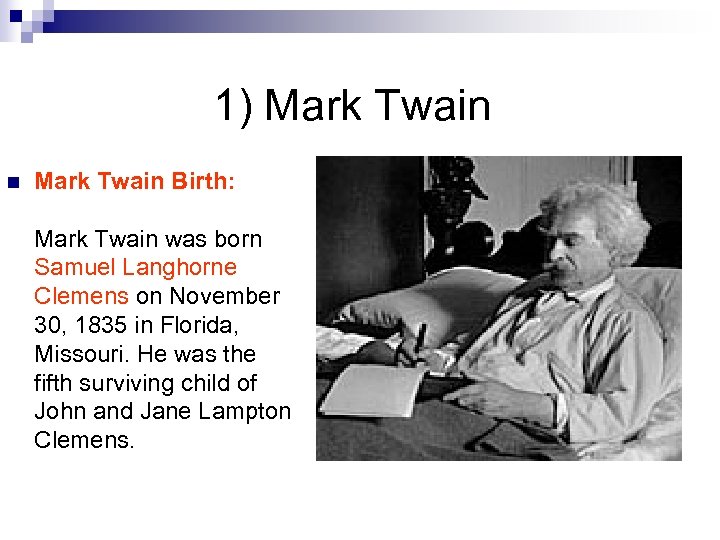
1) Mark Twain n Mark Twain Birth: Mark Twain was born Samuel Langhorne Clemens on November 30, 1835 in Florida, Missouri. He was the fifth surviving child of John and Jane Lampton Clemens.
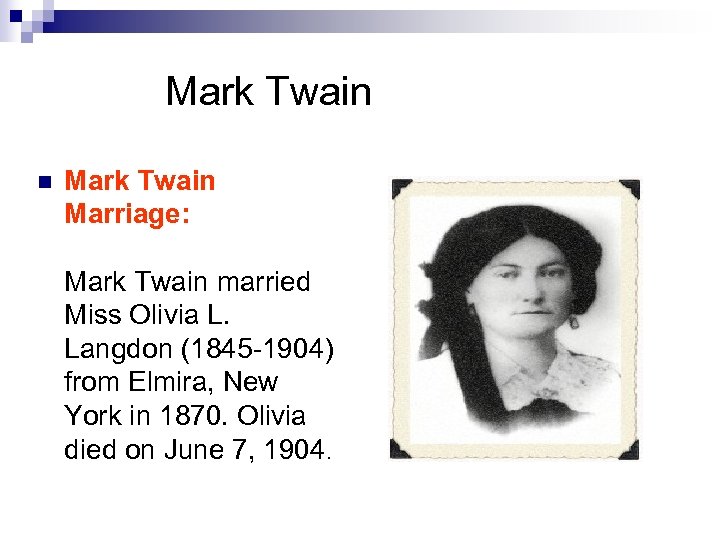
Mark Twain n Mark Twain Marriage: Mark Twain married Miss Olivia L. Langdon (1845 -1904) from Elmira, New York in 1870. Olivia died on June 7, 1904.
Mark Twain Achievements: ["The Gilded Age" (1873), "The Adventures of Tom Sawyer" (1876), "The Prince and the Pauper" (1881), "Adventures of Huckleberry Finn" (1884), "A Connecticut Yankee in King Arthur's Court" (1889) and "The Tragedy of Pudd'nhead Wilson" (1894)] short stories, speeches, and essays. He also wrote some autobiographical works, including "The Innocents Abroad" (1869), "A Tramp Abroad" (1880), "Life on the Mississippi" (1883),
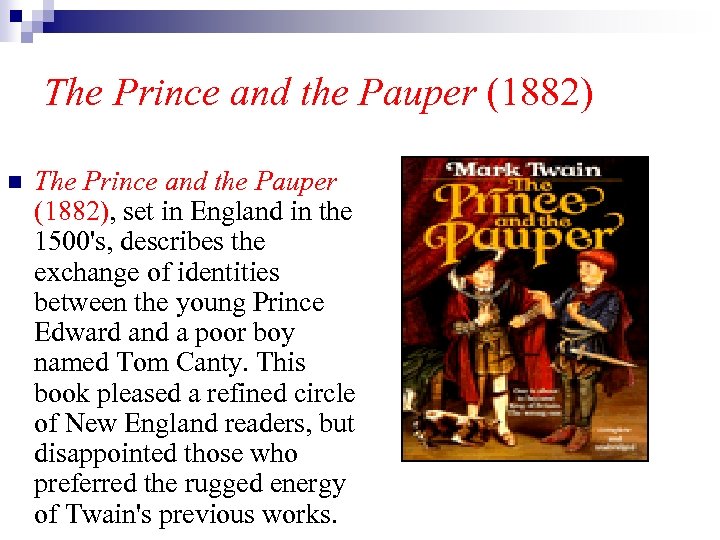
The Prince and the Pauper (1882) n The Prince and the Pauper (1882), set in England in the 1500's, describes the exchange of identities between the young Prince Edward and a poor boy named Tom Canty. This book pleased a refined circle of New England readers, but disappointed those who preferred the rugged energy of Twain's previous works.
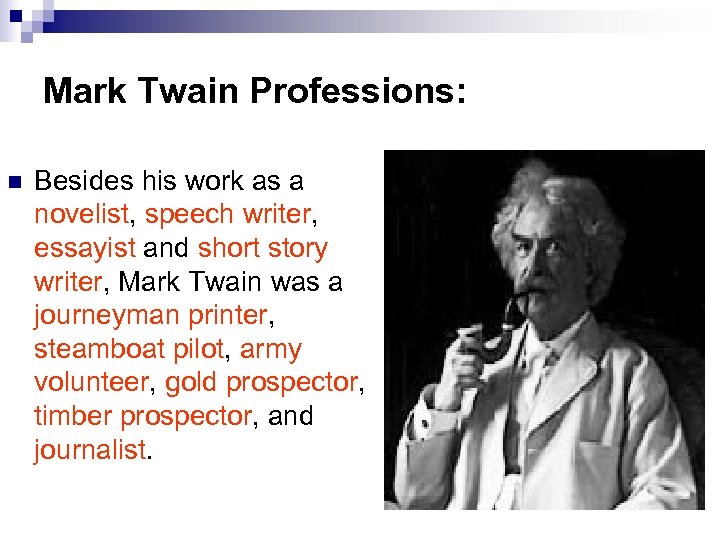
Mark Twain Professions: n Besides his work as a novelist, speech writer, essayist and short story writer, Mark Twain was a journeyman printer, steamboat pilot, army volunteer, gold prospector, timber prospector, and journalist.
2) Introduction of Mark Twain’s major works n The Gilded Age (1873), which followed Roughing It, was Twain's first novel. He wrote it with his friend and fellow Hartford writer, Charles Dudley Warner. The title refers to the decades following the Civil War. This book satirizes the selfishness and money-making schemes that were common during that time.
A Tramp Abroad (1880) n The novel draws on a European tour that Twain took in 1878. The book's narrator describes a walking tour of Germany, Switzerland, and Italy. He mixes stories, jokes, legends, and character sketches, while criticizing European guidebooks and culture.
A Connecticut Yankee in King Arthur's Court (1889) n A Connecticut Yankee in King Arthur's Court (1889) introduces another colorful character, a machine shop foreman from Hartford, Conn. , named Hank Morgan finds himself magically transported back to England in the A. D. 500's. He decides to reform that society by introducing the economic, intellectual, and moral benefits of life in the 1800's. Through events in the book, Twain indirectly satirizes the reverent (respected) attitude of some British authors toward the legendary Knights of the Round Table. But at the same time, he raises questions about certain values in the American culture of his time.
Later works Despite his business and personal difficulties, Twain managed to continue writing. His works during his final years included The American Claimant (1892), about an impractical character named Colonel Mulberry Sellers. The novel was based on an unsuccessful play he wrote with author-critic William Dean Howells in 1883. The Tragedy of Pudd'nhead Wilson (1894) is a detective novel set in the village of Dawson's Landing, another name for Hannibal. In this story, Twain focused on racial prejudice as the most critical issue facing American society. He drew on actual historical sources in Personal Recollections of Joan of Arc (1896).
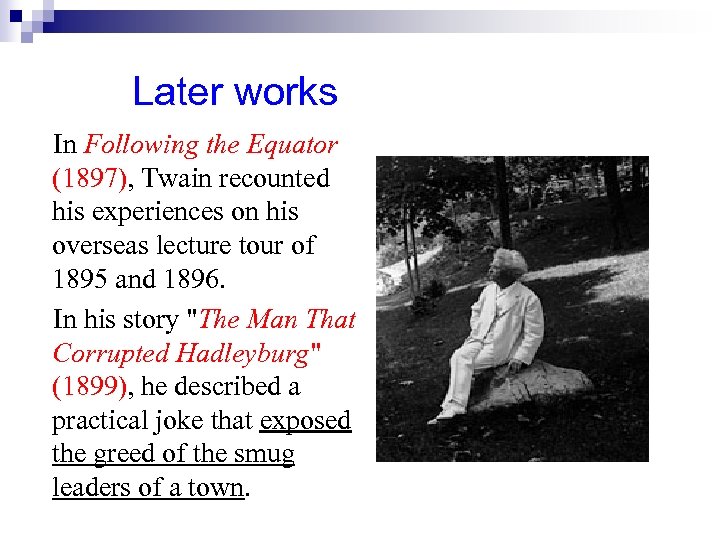
Later works In Following the Equator (1897), Twain recounted his experiences on his overseas lecture tour of 1895 and 1896. In his story "The Man That Corrupted Hadleyburg" (1899), he described a practical joke that exposed the greed of the smug leaders of a town.
3. Type of literature n This is a piece of narration.
4. Macro-structure of the text n n n Part I. (par. 1) A general introduction of Mark Twain Part II. (par. 2 -20) Mark Twain's main experiences and works Part III. (par. 21 -22) Mark twain's disappointment in human life in later years
Detailed Study of the text n n n n Par. 2 1. Give a brief account of Twain's experience before he became a writer. 2. How did he adopt his pen name? 3. Why can we say Twain is still a popular writer? Par. 3 1. Where was the main channel of transportation in his childhood? 2. What does "major commerce" refer to? 3. What do you know about "Westward expansion"?
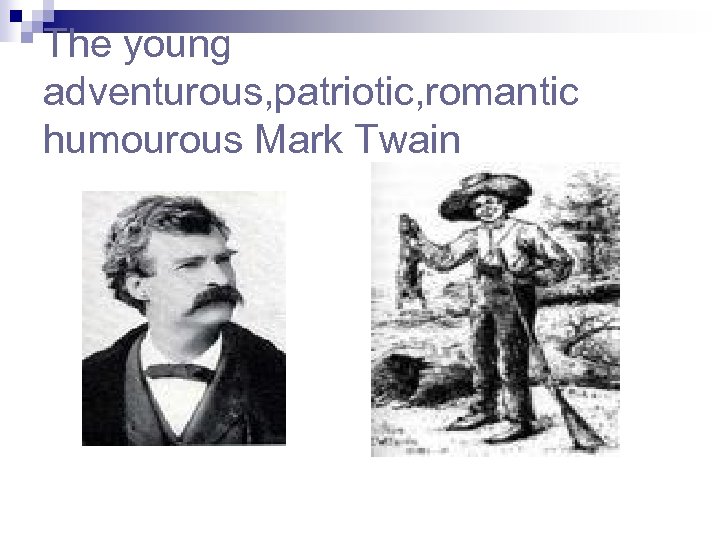
The young adventurous, patriotic, romantic humourous Mark Twain
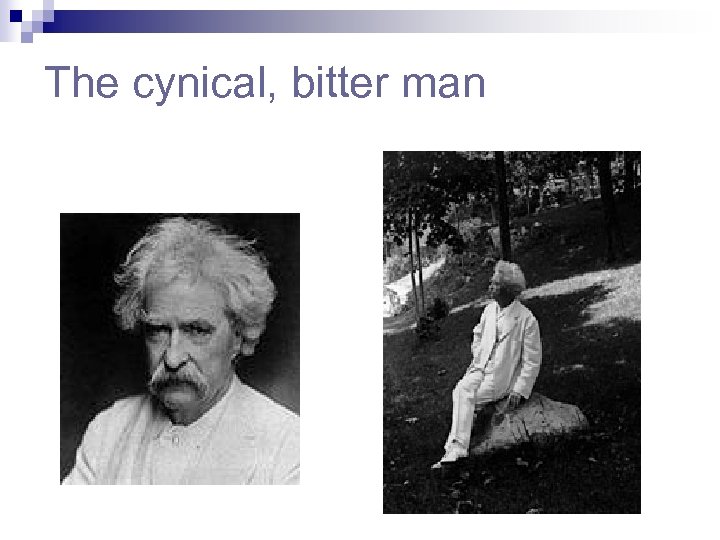
The cynical, bitter man

the Geographic core, the Main Artery of Transportation in the Young Nation’s Heart
Detailed Study of the text n n n Par. 4 1. Paraphrase the second sentence. Explain the metaphorical meaning of " cast of characters" and " cosmos". 2. What kind of stories did he hear on the steamboats? 3. what does it mean by "medicine show"? 4. Paraphrase the last sentence and identify the figure of speech used in it.
Detailed Study of the text Par. 5 n 1. What did "the main current" and "flotsam" refer to? n 2. What did he learn on steamboats? What effect did this experience have on his n writing? n 3. Paraphrase " of the difference between what they claim to be and what they really are". n
Detailed Study of the text Par. 6 n 1. Why did Twain leave the river country? n 2. Explain " dry up the demand for. . . ". n 3. why did he quit the guerrillas ? n 4. Identify the figure of speech in the sentence " who diligently avoided contact with the enemy". n
Detailed Study of the text n n n Par. 7 1. Explain the metaphorical meaning in "succumbed to the epidemic of gold and silver fever". 2. What is the figurative meaning in "flirted with"? 3. Why did he fail as a prospector? 4. What is the implied meaning of " to literature's enduring gratitude"?
Detailed Study of the text n n n Par. 8 1. Paraphrase the second sentence. And identify the figure in " his pen would prove mightier than his pickax". 2. What is the metaphorical meaning of "hotbed"? Par. 9 1. Explain the metaphorical meaning of "honed" and "muscles" in the first sentence. 2. why did he have to leave San Francisco?
Detailed Study of the text n n n n Par. 9 1. Explain the metaphorical meaning of "honed" and "muscles" in the first sentence. 2. why did he have to leave San Francisco? 3. Who did his satirical articles attack? 4. Paraphrase " His descriptions of the rough country settlers. . . on the West Coast". 5. What was Twain's opinion about the people in the West? Why? 6. Explain " for getting up astonishing enterprises and rushing them through with a magnificent. . . smiles as usual". 7. Paraphrase " Well, that's California all over. ".
Detailed Study of the text Par. 10 -11 n 1. What is the main idea of these two paragraphs? n 2. Which work brought Twain national fame? n 3. How do you understand " the wild humorist"? n
Detailed Study of the text Par. 12 n 1. Explain " take a distinctly American look at the Old World" n 2. What does the Holy Land refer to? n 3. Why was the journey by Quaker City called "a milestone"? n 4. What task did Twain get as a reporter? n 5. What is " glowing travelogue"? n
Detailed Study of the text n n n Par. 13. 1. What was his impression about the king of Turkey? 2. What was his attitude towards revered artists and art treasures? 3. what did he do about the Holy Land in his reports? 4. Identify the figure in the sentence" America laughed with him". 5. How was The Innocents Abroad received by Americans? Why?
Detailed Study of the text n n n n Par. 14, 15 1. How did Tom Sawyer come into being? 2. How is the book evaluated? 3. Paraphrase " Tom's mischievous daring, ingenuity, and the sweet innocence of his affection for Becky ". Par. 16 1. How is Par. 16 linked with Par. 15 ? 2. How did he establish his literary position? 3. From this paragraph, how would you comment on Twain's language style in Huckleberry Finn?
Detailed Study of the text n n n Par. 17, 18 1. Explain "swept the nation", " was given a life of its own". 2. What is the significance of this book? 3. Paraphrase" presents a moving panorama for exploration of American society". 4. How was the book important for Twain? 5. Explain "Twain found the ultimate expression. . . for success. "
Detailed Study of the text Par. 19, 20 n 1. What did Twain think was missing in American ambition? n 2. What did he hope American people would do? n 3. What are Twain's personal tragedies? How might these tragedies influence his personality and writing? n
Detailed Study of the text Par. 21 n 1. Paraphrase the first sentence and identify the figure used in it. n 2. Explain "Now the gloves came off with biting satire. " n 3. In his book The Mysterious Stranger, what ideas did he express? n
Detailed Study of the text Par. 22 n 1. When did his own illusion come to an end? n 2. What figure is used in " on men's final release from earthly struggles"? n 3. Identify the figures used in Twain's words in this paragraph. n 4. Explain " lament them a day and forget them forever". n
6. Rhetoric devices Metaphor n Metonymy n Personification n Alliteration n Hyperbole n Euphemism n Antithesis n
7. Follow -up discussion Comment on the language style of this essay by supplying evidences from the text. n Make sentences using the following words in a figurative sense. 1) heart 2) artery 3) current 4) hotbed 5) to dry up 6) to hone n
Reference answer 1 n n 1) humorous and light tone 2) frequent use of metaphors to make language vivid 3) hyperboles employed to emphasize his meaning and convey strong emotions ----mainly the author's respect for Twain and his works 4) direct quotations used to lend authenticity, authority and force
8. Exercise and Homework Write a summary of the life to Mark Twain within 200 words. n Reading and writing assignment: log onto Internet and search for Twain’s works. Select one for reading and write a book report with your own words. n
Скачать презентацию Advanced English Book I Unit Six Mark Twain—Mirror
253b80e93b0e55c42bd8cd070b8ad9fb.ppt