 Скачать презентацию Advanced Algorithms Analysis and Design By Dr Nazir
5b03ffc70fb704bc9823f0fdd553be69.ppt
- Количество слайдов: 22




Advanced Algorithms Analysis and Design By Dr. Nazir Ahmad Zafar Dr Nazir A. Zafar Advanced Algorithms Analysis and Design
Lecture No. 18 2 -Line Assembly Scheduling Problem Dr Nazir A. Zafar Advanced Algorithms Analysis and Design
Today Covered • 2 -Line Assembly Scheduling Algorithm using Dynamic Programming • Time Complexity • n-Line Assembly Problem • Brute Force Analysis • n-Line Assembly Scheduling Algorithm using Dynamic Programming • Time Complexity • Generalization and Applications • Conclusion Dr Nazir A. Zafar Advanced Algorithms Analysis and Design
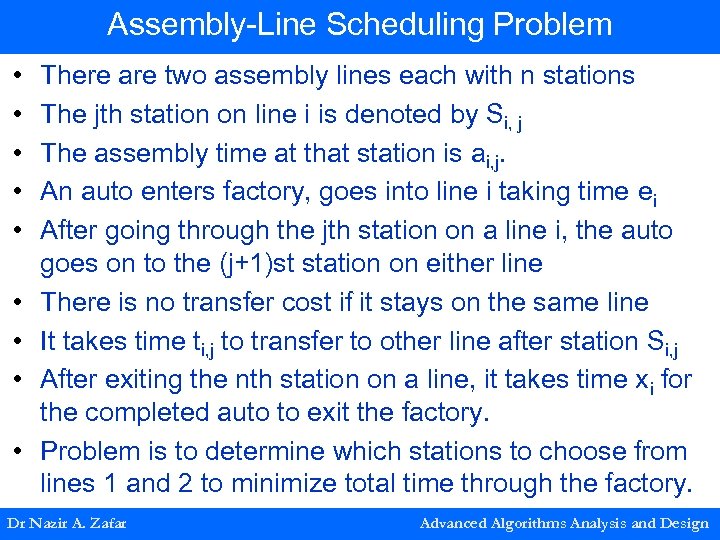
Assembly-Line Scheduling Problem • • • There are two assembly lines each with n stations The jth station on line i is denoted by Si, j The assembly time at that station is ai, j. An auto enters factory, goes into line i taking time ei After going through the jth station on a line i, the auto goes on to the (j+1)st station on either line There is no transfer cost if it stays on the same line It takes time ti, j to transfer to other line after station Si, j After exiting the nth station on a line, it takes time xi for the completed auto to exit the factory. Problem is to determine which stations to choose from lines 1 and 2 to minimize total time through the factory. Dr Nazir A. Zafar Advanced Algorithms Analysis and Design
![Mathematical Model Defining Objective Function Base Cases • f 1[1] = e 1 +](https://present5.com/presentation/5b03ffc70fb704bc9823f0fdd553be69/image-5.jpg "Mathematical Model Defining Objective Function Base Cases • f 1[1] = e 1 +")
Mathematical Model Defining Objective Function Base Cases • f 1[1] = e 1 + a 1, 1 • f 2[1] = e 2 + a 2, 1 Two possible ways of computing f 1[j] • f 1[j] = f 2[j-1] + t 2, j-1 + a 1, j OR f 1[j] = f 1[j-1] + a 1, j For j = 2, 3, . . . , n f 1[j] = min (f 1[j-1] + a 1, j, f 2[j-1] + t 2, j-1 + a 1, j) Symmetrically For j = 2, 3, . . . , n f 2[j] = min (f 2[j-1] + a 2, j, f 1[j-1] + t 1, j-1 + a 2, j) Objective function = f* = min(f 1[n] + x 1, f 2[n] + x 2) Dr Nazir A. Zafar Advanced Algorithms Analysis and Design
![Dynamic Algorithm FASTEST-WAY(a, t, e, x, n) 1 ƒ 1[1] e 1 + a](https://present5.com/presentation/5b03ffc70fb704bc9823f0fdd553be69/image-6.jpg "Dynamic Algorithm FASTEST-WAY(a, t, e, x, n) 1 ƒ 1[1] e 1 + a")
Dynamic Algorithm FASTEST-WAY(a, t, e, x, n) 1 ƒ 1[1] e 1 + a 1, 1 2 ƒ 2[1] e 2 + a 2, 1 3 for j 2 to n 4 do if ƒ 1[ j - 1] + a 1, j ≤ ƒ 2[ j - 1] + t 2, j - 1 + a 1, j 5 6 7 8 9 Dr Nazir A. Zafar then ƒ 1[ j] ƒ 1[ j - 1] + a 1, j l 1[ j] 1 else ƒ 1[ j] ƒ 2[ j - 1] + t 2, j - 1 + a 1, j l 1[ j] 2 if ƒ 2[ j - 1] + a 2, j ≤ ƒ 1[ j - 1] + t 1, j - 1 + a 2, j Advanced Algorithms Analysis and Design
![Contd. . 10. then ƒ 2[ j] ƒ 2[ j - 1] + a](https://present5.com/presentation/5b03ffc70fb704bc9823f0fdd553be69/image-7.jpg "Contd. . 10. then ƒ 2[ j] ƒ 2[ j - 1] + a")
Contd. . 10. then ƒ 2[ j] ƒ 2[ j - 1] + a 2, j 11. 12. l 2[ j] 2 else ƒ 2[ j] ƒ 1[ j - 1] + t 1, j - 1 + a 2, j 13. l 2[ j] 1 14. if ƒ 1[n] + x 1 ≤ ƒ 2[n] + x 2 15. then ƒ* = ƒ 1[n] + x 1 16. l* = 1 17. else ƒ* = ƒ 2[n] + x 2 18. Dr Nazir A. Zafar l* = 2 Advanced Algorithms Analysis and Design
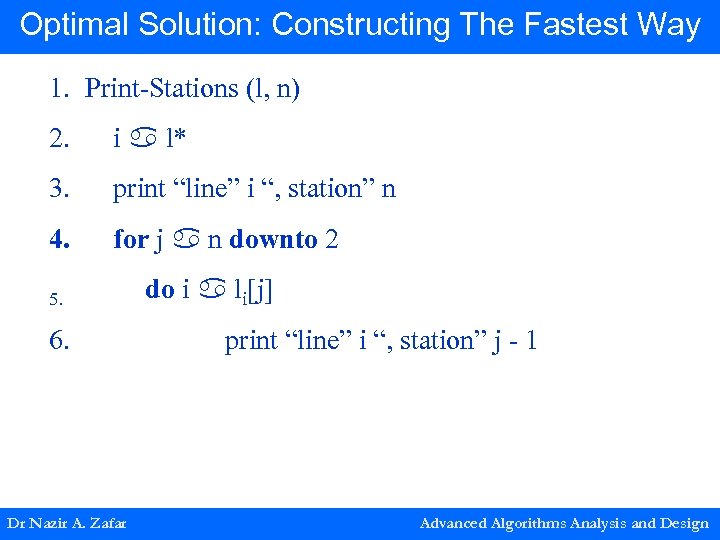
Optimal Solution: Constructing The Fastest Way 1. Print-Stations (l, n) 2. i l* 3. print “line” i “, station” n 4. for j n downto 2 5. 6. Dr Nazir A. Zafar do i li[j] print “line” i “, station” j - 1 Advanced Algorithms Analysis and Design
n-Line Assembly Problem Dr Nazir A. Zafar Advanced Algorithms Analysis and Design
n-Assembly Line Scheduling Problem • • • There are n assembly lines each with m stations The jth station on line i is denoted by Si, j The assembly time at that station is ai, j. An auto enters factory, goes into line i taking time ei After going through the jth station on a line i, the auto goes on to the (j+1)st station on either line • It takes time ti, j to transfer from line i, station j to line i’ and station j+1 • After exiting the nth station on a line i, it takes time xi for the completed auto to exit the factory. • Problem is to determine which stations to choose from lines 1 to n to minimize total time through the factory. Dr Nazir A. Zafar Advanced Algorithms Analysis and Design
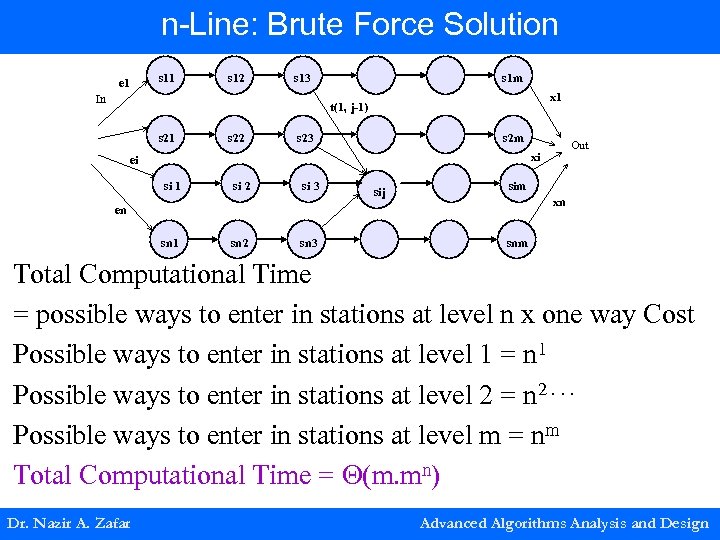
n-Line: Brute Force Solution e 1 s 12 s 13 In s 1 m x 1 t(1, j-1) s 21 s 22 s 23 s 2 m Out xi ei si 1 si 2 si 3 sij sim xn en sn 1 sn 2 sn 3 snm Total Computational Time = possible ways to enter in stations at level n x one way Cost Possible ways to enter in stations at level 1 = n 1 Possible ways to enter in stations at level 2 = n 2. . . Possible ways to enter in stations at level m = nm Total Computational Time = (m. mn) Dr. Nazir A. Zafar Advanced Algorithms Analysis and Design
Dynamic Solution Dr Nazir A. Zafar Advanced Algorithms Analysis and Design
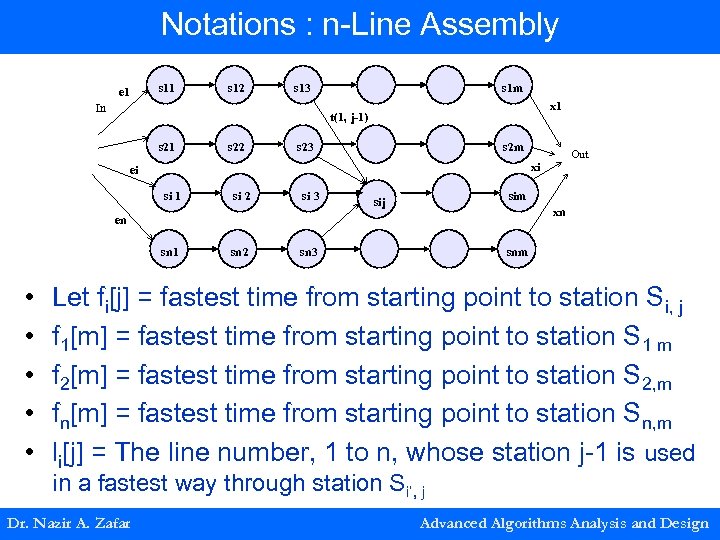
Notations : n-Line Assembly e 1 s 12 s 13 In s 1 m x 1 t(1, j-1) s 21 s 22 s 23 s 2 m ei si 1 si 2 si 3 sim sij xn en sn 1 • • • Out xi sn 2 sn 3 snm Let fi[j] = fastest time from starting point to station Si, j f 1[m] = fastest time from starting point to station S 1 m f 2[m] = fastest time from starting point to station S 2, m fn[m] = fastest time from starting point to station Sn, m li[j] = The line number, 1 to n, whose station j-1 is used in a fastest way through station Si’, j Dr. Nazir A. Zafar Advanced Algorithms Analysis and Design
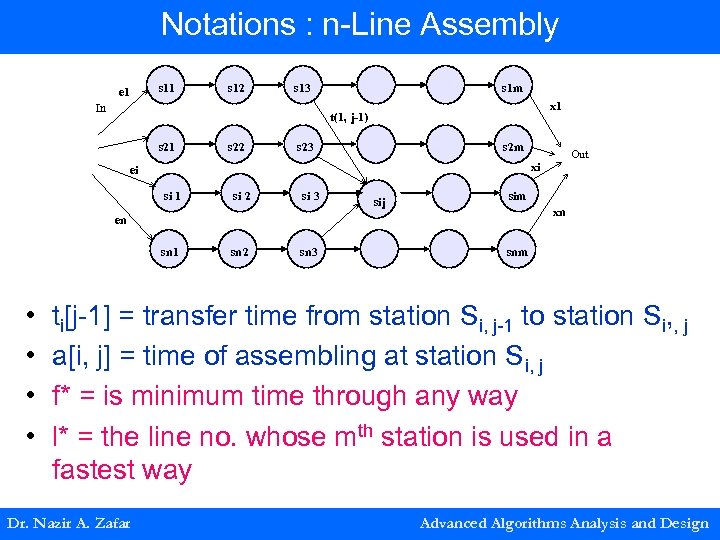
Notations : n-Line Assembly e 1 s 12 s 13 In s 1 m x 1 t(1, j-1) s 21 s 22 s 23 s 2 m ei si 1 si 2 si 3 sij sim xn en sn 1 • • Out xi sn 2 sn 3 snm ti[j-1] = transfer time from station Si, j-1 to station Si, , j a[i, j] = time of assembling at station Si, j f* = is minimum time through any way l* = the line no. whose mth station is used in a fastest way Dr. Nazir A. Zafar Advanced Algorithms Analysis and Design
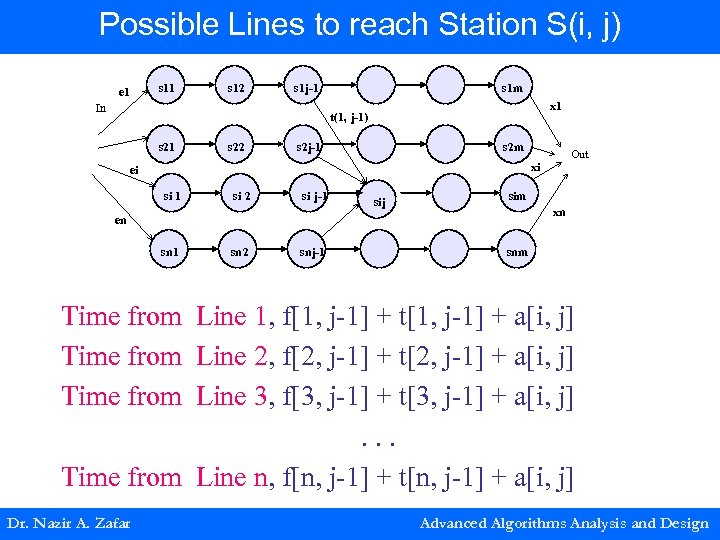
Possible Lines to reach Station S(i, j) e 1 s 12 s 1 j-1 In s 1 m x 1 t(1, j-1) s 21 s 22 s 2 j-1 s 2 m Out xi ei si 1 si 2 si j-1 sij sim xn en sn 1 sn 2 snj-1 snm Time from Line 1, f[1, j-1] + t[1, j-1] + a[i, j] Time from Line 2, f[2, j-1] + t[2, j-1] + a[i, j] Time from Line 3, f[3, j-1] + t[3, j-1] + a[i, j]. . . Time from Line n, f[n, j-1] + t[n, j-1] + a[i, j] Dr. Nazir A. Zafar Advanced Algorithms Analysis and Design
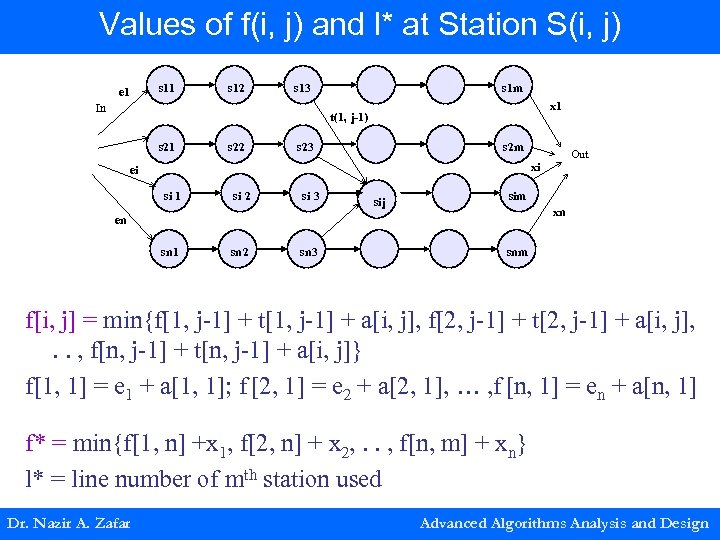
Values of f(i, j) and l* at Station S(i, j) e 1 s 12 s 13 In s 1 m x 1 t(1, j-1) s 21 s 22 s 23 s 2 m Out xi ei si 1 si 2 si 3 sij sim xn en sn 1 sn 2 sn 3 snm f[i, j] = min{f[1, j-1] + t[1, j-1] + a[i, j], f[2, j-1] + t[2, j-1] + a[i, j], . . , f[n, j-1] + t[n, j-1] + a[i, j]} f[1, 1] = e 1 + a[1, 1]; f [2, 1] = e 2 + a[2, 1], … , f [n, 1] = en + a[n, 1] f* = min{f[1, n] +x 1, f[2, n] + x 2, . . , f[n, m] + xn} l* = line number of mth station used Dr. Nazir A. Zafar Advanced Algorithms Analysis and Design
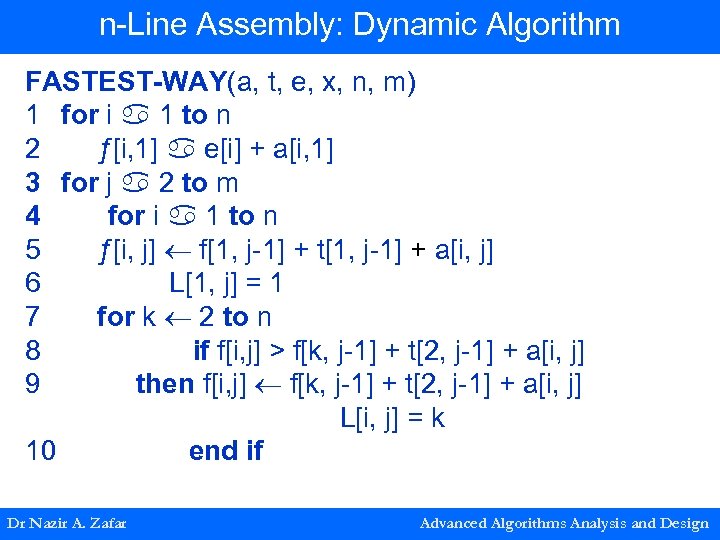
n-Line Assembly: Dynamic Algorithm FASTEST-WAY(a, t, e, x, n, m) 1 for i 1 to n 2 ƒ[i, 1] e[i] + a[i, 1] 3 for j 2 to m 4 for i 1 to n 5 ƒ[i, j] f[1, j-1] + t[1, j-1] + a[i, j] 6 L[1, j] = 1 7 for k 2 to n 8 if f[i, j] > f[k, j-1] + t[2, j-1] + a[i, j] 9 then f[i, j] f[k, j-1] + t[2, j-1] + a[i, j] L[i, j] = k 10 end if Dr Nazir A. Zafar Advanced Algorithms Analysis and Design
![n-Line Assembly: Dynamic Algorithm 11 ƒ* ƒ[1, m] + x[1] 12 l* = 1](https://present5.com/presentation/5b03ffc70fb704bc9823f0fdd553be69/image-18.jpg "n-Line Assembly: Dynamic Algorithm 11 ƒ* ƒ[1, m] + x[1] 12 l* = 1")
n-Line Assembly: Dynamic Algorithm 11 ƒ* ƒ[1, m] + x[1] 12 l* = 1 13 for k 2 to n 14 if f* > f[k, m] + x[k] 15 then ƒ* ƒ[k, m] + x[k] 16 l* = k Dr Nazir A. Zafar Advanced Algorithms Analysis and Design
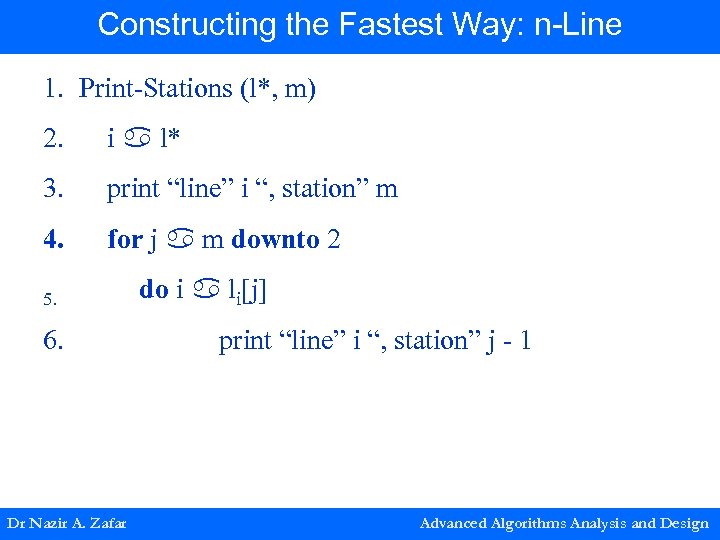
Constructing the Fastest Way: n-Line 1. Print-Stations (l*, m) 2. i l* 3. print “line” i “, station” m 4. for j m downto 2 5. 6. Dr Nazir A. Zafar do i li[j] print “line” i “, station” j - 1 Advanced Algorithms Analysis and Design
Generalization: Cyclic Assembly Line Scheduling Title: Moving policies in cyclic assembly line scheduling Source: Theoretical Computer Science, Volume 351, Issue (February 2006) Summary: Assembly line problem occurs in various kinds of production automation. In this paper, originality lies in the automated manufacturing of PC boards. • In this case, the assembly line has to process number of identical work pieces in a cyclic fashion. In contrast to common variant of assembly line scheduling. • Each station may process parts of several work-pieces at the same time, and parts of a work-piece may be processed by several stations at the same time. Dr Nazir A. Zafar Advanced Algorithms Analysis and Design
Application: Multiprocessor Scheduling • The assembly line problem is well known in the area of multiprocessor scheduling. • In this problem, we are given a set of tasks to be executed by a system with n identical processors. • Each task, Ti, requires a fixed, known time pi to execute. • Tasks are indivisible, so that at most one processor may be executing a given task at any time • They are un-interruptible, i. e. , once assigned a task, may not leave it until task is complete. • The precedence ordering restrictions between tasks may be represented by a tree or forest of trees Dr Nazir A. Zafar Advanced Algorithms Analysis and Design
Conclusion • Assembly line problem is discussed • Generalization is made • Mathematical Model of generalized problem is discribed • Algorithm is proposed • Applications are observed in various domains • Some research issues are identified Dr Nazir A. Zafar Advanced Algorithms Analysis and Design
Скачать презентацию Advanced Algorithms Analysis and Design By Dr Nazir
5b03ffc70fb704bc9823f0fdd553be69.ppt