


 Скачать презентацию Adult Literacy Forum Policy Issues for the 107
72ea439a9b93aeb731ece9ea1ffaf483.ppt
- Количество слайдов: 96
 Adult Literacy Forum Policy Issues for the 107 th Congress Sponsored by The National Adult Education Professional Development Consortium Hosted by The Library of Congress, Center for the Book NAEPDC 1
 Adult Literacy Forum Policy Issues for the 107 th Congress Welcome On behalf of National Adult Education Professional Development Consortium The policy and professional development arm of the Adult Education State Directors Dr. Lennox L. Mc. Lendon, Executive Director Garrett Murphy, Policy Analyst Brenda James, Executive Assistant Tamara Rogers, Graduate Assistant NAEPDC 2
 Adult Literacy Forum Policy Issues for the 107 th Congress n Purpose – Provide adult education profiles for your district, state, and the country – Summarize the impact of low literacy levels on critical services and initiatives--welfare, health, workforce, and the family – Meet the key resource people in adult education and literacy NAEPDC 3
 Adult Literacy Forum Policy Issues for the 107 th Congress n Thanks to – Library of Congress—John Coles and Ann Boni – Sherry Kaiman (Jeffords, VT (R)) and Jane Oates (Kennedy, MA (D)) – Lynn Selmser (House Education and Workforce Committee) – Christy Gullion, National Institute for Literacy – NAEPDC Staff • Garrett Murphy, Policy Analyst • Brenda James, Executive Assistant • Tamara Rogers, Graduate Assistant NAEPDC 4
 Adult Literacy Forum n. Overview –Brief background –Profiles of your locales –Learning disabilities –Policy issues overview NAEPDC 5
 Adult Literacy Forum n Literacy: An individual’s ability to read, write, and speak in English, compute and solve problems, at levels of proficiency necessary to function on the job, in the family of the individual, and in society. Workforce Investment Act of 1998, Title II, The Adult Education and Family Literacy Act NAEPDC 6
 It is not one adult literacy n Adult Basic Education (ABE) n Adult Secondary Education – Adult High School – General Education Development (GED) n English as a Second Language (ESL) n Family Literacy n Workplace Education NAEPDC 7
 Adult Basic Education (ABE) n Services for adults who are functioning at or below the eighth grade level n Individualized and customized to address the learner’s skill level and learning goals—family, work, community or combination NAEPDC 8
 Adult Secondary Education n Adult High School Programs allow adults to complete their credits to receive a high school diploma n GED (General Education Development) programs prepare adults for the battery of GED test to demonstrate a competency level equivalent to a high school diploma NAEPDC 9
 English as a Second Language (ESL) n ESL programs provide English language learning opportunities for adults who speak languages other than English. n Other Terms – ESOL--English for Speakers of Other Languages – LEP--Limited English Proficient Adults NAEPDC 10
 Family Literacy n Family Literacy programs typically offer four components – Adult literacy services for parents – Training for parents as teachers of their children – Early childhood services including school readiness skills for the children, and – Parent-child literacy activities NAEPDC 11
 Workplace Education n Workplace education services are customized ABE, GED, and/or ESL services that address the basic skills needs of employees and employers n Services are usually provided at the work site n Business and adult education partner to provide these services—fee for service NAEPDC 12
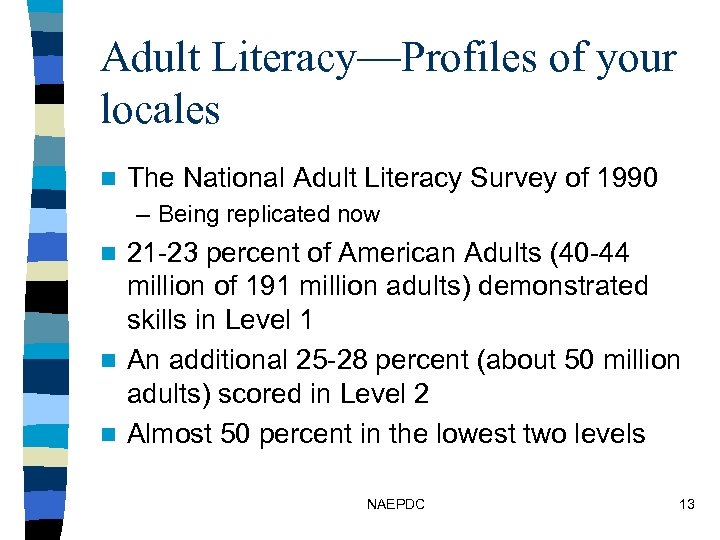 Adult Literacy—Profiles of your locales n The National Adult Literacy Survey of 1990 – Being replicated now 21 -23 percent of American Adults (40 -44 million of 191 million adults) demonstrated skills in Level 1 n An additional 25 -28 percent (about 50 million adults) scored in Level 2 n Almost 50 percent in the lowest two levels n NAEPDC 13
 NALS Level 1 n They could perform simple, routine tasks involving brief and uncomplicated texts and documents. n Example, they were able to total an entry on a deposit slip, locate the time or place of a meeting on a form, and identify a piece of specific information in a brief news article. NAEPDC 14
 NALS Level 2 n They could generally locate information in text, make low-level inferences using printed materials, and integrate easily identifiable pieces of information. n They could perform quantitative tasks that involve a single operation where numbers are either stated or can be easily found in text. NAEPDC 15
 NALS Levels 1 and 2 n The 90 million adults who performed in Levels 1 and 2 did not necessarily perceive themselves as being “at risk. ” n Most described themselves as being able to read or write English “well” or “very well. ” n NAEPDC Kirsch, 1993 16
 Adult Literacy Forum: Issues facing the 107 th Congress n The State of Literacy in America (National Institute for Literacy) NAEPDC 17
 Adult Literacy Forum Policy Issues for the 107 th Congress n Adult Learning Disabilities – NIFL Fact Sheet NAEPDC 18
 Adult Literacy Forum: Issues facing the 107 th Congress n Welfare n Health n Workforce n Family NAEPDC 19
 Welfare/Self-Sufficiency and Adult Literacy Jeffrey Gove Consultant Ohio Center for Curriculum and Assessment NAEPDC 20
 Welfare/Self-Sufficiency and Adult Literacy “Jobs will get them off of welfare, but education will get them out of poverty” Susan Greenblatt n Director of Technical Assistance for n The Administration of Children and the Family n US Department of Health and Human Services n NAEPDC 21
 Welfare/Self-Sufficiency The Relationship with Literacy n Impact/Relationship of Low Literacy on Welfare n Promising Practices n Issues and Gaps NAEPDC 22
 Welfare/Self-Sufficiency The Relationship with Literacy n Nationwide, 70 percent of adults with the lowest literacy skills are unemployed or work in part-time jobs n More than 40 percent of adults in the lowest literacy level live in poverty n NAEPDC Kirsch, 1993 23
 Welfare/Self-Sufficiency The Relationship with Literacy n Let’s not move from a population of the Welfare Poor to one of the Working Poor! n n The Welfare conference, January 2001 first wave is at work. – How do we get them past the entry level job n NAEPDC Welfare conference, January 2001 24
 Welfare/Self-Sufficiency The Relationship with Literacy n The second wave has multiple barriers to initial employment – Limited education – Half are estimated to be learning disabled – Poor work history – Drug and alcohol dependency – Welfare conference, January 2001 NAEPDC 25
 Welfare/Self-Sufficiency The Relationship with Literacy n “Work first” worked because we had an exceptionally robust economy. n Everyone n What who wanted to work, could. do we do if the economy turns? n NAEPDC Welfare conference, January 2001 26
 Welfare/Self-Sufficiency Promising Practices n Non-classroom instructional services – The Virginia Coalfield Project mails customized instructional materials back and forth with 400+ adult students who have teacher support via telephone – Literacy Cyber. Space! in the Panhandle of Florida provides internet based reading, writing, math, job retention, and community resource instruction for adults in fifteen counties NAEPDC 27
 Welfare/Self-Sufficiency Promising Practices n Non-classroom instructional services (cont’d) – Hundreds of business/adult education collaboratives provide workplace education classes on site so entry level workers can improve basic skills in the work context. NAEPDC 28
 Welfare/Self-Sufficiency Promising Practices n Washington State’s “Families that Work” enrolls 1700 hardest to serve adults in a program that stresses coordination with other community providers in social services, mental and physical health care, housing, childcare and education, substance abuse and domestic violence counseling. More than half made significant gains in basic work, and family skills – leading to increased work activity and unsubsidized employment NAEPDC 29
 Welfare/Self-Sufficiency Promising Practices Rhode Island’s Project Opportunity has enrollees create a work readiness, career related portfolio. The program places strong emphasis on the acquisition of employment skills along with needed academic enhancement. Of 455 enrolled in a one-year period, 305 completed job search/job readiness activities, 113 obtained jobs and 105 entered or completed skills training. NAEPDC 30
 Welfare/Self-Sufficiency Promising Practices n West Virginia’s WVWORKS “Jumpstart” program combines basic skills review matched to particular jobs, basic computer literacy, self-esteem building, and job seeking and keeping skills. n In a period of just under one year 619 customers were served at a placement rate of 74%. NAEPDC 31
 Welfare/Self-Sufficiency The Gaps/Issues n Under TANF, the focus was on getting a job and off the roles. – Limited funds were used to provide education to new workers in order for them to move up from entry level. n “A 1999 survey of mid-sized firms found that less than 5 percent of the firms surveyed provide basic skills training to their employees, even though respondents estimated that 37 percent of their workers needed such training. ” Kazis & Miller, 2001 NAEPDC 32
 Welfare/Self-Sufficiency The Gaps/Issues n Continue to work toward better alignment of the systems and performance goals of all WIA Titles, welfare reform, adult postsecondary and higher education, in order to better integrate and improve the delivery of services to those shared customers who are most in need. NAEPDC 33
 Welfare/Self-Sufficiency The Gaps/Issues n Provide access to professional development to staff across WIA titles, welfare reform, and other systems, including but not limited to collaboration skills training, to help support better alignment of systems. NAEPDC 34
 Welfare/Self-Sufficiency The Gaps/Issues n Provide leadership, sufficient policy support, and the resources to achieve both alignment of systems and access to professional development. NAEPDC 35
 Public Health and Literacy: A real issue SCOTT C. RATZAN, MD, MPA, MA Editor-in-Chief, Journal of Health Communication Academy for the Advancement of Health, LLC Washington, DC and George Washington University School of Public Health Tufts University School of Medicine Yale University School of Epidemiology and Public Health NAEPDC 36
 Public Health and Literacy n Impact/Relationship of Low Literacy on Health n Issues and Gaps n Opportunities NAEPDC 37
 Public Health The Relationship with Literacy 90 million Americans are affected with low/marginal literacy n Low literacy, poor health, and early death are inexorably linked n n n (Hohn, 1997) Experts estimate that inadequate patient literacy skills increase national health-care costs by $75 -1000 billion per year n NAEPDC (Pennsylvania, 1999) 38
 Public Health The Relationship with Literacy Limited ability to read medication labels and written instructions for follow-up medical care n Less likely to make regular doctor visits, have preventative tests n Smoke more, exercise less, get hurt on the job more, live in substandard housing in dangerous neighborhoods n Have jobs that tend to be more hazardous n n NAEPDC (Perrin, 1989) 39
 Public Health The Relationship with Literacy Low-literacy adults lack the skills to access and understand health-related information and, as a result, often fail to engage in preventive health and early detection practices. n Low-level literacy skills can result in poor prenatal care and low birth weight which, in turn, increases a child’s risk of developing health, learning, and behavioral problems. n n NAEPDC (Pennsylvania, 1999) 40
 Health Literacy: a unique entity Health Literacy is the capacity of individuals to obtain, interpret, and understand basic health information and services necessary for appropriate health decision-making. S. Ratzan, R. Parker , Editors, Complete Bibliography of Medicine, National Library of Medicine, National Institutes for Health 2000 NAEPDC 41
 Health Literacy A two-sided challenge n The health profession makes use of long utterances, complex sentences, and a standardized vocabulary. n The adult’s literacy status is related to her or his ability to describe symptoms and can affect the practitioner’s ability to diagnose. n NAEPDC (Rudd et. al. , 1999) 42
 Health Literacy Gaps • Less likely to know diagnosis • Less likely to know name and purpose of medications • Less likely to know correct management of illness (e. g. asthma) • Less likely to know correct health behaviors NAEPDC 43
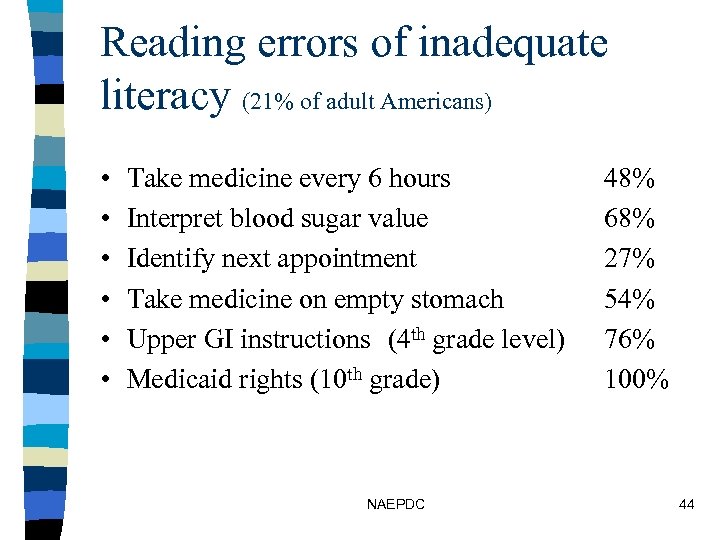 Reading errors of inadequate literacy (21% of adult Americans) • • • Take medicine every 6 hours Interpret blood sugar value Identify next appointment Take medicine on empty stomach Upper GI instructions (4 th grade level) Medicaid rights (10 th grade) NAEPDC 48% 68% 27% 54% 76% 100% 44
 Public Health and Literacy Promising Practices n Maine Area Health Education Center – Training sessions on how to produce easyto-read health materials – Easily reproducible, low-cost pamphlets – A model for teaching oral communications skills to health care providers who deal with low-literate adults – (Rudd, et. al. , 1999) NAEPDC 45
 Public Health and Literacy Promising Practices n National Cancer Institute and its Cancer Information Services – Ten years of developing strategies and materials to reach people with limited literacy skills – Partnered with several states to create teaching modules on cancer-related topics for use in Adult Basic Education and Literacy curriculums – (Rudd et. al. , 1999) NAEPDC 46
 Public Health and Literacy Gaps/Issues Systemic training for health care professionals in communication with low literacy adults n Expansion of health-related literacy and numeracy materials throughout the adult education and literacy network n Informed Consent unrealistic n Lower preventive services use – vaccines and mammograms (OR=1. 4) , pap smears (OR=1. 7) n NAEPDC 47
 Are you health literate? Can you answer 3 basic questions about your health? NAEPDC 48
 Three questions for Americans n What do we do to keep ourselves well? • 3 areas and numbers (immunizations, blood levels, weight, blood pressure, cholesterol) n If we are getting sick, how can we detect and treat these conditions early? • Can you do quality self care; screening? • Do you rely on the system for health decisions n If we are sick, how do we get the best medical care? • Knowledge, information and practice NAEPDC 49
 Health Literacy -- The potential A better quality system of health care n Health Literacy can lower costs n Health Literacy can ensure the public understands basic health components and acts on them appropriately n Health literacy is an outcome of effective health and education interventions n NAEPDC 50
 Activities that could address the issue of Health Literacy n n n Patient’s Bill of Rights Prescription Drug benefit Core health literacy competencies in education Communication on public health tiered to health literacy All Health and education grants include health literacy just as they do women and minorities NAEPDC 51
 Workforce Development Dr. Sam Drew State Director Office of Community Education South Carolina Department of Education NAEPDC 52
 Workforce Development n Impact/Relationship of Low Literacy on Workforce Development/Maintenance n Promising n Issues Practices and Gaps NAEPDC 53
 Workforce Development The Relationship with Literacy n Research shows that by improving employees’ skills: – Employees work smarter and better – Employees cope well with change in the workplace – Union/management relations improve, and – Output and profitability increase. – Conference Board NAEPDC 54
 Workforce Development The Relationship with Literacy n American businesses lose more than $60 billion in productivity each year due to employees’ lack of basic skills n n (NIFL, 1998) U. S experts on workplace literacy have estimated the direct and indirect costs of illiteracy on the American Economy to be $225 billion a year in lost productivity. n NAEPDC (Grimsley, 1995) 55
 Workforce Development The Relationship with Literacy n Approximately 20 percent of American workers are limited by low literacy levels and 75 percent of unemployed adults have reading and writing difficulties. n NAEPDC (Pennsylvania, 1999) 56
 Workforce Development The Relationship with Literacy n The number of companies reporting skilled worker shortages almost doubled between 1995 and 1998, from 27% to more than 47%. n NAEPDC (NIFL) 57
 Workforce Development The Relationship with Literacy n Top 10 skills in Demand in South Carolina – – – – – Integrity/Honesty Responsibility Participate as Team Member Knowing How To Learn Listening Self Esteem Reasoning Reading Self-Management Interpreting and Communicating Information (Skills That Work: : South Carolina Chamber of NAEPDC Commerce, 1998) 58
 Workforce Development The Relationship with Literacy n Most employers look for employees who demonstrate an ability to: – – – read and do math at a ninth-grade level or higher; identify and solve problems; work in diverse groups; communicate effectively, orally and in writing; use technology. n NAEPDC (Pennsylvania, 1999) 59
 Workforce Development The Relationship with Literacy n Employers want “soft” skills not usually considered as requirements for gainful employment 20 years ago. – Responsibility – Initiative – Perseverance, – Effort, -Confidence -Quality consciousness -Team building -Common sense – (Pennsylvania, 1999) NAEPDC 60
 Workforce Development The Relationship with Literacy A survey of more than 300 executives found that while 71 percent reported that employee improvement in basic written communication skills was critical to meeting changing skill demands in the work place, only 26 percent offered this kind of basic skills training. n In addition, 47 percent reported the need for improved basic math skills but only 5 percent offered basic math instruction. n n NAEPDC (NIFL) 61
 Workforce Development The Relationship with Literacy n Industry establishes the benchmarks for skills needed in the workplace. – Previously skills needed in the workplace emphasized basic reading writing and arithmetic. – Today a worker needs these basic skills and the ability to transfer to higher reasoning skills in order to complete job tasks. NAEPDC 62
 Workforce Development The Relationship with Literacy n Making the Transition – Workers need to understand processes and work related content. – In K-12 we teach “Reading to Learn” • 70% is reading to learn • 30% is reading to do – An Employee needs “Reading to Do” • 70% is reading to do • 30% reading to learn (Mikulecry) NAEPDC 63
 Workforce Development The Relationship with Literacy n Making the Transition – Therefore we need to assess what basic skills adults need to successfully do their job, and – develop training that effectively delivers these workplace basic skills. NAEPDC 64
 Workforce Development The Relationship with Literacy n Job Analysis: Define what basic skills are required for a specific workplace. n Assess: Identify what workers need to be successful on the job. n Targeted Training: deliver appropriate basic skills in the context of workplace applications (contextual basic skills). NAEPDC 65
 Workforce Development Promising Practices n Thousands Programs of Workplace Education – Customized educational programs to meet the individual employees work, family, and community needs – Shared cost between the employer and adult education and literacy program. NAEPDC 66
 Workforce Development Promising Practices n Workplace Education (cont’d) – Classes and learning labs on site – Employees attend an hour or two immediately prior to or after the work schedule – A few employers pay employees while participating – Some employers have release time during work hours NAEPDC 67
 Workforce Development Promising Practices n Workplace Broker Models – Brokers are trained to bridge the communication gap between industry and adult education professionals – Trains instructors for professional certification in workplace education – Brokers assists with the development of the contract for service and monitors progress – Brokers assist employers in analyzing basic skill needs ( job tasking) NAEPDC 68
 Workforce Development Promising Practices n Workplace Broker Models(Cont’d) – Brokers develop a curriculum around basic skills needs and locate the best adult education provider(s) to deliver the curriculum. – Collects and houses resource material appropriate to workplace education NAEPDC 69
 Workforce Development Promising Practices Virginia’s Workforce Improvement Network (WIN) – Funded by the Virginia Adult Education State Office – Housed at James Madison University in Harrisonburg, VA – http: //cep. jmu. edu/workforce/ NAEPDC 70
 Workforce Development Promising Practices Pennsylvania Workforce Improvement Network (PA-WIN) n Funded by the Pennsylvania Bureau of Adult Basic Education and Literacy n Housed at Penn State University n http: //www. ed. psu. edu/pawin/ NAEPDC 71
 Workforce Development Promising Practices South Carolina Workplace Resource Center n Funded by the South Carolina Department of Education Office of Adult and Community Education n Housed in Laurens South Carolina n http: //www. scwrc. org NAEPDC 72
 Workforce Development Gaps and Issues n Incentives for employers to provide onsite basic skills programs in collaboration with their local adult education and literacy provider n Expansion of the “brokering” function to link business with adult education and literacy services. n Definition of eligible adult under Sec. 203(1) of Title II of the WIA. NAEPDC 73
 Workforce Development Gaps and Issues n Transitioning contextual basic skills training to more pre-employment programs through Title I, One-Stops. n More focus on staff development to increase the number of professionally trained workplace instructors. NAEPDC 74
 Helping Children Read Well Parental Involvement and the Home Literacy Environment Cheryl Keenan Director Pennsylvania Bureau of Adult Basic and Literacy Education NAEPDC 75
 Helping Children Read Well n Impact/Relationship of Low Literacy and the Family n Promising n Issues Practices and Gaps NAEPDC 76
 What Have We Considered? n Role of sound instructional approach n Role of qualified teacher NAEPDC 77
 What Are We Missing? “It is difficult for a classroom or school to make up for the lack of literacy activities in the family” NAEPDC 78
 What Are We Missing? The Role of Home Literacy Environment n Value placed on reading n Press for achievement n Availability and instrumental use of reading materials n Reading with children n Opportunities for verbal interactions (Hess and Holloway, 1984) NAEPDC 79
 Adult Education: The Critical Connection n. A parent’s educational attainment is a strong indicator of a child’s academic performance n Parent’s attitudes about literacy and reading influence children’s literacy development (De. Baryshe; Baker et al. ; Speigal) NAEPDC 80
 Adult Education: The Critical Connection n Low levels of parent education can have negative impact on career development. (De. Ridder, 1990) n Children of parents who are unemployed and who have not completed high school are five times more likely to drop out of school than children of employed parents. (NIFL) NAEPDC 81
 Adult Education: The Critical Connection n Parents with higher skill levels and higher SES tend to: – Talk more to their children – Read to them more often – Buy them educational games – Provide them with more literacy enriched environments NAEPDC 82
 Family Literacy: Parents and Children Learning Together Family Literacy programs improve the educational opportunities of eligible families by integrating early childhood, adult literacy and parent education in a unified program. NAEPDC 83
 Family Literacy Research Synthesis Documented research consistently supports the finding that participants in family literacy programs are benefited by increased literacy interactions in the home between parent and child as a correlate of their participation. (Tracey, 1994) NAEPDC 84
 PA Evaluation Findings n Adults basic skills improved n Parents achieved employment and academic goals n Parents supported children’s literacy development n Children entered school ready to learn n Children were successful in school n Families improved their economic status NAEPDC 85
 PA Evaluation: Closer Look at Parents Support of Literacy é Parents and children read together é Children read for fun parents took children to libraries é Parents talked to kids about school é Parents talked to teachers about positive school behavior and academic progress NAEPDC 86
 PA Evaluation: Closer Look at Entering School Ready to Learn n Children demonstrated developmental gains in skills known to be essential to school readiness – Emergent literacy, numeracy, and language skills – General cognitive skills – Gross and fine motor skills – Social and emotional well-being NAEPDC 87
 PA Evaluation: Closer Look at Success in School n Elementary teachers reported: – 90% of children showed gains in overall school performance – 2 out of 3 children talked more positively about school and learning – 60% were reading more books NAEPDC 88
 PA Evaluation: Closer Look at Economic Status n 14% of adults obtained employment n 15% of adults upgraded to full time employment n Employment benefits increased from 19% to 25% n 12% of families reduced their dependence on public welfare NAEPDC 89
 PA Evaluation: Closer Look at Access to Support Services n One-third of adults received new employment and training services n 25% of adults began receiving childcare and transportation n 20% received professional counseling n 14% received health related services n 25% of children received additional educational support services in school NAEPDC 90
 Family Literacy: Research Findings n Children who participate in family literacy programs – Make gains three times greater than would have been expected based on their preenrollment rate of development – Demonstrated an 80 percent increase in reading books – Made twice as many trips to the library. – (NIFL; National Center for Family Literacy) NAEPDC 91
 Family Literacy: Research Findings n Adult participating in family literacy – Remain enrolled longer than those in most adult-only programs – Attend at higher rates – 50 percent earn their GED – 40 percent become employed – 10 percent enroll in higher education or training programs – 23 percent become self-sufficient. – (NIFL; National Center for Family Literacy, 1996) NAEPDC 92
 Family Literacy: Gaps and Issues Convincing schools that investment in parental involvement and family literacy pays n Research based practices in early childhood and adult education programs n Preparing parents to be their child’s first teacher n Attracting, training, and retaining qualified teachers n NAEPDC 93
 Family Literacy: Gaps and Issues n Strengthening the tie between districts and adult and early childhood education n Creating more high quality pre-school services and adult education programs NAEPDC 94
 References n Bloom, M. R. & Lafleur, B. , (1999) Turning skills into profit: Economic benefits of workplace education programs. New York, The Conference Board, Inc. n De. Baryshe, B. D. , M. B. Caulfield, J. P. Witty, J. Sidden, H. E. Holt, and C. E. Reich: (1991) the Ecology of Young Children’s Home Reading Environments. Paper presented at the biennial meeting of the Society for Research in Child Development, April 18 -21, 1991, Seattle. Spingel, D. L. (1994) A portrait of parents of successful readers. In Fostering the Love of Reading: The Affective Domain in Reading Education. Newark, DE: International Reading Association. n De. Ridder, L. (1990) The impact of parents and parenting on career development. Knoxville, NT: Comprehensive Career Development Project. n Greenblatt, S. (1992) telephone interview. Washington, D. C. n Grimsley, K. D. (1995). Workplace illiteracy and the bottom line: Deteriorating skill levels are a cost of $225 billion a year. The Washington Post. n n n Hess, R. D. , and S. Holloway (1984) Family and school as educational institutions. Pp. 179 -222 in Review of Child Development Research, 7: The Family, R. D. Parke, ed. Chicago University of Chicago Press. Hohn, M. D. (1997). Empowerment health education in adult literacy. National Institute for Literacy. Kazis, R. , & Miller, M. S. (eds. ), (2001) Draft policy statement: Low wage workers in the new economy. Boston, Jobs for the Future. n NAEPDC 95
 References Continued… n Kirsch, I. S. , Jungeblut, A. , Jenkins, L. , & Kolstad, A. (1993), Adult literacy in America: A first look at the results of the National Adult Literacy survey (NALS). Washington, D. C. , Department of Education. n Mikulecry n n n The National Institute for Literacy (1998). Literacy: It's a whole new world. Fact Sheet n The National Institute for Literacy ( ), The State of Literacy in America, Washington, D. C. , The National Institute for Literacy (Slide 16). New World of Welfare conference. (2001) Washington, D. C. n n n Pennsylvania. (1999) Blueprint for change. Harrisburg, PA. , Pennsylvania Department of Education n Ratzan, S. , Parker, R. (eds. ) (2000) Complete bibliography of medicine. National Library of Medicine, National Institutes for Health. n n Perrin, B. (1989). Literacy and health: Making the connection. Health Promotion, Vol. 28 (1), pp. 2 -5. Rudd, R. E. , Moeykens, B. A. , & Colton, T. C. , (1999) Health and literacy: A review of medical and public health literature. In Health and Literacy. New York. Jossey-Bass n South Carolina Chamber of Commerce. (1998) Skills that Work. Columbia n Tracey, D. H. (1994) Family Literacy Research Synthesis. Paper presented at the Annual Meeting of the National Reading Conference (44 th, San Diego, CA, November 30 -December 3, 1994). n NAEPDC 96