 Скачать презентацию ADSR systems UK activity Roger Barlow FFAG 09
71a132893504e7bc5a97a8df529143c6.ppt
- Количество слайдов: 32



ADSR systems UK activity Roger Barlow FFAG 09 Fermilab 24 th September 2009
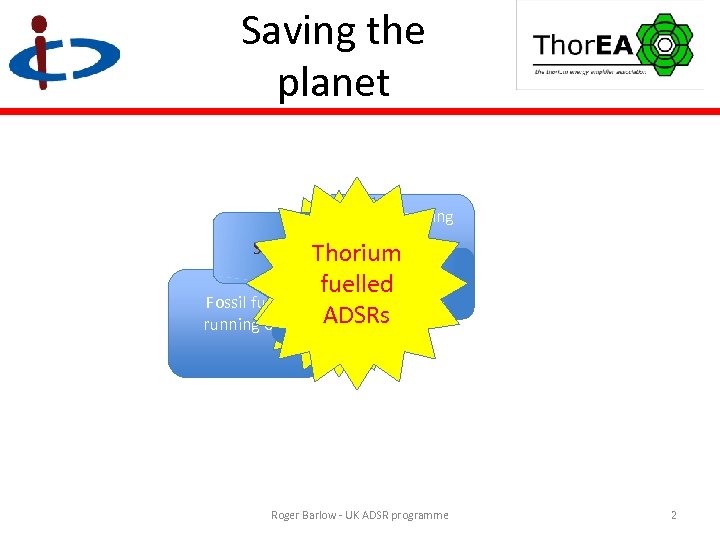
Saving the planet Global warming due to CO 2 Safety Thorium emissions Nuclear Waste fuelled Fossil fuels P Power roli. ADSRs feratio running out n Roger Barlow - UK ADSR programme 2
ADSRs 101 • Uses Thorium (abundant, widespread) • Spallation Neutrons: 232 Th 233 Pa 233 U fission • Accelerator consumes 5 -10% of power • Does not generate Actinides • Consumes Actinides and nastiest fission products (I, Tc) from conventional reactors • Very proliferation resistant Roger Barlow - UK ADSR programme 3
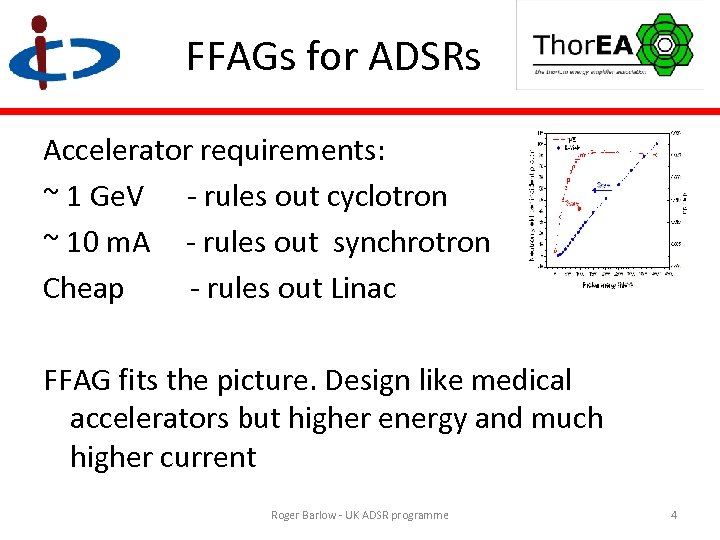
FFAGs for ADSRs Accelerator requirements: ~ 1 Ge. V - rules out cyclotron ~ 10 m. A - rules out synchrotron Cheap - rules out Linac FFAG fits the picture. Design like medical accelerators but higher energy and much higher current Roger Barlow - UK ADSR programme 4
Various models (a) ADSR as standard 1 -2 GW power station for advanced energy-consuming society (US, UK…) (b) ADSR as ~500 MW power station suitable for developing country (c) ADSR run on same site as cluster of conventional reactors to consume waste products We currently favour (b) as a first step Roger Barlow - UK ADSR programme 5
Thor. EA The Thorium Energy Amplifier Association Members: 78 (loose) or 40 (public) Accelerator Scientists Particle Physicists Nuclear Engineers Economists … Founded 1 year ago Website www. thorea. org 3 -4 workshops/year Co-ordinated research bids Outreach and publicity Links with European and US co-enthusiasts What follows are highlights from recent workshops, plus some thoughts of my own Roger Barlow - UK ADSR programme From: Cockcroft JAI Imperial, Glasgow, Cambridge, Brunel, Huddersfield Industry Non-UK 6
Imperial College CONSORT Research Reactor (Recent talk by Dave Wark) Dave knows someone who has a spare reactor we might use… 100 k. W, pool-type enriched U/Al fuel, light water moderated Already licensed Roger Barlow - UK ADSR programme 7
Basic Idea – Modify CONSORT into ADSR. • Build/buy small proton accelerator (few - 10 k. W total power) for reactor facility. • Insert small spallation target either in place of one fuel assembly or above the core. • Leave control rods in place to scram reactor and make it sub-critical. • Use sample insertion locations/devices (or add more) to place other fuel in/near core. • Probably increase instrumentation of the reactor to measure neutron profiles, etc. Roger Barlow - UK ADSR programme 8
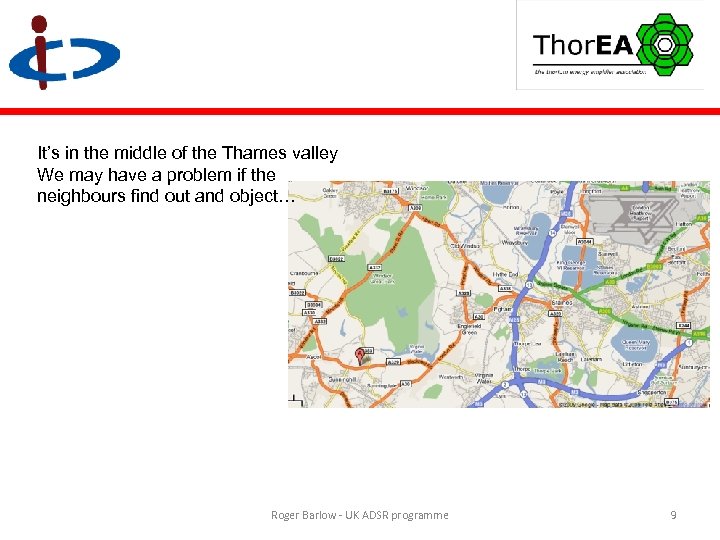
It’s in the middle of the Thames valley We may have a problem if the neighbours find out and object… Roger Barlow - UK ADSR programme 9
CONSORT/ADSR – Experiments to be done. Breeding 233 U fuel from 232 Th in an ADSR. Burning Pu in an ADSR. Burning MA in an ADSR. Burning LLFP in an ADSR. Effects of all of this on the reactivity, neutron profile, and other parameters of the reactor – reactivity feedback in an ADSR has not been measured up to now. • Measure all of this as a function of k by changing control rod positions. • Use all this to benchmark simulations. Thought of before but not actually done (TRADE/TRIGA) • • • Roger Barlow - UK ADSR programme 10
Thorium Fuel Rods Taken from a talk by: Bob Cywinski School of Applied Sciences University of Huddersfield
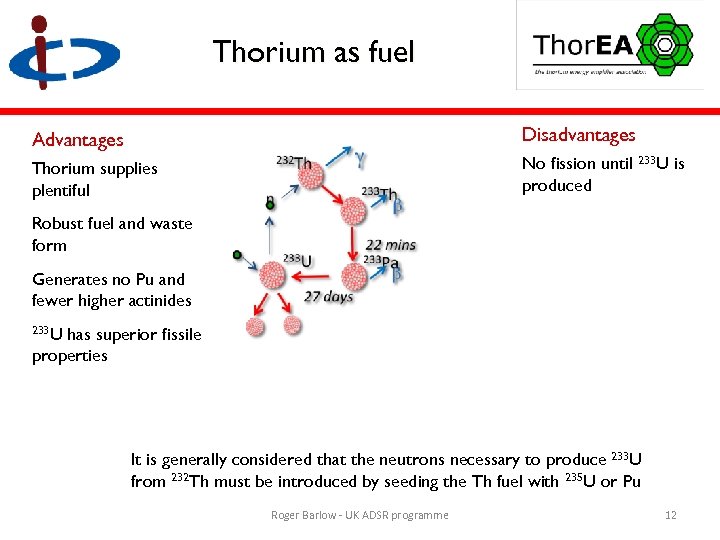
Thorium as fuel Advantages Disadvantages Thorium supplies plentiful No fission until 233 U is produced Robust fuel and waste form Generates no Pu and fewer higher actinides 233 U has superior fissile properties It is generally considered that the neutrons necessary to produce 233 U from 232 Th must be introduced by seeding the Th fuel with 235 U or Pu Roger Barlow - UK ADSR programme 12
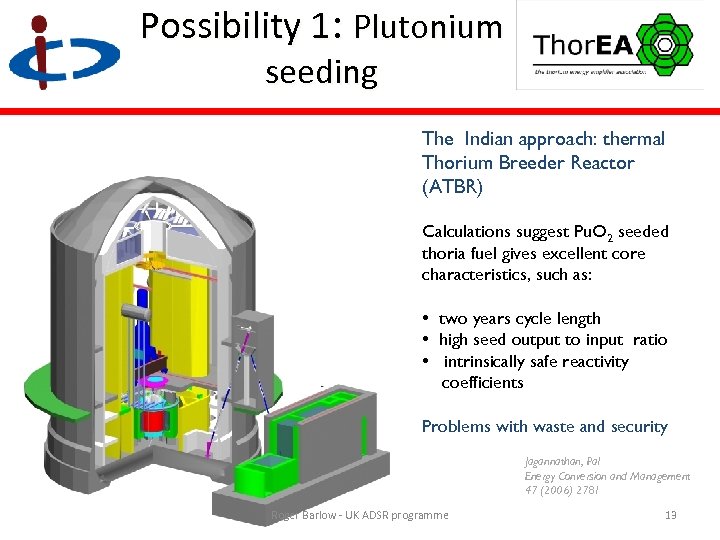
Possibility 1: Plutonium seeding The Indian approach: thermal Thorium Breeder Reactor (ATBR) Calculations suggest Pu. O 2 seeded thoria fuel gives excellent core characteristics, such as: • two years cycle length • high seed output to input ratio • intrinsically safe reactivity coefficients Problems with waste and security Jagannathan, Pal Energy Conversion and Management 47 (2006) 2781 Roger Barlow - UK ADSR programme 13
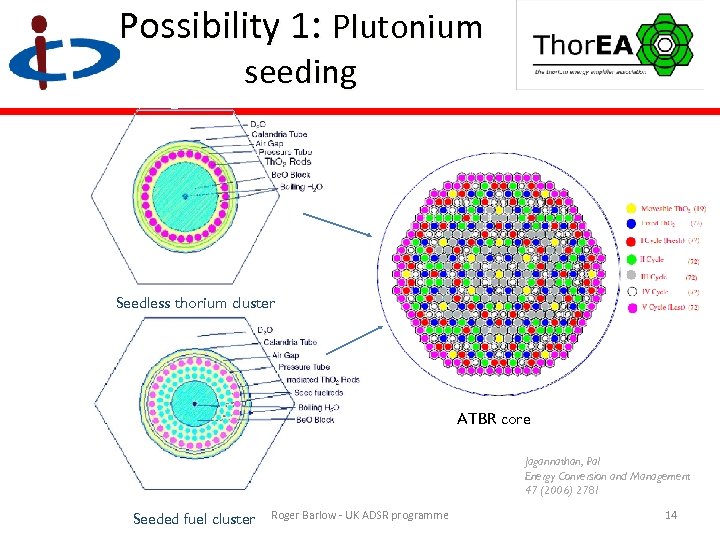
Possibility 1: Plutonium seeding Seedless thorium cluster ATBR core Jagannathan, Pal Energy Conversion and Management 47 (2006) 2781 Seeded fuel cluster Roger Barlow - UK ADSR programme 14
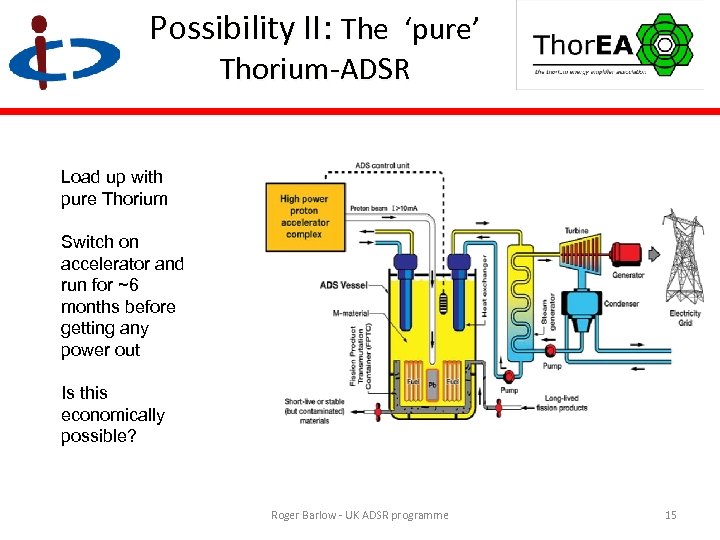
Possibility II: The ‘pure’ Thorium-ADSR Load up with pure Thorium Switch on accelerator and run for ~6 months before getting any power out Is this economically possible? Roger Barlow - UK ADSR programme 15
Possibility III: Transitional technology Production of ready-engineered Th fuel rods for direct deployment in conventional nuclear reactors, with fertile to fissile conversion achieved through dedicated spallation charging from an accelerator+target Why? 232 Th to 233 U conversion can be better optimised, with mitigation against detrimental neutron absorption by 233 Th and 233 Pa Modifications to existing reactors are not necessary Wider global exploitation of nuclear technology is possible Fuel preparation and burn cycles are decoupled Roger Barlow - UK ADSR programme 16
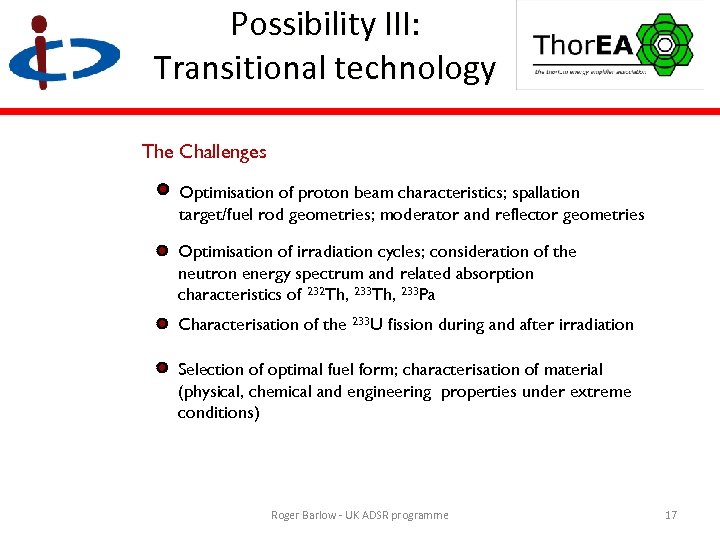
Possibility III: Transitional technology The Challenges Optimisation of proton beam characteristics; spallation target/fuel rod geometries; moderator and reflector geometries Optimisation of irradiation cycles; consideration of the neutron energy spectrum and related absorption characteristics of 232 Th, 233 Pa Characterisation of the 233 U fission during and after irradiation Selection of optimal fuel form; characterisation of material (physical, chemical and engineering properties under extreme conditions) Roger Barlow - UK ADSR programme 17
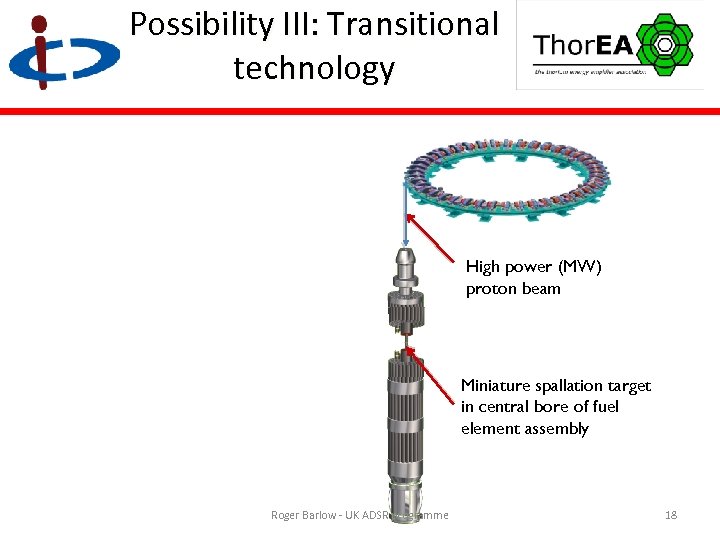
Possibility III: Transitional technology High power (MW) proton beam Miniature spallation target in central bore of fuel element assembly Roger Barlow - UK ADSR programme 18
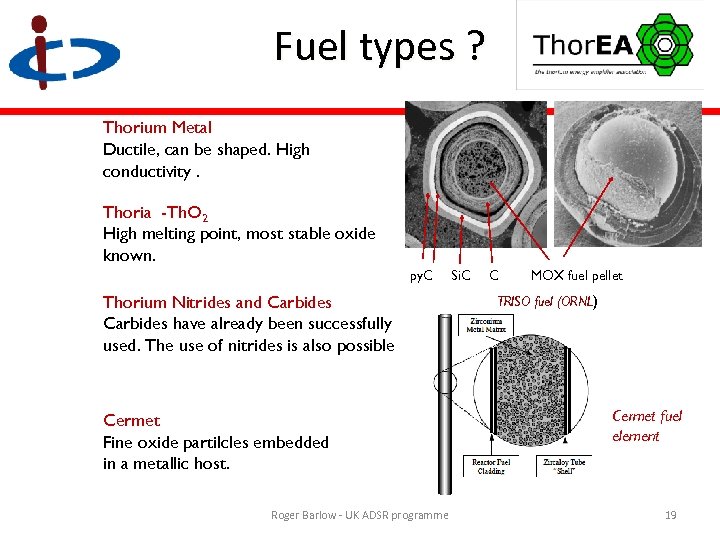
Fuel types ? Thorium Metal Ductile, can be shaped. High conductivity. Thoria -Th. O 2 High melting point, most stable oxide known. py. C Thorium Nitrides and Carbides have already been successfully used. The use of nitrides is also possible Cermet Fine oxide partilcles embedded in a metallic host. Roger Barlow - UK ADSR programme Si. C C MOX fuel pellet TRISO fuel (ORNL) Cermet fuel element 19
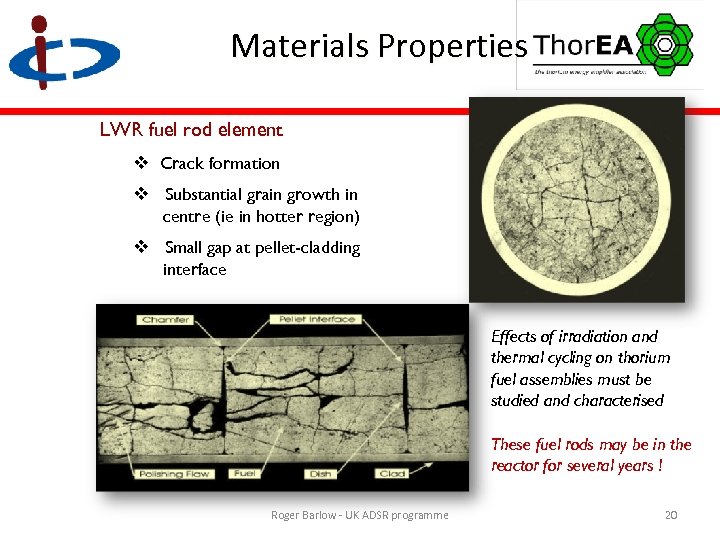
Materials Properties LWR fuel rod element v Crack formation v Substantial grain growth in centre (ie in hotter region) v Small gap at pellet-cladding interface Effects of irradiation and thermal cycling on thorium fuel assemblies must be studied and characterised These fuel rods may be in the reactor for several years ! Roger Barlow - UK ADSR programme 20
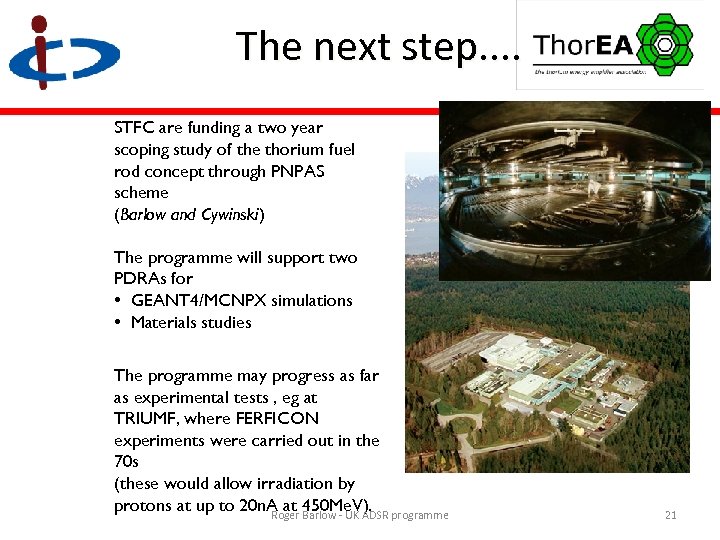
The next step. . STFC are funding a two year scoping study of the thorium fuel rod concept through PNPAS scheme (Barlow and Cywinski) The programme will support two PDRAs for • GEANT 4/MCNPX simulations • Materials studies The programme may progress as far as experimental tests , eg at TRIUMF, where FERFICON experiments were carried out in the 70 s (these would allow irradiation by protons at up to 20 n. A at 450 Me. V). programme Roger Barlow - UK ADSR 21
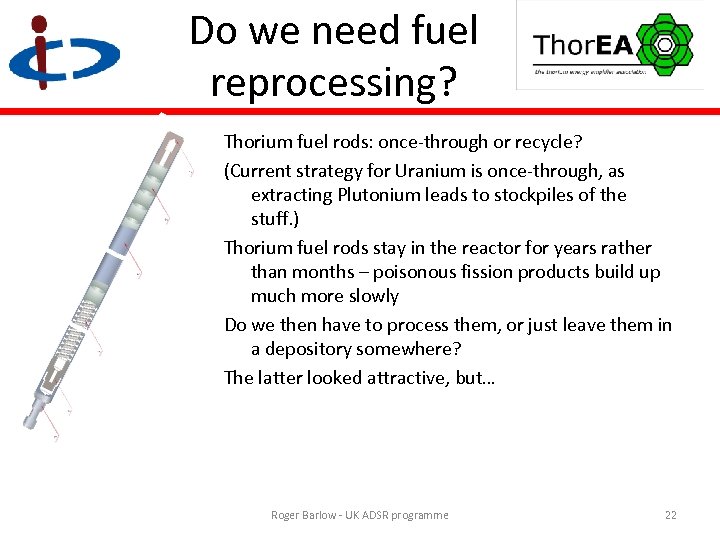
Do we need fuel reprocessing? Thorium fuel rods: once-through or recycle? (Current strategy for Uranium is once-through, as extracting Plutonium leads to stockpiles of the stuff. ) Thorium fuel rods stay in the reactor for years rather than months – poisonous fission products build up much more slowly Do we then have to process them, or just leave them in a depository somewhere? The latter looked attractive, but… Roger Barlow - UK ADSR programme 22
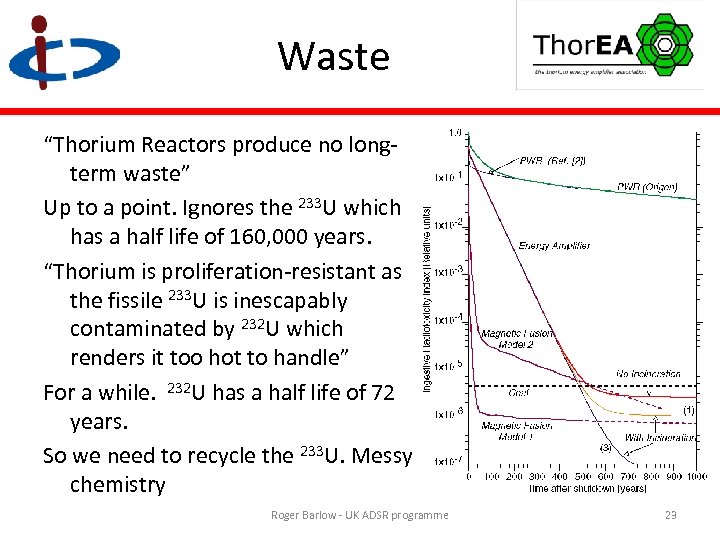
Waste “Thorium Reactors produce no longterm waste” Up to a point. Ignores the 233 U which has a half life of 160, 000 years. “Thorium is proliferation-resistant as the fissile 233 U is inescapably contaminated by 232 U which renders it too hot to handle” For a while. 232 U has a half life of 72 years. So we need to recycle the 233 U. Messy chemistry Roger Barlow - UK ADSR programme 23
Reliability “If the beam stops, the reactor stops” - safety mantra If the accelerator drops out, the reactor stops 1) Stress, thermal shock, target breakdown… 2) You are now losing money VERY fast (electricity spot market) Suggestion that at most ~5 trips (of >1 second) / year are permissible Long way beyond today’s accelerator systems: (Analysis by R Seviour of data from SINQ and others) Roger Barlow - UK ADSR programme 24
Achieving Reliability Many sophisticated machines are reliable Achieving reliability is a science (FMEA*): • Parallelism (even >1 accelerator) Cost money • Under-rating Need full knowledge of • Graceful failure whole system • Scheduled preventive maintenance Build in from • Sticking to the original spec start of design Roger Barlow - UK ADSR programme *Failure Mode and Effects Analysis 25
Considerations • DC Magnets are fairly reliable provided they are maintained (e. g. renew coolant pipes) • Ion sources are unreliable but can be duplicated • RF cavities frequently break down. Need not be catastrophic for Linac and FFAG (consider ILC). But rules out harmonic number jump scheme • But first: Define break in provision of service ( 1 sec, 1 min, . . ) - How many breaks can we live with ( 1, 5, . . . per year) - Allowable capital cost (From R Seviour: Thor. EA workshop, Glasgow, 2009) Roger Barlow - UK ADSR programme 26
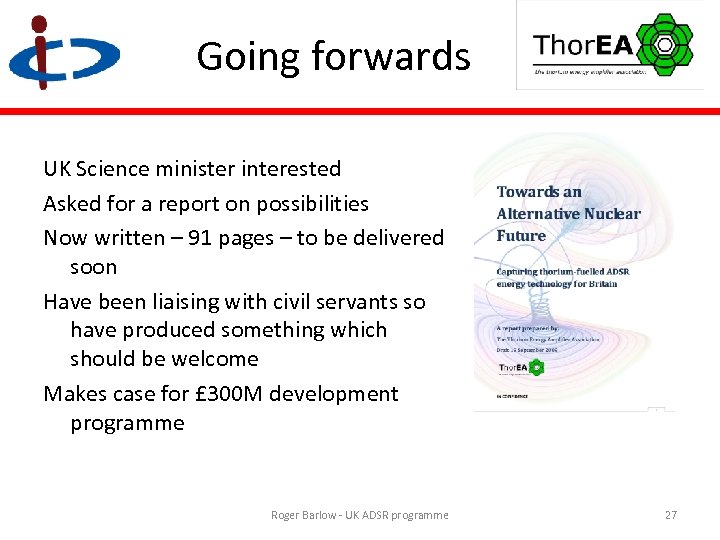
Going forwards UK Science minister interested Asked for a report on possibilities Now written – 91 pages – to be delivered soon Have been liaising with civil servants so have produced something which should be welcome Makes case for £ 300 M development programme Roger Barlow - UK ADSR programme 27
Straw man scheme: AESIR Accelerator Energy System with Inuilt Reliability Design and build a Thorium ADSR, hopefully with an ns. FFAG providing the accelerator (Other accelerator solutions are acceptable. ) Roger Barlow - UK ADSR programme 28
Stage I: LOKI The Low-key demonstrator 35 Me. V H- system High current. (1 m. A? 10 m. A? ) • Commercial source • RF Quadrupole • Standard Linac Study reliability and build it in from the start. Learn from mistakes Looks like the Front End Test Stand? ? Copy? Move? Also measurements of cross sections on Thorium (at CERN? ), simulations, materials studies Roger Barlow - UK ADSR programme 29
Stage 2: FREA FFAG Research for the Energy Amplifier • Add a 2 nd stage ring: boost energy to 390 Me. V • Why 390? Pion production. But ~300 would still be interesting • Produces spallation. Not as much as 1 Ge. V, but enough to be interesting. • Continue to emphasise reliability. Increase Current to 10 m. A • Use a proton ns. FFAG – with a cyclotron as fallback. Or Linac • Gives useful proton machine (c. f. TRIUMF, PSI). 99 m. Tc production? • Links to proton therapy Roger Barlow - UK ADSR programme 30
Stage 3: Thor Add a second ring to give 1 Ge. V ns. FFAG, with RCS and Linac as backup options Use with a real target and nuclear core for production Need private funding ~ £ 1 Bn Roger Barlow - UK ADSR programme 31
Conclusions Things are moving • More people • More ideas • Serious possibility of some sort of funding Roger Barlow - UK ADSR programme 32
Скачать презентацию ADSR systems UK activity Roger Barlow FFAG 09
71a132893504e7bc5a97a8df529143c6.ppt