


 Скачать презентацию ADSHE Conference 21 st June 2012 Unlocking
78d6599f380e47693aa2f50664d8a185.ppt
- Количество слайдов: 23
 ADSHE Conference 21 st June 2012 Unlocking Potential and Confronting Challenges Plagiarism – key issues and debates Sue Onens and Vikki Anderson University of Birmingham
 Plagiarism – key issues and debates Outline of session § Context § Practical exercise § Background to our research § What we did § What we found § The way forward
 Plagiarism – key issues and debates Context § Plagiarism appears to have increased in relation to the availability of online information. § ‘It is reasonable to expect to encounter at least 10% of students’ work that requires attention beyond normal assessment’ (Carroll 2004, p. 2). § International students; students with Sp. LDs. § Use of software such as Turnitin.
 Plagiarism – key issues and debates Practical Exercise Working in pairs, sort the cards under the following headings: Plagiarism Not plagiarism
 Plagiarism – key issues and debates Background to our research § Drawn to attention of Learning Support Team by students with Sp. LDs asking for support when suspected of plagiarism. § ‘Changing goal posts’. § Revised Code of Practice. § Project bid.
 Plagiarism – key issues and debates Dyslexic students - what we did § Current policy and procedure § Overview of Turnitin § Definition of plagiarism § Exercises pertaining to good academic practice § Useful resources
 Plagiarism – key issues and debates Our study § Original project bid § Modified project Main aims § To explore Plagiarism Officers’ views on how students gain an understanding of plagiarism and how to avoid it, § To explore the perceptions of students regarding their understanding of plagiarism. § To consider the effectiveness of existing approaches, with the aim of identifying areas for development. § To examine the use of text matching software, focusing on when, with whom, how and why it is being used. § To elicit the views of academic staff and students as to how practice could be improved. What we did § Investigated existing resources. § Interviewed 17 Plagiarism Officers. § Sent out electronic questionnaire to students (450 returned).
 Plagiarism – key issues and debates Findings - what POs said Who tends to be suspected of plagiarism? § Students who have not had enough academic experience; those who come through BTEC, Access and other non-traditional routes. § ‘Weaker’ students; students under pressure. § Overseas Masters students. § Students for whom English is not their 1 st language including Erasmus students § Intercalaters (Medics)
 Plagiarism – key issues and debates Findings - what POs said Why do students plagiarise? § Lack of knowledge/understanding. ‘Don’t get it’. § Sloppiness (starts with note-making). § Poor time management. § Approach to group work. § Cultural differences. § Difficulties in personal (or professional) lives. § Think they can get away with it. § Contract cheating accessible to all.
 Plagiarism – key issues and debates Findings - what POs said How are students informed about plagiarism? § Section in programme handbook but majority said hands-on/direct input needed to achieve the best effect. § 1 hour workshop in 1 st Year Week 4. Active participation by students. Talk given at 2 nd + 3 rd Year inductions. Students sign declaration of attending induction on plagiarism – penalty chart on back - Philosophy, Theology and Religion § Lecture in 1 st Year before hand in 1 st assignment. Part of personal tutorial programme. Students encouraged to ask tutors if unsure. VLE video - Psychology. § Contextualized at start of each year. Made relevant to assignments. Yr 1 – wk 4 session on plagiarism + library skills – students encouraged to ask if in doubt. Highlighted when assignments given out, particularly extended writing (Yrs 2+3) - Chemistry.
 Plagiarism – key issues and debates Findings - what POs said How are students informed about plagiarism? § Info on Web – linked to Code of Practice. Skills class attended by all 1 st years - usually week 4. Deal with referencing at same time. Discussed in class with groups of around 20 students. Involves TII – Physics § 1 st Year induction – 1 st 5 weeks -1 day a week focusing on study skills - academic writing, paraphrasing note-taking/making. Research for evidence based learning module - core element is plagiarism. TII report explained. Repeated in 2 nd + 3 rd year inductions. Optional sessions on paraphrasing ; every module has assignment preparation session. Can meet with academic tutor 1: 1 – Social Work
 Plagiarism – key issues and debates Findings - what POs said Concerns § Students may not read handbooks or refer to web sites. § Variation in practice between - and sometimes within - Schools (especially re use of TII). Joint Honours. § Rogue staff, inconsistency, not knowing Code of Practice. § Resource intensive process to educate overseas students to avoid plagiarism. § Input on plagiarism needs to be timely and relevant. § Focus needs to be on developing academic skills.
 Plagiarism – key issues and debates Findings - what POs said Concerns – Turnitin § Concerns about TII being used in different ways with varying amounts of expertise. § Amount of work involved in looking at originality reports. § Using TII formatively could be teaching students how to avoid being caught rather than how to write well. § Need consistent approach to training staff and updating their training in use of TII.
 Plagiarism – key issues and debates Findings - what POs said Comments § “It’s important to have face to face and online conversations, which are part of the ongoing learning conversation. You can’t just do it with an injection at the beginning and a reminder. ” (Education) § “If you have a heavy push, you get fewer cases. ” (Earth Sciences) § “We don’t run Turnitin sessions for staff. We just want them to tell people how to write essays properly. ” (Economics) § “The aim is to learn programming, not to Google! They need to learn how to tackle an empty page. ” (Computer Science) § “Students are generally horrified and upset that they’re on the register………They need direct delivery, contextualised and backed up by other links to information. ” (Chemistry)
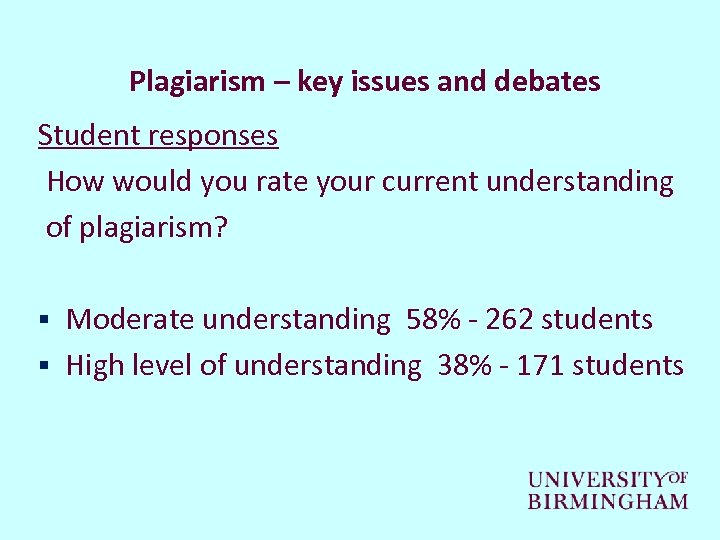 Plagiarism – key issues and debates Student responses How would you rate your current understanding of plagiarism? Moderate understanding 58% - 262 students § High level of understanding 38% - 171 students §
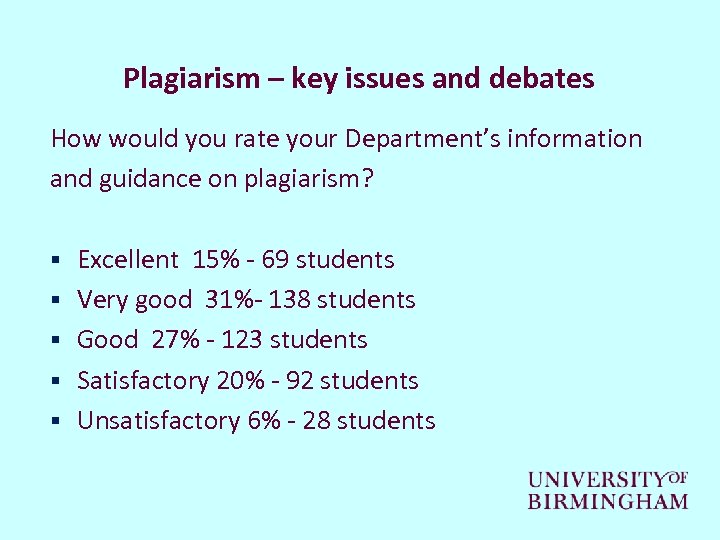 Plagiarism – key issues and debates How would you rate your Department’s information and guidance on plagiarism? § § § Excellent 15% - 69 students Very good 31%- 138 students Good 27% - 123 students Satisfactory 20% - 92 students Unsatisfactory 6% - 28 students
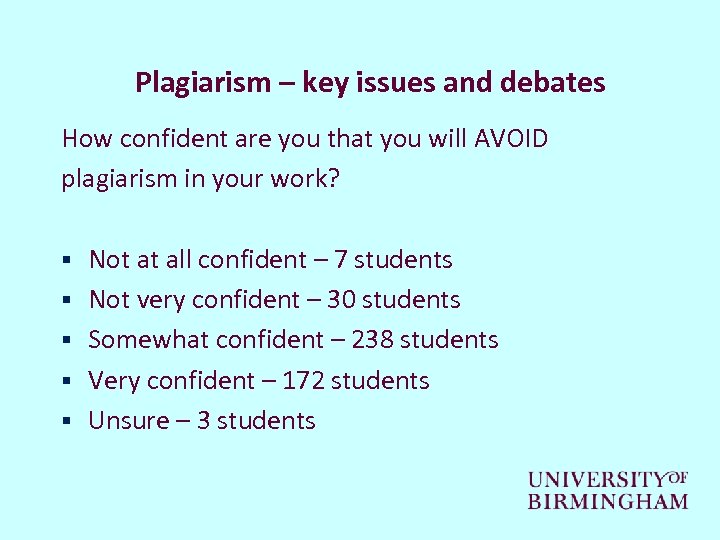 Plagiarism – key issues and debates How confident are you that you will AVOID plagiarism in your work? § § § Not at all confident – 7 students Not very confident – 30 students Somewhat confident – 238 students Very confident – 172 students Unsure – 3 students
 Plagiarism – key issues and debates How could your understanding of plagiarism (and how to avoid it) be improved? § ‘They give you one lecture and expect you to be fine at it…Your 1 st essay can be marked down or failed because of plagiarism when it should really be a practice. ’ § ‘A very detailed outline of how to cite. . we are given a general guide but unusual instances come up and I am actually more inclined not to use that piece of research to avoid penalties. ’ § ‘As a (very) mature student I can’t see what the big issue is…. it is surely very simple. I think clarity about web use, teaching how to take notes from primary literature would be useful. Clear instruction about what is admissible and what isn’t right from the start. ’
 Plagiarism – key issues and debates How could your understanding of plagiarism (and how to avoid it) be improved? § ‘Examples of traps that people fall into – i. e. if we could see actual assignments that have been failed for plagiarism’. § ‘A plagiarism lecture was held in the 1 st yr but more tailored towards final year dissertations would have been useful’. § ‘Further detailed information via emails. ’ § ‘More information on essay writing and paraphrasing. ’ ‘Tell us more on what ‘bad practice’ is. Some lecturers insist on us using several sources of information, yet they say it must be our own work. ’ § Stop the repetitive plagiarism lectures – the material is the same as the 1 st yr and it is patronising. ’ §
 Plagiarism – key issues and debates § ‘I think that in earlier years the initial guidance is inadequate, § ‘I think my understanding is good. However, I worry about blind use of software because at the end of the day there are only a certain number of ways you can say certain things. ’ § ‘I was not aware of the concept of ‘self plagiarism’ and do not really understand it. ’ especially as those coming to university from state education have never encountered the Harvard system of referencing. I only now feel my understanding of plagiarism and how to avoid it is high as I am in my 3 rd yr and have had time to develop my knowledge. ’ ‘I think there should be more face to face teaching on the topic, even to post grads. Things are changing all the time and it pays to be reminded. ’ § ‘Wasn’t aware that using a large number of quotes was poor academic practice and would be treated as plagiarism. ’ §
 Plagiarism – key issues and debates Critical issues § Poor academic practice? § Same for all students? § Role of specialist tutors? § Use of text matching software.
 Plagiarism – key issues and debates Discussion (flipchart) § What are the issues in your institution/experience? § Communication and consistency? § Solutions? § Key points for students and staff.
 Plagiarism – key issues and debates Resources § § § § You Tube video – ref works http: //www. youtube. com/proquestrefworks Useful example - University of Leeds http: //www. ldu. leeds. ac. uk/plagiarism/ Interactive tutorial – subject specific – University of Leicester - http: //www 2. le. ac. uk/offices/careers/ld/resources/study/plagiarismtutorial Learn Higher – useful information for staff and students http: //learnhigher. ac. uk/Staff/Referencing. html Links to tip sheets/resources Plagiarism. org - http: //www. plagiarism. org/plag_resources. html http: //www. plagiarismadvice. org/ advice for organisations/current research Plagiarismadvice. org This service provides resources, training, advice and guidance on plagiarism prevention and detection to institutions and academics. Plagiarism Quiz – University of East Anglia - http: //www. uea. ac. uk/menu/admin/dos/quiz/ Interactive resource with section on plagiarism http: //www. skills 4 studycampus. com/orglogin. aspx