


 Скачать презентацию Adoption of RDA-DFT Terminology and Data Model to
1f54109a58c1a876dd71ade6f2b4c2e5.ppt
- Количество слайдов: 20
 Adoption of RDA-DFT Terminology and Data Model to the Description and Structuring of Atmospheric Data Aaron Addison, Rudolf Husar, Cynthia Hudson-Vitale
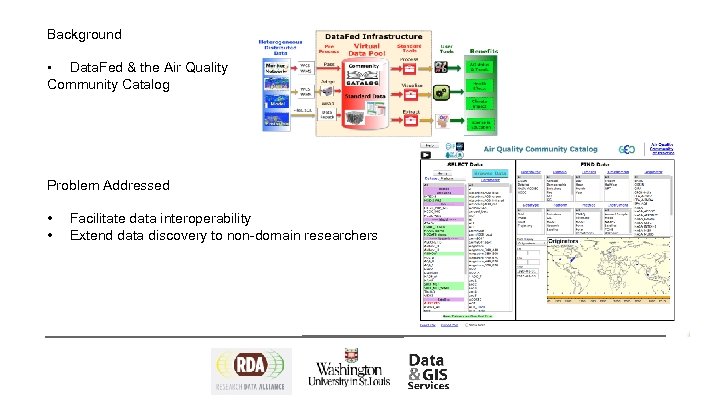 Background • Data. Fed & the Air Quality Community Catalog Problem Addressed • • Facilitate data interoperability Extend data discovery to non-domain researchers
 RDA Data Foundation and Terminology (DFT) Data Foundation & Terminology WG
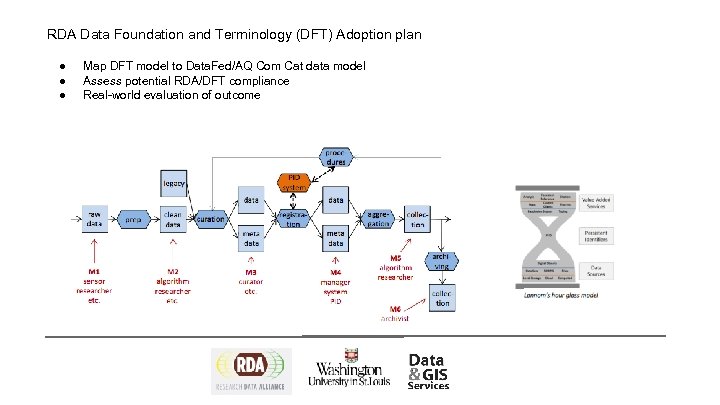 RDA Data Foundation and Terminology (DFT) Adoption plan ● ● ● Map DFT model to Data. Fed/AQ Com Cat data model Assess potential RDA/DFT compliance Real-world evaluation of outcome
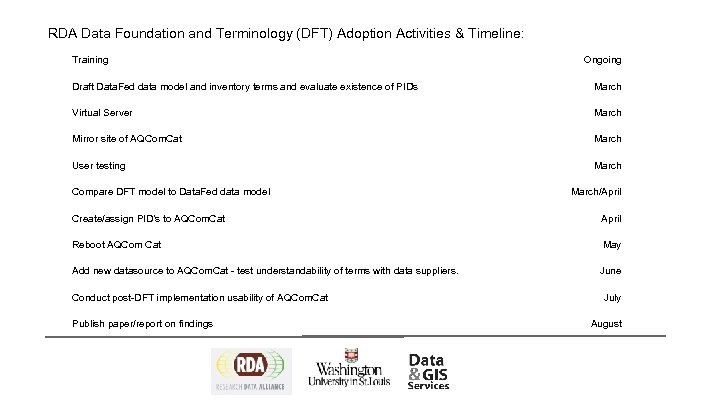 RDA Data Foundation and Terminology (DFT) Adoption Activities & Timeline: Training Ongoing Draft Data. Fed data model and inventory terms and evaluate existence of PID’s March Virtual Server March Mirror site of AQCom. Cat March User testing March Compare DFT model to Data. Fed data model March/April Create/assign PID’s to AQCom. Cat April Reboot AQCom Cat May Add new datasource to AQCom. Cat - test understandability of terms with data suppliers. June Conduct post-DFT implementation usability of AQCom. Cat Publish paper/report on findings July August
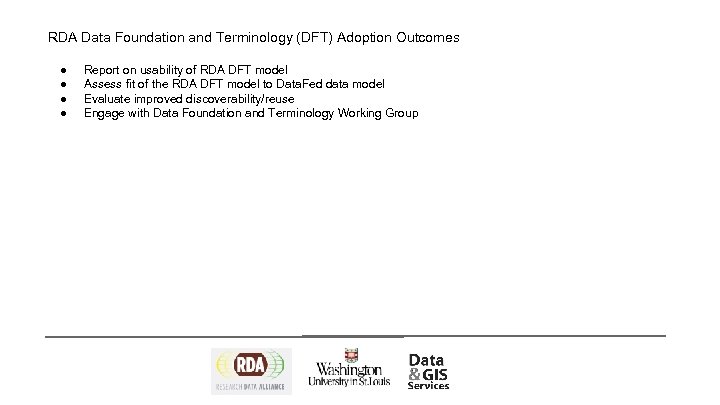 RDA Data Foundation and Terminology (DFT) Adoption Outcomes ● ● Report on usability of RDA DFT model Assess fit of the RDA DFT model to Data. Fed data model Evaluate improved discoverability/reuse Engage with Data Foundation and Terminology Working Group
 Thank you!
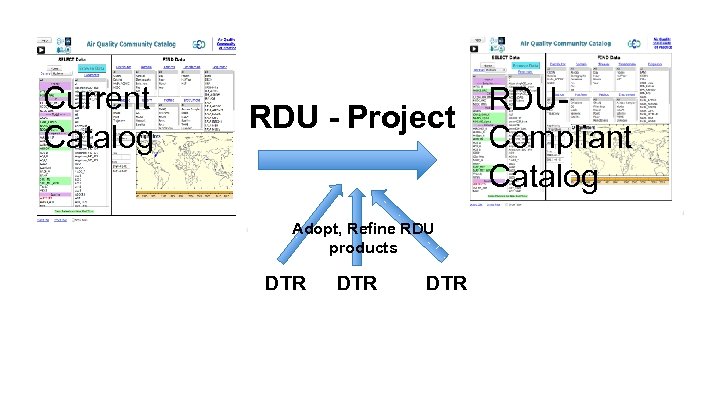 Current Catalog RDU - Project Adopt, Refine RDU products DTR DTR RDUCompliant Catalog
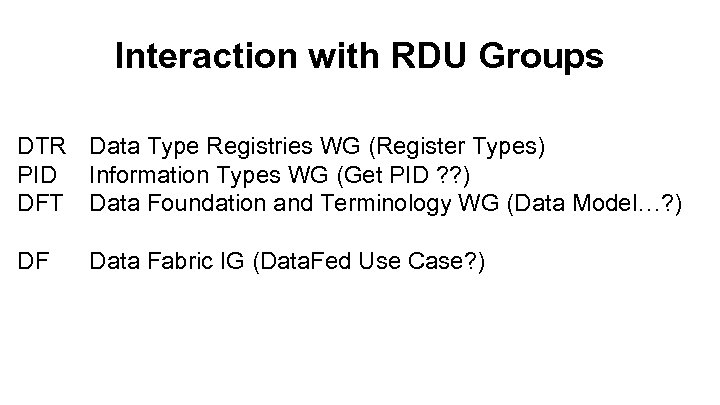 Interaction with RDU Groups DTR Data Type Registries WG (Register Types) PID Information Types WG (Get PID ? ? ) DFT Data Foundation and Terminology WG (Data Model…? ) DF Data Fabric IG (Data. Fed Use Case? )
 Data Type Registry for Sharing and Reuse We will use the RDA Type registry (L. Lannom) Registry needs to be federated… e. g. with GCMD registry
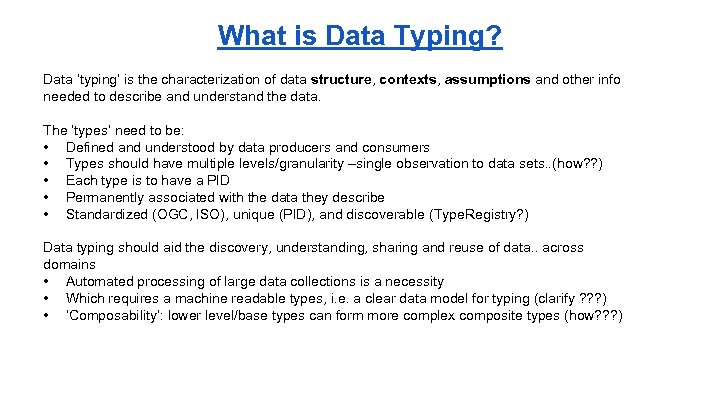 What is Data Typing? Data ‘typing’ is the characterization of data structure, contexts, assumptions and other info needed to describe and understand the data. The ‘types’ need to be: • Defined and understood by data producers and consumers • Types should have multiple levels/granularity –single observation to data sets. . (how? ? ) • Each type is to have a PID • Permanently associated with the data they describe • Standardized (OGC, ISO), unique (PID), and discoverable (Type. Registry? ) Data typing should aid the discovery, understanding, sharing and reuse of data. . across domains • Automated processing of large data collections is a necessity • Which requires a machine readable types, i. e. a clear data model for typing (clarify ? ? ? ) • ‘Composability’: lower level/base types can form more complex composite types (how? ? ? )
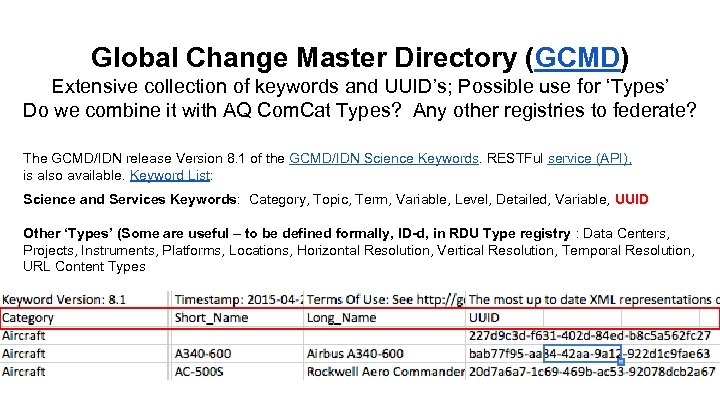 Global Change Master Directory (GCMD) Extensive collection of keywords and UUID’s; Possible use for ‘Types’ Do we combine it with AQ Com. Cat Types? Any other registries to federate? The GCMD/IDN release Version 8. 1 of the GCMD/IDN Science Keywords. RESTFul service (API), is also available. Keyword List: Science and Services Keywords: Category, Topic, Term, Variable, Level, Detailed, Variable, UUID Other ‘Types’ (Some are useful – to be defined formally, ID-d, in RDU Type registry : Data Centers, Projects, Instruments, Platforms, Locations, Horizontal Resolution, Vertical Resolution, Temporal Resolution, URL Content Types
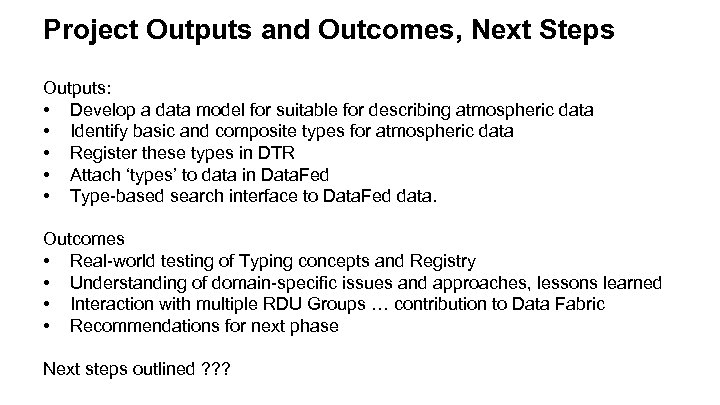 Project Outputs and Outcomes, Next Steps Outputs: • Develop a data model for suitable for describing atmospheric data • Identify basic and composite types for atmospheric data • Register these types in DTR • Attach ‘types’ to data in Data. Fed • Type-based search interface to Data. Fed data. Outcomes • Real-world testing of Typing concepts and Registry • Understanding of domain-specific issues and approaches, lessons learned • Interaction with multiple RDU Groups … contribution to Data Fabric • Recommendations for next phase Next steps outlined ? ? ?
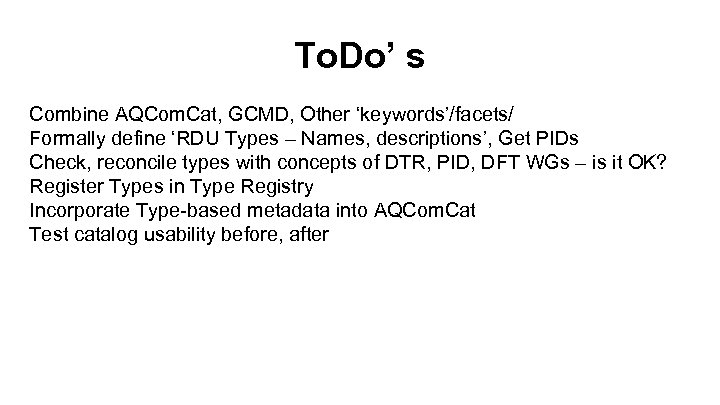 To. Do’ s Combine AQCom. Cat, GCMD, Other ‘keywords’/facets/ Formally define ‘RDU Types – Names, descriptions’, Get PIDs Check, reconcile types with concepts of DTR, PID, DFT WGs – is it OK? Register Types in Type Registry Incorporate Type-based metadata into AQCom. Cat Test catalog usability before, after
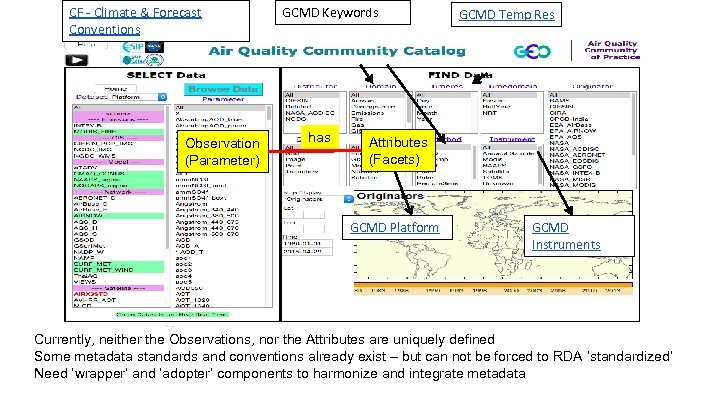 CF - Climate & Forecast Conventions Observation (Parameter) GCMD Keywords has GCMD Temp Res Attributes (Facets) GCMD Platform GCMD Instruments Currently, neither the Observations, nor the Attributes are uniquely defined Some metadata standards and conventions already exist – but can not be forced to RDA ‘standardized’ Need ‘wrapper’ and ‘adopter’ components to harmonize and integrate metadata
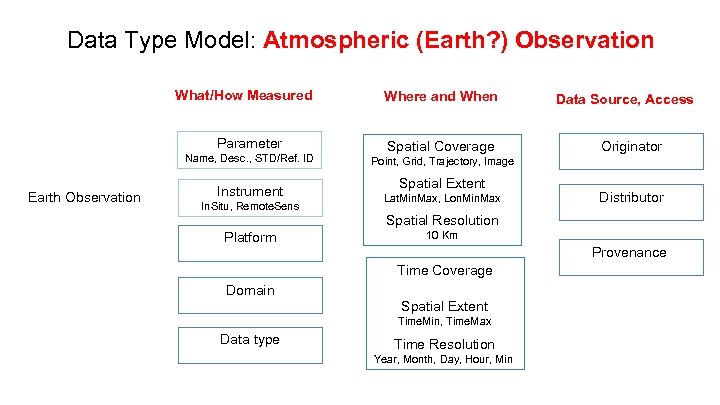 Data Type Model: Atmospheric (Earth? ) Observation What/How Measured Parameter Name, Desc. , STD/Ref. ID Earth Observation Instrument In. Situ, Remote. Sens Where and When Spatial Coverage Data Source, Access Originator Point, Grid, Trajectory, Image Spatial Extent Lat. Min. Max, Lon. Min. Max Distributor Spatial Resolution Platform 10 Km Provenance Time Coverage Domain Spatial Extent Time. Min, Time. Max Data type Time Resolution Year, Month, Day, Hour, Min
 Data. Fed: Federated Data System Data. Fed
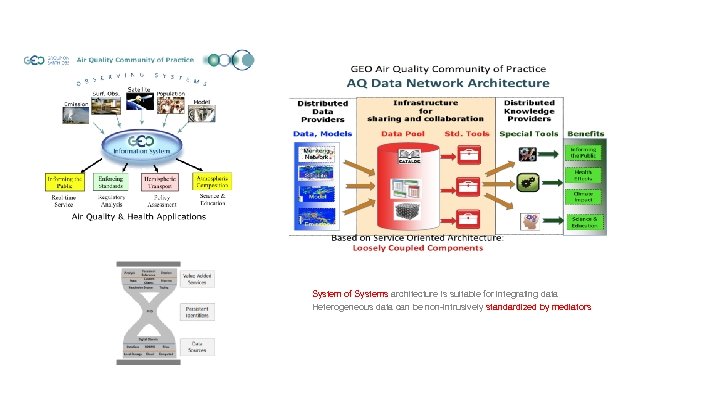 System of Systems architecture is suitable for integrating data Heterogeneous data can be non-intrusively standardized by mediators
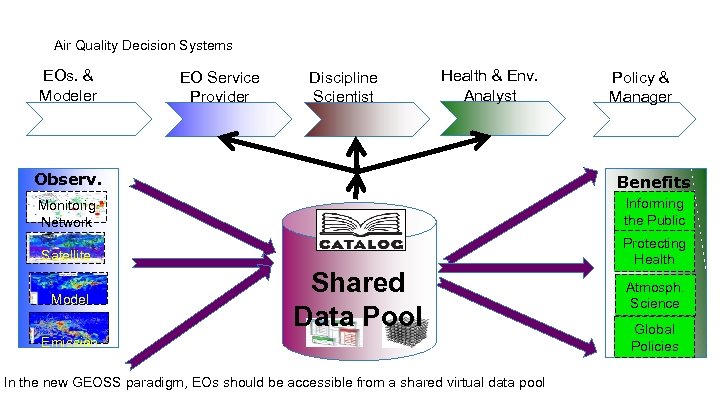 Air Quality Decision Systems EOs. & Modeler EO Service Provider Discipline Scientist Health & Env. Analyst Policy & Manager Observ. Benefits Monitorig Network Informing the Public Satellite Protecting Health Model Shared Data Pool Emission In the new GEOSS paradigm, EOs should be accessible from a shared virtual data pool Atmosph. Science Global Policies
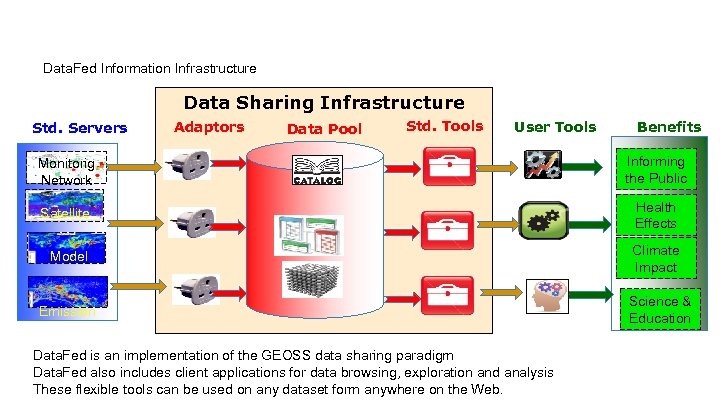 Data. Fed Information Infrastructure Data Sharing Infrastructure Std. Servers Adaptors Data Pool Std. Tools User Tools Benefits Monitorig Network Informing the Public Satellite Health Effects Model Climate Impact Emission Science & Education Data. Fed is an implementation of the GEOSS data sharing paradigm Data. Fed also includes client applications for data browsing, exploration and analysis These flexible tools can be used on any dataset form anywhere on the Web.