 Скачать презентацию Adolescent Wellbeing and Connectedness to School Family Peers
715fbeda182aee9ab348c13bca6b370f.ppt
- Количество слайдов: 19



Adolescent Wellbeing and Connectedness to School, Family, Peers, and Community over Time Paul E. Jose & Jan Pryor Victoria University of Wellington, Roy Mc. Kenzie Centre for the Study of Families SASP Conference Wellington, NZ March 29, 2008
Thank you To the FRST Foundation for their financial support ¡ To the YCP research team: Bill Siddells, Jo Kleeb, Carla Crespo, our Maori Research group, and all of the research staff ¡ To the respondents, their families, their schools, and their principals ¡
Rationale for the study ¡ ¡ Western society has tended to emphasise the “individuation” of its adolescents, i. e. , their development of self and separation from their family of origin. Is healthy development during adolescence simply a case of e separation? We are interested in striking a more balanced note: we believe that this individuation occurs within a matrix of connections: l l Family Peer group School Community
Development over time ¡ ¡ Probably the strength of these connections vary over time (and possibly by age, gender, and ethnicity) We expect that over time, connectedness will go down for: l l ¡ And we would expect that general adjustment would go down as well: l ¡ Family School Wellbeing (a combination of 4 related constructs) And we expect that over time, connectedness will go up for: l l Peers Community -------------------------------¡ What is the association between connectedness and wellbeing over time?
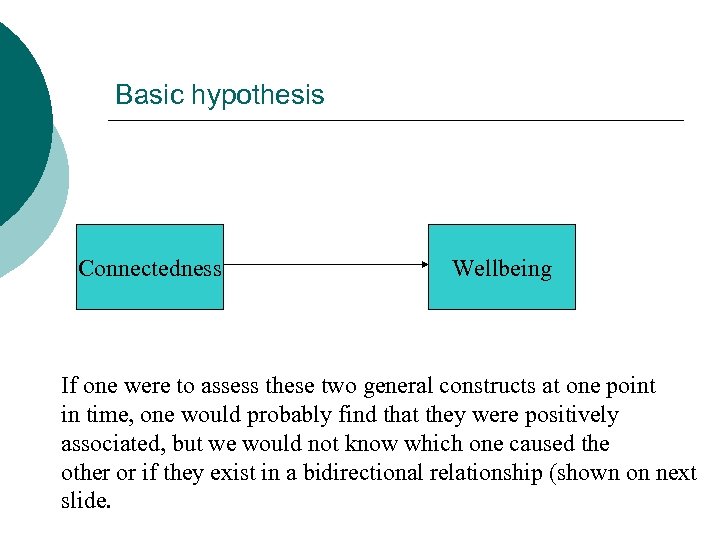
Basic hypothesis Connectedness Wellbeing If one were to assess these two general constructs at one point in time, one would probably find that they were positively associated, but we would not know which one caused the other or if they exist in a bidirectional relationship (shown on next slide.
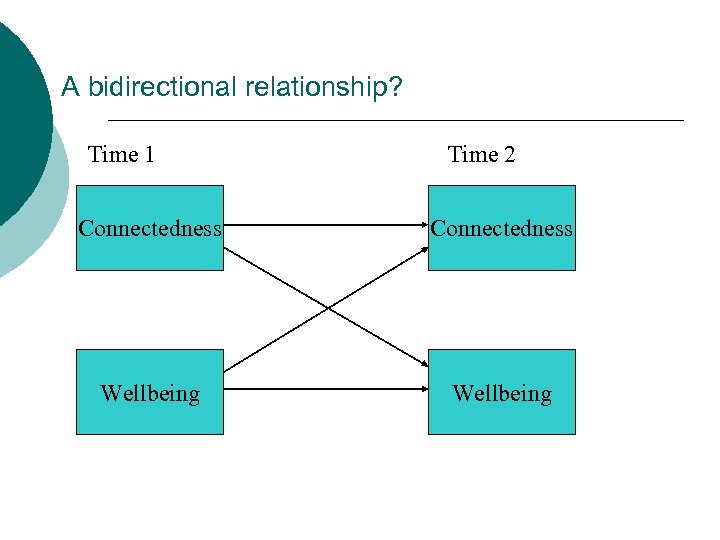
A bidirectional relationship? Time 1 Time 2 Connectedness Wellbeing
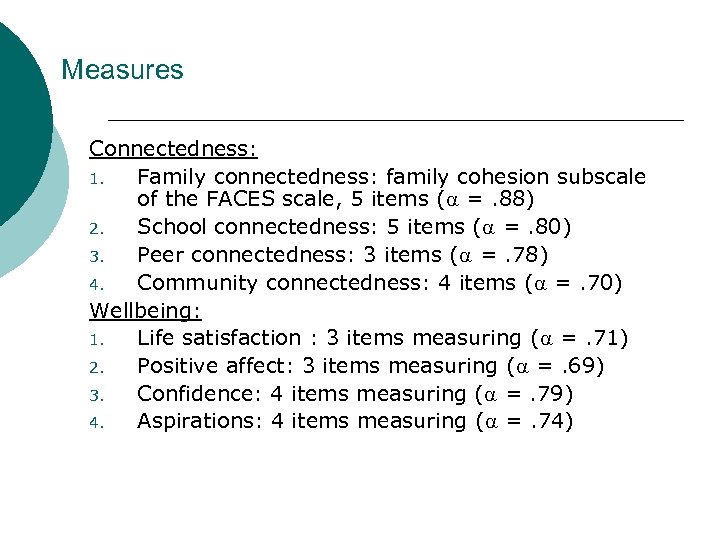
Measures Connectedness: 1. Family connectedness: family cohesion subscale of the FACES scale, 5 items (a =. 88) 2. School connectedness: 5 items (a =. 80) 3. Peer connectedness: 3 items (a =. 78) 4. Community connectedness: 4 items (a =. 70) Wellbeing: 1. Life satisfaction : 3 items measuring (a =. 71) 2. Positive affect: 3 items measuring (a =. 69) 3. Confidence: 4 items measuring (a =. 79) 4. Aspirations: 4 items measuring (a =. 74)
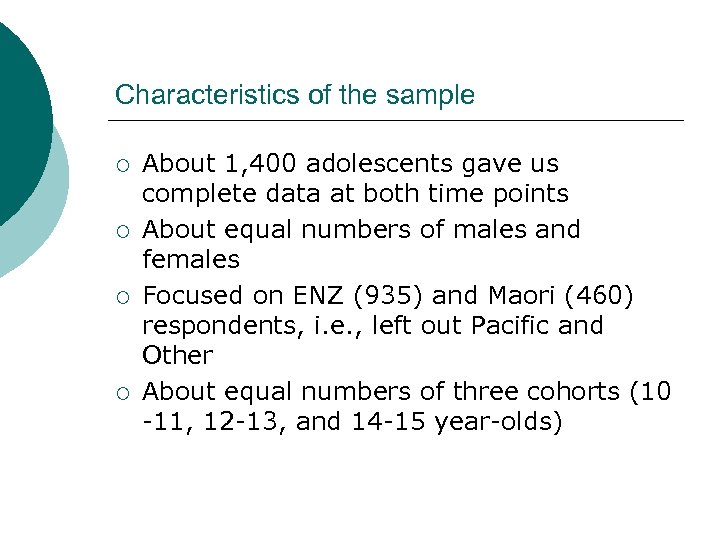
Characteristics of the sample ¡ ¡ About 1, 400 adolescents gave us complete data at both time points About equal numbers of males and females Focused on ENZ (935) and Maori (460) respondents, i. e. , left out Pacific and Other About equal numbers of three cohorts (10 -11, 12 -13, and 14 -15 year-olds)
Procedure Administered a large survey (over 250 questions) via laptop to the adolescents in their schools ¡ Period of time between T 1 and T 2 was about one year (we are collecting T 3 now) ¡ Obtained data from parents and principals as well. Also, an in-depth qualitative study by NZCER. Much more to come. . . ¡
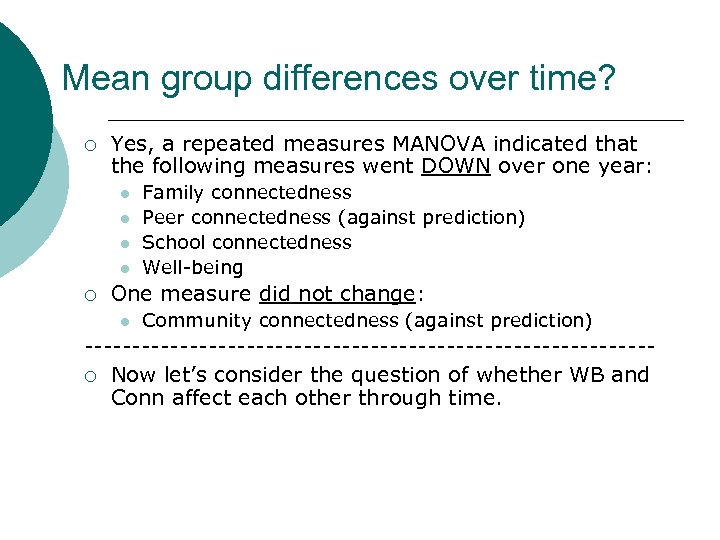
Mean group differences over time? ¡ Yes, a repeated measures MANOVA indicated that the following measures went DOWN over one year: l l ¡ Family connectedness Peer connectedness (against prediction) School connectedness Well-being One measure did not change: l Community connectedness (against prediction) ------------------------------¡ Now let’s consider the question of whether WB and Conn affect each other through time.
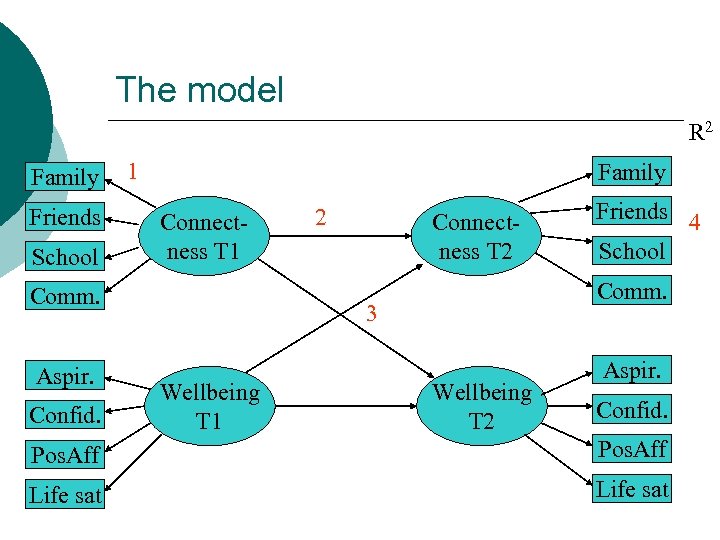
The model R 2 Family Friends School 1 Family Connectness T 1 Comm. Aspir. Confid. 2 Connectness T 2 Comm. 3 Wellbeing T 1 Friends 4 School Wellbeing T 2 Aspir. Confid. Pos. Aff Life sat
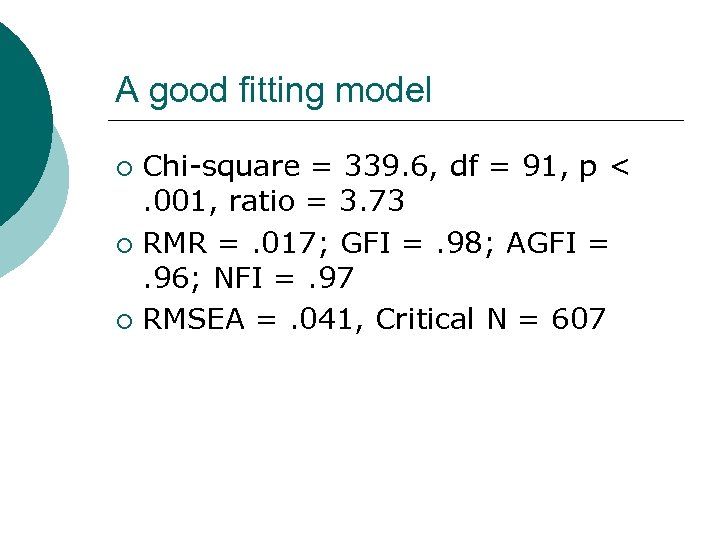
A good fitting model Chi-square = 339. 6, df = 91, p <. 001, ratio = 3. 73 ¡ RMR =. 017; GFI =. 98; AGFI =. 96; NFI =. 97 ¡ RMSEA =. 041, Critical N = 607 ¡
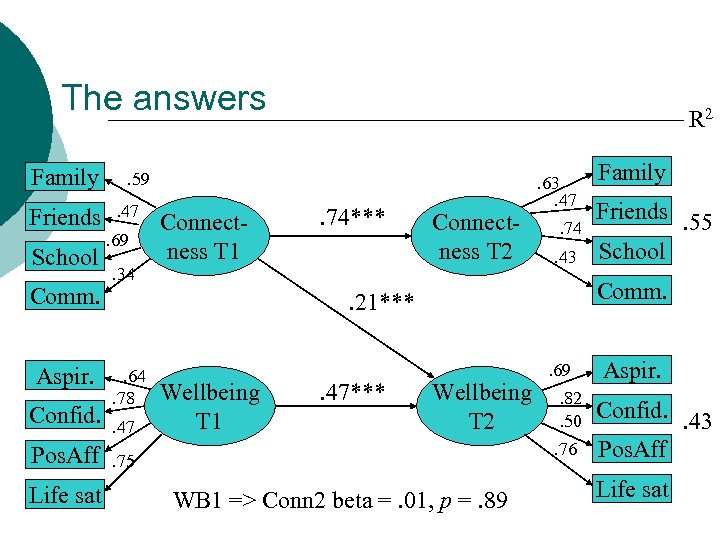
The answers Family Friends School Comm. Aspir. Confid. Pos. Aff Life sat R 2 . 59. 47. 69. 34 Connectness T 1 . 74*** Connectness T 2 . 63. 47. 74. 43 . 47 Wellbeing T 1 . 47*** Friends. 55 School Comm. . 21***. 64. 78 Family Wellbeing T 2 . 69. 82. 50. 76 . 75 WB 1 => Conn 2 beta =. 01, p =. 89 Aspir. Confid. . 43 Pos. Aff Life sat
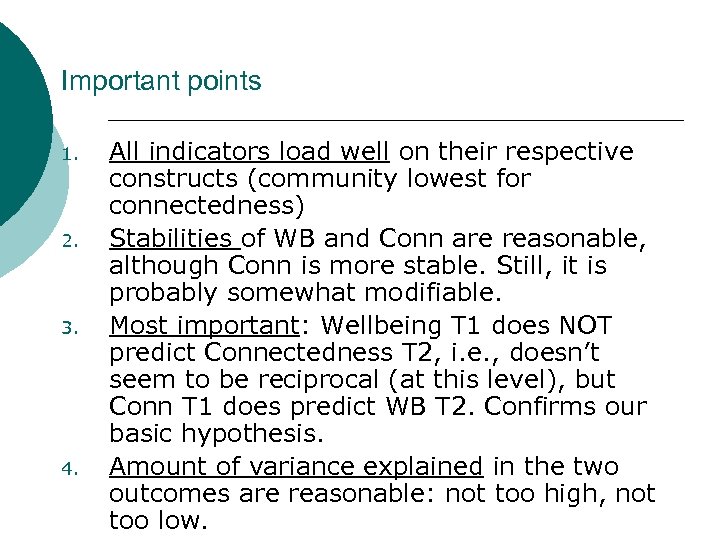
Important points 1. 2. 3. 4. All indicators load well on their respective constructs (community lowest for connectedness) Stabilities of WB and Conn are reasonable, although Conn is more stable. Still, it is probably somewhat modifiable. Most important: Wellbeing T 1 does NOT predict Connectedness T 2, i. e. , doesn’t seem to be reciprocal (at this level), but Conn T 1 does predict WB T 2. Confirms our basic hypothesis. Amount of variance explained in the two outcomes are reasonable: not too high, not too low.
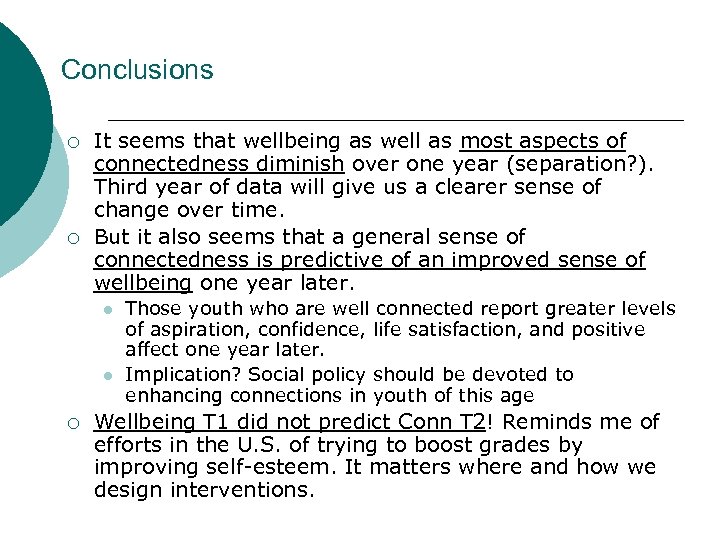
Conclusions ¡ ¡ It seems that wellbeing as well as most aspects of connectedness diminish over one year (separation? ). Third year of data will give us a clearer sense of change over time. But it also seems that a general sense of connectedness is predictive of an improved sense of wellbeing one year later. l l ¡ Those youth who are well connected report greater levels of aspiration, confidence, life satisfaction, and positive affect one year later. Implication? Social policy should be devoted to enhancing connections in youth of this age Wellbeing T 1 did not predict Conn T 2! Reminds me of efforts in the U. S. of trying to boost grades by improving self-esteem. It matters where and how we design interventions.
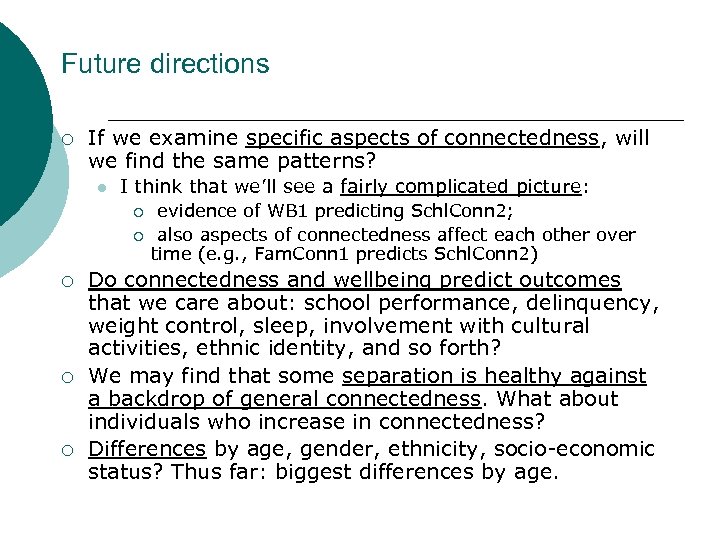
Future directions ¡ If we examine specific aspects of connectedness, will we find the same patterns? l I think that we’ll see a fairly complicated picture: ¡ ¡ ¡ evidence of WB 1 predicting Schl. Conn 2; also aspects of connectedness affect each other over time (e. g. , Fam. Conn 1 predicts Schl. Conn 2) Do connectedness and wellbeing predict outcomes that we care about: school performance, delinquency, weight control, sleep, involvement with cultural activities, ethnic identity, and so forth? We may find that some separation is healthy against a backdrop of general connectedness. What about individuals who increase in connectedness? Differences by age, gender, ethnicity, socio-economic status? Thus far: biggest differences by age.
Thank you for listening Check out our web-site: http: //www. vuw. ac. nz/youthconnec tedness/ ¡ Write to myself: paul. jose@vuw. ac. nz ¡ Or Jan Pryor: jan. pryor@vuw. ac. nz ¡ -----------------------------Does anyone have a few dollars to continue this project?
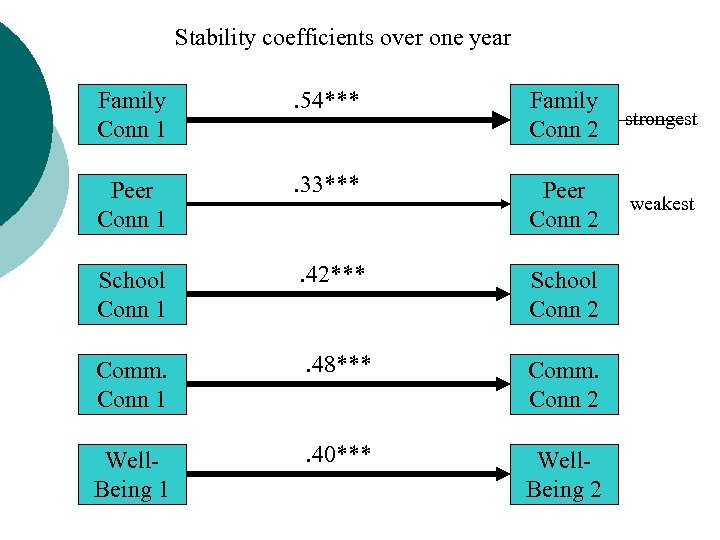
Stability coefficients over one year Family Conn 1 . 54*** Family Conn 2 strongest Peer Conn 1 . 33*** Peer Conn 2 weakest School Conn 1 . 42*** School Conn 2 Comm. Conn 1 . 48*** Comm. Conn 2 Well. Being 1 . 40*** Well. Being 2
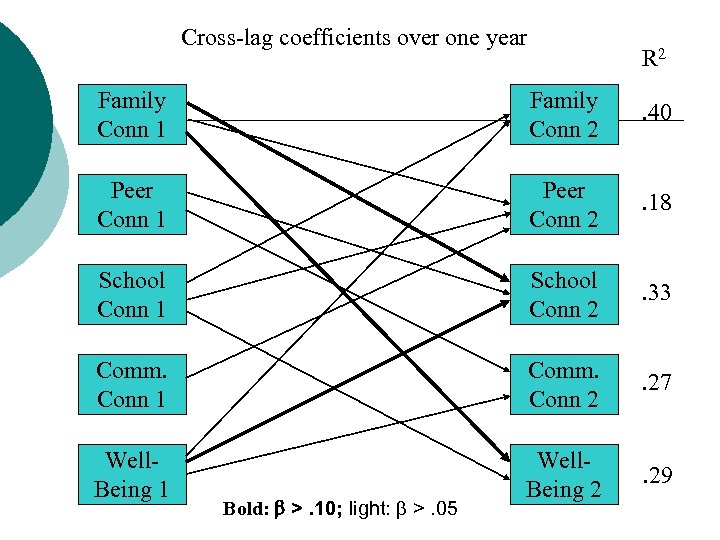
Cross-lag coefficients over one year R 2 Family Conn 1 Family Conn 2 . 40 Peer Conn 1 Peer Conn 2 . 18 School Conn 1 School Conn 2 . 33 Comm. Conn 1 Comm. Conn 2 . 27 Well. Being 1 Well. Being 2 . 29 Bold: b >. 10; light: b >. 05
Скачать презентацию Adolescent Wellbeing and Connectedness to School Family Peers
715fbeda182aee9ab348c13bca6b370f.ppt