 Скачать презентацию Adolescent mental disorders A global perspective Vikram Patel
0300d7bf14c41ad3beb635a257b3a387.ppt
- Количество слайдов: 20



Adolescent mental disorders A global perspective Vikram Patel Wellcome Trust Senior Research Fellow Professor of International Mental Health 1
Plan 2 The burden The challenges The action needed
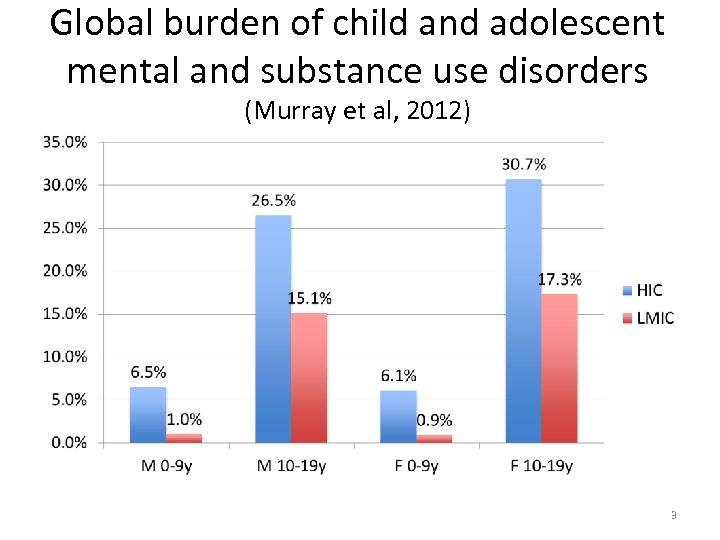
Global burden of child and adolescent mental and substance use disorders (Murray et al, 2012) 3
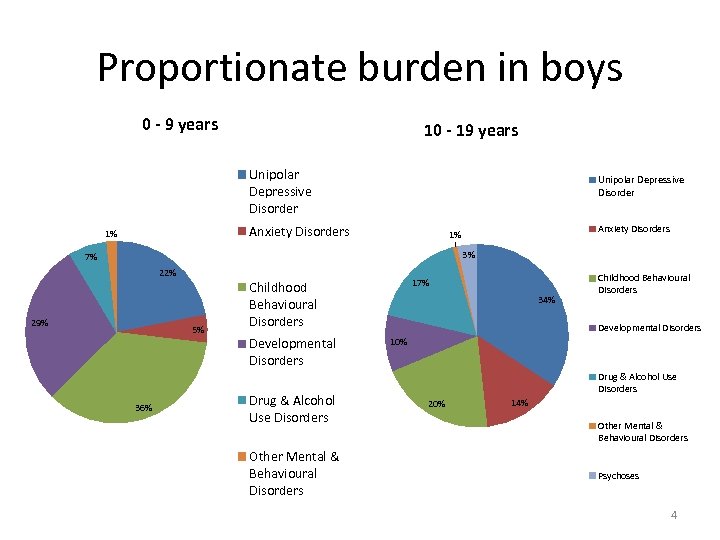
Proportionate burden in boys 0 - 9 years 10 - 19 years Unipolar Depressive Disorder Anxiety Disorders 1% 3% 7% 22% 29% 5% 36% 17% Childhood Behavioural Disorders Developmental Disorders Drug & Alcohol Use Disorders Other Mental & Behavioural Disorders 34% Childhood Behavioural Disorders Developmental Disorders 10% Drug & Alcohol Use Disorders 20% 14% Other Mental & Behavioural Disorders Psychoses 4
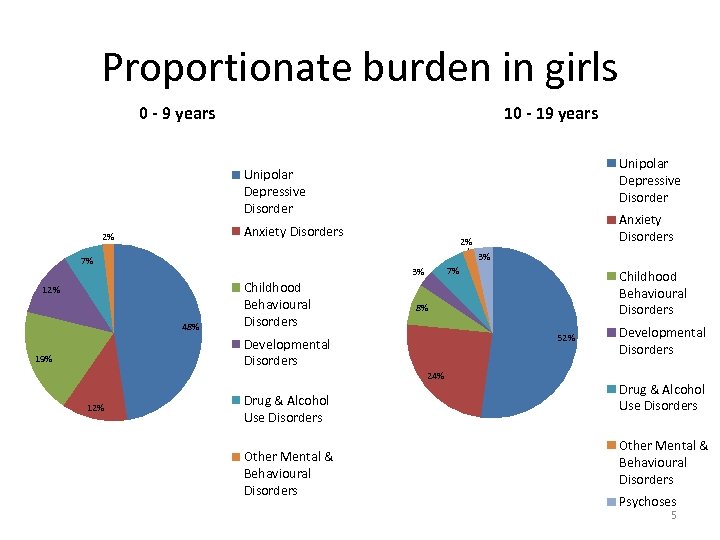
Proportionate burden in girls 0 - 9 years 10 - 19 years Unipolar Depressive Disorder Anxiety Disorders 2% 2% 3% 7% 7% 3% 12% 48% Childhood Behavioural Disorders 52% 24% 12% Drug & Alcohol Use Disorders Other Mental & Behavioural Disorders Childhood Behavioural Disorders 8% Developmental Disorders 19% Anxiety Disorders Developmental Disorders Drug & Alcohol Use Disorders Other Mental & Behavioural Disorders Psychoses 5
Impact • Adverse impacts on educational enrolment and achievements • Stigma, discrimination and human rights abuse • Premature mortality 6
7
Neurodevelopmental understandings Differential maturation of brain regions with delayed maturation of the prefrontal cortex Risk-taking, reward-seeking and impulsive behaviours are normative and evolutionary Interaction with rapidly changing environments for adolescents 8
The challenges 9
Barriers to promoting adolescent mental health • Highly biomedical model which is out of step with these neurodevelopmental understandings • Low levels of help-seeking • Very poor mental health resources: 1 out of 10 of all mental health resources (beds, professionals, dollars) are allocated to countries housing about 9 out of 10 of the global population • WHO study in 13 low, 24 lower-middle, and 5 upper-middle-income countries (Morris et al, J Child Psychol Psychiatr 2011) – Children and adolescents make up 12% of the patient population in mental health outpatient facilities and less than 6% in all other types of mental health facilities. – Less than 1% of beds in inpatient facilities are reserved for children and adolescents. – Training provided for mental health professionals on child and adolescent mental health is minimal 10
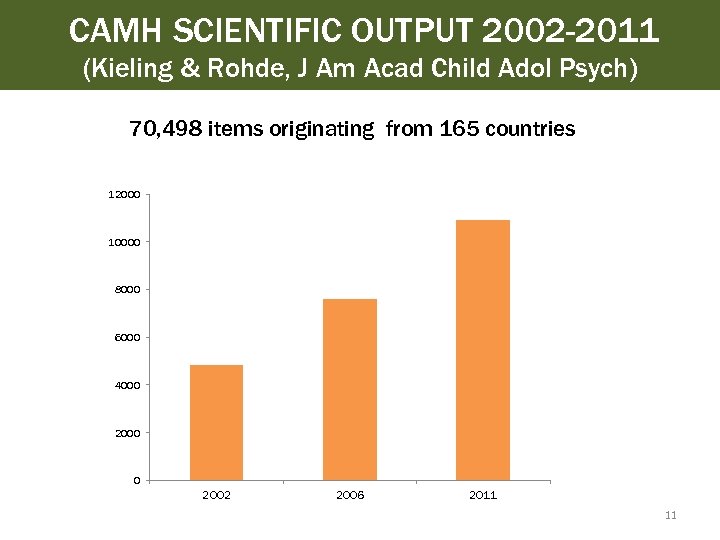
CAMH SCIENTIFIC OUTPUT 2002 -2011 (Kieling & Rohde, J Am Acad Child Adol Psych) 70, 498 items originating from 165 countries 12000 10000 8000 6000 4000 2000 0 2002 2006 2011 11
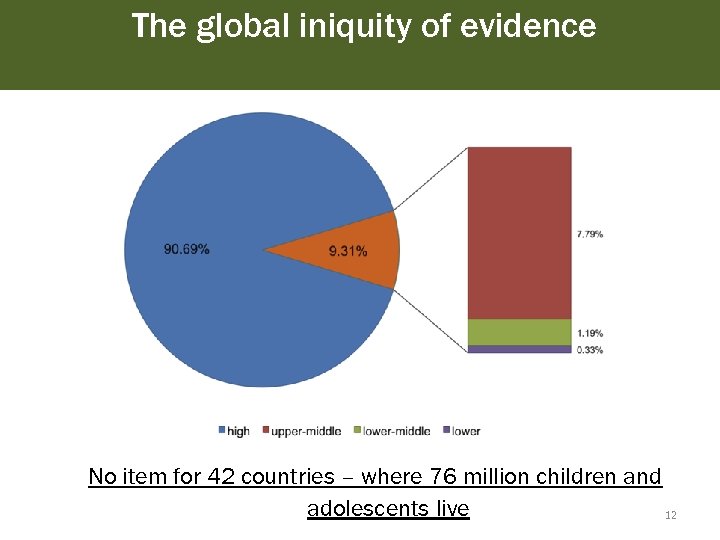
The global iniquity of evidence No item for 42 countries – where 76 million children and adolescents live 12
13 The action needed
Principles • Focus on high burden conditions • Cost-effective interventions for prevention and care which are consistent with neurodevelopmental findings • Integrated with established platforms, e. g. youth friendly services, schools • Delivery by non-specialized workers, including peers, lay counsellors and community health workers 14
Examples of actions • The early detection and management of mental disorders • Preventive strategies to train children and youth to improve cognitive control and manage stress to reduce the propensity for “hot cognition. ” • Limiting access to harmful risk-taking situations and providing opportunities to engage are less harmful, but equally rewarding 15
16
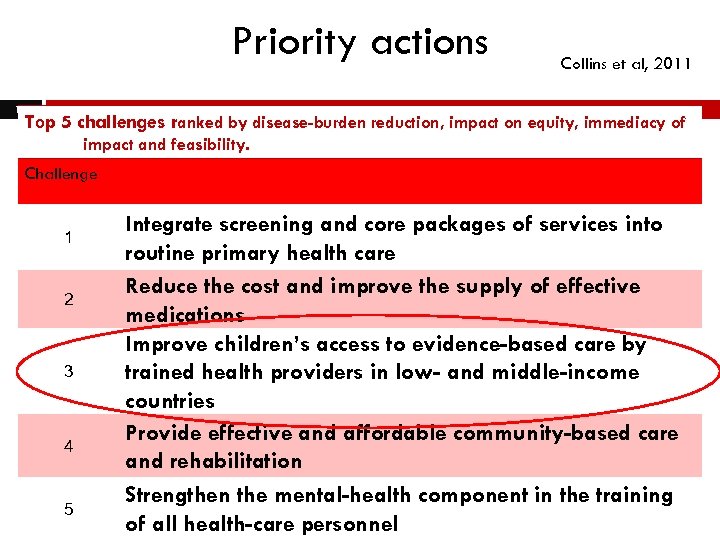
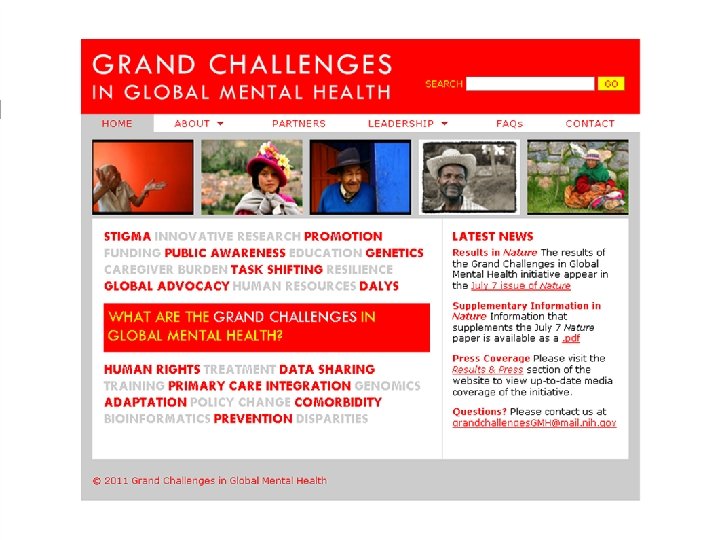
Priority actions Collins et al, 2011 17 Top 5 challenges ranked by disease-burden reduction, impact on equity, immediacy of impact and feasibility. Challenge 1 2 3 4 5 Integrate screening and core packages of services into routine primary health care Reduce the cost and improve the supply of effective medications Improve children’s access to evidence-based care by trained health providers in low- and middle-income countries Provide effective and affordable community-based care and rehabilitation Strengthen the mental-health component in the training of all health-care personnel
The impact 18 New resources: e. g. Grand Challenges Canada (C$50 m in 2012/3 in two programs: Saving Brains and Global Mental Health) Over 50 institutions around the world engaged in research to address the GCGMH in past 24 months
Other research priorities 19 Examining how shared genetic predispositions and neurodevelopmental trajectories interact with environmental factors to lead to differential phenotypes of dysphoria and risk behaviors in youth. Large population-based cohorts of young children with explicit interdisciplinary leadership, in diverse sociocultural contexts.
Summary 20 The proportionate burden of mental disorders in childhood rises with age, reaching 15 to 30% in adolescence The interaction of the features of neurodevelopment in adolescence and rapidly changing environments predispose to a range of risk behaviours and mental illness Highly biomedical approaches relying on scarce resources, combined to low levels of help-seeking and very low levels of research from developing countries mean that probably <5% of the mental health care needs of adolescents are addressed Developmentally appropriate interventions integrated with youth friendly services and promoting global research are key strategies for the future
Скачать презентацию Adolescent mental disorders A global perspective Vikram Patel
0300d7bf14c41ad3beb635a257b3a387.ppt