


 Скачать презентацию Administration of overland trade during the Han-Tang period
ad1d27be3d5ce435673ef594530c6e75.ppt
- Количество слайдов: 42
 Administration of overland trade during the Han-Tang period Harmonizing relations with the barbarians by trade
 The Silk Road It stretched across Central Asia to Europe. It supported a thriving transcontinental trade among China, Central Asia, and India. Trading items: Chinese silk, spices, perfumes, Baltic amber, Mediterranean coral, foodstuff, and many other goods
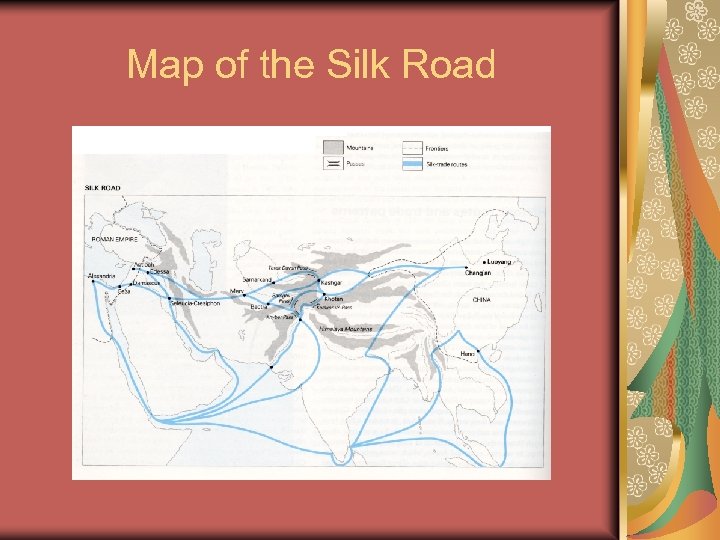 Map of the Silk Road
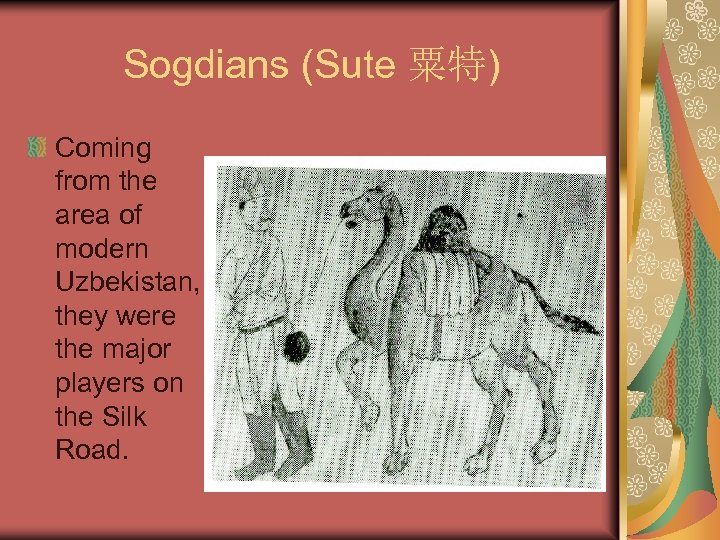 Sogdians (Sute 粟特) Coming from the area of modern Uzbekistan, they were the major players on the Silk Road.
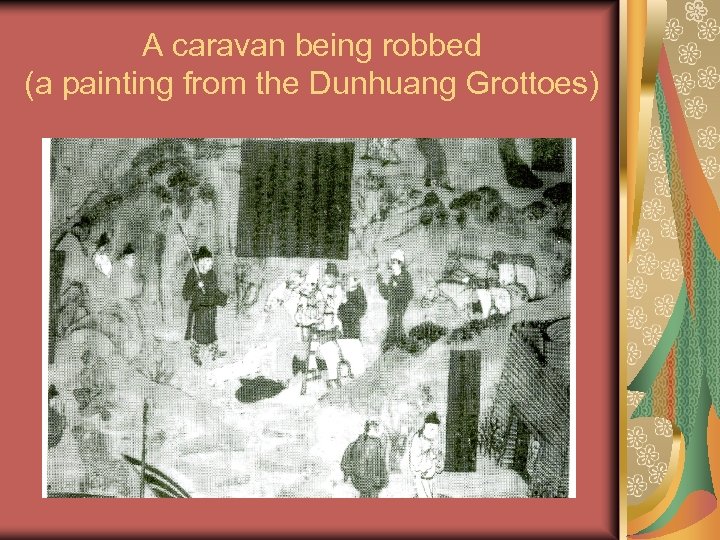 A caravan being robbed (a painting from the Dunhuang Grottoes)
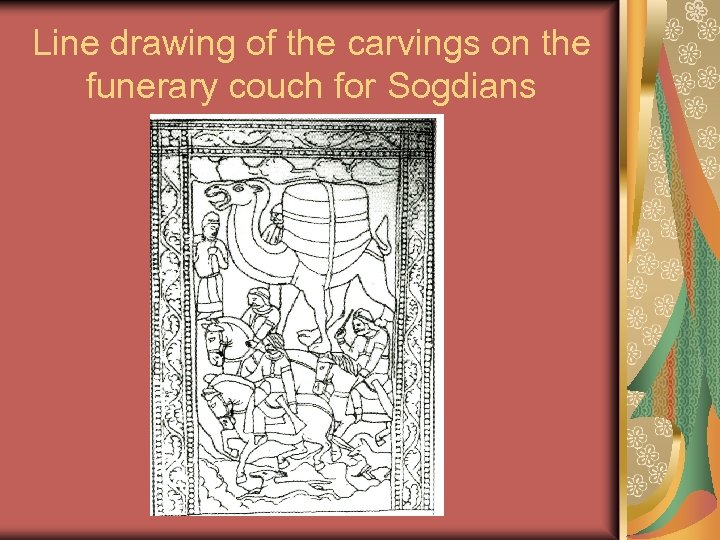 Line drawing of the carvings on the funerary couch for Sogdians
 Scope of Sogdian trading activities Changan and Loyang, the two Tang capitals Dunhuang (敦煌)in Gansu province Inner Mongolia and southern Manchuria
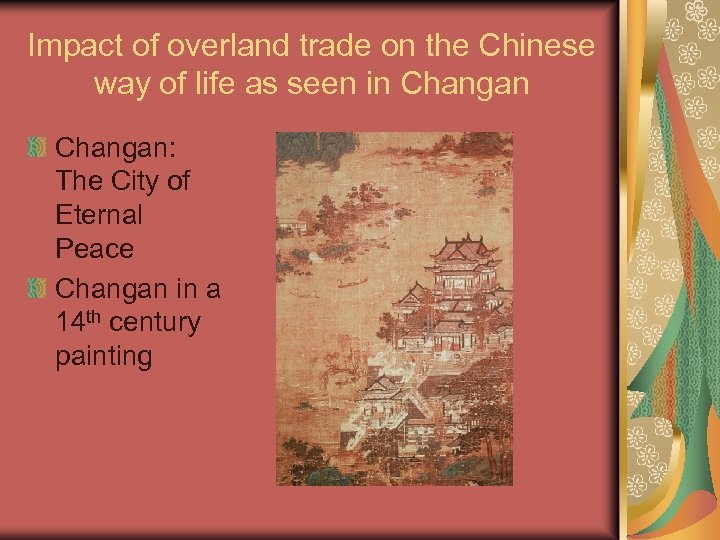 Impact of overland trade on the Chinese way of life as seen in Changan: The City of Eternal Peace Changan in a 14 th century painting
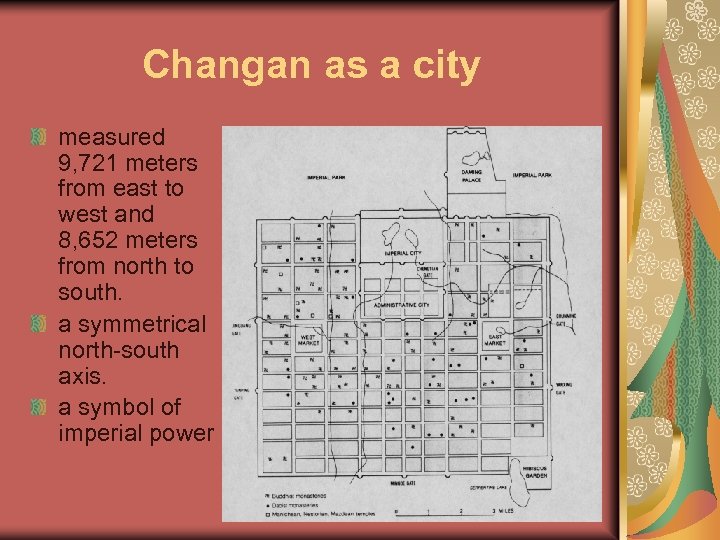 Changan as a city measured 9, 721 meters from east to west and 8, 652 meters from north to south. a symmetrical north-south axis. a symbol of imperial power
 Changan as a trading place The Eastern and Western markets were vibrant centers for overland trade, where local products from all over China and foreign goods from Samarkand, Persia, and Syria changed hands. Large number of shops
 Management of markets Office for the Market Director, Price-regulating office, and Price-equalizing office to control weights, measures, and prices. Fixed business hours Commercial activities outside Changan Curfew on Tang cities and its relaxation after the mid-ninth century Tang poem: "It is customary that Luoyang (the eastern capital of Tang) has no curfew; returning on horseback at night, the fragrance (of a lady) fills my bosom. " Night markets
 Changan as an international metropolis Merchants from the middle and western parts of the Asian continent, and the Indian peninsula Missionaries who preached various religious beliefs Monks from East Asia in search of the Buddhist laws Princes of foreign countries who remained in Changan as hostages Foreign diplomats.
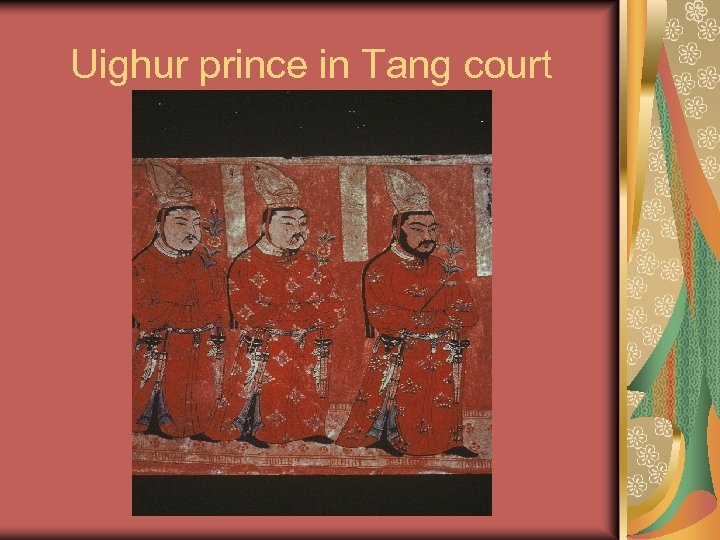 Uighur prince in Tang court
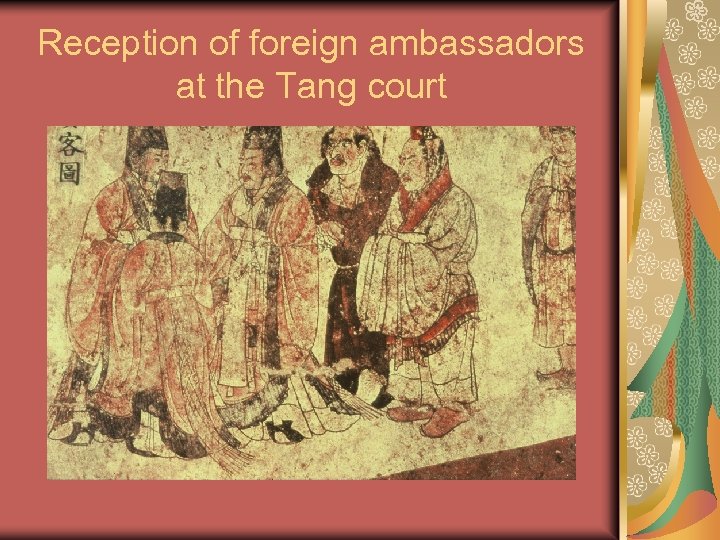 Reception of foreign ambassadors at the Tang court
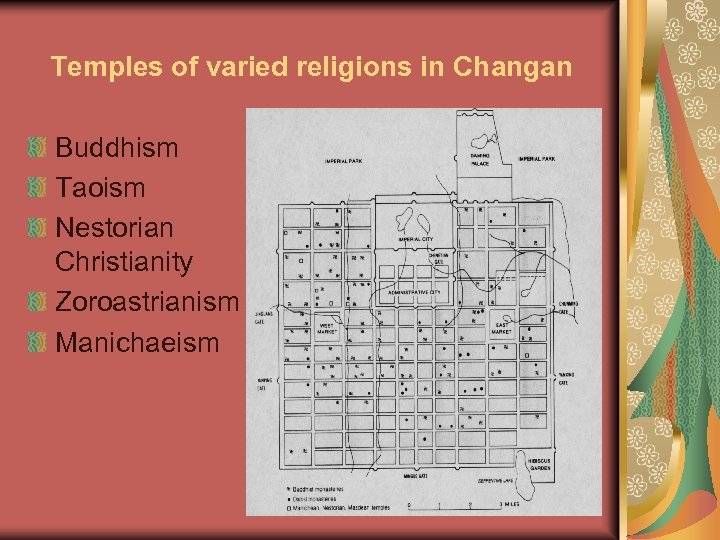 Temples of varied religions in Changan Buddhism Taoism Nestorian Christianity Zoroastrianism Manichaeism
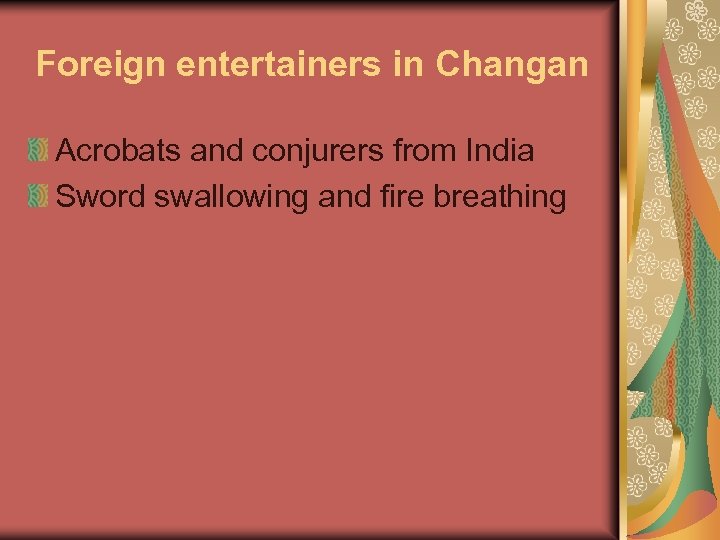 Foreign entertainers in Changan Acrobats and conjurers from India Sword swallowing and fire breathing
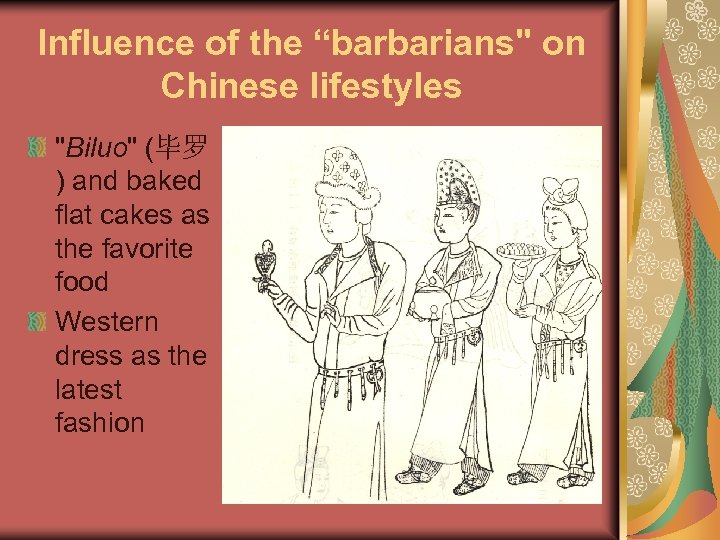 Influence of the “barbarians" on Chinese lifestyles "Biluo" (毕罗 ) and baked flat cakes as the favorite food Western dress as the latest fashion
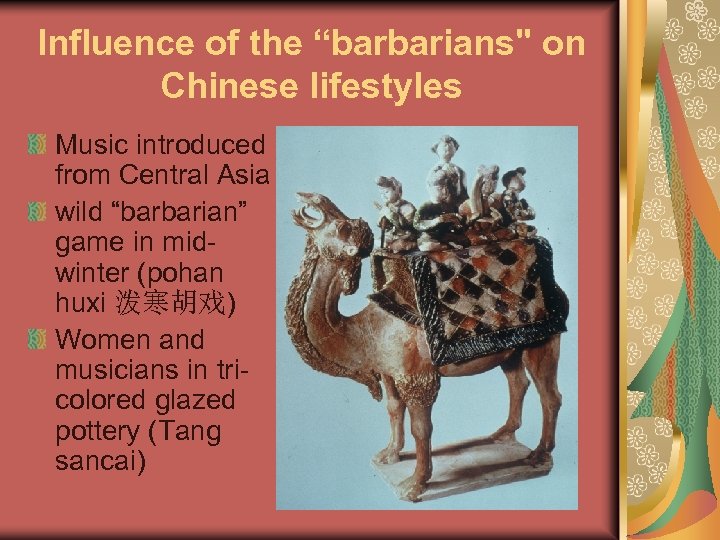 Influence of the “barbarians" on Chinese lifestyles Music introduced from Central Asia wild “barbarian” game in midwinter (pohan huxi 泼寒胡戏) Women and musicians in tricolored glazed pottery (Tang sancai)
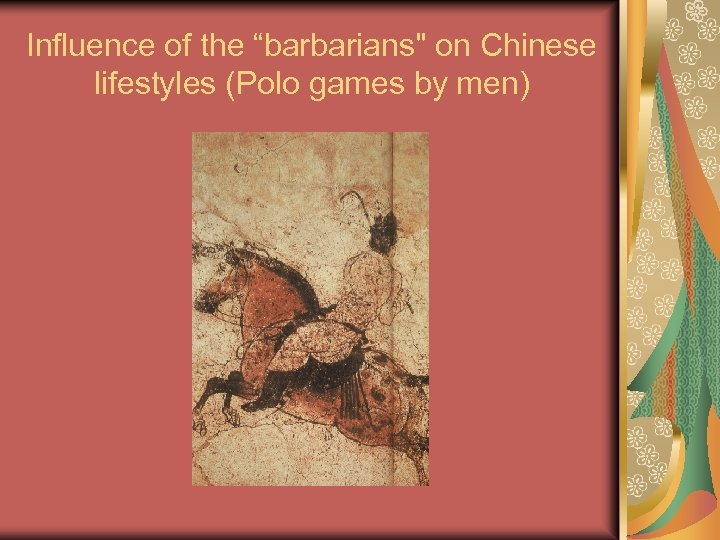 Influence of the “barbarians" on Chinese lifestyles (Polo games by men)
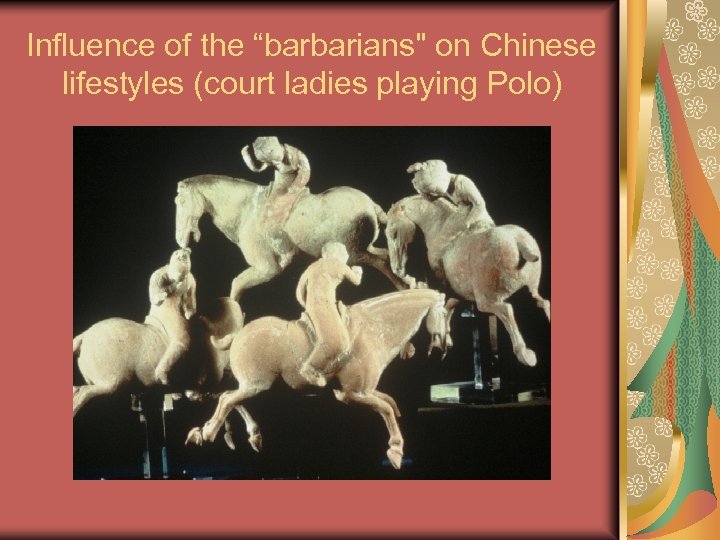 Influence of the “barbarians" on Chinese lifestyles (court ladies playing Polo)
 Barbarian influences on China as reflected in Tang poems Yuan Zhen (an early ninth-century poet “Ever since the Western horsemen began raising smut and dust, Fur and fleece, rank and rancid, have filled Xian and Luo. Women make themselves Western matrons by the study of Western make-up; Entertainers present Western tunes, in their devotion to Western music. ”
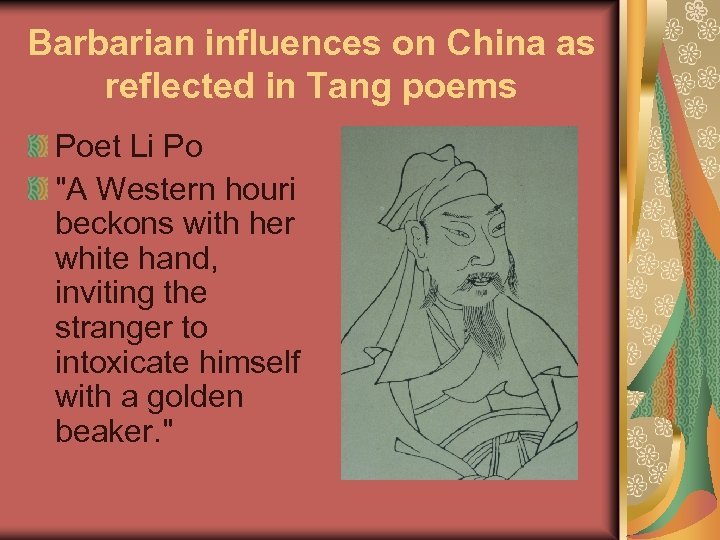 Barbarian influences on China as reflected in Tang poems Poet Li Po "A Western houri beckons with her white hand, inviting the stranger to intoxicate himself with a golden beaker. "
 Barbarian influences on China as reflected in Tang poems That Western houri with features like a flower. She stands by the wine-warmer, and laughs with the breath of spring; Laughs with the breath of spring, Dances in a dress of gauze! "Will you be going somewhere, milord, now, before you are drunk? "
 Attitude of the Tang court toward overland trade The court forbade unrestricted flow of goods and people into and out of Chinese borders. The Tang court used management of overland trade as a means for achieving both its desired economic and diplomatic goals.
 Political nature of trade as elaborated by Wang Qinruo (a Song-dynasty writer) “An emperor looks after the barbarians as if they are a herd of his cattle. He employs [a policy of] conciliation and loose reign to bring about peace to border areas so as to rest [his people in] the Middle Kingdom. Opening markets therefore aims at conciliation and loose reign [in relations with foreign countries].
 Political nature of trade as elaborated by Wang Qinruo Trading with the barbarians was first suggested to the court in the early [Western] Han. The court then chose marketplaces and regulated trading activities. [Through trade, the court] acquired goods and valuables, and advocated trust and righteousness, [hoping that foreign rulers] would respect and practice [these virtues] for generations to come. Trade is thus one of the ways for harmonizing relations with the barbarians. ”
 Tang management of overland trade on frontier markets five major seasonal frontier markets (zouji 走集) 1. Yingzhou (营州), a gateway to Manchuria and Korea 2. Xiazhou (夏州 in Inner Mongolia), a contacting point with the Turks
 Tang management of overland trade on frontier markets 3. Zhong Shouxiang cheng ( 中受降城 in Inner Mongolia), a gathering place for Chinese and Uighur traders on the northern bank of the Yellow River 4. Liangzhou ( 凉州 in Gansu province), a window to countries in Central Asia 5. Jiaozhi (交趾 near Hanoi, Vietnam), the starting point of routes leading to Indina.
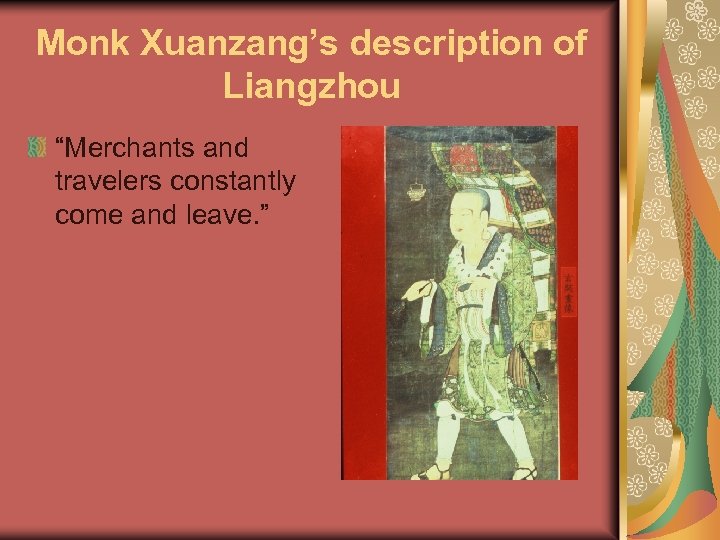 Monk Xuanzang’s description of Liangzhou “Merchants and travelers constantly come and leave. ”
 Tang administration of overland trade Localized and under the jurisdiction of a local official: Directorate for Tributary Trade (Hushi jian 互市监) Three major responsibilities of the Director: (1) maintaining order, (2) implementing prohibition of trade in specific items, and (3) conducting "official purchase" at marketplace.
 Tang administration of overland trade Statute on Markets and Customs Stations (guanshi ling 关市令) set the date, the time, and the place for frontier trade as well as the prices for goods to be traded.
 Official Purchase (官市) A practice that allowed officials to buy exotic goods from foreign merchants before commoners entered the market. Exotic goods were a symbol of political submission of these countries to the Tang court. Court procedure for procuring exotic goods: the local authorities, the steward from the Office of State Visitors, the Court of State Ceremonial, the Directorate for Imperial Manufactories, and the Secretariat.
 “Items under imperial prohibition” (jinduan se 禁断色) Goods that were prohibited to be brought out of China Silk brocade, silk damask, silk gauze, silk crepe, heavy silk, silk floss, pongee, silk thread, yaks’ tails, pearls, gold, silver, and iron Exportation of Chinese books as an example
 Prohibition against the exportation of certain Chinese books Maps of the heavens, The Six Strategies of the Great Duke, The Three Plans of the Yellow Stone Duke, Books dealing with the calendar, the Sun, the Moon, and the five stars, and books on methods of predicting good and evil
 Limited access to certain historical, philosophical, and military works The case of Silla (a Korean state) in 686 The Book of Rites (Li ji 礼记) Indiscriminate granting of books to foreigners exposed China to potential danger.
 The opinion of Xue Deng (薛登) Should they be able to read our language, they would understand our laws and regulations, and the fundamental principles and practices that we use to govern China. Should they become literate in Chinese, they would learn from our successes and defeats, which have been fully recorded in our dynastic histories. Should they have access to geographical works, they would gain knowledge of our strategic places. With knowledge of China, they would be able to help their rulers work out strategic plans and military maneuvers against us, causing trouble for China.
 The case of Tibetan ambassador in 730 The Classic of Poetry (Shi jing 诗经) The Book of Rites (Li ji) The Chunqiu with Zuo Commentaries (Chunqiu Zuo zhuan春秋左传) The Selections of Refined Literature (Wen xuan 文选)
 Yu Xiulie (余休烈)’s objection The books in question contained information on China's military strategies toward foreign countries. The Book of Historical Documents (Shang shu 尚 书): the traditional Chinese way of war. The Classic of Poetry (Shi jing): Chinese military tactics such as using carriages and maneuvering troops. The "monthly instructions (yue ling 月令)" in The Book of Rites (Li ji): information on the suitable monthly activities, including military operations, for an emperor. The Chunqiu with Zuo Commentaries (Zuo zhuan): tactics employed in maneuvering troops.
 Tang management of people’s movement Guan (关): customs stations The case of Xuanzang in 626 The “travel permit” (guosuo 过所)
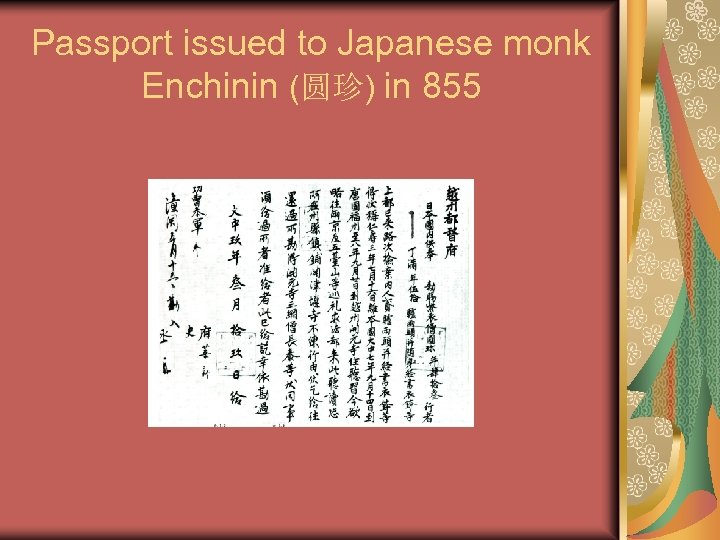 Passport issued to Japanese monk Enchinin (圆珍) in 855
 The case of monk Enchin kanru (勘入): “checked, and entry is granted. ” kanchu (勘出): “checked, and departure is granted. ”
 Trade as a means for political influence Foreign trade was never a mere economic activity, but a means to both derive economic benefits from and exert political influence on its trading partners. The practice of “tributary trade conducted according to imperial edict” (zhunchi hushi 准敕互市). Purchasing activities of foreign diplomats were conducted under a situation wellcontrolled by the court. The case of Japanese ambassador in Changan in 717 and 838