 Скачать презентацию Adjective and Adverb OUTLINE 1 Adjective Categorial
4 Adjective and Adverb.ppt
- Количество слайдов: 62



Adjective and Adverb
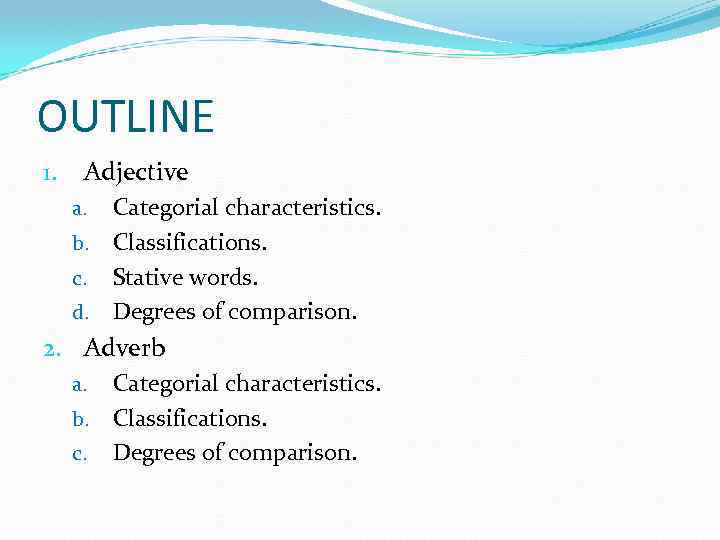
OUTLINE 1. Adjective Categorial characteristics. b. Classifications. c. Stative words. d. Degrees of comparison. a. 2. Adverb a. Categorial characteristics. b. Classifications. c. Degrees of comparison.
Adjective Categorial characteristics
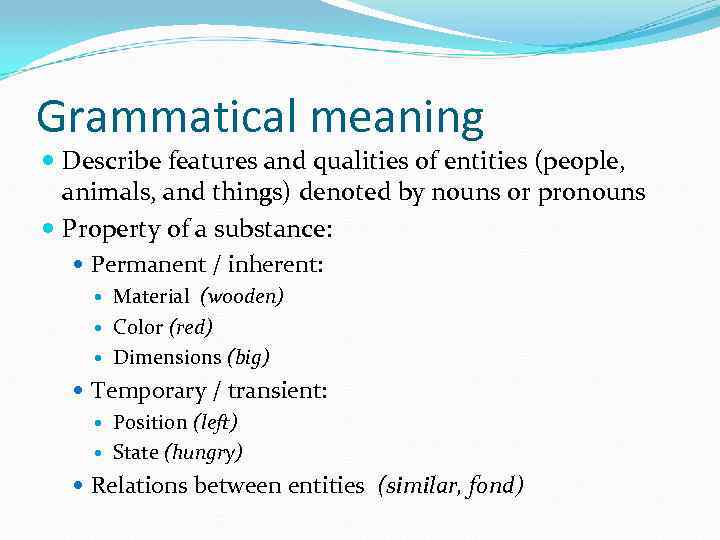
Grammatical meaning Describe features and qualities of entities (people, animals, and things) denoted by nouns or pronouns Property of a substance: Permanent / inherent: Material (wooden) Color (red) Dimensions (big) Temporary / transient: Position (left) State (hungry) Relations between entities (similar, fond)

Unlike nouns, adj do not possess a full nominative value (only in collocations) <= semantically bound In self-dependent position, adj substantivize: The rich will never understand the poor.
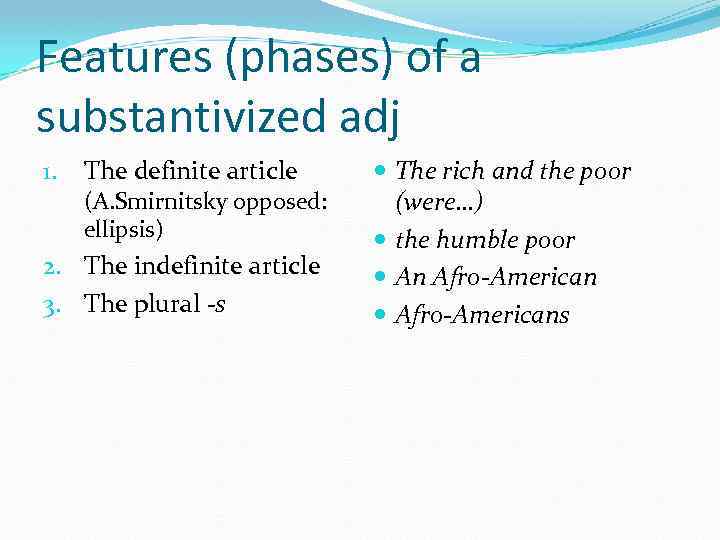
Features (phases) of a substantivized adj 1. The definite article (A. Smirnitsky opposed: ellipsis) 2. The indefinite article 3. The plural -s The rich and the poor (were…) the humble poor An Afro-Americans
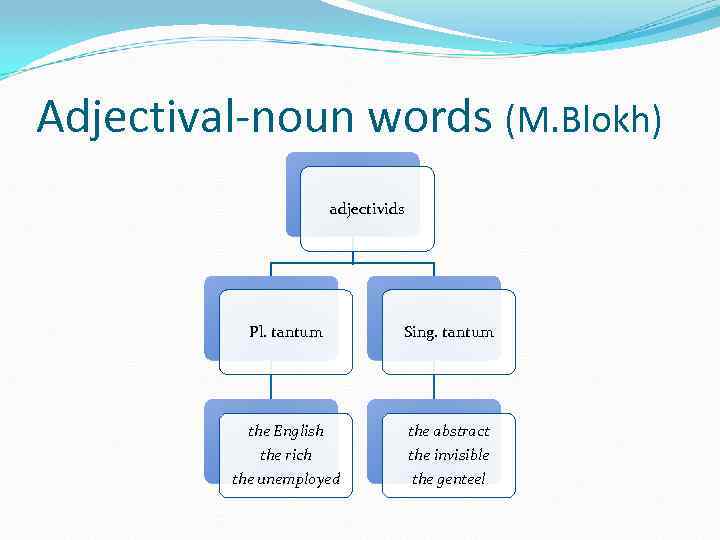
Adjectival-noun words (M. Blokh) adjectivids Pl. tantum Sing. tantum the English the rich the abstract the invisible the unemployed the genteel
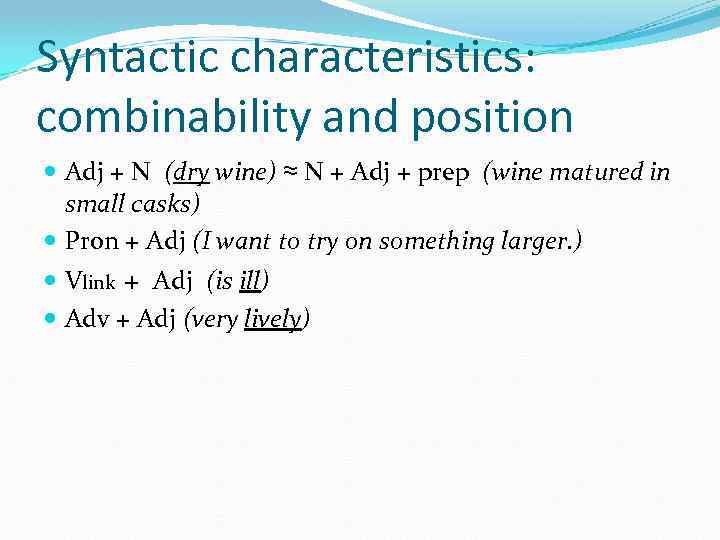
Syntactic characteristics: combinability and position Adj + N (dry wine) ≈ N + Adj + prep (wine matured in small casks) Pron + Adj (I want to try on something larger. ) Vlink + Adj (is ill) Adv + Adj (very lively)
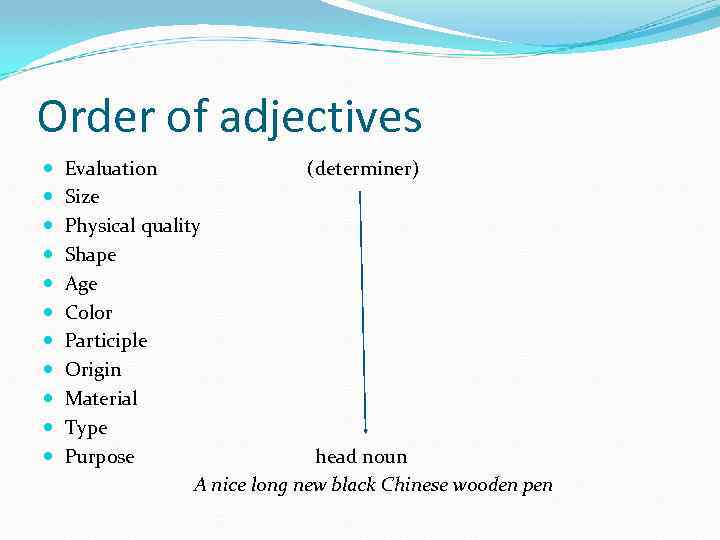
Order of adjectives Evaluation (determiner) Size Physical quality Shape Age Color Participle Origin Material Type Purpose head noun A nice long new black Chinese wooden pen
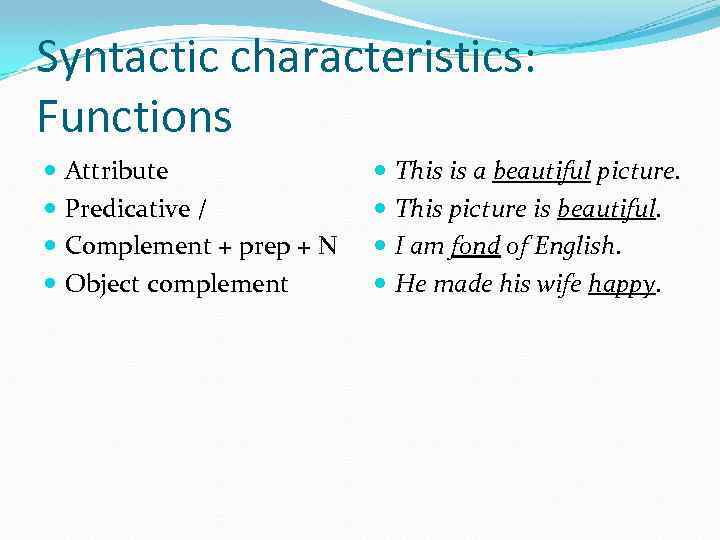
Syntactic characteristics: Functions Attribute Predicative / Complement + prep + N Object complement This is a beautiful picture. This picture is beautiful. I am fond of English. He made his wife happy.
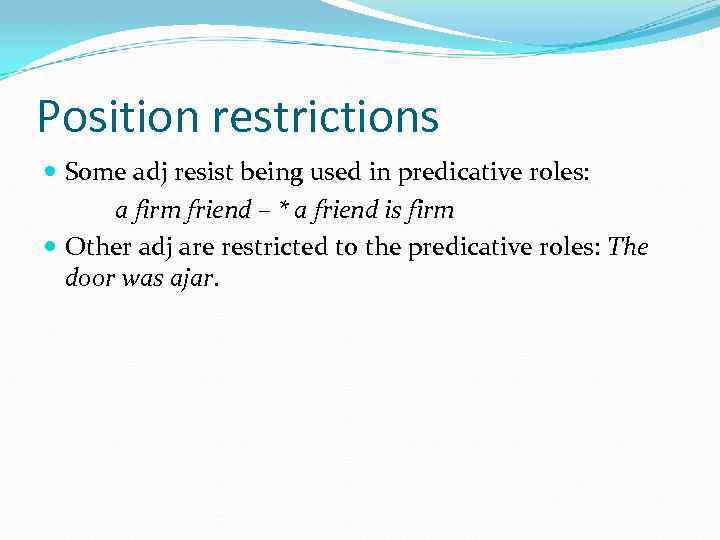
Position restrictions Some adj resist being used in predicative roles: a firm friend – * a friend is firm Other adj are restricted to the predicative roles: The door was ajar.
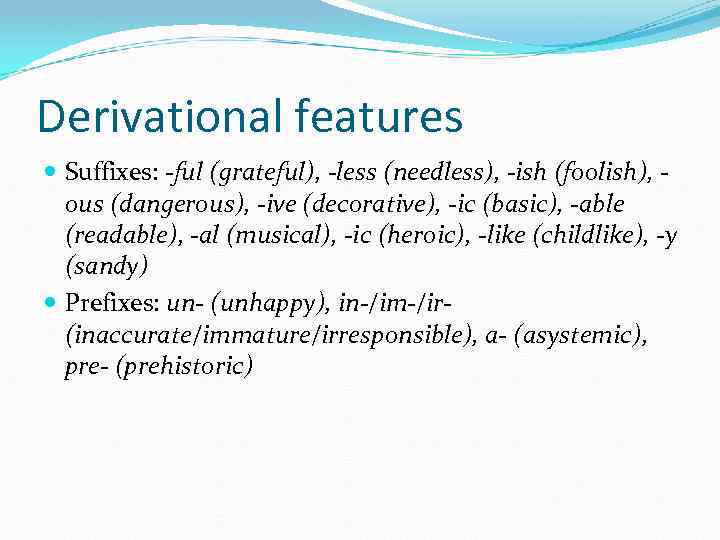
Derivational features Suffixes: -ful (grateful), -less (needless), -ish (foolish), ous (dangerous), -ive (decorative), -ic (basic), -able (readable), -al (musical), -ic (heroic), -like (childlike), -y (sandy) Prefixes: un- (unhappy), in-/im-/ir(inaccurate/immature/irresponsible), a- (asystemic), pre- (prehistoric)
Morphological variation Degrees of comparison
Adjective Classifications
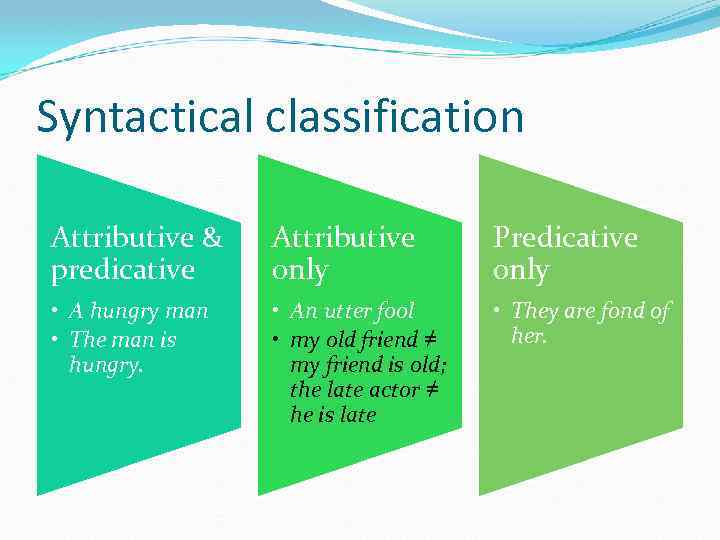
Syntactical classification Attributive & predicative Attributive only Predicative only • A hungry man • The man is hungry. • An utter fool • my old friend ≠ my friend is old; the late actor ≠ he is late • They are fond of her.
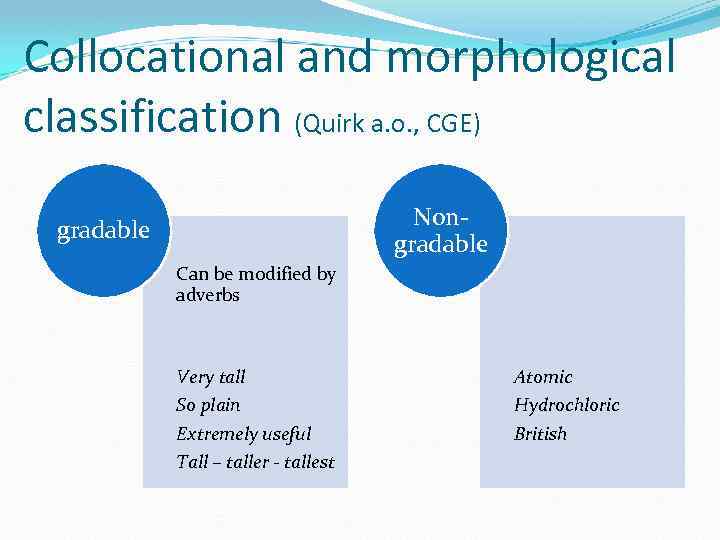
Collocational and morphological classification (Quirk a. o. , CGE) Nongradable Can be modified by adverbs Very tall So plain Atomic Hydrochloric Extremely useful Tall – taller - tallest British
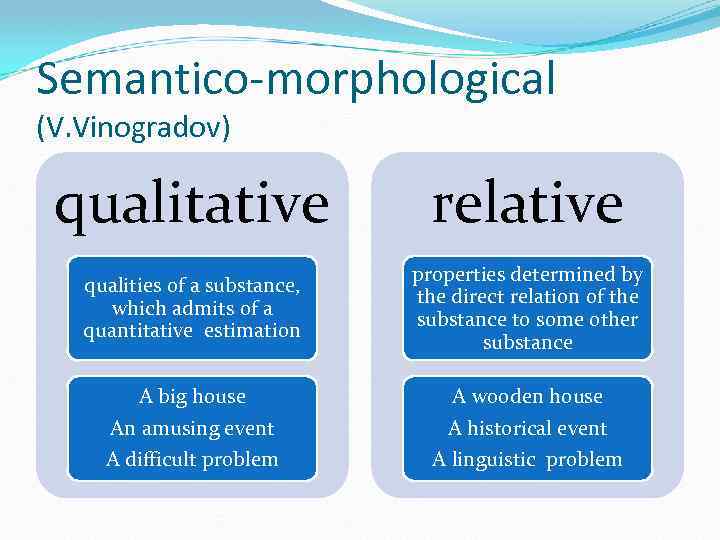
Semantico-morphological (V. Vinogradov) qualitative relative qualities of a substance, which admits of a quantitative estimation properties determined by the direct relation of the substance to some other substance A big house An amusing event A wooden house A historical event A difficult problem A linguistic problem
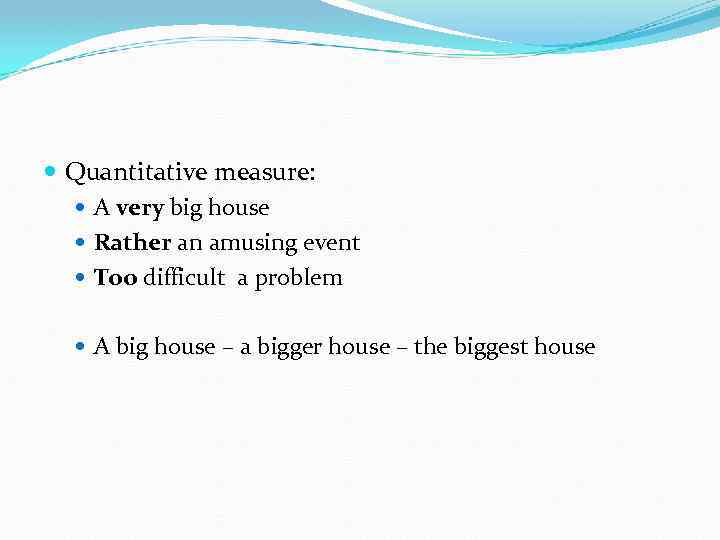
Quantitative measure: A very big house Rather an amusing event Too difficult a problem A big house – a bigger house – the biggest house
Lexical or grammatical criterion? Abstract lexical meaning = qualitative + relative Dependent grammatical meaning grammatically relevant (I. P. Ivanova):
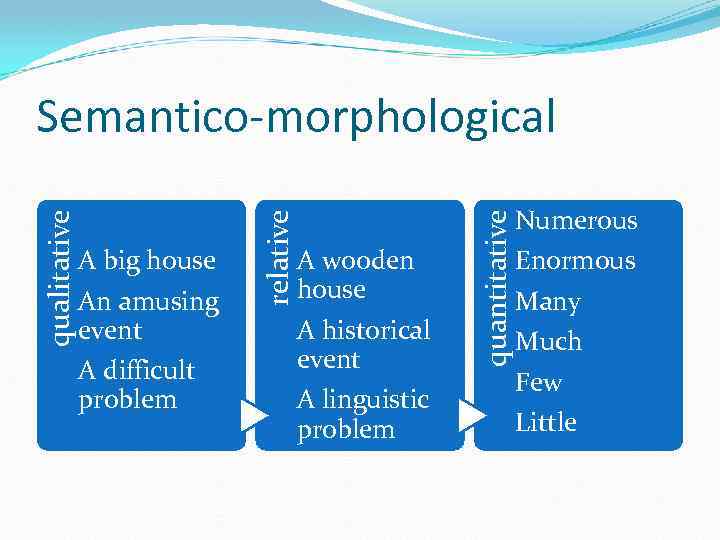
A wooden house A historical event A linguistic problem quantitative A big house An amusing event A difficult problem relative qualitative Semantico-morphological Numerous Enormous Many Much Few Little
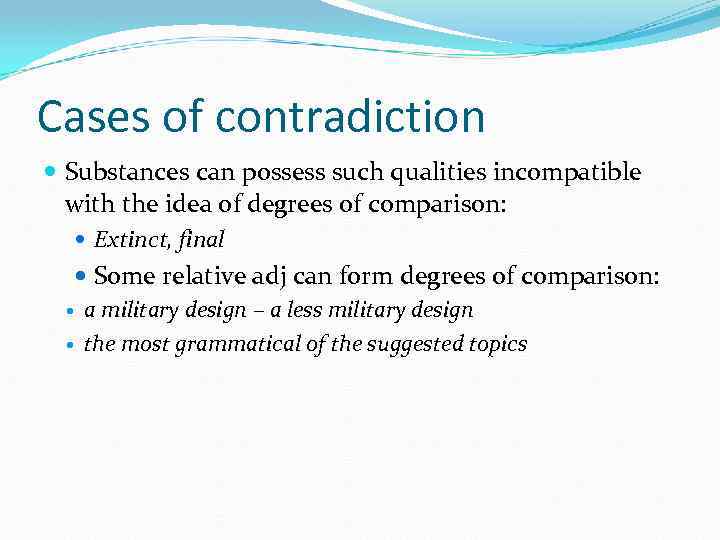
Cases of contradiction Substances can possess such qualities incompatible with the idea of degrees of comparison: Extinct, final Some relative adj can form degrees of comparison: a military design – a less military design the most grammatical of the suggested topics
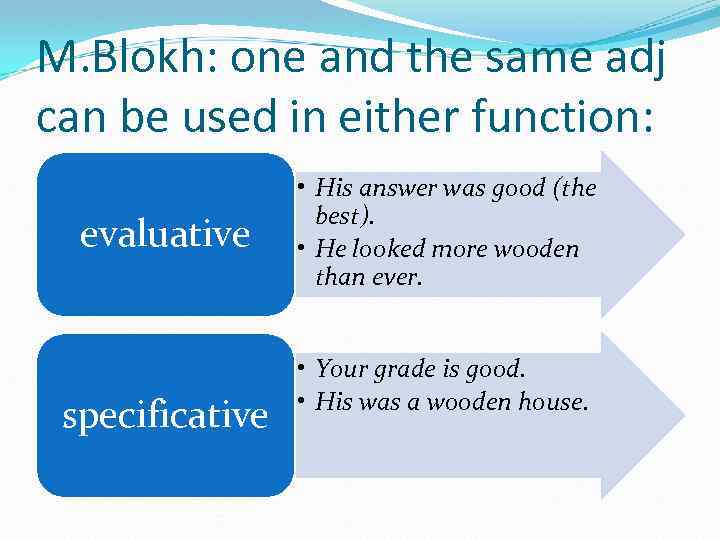
M. Blokh: one and the same adj can be used in either function: evaluative specificative • His answer was good (the best). • He looked more wooden than ever. • Your grade is good. • His was a wooden house.
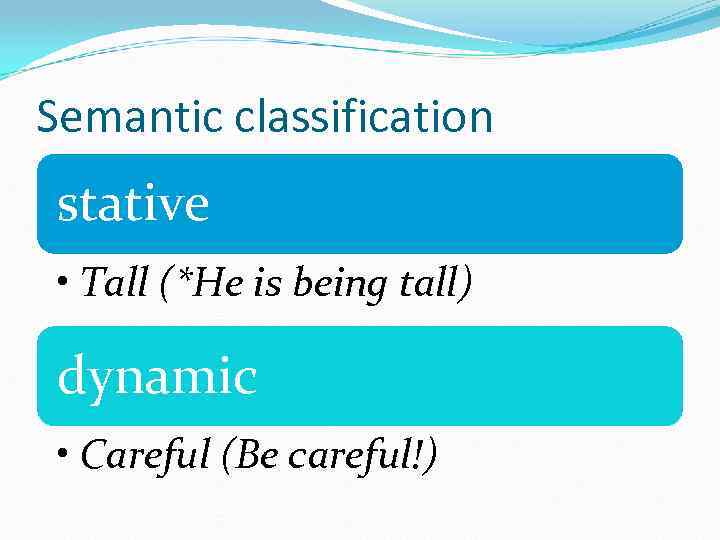
Semantic classification stative • Tall (*He is being tall) dynamic • Careful (Be careful!)
Adjective Words of the category of state, or stative words, or statives
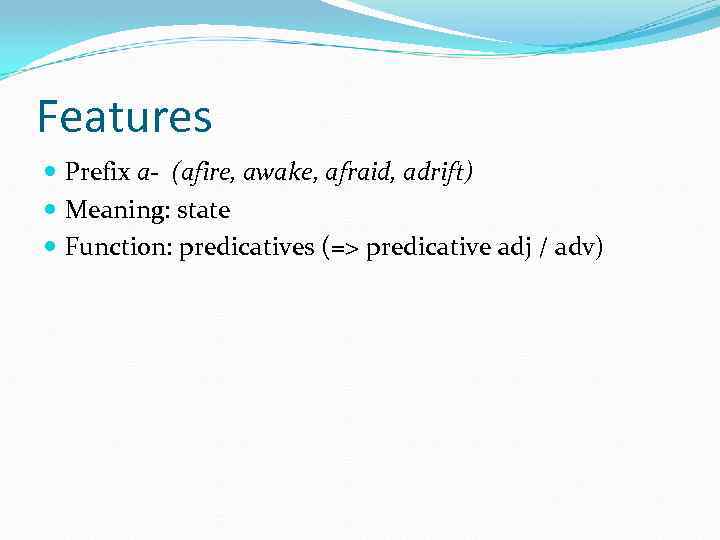
Features Prefix a- (afire, awake, afraid, adrift) Meaning: state Function: predicatives (=> predicative adj / adv)
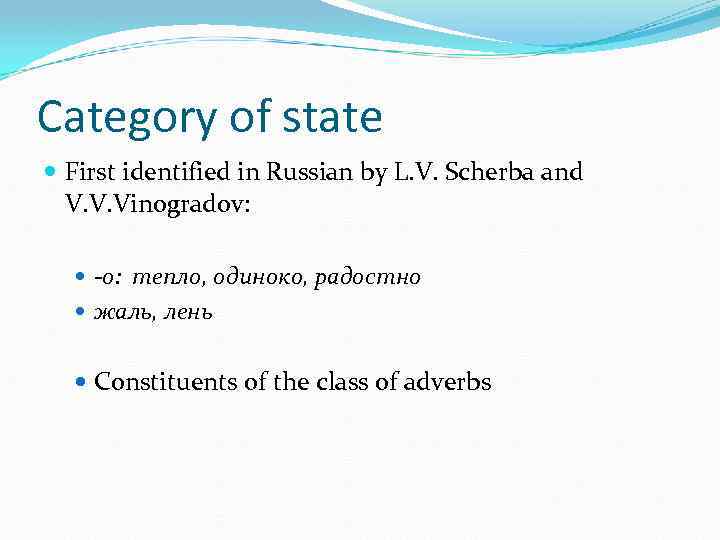
Category of state First identified in Russian by L. V. Scherba and V. V. Vinogradov: -o: тепло, одиноко, радостно жаль, лень Constituents of the class of adverbs
In English, singled out by B. A. Ilyish + B. S. Khaimovich & B. I. Rogovskaya Opposed to by L. S. Barkhudarov, M. Blokh
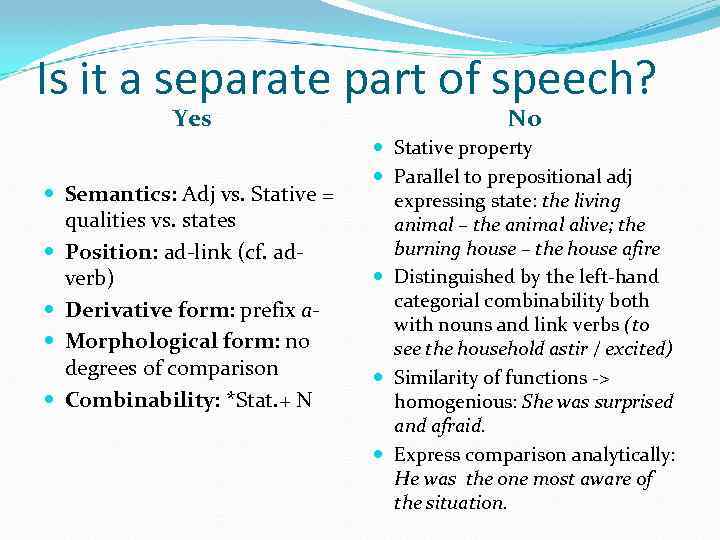
Is it a separate part of speech? Yes Semantics: Adj vs. Stative = qualities vs. states Position: ad-link (cf. adverb) Derivative form: prefix a Morphological form: no degrees of comparison Combinability: *Stat. + N No Stative property Parallel to prepositional adj expressing state: the living animal – the animal alive; the burning house – the house afire Distinguished by the left-hand categorial combinability both with nouns and link verbs (to see the household astir / excited) Similarity of functions -> homogenious: She was surprised and afraid. Express comparison analytically: He was the one most aware of the situation.
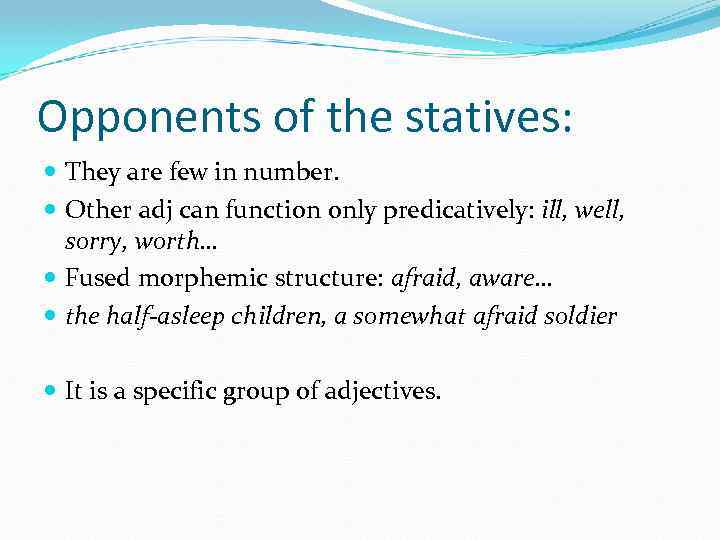
Opponents of the statives: They are few in number. Other adj can function only predicatively: ill, well, sorry, worth… Fused morphemic structure: afraid, aware… the half-asleep children, a somewhat afraid soldier It is a specific group of adjectives.
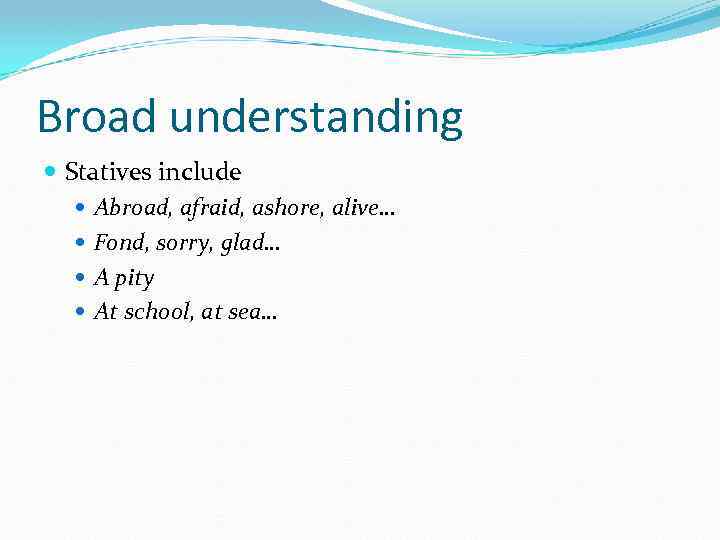
Broad understanding Statives include Abroad, afraid, ashore, alive… Fond, sorry, glad… A pity At school, at sea…
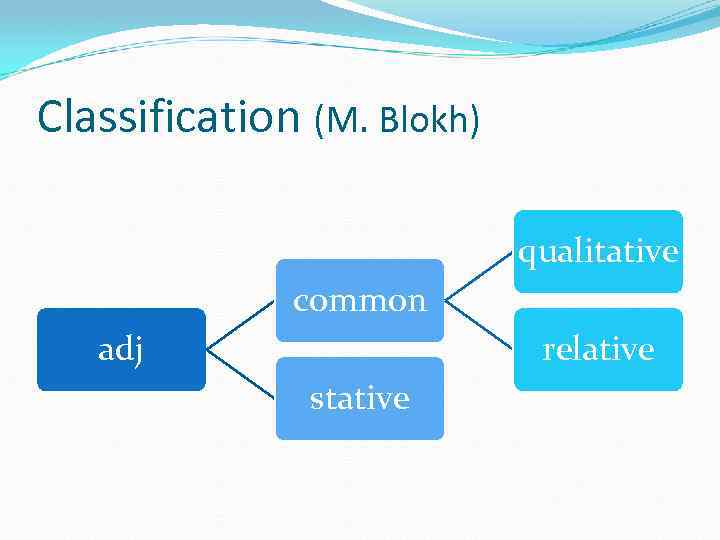
Classification (M. Blokh) qualitative common adj relative stative
Adjective Degrees of comparison
Meaning of the category The category of comparison expresses the quantitative characteristic of the quality of a noun referent; a difference of degree in the same property.
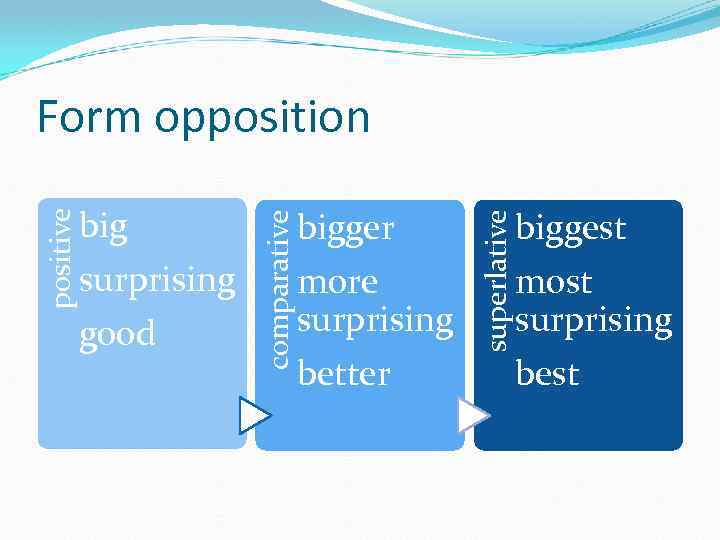
surprising good bigger more surprising better superlative big comparative positive Form opposition biggest most surprising best
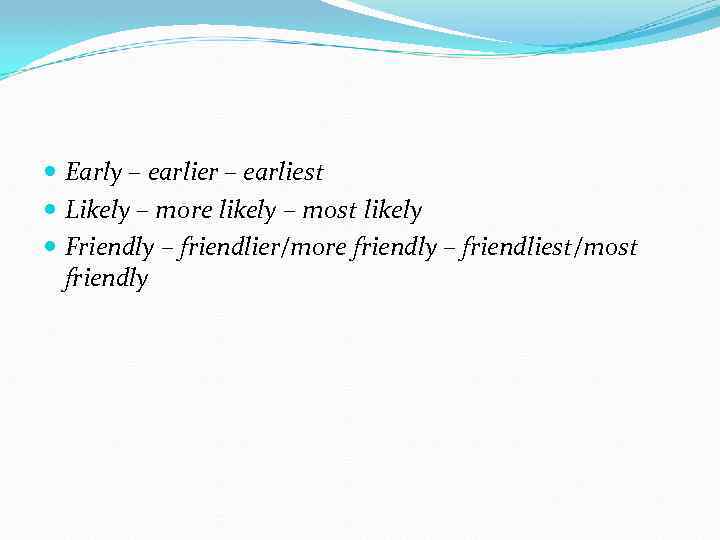
Early – earlier – earliest Likely – more likely – most likely Friendly – friendlier/more friendly – friendliest/most friendly
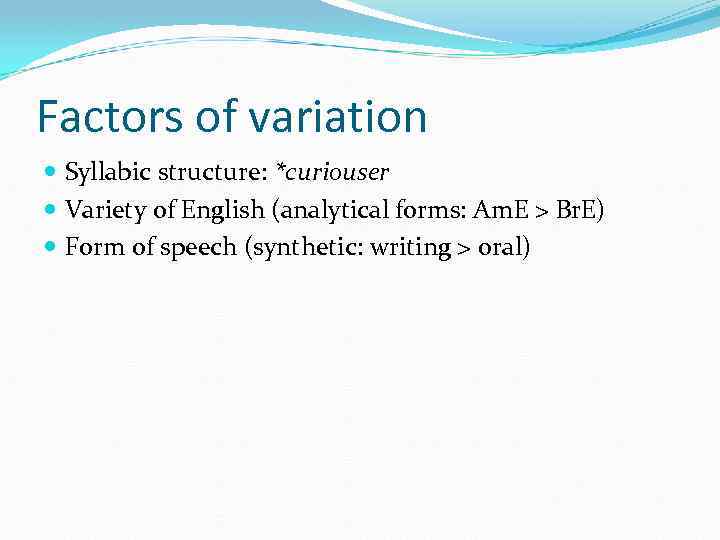
Factors of variation Syllabic structure: *curiouser Variety of English (analytical forms: Am. E > Br. E) Form of speech (synthetic: writing > oral)
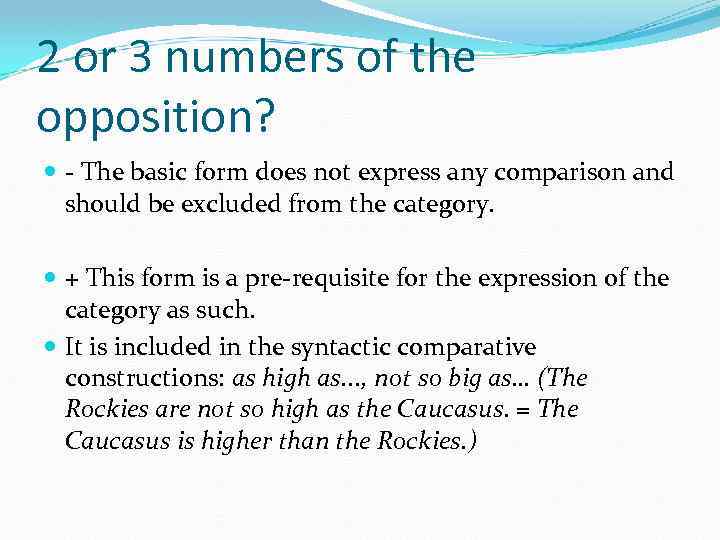
2 or 3 numbers of the opposition? - The basic form does not express any comparison and should be excluded from the category. + This form is a pre-requisite for the expression of the category as such. It is included in the syntactic comparative constructions: as high as. . . , not so big as… (The Rockies are not so high as the Caucasus. = The Caucasus is higher than the Rockies. )
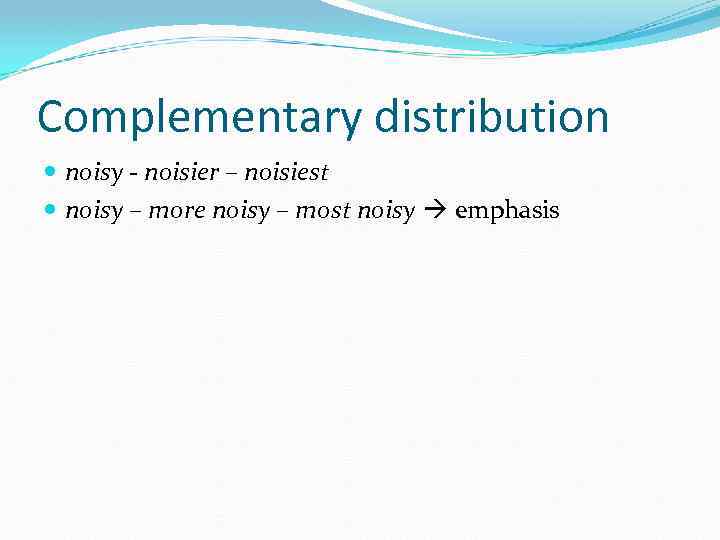
Complementary distribution noisy - noisier – noisiest noisy – more noisy – most noisy emphasis
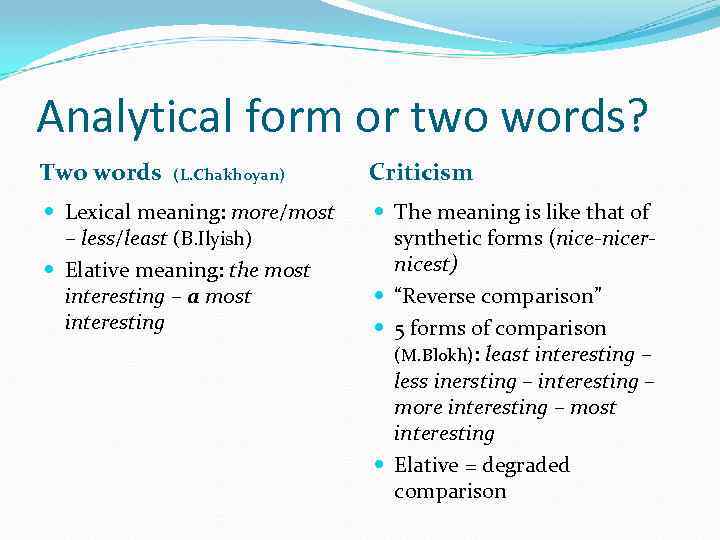
Analytical form or two words? Two words (L. Chakhoyan) Lexical meaning: more/most – less/least (B. Ilyish) Elative meaning: the most interesting – a most interesting Criticism The meaning is like that of synthetic forms (nice-nicernicest) “Reverse comparison” 5 forms of comparison (M. Blokh): least interesting – less inersting – interesting – more interesting – most interesting Elative = degraded comparison
Adverb Categorial characteristics
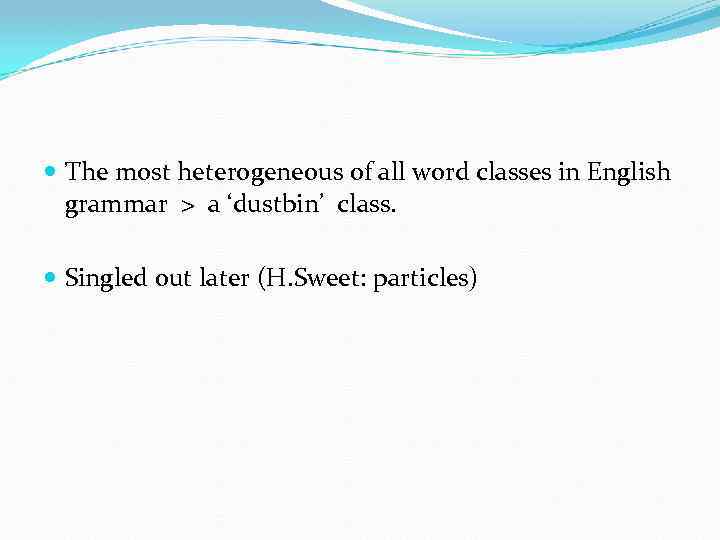
The most heterogeneous of all word classes in English grammar > a ‘dustbin’ class. Singled out later (H. Sweet: particles)

Grammatical meaning Either property of an action or property of another property or circumstances in which the action occurs. I walked quietly. Most adverbs are fairly easy to recognize. They ran very quickly. a non-substantive property
Morphological form invariable
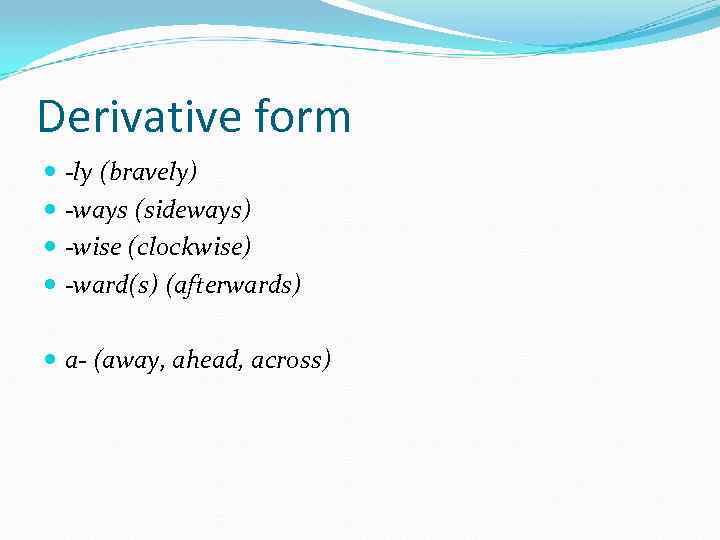
Derivative form -ly (bravely) -ways (sideways) -wise (clockwise) -ward(s) (afterwards) a- (away, ahead, across)
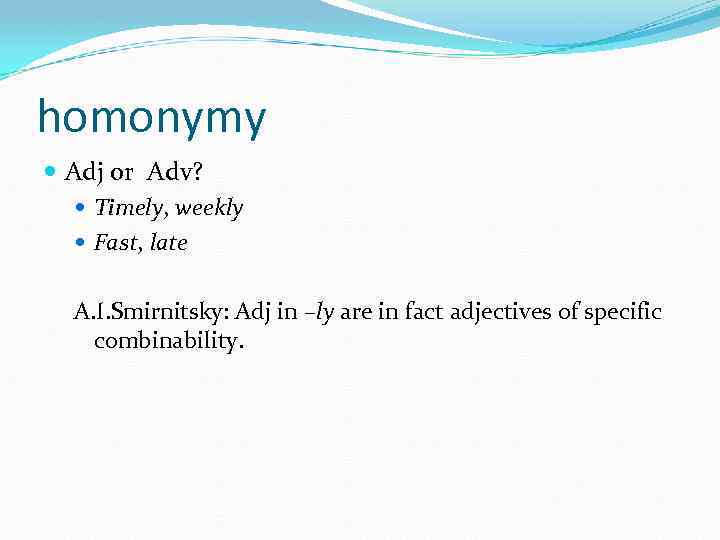
homonymy Adj or Adv? Timely, weekly Fast, late A. I. Smirnitsky: Adj in –ly are in fact adjectives of specific combinability.
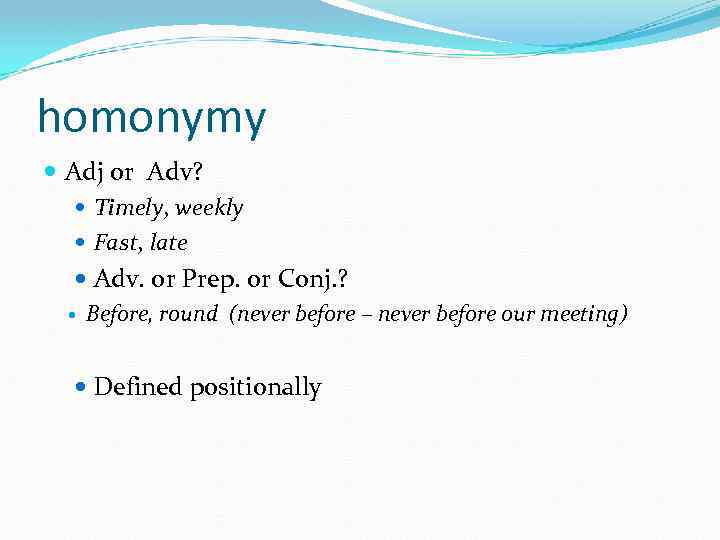
homonymy Adj or Adv? Timely, weekly Fast, late Adv. or Prep. or Conj. ? Before, round (never before – never before our meeting) Defined positionally
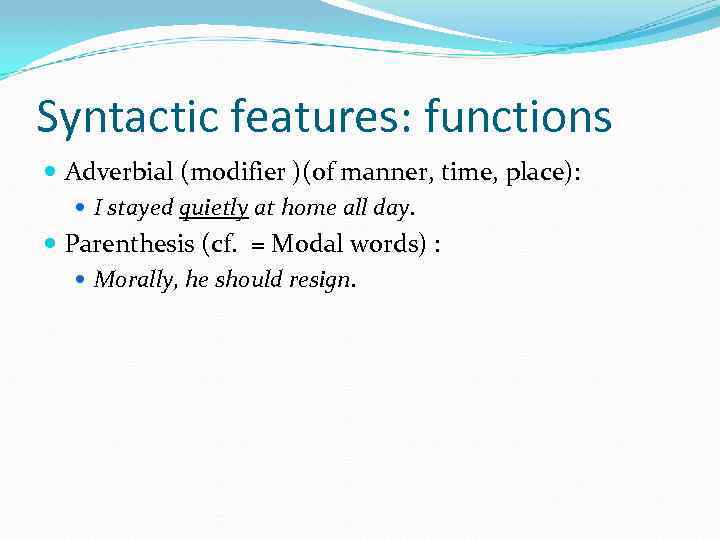
Syntactic features: functions Adverbial (modifier )(of manner, time, place): I stayed quietly at home all day. Parenthesis (cf. = Modal words) : Morally, he should resign.
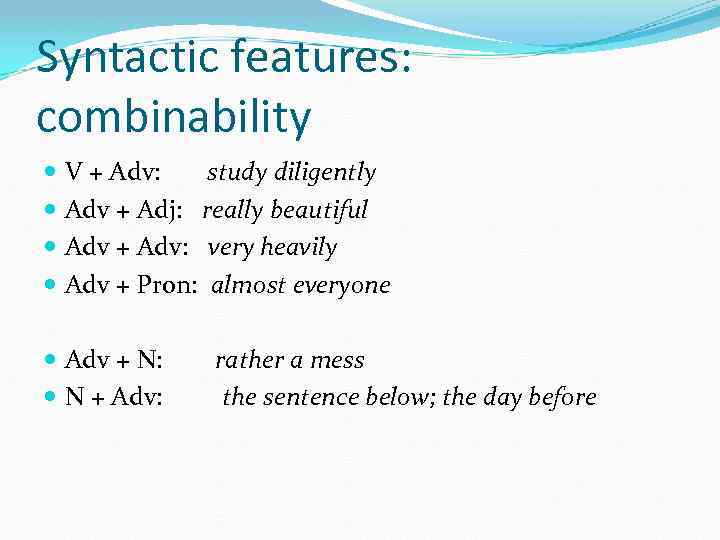
Syntactic features: combinability V + Adv: study diligently Adv + Adj: really beautiful Adv + Adv: very heavily Adv + Pron: almost everyone Adv + N: N + Adv: rather a mess the sentence below; the day before
Status of the part of speech? The then president The world today
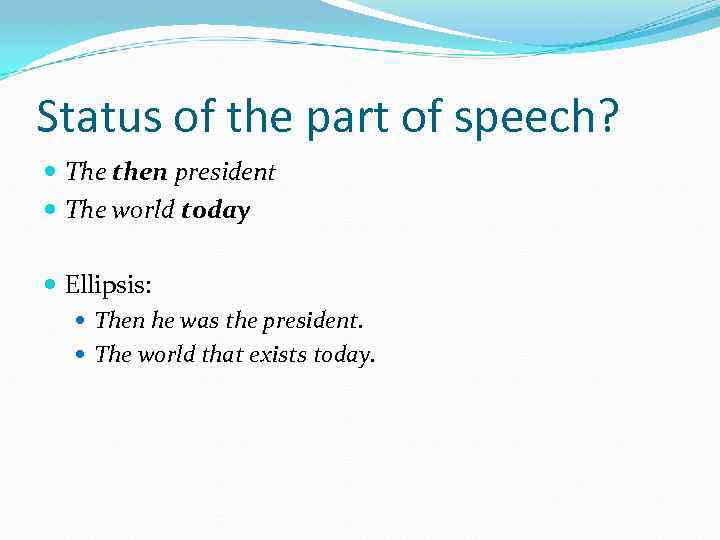
Status of the part of speech? The then president The world today Ellipsis: Then he was the president. The world that exists today.
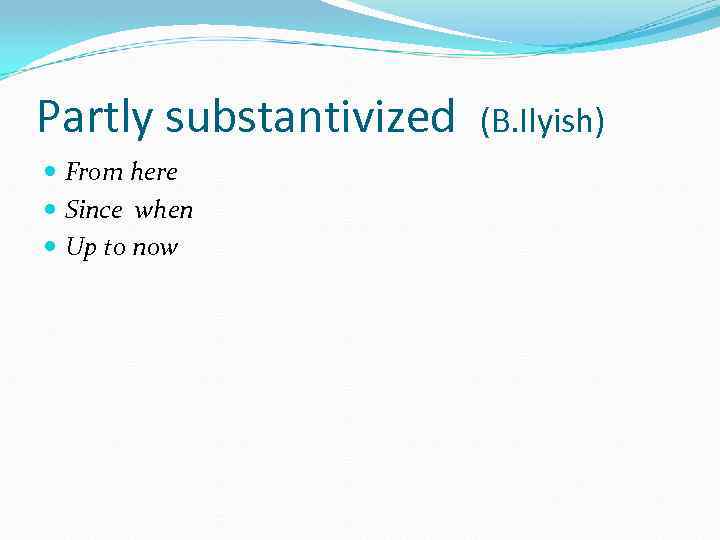
Partly substantivized From here Since when Up to now (B. Ilyish)
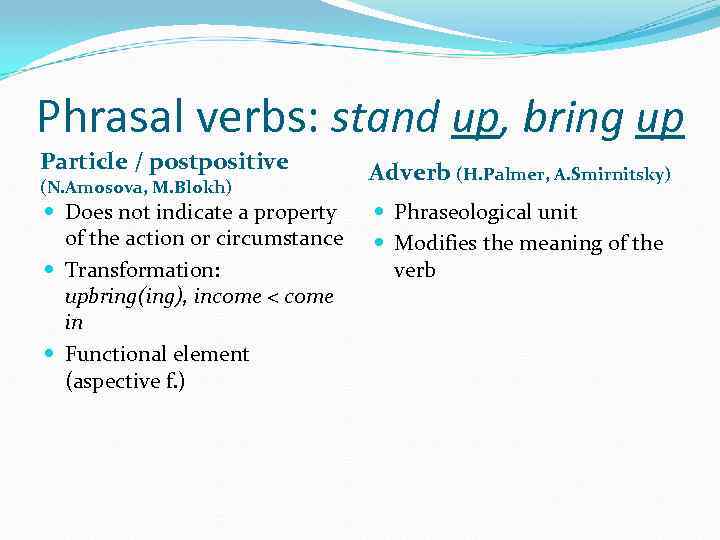
Phrasal verbs: stand up, bring up Particle / postpositive (N. Amosova, M. Blokh) Does not indicate a property of the action or circumstance Transformation: upbring(ing), income < come in Functional element (aspective f. ) Adverb (H. Palmer, A. Smirnitsky) Phraseological unit Modifies the meaning of the verb
Adverb Classifications
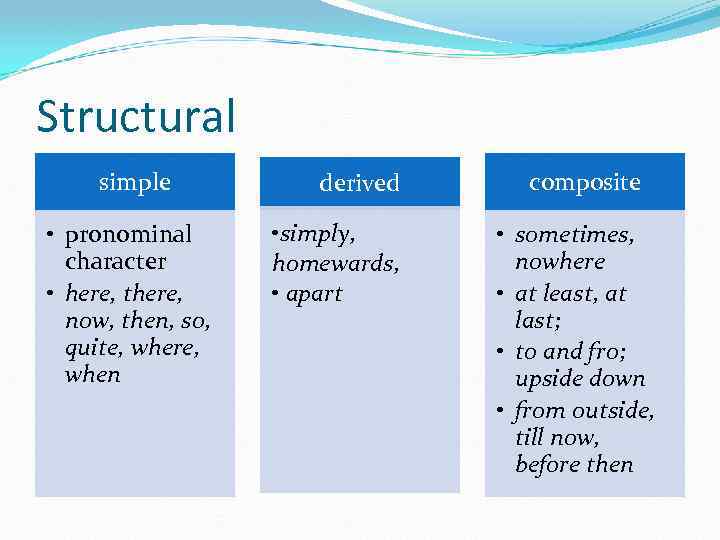
Structural simple • pronominal character • here, there, now, then, so, quite, where, when derived • simply, homewards, • apart composite • sometimes, nowhere • at least, at last; • to and fro; upside down • from outside, till now, before then
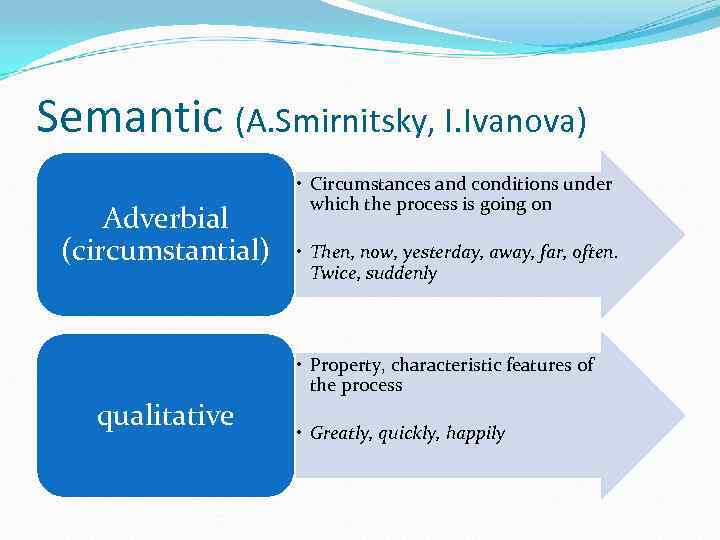
Semantic (A. Smirnitsky, I. Ivanova) Adverbial (circumstantial) qualitative • Circumstances and conditions under which the process is going on • Then, now, yesterday, away, far, often. Twice, suddenly • Property, characteristic features of the process • Greatly, quickly, happily
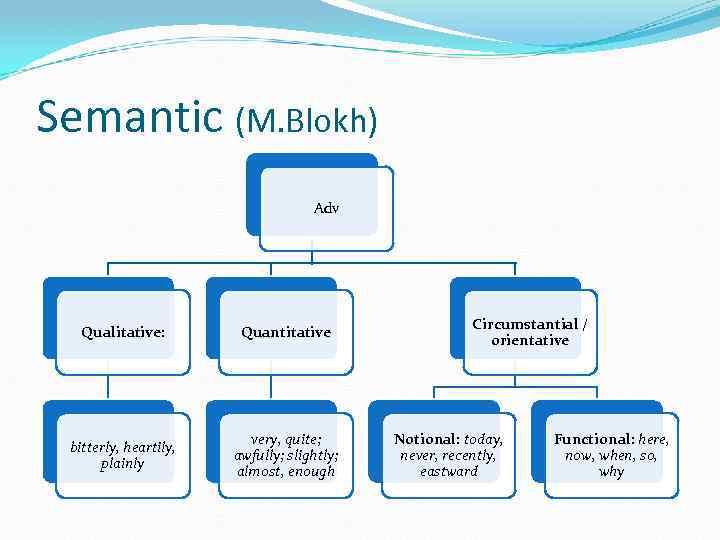
Semantic (M. Blokh) Adv Qualitative: Quantitative bitterly, heartily, plainly very, quite; awfully; slightly; almost, enough Circumstantial / orientative Notional: today, never, recently, eastward Functional: here, now, when, so, why
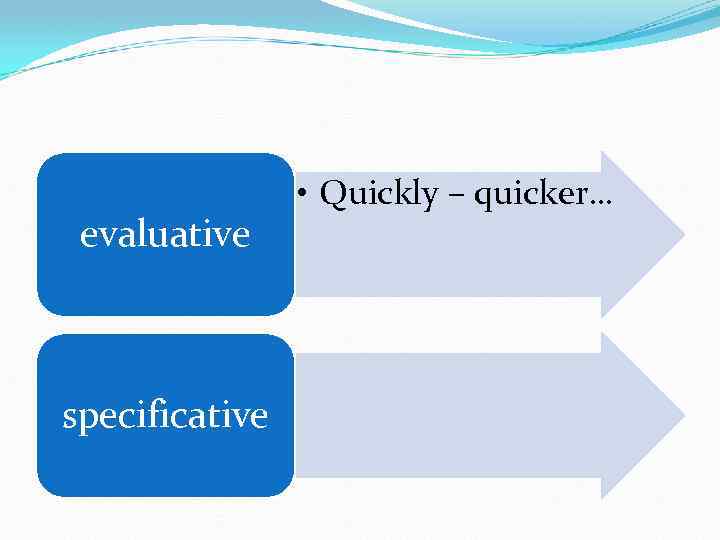
evaluative specificative • Quickly – quicker…
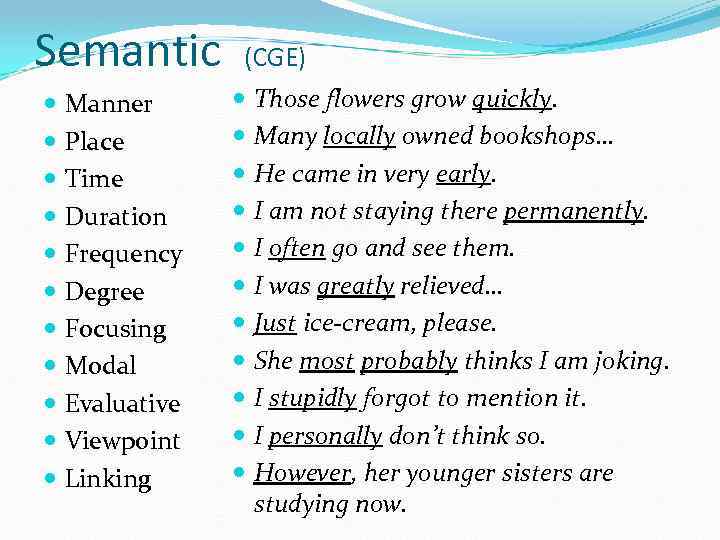
Semantic Manner Place Time Duration Frequency Degree Focusing Modal Evaluative Viewpoint Linking (CGE) Those flowers grow quickly. Many locally owned bookshops… He came in very early. I am not staying there permanently. I often go and see them. I was greatly relieved… Just ice-cream, please. She most probably thinks I am joking. I stupidly forgot to mention it. I personally don’t think so. However, her younger sisters are studying now.
Adverb Degrees of comparison
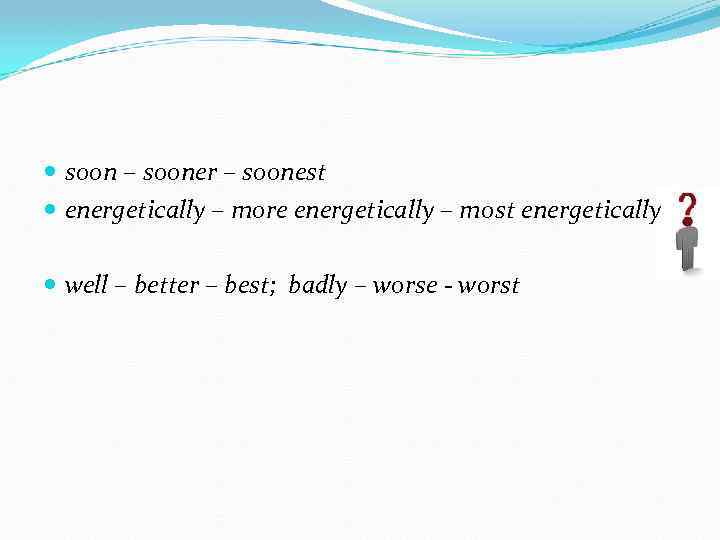
soon – sooner – soonest energetically – more energetically – most energetically well – better – best; badly – worse - worst
Literature Bussman H. Routledge Dictionary of Language and Linguistics. 1996. CGE = Carter R. , Mc. Carthy M. Cambridge Grammar of English. – CUP, 2006 Crystal D. The Cambridge Encyclopedia of the English Language. – CUP, 1995 Peters Pam. The Cambridge guide to English usage. – CUP, 2004.
Literature Бархударов Л. С. Очерки по морфологии современного АЯ. – М. , 1975. Блох М. Я. Теоретическая грамматика АЯ. – М. , 1983. Вейхман Г. А. Новое в грамматике современного АЯ. - М. : Астрель, 2002. Иванова И. П. , Бурлакова В. В. , Почепцов Г. Г. Теоретическая грамматика современного АЯ. – М. , 1981. Ильиш Б. А. Строй современного английского языка. – Л. , 1971. Корнеева Е. , Кобрина Н. , Гузеева К. , Оссовская М. Пособие по морфологии АЯ. – М. ВШ. , 1974 Плоткин В. Я. Строй английского языка. – М. : ВШ, 1989 Смирницкий А. И. Морфология АЯ. – М. , 1959.
Скачать презентацию Adjective and Adverb OUTLINE 1 Adjective Categorial
4 Adjective and Adverb.ppt