 Скачать презентацию Adelaide Poultry 1 Onsite WW Treatment Brief
8bba665a9ed409c8cf30c7dfa642e6d3.ppt
- Количество слайдов: 7



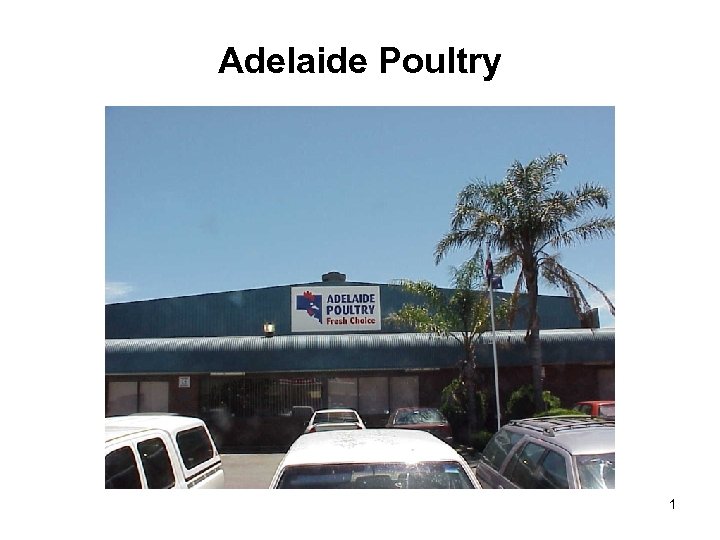
Adelaide Poultry 1
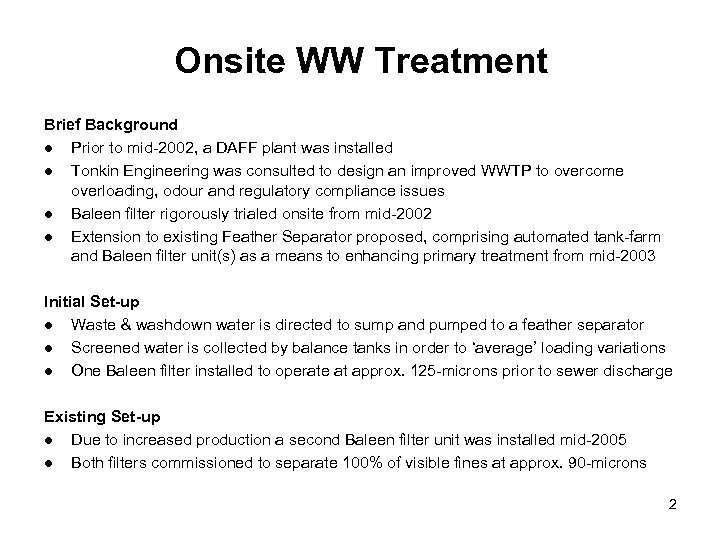
Onsite WW Treatment Brief Background ● Prior to mid-2002, a DAFF plant was installed ● Tonkin Engineering was consulted to design an improved WWTP to overcome overloading, odour and regulatory compliance issues ● Baleen filter rigorously trialed onsite from mid-2002 ● Extension to existing Feather Separator proposed, comprising automated tank-farm and Baleen filter unit(s) as a means to enhancing primary treatment from mid-2003 Initial Set-up ● Waste & washdown water is directed to sump and pumped to a feather separator ● Screened water is collected by balance tanks in order to ‘average’ loading variations ● One Baleen filter installed to operate at approx. 125 -microns prior to sewer discharge Existing Set-up ● Due to increased production a second Baleen filter unit was installed mid-2005 ● Both filters commissioned to separate 100% of visible fines at approx. 90 -microns 2
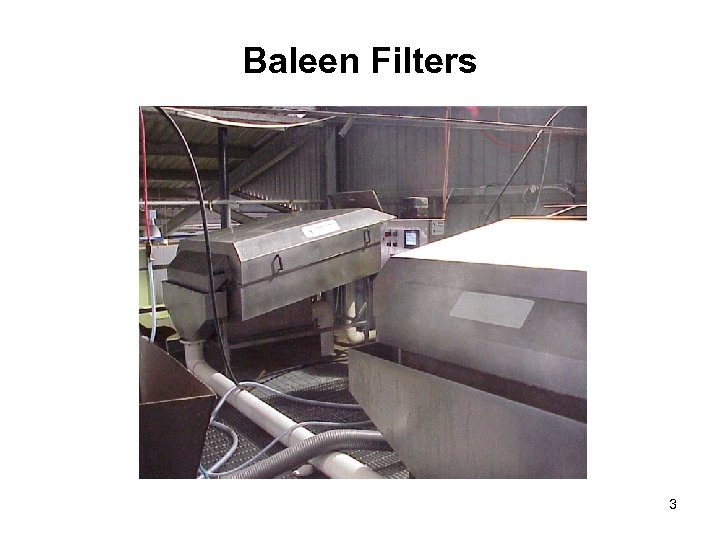
Baleen Filters 3
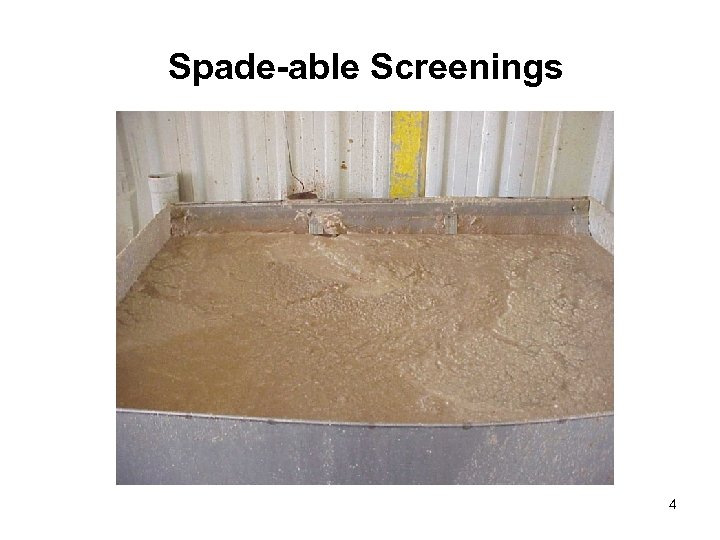
Spade-able Screenings 4
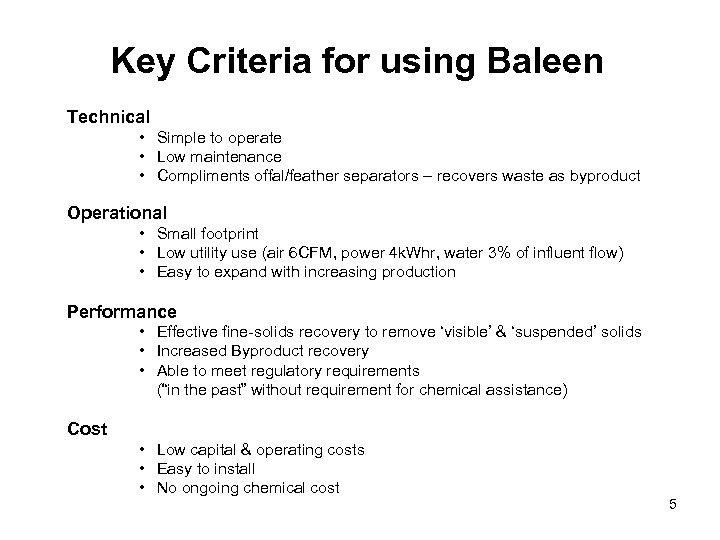
Key Criteria for using Baleen Technical • Simple to operate • Low maintenance • Compliments offal/feather separators – recovers waste as byproduct Operational • Small footprint • Low utility use (air 6 CFM, power 4 k. Whr, water 3% of influent flow) • Easy to expand with increasing production Performance • Effective fine-solids recovery to remove ‘visible’ & ‘suspended’ solids • Increased Byproduct recovery • Able to meet regulatory requirements (“in the past” without requirement for chemical assistance) Cost • Low capital & operating costs • Easy to install • No ongoing chemical cost 5
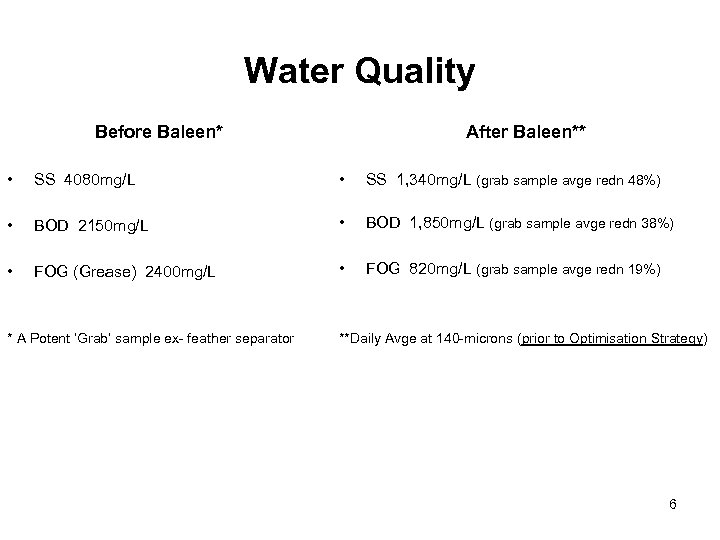
Water Quality Before Baleen* After Baleen** • SS 4080 mg/L • SS 1, 340 mg/L (grab sample avge redn 48%) • BOD 2150 mg/L • BOD 1, 850 mg/L (grab sample avge redn 38%) • FOG (Grease) 2400 mg/L • FOG 820 mg/L (grab sample avge redn 19%) * A Potent ‘Grab’ sample ex- feather separator **Daily Avge at 140 -microns (prior to Optimisation Strategy) 6
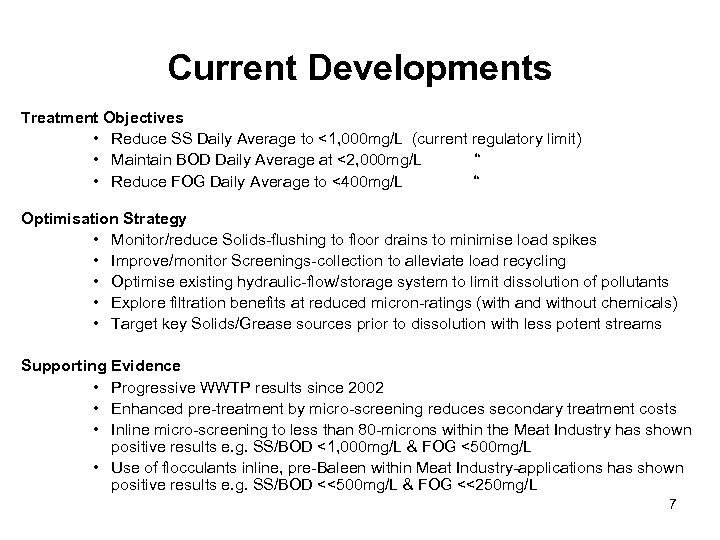
Current Developments Treatment Objectives • Reduce SS Daily Average to <1, 000 mg/L (current regulatory limit) • Maintain BOD Daily Average at <2, 000 mg/L “ • Reduce FOG Daily Average to <400 mg/L “ Optimisation Strategy • Monitor/reduce Solids-flushing to floor drains to minimise load spikes • Improve/monitor Screenings-collection to alleviate load recycling • Optimise existing hydraulic-flow/storage system to limit dissolution of pollutants • Explore filtration benefits at reduced micron-ratings (with and without chemicals) • Target key Solids/Grease sources prior to dissolution with less potent streams Supporting Evidence • Progressive WWTP results since 2002 • Enhanced pre-treatment by micro-screening reduces secondary treatment costs • Inline micro-screening to less than 80 -microns within the Meat Industry has shown positive results e. g. SS/BOD <1, 000 mg/L & FOG <500 mg/L • Use of flocculants inline, pre-Baleen within Meat Industry-applications has shown positive results e. g. SS/BOD <<500 mg/L & FOG <<250 mg/L 7
Скачать презентацию Adelaide Poultry 1 Onsite WW Treatment Brief
8bba665a9ed409c8cf30c7dfa642e6d3.ppt