


 Скачать презентацию ADDRESSING THE INFORMATIONAL REQUIREMENTS OF REGULATORY AGENCIES IN
74d3ed4bba7e5f62c9ac87a3f5f92691.ppt
- Количество слайдов: 15
 ADDRESSING THE INFORMATIONAL REQUIREMENTS OF REGULATORY AGENCIES IN INTERNATIONAL VACCINE DEVELOPMENT STUART Z. SHAPIRO MD, Ph. D Vaccine & Prevention Research Program DAIDS/NIAID/NIH sshapiro@niaid. nih. gov DHHS/NIH/NIAID/DAIDS September 8, 2004
 Ø The US FDA routinely approves export of unlicensed drugs/biologics to countries with similar or allied regulatory authorities: § Australia, Canada, Israel, Japan, New Zealand, Switzerland, South Africa, and any member of the European Union or the European Economic Area DHHS/NIH/NIAID/DAIDS September 8, 2004
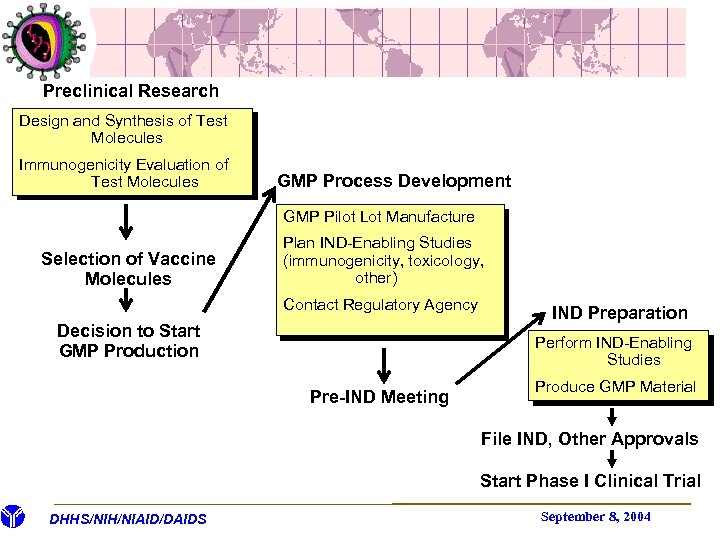 Preclinical Research Design and Synthesis of Test Molecules Immunogenicity Evaluation of Test Molecules GMP Process Development GMP Pilot Lot Manufacture Selection of Vaccine Molecules Plan IND-Enabling Studies (immunogenicity, toxicology, other) Contact Regulatory Agency Decision to Start GMP Production IND Preparation Perform IND-Enabling Studies Pre-IND Meeting Produce GMP Material File IND, Other Approvals Start Phase I Clinical Trial DHHS/NIH/NIAID/DAIDS September 8, 2004
 What are the Regulatory Agencies’ Major Concerns? SAFETY and efficacy DHHS/NIH/NIAID/DAIDS September 8, 2004
 What are the critical stages in vaccine clinical testing from the regulatory perspective? DHHS/NIH/NIAID/DAIDS September 8, 2004
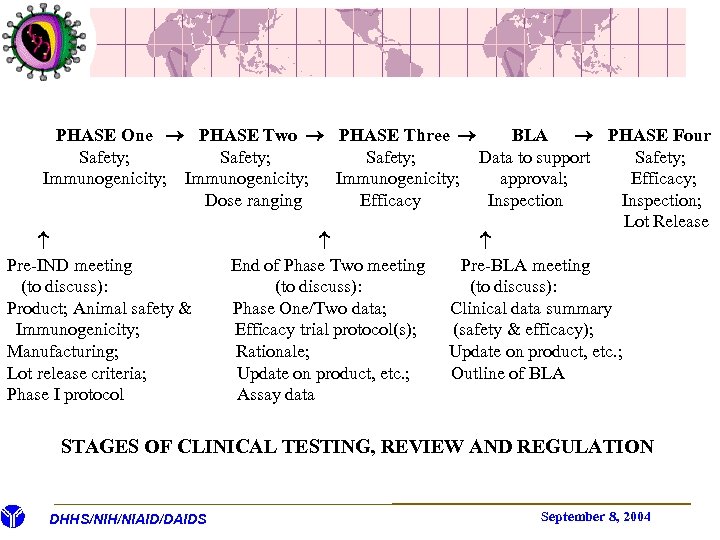 PHASE One PHASE Two PHASE Three BLA PHASE Four Safety; Data to support Safety; Immunogenicity; approval; Efficacy; Dose ranging Efficacy Inspection; Lot Release Pre-IND meeting End of Phase Two meeting Pre-BLA meeting (to discuss): (to discuss): Product; Animal safety & Phase One/Two data; Clinical data summary Immunogenicity; Efficacy trial protocol(s); (safety & efficacy); Manufacturing; Rationale; Update on product, etc. ; Lot release criteria; Update on product, etc. ; Outline of BLA Phase I protocol Assay data STAGES OF CLINICAL TESTING, REVIEW AND REGULATION DHHS/NIH/NIAID/DAIDS September 8, 2004
 The Three Basic Laws of the FDA (and ALL Regulatory Agencies) are: SAFETY! DHHS/NIH/NIAID/DAIDS September 8, 2004
 Safety Studies (for more detailed information see: Shapiro, S. Z. , Vaccine 20: 1261 -1280, 2002. ) 1. routine toxicology (human inoculations+1/human dose not dose per Kg/+adjuvant/4 -6 rabbits per group/ follow clinically then with thorough necropsy) 2. specialized toxicology for different types of vaccines a. DNA vaccines (biodistribution/integration) b. virus- and bacterial- or eukaryotic cell-vectored vaccines (non-pathogenic replication comp vs. replication incompetent) c. “whole-killed” virus vaccines (demonstrate killing) d. pseudovirion vaccines (demonstrate no live virus) e. Live attenuated virus vaccines (demonstrate attenuation) DHHS/NIH/NIAID/DAIDS September 8, 2004
 What Else Regulatory Agencies want to know about your vaccine: 1. 2. 3. 4. 5. description of the product previous human data relevant to the vaccine, if available description of the manufacturing process description of the manufacturing facility proposed Phase One clinical protocol and the clinical development plan 6. preclinical immunogenicity data with the proposed vaccine that justifies a clinical study DHHS/NIH/NIAID/DAIDS September 8, 2004
 DESCRIPTION OF THE MANUFACTURING PROCESS (flowchart, description of the manufacturing process steps, description of the source and quality of starting materials, description of in-process testing, and tentative lot-release specifications, i. e. description, identity, purity, sterility, general safety, potency) a. cell substrate testing (Ca and Adventitious agents) b. steps in the manufacturing process (GMP) c. in-process testing d. lot-release tests e. potency testing f. assay validation DHHS/NIH/NIAID/DAIDS September 8, 2004
 What is GMP? “Good Manufacturing Practices” Stanley Steamer vs. Model T Ford The Taylor System DHHS/NIH/NIAID/DAIDS September 8, 2004
 “We must organize in Russia the study and teaching of the Taylor system and systematically try it out and adapt it to our own ends. ” - V. I. Lenin “The Immediate Tasks of the Soviet Government” Pravda, no. 83, April 28, 1918 DHHS/NIH/NIAID/DAIDS September 8, 2004
 GMP=Manufacturing Consistency Why is manufacturing consistency so important for biologicals? Because inability to completely define end product by testing, GMP ensures: • Reproducibility of safety • Reproducibility of activity (efficacy) DHHS/NIH/NIAID/DAIDS September 8, 2004
 FDA (and related) DOCUMENTS (and how to get them) 1. CBER Investigational New Drug Application (IND) website: http: //www. fda. gov/cber/ind. htm 2. Code of Federal Regulations: http: //www. access. gpo. gov/nara/cfr/cfr-table-search. html 3. CBER Draft Guidances: http: //www. fda. gov/cber/guidelines. htm 4. CBER Points to Consider documents: http: //www. fda. gov/cber/points. htm 5. How to obtain CBER documents by CBER’s “Fax-on-demand” or mail: http: //www. fda. gov/cber/pubinfo/FAXinfo. htm 6. International Conference on Harmonisation Guidelines: http: //www. ifpma. org/ich 5. html 7. CDER’s orientation web site for drug development: http: //www. fda. gov/cder/regulatory/applications/default. htm 8. FDA Guidance on Export of Drugs http: //www. fda. gov/opacom/fedregister/frexport. html#quick%20 locator DHHS/NIH/NIAID/DAIDS September 8, 2004
 SUGGESTED READING Chandler, D. K. F. , Mc. Vittie, L. D. , and Novak, J. M. , “IND Application Submissions for Vaccines: Perspectives of IND Reviewers” Chapter 6 in VACCINES: FROM CONCEPT TO CLINIC, Paoletti, L. C. & Mc. Innes, P. M. (1999). CRC Press, Boca Raton, FL. Paoletti, L. C. , “Considerations in the Production of Vaccines for Use in Phase I Clinical Trials and Preparation of the Manufacturer’s Protocol” Chapter 4 in VACCINES: FROM CONCEPT TO CLINIC… Shapiro, S. Z. “The HIV/AIDS Vaccine Researcher’s Orientation to the Process of Preparing a US FDA Application for an Investigational New Drug (IND): What it is all about and how you start by preparing for your pre-IND meeting” Vaccine 20: 1261 -1280, 2002. DHHS/NIH/NIAID/DAIDS September 8, 2004