


 Скачать презентацию Addressing the Family Planning Needs of People Living
b960474e38de85177a7e97de520cb304.ppt
- Количество слайдов: 29
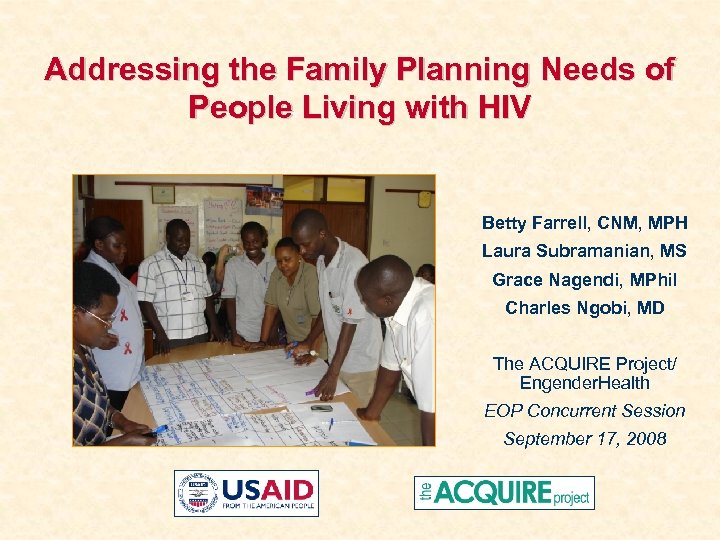 Addressing the Family Planning Needs of People Living with HIV Betty Farrell, CNM, MPH Laura Subramanian, MS Grace Nagendi, MPhil Charles Ngobi, MD The ACQUIRE Project/ Engender. Health EOP Concurrent Session September 17, 2008
 Session Outline n Integrating family planning (FP) and HIV services: definition, rationale and goals n Applications of ACQUIRE’s FP-HIV integration approach n Lessons learned and recommendations for FP-HIV integration programs
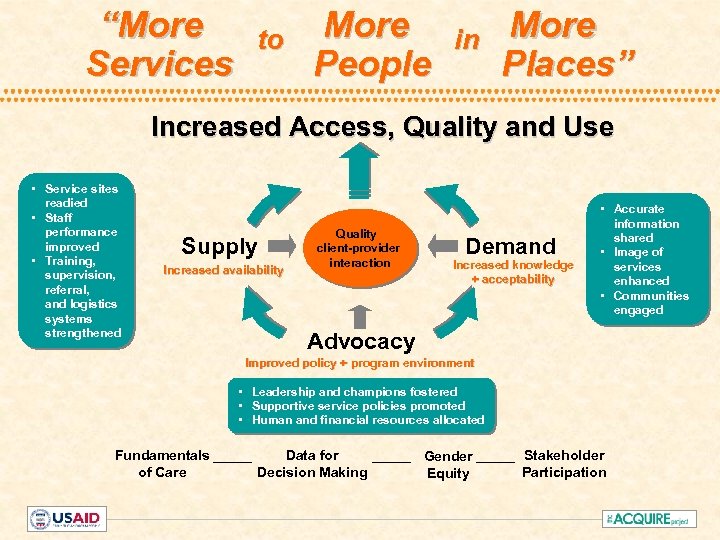 “More Services to More People in More Places” Increased Access, Quality and Use • Service sites readied • Staff performance improved • Training, supervision, referral, and logistics systems strengthened Supply Increased availability Quality client-provider interaction Demand Increased knowledge + acceptability • Accurate information shared • Image of services enhanced • Communities engaged Advocacy Improved policy + program environment • Leadership and champions fostered • Supportive service policies promoted • Human and financial resources allocated Fundamentals of Care Data for Decision Making Gender Equity Stakeholder Participation
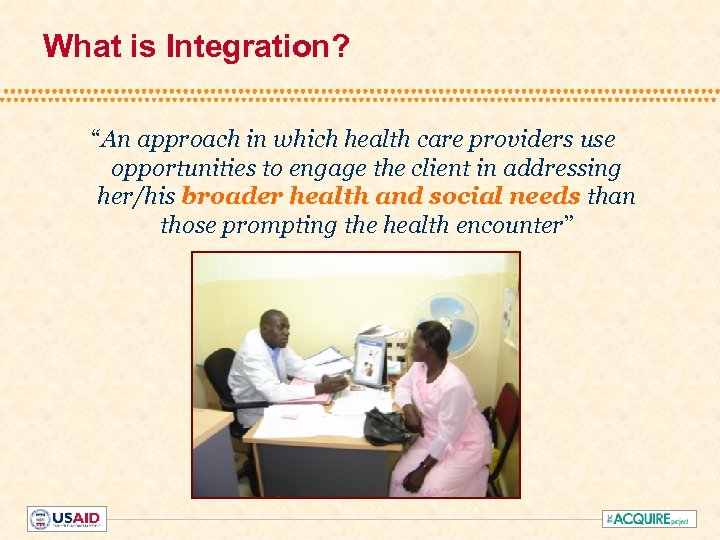 What is Integration? “An approach in which health care providers use opportunities to engage the client in addressing her/his broader health and social needs than those prompting the health encounter”
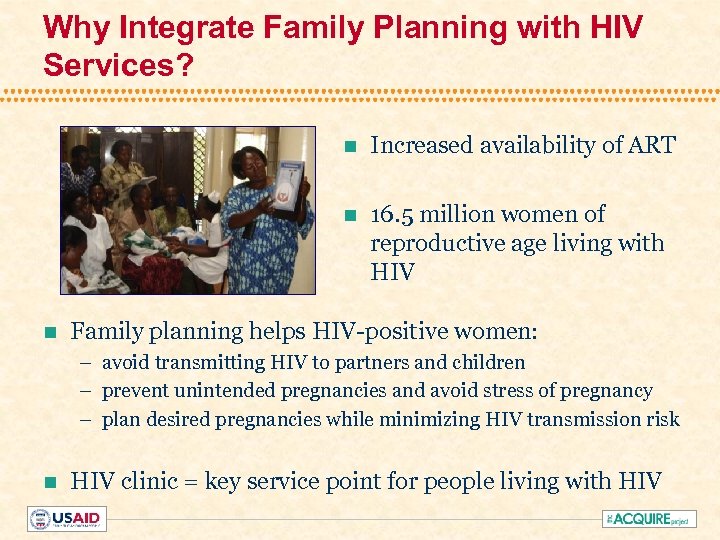 Why Integrate Family Planning with HIV Services? n n n Increased availability of ART 16. 5 million women of reproductive age living with HIV Family planning helps HIV-positive women: – avoid transmitting HIV to partners and children – prevent unintended pregnancies and avoid stress of pregnancy – plan desired pregnancies while minimizing HIV transmission risk n HIV clinic = key service point for people living with HIV
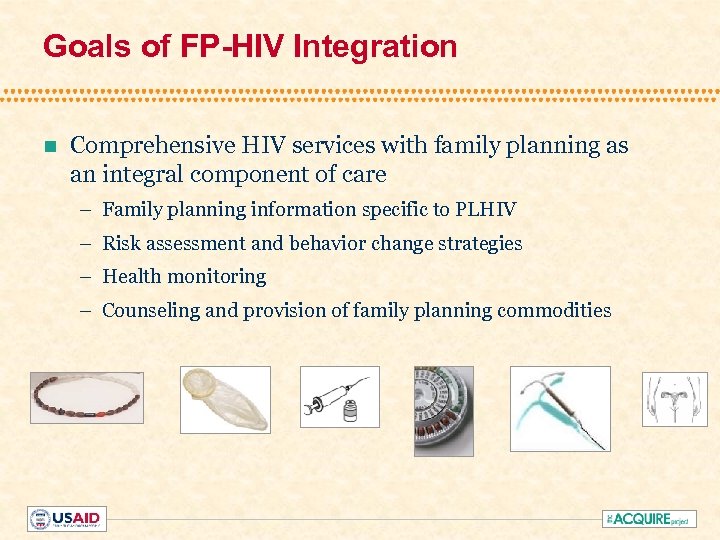 Goals of FP-HIV Integration n Comprehensive HIV services with family planning as an integral component of care – Family planning information specific to PLHIV – Risk assessment and behavior change strategies – Health monitoring – Counseling and provision of family planning commodities
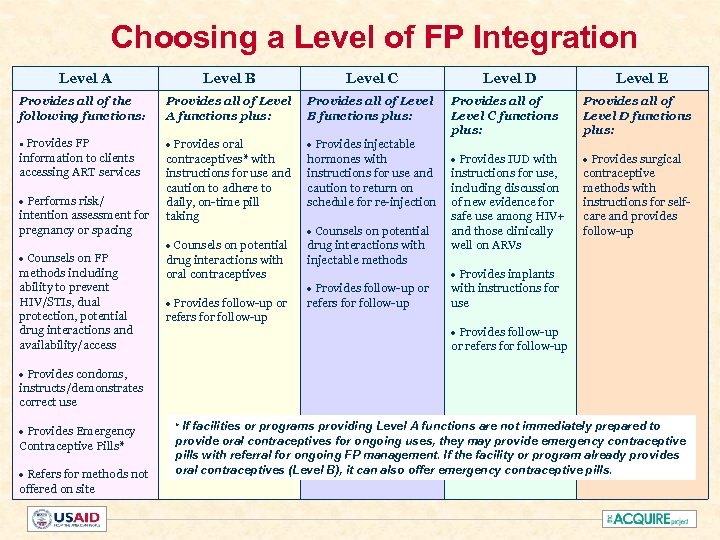 Choosing a Level of FP Integration Level A Level B Level C Provides all of the following functions: Provides all of Level A functions plus: Provides all of Level B functions plus: Provides oral Provides injectable contraceptives* with instructions for use and caution to adhere to daily, on-time pill taking hormones with instructions for use and caution to return on schedule for re-injection FP information to clients accessing ART services Performs risk/ intention assessment for pregnancy or spacing Counsels on FP methods including ability to prevent HIV/STIs, dual protection, potential drug interactions and availability/access Counsels on potential drug interactions with oral contraceptives drug interactions with injectable methods Level E Provides all of Level C functions plus: Provides all of Level D functions plus: Provides IUD with Provides surgical instructions for use, including discussion of new evidence for safe use among HIV+ and those clinically well on ARVs contraceptive methods with instructions for selfcare and provides follow-up Provides implants Provides follow-up or Level D refers for follow-up with instructions for use refers for follow-up Provides follow-up or refers for follow-up Provides condoms, instructs/demonstrates correct use Provides Emergency Contraceptive Pills* Refers for methods not offered on site * If facilities or programs providing Level A functions are not immediately prepared to provide oral contraceptives for ongoing uses, they may provide emergency contraceptive pills with referral for ongoing FP management. If the facility or program already provides oral contraceptives (Level B), it can also offer emergency contraceptive pills.
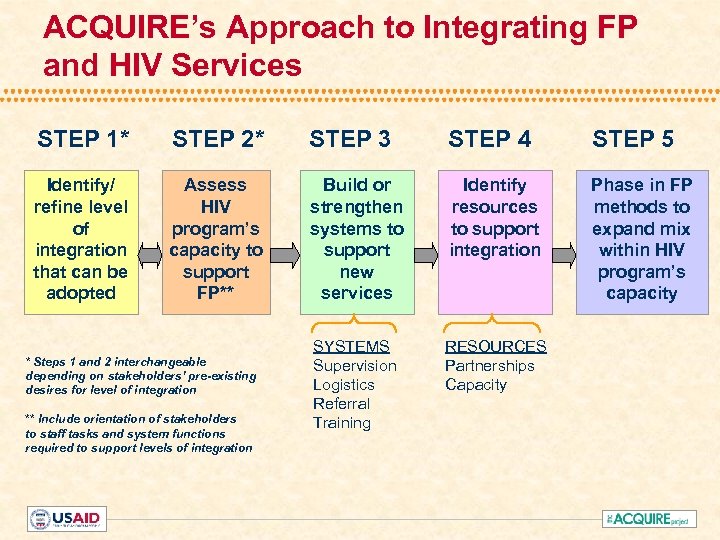 ACQUIRE’s Approach to Integrating FP and HIV Services STEP 1* STEP 2* STEP 3 STEP 4 STEP 5 Identify/ refine level of integration that can be adopted Assess HIV program’s capacity to support FP** Build or strengthen systems to support new services Identify resources to support integration Phase in FP methods to expand mix within HIV program’s capacity SYSTEMS Supervision Logistics Referral Training RESOURCES Partnerships Capacity * Steps 1 and 2 interchangeable depending on stakeholders’ pre-existing desires for level of integration ** Include orientation of stakeholders to staff tasks and system functions required to support levels of integration
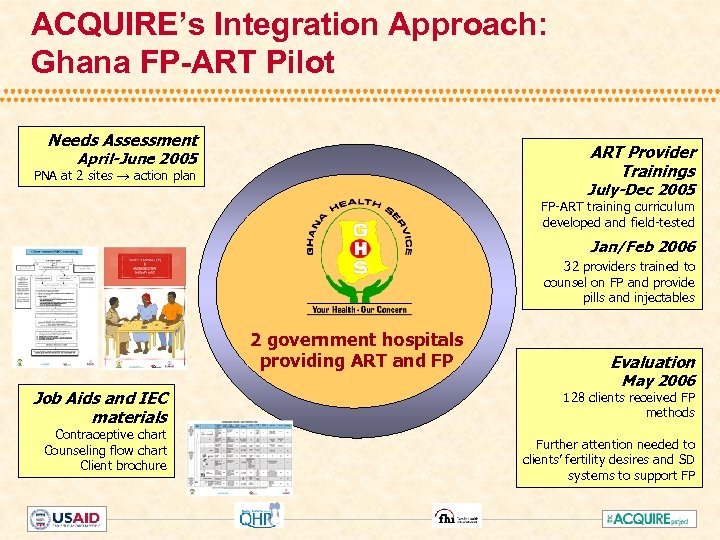 ACQUIRE’s Integration Approach: Ghana FP-ART Pilot Needs Assessment ART Provider Trainings April-June 2005 PNA at 2 sites action plan July-Dec 2005 FP-ART training curriculum developed and field-tested Jan/Feb 2006 32 providers trained to counsel on FP and provide pills and injectables 2 government hospitals providing ART and FP Job Aids and IEC materials Contraceptive chart Counseling flow chart Client brochure Evaluation May 2006 128 clients received FP methods Further attention needed to clients’ fertility desires and SD systems to support FP
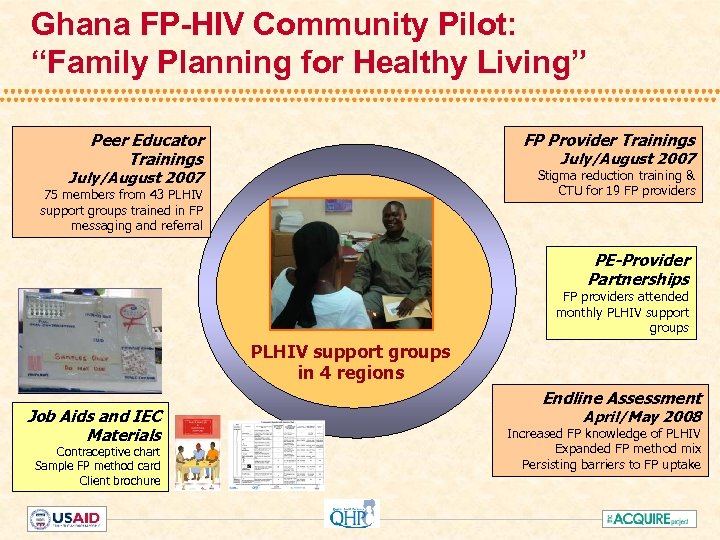 Ghana FP-HIV Community Pilot: “Family Planning for Healthy Living” Peer Educator Trainings FP Provider Trainings July/August 2007 Stigma reduction training & CTU for 19 FP providers July/August 2007 75 members from 43 PLHIV support groups trained in FP messaging and referral PE-Provider Partnerships FP providers attended monthly PLHIV support groups in 4 regions Job Aids and IEC Materials Contraceptive chart Sample FP method card Client brochure Endline Assessment April/May 2008 Increased FP knowledge of PLHIV Expanded FP method mix Persisting barriers to FP uptake
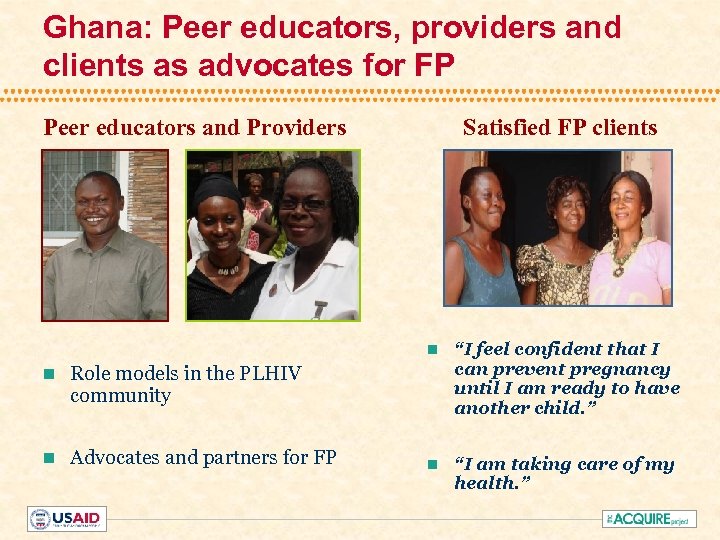 Ghana: Peer educators, providers and clients as advocates for FP Peer educators and Providers Satisfied FP clients n n Advocates and partners for FP n “I am taking care of my health. ” Role models in the PLHIV community n “I feel confident that I can prevent pregnancy until I am ready to have another child. ”
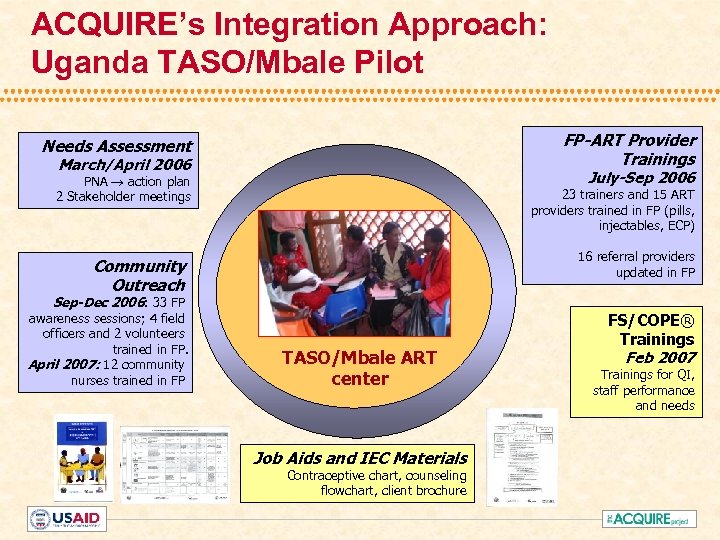 ACQUIRE’s Integration Approach: Uganda TASO/Mbale Pilot FP-ART Provider Trainings Needs Assessment March/April 2006 July-Sep 2006 PNA action plan 2 Stakeholder meetings 23 trainers and 15 ART providers trained in FP (pills, injectables, ECP) 16 referral providers updated in FP Community Outreach Sep-Dec 2006: 33 FP awareness sessions; 4 field officers and 2 volunteers trained in FP. April 2007: 12 community nurses trained in FP TASO/Mbale ART center Job Aids and IEC Materials Contraceptive chart, counseling flowchart, client brochure FS/COPE® Trainings Feb 2007 Trainings for QI, staff performance and needs
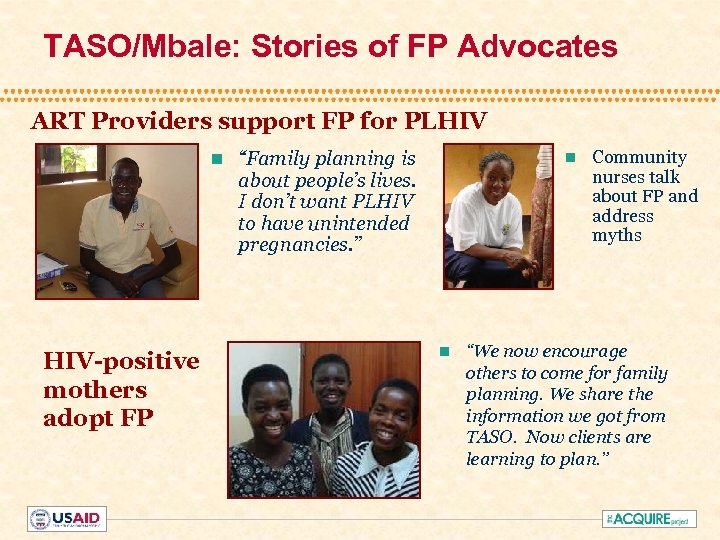 TASO/Mbale: Stories of FP Advocates ART Providers support FP for PLHIV n HIV-positive mothers adopt FP “Family planning is about people’s lives. I don’t want PLHIV to have unintended pregnancies. ” n n Community nurses talk about FP and address myths “We now encourage others to come for family planning. We share the information we got from TASO. Now clients are learning to plan. ”
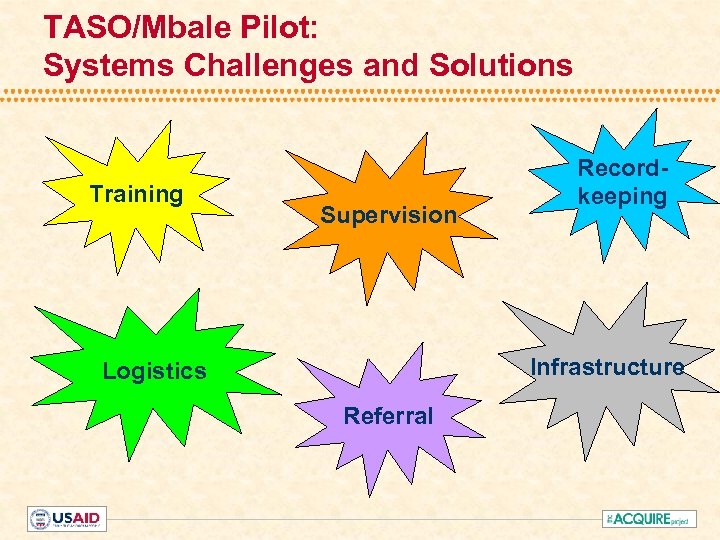 TASO/Mbale Pilot: Systems Challenges and Solutions Training Supervision Recordkeeping Infrastructure Logistics Referral
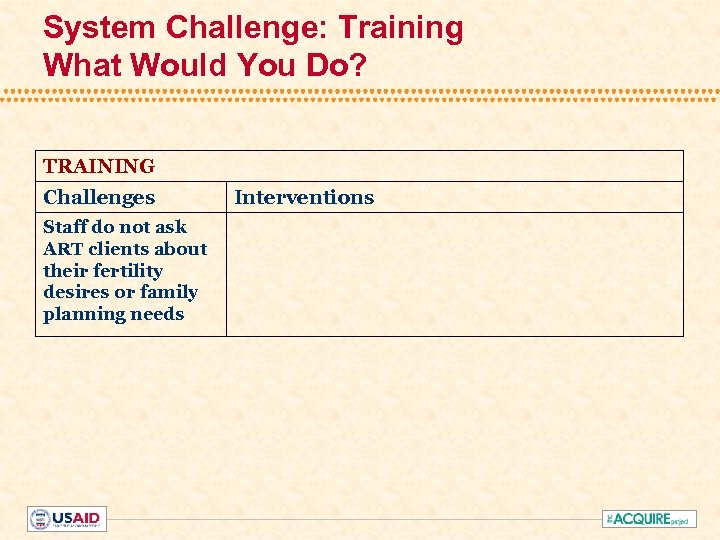 System Challenge: Training What Would You Do? TRAINING Challenges Staff do not ask ART clients about their fertility desires or family planning needs Interventions
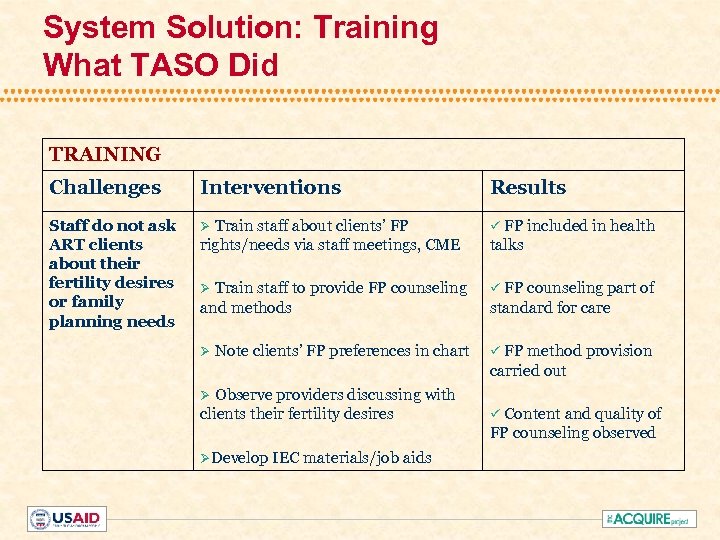 System Solution: Training What TASO Did TRAINING Challenges Interventions Results Staff do not ask ART clients about their fertility desires or family planning needs Ø Train staff about clients’ FP ü FP included in health rights/needs via staff meetings, CME talks Ø Train staff to provide FP counseling ü FP counseling part of and methods standard for care Ø Note clients’ FP preferences in chart ü FP method provision carried out Ø Observe providers discussing with clients their fertility desires ü Content and quality of FP counseling observed ØDevelop IEC materials/job aids
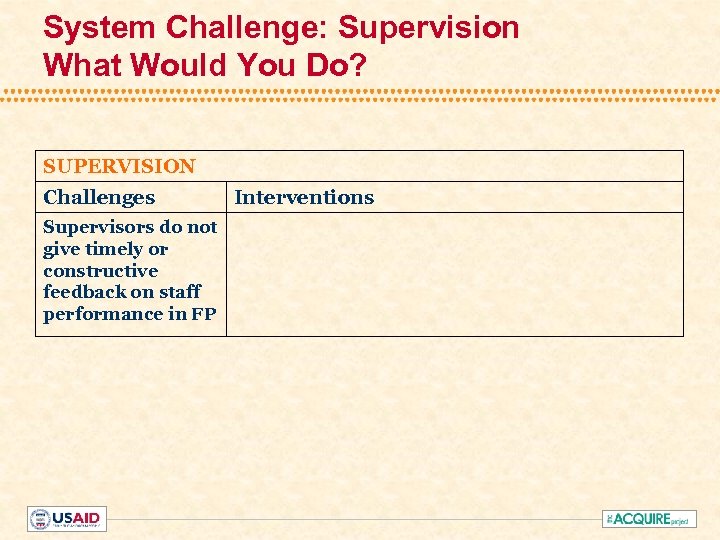 System Challenge: Supervision What Would You Do? SUPERVISION Challenges Supervisors do not give timely or constructive feedback on staff performance in FP Interventions
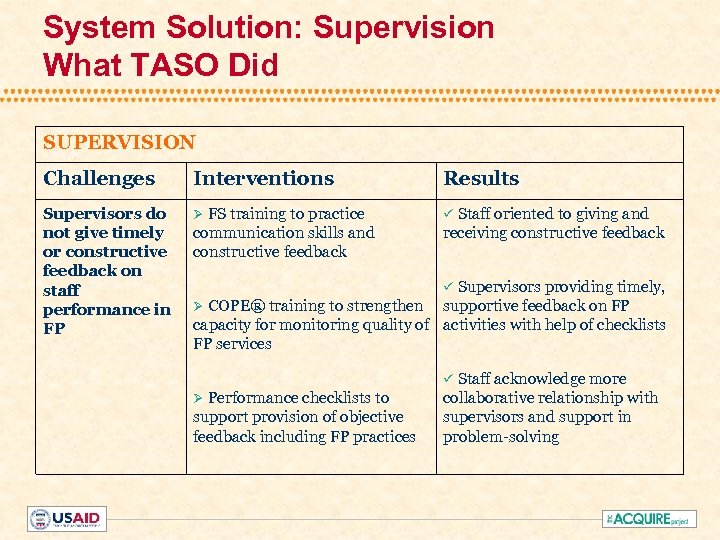 System Solution: Supervision What TASO Did SUPERVISION Challenges Interventions Results Supervisors do not give timely or constructive feedback on staff performance in FP Ø FS training to practice ü Staff oriented to giving and communication skills and constructive feedback receiving constructive feedback ü Supervisors providing timely, supportive feedback on FP capacity for monitoring quality of activities with help of checklists FP services Ø COPE® training to strengthen ü Staff acknowledge more Ø Performance checklists to support provision of objective feedback including FP practices collaborative relationship with supervisors and support in problem-solving
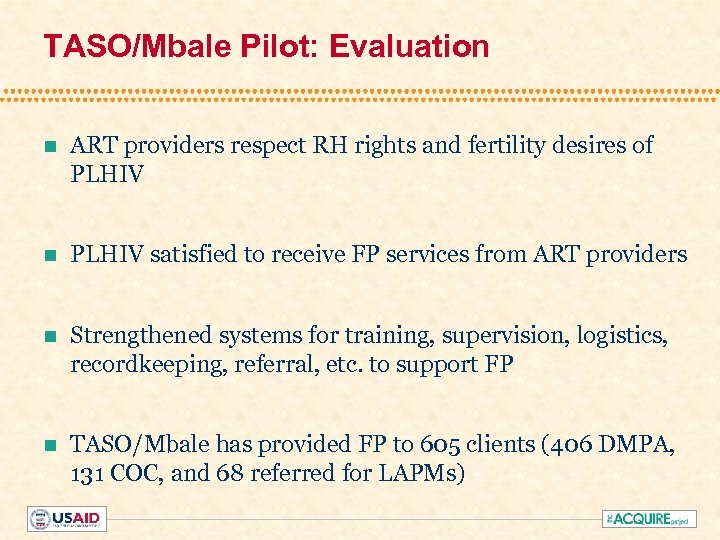 TASO/Mbale Pilot: Evaluation n ART providers respect RH rights and fertility desires of PLHIV n PLHIV satisfied to receive FP services from ART providers n Strengthened systems for training, supervision, logistics, recordkeeping, referral, etc. to support FP n TASO/Mbale has provided FP to 605 clients (406 DMPA, 131 COC, and 68 referred for LAPMs)
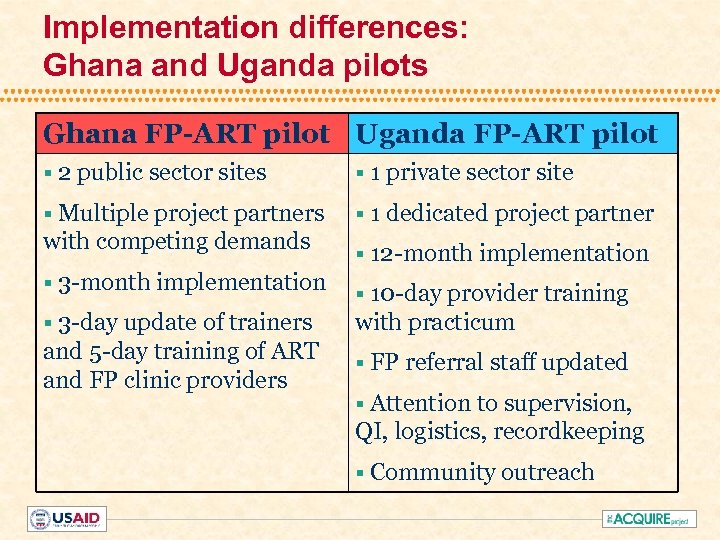 Implementation differences: Ghana and Uganda pilots Ghana FP-ART pilot Uganda FP-ART pilot § 2 public sector sites § 1 private sector site § Multiple project partners § 1 dedicated project partner with competing demands § 3 -month implementation § 12 -month implementation § 10 -day provider training § 3 -day update of trainers with practicum and 5 -day training of ART and FP clinic providers § FP referral staff updated § Attention to supervision, QI, logistics, recordkeeping § Community outreach
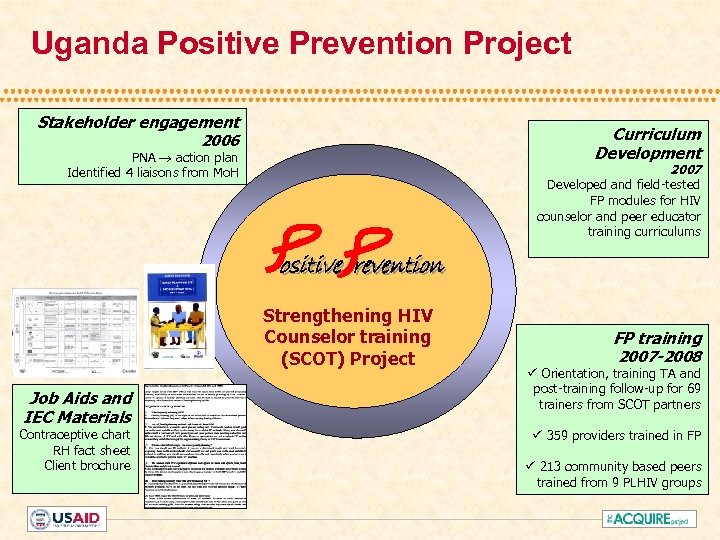 Uganda Positive Prevention Project Stakeholder engagement Curriculum Development 2006 PNA action plan Identified 4 liaisons from Mo. H 2007 Developed and field-tested FP modules for HIV counselor and peer educator training curriculums Strengthening HIV Counselor training (SCOT) Project Job Aids and IEC Materials Contraceptive chart RH fact sheet Client brochure FP training 2007 -2008 ü Orientation, training TA and post-training follow-up for 69 trainers from SCOT partners ü 359 providers trained in FP ü 213 community based peers trained from 9 PLHIV groups
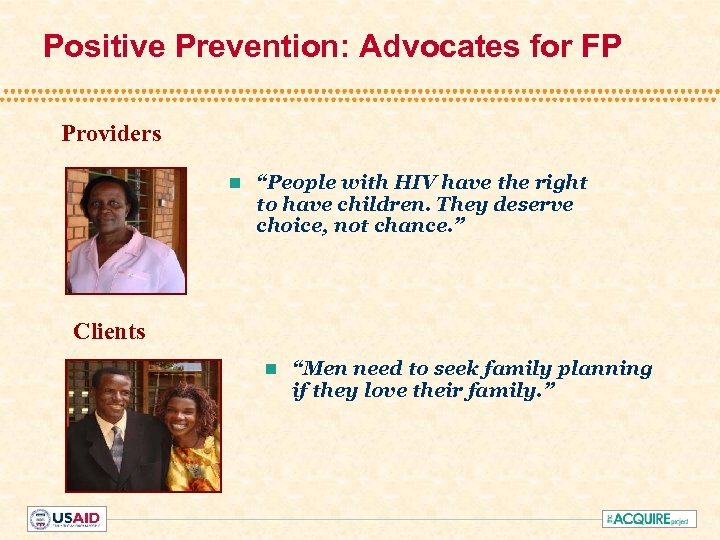 Positive Prevention: Advocates for FP Providers n “People with HIV have the right to have children. They deserve choice, not chance. ” Clients n “Men need to seek family planning if they love their family. ”
 Integrating FP and HIV Services: Lessons Learned n FP-integrated HIV services are acceptable, feasible and effective n Integration can be implemented at a variety of levels n Holistic Supply-Demand-Advocacy approach contributes to successful sustained integrated services
 ACQUIRE’s Integration Approach: Lessons Learned n Supply: strengthening systems is key – Counseling/clinical training in FP with practicum, post-training follow-up, job aids/ IEC materials – FS/COPE® to strengthen overall systems and supervision – TA for using FP commodity supply system – Accurate, organized records to track provision of FP counseling and methods – Strong referral linkages – Assistance from volunteers to manage increased workload
 ACQUIRE’s Integration Approach: Lessons Learned (continued) n Demand: generate FP awareness and link HIVpositive clients with services – Disseminate FP info through awareness sessions and campaigns – Develop partnerships with peer educators and PLHIV groups n Advocacy: gain buy-in to create/maintain a supportive environment for integration – Collaborate with stakeholders, including community – Orient donors to integrationale and approach – Engage senior health personnel in integration process – Create fora for collaboration between FP and HIV leadership – Develop supportive guidelines and policies for integration
 Recommendations for FP-HIV Integration n 5 -step integration approach with SDA elements and attention to systems strengthening – Engage multiple levels of facility and Mo. H staff – Consider LOE required for integration – Implement comprehensive FP training + follow-up package including addressing provider attitudes toward PLHIV – Update referral site staff to strengthen linkages – Partner with PLHIV communities as advocates for FP – Assess site capacity for expanding FP method mix n Explore modifications to ACQUIRE integration approach
 Acknowledgments n USAID – Mary Ann Abeyta-Behnke, Sereen Thaddeus, Peter Wondergem n TASO – Drs. K. Mugisha & C. Ngobi; G. Ochieng; Center staff n Uganda Mo. H – Drs. Sentongo, Madra, Latigo, Esiru, Lukoda n Mbale Regional Hospital FP Unit – the late Sr. Tunde n ACQUIRE/Uganda – Dr. H. Kakande, G. Nagendi n QHP – O. Aglah, Drs. P. Preko and E. Bonku, P. Ampofo, R. Killian n OICI, CRS, SHARP and Ghana Health Service n ACQUIRE/NY – A. Kaniauskene, N. Johri, N. Russell, J. Wickstrom n Photo credits: N. Russell and TASO/Mbale
 Featured Materials n n n n n FP/HIV Integration Framework document (NY, June 2006) ACQUIRING Knowledge: TASO/Mbale Project Brief (NY, 2007) Evaluation of the TASO FP/ART Pilot (NY, August 2008) Job Aids from Ghana and Uganda (2005, 2006) Contraception for Women and Couples with HIV (FHI/ACQUIRE product collaboration) FP-HIV Integration Toolkit (FHI/ACQUIRE product collaboration) Positive Prevention Family Planning Module #9 (from the tool Positive Prevention Counseling: A training manual (Uganda, 2007) Integrating Family Planning with HIV Care and Treatment Services: A Training Curriculum for Providers & Counselors (Uganda, July 2006) Ghana Peer Educator training manual: Family Planning for People Living with HIV and AIDS, July 2007
 Want to Know More? n Visit the ACQUIRE Project website: www. acquireproject. org or email us at infoacquire@acquireproject. org n To learn more about TASO and their activities, visit their website at www. tasouganda. org. For specific information on TASO/Mbale, visit http: //www. tasouganda. org/mbl. php