


 Скачать презентацию Addressing Health and Safety in Early Care and
1e4c49a72a938dc29acf9ccca8c76678.ppt
- Количество слайдов: 27
 Addressing Health and Safety in Early Care and Education Programs: Essential to Quality and Outcomes Judith Meyers, Ph. D Angela A. Crowley, Ph. D, APRN, PNP-BC, FAAN Yale Marjorie S. Rosenthal, MD, MPH, FAAP University School of August 25, 2011 Medicine
 Health as Key Component of School Readiness: Public/Private Partnership n n Children’s Fund of CT/Yale University/Head Start Collaborative/DSS CHDI/Key Goal – advance health and mental health care systems to improve health outcomes for children in CT Framework for Comprehensive Child Health System Key Component of ECE System Development (e. g. PA 11 -181 and RTTT-ELC)
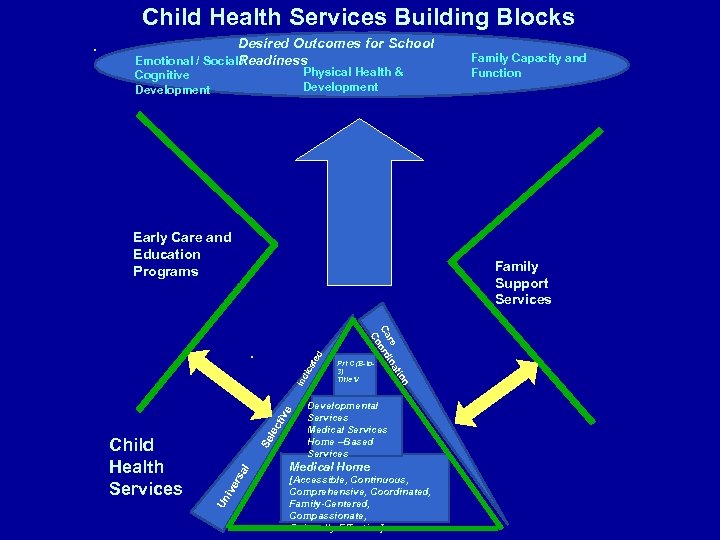 Child Health Services Building Blocks Desired Outcomes for School Emotional / Social. Readiness / Physical Health & Development Cognitive Development Early Care and Education Programs ted ica Ind e tiv lec Se al rs ive n Prt C (B-to 3) Title V tio re ina Ca ord Co Child Health Services Family Capacity and Function Family Support Services . Un . Developmental Services Medical Services Home –Based Services Medical Home [Accessible, Continuous, Comprehensive, Coordinated, Family-Centered, Compassionate, Culturally Effective]
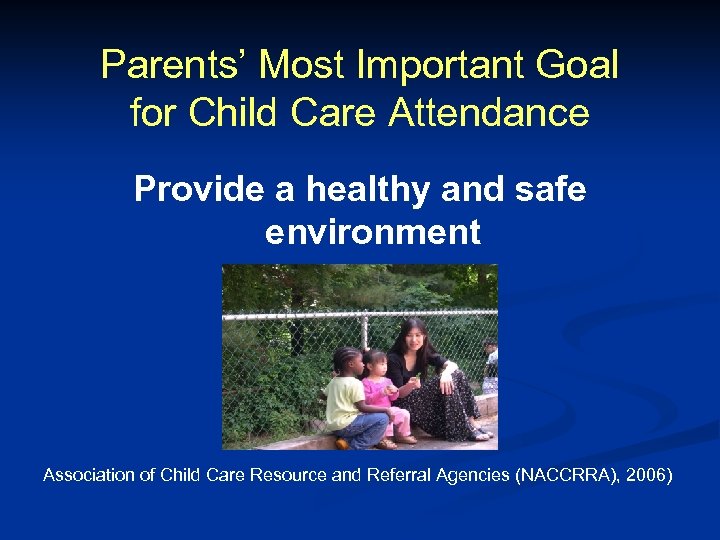 Parents’ Most Important Goal for Child Care Attendance Provide a healthy and safe environment Association of Child Care Resource and Referral Agencies (NACCRRA), 2006)
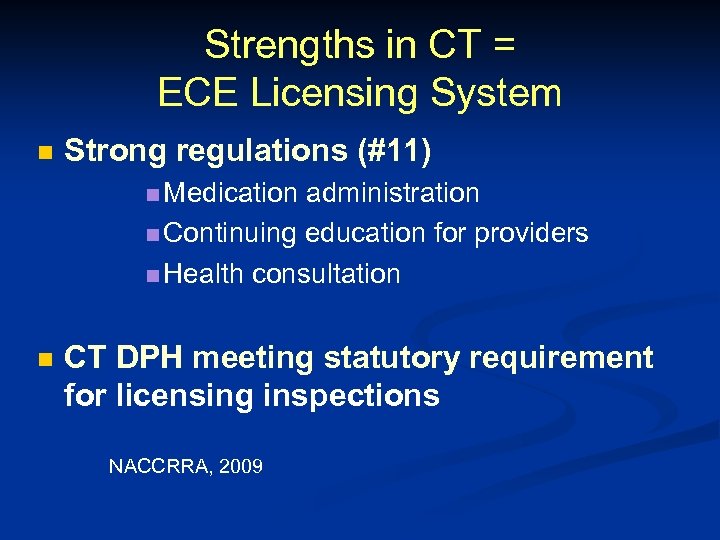 Strengths in CT = ECE Licensing System n Strong regulations (#11) n Medication administration n Continuing education for providers n Health consultation n CT DPH meeting statutory requirement for licensing inspections NACCRRA, 2009
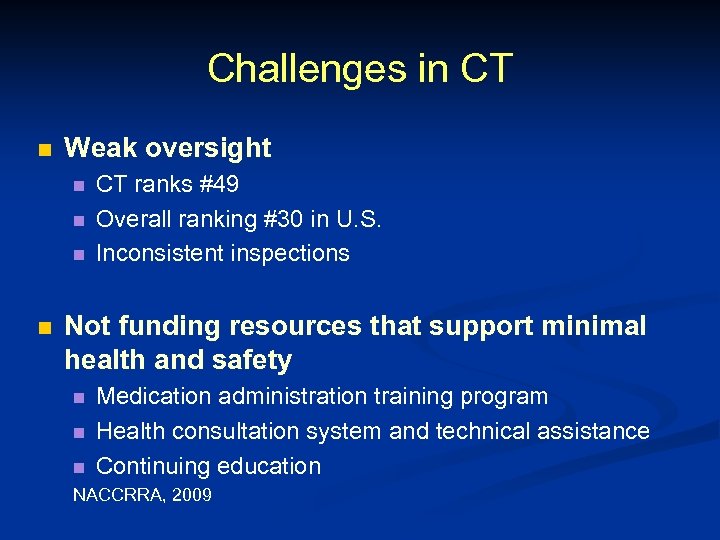 Challenges in CT n Weak oversight n n CT ranks #49 Overall ranking #30 in U. S. Inconsistent inspections Not funding resources that support minimal health and safety n n n Medication administration training program Health consultation system and technical assistance Continuing education NACCRRA, 2009
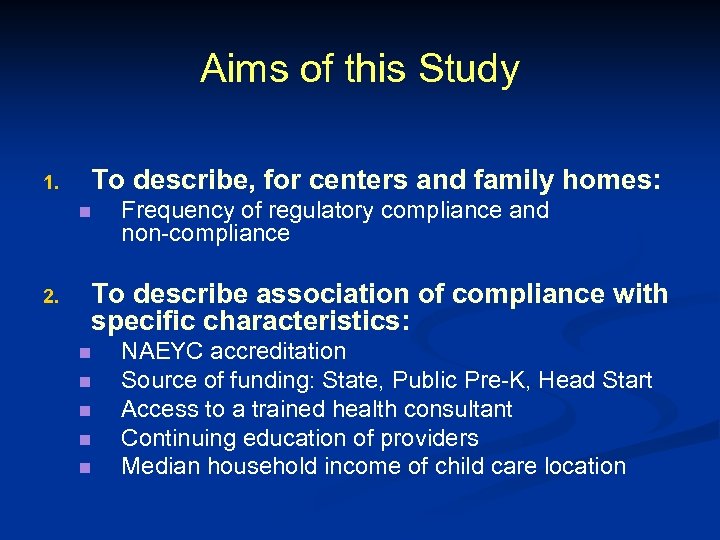 Aims of this Study 1. To describe, for centers and family homes: n 2. Frequency of regulatory compliance and non-compliance To describe association of compliance with specific characteristics: n n n NAEYC accreditation Source of funding: State, Public Pre-K, Head Start Access to a trained health consultant Continuing education of providers Median household income of child care location
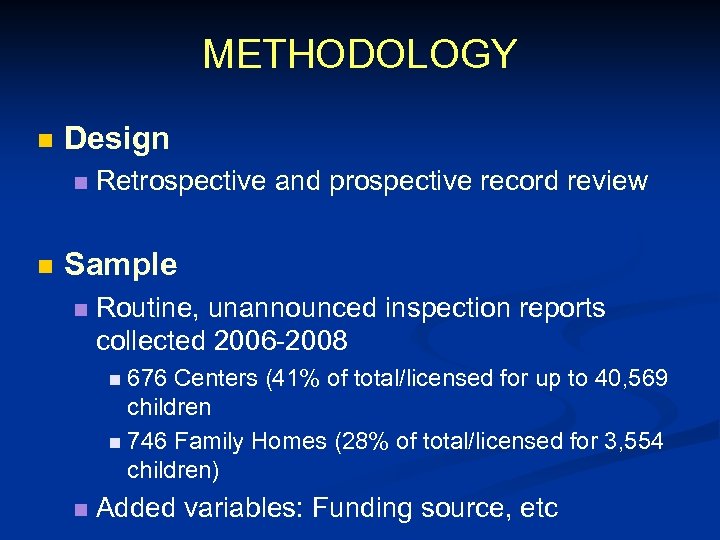 METHODOLOGY n Design n n Retrospective and prospective record review Sample n Routine, unannounced inspection reports collected 2006 -2008 n 676 Centers (41% of total/licensed for up to 40, 569 children n 746 Family Homes (28% of total/licensed for 3, 554 children) n Added variables: Funding source, etc
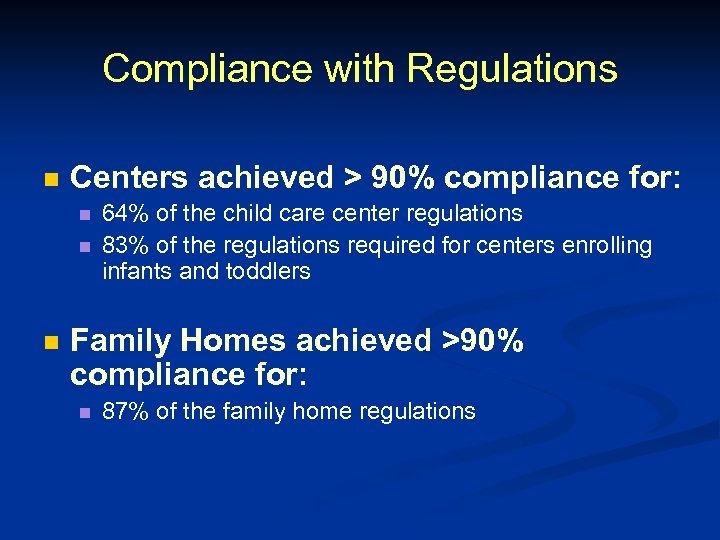 Compliance with Regulations n Centers achieved > 90% compliance for: n n n 64% of the child care center regulations 83% of the regulations required for centers enrolling infants and toddlers Family Homes achieved >90% compliance for: n 87% of the family home regulations
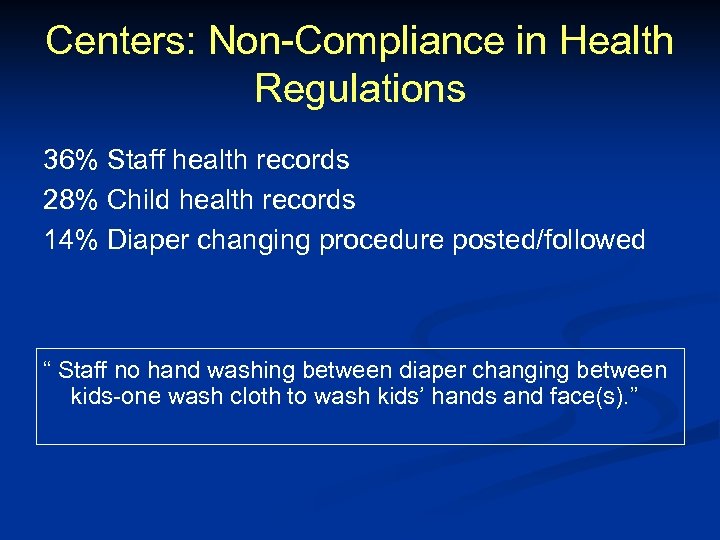 Centers: Non-Compliance in Health Regulations 36% Staff health records 28% Child health records 14% Diaper changing procedure posted/followed “ Staff no hand washing between diaper changing between kids-one wash cloth to wash kids’ hands and face(s). ”
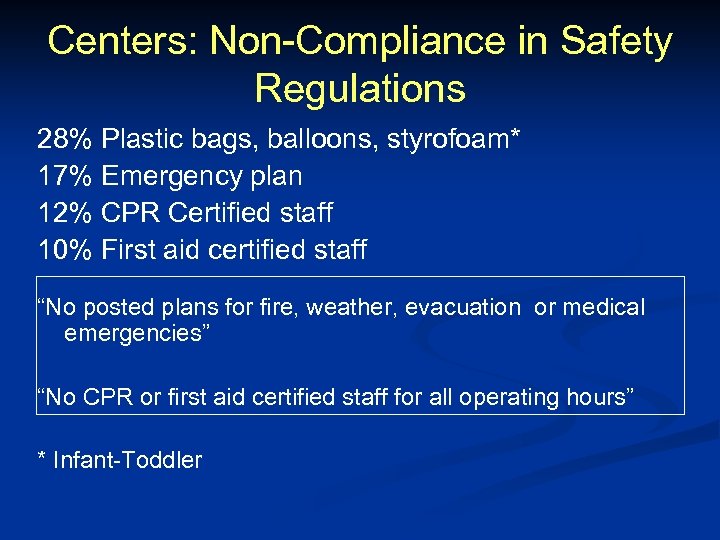 Centers: Non-Compliance in Safety Regulations 28% Plastic bags, balloons, styrofoam* 17% Emergency plan 12% CPR Certified staff 10% First aid certified staff “No posted plans for fire, weather, evacuation or medical emergencies” “No CPR or first aid certified staff for all operating hours” * Infant-Toddler
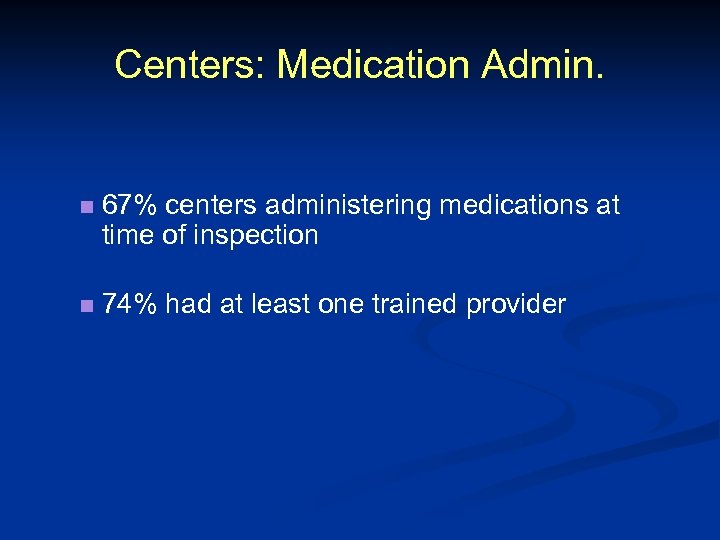 Centers: Medication Admin. n 67% centers administering medications at time of inspection n 74% had at least one trained provider
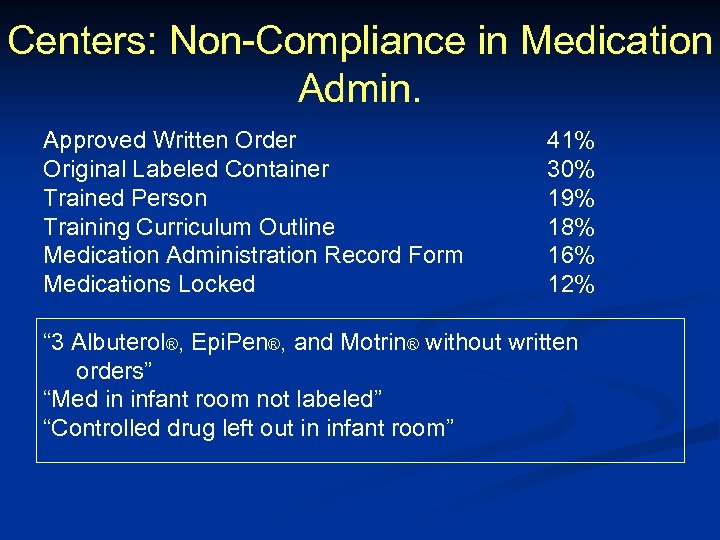 Centers: Non-Compliance in Medication Admin. Approved Written Order Original Labeled Container Trained Person Training Curriculum Outline Medication Administration Record Form Medications Locked 41% 30% 19% 18% 16% 12% “ 3 Albuterol®, Epi. Pen®, and Motrin® without written orders” “Med in infant room not labeled” “Controlled drug left out in infant room”
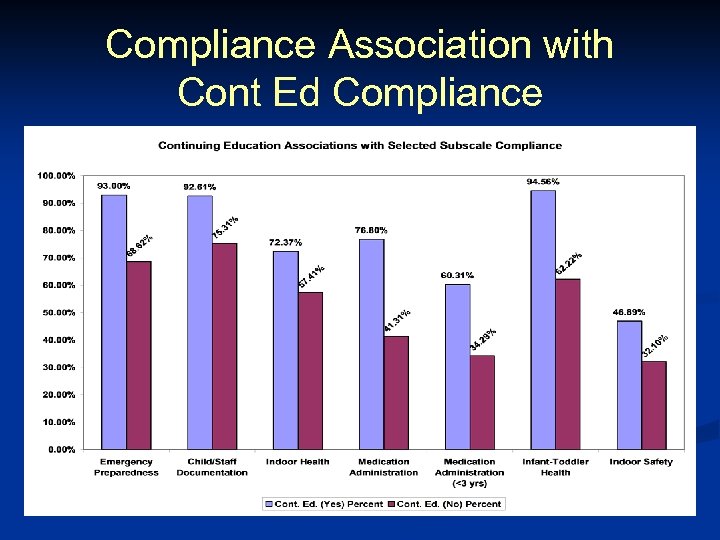 Compliance Association with Cont Ed Compliance
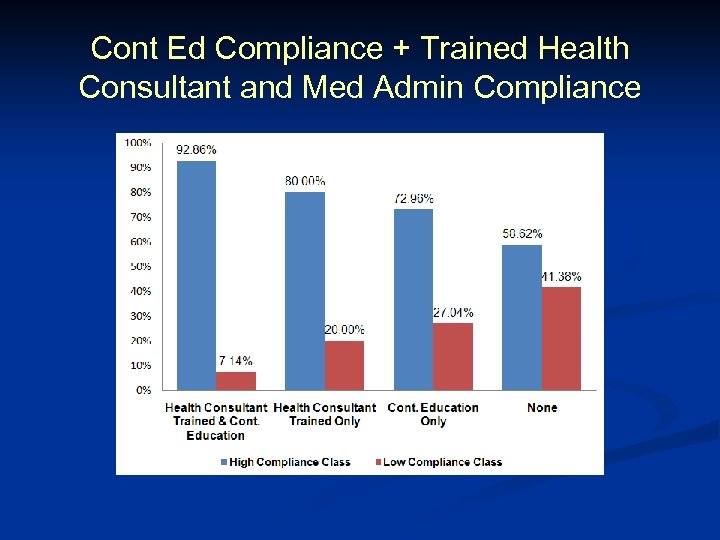 Cont Ed Compliance + Trained Health Consultant and Med Admin Compliance
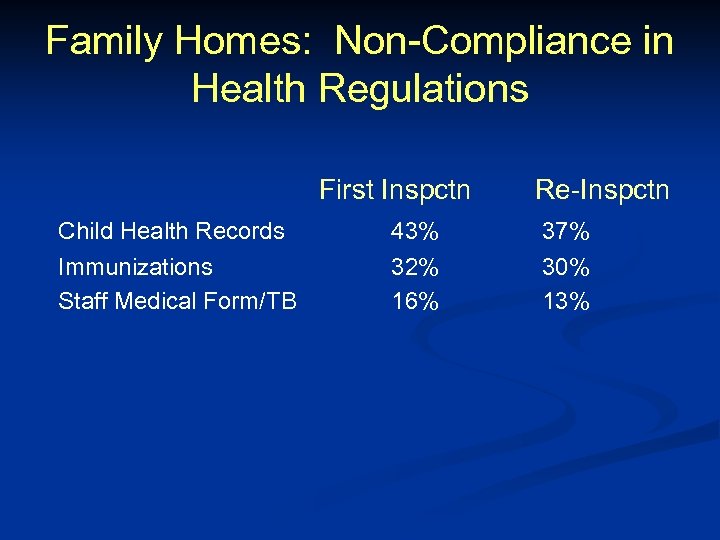 Family Homes: Non-Compliance in Health Regulations First Inspctn Child Health Records Immunizations Staff Medical Form/TB 43% 32% 16% Re-Inspctn 37% 30% 13%
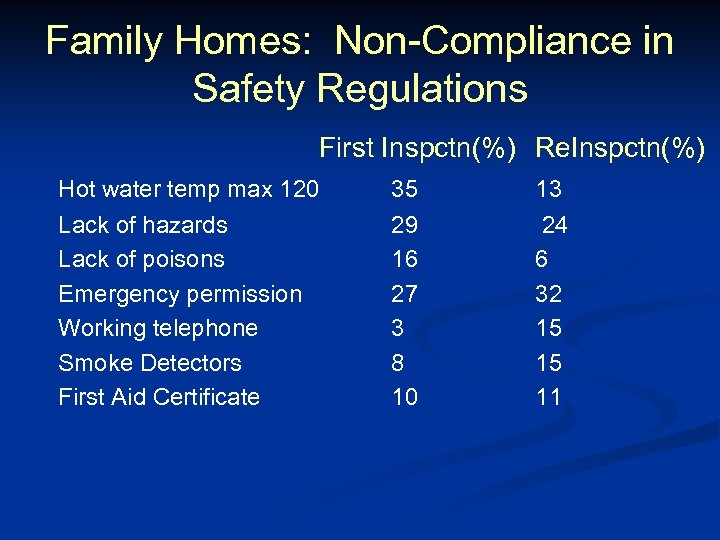 Family Homes: Non-Compliance in Safety Regulations First Inspctn(%) Re. Inspctn(%) Hot water temp max 120 Lack of hazards Lack of poisons Emergency permission Working telephone Smoke Detectors First Aid Certificate 35 29 16 27 3 8 10 13 24 6 32 15 15 11
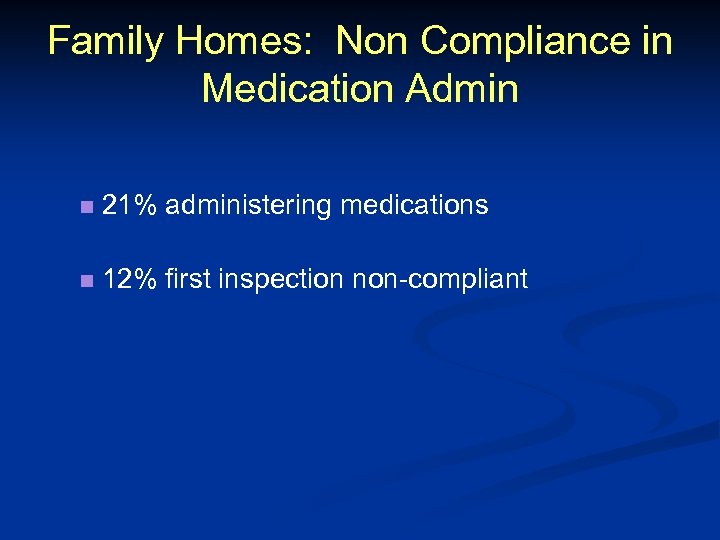 Family Homes: Non Compliance in Medication Admin n 21% administering medications n 12% first inspection non-compliant
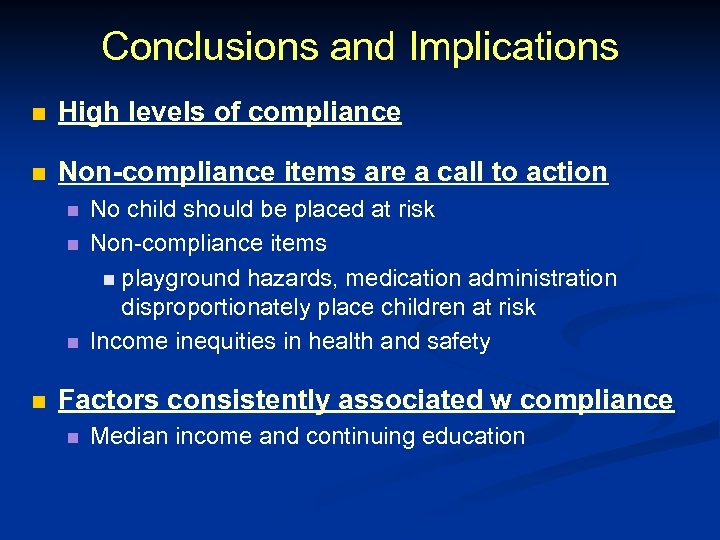 Conclusions and Implications n High levels of compliance n Non-compliance items are a call to action n n No child should be placed at risk Non-compliance items n playground hazards, medication administration disproportionately place children at risk Income inequities in health and safety Factors consistently associated w compliance n Median income and continuing education
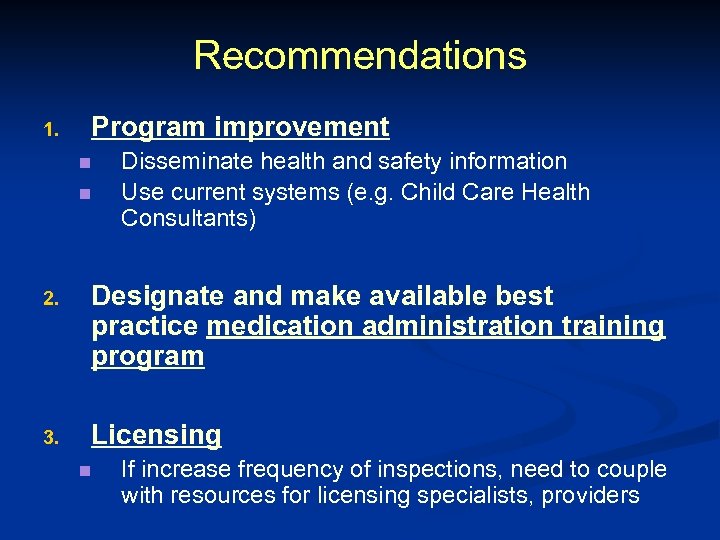 Recommendations 1. Program improvement n n Disseminate health and safety information Use current systems (e. g. Child Care Health Consultants) 2. Designate and make available best practice medication administration training program 3. Licensing n If increase frequency of inspections, need to couple with resources for licensing specialists, providers
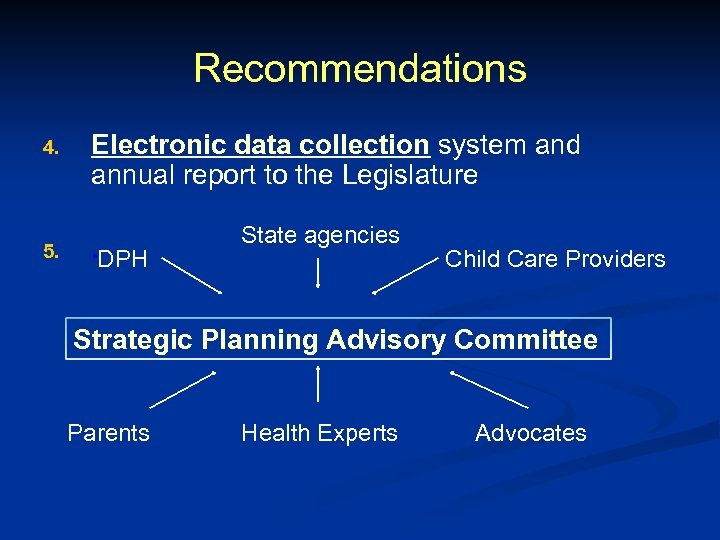 Recommendations 4. 5. Electronic data collection system and annual report to the Legislature. DPH State agencies Child Care Providers Strategic Planning Advisory Committee Parents Health Experts Advocates
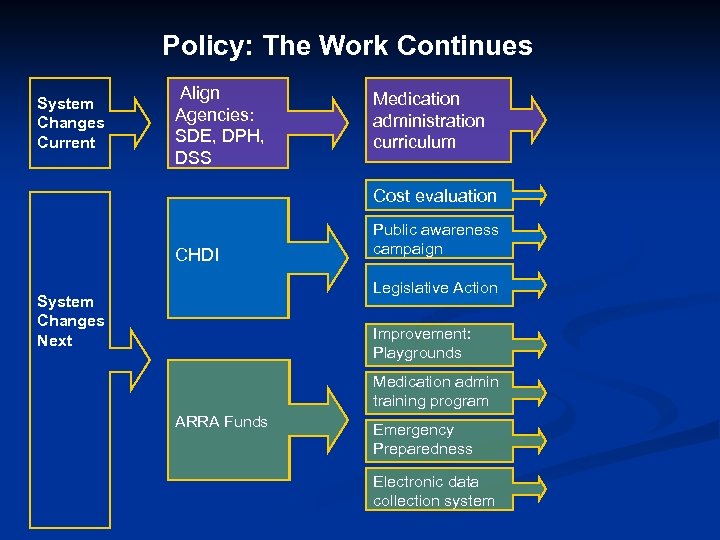 Policy: The Work Continues System Changes Current Align Agencies: SDE, DPH, DSS Medication administration curriculum Cost evaluation CHDI Public awareness campaign Legislative Action System Changes Next Improvement: Playgrounds Medication admin training program ARRA Funds Emergency Preparedness Electronic data collection system
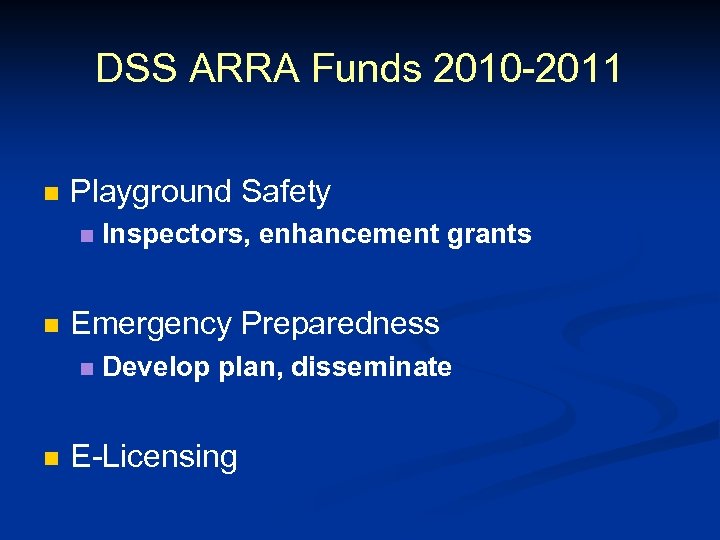 DSS ARRA Funds 2010 -2011 n Playground Safety n n Emergency Preparedness n n Inspectors, enhancement grants Develop plan, disseminate E-Licensing
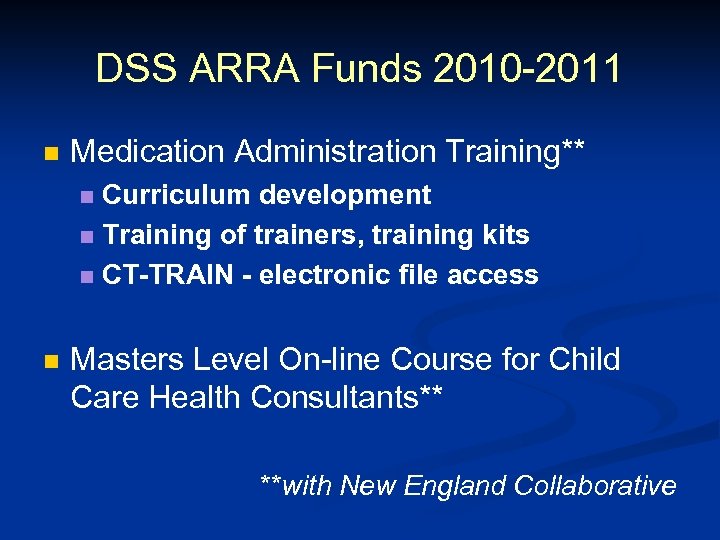 DSS ARRA Funds 2010 -2011 n Medication Administration Training** Curriculum development n Training of trainers, training kits n CT-TRAIN - electronic file access n n Masters Level On-line Course for Child Care Health Consultants** **with New England Collaborative
 Next Steps n Medication Administration in ECE Spanish translation ($ AAP) n Training system development ($ CHDI) n n Embed into PD system n Coordinator n Establish advisory/connect with others for systems development, e. g. , RTTT-ELG
 Study Acknowledgements n Connecticut Department of Public Health, Child Care Licensing n Yale University School of Nursing graduate nursing students and research faculty and staff n The Children’s Fund of Connecticut and the Child Health and Development Institute of Connecticut
 Study References American Academy of Pediatrics, American Public Health Association, & National Resource Center for Health and Safety in Child Care. (2002). Caring for our children, National health and safety performance standards: Guidelines for out-of-home child care programs (2 nd ed. ), Washington, DC. Bradley, R. H. & NICHD Early Child Care Research Network (2003). Child care and common communicable diseases in children aged 37 -54 months. Archives of Pediatrics and Adolescent Medicine, 157 (2): 196 -200. National Association of Child Care Resource & Referral Agencies. (2006). Parents' perceptions of child care in the United States: NACCRRA's National Parent Poll. Retrieved on August 28, 2007 from: http: //www. naccrra. org/policy_poll. php. NACCRRA. (2009). We can do better: 2009 update: NACCRRA’s ranking of state child care center regulation and oversight. Retrieved on June 14, 2009 from http: //www. naccrra. org/publications Ramler, M, Nakatsukasa-Ono, W. , Loe, C. , & Harris, K. (2006). The influence of child care health consultants in promoting children’s health and well-being: A report on selected resources. Newton, MA: EDC & Oakland, CA: CHT Resource Group. Waibel, R. & Misra, R. (2003). Injuries to preschool children and infection control practices in child care programs. Journal of School Health, 73 (5): 167 -172. Williams, E. G. & Sadler, L. S. (2001). Effects of an urban high school-based child care center on self-selected adolescent parents and their children. Journal of School Health (71) 2: 47 -52.