


 Скачать презентацию Addressing Alternative Explanations Multiple Regression 17 871
acf906d363322066aa903c63af3d2034.ppt
- Количество слайдов: 36
 Addressing Alternative Explanations: Multiple Regression 17. 871
 Did Clinton hurt Gore example n Did Clinton hurt Gore in the 2000 election? ¨ Treatment n is not liking Bill Clinton How would you test this?
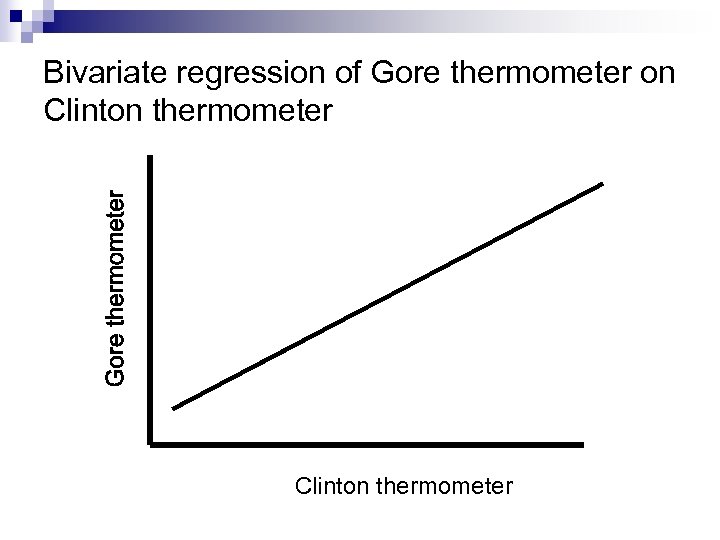 Bivariate regression of Gore thermometer on Clinton thermometer
 Did Clinton hurt Gore example n n What alternative explanations would you need to address? Nonrandom selection into the treatment group (disliking Clinton) from many sources Let’s address one source: party identification How could we do this? Matching: compare Democrats who like or don’t like Clinton; do the same for Republicans and independents ¨ Multivariate regression: control for partisanship statistically ¨ n n Also called multiple regression, Ordinary Least Squares (OLS) Presentation below is intuitive
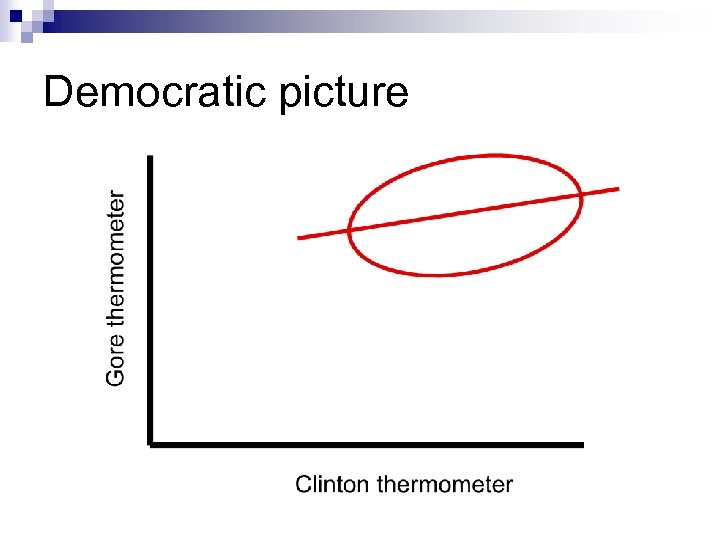 Democratic picture
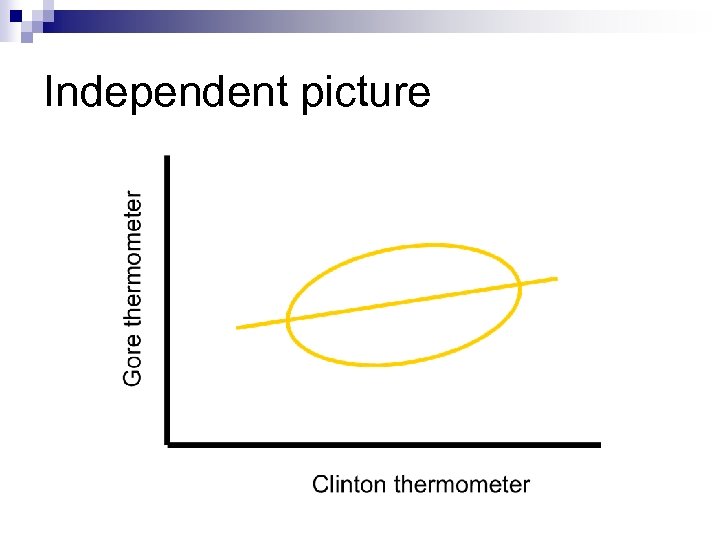 Independent picture
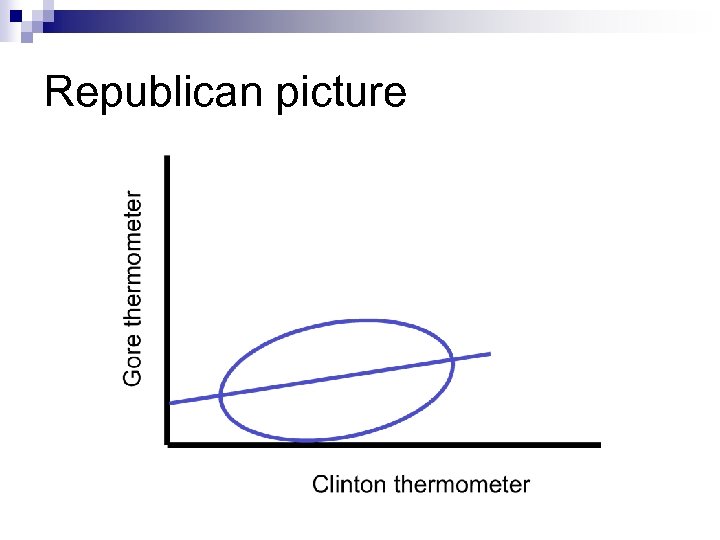 Republican picture
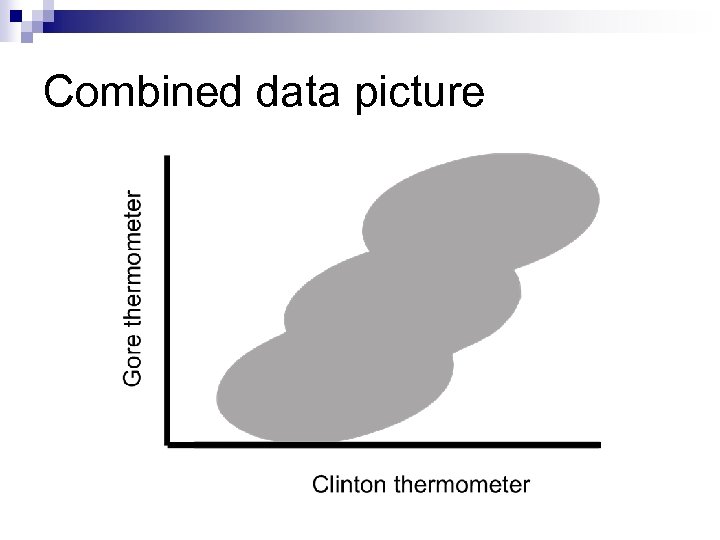 Combined data picture
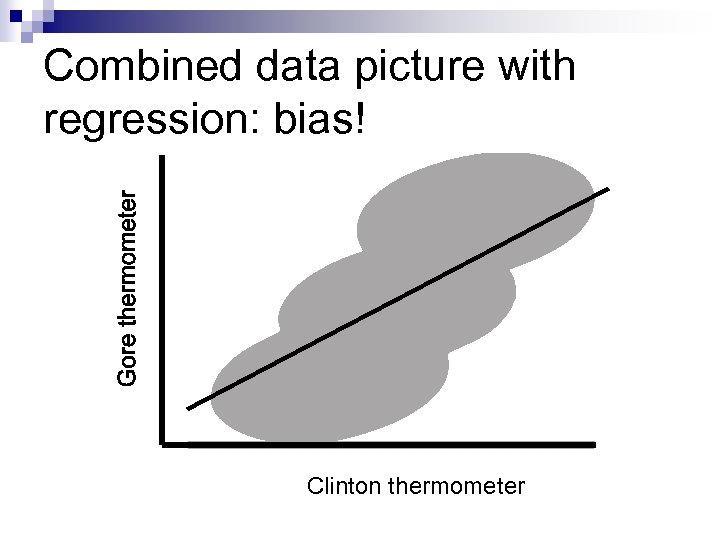 Combined data picture with regression: bias! Clinton thermometer
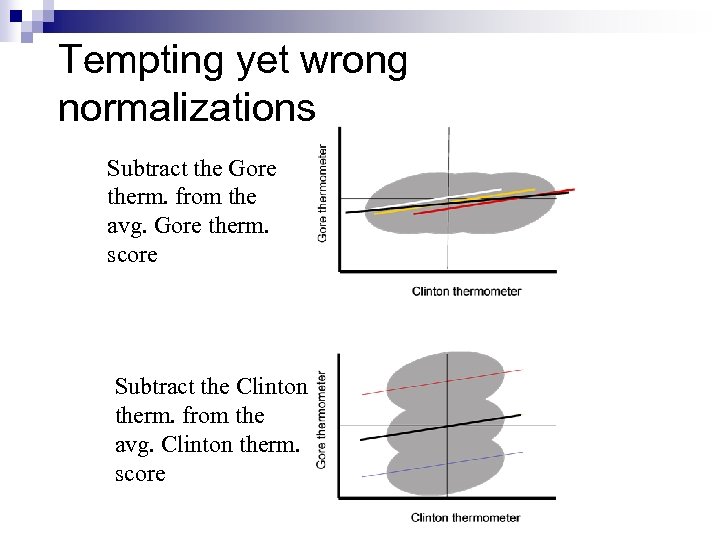 Tempting yet wrong normalizations Subtract the Gore therm. from the avg. Gore therm. score Subtract the Clinton therm. from the avg. Clinton therm. score
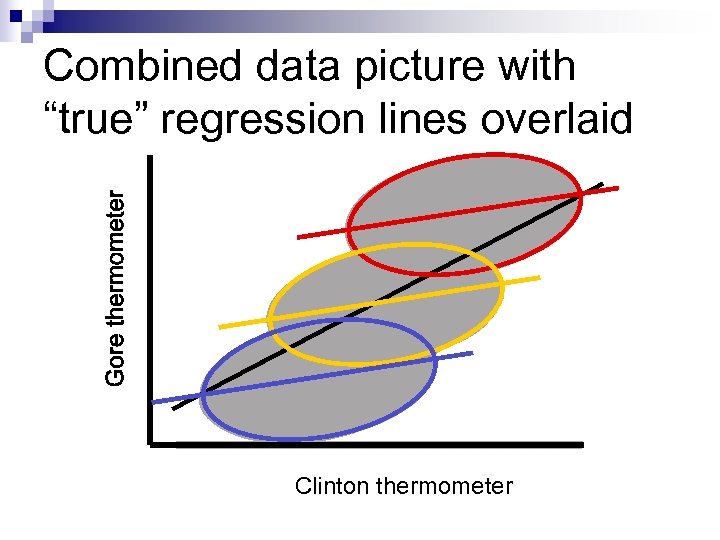 Combined data picture with “true” regression lines overlaid Clinton thermometer
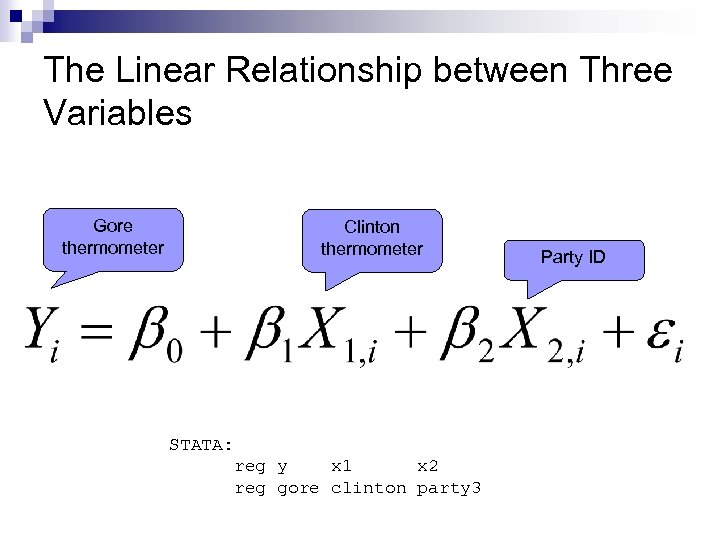 The Linear Relationship between Three Variables Gore thermometer Clinton thermometer STATA: reg y x 1 x 2 reg gore clinton party 3 Party ID
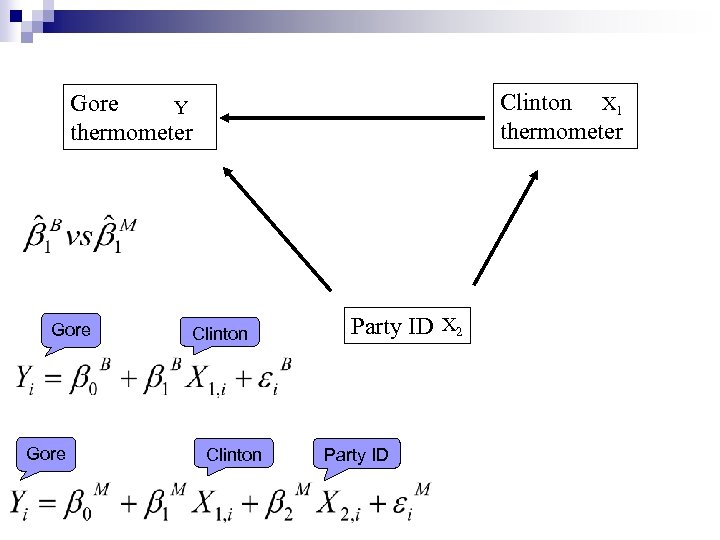 Clinton X 1 thermometer Gore Y thermometer Gore Clinton Party ID X 2 Party ID
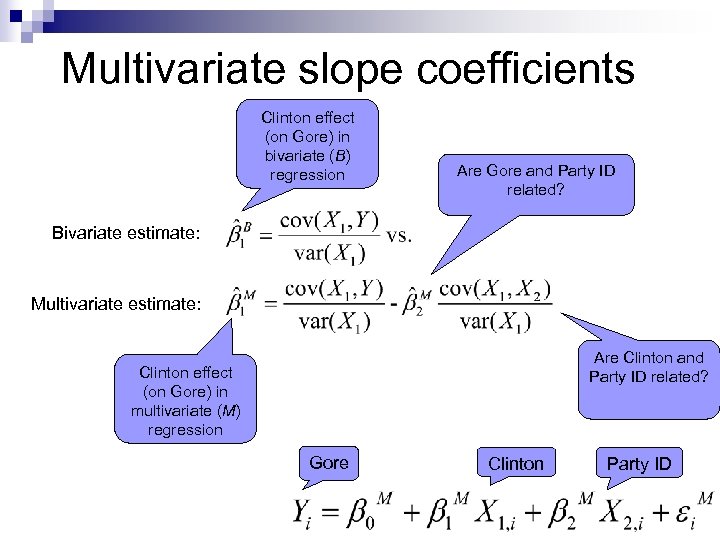 Multivariate slope coefficients Clinton effect (on Gore) in bivariate (B) regression Are Gore and Party ID related? Bivariate estimate: Multivariate estimate: Are Clinton and Party ID related? Clinton effect (on Gore) in multivariate (M) regression Gore Clinton Party ID
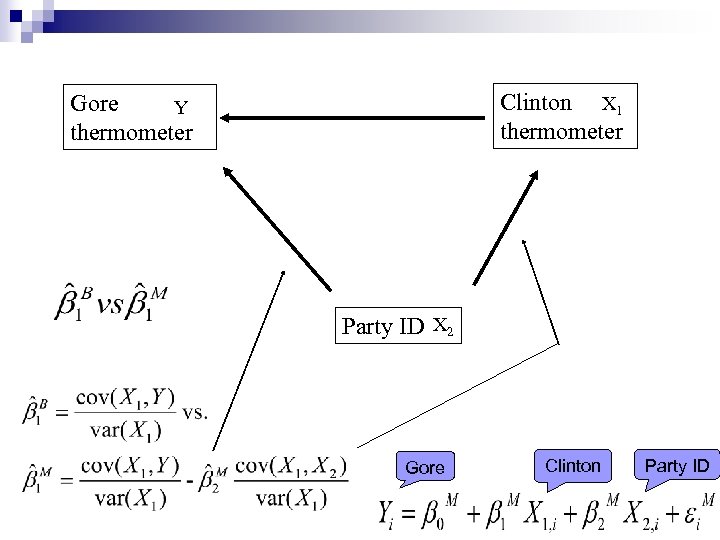 Clinton X 1 thermometer Gore Y thermometer Party ID X 2 Gore Clinton Party ID
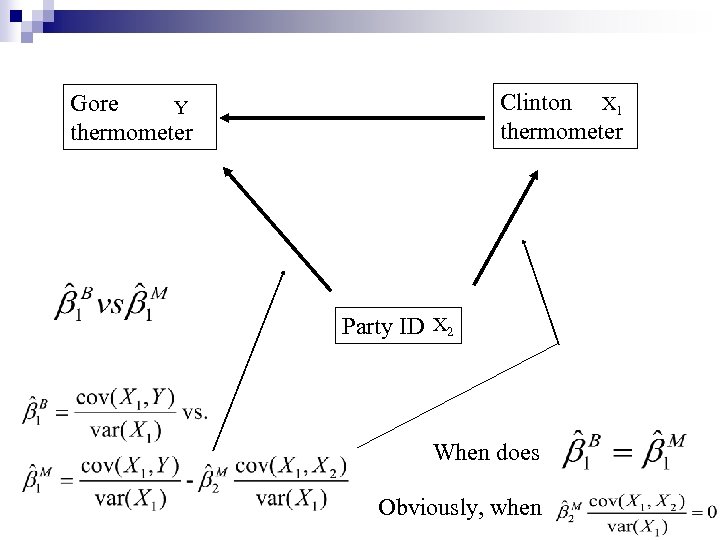 Clinton X 1 thermometer Gore Y thermometer Party ID X 2 When does Obviously, when
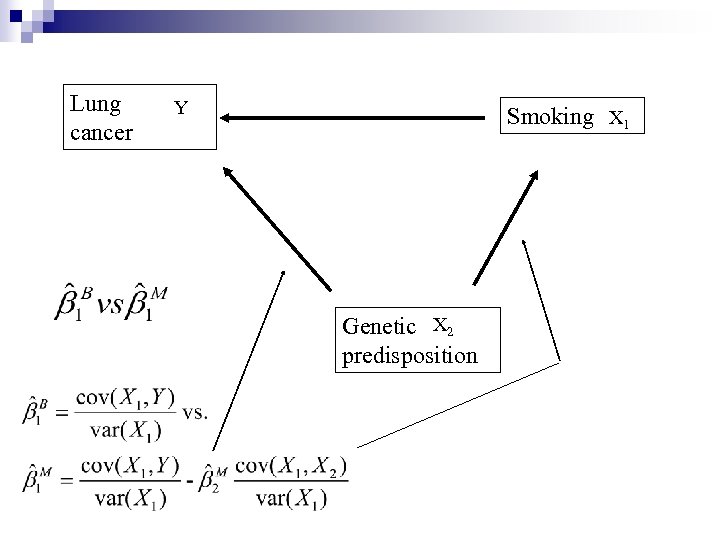 Lung cancer Y Smoking X 1 Genetic X 2 predisposition
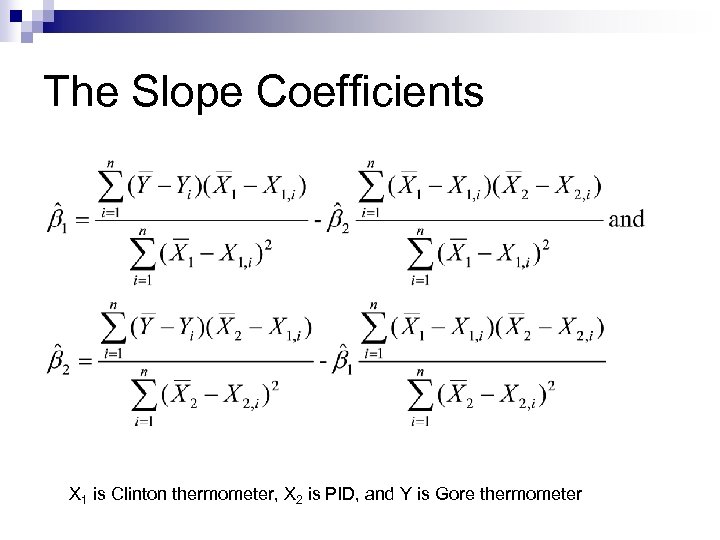 The Slope Coefficients X 1 is Clinton thermometer, X 2 is PID, and Y is Gore thermometer
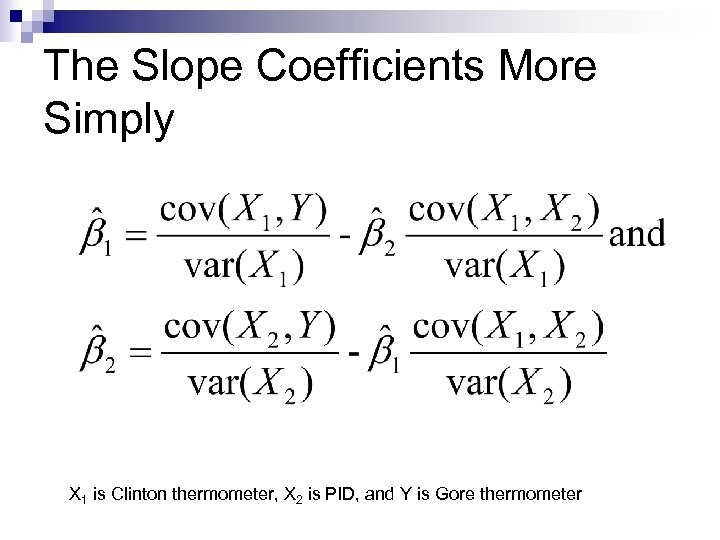 The Slope Coefficients More Simply X 1 is Clinton thermometer, X 2 is PID, and Y is Gore thermometer
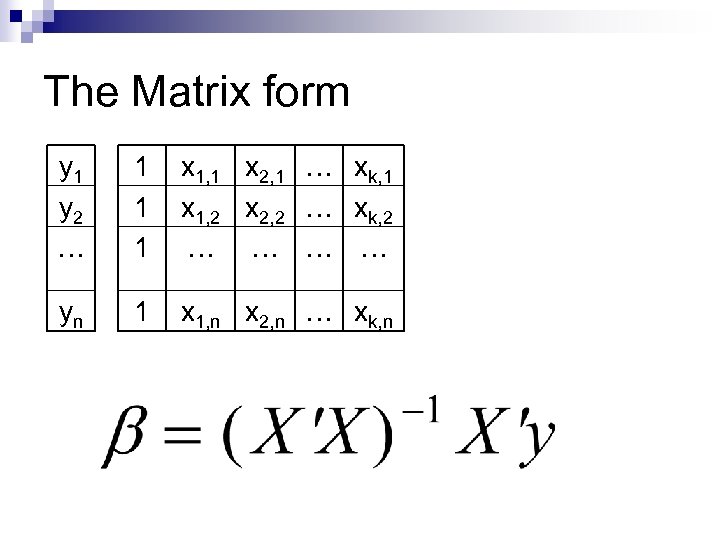 The Matrix form y 1 y 2 … 1 1 1 x 1, 1 x 2, 1 … xk, 1 x 1, 2 x 2, 2 … xk, 2 … … yn 1 x 1, n x 2, n … xk, n
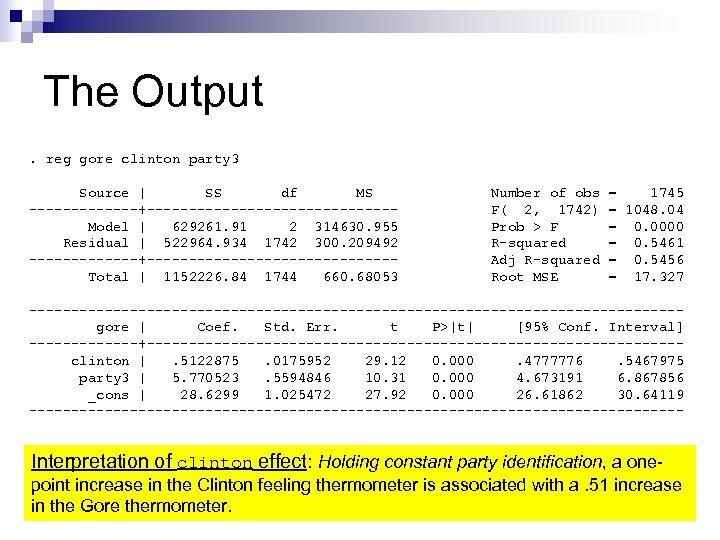 The Output. reg gore clinton party 3 Source | SS df MS -------+---------------Model | 629261. 91 2 314630. 955 Residual | 522964. 934 1742 300. 209492 -------+---------------Total | 1152226. 84 1744 660. 68053 Number of obs F( 2, 1742) Prob > F R-squared Adj R-squared Root MSE = 1745 = 1048. 04 = 0. 0000 = 0. 5461 = 0. 5456 = 17. 327 ---------------------------------------gore | Coef. Std. Err. t P>|t| [95% Conf. Interval] -------+--------------------------------clinton |. 5122875. 0175952 29. 12 0. 000. 4777776. 5467975 party 3 | 5. 770523. 5594846 10. 31 0. 000 4. 673191 6. 867856 _cons | 28. 6299 1. 025472 27. 92 0. 000 26. 61862 30. 64119 --------------------------------------- Interpretation of clinton effect: Holding constant party identification, a onepoint increase in the Clinton feeling thermometer is associated with a. 51 increase in the Gore thermometer.
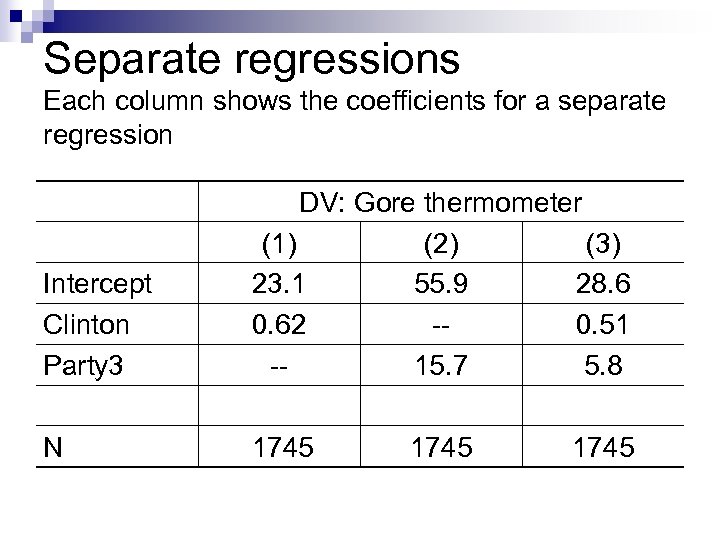 Separate regressions Each column shows the coefficients for a separate regression Intercept Clinton Party 3 DV: Gore thermometer (1) (2) (3) 23. 1 55. 9 28. 6 0. 62 -0. 51 -15. 7 5. 8 N 1745
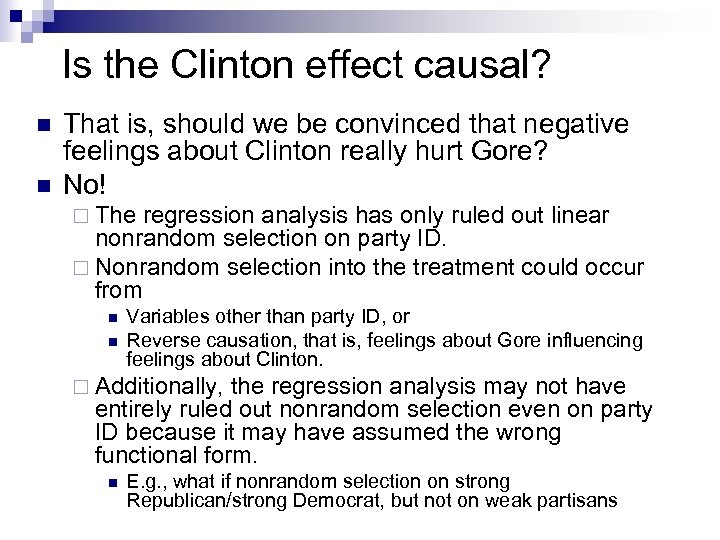 Is the Clinton effect causal? n n That is, should we be convinced that negative feelings about Clinton really hurt Gore? No! ¨ The regression analysis has only ruled out linear nonrandom selection on party ID. ¨ Nonrandom selection into the treatment could occur from n n Variables other than party ID, or Reverse causation, that is, feelings about Gore influencing feelings about Clinton. ¨ Additionally, the regression analysis may not have entirely ruled out nonrandom selection even on party ID because it may have assumed the wrong functional form. n E. g. , what if nonrandom selection on strong Republican/strong Democrat, but not on weak partisans
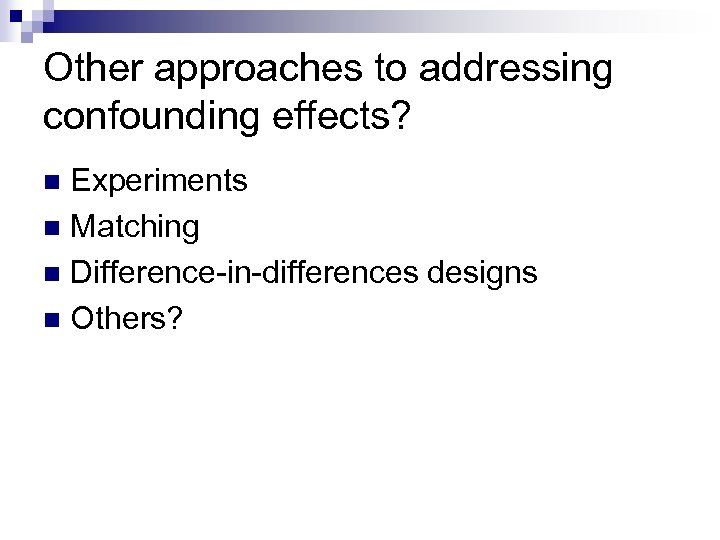 Other approaches to addressing confounding effects? Experiments n Matching n Difference-in-differences designs n Others? n
 Summary: Why we control n n Address alternative explanations by removing confounding effects Improve efficiency
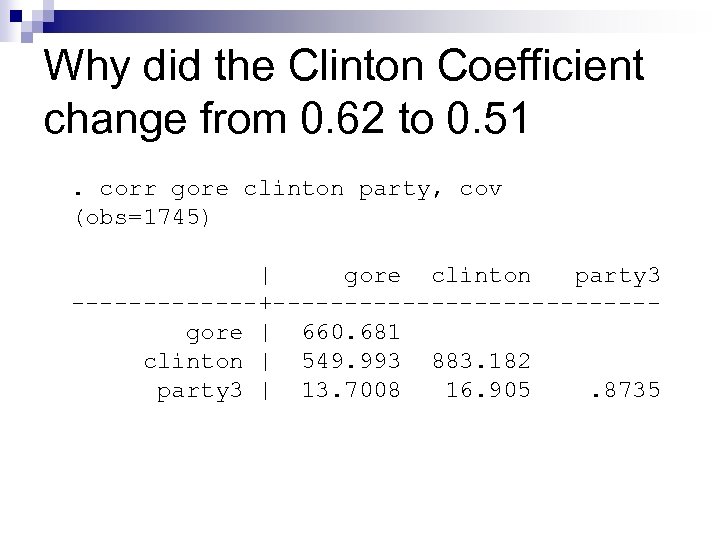 Why did the Clinton Coefficient change from 0. 62 to 0. 51. corr gore clinton party, cov (obs=1745) | gore clinton party 3 -------+-------------gore | 660. 681 clinton | 549. 993 883. 182 party 3 | 13. 7008 16. 905. 8735
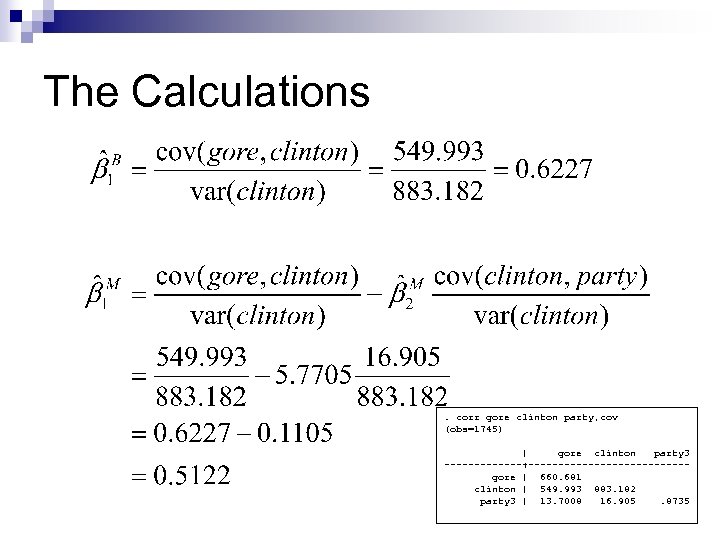 The Calculations . corr gore clinton party, cov (obs=1745) | gore clinton party 3 -------+-------------gore | 660. 681 clinton | 549. 993 883. 182 party 3 | 13. 7008 16. 905. 8735
 Drinking and Greek Life Example n Why is there a correlation between living in a fraternity/sorority house and drinking? ¨ Greek organizations often emphasize social gatherings that have alcohol. The effect is being in the Greek organization itself, not the house. ¨ There’s something about the House environment itself. n Example of indicator or dummy variables
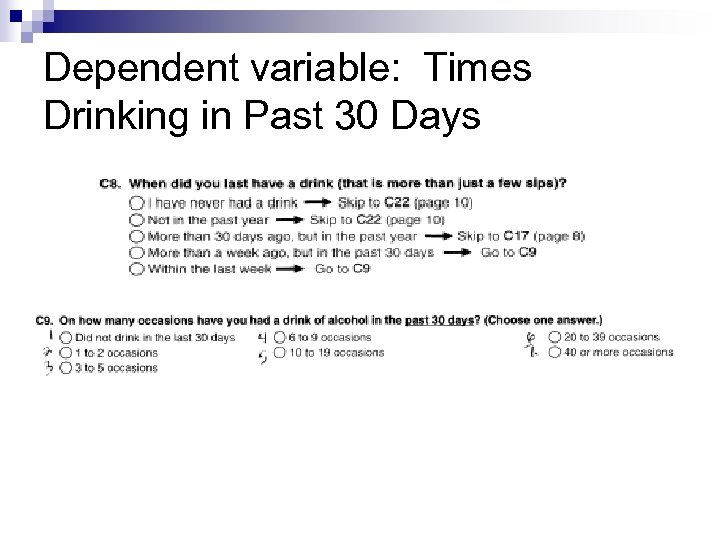 Dependent variable: Times Drinking in Past 30 Days
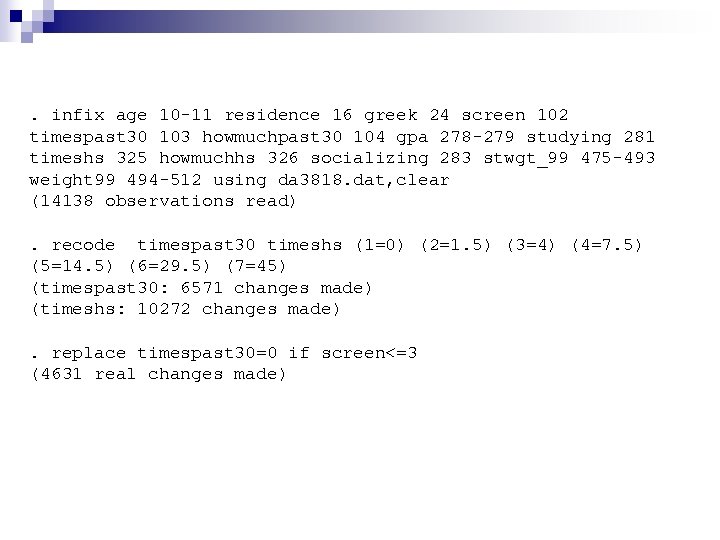 . infix age 10 -11 residence 16 greek 24 screen 102 timespast 30 103 howmuchpast 30 104 gpa 278 -279 studying 281 timeshs 325 howmuchhs 326 socializing 283 stwgt_99 475 -493 weight 99 494 -512 using da 3818. dat, clear (14138 observations read). recode timespast 30 timeshs (1=0) (2=1. 5) (3=4) (4=7. 5) (5=14. 5) (6=29. 5) (7=45) (timespast 30: 6571 changes made) (timeshs: 10272 changes made). replace timespast 30=0 if screen<=3 (4631 real changes made)
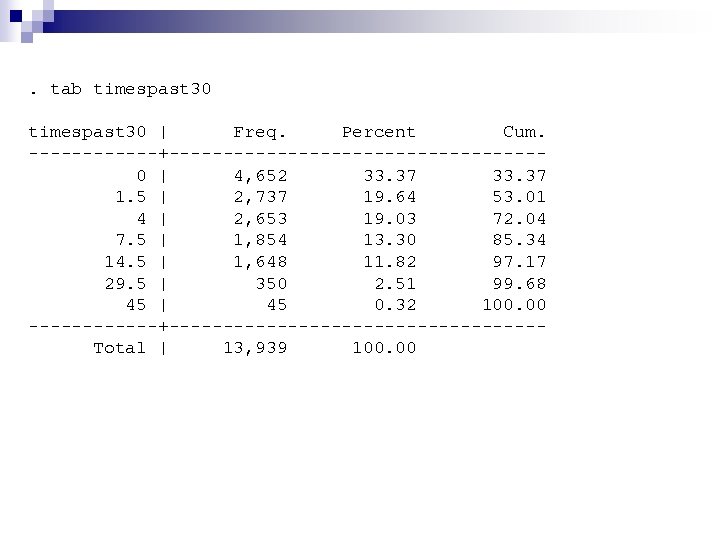 . tab timespast 30 | Freq. Percent Cum. ------+-----------------0 | 4, 652 33. 37 1. 5 | 2, 737 19. 64 53. 01 4 | 2, 653 19. 03 72. 04 7. 5 | 1, 854 13. 30 85. 34 14. 5 | 1, 648 11. 82 97. 17 29. 5 | 350 2. 51 99. 68 45 | 45 0. 32 100. 00 ------+-----------------Total | 13, 939 100. 00
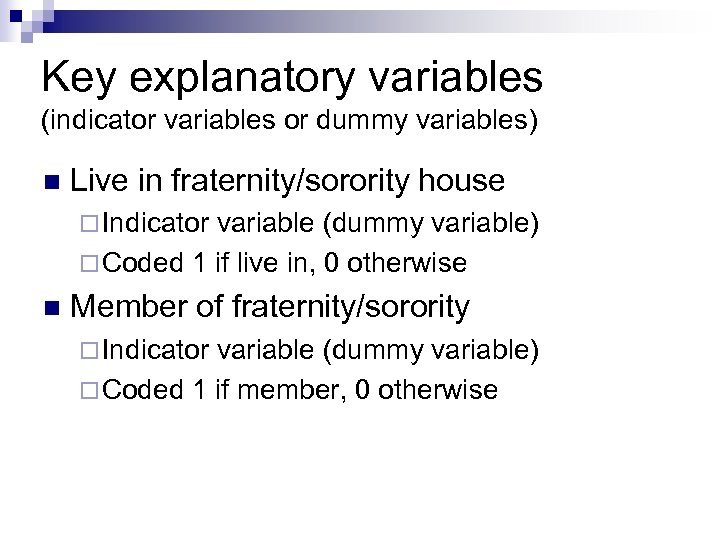 Key explanatory variables (indicator variables or dummy variables) n Live in fraternity/sorority house ¨ Indicator variable (dummy variable) ¨ Coded 1 if live in, 0 otherwise n Member of fraternity/sorority ¨ Indicator variable (dummy variable) ¨ Coded 1 if member, 0 otherwise
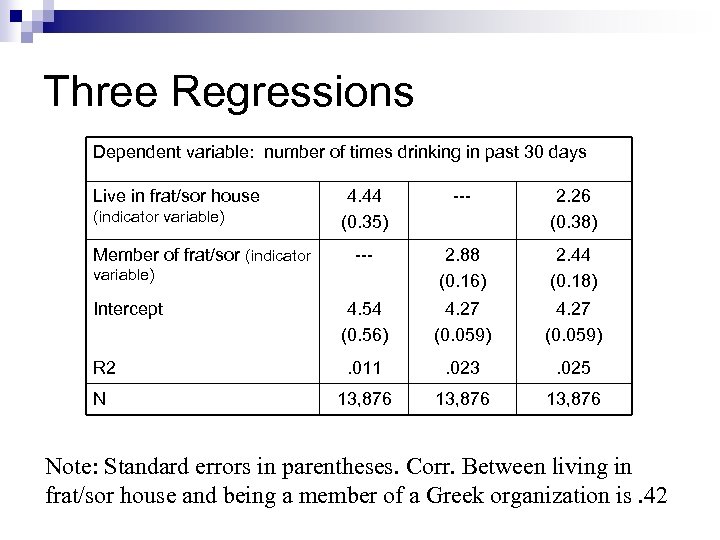 Three Regressions Dependent variable: number of times drinking in past 30 days Live in frat/sor house 4. 44 (0. 35) --- 2. 26 (0. 38) --- 2. 88 (0. 16) 2. 44 (0. 18) 4. 54 (0. 56) 4. 27 (0. 059) R 2 . 011 . 023 . 025 N 13, 876 (indicator variable) Member of frat/sor (indicator variable) Intercept Note: Standard errors in parentheses. Corr. Between living in frat/sor house and being a member of a Greek organization is. 42
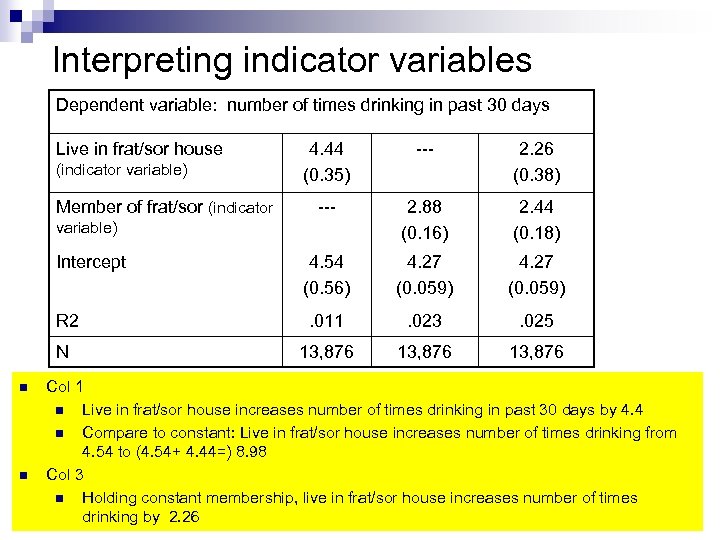 Interpreting indicator variables Dependent variable: number of times drinking in past 30 days Live in frat/sor house 4. 44 (0. 35) --- 2. 26 (0. 38) --- 2. 88 (0. 16) 2. 44 (0. 18) 4. 54 (0. 56) 4. 27 (0. 059) R 2 . 011 . 023 . 025 N 13, 876 (indicator variable) Member of frat/sor (indicator variable) Intercept n n Col 1 n Live in frat/sor house increases number of times drinking in past 30 days by 4. 4 n Compare to constant: Live in frat/sor house increases number of times drinking from 4. 54 to (4. 54+ 4. 44=) 8. 98 Col 3 n Holding constant membership, live in frat/sor house increases number of times drinking by 2. 26
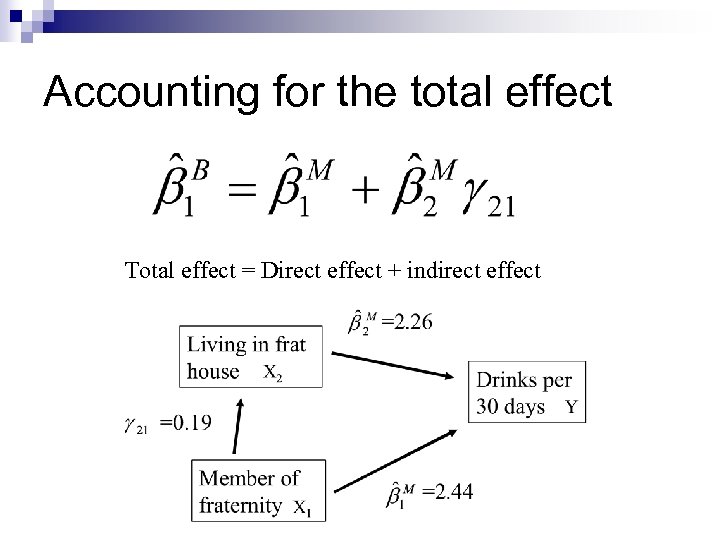 Accounting for the total effect Total effect = Direct effect + indirect effect
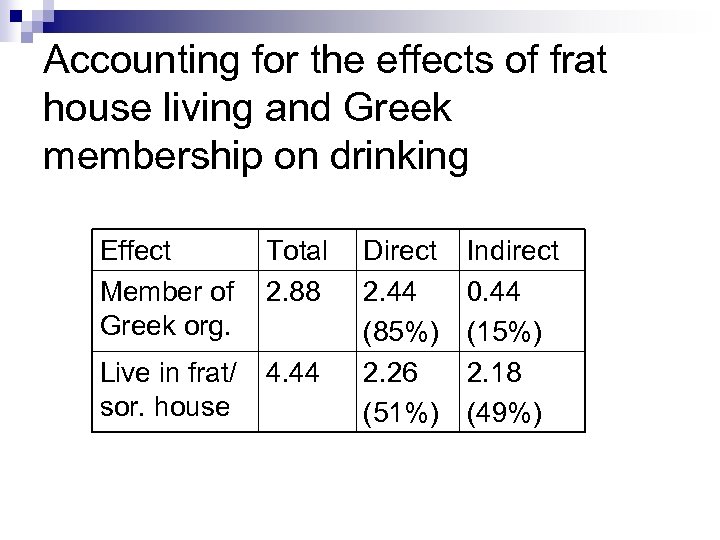 Accounting for the effects of frat house living and Greek membership on drinking Effect Member of Greek org. Total 2. 88 Live in frat/ sor. house 4. 44 Direct 2. 44 (85%) 2. 26 (51%) Indirect 0. 44 (15%) 2. 18 (49%)