 Скачать презентацию ADB s Role in Power Sector Reforms Its
b004d53ba2b93a26e482c4c79b753f22.ppt
- Количество слайдов: 21



ADB’s Role in Power Sector Reforms & Its Accountability Mechanism ALNI / Philippines Forum on “Key Union Issues in Napocor Privatization” VIOLETA P. CORRAL September 2009
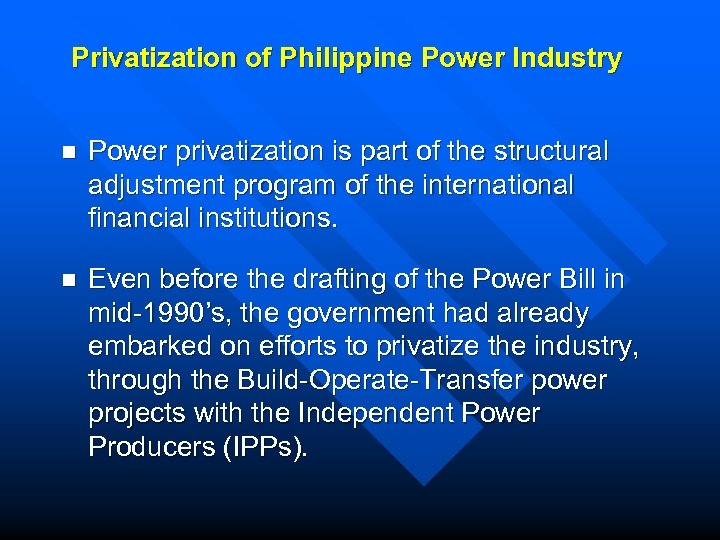
Privatization of Philippine Power Industry n Power privatization is part of the structural adjustment program of the international financial institutions. n Even before the drafting of the Power Bill in mid-1990’s, the government had already embarked on efforts to privatize the industry, through the Build-Operate-Transfer power projects with the Independent Power Producers (IPPs).
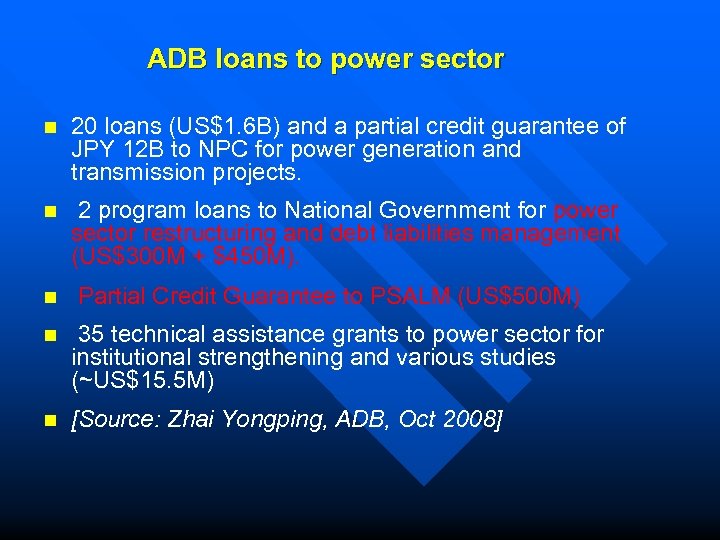
ADB loans to power sector n 20 loans (US$1. 6 B) and a partial credit guarantee of JPY 12 B to NPC for power generation and transmission projects. n 2 program loans to National Government for power sector restructuring and debt liabilities management (US$300 M + $450 M). n Partial Credit Guarantee to PSALM (US$500 M) n 35 technical assistance grants to power sector for institutional strengthening and various studies (~US$15. 5 M) n [Source: Zhai Yongping, ADB, Oct 2008]
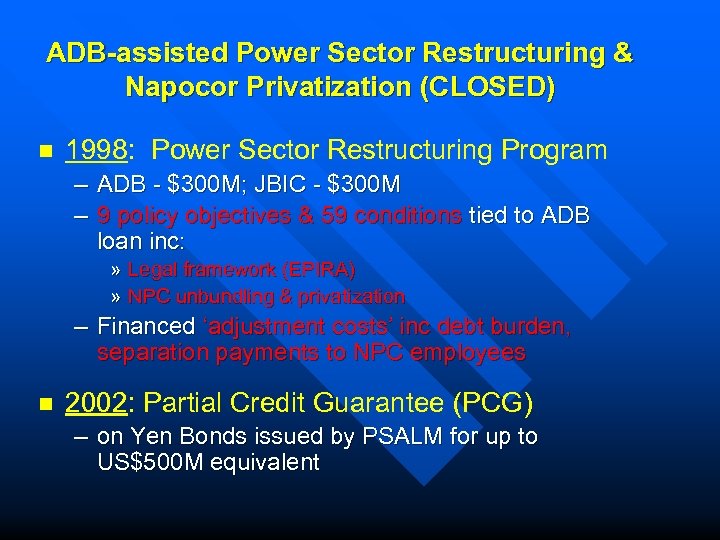
ADB-assisted Power Sector Restructuring & Napocor Privatization (CLOSED) n 1998: Power Sector Restructuring Program – – ADB - $300 M; JBIC - $300 M 9 policy objectives & 59 conditions tied to ADB loan inc: » Legal framework (EPIRA) » NPC unbundling & privatization – Financed ‘adjustment costs’ inc debt burden, separation payments to NPC employees n 2002: Partial Credit Guarantee (PCG) – on Yen Bonds issued by PSALM for up to US$500 M equivalent
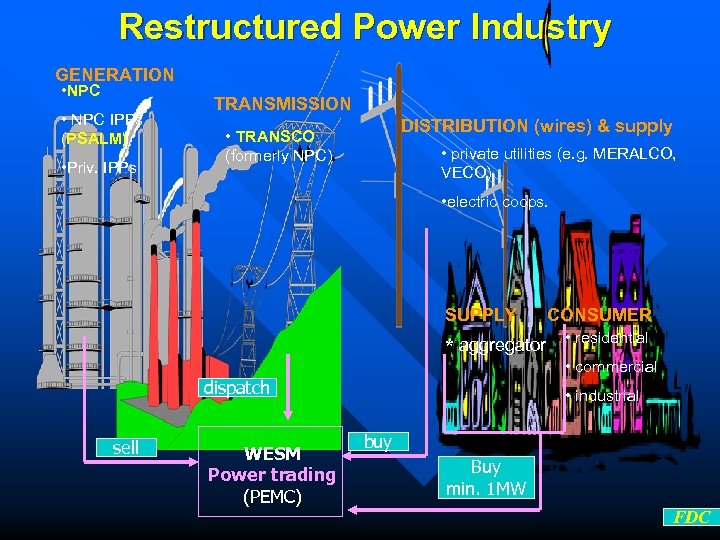
Restructured Power Industry GENERATION • NPC IPPs (PSALM) • Priv. IPPs TRANSMISSION DISTRIBUTION (wires) & supply • TRANSCO (formerly NPC) • private utilities (e. g. MERALCO, VECO) • electric coops. SUPPLY * aggregator CONSUMER • residential • commercial dispatch sell WESM Power trading (PEMC) • industrial buy Buy min. 1 MW FDC
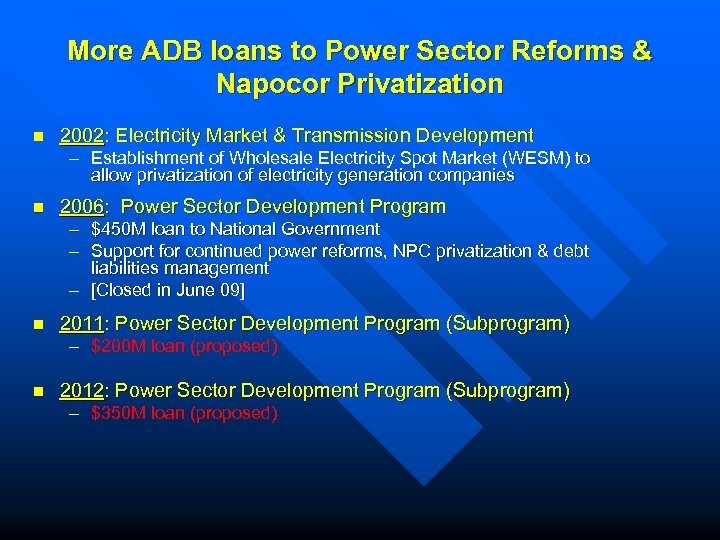
More ADB loans to Power Sector Reforms & Napocor Privatization n 2002: Electricity Market & Transmission Development – Establishment of Wholesale Electricity Spot Market (WESM) to allow privatization of electricity generation companies n 2006: Power Sector Development Program – $450 M loan to National Government – Support for continued power reforms, NPC privatization & debt liabilities management – [Closed in June 09] n 2011: Power Sector Development Program (Subprogram) – $200 M loan (proposed) n 2012: Power Sector Development Program (Subprogram) – $350 M loan (proposed)
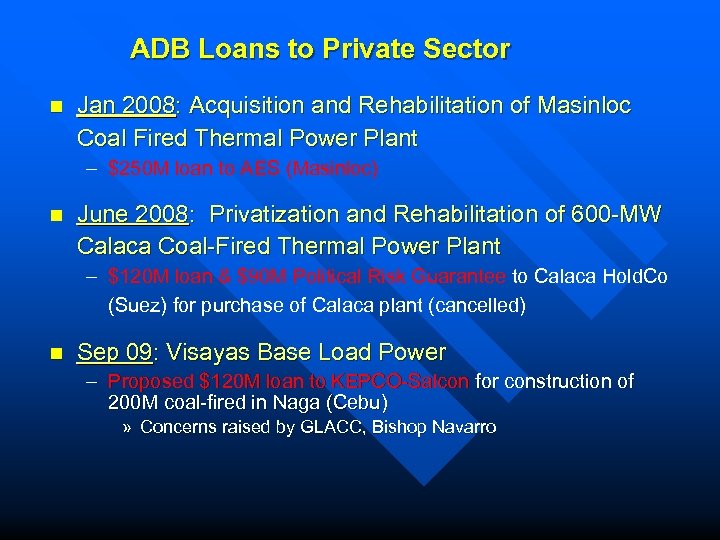
ADB Loans to Private Sector n Jan 2008: Acquisition and Rehabilitation of Masinloc Coal Fired Thermal Power Plant – $250 M loan to AES (Masinloc) n June 2008: Privatization and Rehabilitation of 600 -MW Calaca Coal-Fired Thermal Power Plant – $120 M loan & $90 M Political Risk Guarantee to Calaca Hold. Co (Suez) for purchase of Calaca plant (cancelled) n Sep 09: Visayas Base Load Power – Proposed $120 M loan to KEPCO-Salcon for construction of 200 M coal-fired in Naga (Cebu) » Concerns raised by GLACC, Bishop Navarro
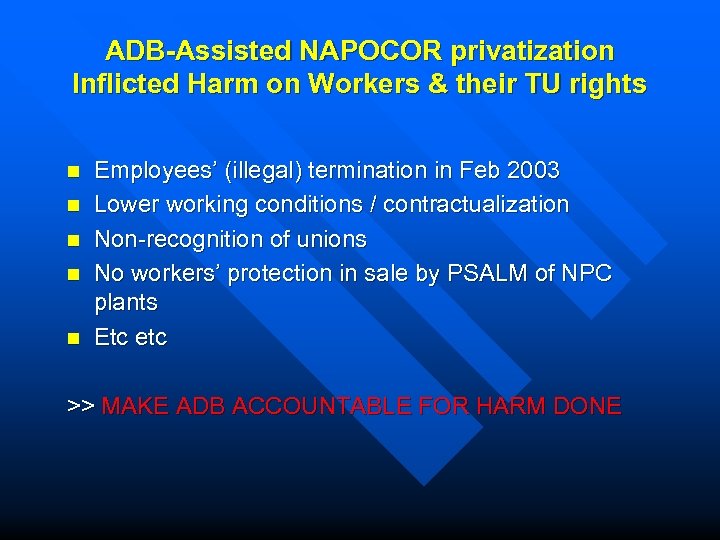
ADB-Assisted NAPOCOR privatization Inflicted Harm on Workers & their TU rights n n n Employees’ (illegal) termination in Feb 2003 Lower working conditions / contractualization Non-recognition of unions No workers’ protection in sale by PSALM of NPC plants Etc etc >> MAKE ADB ACCOUNTABLE FOR HARM DONE
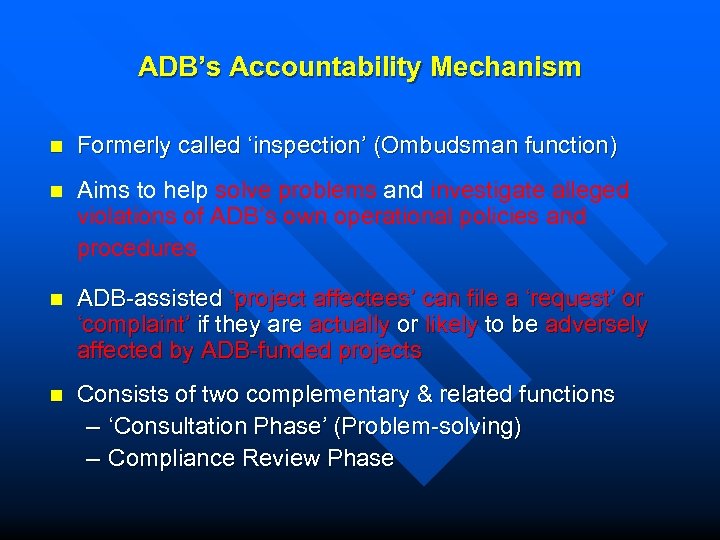
ADB’s Accountability Mechanism n Formerly called ‘inspection’ (Ombudsman function) n Aims to help solve problems and investigate alleged violations of ADB’s own operational policies and procedures n ADB-assisted ‘project affectees’ can file a ‘request’ or ‘complaint’ if they are actually or likely to be adversely affected by ADB-funded projects n Consists of two complementary & related functions – ‘Consultation Phase’ (Problem-solving) – Compliance Review Phase
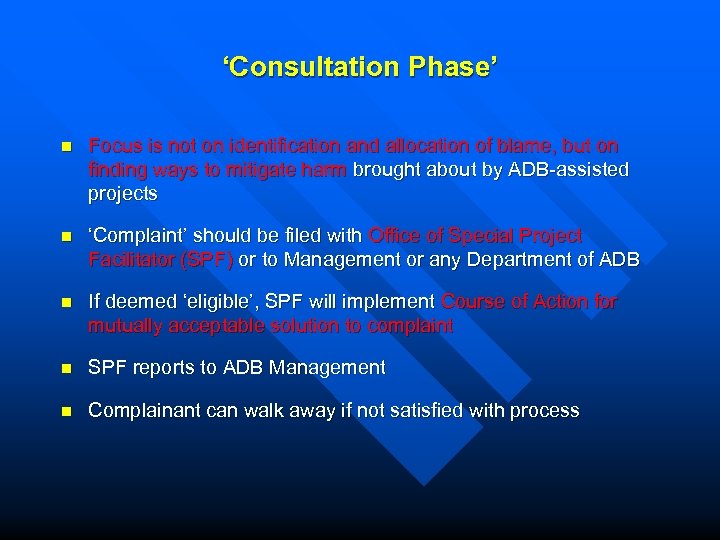
‘Consultation Phase’ n Focus is not on identification and allocation of blame, but on finding ways to mitigate harm brought about by ADB-assisted projects n ‘Complaint’ should be filed with Office of Special Project Facilitator (SPF) or to Management or any Department of ADB n If deemed ‘eligible’, SPF will implement Course of Action for mutually acceptable solution to complaint n SPF reports to ADB Management n Complainant can walk away if not satisfied with process
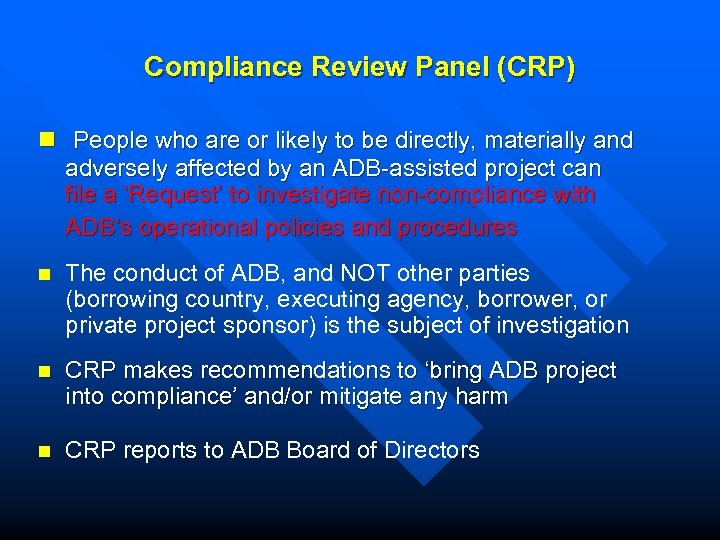
Compliance Review Panel (CRP) n People who are or likely to be directly, materially and adversely affected by an ADB-assisted project can file a ‘Request’ to investigate non-compliance with ADB’s operational policies and procedures n The conduct of ADB, and NOT other parties (borrowing country, executing agency, borrower, or private project sponsor) is the subject of investigation n CRP makes recommendations to ‘bring ADB project into compliance’ and/or mitigate any harm n CRP reports to ADB Board of Directors
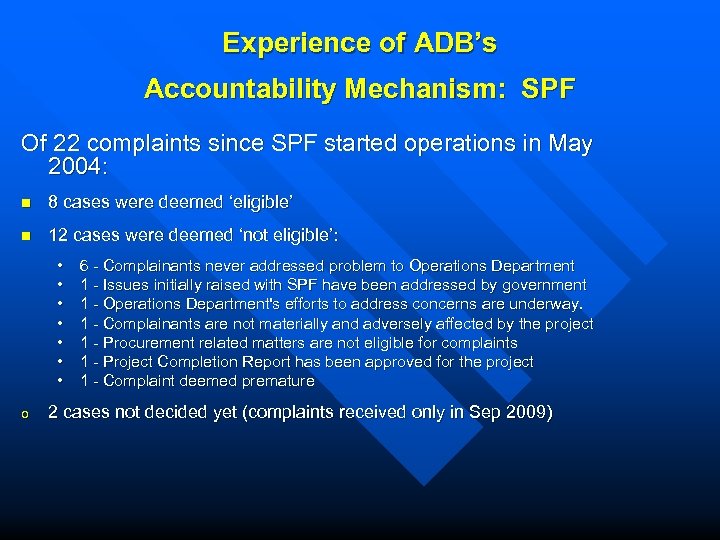
Experience of ADB’s Accountability Mechanism: SPF Of 22 complaints since SPF started operations in May 2004: n 8 cases were deemed ‘eligible’ n 12 cases were deemed ‘not eligible’: • • o 6 - Complainants never addressed problem to Operations Department 1 - Issues initially raised with SPF have been addressed by government 1 - Operations Department's efforts to address concerns are underway. 1 - Complainants are not materially and adversely affected by the project 1 - Procurement related matters are not eligible for complaints 1 - Project Completion Report has been approved for the project 1 - Complaint deemed premature 2 cases not decided yet (complaints received only in Sep 2009)
Most Common Complaints No Access to Information n No Consultation & Participation n Weak Social Impact Assessment n Non-implementation of ADB’s ‘Safeguard Policies’ n n No complaint has been filed to date due to non-compliance with CLS, or by trade unions
ADB’s Policy on Info Disclosure n ADB’s Public Communication Policy (2005) n ADB “shall share information with affected people early enough for them to provide meaningful inputs into project design and implementation” n Time Limits for Responses to Requests for Current Information: – ADB must acknowledge receipt of information request within five (5) working days – Within 30 calendar days, ADB must either provide information or otherwise cite reasons as to why they cannot release said information – (copy furnish disclosure@adb. org whenever you request for documents from project staff) n
ADB’s Policies on Consultation and Participation (C&P) n C&P is supported by virtually all of ADB's sector and thematic policies, its business processes, and staff instructions n ADB should hold consultations with key stakeholders, inc trade unions where a ‘labor participation strategy’ should be developed n There should be prior informed consent of stakeholders before any project approval
ADB’s “Safeguard Policies” n 3 Safeguard Policies: – Environment – Involuntary Resettlement – Indigenous Peoples n Mandatory that (i) impacts are identified and assessed early in the project cycle; (ii) adverse impacts are avoided, minimized, or mitigated; and (iii) affected people are consulted.
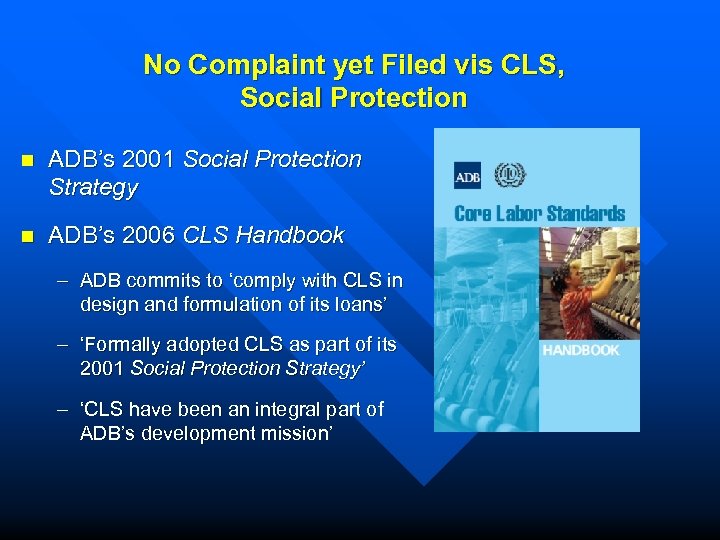
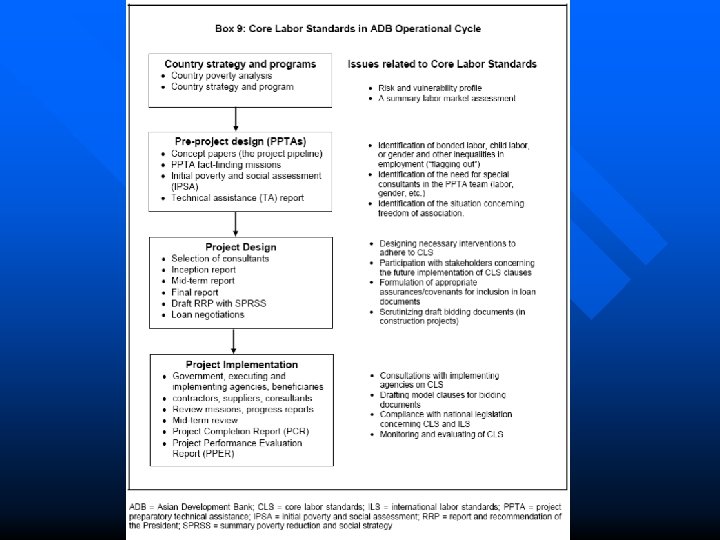
No Complaint yet Filed vis CLS, Social Protection n ADB’s 2001 Social Protection Strategy n ADB’s 2006 CLS Handbook – ADB commits to ‘comply with CLS in design and formulation of its loans’ – ‘Formally adopted CLS as part of its 2001 Social Protection Strategy’ – ‘CLS have been an integral part of ADB’s development mission’
FOA ‘Checklist’ (From: ‘Discussion Points on Freedom of Association & Collective Bargaining’, CLS Handbook, ADB, p. 96) n Are there mechanisms for voluntary collective bargaining? n How many trade unions are registered? n Are there trade unions active in the sector of the economy concerned by the ADB activity? n Does the government or employer put obstacles in the way of organization and collective bargaining? n How many disputes are there relating to freedom of association and collective bargaining? n Have any complaints been made to ILO? n Do collective agreements cover aspects of CLS and, if so, which aspects?
… FOA ‘Checklist’ n Are there free and independent workers’ and employers’ organizations at the national level? n Are there tripartite bodies at the national level with representatives from the social partners? If so, are the workers’ and employers’ representatives selected by their own organizations or appointed by a government body? n At the enterprise level are there bipartite arrangements, such as joint worker-management committees, to deal with disputes? Does the disputes procedure follow conventional stages? n Are any such joint structures balanced so that neither mgt nor workers dominate in terms of a majority? n Are worker and employer representatives appointed without outside interference? n Have any worker or employer representatives been penalized for carrying out their activities related to freedom of association and collective bargaining?
CONCLUSION n Trade unions can file a test case at ADB’s accountability mechanism if they feel they are actually or likely to be harmed by ADB-assisted projects, as in the case of NAPOCOR privatization & its harmful impacts on NPC workers. n If aim is to mitigate harm brought about by ADB-assisted project, then a ‘Complaint’ can be filed at SPF/Management. n If the focus is to also highlight ADB’s non-compliance with its own policies & procedures in implementation of ADB-assisted project (e. g. Social Protection, CLS, C&P, Info Disclosure, Safeguard Policies, etc), then a ‘Request’ can be filed at CRP/Board. n To bring such a challenge to a huge institution like ADB, solidarity from TU movement & like-minded groups should be mobilized to ensure that ADB does not ignore or take lightly workers’ complaint / request.
Скачать презентацию ADB s Role in Power Sector Reforms Its
b004d53ba2b93a26e482c4c79b753f22.ppt