


 Скачать презентацию Adaptively Sampled Distance Fields ADFs Representing Shape for
26dcd3e4edf3a7728d7ca759a01bbeaa.ppt
- Количество слайдов: 58
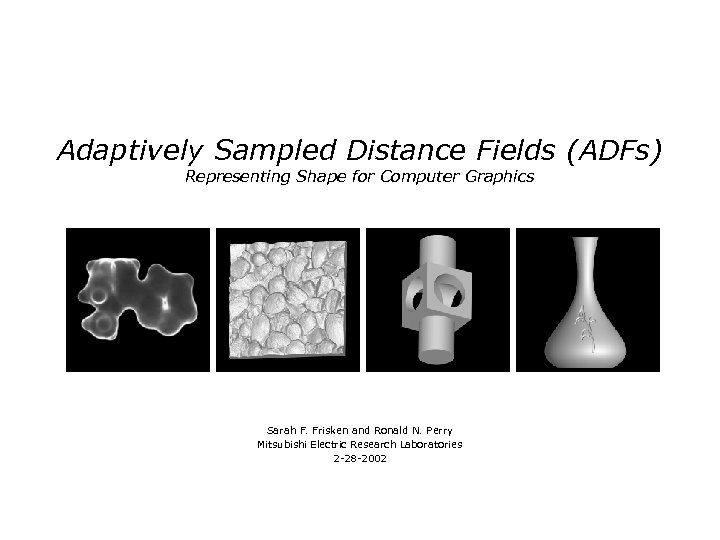 Adaptively Sampled Distance Fields (ADFs) Representing Shape for Computer Graphics Sarah F. Frisken and Ronald N. Perry Mitsubishi Electric Research Laboratories 2 -28 -2002
 Outline • Introduction to ADFs • definition, advantages, instantiations, algorithms • Accuracy and Benchmarks • Technology status • Demonstration • Business Opportunities
 Distance Fields • A distance field is a scalar field that • specifies the distance to the surface of a shape. . . • where the distance may be signed to distinguish between the inside and outside of the shape • Distance • can be defined very generally (e. g. , non-Euclidean) • minimum Euclidean distance is used for most of this presentation (with the exception of the volumetric molecules)
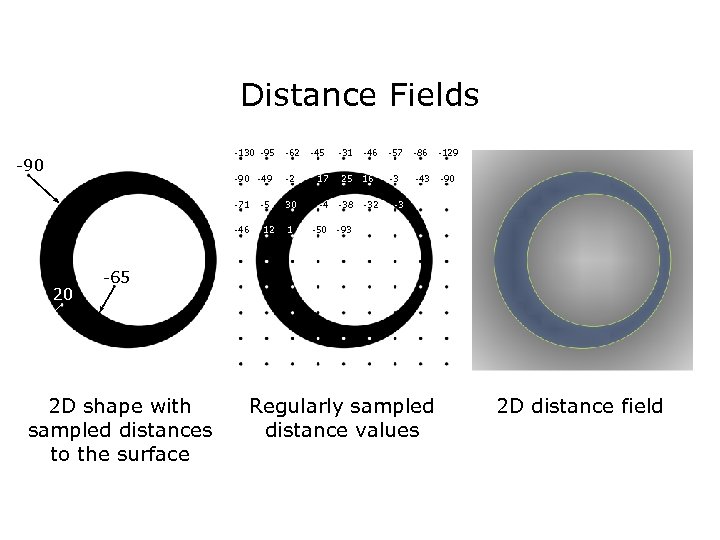 Distance Fields -130 -95 -62 -45 -31 -46 -57 -86 -129 -90 -49 -2 17 25 16 -3 -43 -90 -71 -5 30 -4 -38 -32 -3 -46 12 1 -50 -93 -3 20 -65 2 D shape with sampled distances to the surface Regularly sampled distance values 2 D distance field
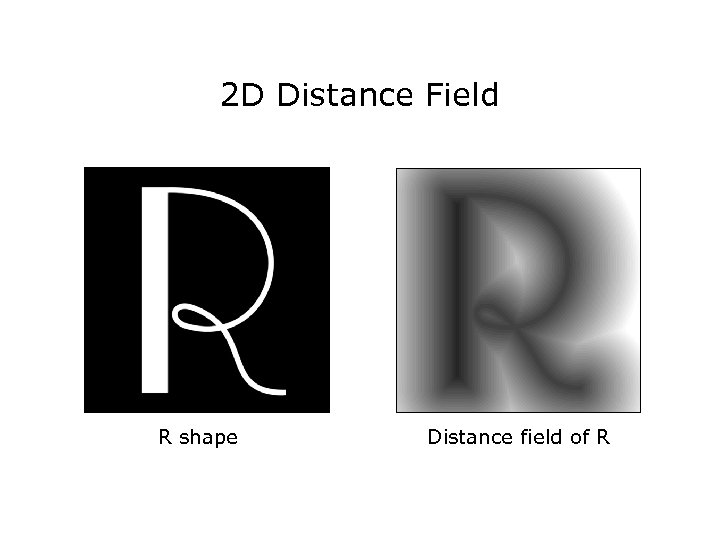 2 D Distance Field R shape Distance field of R
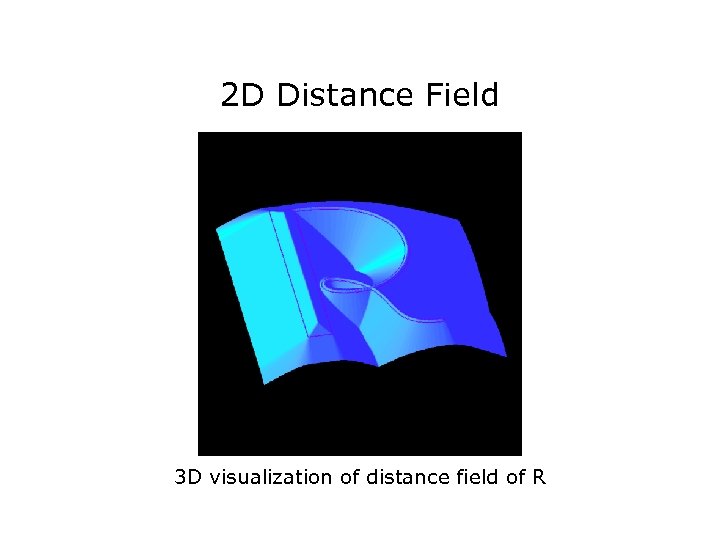 2 D Distance Field 3 D visualization of distance field of R
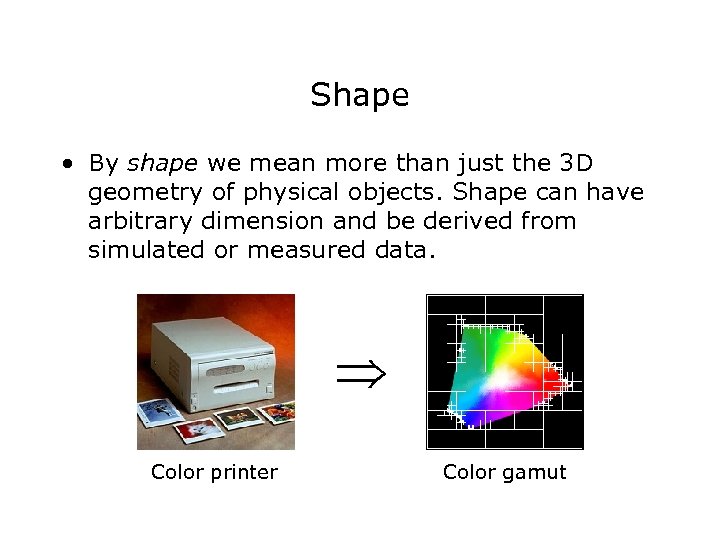 Shape • By shape we mean more than just the 3 D geometry of physical objects. Shape can have arbitrary dimension and be derived from simulated or measured data. Color printer Color gamut
 Conceptual Advantages of Distance Fields • Represent more than the surface • object interior and the space in which the object sits • Gains in efficiency and quality because • distance fields vary “smoothly” • are defined throughout space • Gradient of the distance field yields • surface normal for points on the surface • direction to closest surface point for points off the surface
 Practical Advantages of Distance Fields • Smooth surface reconstruction • continuous reconstruction of a smooth field • Trivial inside/outside and proximity testing • using sign and magnitude of the distance field • Fast and simple Boolean operations • • intersection: dist(A B) = min(dist(A), dist(B)) union: dist(A B) = max(dist(A), dist(B)) • Fast and simple surface offsetting • offset by d: dist(Aoffset) = dist(A) + d • Enables geometric queries such as closest point • using gradient and magnitude of the distance field
 Sampled Distance Fields • Similar to sampled images, insufficient sampling of distance fields results in aliasing • Because fine detail requires dense sampling, excessive memory is required with regularly sampled distance fields when any fine detail is present
 Adaptively Sampled Distance Fields • Detail-directed sampling of a distance field • High sampling rates only where needed • Spatial data structure (e. g. , an octree) • Fast localization for efficient processing • Reconstruction method (e. g. , trilinear interpolation) • For reconstructing the distance field and gradient from sampled distance values
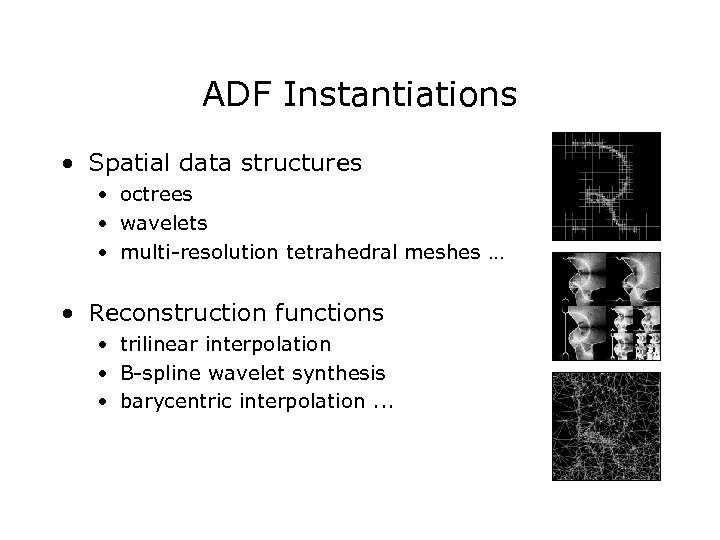 ADF Instantiations • Spatial data structures • octrees • wavelets • multi-resolution tetrahedral meshes … • Reconstruction functions • trilinear interpolation • B-spline wavelet synthesis • barycentric interpolation. . .
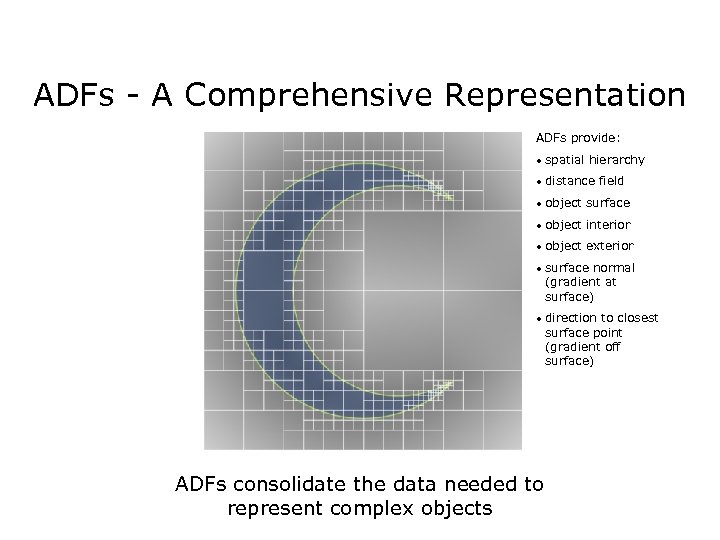 ADFs - A Comprehensive Representation ADFs provide: • spatial hierarchy • distance field • object surface • object interior • object exterior • surface normal (gradient at surface) • direction to closest surface point (gradient off surface) ADFs consolidate the data needed to represent complex objects
 ADFs - A Unifying Representation • Represent surfaces, volumes, and implicit functions • Represent sharp edges, organic surfaces, thinmembranes, and semi-transparent substances • Consolidate multiple structures for complex objects (e. g. , for collision detection, LOD construction, and dynamic meshing) • Can store auxiliary data in cells or at cell vertices (e. g. , color and texture)
 Algorithms for Octree-based ADFs • • Specifics of octree-based ADFs Generating ADFs Editing ADFs Rendering ADFs Generating point models from ADFs Triangulating ADFs Surfacing ADFs Hierarchical transmission of ADFs
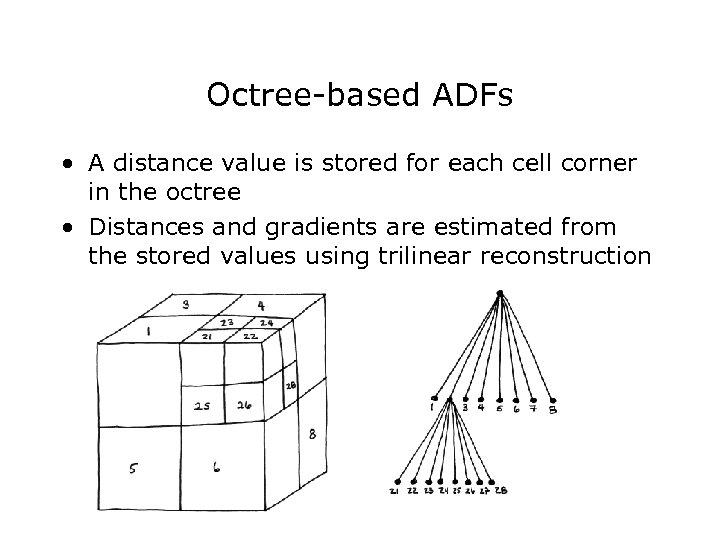 Octree-based ADFs • A distance value is stored for each cell corner in the octree • Distances and gradients are estimated from the stored values using trilinear reconstruction
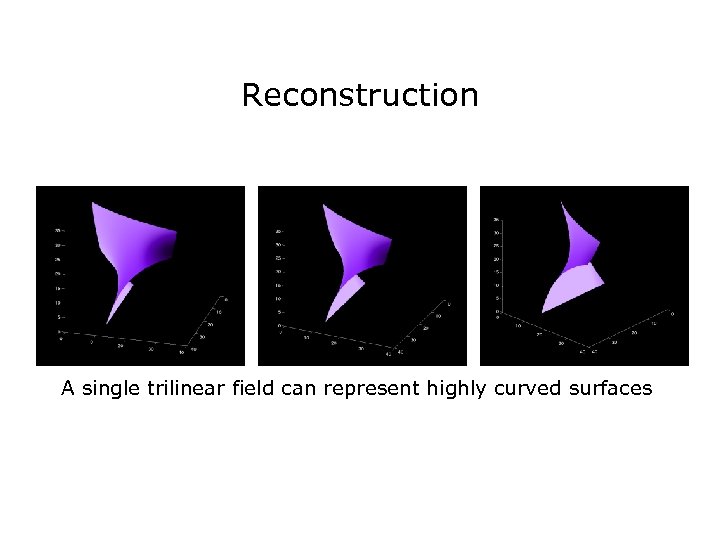 Reconstruction A single trilinear field can represent highly curved surfaces
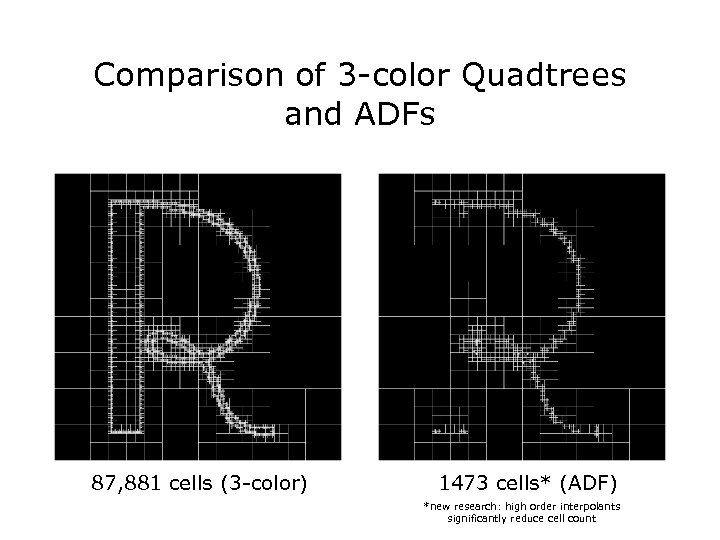 Comparison of 3 -color Quadtrees and ADFs 87, 881 cells (3 -color) 1473 cells* (ADF) *new research: high order interpolants significantly reduce cell count
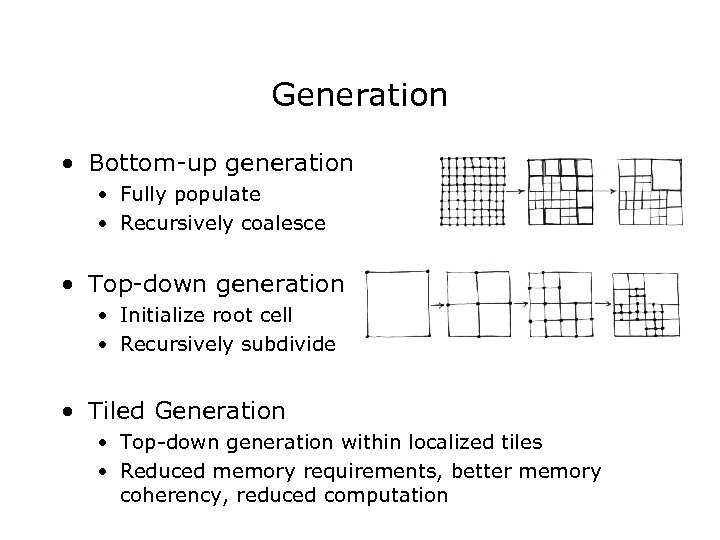 Generation • Bottom-up generation • Fully populate • Recursively coalesce • Top-down generation • Initialize root cell • Recursively subdivide • Tiled Generation • Top-down generation within localized tiles • Reduced memory requirements, better memory coherency, reduced computation
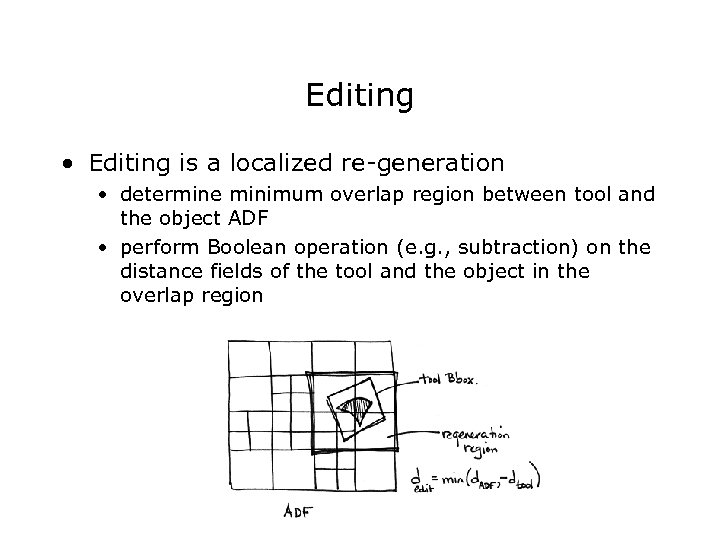 Editing • Editing is a localized re-generation • determine minimum overlap region between tool and the object ADF • perform Boolean operation (e. g. , subtraction) on the distance fields of the tool and the object in the overlap region
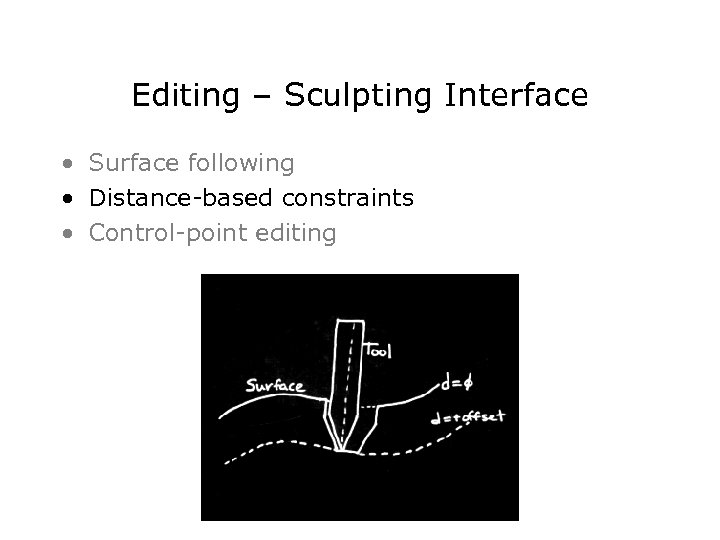
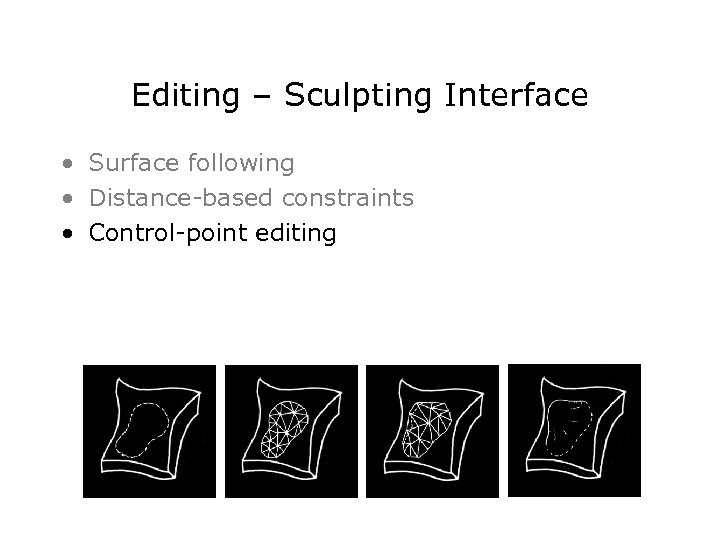
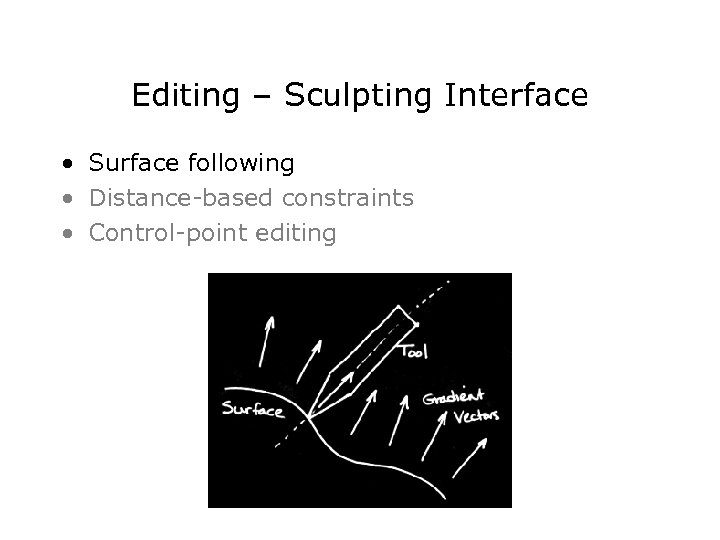 Editing – Sculpting Interface • Surface following • Distance-based constraints • Control-point editing
 Editing – Sculpting Interface • Surface following • Distance-based constraints • Control-point editing
 Editing – Sculpting Interface • Surface following • Distance-based constraints • Control-point editing
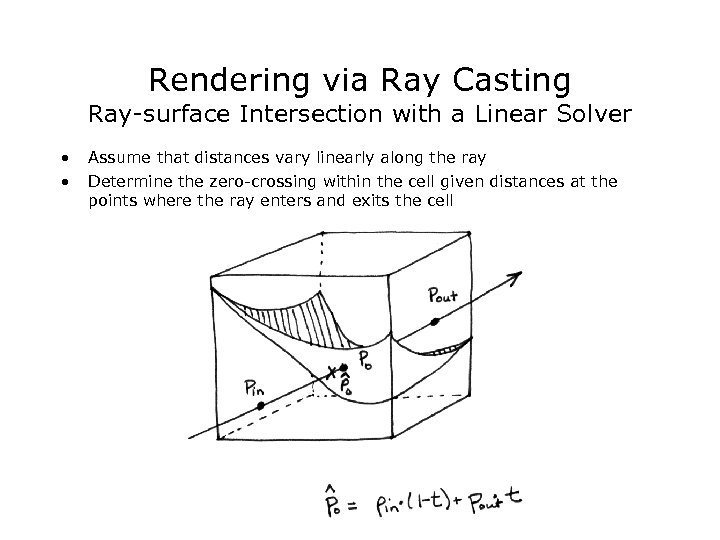 Rendering via Ray Casting Ray-surface Intersection with a Linear Solver • • Assume that distances vary linearly along the ray Determine the zero-crossing within the cell given distances at the points where the ray enters and exits the cell
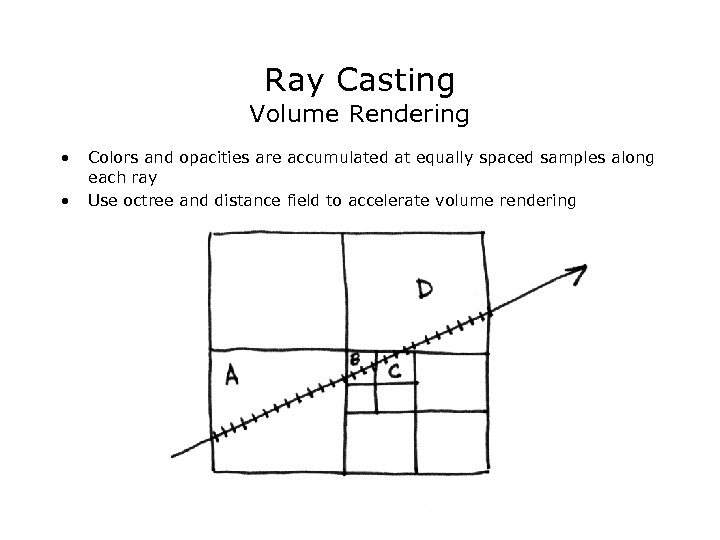 Ray Casting Volume Rendering • • Colors and opacities are accumulated at equally spaced samples along each ray Use octree and distance field to accelerate volume rendering
 Adaptive Asynchronous Ray Casting • Adaptive rendering • the image region to be rendered is divided into a hierarchy of image tiles • the subdivision of each tile is guided by a perceptuallybased predicate • pixels within image tiles of size greater than 1 x 1 are bilinearly interpolated to produce the image • rays are cast into the ADF at tile corners and intersected with the surface using the linear solver • Processing occurs • asynchronously • upon user request • to update edited regions
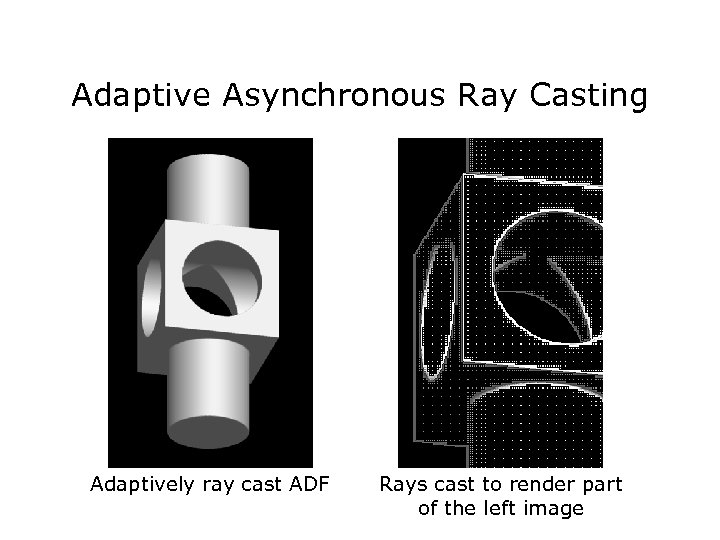 Adaptive Asynchronous Ray Casting Adaptively ray cast ADF Rays cast to render part of the left image
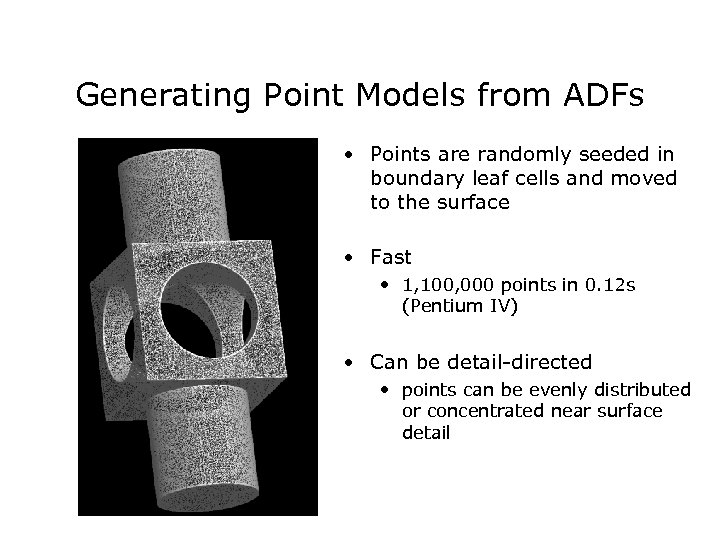 Generating Point Models from ADFs • Points are randomly seeded in boundary leaf cells and moved to the surface • Fast • 1, 100, 000 points in 0. 12 s (Pentium IV) • Can be detail-directed • points can be evenly distributed or concentrated near surface detail
 Triangulating ADFs • ADFs can be triangulated using a fast new triangulation method • Triangulation is efficient • 300, 000 triangles in 0. 37 seconds, Pentium IV • 3, 000 triangles in < 0. 01 seconds • The triangulation produces models that are orientable and closed
 Triangulation Algorithm • Seed • Assign a vertex to each boundary leaf cell of the ADF, initially placing vertices at cell centers • Join vertices of neighboring cells to form triangles • Relax • Move vertices to the surface using the distance field • Improve • Move vertices over the surface towards their average neighbors' position to improve triangle quality
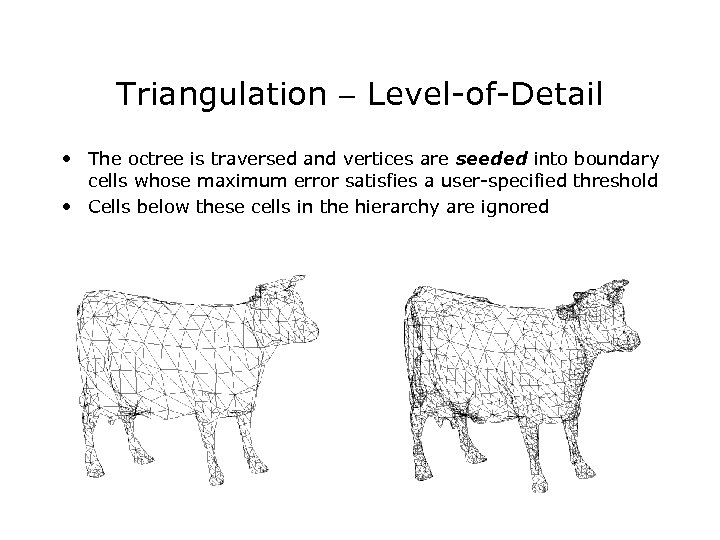 Triangulation - Level-of-Detail • The octree is traversed and vertices are seeded into boundary cells whose maximum error satisfies a user-specified threshold • Cells below these cells in the hierarchy are ignored
 Surfacing ADFs • Off-the-shelf solution • generate a dense point model or a detail-directed triangle model • use Geomagic Studio 4 to create NURBS • ADF-specific approach • exploit detail-directed sampling to identify initial patches • refine patches using an optimization approach • use the distance field to compute surface error and guide refinement
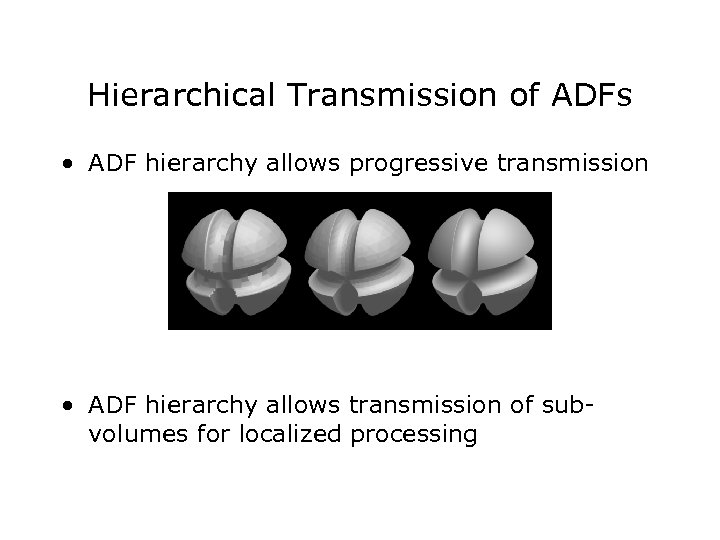 Hierarchical Transmission of ADFs • ADF hierarchy allows progressive transmission • ADF hierarchy allows transmission of subvolumes for localized processing
 Accuracy and Benchmarks • Surface accuracy summary • Timing
 Surface Accuracy Summary • Planar surfaces • can be reconstructed to floating point precision from a small number of sample points • Curved surfaces • limited by the maximum cell error (an ADF generation parameter) • level 7 ADF achieves 30 micron accuracy for a 1 meter diameter sphere • Edges and corners • limited by maximum ADF level (an ADF generation parameter) • level 13 ADF achieves 10 micron accuracy for a (8 cm) 3 part
 Timing • Generation and Editing • Approximately 300, 000 cells per second (Pentium IV) • 1 meter sphere (at 31 micron accuracy) in 0. 265 seconds • 1 meter box (at 85 micron accuracy) in 0. 310 seconds • Rendering • Asynchronous, adaptive, on-demand ray casting provides interactive rendering • Point generation • 9. 2 million points per second (Pentium IV) • Triangle generation • 800, 000 triangles per second (Pentium IV)
 Technology Status • Research papers • Patents • ADF library
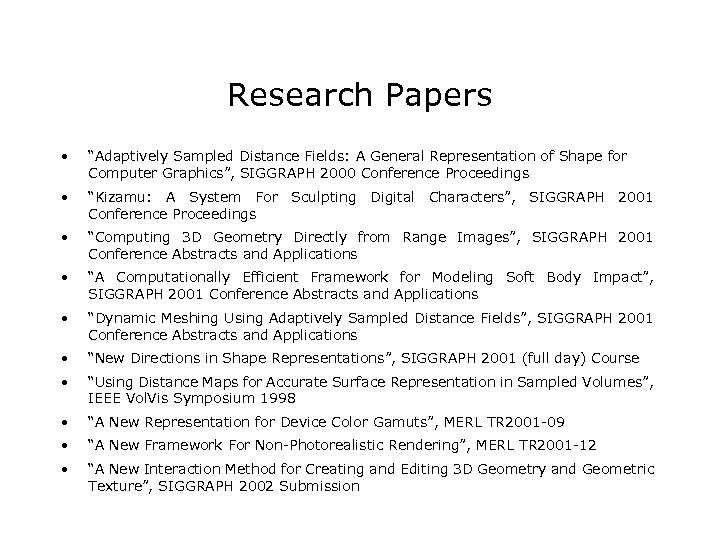 Research Papers • “Adaptively Sampled Distance Fields: A General Representation of Shape for Computer Graphics”, SIGGRAPH 2000 Conference Proceedings • “Kizamu: A System For Sculpting Digital Characters”, SIGGRAPH 2001 Conference Proceedings • “Computing 3 D Geometry Directly from Range Images”, SIGGRAPH 2001 Conference Abstracts and Applications • “A Computationally Efficient Framework for Modeling Soft Body Impact”, SIGGRAPH 2001 Conference Abstracts and Applications • “Dynamic Meshing Using Adaptively Sampled Distance Fields”, SIGGRAPH 2001 Conference Abstracts and Applications • “New Directions in Shape Representations”, SIGGRAPH 2001 (full day) Course • “Using Distance Maps for Accurate Surface Representation in Sampled Volumes”, IEEE Vol. Vis Symposium 1998 • “A New Representation for Device Color Gamuts”, MERL TR 2001 -09 • “A New Framework For Non-Photorealistic Rendering”, MERL TR 2001 -12 • “A New Interaction Method for Creating and Editing 3 D Geometry and Geometric Texture”, SIGGRAPH 2002 Submission
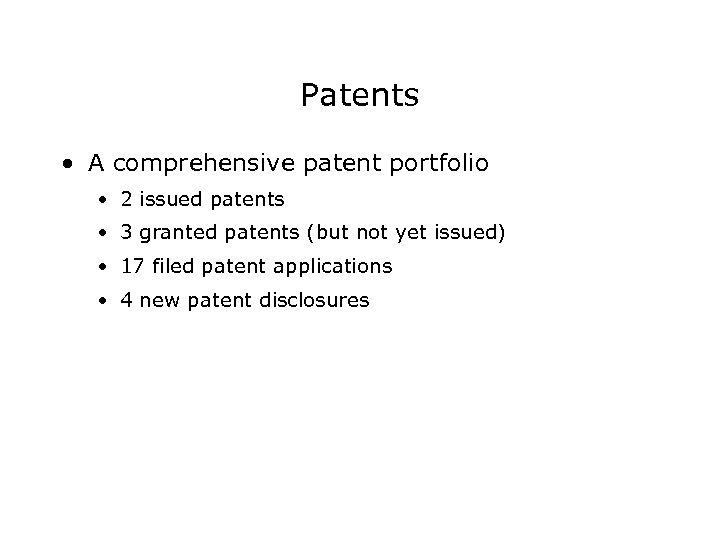 Patents • A comprehensive patent portfolio • 2 issued patents • 3 granted patents (but not yet issued) • 17 filed patent applications • 4 new patent disclosures
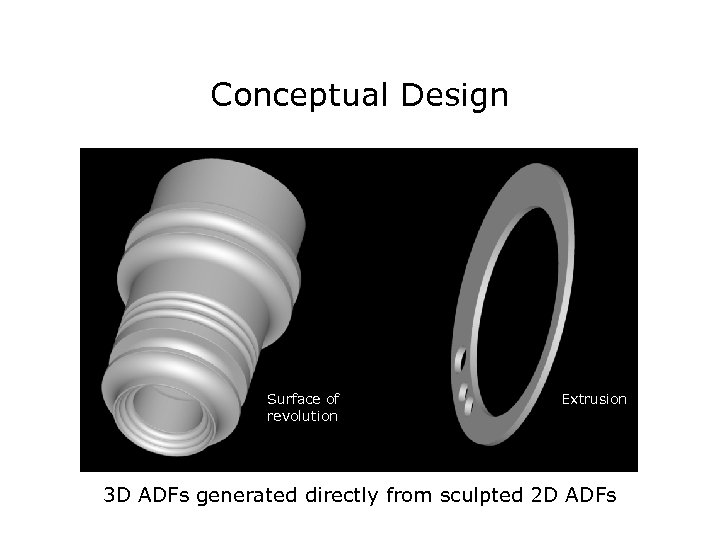
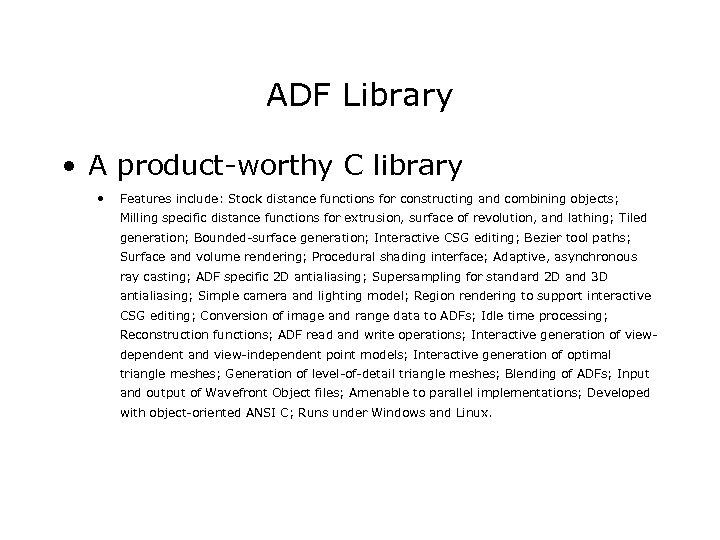 ADF Library • A product-worthy C library • Features include: Stock distance functions for constructing and combining objects; Milling specific distance functions for extrusion, surface of revolution, and lathing; Tiled generation; Bounded-surface generation; Interactive CSG editing; Bezier tool paths; Surface and volume rendering; Procedural shading interface; Adaptive, asynchronous ray casting; ADF specific 2 D antialiasing; Supersampling for standard 2 D and 3 D antialiasing; Simple camera and lighting model; Region rendering to support interactive CSG editing; Conversion of image and range data to ADFs; Idle time processing; Reconstruction functions; ADF read and write operations; Interactive generation of viewdependent and view-independent point models; Interactive generation of optimal triangle meshes; Generation of level-of-detail triangle meshes; Blending of ADFs; Input and output of Wavefront Object files; Amenable to parallel implementations; Developed with object-oriented ANSI C; Runs under Windows and Linux.
 Demonstration
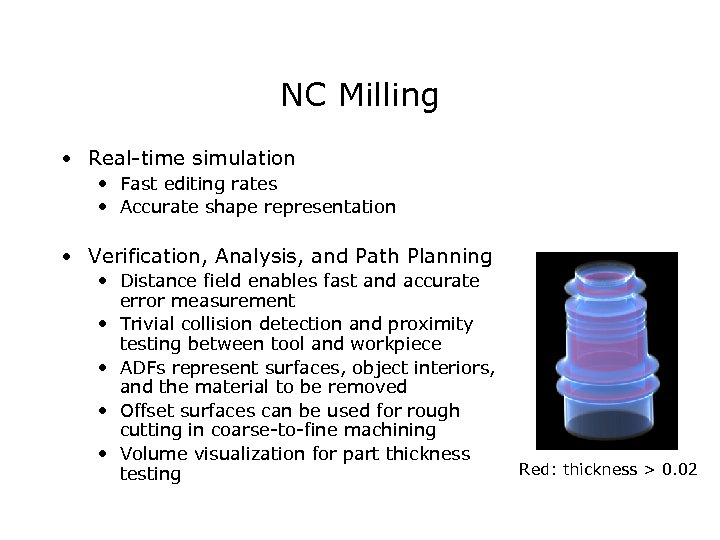
 Business Opportunities • Digital clay • Conceptual design • Real-time simulation, verification, and path planning for NC milling
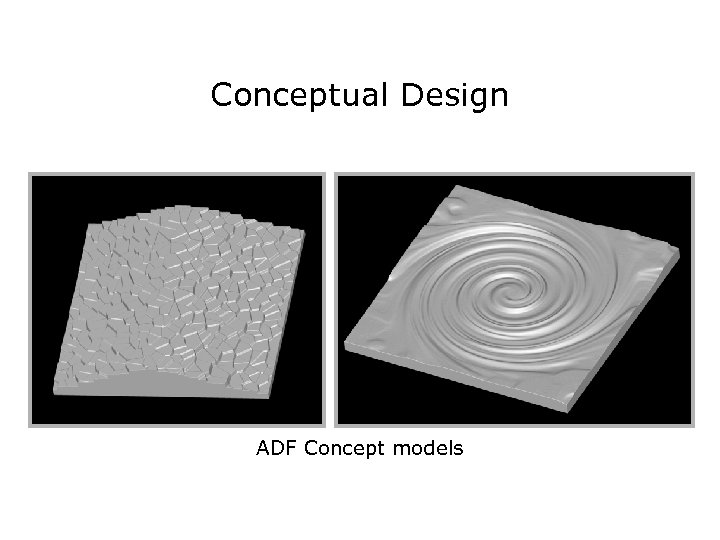
 Digital Clay • ADFs provide a fresh approach to design with • direct sculpting interface • organic shapes • razor sharp edges • highly detailed texture from range images, photographs, and procedurally generated data • Market opportunities include • constructing Hollywood models • constructing models for game design • 3 D ‘sketching’ for industrial design
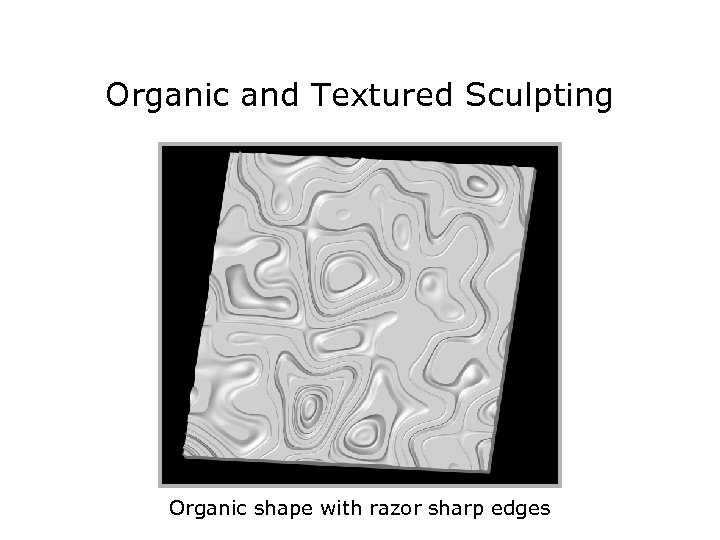 Organic and Textured Sculpting Organic shape with razor sharp edges
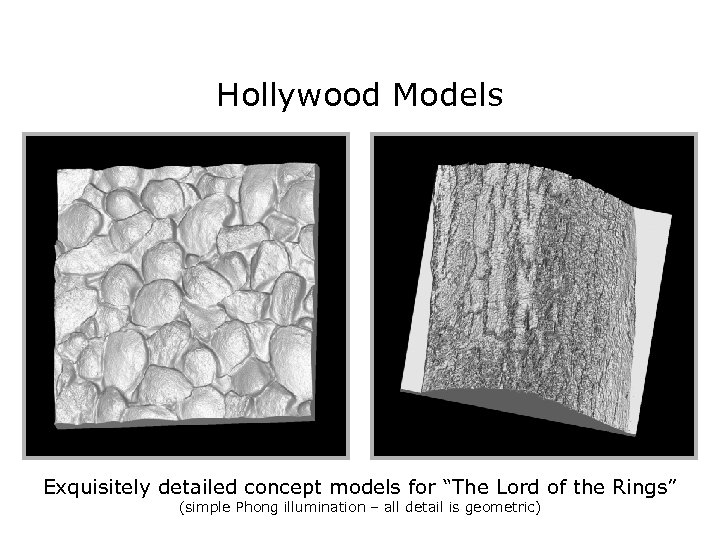 Hollywood Models Exquisitely detailed concept models for “The Lord of the Rings” (simple Phong illumination – all detail is geometric)
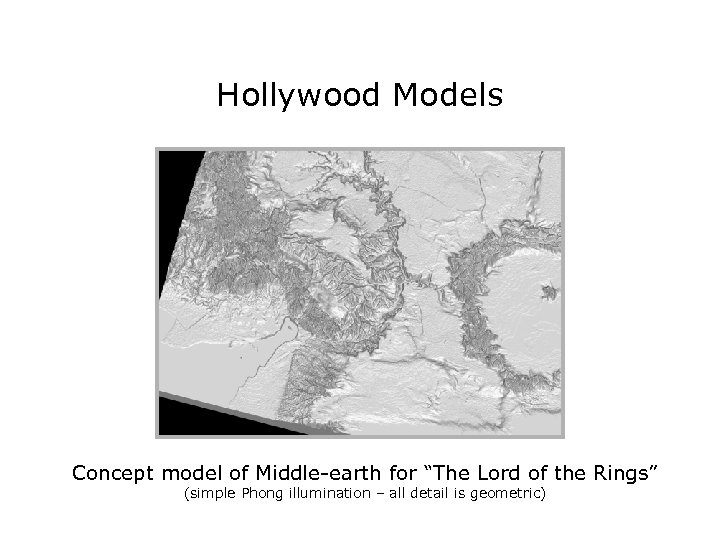 Hollywood Models Concept model of Middle-earth for “The Lord of the Rings” (simple Phong illumination – all detail is geometric)
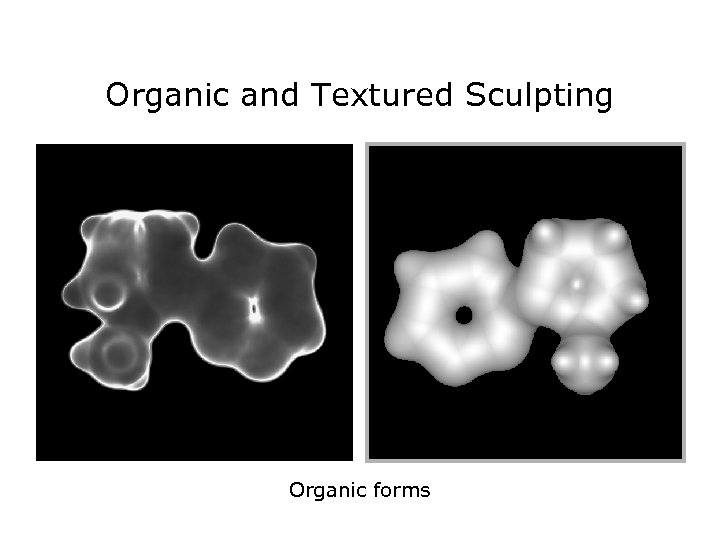 Organic and Textured Sculpting Organic forms
 Digital Clay • Advantages of ADFs for Editing • Represent both smooth surfaces and sharp corners without excessive memory • Sculpting is direct, intuitive, and fast • Does not require control point manipulation or trimming • The distance field can be used to enhance the user interface • Guide the position and orientation of the sculpting tool • Enable distance-based constraints for carving • ADF-specific methods for capturing geometry from range data and photographs
 Conceptual Design ADF Concept models
 Conceptual Design Surface of revolution Extrusion 3 D ADFs generated directly from sculpted 2 D ADFs
 Conceptual Design • Reverse engineering from range data • fast and memory efficient • water-tight, hole-free models • can be trivially sculpted in 3 D to repair occluded regions • can produce optimal level-of-detail tessellations
 NC Milling • Real-time simulation • Fast editing rates • Accurate shape representation • Verification, Analysis, and Path Planning • Distance field enables fast and accurate error measurement • Trivial collision detection and proximity testing between tool and workpiece • ADFs represent surfaces, object interiors, and the material to be removed • Offset surfaces can be used for rough cutting in coarse-to-fine machining • Volume visualization for part thickness Red: thickness > 0. 02 testing
 The End
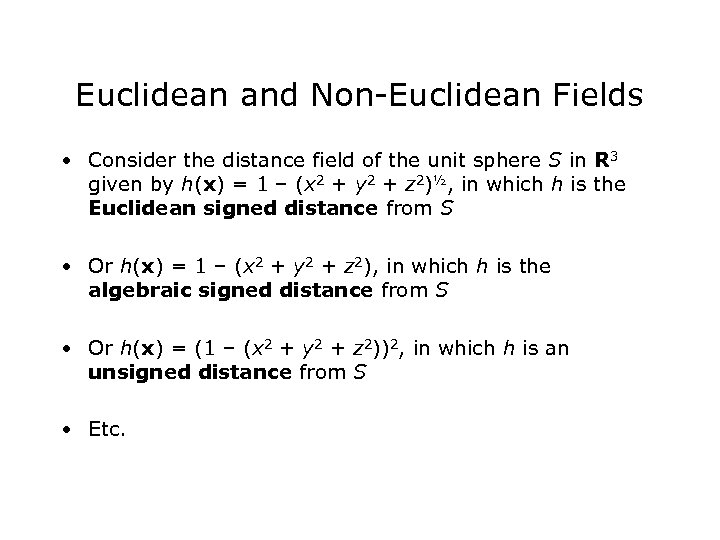 Euclidean and Non-Euclidean Fields • Consider the distance field of the unit sphere S in R 3 given by h(x) = 1 – (x 2 + y 2 + z 2)½, in which h is the Euclidean signed distance from S • Or h(x) = 1 – (x 2 + y 2 + z 2), in which h is the algebraic signed distance from S • Or h(x) = (1 – (x 2 + y 2 + z 2))2, in which h is an unsigned distance from S • Etc.
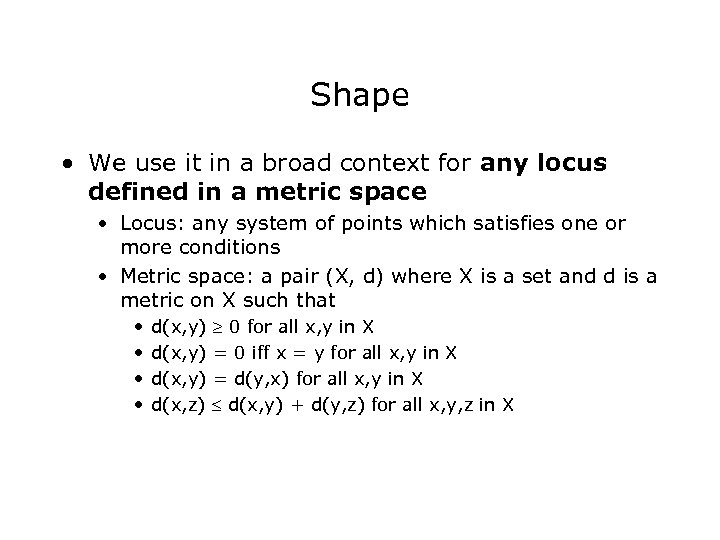 Shape • We use it in a broad context for any locus defined in a metric space • Locus: any system of points which satisfies one or more conditions • Metric space: a pair (X, d) where X is a set and d is a metric on X such that • • d(x, y) 0 for all x, y in X d(x, y) = 0 iff x = y for all x, y in X d(x, y) = d(y, x) for all x, y in X d(x, z) d(x, y) + d(y, z) for all x, y, z in X
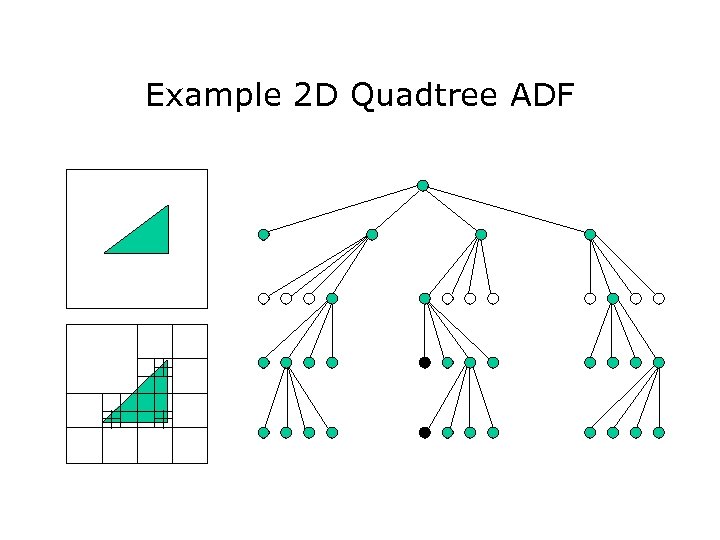 Example 2 D Quadtree ADF
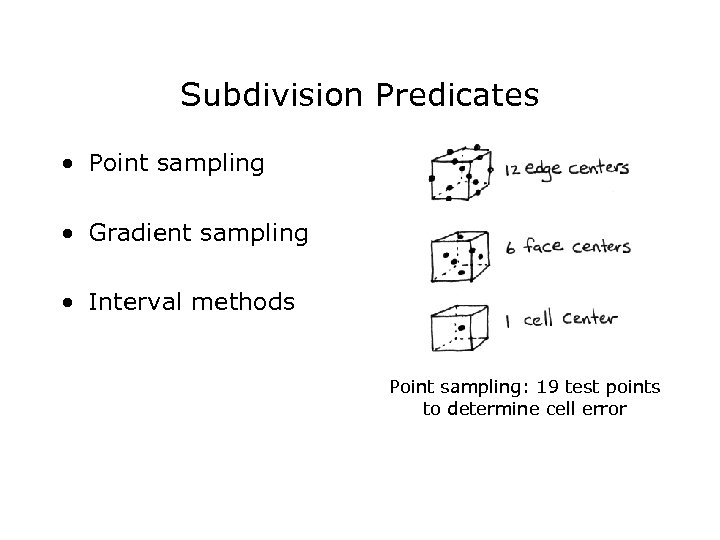 Subdivision Predicates • Point sampling • Gradient sampling • Interval methods Point sampling: 19 test points to determine cell error
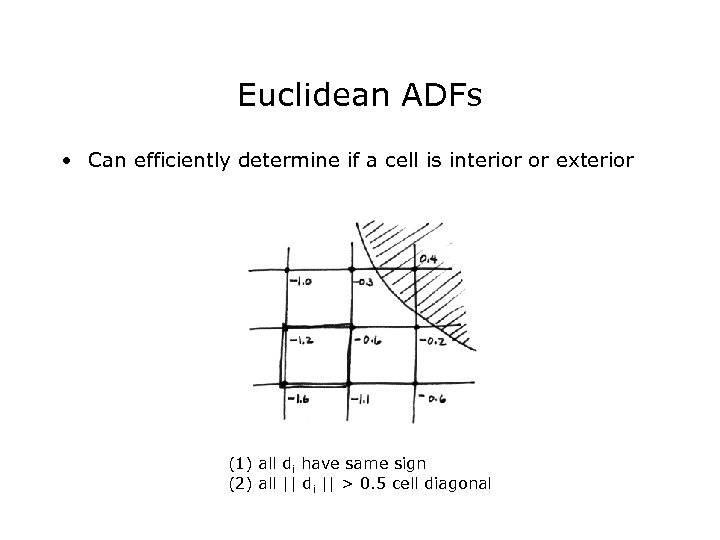 Euclidean ADFs • Can efficiently determine if a cell is interior or exterior (1) all di have same sign (2) all || di || > 0. 5 cell diagonal