


 Скачать презентацию Adapting a Family Counseling Intervention for HIV Men
b268f2ba985cf984ba4546bcddd60ac2.ppt
- Количество слайдов: 35
 Adapting a Family Counseling Intervention for HIV+ Men Leaving Jail/Prison Research Perspective: Olga Grinstead, Ph. D. , MPH, UCSF Community Perspective: Barry Zack, MPH, Centerforce
 Incarceration Epidemic in the US z 2. 1 million Americans are currently incarcerated in jails and prisons; 4. 6 million more on probation/parole z US has the highest per capita incarceration rate in the world z 65% of prisoners are people of color; 90% are men z 1/3 of African-American men 20 -29 are involved with the criminal justice system
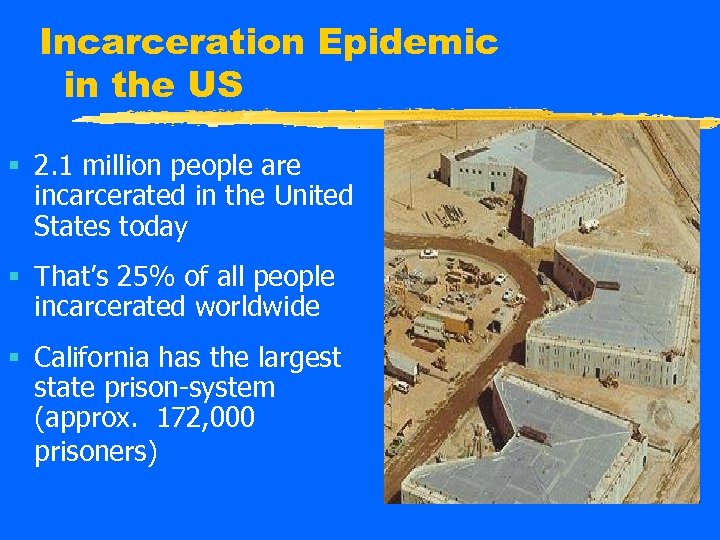 Incarceration Epidemic in the US § 2. 1 million people are incarcerated in the United States today § That’s 25% of all people incarcerated worldwide § California has the largest state prison-system (approx. 172, 000 prisoners)
 Prison Health is Public Health z Low income people of color are at disproportionate risk for incarceration z Prisoners are at disproportionate risk for infectious diseases and other poor health outcomes z 9 out of 10 prisoners are eventually released back to their communities z Prison programs represents an opportunity to improve community health
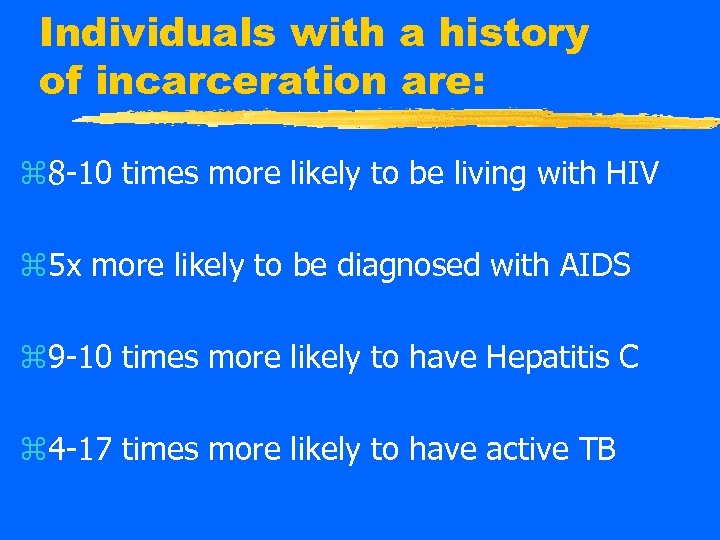 Individuals with a history of incarceration are: z 8 -10 times more likely to be living with HIV z 5 x more likely to be diagnosed with AIDS z 9 -10 times more likely to have Hepatitis C z 4 -17 times more likely to have active TB
 Risk Behaviors Associated with Incarceration z. Tattoos done with re-used equipment z. Needle sharing for injection drug use z. Unprotected sexual intercourse
 Prevention in Correctional Settings z. Condoms, needles and bleach are contraband in most US prisons z. HIV testing and counseling policies in US prisons are inconsistent z. Poor medical care includes out-of-date treatment regimens and poor continuity of care after release
 Prevention in Correctional Settings z. Security is institution’s top priority z. Curricula must meet institutional approval; programs can be suspended or shut down z. Challenge of maintaining trust of both prisoners and correctional staff z. No privacy and little if any confidentiality for programs or health care
 Community/Academic Collaboration z. Since 1992 collaborative relationship between UCSF-CAPS and Centerforce, Inc. z. Collaborative relationships with Department of Corrections and specific prisons and jails z. Ongoing collaboration with prison peer educators z. Program of research would not be possible without these collaborative relationships
 CAPS-Centerforce Collaborative Projects z. Prevention for Incarcerated Men Peer-led HIV Orientation (2, 295; 1997) Peer-led Pre-Release Intervention (414; 1999) Health Promotion for HIV+ Prisoners (147; 1999) Project START: Young Men in Prison (522; 2006) SET Re-Entry for HIV+ Men Leaving Prison (162; 2007)
 CAPS-Centerforce Collaborative Projects z. Prevention for Women Partners Love Your Man, Love Yourself (1995 -1997) The HOME Project (2003 -2007) Inside/Out: Real Stories of Men, Women and Life After Incarceration (Video; 1999)
 Evolution of our Research Questions z Peer education lead to an increase in testing; z Increase in HIV+ people lead to Health Promotion; z How do I tell my partner led to Visitors / Partners / Family z Booster and Project START z All lead us to family/ecosystem support ycommunity re-entry yfamily reunification yaccess to care and treatment yrisk reduction
 Effective Programs for Incarcerated Community z. Address institutional challenges and barriers; know the system, provide practical knowledge z. Address structural and institutional as well as individual-level change z. Develop population-specific intervention and educational materials z. Work toward sustainability and community integration from the beginning
 Effective Programs for Incarcerated Community z. Participation open to all (combats stigma, promotes social support and connection) z. Promote self and community advocacy z. Cover broad scope of topics rather than focusing solely on stigma-laden issues (HIV and AIDS) z. Peer educators offer clear information and population-specific materials and referrals
 Effective Research and Evaluation Design z. Requires input from the target audience and gatekeepers z. Creativity is key: “gold standard” may not be appropriate in all settings with all populations z. Definition of realistic and feasible outcomes z. Dissemination to all stakeholders who can use the information
 SET Project Development z. CAPS/Centerforce collaborating since 1993 to develop and evaluate STD/HIV programs for inmates and their families z. University of Miami ongoing program of research to explore application and effectiveness of SET z. Parallels between HIV+ women leaving residential drug treatment and HIV+men leaving prison led to this collaboration
 SET Collaborative Partners z Centerforce z UCSF- Center for AIDS Prevention Studies z University of Miami, Center for Family Studies z California: y Department of Corrections and Rehabilitation y San Francisco County Jail All collaborative partners are involved in the development, implementation and evaluation of the intervention
 Components of Structural Ecosystem Therapy Joining: Forming a therapeutic alliance Diagnosis: Assessing the functioning of the system Restructuring: transforming interactions within the family or ecosystem to support health-enhancing, prosocial behavior
 Adaptation of SET z. Adaptation of SET to the specific context of prison release and community reintegration z. Training from University of Miami (SET model and clinical examples) z. Transfer of knowledge from our previous interventions with incarcerated men
 Adaptation of SET (Set Re-entry) z. What is unique about prisoners/prison interventions? Specific language/knowledge Specific situational constraints Specific risks associated with incarceration and separation from family/partners Internal Review Board and COC Intervention had to be modified to take these population specific factors into consideration
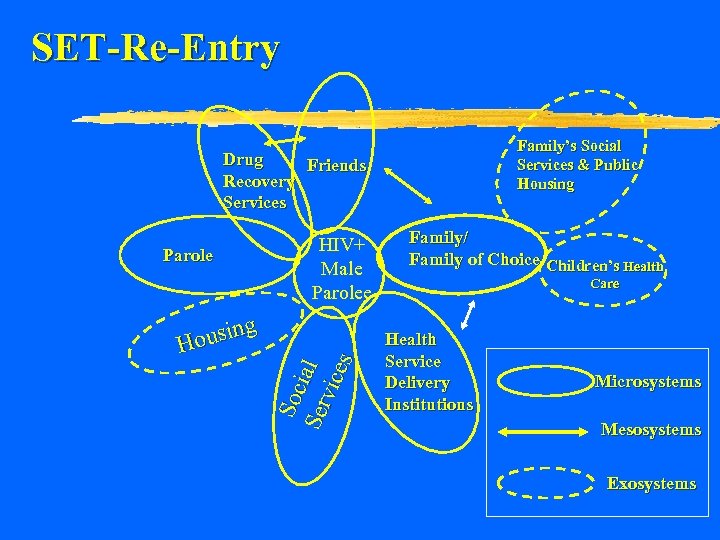 SET-Re-Entry Family’s Social Services & Public Housing Drug Friends Recovery Services g ousin H Soc Ser ial vic es Parole HIV+ Male Parolee Family/ Family of Choice Children’s Health Care Health Service Delivery Institutions Microsystems Mesosystems Exosystems
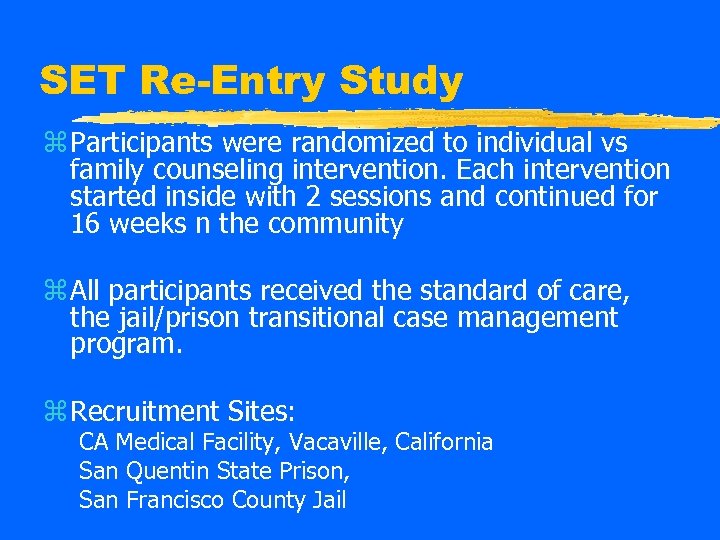 SET Re-Entry Study z Participants were randomized to individual vs family counseling intervention. Each intervention started inside with 2 sessions and continued for 16 weeks n the community z All participants received the standard of care, the jail/prison transitional case management program. z Recruitment Sites: CA Medical Facility, Vacaville, California San Quentin State Prison, San Francisco County Jail
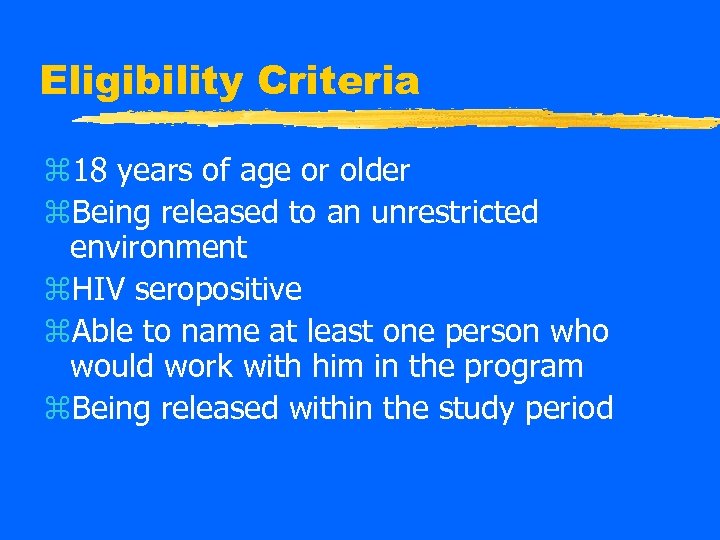 Eligibility Criteria z 18 years of age or older z. Being released to an unrestricted environment z. HIV seropositive z. Able to name at least one person who would work with him in the program z. Being released within the study period
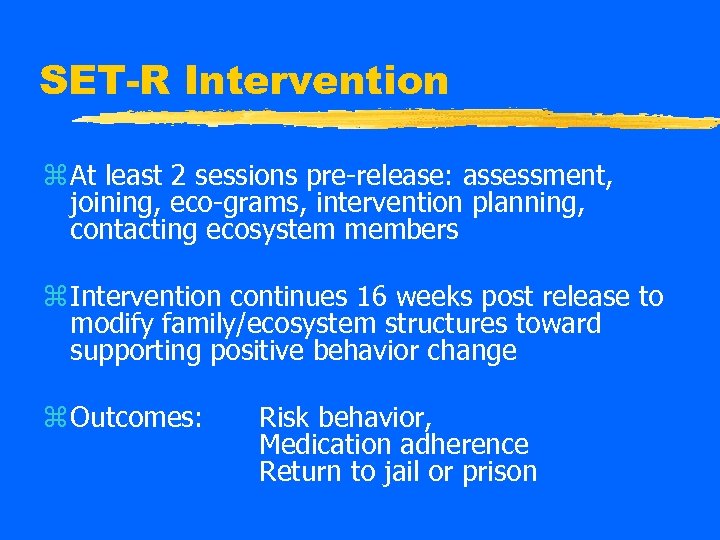 SET-R Intervention z At least 2 sessions pre-release: assessment, joining, eco-grams, intervention planning, contacting ecosystem members z Intervention continues 16 weeks post release to modify family/ecosystem structures toward supporting positive behavior change z Outcomes: Risk behavior, Medication adherence Return to jail or prison
 Evaluation Design z. Pre-release interviewer administered survey z. Survey repeated 4 months post-release (post-intervention) z. Survey repeated at 8 and 12 months postrelease to assess longer term impact on health and behavior z. Medical record reviews
 Current Project Status z. Pilot study began in February, 2005 To test study procedures, acceptability of the intervention 10 participants Follow-up for 4 months only z. Recruitment for main study began July, 2005 z. Recruitment was completed in April, 2007 z. Currently conducting follow-up surveys
 Current Project Status z 162 individuals were recruited from 3 sites z 3 withdrew, 12 were dropped for administrative reasons, and one died before the second survey (To date five participants have died) z Follow-up rates are 90% at the 4 month four month survey, 89% at the 8 month survey and 86% at the 12 month survey to date z 50% of participants have completed at least one follow up survey inside prison or jail
 Study Sample Age Mean = 35 years Transgender 7. 4% (12) Identify as gay or bisexual 29% Ethnicity 25% defined themselves as Latino Race African American 57% White 27% Native American 4% Pacific Islander 1% Other 10%
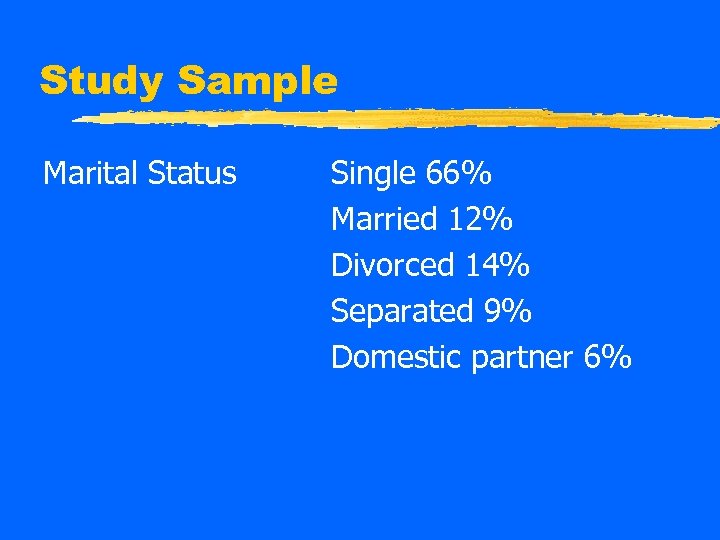 Study Sample Marital Status Single 66% Married 12% Divorced 14% Separated 9% Domestic partner 6%
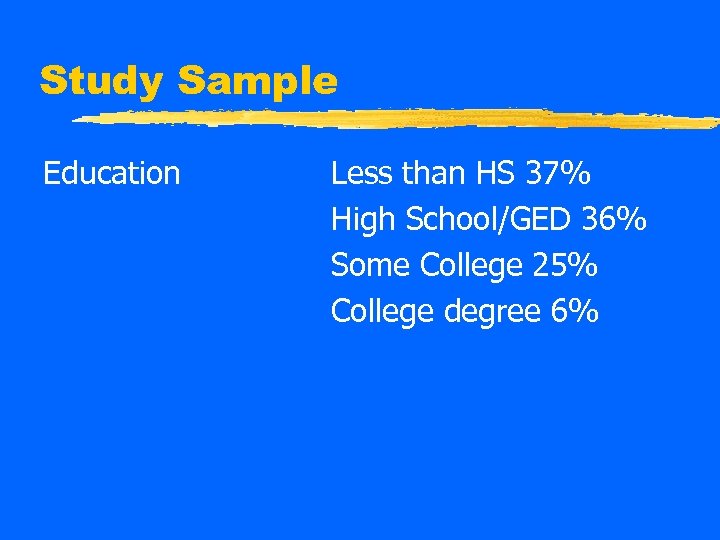 Study Sample Education Less than HS 37% High School/GED 36% Some College 25% College degree 6%
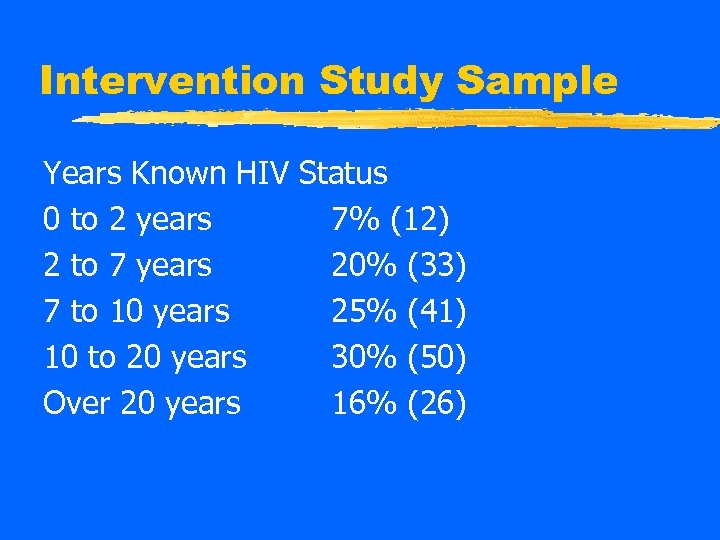 Intervention Study Sample Years Known HIV Status 0 to 2 years 7% (12) 2 to 7 years 20% (33) 7 to 10 years 25% (41) 10 to 20 years 30% (50) Over 20 years 16% (26)
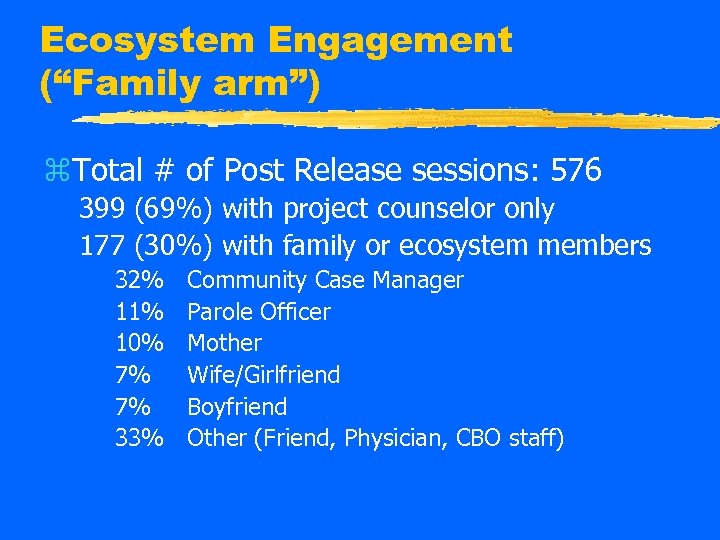 Ecosystem Engagement (“Family arm”) z. Total # of Post Release sessions: 576 399 (69%) with project counselor only 177 (30%) with family or ecosystem members 32% 11% 10% 7% 7% 33% Community Case Manager Parole Officer Mother Wife/Girlfriend Boyfriend Other (Friend, Physician, CBO staff)
 Family and Ecosystem in SETRe-Entry: Lessons Learned z. HIV+ people in prison and jail had few (if any) identified ecosystem support z. Identification of family/ecosystem requires: y. Creative probing to identify ecosystem members y. Participant’s freedom to define “family” x. Not blood relative x. Support person x. Active engagement by counselor to identify contact
 Acknowledgements z SET Project funded by NIMH z Special thanks to our Project Officer, Willo Pequegnat z University of Miami and Florida International University: Carleen Robinson, José Szapocznik, Dan Feaster z Centerforce: Barry Zack, Annette Lerma, Katie Kramer, David Caplan, Maggie Dann, Isaiah Hurtado, Kelly Dalzel, Teresa Lee, Nadya Uribe z UCSF Center for AIDS Prevention Studies (CAPS): Olga Grinstead, Kathleen Mc. Cartney, Claudine Offer, Allison Futeral, Jackie Ramos z All of our study participants and their families, however defined…
 Contact Information Olga Grinstead, Ph. D. , MPH UCSF Center for AIDS Prevention Studies (CAPS) (415) 597 -9168 ogrinstead@psg. ucsf. edu Barry Zack, MPH Centerforce (415) 456 -9980 bzack@centerforce. org